
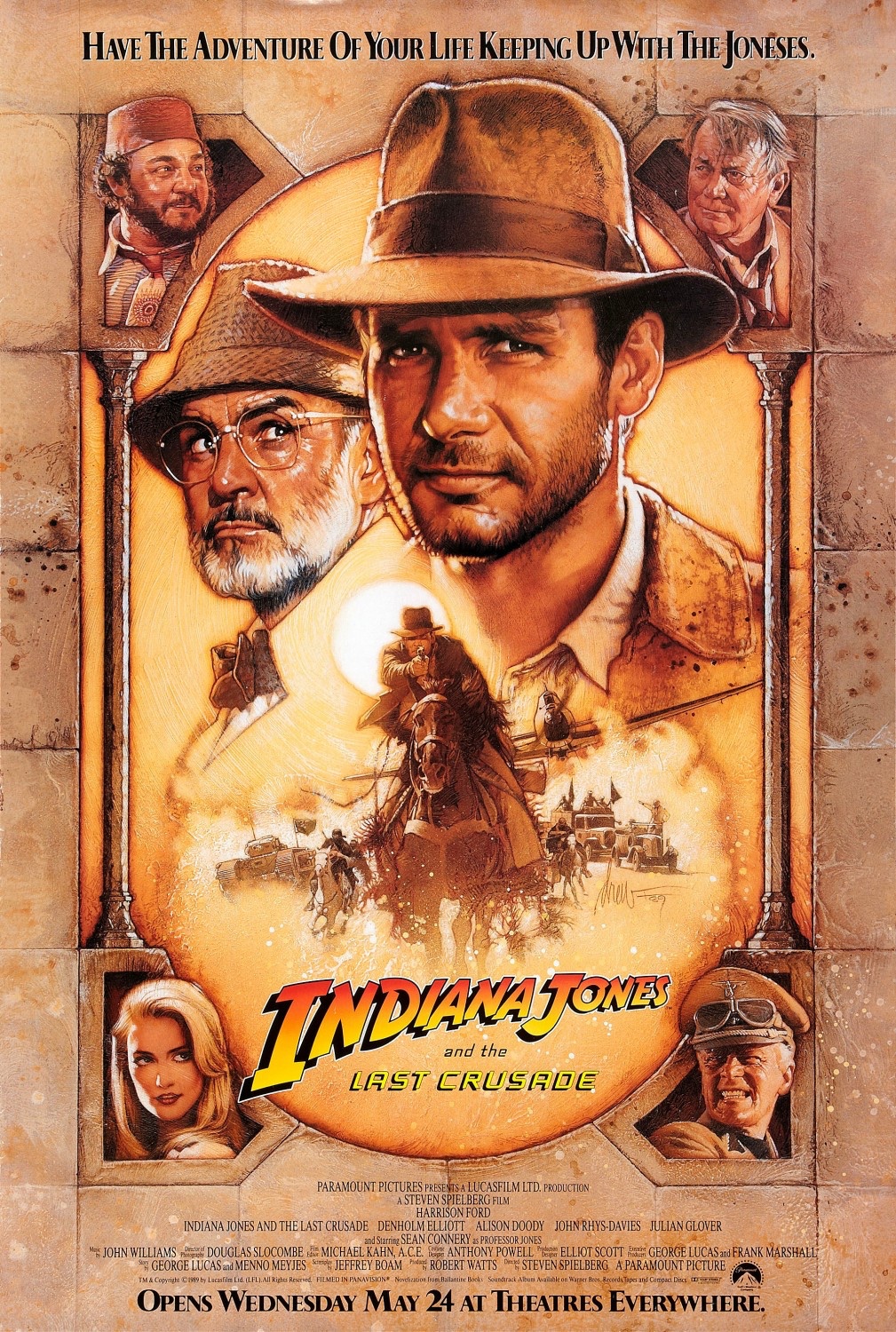
Starring: Harrison Ford, Sean Connery, John Rhys-Davies, and River Phoenix
Grade: Classic
Does anyone know the reference involving the handshake between Henry and Brody? The “Genius of the Restoration…” and Brody finishing it with “..Aid our own resuscitation” is oddly charming. What is it referring to?
Summary
In Utah in 1912, a young Indiana Jones (Phoenix) is with his Boy Scout troop in the mountains. His scoutmaster Havelock tells the group to not wander off too far because some of the passageways there can run for miles. Jones and his friend Herman go into one cave by themselves and see Garth (Richard Young) with his group of graverobbers find the Cross of Coronado. Cortez gave it to Francisco Vasquez de Corondo in 1520. An angry Jones tells Herman that it’s an important artifact and belongs in a museum. He wants Herman to go back to find the others, to tell Havelock that there are men looting in the caves, and to bring the sheriff. Just then, a snake slithers onto Herman, but Jones grabs it off him without hesitation and says that it’s only a snake. As far as what Jones will do while he waits, he isn’t sure, but he will think of something. Soon after, Jones steals the cross while the group isn’t looking. He almost makes it out of there without making a noise, as he climbs back up a rope. Unfortunately, he steps on a plank that breaks, and the group turns to realize Jones stole the cross. Jones runs out of the cave, but no one from the Boy Scouts is there. Pivoting, Jones calls over his horse and gets out of there, with Garth and his men following in a car. Jones rides by a train and jumps onto it, so Garth leads his guys to do the same. He runs into one of the train cars, but it’s for the circus, so this cart is filled with snakes. He comes face to face with a python before jumping out of its way and into a crate. Sadly, there are thousands of small snakes inside of the crate and Jones freaks out and starts yelling, making sense of his snake phobia traced all the way back to Raiders of the Lost Ark. Next, he climbs out of that train car, throws a live snake out of his clothes, and gets on top of another train car. This one has a rhinoceros inside of it. Jones is tackled while on top of the car, and it makes a lantern inside the car break onto the rhino’s head. Because of this, the rhino gets mad and start poking through the roof with his spike. It almost goes through Jones and the guy he is wrestling.
Eventually, Jones breaks free and is able to grab onto a pole outside of the train. He swings back to hit the guy. He lands back on the train car, and Garth is there waiting for him. Jones moves backwards until he falls into the lion car. The lion roars at Jones, so he grabs a whip and cracks it, slicing his own jaw accidentally. He makes the lion back off after cracking the whip at him a couple more times and picks up the cross from the ground, as he dropped it there during his fall. Garth and his group hang outside of the train car, and he tells Jones to toss up the whip since they see Jones in trouble. They pull Jones out of the train car just as the lion lunges toward him. Garth gives Jones props for having heart, but he wants the cross back. Jones tells him it belongs to Coronado. Garth fires back that Coronado is dead, as are all his grandchildren. Jones still adds that it should be in a museum, so they try grabbing it from him. A snake that was still stuck in Jones clothes slithers out onto one of the men and he freaks out. This allows Jones to escape into the magic car, and he jumps into a trick box and closes it. Garth enters right after and can see the box moving, so he goes to open it. It flattens out to the ground. Jones isn’t there. Garth runs to the back of the car and sees that Jones escaped the train and is running on the tracks in the opposite direction. Garth can’t help smile. Jones runs home to his father, Henry Jones Sr. (Connery) and he tries to show him the cross, but Henry stops him because he’s painting. He tells Jones to count to 20 in Greek, so Jones does this while exiting Henry’s room. Herman shows up with the sheriff, and Jones confirms that he has the cross on him. The sheriff grabs it from him and says that the “rightful” owner will not press charges on Jones. Just then, Garth and his guys enter the house, as the sheriff is in on it. The one guy rushes outside to the man that paid them to get the cross in the Man with the Panama Hat (Paul Maxwell), and everyone leaves except for Garth. Garth tells Jones that he lost today, but he doesn’t have to like it. With this, he gifts Jones his fedora that he would wear in his adult years.
On the Portuguese Coast in 1938, the now adult Indiana Jones (Ford) has been caught trying to steal the Cross of Coronado again from the Man with Panama Hat. He recognizes Jones and mentions how it’s the second time he’s had to reclaim his property from him. Jones insists it belongs in a museum, but the man tells Jones that he does too. He tells his guys to throw Jones off the side of the boat. They take him to the side, but Jones is able to fight them. He grabs the cross back, takes out a few more guys, and swings off the hook and into the water. Due to the rainfall and heavy waves continuously splashing the boat, an oil tank is knocked from a high place and explodes. It sinks the entire ship. All that is left in the wreckage is the Panama hat. Jones is able to swim to safety, grabbing a lifesaver in the water. Sometime after, Jones is at the university going through his lecture and talking about how archeology is the search for fact, not truth. He goes on about how his field of study doesn’t involve lost cities, exotic travel, and digging up the world nor do they follow maps to buried treasure. In addition, “X” never marks the spot. As he talks about 70% of archaeology being done in the library, Marcus Brody (Denholm Elliott) enters the classroom and stands to the side. After class ends, Jones gives Brody the Cross of Coronado. It’s taken him his entire life to get it, but he did it. Brody is ecstatic and comments how it will find its place of honor in their Spanish collection. Jones jokes how they’re having dinner and champagne tonight and it’s Brody’s treat. Jones exits his classroom and heads over to his office, but he’s bombarded by students who want to talk to him during his office hours. He has to practically fight to get through the mob and he tells his secretary Irene to get everyone’s information down. He gets into his office and shuts the door. Taking a look at his mail, he sees one letter from Venice, Italy. Before he does anything more, he stops for a moment. Hearing and seeing all the students bang on his door wanting to talk to him, Jones instead open his window and climbs out of his office since he’s on the ground floor anyway.
He’s only able to walk for a little bit before he’s stopped by a group of men who know him by name. They exit the car and circle him to force Jones to come with. Following this, Jones is in the home of wealthy American businessman Walter Donovan (Julian Glover). Donovan introduces himself, and Jones is aware of who he is because of Donovan’s many generous contributions to the museum over the years. He also notes Donovan’s impressive collection in his home, which Donovan attributes to his passion for antiquities being similar to Jones. He then directs his attention to a concrete slab on the table. Jones examines it’s and determines its sandstone, has a Christian symbol, has early Latin text, and deduces that it’s from the mid 12th Century. Donovan confirms that this is what his team thought as well. Donovan’s engineers unearthed it in the mountain region north of Ankara while excavating for copper. He asks Jones if he can translate the inscription on the slab, so Jones relays, “… who drinks the water, I shall give him, says the lord will have a spring inside him welling up for eternal life. Let them bring me to your holy mountain in the place where you dwell across the desert and through the mountain to the Canyon of the Crescent Moon, to the temple where the cup that holds the blood of Jesus Christ resides forever”. Jones looks up at Donovan in shock. This slab is talking about the Holy Grail, the chalice used by Christ during the Last Supper. It’s the cup that caught His blood at the crucifixion and was entrusted to Joseph of Arimathea. Jones refers to it as the “Arthur legend” and downplays it as a bedtime story, but Donovan is serious when he talks about this leading to eternal life and how it’s every man’s dream. He adds that it was Jones’s father’s dream too. Jones replies that Grail lore is Henry’s hobby since he’s a teacher of medieval literature, “The one the students hope they don’t get”. Donovan’s wife interrupts the two for the moment to try and get Donovan to come back into the main area to talk to his guests since he’s in the middle of a party.
Donovan tells her that he will be there soon and turns back to see Jones looking at the slab some more. As he talks about how hard it is to resist since this slab is describing the Holy Grail’s final resting place in detail, Jones still doesn’t think it’s anything since it just vaguely details deserts, mountains, and canyons. If the entire tablet were intact, they’d have something to go on, but the top half of it is missing. Donovan says an attempt to recover the Grail is currently underway. He comments how after the Grail was entrusted to Joseph of Arimathea, it disappeared and was lost for a thousand years before it was found again by three brothers and knights of the First Crusade. Jones has heard the story and finishes it for him, saying how two of the brothers walked out of the desert 150 years after having found the Grail and began the journey back to France. Only one of them made it. Before dying of extreme old age, he supposedly imparted his tale to a Franciscan friar. Donovan corrects him. It’s not “supposedly”. He shows Jones the actual manuscript in which the friar chronicled the knight’s story. It doesn’t reveal the location of the Grail, but the knight promised that two markers that had been left behind would. The tablet was one of those markers. It proves the knight’s story was true, though he concedes that half of the tablet is missing like Jones pointed out. Nevertheless, the second marker is entombed with the knight’s dead brother. Their project leader believes the tomb to be located within the city of Venice, Italy. They are about to complete a quest that began almost 2,000 years ago. They’re only one step away. As Jones scans the manuscript, he notes that when you’re one step away, the ground tends to fall out from underneath the feet. This leads Donovan to admit they have hit a snag. Their project leader has vanished, along with all of his research. They received a cable from his colleague Dr. Schneider who has no idea of his whereabouts or what’s become of him. Donovan wants Jones to pick up the trail where his project leader left off. If he finds the man, he will find the Grail. Jones laughs and says they have the wrong Jones.
He suggests they find his father Henry, so Donovan reveals they already have. Henry is the man who disappeared.
Following this, Jones drives to Henry’s home with Brody, and Brody talks about how he’s been friends with Henry from the beginning, how he watched Jones grow up, how he watched as the two grew apart, and how he’s never seen Jones this concerned about Henry before. As they enter the house, Jones tells Brody that Henry is an academic, not a field man. They get into his living room to see the place has been destroyed. Brody sees today’s mail is there and has been opened. Remembering his package from Venice that he got earlier in his office, Jones pulls it out of his suit jacket. He opens the package to find Henry’s old Grail diary. It has every clue Henry followed, and every discovery he made regarding the Grail. It was a complete record of his search for the Holy Grail. It was Henry’s whole life. Jones questions why Henry would have sent his diary to him. Brody isn’t sure but assumes someone must have wanted it pretty badly. Jones’s eyes are drawn to two paintings in the house, one of Christ’s crucifixion and the other of a knight holding the Holy Grail in a leap of faith. He asks Brody if he thinks the Grail actually exists. Brody replies that the search for the Cup of Christ is the search for the divine in all of us. With that being said, he’s got nothing to say, other than that he’s prepared to take a few things on faith given his age. Jones tells Brody to call Donovan to say he will take that ticket to Venice now. Brody replies that he will tell Donovan to take two, as he’s coming with. At the airport, Donovan tells Brody that Schneider will be there to meet them. He also has an apartment in Venice, and it will be at their disposal. Donovan wishes Jones good luck and tells him to not trust anybody. With this, Jones and Brody fly to Venice, with Jones reading Henry’s Grail diary throughout the flight. Right after they arrive and boat into town, they question how they will find Schneider. Seconds later, Schneider greets them. Her first name is Elsa (Alison Doody) and she recognizes Jones, saying that he has the eyes of his father. Jones replies that he has his mother’s ears and flirtatiously adds that the rest belongs to her.
After she greets Brody, they walk into town and Elsa details how the last time she saw Henry was in the library. Apparently, he was very close to tracking the knight’s tomb.
Jones sneakily steals a flower from a vendor and offers to put it on Elsa’s lapel as a gift. She permits it, though plays hard to get. As he offers to steal her a new flower tomorrow, Brody interrupts because he wants to get to the point. Elsa gives Jones a paper while detailing how Henry had sent her to the map section of the library to fetch an ancient plan of the city. When she got back to his table, he was gone, along with all of his papers. The only thing she did see was the scrap she handed Jones, which she found near his chair. Jones shows Brody how it has Roman numerals. Else leads the two to the library she was talking about, though Jones and Brody note how it doesn’t look like a library but a converted church. They are right too, as Elsa tells them how they are on holy ground. While inside, she points out how two columns in the side of the main room were brought back as spoils of war after the sacking of Byzantium during the Crusades. Since the library is closing soon, Elsa leaves the two alone for a moment to arrange for them to stay a little longer. Jones looks at the plate glass window and recognizes it from Henry’s diary, so he pulls it out to show Brody. Brody sees the Roman numerals as well, meaning Henry was on to something here. Brody isn’t sure because they still don’t know what the numerals mean. They only now the source of them now. Still, Jones knows Henry sent him the diary for a reason. Until they find out why, Jones tells Brody they should keep it to themselves. Once Elsa walks back in, she asks if they found something, and Brody comments the numbers III, VII, and X and how the window seems to be the source of the numerals. Just then, Jones starts to realize something, Henry wasn’t looking for a book about the knight’s tomb. He was looking for the tomb itself! Jones thinks the tomb is in the library, pointing out how Elsa said it used to be a church. Jones notes the numerals on the plate glass window and how the same ones are on the columns. It’s as if it was a real-life map. The “III” and the “VII” are right there. They just need the “X”. They all spread out to look for it.
Jones looks down, runs up the spiral staircase, and points it out from the upper level. It’s the entire ground floor they were standing on. Ironically enough, “X” marks the spot.
Jones uses a stanchion to break the ground open enough and he times it with the desk clerk stamping books, so it doesn’t draw too much attention. Jones removes the piece, and there is an entire tomb located below them. He lowers Elsa down the hole first, and she steps on some skulls as she gets inside. Jones gives Brody the diary for safekeeping and then goes into the hole next, leading Elsa into the tomb. Elsa pulls out her lighter and sees that there are pagan symbols from the 4th or 5th century on the wall. Jones notes how they are from 600 years before the Crusades. Elsa says that the Christians would have dug their own passages and burial chambers centuries later. Jones agrees. He also says that if there is the knight of the First Crusade down there, this is where they will find him. Meanwhile, unknown agents quietly make their way down the spiral staircase and knock out Brody. Jones and Elsa find another skeleton and then another drawing on the cave wall. Jones recognizes it as the Ark of the Covenant. Elsa asks if he’s sure, and he comically replies, “Pretty sure”. Jones finds a soft spot in the wall and barrels through it into another room. He lands in a pool of water and petroleum. Once he gets up, he grabs a bone from another skeleton and part of the body’s tattered clothes. He wraps the cloth around the bone, dips the thing in petroleum, and uses Elsa’s lighter to make a torch out of it. After making it through a room full of rats and another hallway filled with them, they make it into a tomb room. It has to be one of these. As the agents make their way to Jones and Elsa’s direction, Jones and Elsa find the knight’s tomb. They open it and the skeleton of the knight is holding his engraved shield. It’s the same as the Grail tablet, but it contains the full message. The shield is the second marker! He pulls out a paper that is a rubbing Henry made of the Grail tablet. He lays it over the shield and rubs it in to complete the message of the tablet. Elsa notes how he’s just as giddy as Henry was when she saw him and questions how wonderful it would be if Henry were here to see it.
Jones jokes that Henry wouldn’t have made it past the rats because he’s scared to death of them.
One of the agents lights a match and throws it into the petroleum, and it starts lighting the entire place on fire. Jones notices the flames coming their way once he sees the rats all scurrying away. He flips the tomb over into the pool of liquid and directs Elsa to go under it with him, so they can use the tomb’s air pocket to survive under it. Once they are there, Jones tells her to stay, and he goes underwater to look for a way out. As this happens, rats get into the tomb and start jumping on her. Jones pops back in and tells her that he thinks he found a way out. They both go underwater and climb out the sewer in the middle of an outside restaurant, scaring everyone there. The agents run out of the library and see them, so Jones and Elsa run to a dock and steal a speedboat to drive off. One of the agents is able to jump onto their boat just as they drive off though, so Jones fights him on the back of the boat while trying to avoid being shot by him. Elsa drives and looks like she’s about to go in the middle of two larger boats, with the in-between space being a noticeably tight squeeze. Jones calls her crazy since he assumes she’s considering it. She mishears him, thinks he’s suggesting it, and she’s calls him crazy as a result. However, she trusts Jones and goes for it. Jones finally clocks the one agent and sends him into the water. He then takes the wheel and yells at her for trying to go in the middle of the two boats, so she tries to explain that’s what he said. It’s too late anyhow, so Jones goes through with it and just narrowly escapes. The boat chasing them gets crushed in-between the two larger boats because it’s too late, and they explode. Even so, there is still another boat chasing them and they got a guy with a machine. They do serious damage to Jones’s boat and knock into the side of it upon getting close to Jones and Elsa. They get near a propeller of another boat, so Jones leaps from his boat to theirs. He takes out one guy and begins kicking the other’s ass before he demands to know why they are trying to kil him and Elsa. The man in Kazim (Kevork Malikyan) tells Jones it’s because they are looking for the Holy Grail. Jones brings up how Henry was looking for it to and asks if they killed him too. Kazim says they didn’t.
As the boat is being crushed by the giant propeller, Jones demands to know where Henry is and refuses to let go of Kazim until he does so. Kazim argues that they will both die if he doesn’t let go. Jones doesn’t budge and just replies that they will both die. Kazim responds “My soul is prepared. How’s yours?”. Jones is adamant that this is his last chance, but Kazim replies that it’s actually Jones’s. Elsa drives the boat right next to theirs, so Jones changes his tune and him and Kazim jump to safety onto Elsa’s boat. On the ride out of there, Kazim agrees to tell Jones where Henry is if he lets him go, so Jones relents. Kazim was trying to kill Jones because the secret of the Grail has been safe for a thousand years. For all that time, the Brotherhood of the Cruciform Sword have been prepared to do anything to keep it safe. With this, he shows Jones the tattoo of their symbol on his chest. They get to a dock to drop off Kazim, and he requests for Jones to ask himself why he seeks the Cup of Christ. Is it for His glory, or for his own? Jones sternly replies that he came for his father Henry, not for the Cup of Christ. Kazim hopes for God to be with him on his quest if this is the case. He lets Jones know that Henry is being held in the Castle of Brunwald on the Austrian-German border. Later, Jones and Elsa are back with Brody at the apartment, and Jones shows him the rubbing of the tablet. Brody sees that it’s the name of a city, Alexandretta. Jones comments how the knights of the First Crusade laid siege to the city of Alexandretta for over a year. The entire city was destroyed. However, the present city of Iskenderun is built on its ruins. Reminding Brody what the Grail tablet said in that “Across the desert and through the mountain to the Canyon of the Crescent Moon…”, he thinks he’s onto something but still isn’t sure what this clue is alluding to. Brody says Henry would know and then remembers that he made a map in his Grail diary. He comments how Henry must have pieced it together from clues scattered through the whole history of the Grail quest, a map with no names. Henry knew there was a city with an oasis due east.
Pointing to the drawing in the diary, he says Henry also knew the course turned south through the desert to a river and the river led into the mountains straight to the canyon. He knew everything except where to begin, except the name of the city. Alexandretta was what he was looking for the entire time. Now they know! Jones tells Brody to get a hold of Sallah (Rhys-Davies). He wants Sallah to meet Brody in Iskenderun. However, Jones is going to go after Henry. He makes his way over to his room but finds the place destroyed. He goes to Elsa’s room next and sees the same thing. She was in the bathroom listening to a music box and somehow missed the whole thing. She questions what they were looking for, and Jones shows her that it was the Grail diary. She sees that Jones didn’t trust her, which is why he didn’t say he had it. Jones admits he didn’t know her but argues that he still let her tag along. She tries to get angry with him, but Jones isn’t going for it. He points out how he has conveniently almost been killed several times over since meeting her and is now coming to the realization that there is something sinister at play here. This seems like a given but whatever. Regardless, Jones thinks Henry found out more than what he was looking for. Until he’s sure, he’s going to continue doing things the way he thinks they should be done. With this in mind, Jones kisses Elsa aggressively. She can’t believe his audacity but then kisses him back. He tells her to leave him alone because he doesn’t like fast women and then comically kisses her again. She kisses back while talking about how she hates arrogant men, and they get intimate right after (“Ah, Venice”). Sometime after, Jones and Elsa drive to the Castle of Brunwald in Austria. All Elsa knows about the place is that the Brunwalds are famous art collectors. Grabbing his whip, he begins to think about what to do upon getting inside. He notices her beret, so he comes up with an idea. Elsa knocks on the door wearing his fedora, and Jones wears the beret and speaks in a Scottish accent.
He yells at the doorman (Vernon Dobtcheff) for making them wait outside in the rain and he sneezes on him. The doorman asks if he’s expected, and Jones acts offended before telling him to relay to Baron Brunwald that “Lord Clarence McDonald and his lovely assistant are here to view the tapestries”.
The doorman isn’t buying the shtick, so Jones knocks him out. Jones gets back into his regular clothes and hat, and him and Elsa peak down below to the second level. Inside, there is an entire Nazi operation going on. They walk around, and Jones finds one room he assumes Henry is in because it’s wired. He knocks on the door of the second room next to it. Since no one is in there, Jones goes inside, opens the window, climbs onto the windowsill, uses his whip to swing onto some of the wiring outside, and swings to the opposite building. From there, he swings into the room Henry is being held and breaks through the window to land inside. As soon as he gets up, Henry breaks a vase over his head thinking he was an intruder. It’s not until he gets up that Henry realizes it’s his son. He’s happy to see him, though confused as to why he’s there. As Jones talks about how he’s there to rescue him, they are interrupted by the sounds of nearby Nazis talking. Henry looks at the vase he just broke and examines it under the light, mentioning how it’s from the Ming Dynasty in the late 14th Century. Then, he realizes it’s a fake, so everything is cool. Jones readies Henry to go as Henry apologizes for hitting him. He argues that he thought Jones was one of them, but Jones points out how they come through the doors. Henry laughs and realizes he’s right. He says he was wrong, but he wasn’t when he mailed Jones his diary, noting how he obviously got it. Jones confirms and says they used it to find the entrance to the catacombs. Henry is in shock and asks if it was through the library to which Jones smiles and confirms. Henry feels vindicated and asks if he saw the Tomb of Sir Richard. Jones tells him how he found it. Henry can barely hold in his excitement while asking if he actually saw him. Jones says he saw what was left of him and how the inscription on Richard’s shield detailed the city of Alexandretta. Henry is ecstatic hearing this and realizes how it all makes sense since it was on the pilgrim trail from the Eastern Empire. He tells Jones that he did it, but Jones humbly gives the credit to Henry for his 40 years of work.
Henry wishes he could have been there with him, but Jones explains how there were rats everywhere, and Henry’s expression changes.
Moving on, he asks Henry what the Nazis want with him. Henry says they wanted his diary. He knew he had to get that book as far away as possible. Knowing that he has it on him at that moment, Jones looks anxious. Just then, the Nazis bust in the door with guns and demand the diary. Henry starts trash talking them and says his son wouldn’t be stupid enough to bring it there. However, he realizes Jones did in fact bring it when he gives him an uneasy look (“I should have mailed it to the Marx Brothers”). Henry starts flipping out on Jones because the whole reason he sent it to Jones was so it wouldn’t end up in the hands of the Nazis. Jones argues that he came all the way there to save him, but Henry questions who is going to save him. Jones uses this argument as a distraction, snatches the machine gun off the soldier, and shoots down the two behind him (“Don’t call me Junior”). Jones leads Henry out and they get into the other room to find another Nazi holding Elsa at gunpoint. Right away, Henry tells Jones that Elsa is a Nazi and to trust him. Jones doesn’t believe Henry and puts his gun down to save Elsa. Elsa apologizes to Jones but then admits that he should have listened to Henry, as she grabs the diary from Jones’s jacket. As Jones and Henry are pulled into the main room, Jones tells Henry how Elsa ransacked her own room and he fell for it. Jones asks Henry how he knew she was a Nazi and he slyly replies that she talks in her sleep, implying that he fucked her too. Still, Henry never trusted her and questions why Jones did. Shockingly, Donovan shows up and says that the reason is because Jones didn’t take his advice on not trusting anybody. Henry tells Donovan he misjudged him. He knew he would sell his mother for an “Etruscan vase”, but he didn’t know Donovan would sell his country and soul too. Donovan ignores him and looks through the diary. He calls Elsa over because he sees there are pages torn out of it. Jones smirks and looks at Henry. Elsa points out this diary contained a map with no names, precise directions from the unknown city to the secret Canyon of the Crescent Moon. Jones confirms.
Donovan demands the pages, but Elsa knows Jones won’t tell them. However, she thinks it’s obvious where the pages are. He gave them to Brody. Henry can’t believe Jones brought Brody into this, as he doesn’t think Brody is up for such a challenge. Donovan isn’t worried because Brody sticks out like a sore thumb, but Jones says Brody already as a two-day head start on him, which is more than he needs. He points out how Brody has friends in every town and every village from there to Sudan, knows a dozen languages, and knows every local custom. He’ll blend in and disappear, and they will never see him again. Jones says that with any luck, he may have the Grail already. In reality, Jones is bluffing to scare them off. Brody is in Iskenderun but is completely lost and is asking random locals if they speak English or ancient Greek. Finally, Sallah finds him and greets him. Brody tells him that Jones had a detour in Austria, but everything is under control. Sallah confirms he has arranged their supplies and asks where they are going. Just as he’s about to show him the map, a mysterious man in all black, sunglasses, and a hat appears and tells Brody that the director of the Museum of Antiquities has sent a car for him. Brody buys it right away and assumes his reputation precedes him, but Sallah tells him that there is no museum in Iskenderun. The man’s assistant demands their papers, so Sallah tries to stall by pulling out a newspaper. He tells Brody to run while he’s talking, but Brody doesn’t pick up on it until Sallah punches the assistant. He rushes Brody out of there and has him hide in what he thinks is a doorway. Sallah turns to fight whoever is coming their way. Unbeknownst to Sallah, he accidentally placed Brody directly into the back of a truck that was put there as a trap. Two guys close it behind Sallah and drive off. He doesn’t see it until it’s too late. Back at Castel Brunwan, Jones and Henry are tied to chairs back-to-back. Elsa is told by SS officer Ernst Vogel (Michael Byrne) that she is wanted back in Berlin for a rally at the Institute of Aryan Culture. Apparently, the request for her presence comes from the highest level.
She says she will meet them at Iskenderun. Donovan gives her the diary to take to Reichmuseum in Berlin to show them their progress and how they are ahead of schedule. Even so, he says it’s no better than a souvenir without the map. Vogel wants to kill Jones and Henry now, but Elsa says not to. If they fail to recover the pages from Brody, they will need Jones and Henry alive. They agree and leave the room. Elsa stays back to talk to an angry Jones. She says they both wanted the Grail, but she would do anything to get it. She thinks Jones would have done the same to which he replies, “I’m sorry you think so”. She leans in close and admits to him that she can’t forget how wonderful their time together was. Thinking she’s talking about him, Henry thanks her and agrees that it was wonderful. A disgusted Jones looks at Henry, but Elsa grabs Jones and kisses him. Vogel comes back into the room to tell Elsa her car is waiting for her. Elsa tells a confused Jones that this is how Austrians say goodbye and departs. Vogel comes over to Jones and punches him on account of how they say goodbye in Germany. Jones’s head jerks back and hits Henry. Once Vogel leaves the room, Jones jokes that he liked the Austrian better, and Henry replies that he did too. Since they are by themselves, Jones immediately goes to work on getting the ropes off since they have to get to Brody before the Nazis do. Henry is confused because of all the stuff he said about Brody blending in and disappearing, but Jones admits he was lying and Brody got lost once in his own museum. Since Henry’s hand is closer to Jones’s jacket pocket, he tells Henry to grab his lighter to burn through the ropes. Henry gets it but accidentally burns his hand when trying to get the lighter going and instinctively drops it on the carpet. The flame is going however and begins burning the carpet. Henry tries to blow it out, but it just gets worse. It sets the curtain on fire and starts inching towards the chair as Henry alerts Jones to what is happening.
As the room is burning up around them and the two are bouncing around while tied up on their respective chairs, Donovan is told they have Brody and the map. In a message straight from Adolph Hitler himself, Donovan reads that secrecy is essential to their success and they are to eliminate the American conspirators. Donovan tells Vogel that Germany has declared war on the Jones boys and drives off while Vogel laughs. Jones and Henry scooch over to the fireplace for cover. As Jones works hard to free his hands from the ropes, his legs hits a switch in the fireplace. It opens a hidden entrance to where other Nazi operations are happening within the castle. Jones accidentally hits the same lever again too as soon as they get back to the room that’s on fire. Finally, they stop for a moment in the Nazi room and make eye contact with one of the women. She alerts the room of Nazis to them, so Jones hits the lever to switch back to the other room, just as the Nazis begin open fire at them (“This is intolerable!”). Jones finally frees himself and gets Henry out. The Nazi pursue and open the door, getting into the room that is completely on fire. Jones and Henry pop out behind them and try to sneak back into the Nazi operation room. Jones fights the outlier soldier and hits the switch while he does so. Henry wasn’t quick enough to get around this and is stuck there for a moment until the door revolves around once more to allow for him to join Jones. Just then, the rest of the Nazis turn to see the other soldier taken out. They try to use to lever to get back in, but Jones uses a small bust to wedge the door, trapping them in the room that’s on fire. As Vogel makes his way back into the castle with some extra soldiers, Jones and Henry grab their things and head into a different room. It seems like a dead end, so Jones looks around for some type of passageway or switch to get them out of there. Henry sits down for a moment to think, and that ends up being the switch. It opens a descending staircase to the garage that Jones falls down because he was standing there when it opened.
Jones sees the boats near him, so he unties them from the dock and sends them off as a trick. As Vogel leads his troops out and sees the boat in the river, he gets everyone on another boat to go after them. As soon as they get on it, Jones drives a motorcycle out of a crate with Henry in his sidecar. They hit two Nazis into the water with the motorcycle and drive off. The Nazis are in hot pursuit, and Jones is able to elude one, grab a flagpole to joust another, and sticks the pole through the spokes of the last one’s tires, causing the man to flip into the air. Even so, Henry is not impressed. They get to a junction and stop. Henry wants to go to Berlin to get the diary, but Jones says they don’t need it because Brody has the map. They need to get to him. However, Henry says there is more in the diary than just the map. He details to Jones that he who finds the Grail must face the final challenge, three devices of such lethal cunning. It will involve booby traps, but Henry has found the clues that will safely take them through in the Chronicles of St. Anselm. Unfortunately, he doesn’t remember them. He wrote them down in the diary so he wouldn’t have to. An annoyed Jones points out how half the German army is on their tail and Henry wants him to go to Berlin of all places, but Henry says the Grail is the only thing that matters. He even argues that Brody would agree with him. Jones replies sarcastically, “Two selfless martyrs. Jesus Christ”, which prompts Henry to slap him for blasphemy. He says the quest for the Grail is not archaeology. It’s a race against evil. If it’s captured by Nazis, the armies of darkness will march all over the face of the Earth. Jones refers to this all as Henry’s obsession, something neither him nor mom understood. Henry argues that she did though. Sadly, she kept her illness from him, so all he could do was mourn her. Knowing they have no choice, Jones and Henry go straight into the heart of Berlin. If that’s what they have to do to get to the Grail, then that’s what they have to do.
My Thoughts:
Bookending the original trilogy in strong fashion, Indiana Jones and the Last Crusade continues the iconic franchise in exciting fashion with a raising of the stakes that is the ultimate prize, the Holy Grail. Stronger in some respects but weaker in others, the most amusing entry in the series is still a grand action-adventure film fitting of the legendary hero and feels just as special as the previous two, helping validate its possible claim to being one of the best cinematic trilogies there is. One of the best movies of a stacked 1989, Steven Spielberg’s thrilling and heartfelt Indiana Jones and the Last Crusade is a fan favorite of the overall saga, and some argue its case for being the best in the series as a whole.
What separates the third movie from Temple of Doom and Raiders of the Lost Ark is its focus on the overall arc of the protagonist. The first movie revolved around Indiana Jones’s initial introduction, the world building within the series, and getting used to the traits and details that would become staples of the franchise moving forward. The prequel shows Jones at his action hero best to stretch the imagination and world of the character, it covers enough ground to show us the reach of the hero and how far the series can go, and it works in solidifying its legacy. With this built-in equity with the audience through two movies and all the cool stuff being the focus, the idea was for the third movie to maintain what the series does best but make it more personal than ever before. If this was going to be Indiana Jones’s last ride, which in their defense was the idea at the time, this was a good approach for this supposed final chapter. We should want to have all our questions answered and feel that our beloved hero is fulfilled from a personal standpoint, as he’s set professionally. Nevertheless, this is what positions us firmly on the middle of the metaphorical fence regarding the Last Crusade. With this sincere approach in mind, the movie takes a great deal of time demystifying the Indiana Jones character to a degree where we can’t help but question if this was the way to go, at least to the extent that it does. To be fair, some elements of it do work. Jones’s father Henry being an obsessed scholar of medieval literature and being entirely devoted to the Holy Grail legend instead of Indy’s focus being any and all of world history is a cool wrinkle to go off of. Fueled by an amusing Sean Connery who powers the Henry Jones Sr. character with a thirst and genuine happiness for knowledge and his own life’s work makes him a lovable character almost instantly upon his introduction onscreen. His inclusion takes the narrative in a variety of different ways, and the writers have a great deal of fun in exploring the opportunities such a character presents.
We can find out what makes Jones tick through their interactions, how Jones is similar and different to his father, Henry’s disappearance motivating Jones to take on the mission, and amusing situations like Henry piping the love interest before Jones gets to.
Just in case his son was wondering, he’s still got it. Take that, Junior.
There is a lot of fun to be had with Henry’s inclusion, and you can tell Sean Connery is having fun too, highlighted by Henry-focused moments like his using of an umbrella to make the seagulls fly into the air to blind the Nazi pilot and get into his engine (“Let my armies be the rocks and the trees and the birds in the sky”) or him accidentally shooting the back of the plane with the turret gun and lying to Jones and saying the Nazis did it. More impressively, despite the star power of Connery and many of the fun scenes involving him, he understands his role in the narrative completely. Outside of the character having a little Connery in him due to the aged Henry sleeping with Elsa before Jones did, the actor firmly understands his role as the academic father that has no experience nor lust for field work like his son in Jones. With this, there is no upstaging, a crucial element to this third movie that could have been a make-or-break decision. The star could have waved his credentials in the air to demand certain rewrites or cooler things for the character to do that is on par with his credibility as an action star, but Connery revels in the chance to play the sidecar-rider and he’s a joy to watch because of it. His chemistry with Harrison Ford and allowing Ford to shine yields a litany of comic results. Actually, Connery’s performance is a major reason as to why this is the funniest movie in the series. Some have even argued that it was almost too light-hearted to some degree, but this is probably because it followed up the drastically different Temple of Doom. Though it’s true the Last Crusade is softer in comparison, it was clearly by design to get it back on track with its roots from Raiders. As far as the detractors’ side goes, I will say that portions of the goofy humor do work against it, especially with Marcus Brody. His increased role actually made him less likable, as his helplessness in real-life scenarios outside of the classroom completely undermines the credibility that we thought the character had. It’s not as annoying as Kate Capshaw’s Willie, but it gets that close.
Still, Henry Sr. and “Junior’s” uneasy father/son relationship being the crux of the story is a surprisingly great starting point to work off. Usually including an older family member would drag the action down, but Connery makes it work. With this, the joy and action stems from their rekindling of what once was when they realize that Henry’s life’s work is actually paying off. As scholars, both of them are excited about discovering the greatest treasure of them all. Initially, Henry feels vindicated due to how close they are, as it almost makes his presumed neglect of his family worth it in his eyes. When they finally have a moment alone, Jones brings up how the last time they shared a drink was when he had a milkshake, indicating that they haven’t truly talked since he was a child. Not even looking at Jones and staring at his book, he asks if he detects a rebuke from Jones. Jones talks about loneliness and assumes the same for Henry, but Henry proudly claims himself to be a great father and how he never told Jones to do certain things, he respected his privacy, and he taught him self-reliance. Jones counters with how Henry’s actions essentially told him that he was less important to Henry than people who have been dead for 500 years in another country and “I learned it so well that we’ve hardly spoken for 20 years”. Declining to concede to any of his son’s points, Henry tells Jones that he left “just when you were becoming interesting”. Then, he childishly challenges Jones to bring up anything he wants to talk about right then and there. For the first time in the series, Jones can’t think of anything on the spot due to being belittled by his father, prompting Henry to change the subject back to the task at hand because “We have work to do”. It’s part of Henry’s arc, as everything that is happening makes Henry feel as if this journey is his and all of it was leading to the discovery of the Grail. At the same time, Jones sees this as more or less the same once he secures his dad, as Jones’s inclusion in the mission just aligns with his previous missions. He’s excited about the potential of making history by finding the impossible.
In reality, the point to it all is Spielberg’s ultimate heartfelt message in that the real treasure was the rediscovery of this father/son relationship and rekindling the love they have for one another, which is something they both shy away from in pursuit of the Grail. It’s not until when their backs are against the wall do they realize why divine intervention stepped in once again to bring these two closer together. With Henry, it doesn’t hit him until he thinks Jones flies off the cliff while battling Vogel in the all-time fistfight on the tank. The pause as a father comes to the realization that he’s outlived his son makes him stand to recognize his personal faults that he ignored before. Standing next to Brody and Sallah, he sadly comments, “Oh, God. I’ve lost him and I never told him anything. I just wasn’t ready Marcus. Five minutes would have been enough”. As soon as he comprehends the true meaning of it all is when Jones miraculously resurfaces, and Henry doesn’t waste the opportunity to embrace him (“I thought I’d lost you boy!”). Though he rounds up the group to continue on with the mission right after, it does change Henry to his core, which is why he’s able to let go in those final frames and convince Jones to do so as well. Some things are just more important in life. By the end, the connection is made by the viewers and the characters in that the real treasures are love and family, and that’s beautiful. Indiana Jones realizing what is actually important in life and reconnecting with his father in the manner that he does is a great way for the third movie to hang its hat on instead of the MacGuffin taking precedence. Had they known there were going to be more adventures in the future, they probably wouldn’t have made the Last Crusade‘s story focus this personal because it is a fitting end. However, it’s how it played out and it did work for the timeframe, as the emotional intensity of third act carries a lot more weight with Henry involved and Jones having to press through the three challenges to save him instead of Jones just having a fight with the main villains with no extra hurdle to cross.
Between the two, there is enough there to explain all we want to know about Jones. On the other hand, the intro involving a young Boy Scout Indiana Jones was a step too far. Though it has become another fan favorite opening of the Indiana Jones films in general, I think it’s the weakest and this includes the CGI extravaganza of a de-aged Indiana Jones in Dial of Destiny. Seeing Indiana Jones as a Boy Scout made him instantly less cool on all fronts. Everything unique about the character apparently happened to him in the span of an hour when he was a kid, and he stole his entire look off some graverobber named Garth? Everything about this was lame. Maybe George Lucas just had an obsession with wanting to see a younger Jones for whatever reason, which is what led to the highly unnecessary television series, The Young Indiana Jones Chronicles. However, it didn’t belong in a feature film when Harrison Ford is available and on set. There’s only five Indiana Jones movies in existence and only three where Jones was physically capable of pulling off insanely cool action hero type stuff, but they consciously chose to waste half of the first act on River Phoenix and his great hair cosplaying Indy while giving him a lame backstory as a white knight boy scout whole stole everything about his gimmick from someone else? That really doesn’t bother anybody else? They should have just opened the film with a longer sequence of the adult Jones getting the Cross of Coronado. Include him kicking some more ass on that boat before the thing explodes, and everything would have been golden. While we’re on the subject of revealing too much, they never should have said his real name was Henry Jr. This was the worst revelation of the series, and it happens in the final minute, undermining the title of the entire franchise for a stupid joke. They couldn’t have allowed the two archeologists and academics to come up with an elaborate historical reason as to why the protagonist was named after a state? They just went with the joke about the dog and revealed that Jones is actually a “Junior” this whole time? No, this is inexcusable.
Only three things irk me about Indiana Jones himself in this film. Strangely enough, the first is that he wore the tie for way too long. This seems like a minor detail to some, but Jones not reverting back to his main gear without the tie until later in the film just doesn’t sit right aesthetically for us massive Indiana Jones fans. In addition, Elsa admitting she never expected to see Jones again to which he replies, “I’m like a bad penny. I always turn up” was comically perplexing. It might have sounded cool in screenwriter Jeffrey Boam’s head, but it shouldn’t have made it past the table read. Henry telling Jones that he found “illumination” after everything that happened was also a questionable decision. Besides this, why does Jones pass off the possibility of the Holy Grail as a fantasy bedtime story, as if he didn’t see the power of God in Raiders of the Lost Ark and the Hindu god Shiva possessing the Sankara Stones in Temple of Doom and burn them out of Mola Ram’s hand? Surely, the events of the previous two movies would make Jones more open-minded about the Holy Grail being a thing. At this point, literally anything is possible and Jones should have an attitude that aligns with this in every sequel.
Also, if the Grail is believed to grant everlasting life to those that drink from it, wouldn’t Henry live forever? Not only did he get the water poured on him, but he drank a lot of it. Moving forward, wouldn’t this make him immortal according to everyone involved?
Of all the treasure hunting movies and all the objects of desire for the hero, Indiana Jones chasing the Holy Grail is a match made in heaven. The screenplay really makes it feel like this is the greatest artifact in the history of mankind, which makes it worthy of being the focus of the third film and what was initially thought of as the grand finale. It really does feel like a massive deal in the midst of all the dogfights in the sky and boat chases. When Henry gets mad at Jones once they hear Brody is kidnapped and he’s in possession of the map, his comments of “… And in this sort of race, there’s no silver medal for finishing second” means a great deal. The players involved are indeed meddling with powers they cannot possibly comprehend, as Brody states. They can do all the research they want and assume what could be possible if they secure such a crucial artifact, but nobody knows for sure what the finish will entail, raising the anticipation of the audience tenfold. All anyone knows is that they have to be the first to get it because the Grail ending up in the wrong hands can spell doom for everyone, just like the Ark or even the Dial from the Dial of Destiny. It very much feels like a race against time. Granted, each Indiana Jones film does a great job in making each MacGuffin feel like it’s more important than the last, but the Holy Grail is special. Maybe it’s the religious connotations that come with it or the idea that it gives eternal life like the classic MacGuffin that is the Fountain of Youth, but the next-level chills are felt when Jones finally meets the 700-year-old knight who’s ready to fight in honor of his oath to guard the Grail but is too frail and concedes to Jones. This entire sequence of Jones once again proving he’s the greatest cinematic hero is a legacy and decade-defining moment in film. The simplicity revolved around the cup he chooses is so straightforward but yet downright brilliant. The knight cracking a smile, acknowledging Jones’s “Chosen One” status and later waving like he was the lucky one who ran into the GOAT is just reaffirming the fact that we have known since 1981.
It also might be a funny real-life reference, as Harrison Ford was a carpenter in real life before he became a movie star, so he would indeed know what the cup would look like.
Pulling off another scene where Indiana Jones shows how he’s essentially the American James Bond, his sneaking into the book burning to grab the Grail diary from Elsa was just as cool as it was suspenseful, reaching its absolute zenith of shock and awe when Jones runs into Adolph Hitler himself by chance. Our hearts haven’t stopped like that since Jones saw Mola Ram rip that guy’s actual heart out of his chest. By the way, Elsa was a ridiculous love interest on all accounts. She was all over the place. Outside of being attractive physically, I don’t know what the goal is with her. Who the fuck does she thinks she is by playing a full-on proud Nazi in one scene, trying to act like one of the “good ones” because she’s tearing up at the book burning in another scene, and then trying to show why she’s different because she may or may not be serious about her love for Jones by the late second act and third? Do we have to remind her that she already fucked his dad? Why was Elsa even worth attempting to save when the temple is about to fall apart? Why would anyone trust her (“It’s ours, Indy. Yours and mine!”)? She’s so in the middle that we don’t know what to make of her by the end. Her character arc is just a series of peaks and valleys rather than one singular arc. The audacity she has to defend herself by saying she believes in the Grail and not the swastika but a day before was wholeheartedly willing to leave Jones and Henry rotting in a chair tied up is just further evidence as to why we have no idea what was true about her, what was she lying about, and where her loyalty ultimately was. She can claim whatever, but her eyes tell a different story in each scene. It’s like what Jones says, “You stood up with the enemy of everything that the Grail stands for! Who gives a damn what you think?”. The character was too undefined, and Alison Doody’s performance didn’t seem to align with any allegiance either, not even subtly. With Willie in Temple of Doom, the viewer could at least smile at the ending because her connection with Jones in the final minute was cute and uncomplicated. Once Elsa was gone however, you just kind of shrug and move on.
In another legitimately funny moments, the “No Ticket” scene was gold, as was Jones being confident that they are out of range from the tank, but he’s proven to be wrong immediately after once they are fired upon. Along with Henry being surprised at the “new experience” of people trying to kill them and an annoyed Jones replying that it happens to him all the time, I also loved how Henry tells Jones how interesting of an experience it is to share his adventures with him, prompting Jones to point out how that’s not all they shared (“I’m as human as the next man” – “I was the next man”). Referring to Elsa, he tells Henry that he’s old enough to be her grandfather, which is the pot calling the kettle black knowing a point of contention in Raiders of the Lost Ark was Jones being involved with an underage Marion. Thought we forgot that didn’t you, Jonesy? The chemistry of Henry and Brody was also amusing in spurts like Brody bringing up how Henry used the tank gun to blow up a truck and Henry defending himself by commenting under duress, “It’s war!”.
As said before, Indiana Jones and the Last Crusade maintains the precedence of awesome action that the previous two movies set. Besides Jones driving through the tunnel to avoid the crashing plane and then driving the car directly into a bombed hole in the road, Jones on his horse leading the charge to save Brody from the tank and how Henry makes matter worse (and even more exciting) when he takes it upon himself to sneak into the tank only to get caught ranks at the top of the list of Indiana Jones at his action hero best. From Jones dodging shots from the tank on his horse, Jones again making it up as he goes along by grabbing a rock and sticking it into the tank’s gun to cause it to backfire, Jones having a shootout from his horse against Vogel who pops out of the top of the tank to shoot at him in an ultra-cool western visual, Jones courageously leaping onto the tank to fight more Nazis and shooting three at once in an ultimate kill shot that is played up for laughs, and Jones taking on Vogel in an all-time fistfight, it’s our hero close to his finest hour. It’s right up there with the truck commandeering scene from Raiders of the Lost Ark and the iconic bridge sequence of Temple of Doom. Though there is a lot of light-hearted humor in the middle of the action like Jones getting slammed face-first into the telescope or Brody’s useless ass pointing out to Henry that the pen is mightier than the sword when Henry uses his pen to squirt ink in a soldier’s face, it’s never corny enough to take away from the adrenaline-inducing pick-ups that happen right after these small asides like Henry struggling to grab the gun Jones threw inside the tank because of the attacking soldier or Jones’s strap keeping him attached to the side of the tank that almost leads to him being crushed to death by a rock wall until a stray bullet kills the tank driver and he falls onto the steering wheel, allowing Jones to narrowly avoid death. Though it makes no sense for Sallah to be that conveniently late to the party to help Henry off the moving tank, there’s very few cooler cinematic moments than Jones using his whip to latch onto Henry’s ankles while fighting Vogel and taking a series of unprotected rib punches while standing on a moving tank towards a cliff.
We’ve said it in previous Indiana Jones film reviews, and we will say it in the future sequels: This is what movies are made for! Even if you dare challenge this notion, go back and watch the transition that leads to the four men finding the awe-inspiring temple in the Canyon of the Crescent Moon. Henry readying an exhausted Jones by happily encouraging him, “Why are you sitting there resting when we’re so near the end? Come on! Let’s go!” and then the wind blowing Jones’s fedora in front of him which cues the theme song is about as cinematically pleasing as it gets.
Though it’s not necessarily a huge deal, I’m surprised that the only thing the Republic of Hatay’s Sultan wanted was a car. Granted, it was a Rolls Royce Phantom Two and his knowledge of the car put Jay Leno to shame, but it’s wild that this was all he required before giving Donovan free camels, horses, an armed escort, provisions, desert vehicles, and tanks. At the same time, does it surprise anyone else that Donovan was nice enough to talk to the Sultan beforehand because he didn’t want to cross into his soil nor take the Grail from his borders without permission? This is one hell of an unnecessary risk for an American businessman who hangs with Nazis. You would think this whole thing would be a covert op because the less people that know about the Grail the better, right? What if the Sultan’s interest was piqued and he went after the Grail too? Color Donovan lucky on that one.
Without spoiling it, the screenplay raising the stakes even more with Donovan’s actions by forcing Jones’s hand to get the Grail for him was genius from a writing perspective (“It’s time to ask yourself what you believe”). Jones walking forward inside to begin the three challenges brings out goosebumps like never before too. The challenges of the Breath of God (“Only the penitent man will pass”), the Word of God (“Only in the footsteps of God will he proceed”), and the Path of God (“Only in the leap from the lion’s head will he prove his worth”) are as engaging and suspenseful as any action scene in the film and is worthy of the buildup over the running time. The intricacies of the biblical puzzle to enliven arguably the best climax of the series is first-rate ingenuity from a creative standpoint as well. Evey step felt like it meant something, and it gets the heart pumping like no shootout ever could dream of in a million years. Once again, it’s just an incredible combination of acting, storytelling, and filmmaking at its finest (“You must believe, boy!”).
Through the strong dynamic of Harrison Ford and Sean Connery, the lighter Indiana Jones and the Last Crusade is still an exhilarating action-adventure worthy of the name’s cinematic legacy. On top of this, it’s the most welcoming entry of the series, with a family-oriented message, solid humor, and yet another great, globe-trotting story for our beloved hero to attempt to save the day from evildoers in a race for one of the greatest treasures known to man. It’s hard to say where it confidently places among the rest of the Indiana Jones movies, as this can be argued until the end of time. Even so, what cannot be argued is that this sequel is a “Classic” without question.
Fun Fact: Laurence Olivier was originally considered to play the Grail Knight was too ill and died the same year the movie was released.


+ There are no comments
Add yours