
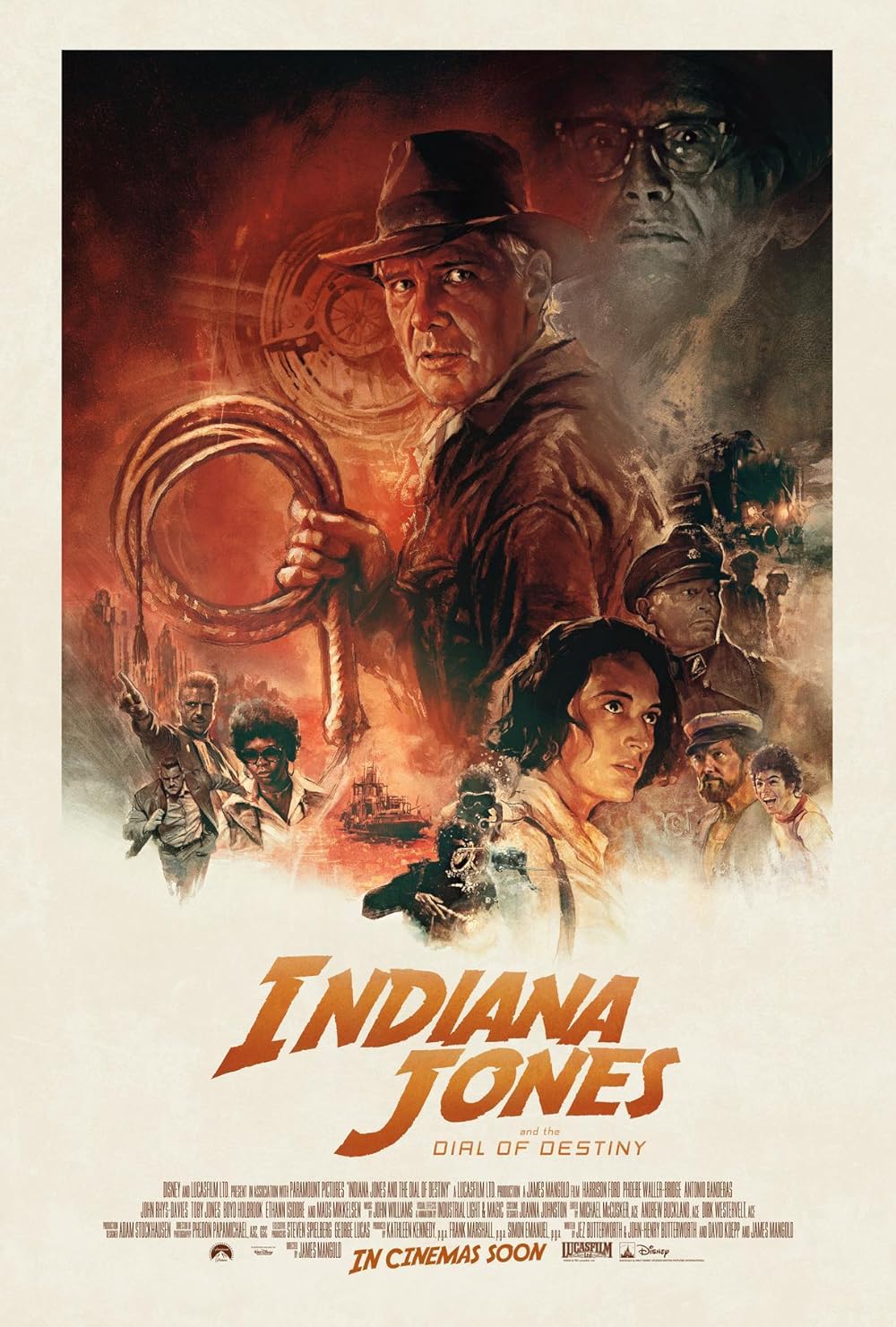
Starring: Harrison Ford, Phoebe Waller-Bridge, Mads Mikkelsen, Antonio Banderas, Karen Allen, and John Rhys-Davies
Grade: A
Though fans wallowing in misery will refuse to admit it, Indiana Jones and the Dial of Destiny was a lot of fun. It may have not achieved the cinematic greatness the previous films have done, but that standard is a near impossibility to reach this late in the game. In terms of getting closure, we got it, and we got it a high level.
Summary
Towards the end of World War II, a young Indiana Jones (Ford) is captured behind enemy lines in Nazi Germany while impersonating an officer. Oxford archaeologist Basil Shaw (Toby Jones) spots Jones being taken to interrogation but is hidden. Later, Col. Weber (Thomas Kretschmann) asks Jones if he is there alone. Jones implies that he is. Weber asks why he is there, and Jones cheekily comments that they have a lot of nice stuff since they’ve been stealing boatloads of artifacts and such. Weber says it belongs to the victor, but Jones doesn’t want to hear it. He has no problem in pointing out how Berlin is in rubble and Adolph Hitler is in hiding. He straight up says to Weber’s face that he lost. Jones is taken away. Just then, Dr. Jürgen Voller (Mikkelsen) shows up with his discovery. Opening a trunk, he presents to Weber the “Holy Lance” or the Lance of Longinus, the blade that drew Christ’s blood. After an explosion outside that shakes the building that they are in, Weber closes the trunk and tells them to double the guard around it since this is the prize Hitler seeks. Voller still wants to talk, but Weber says there is no time and the train to Berlin is waiting. Weber then sends soldiers out to find who Jones was with, as he knows he wasn’t alone. This is Basil, and he’s running through the forest to escape. As the place is being destroyed outside, Jones is about to be hanged in a room upstairs. They demand Jones tell them his story or he will die. Jones has a blade in hidden in his hands, so he cuts his hands loose while he makes fun of the Nazis for following Hitler. The angry soldier kicks the chair out from underneath Jones just as he’s able to get his hands free, though he’s hanging there by his throat. Before the soldiers can do anything, they are distracted by planes flying overhead. A bomb is dropped directly through the roof and into the room but doesn’t explode. It breaks a hole in the ground and goes through each floor until it finally explodes at the bottom.
It sends ripples of fire all the way back up to where they are at, killing everyone except Jones. He is still swinging from his rope until it breaks from the statue he’s hanging from. He is able to just get it off his neck before the statue falls to the many floors below.
Outside, the Nazis are loading many artifacts into a truck, and Basil has been captured and brought to Weber. Still dressed as a Nazi soldier, Jones knocks on the window of a driver’s seat of a soldier’s car and punches the guy out. As soon he takes the seat, two officers sit in the back and they are ready to be driven, so Jones is forced to go with it. He puts on a helmet to further disguise himself. Basil is put on Weber’s train, and Weber tells him that they have Jones. To prove it, he pulls Jones’s fedora and whip out of a bag. Jones sees the train and takes a detour road to get closer to it, prompting the soldiers that were escorting Jones to follow him. They get near and attempt to shoot, but Jones puts his helmet on the gas pedal and opens his own door to jump onto the sidecar of the motorcycle. He takes the one soldier out and dumps him onto the ground. It causes the car he was driving to eventually crash and blow up. Next, Jones attacks the driver of the motorcycle and is able to drive it into a tree to break off the sidecar from the motorcycle, with Jones taking the wheel and driving towards the train. Jones gets onto the train, takes out two soldiers, and runs on top of the train. Meanwhile, Basil is getting his ass kicked while Weber asks who sent him and what his mission was. Weber says he will never see his daughter again unless he explains why Jones had the Lance of Longinus. Basil says they were told the Lance of Longinus could be found at the fortress. Weber asks if they were looking for it because of its power, but Basil says it doesn’t have any. They were just trying to save history. At the same time, Jones walks into a train car and finds the box containing what he wants, but he runs into two soldiers. Because of his uniform, they think Jones outranks them and they salute. Jones goes along with it, intimidates them, pours out the one guy’s coffee, grabs the box, and turns to leave. The one soldier shines a flashlight on Jones’s back and sees the wound on the back of his uniform. Knowing the jig is up, Jones runs and locks the door behind him.
He breaks open the box and finds the Lancer. Unfortunately, it’s a fake, which is something Voller realizes and tells Weber at the same time. With his background in physics, Voller says the blade is an alloy. It’s only 50 years old and a replica. The engravings are recent. Jones looks around at the other artifacts, seeing stuff from the 12th and 13th centuries and Ramesses II, amongst others. He can at least confirm that this stuff is all real. Because of this, he knows he has to stop the train. Meanwhile, Voller says there is another relic on board with real power, the Antikythera or Archimedes’ Dial. Basil can overhear Voller from the other room and is stunned at the revelation. On the other hand, Weber doesn’t want to hear about this old dial. As Voller goes on about Hitler losing the war and his mind, Basil falls out of his chair while still tied to it. Voller tells Weber that the Dial’s power is not supernatural. It’s mathematics. Whoever harnesses it will not be king nor emperor nor Führer. He will be God. Jones runs through the soldier’s sleeping cart just as they are alerted of Jones’s presence, but he’s able to stick the Lancer in the door handle to keep it lodged shut (“Too many Nazis”). Weber asks Voller how they will tell Hitler because of how confusing this is to explain until they are interrupted and told an intruder who stole the Lancer is on board. Jones gets into the dining cart with more soldiers and sees incoming guys about to run in. So, Jones takes a tray of food and sits down to eat until the soldiers looking for him run through and don’t notice him. After they leave, Jones gets up from the table and continues through the cart. Jones finds the cart where his hat and whip are and he sees Basil in there with it. He unties Basil while reminding him that he told him to stay in the woods. Basil questions what kind of man would stay in the woods when his friend is facing death. As soldiers try to break in, Basil lets Jones know they are carting off half of the world’s antiquities.
As Jones switches back to his regular clothes, he tells Basil that he was going to stop him but now has to rescue him. Basil asks if he has the Lance, but Jones reveals to him that it’s a fake. Jones leads Basil into the next door and runs into Voller. He is unaware of who Jones is, and Jones responds by putting his fedora in front of Voller’s face and punching him out. Basil finds the Antikythera in Voller’s bag and shows Jones. They take it with, and the soldiers who are chasing them begin to scale the outside of the train since Jones locked all the doors behind him. Jones and Basil get to the outside of the train and see a Nazi running a machine gun turret shooting at planes above them. Eventually, the planes lay waste to the gunner, but it’s stuck continuously firing. Jones and Basil take cover, and the giant machine gun fires every bullet back at the train. It kills many Nazis and destroys the place. It even sends Voller back to the ground upon impact. Voller tells Weber that Jones and Basil have the Antikythera, but Weber just walks past Voller. At the same time, Jones helps Basil get on top of another train cart. Weber gets on the other end of it and meets Jones in a standoff. He has the Lancer in hand. As they walk towards each other, Basil yells out for the incoming tunnel, so they both dive down and fight while laying on their stomachs. Jones is able to knock the Lancer out of Weber’s hand, and he saves Basil from falling off the train. Basil goes for the Lancer while Weber gets the best of Jones. Jones almost gets his gun, but they go through another tunnel and Weber pushes Jones upwards to scrape his back against the tunnel ceiling. Once they get out of it, Jones almost falls off the train. Weber is free to shoot him, but Jones uses his whip to rip the gun out of his hand and throws it away. Weber jumps on top of him, so Jones tells Basil to grab the gun to shoot him. Basil shoots but almost hits Jones. Weber gains control again until Basil finally shoots Weber dead in the chest. Jones then kicks Weber off the train to his death (“To the victor go the spoils!”).
Just as Jones helps Basil up and they see parachuters everywhere, Voller shows up on the side of the train pointing his gun at them, demanding the Antikythera. Basil drops his gun, and Jones throws Voller the bag with it. An outstretched pole from the railroad is coming up, and Basil warns him. Jones jumps and is minorly clipped in the legs with it, but Voller didn’t see it coming and gets smoked, falling off the train on impact. Allied planes fly by to derail the train. Jones and Basil try to get the plane’s attention, but Jones realizes it’s no use as the plane starts bombing the bridge. Jones and Basil jump into the water below for safety. They get out of the water, and Basil comments how it sucks they come home empty-handed after all that. Thankfully, they didn’t, as Jones shows Basil that he retained Archimedes’ Dial.
In 1969, 12 years after the events of Indiana Jones and the Kingdom of the Crystal Skull, an aged Jones is woken up at 8AM in his apartment because his young neighbor Larry is having a party and is blasting The Beatles’ “Magical Myster Tour”. Jones puts on a shirt and takes a bat over to Larry’s apartment door to remind him it’s a workday, and he agreed not to do shit like this. Larry tells him it’s “Moon Day” and he shuts the door in Jones’s face. Following this, Jones is dressed and making some instant coffee with whiskey, and he glances over at the separation agreement he was served with by his estranged wife, Marion Ravenwood (Allen). Jones looks over at the fridge where he has a picture of the young Marion on it. He places a magnet over her face. He takes the subway to work and sees different people and young adults in costumes for Moon Day. Later, he’s lecturing his class, as he teaches at Hunter College. He asks if anyone did the reading, but no one responds, even though it’s on the test. With this, he decides to spoon-feed it to them. Putting pictures on the projector, he talks about how in 213 BC, Roman forces led by Marcellus laid siege to the city of Syracuse. Helena Shaw (Waller-Bridge) is in class and is mouthing the words to his lecture, as she knows it by heart. A student named Tonya reiterates “Syracuse” to the boy next to her, and Jones explains how it has nothing to do with the Syracuse in New York. It’s the one in Sicily. Helena smiles seeing the interaction. Jones continues on about how its most famous resident was one of the defenders of the city. He wants them to answer since it’s on the final, but the only one who speaks up is Helena who answers correctly that it’s Archimedes. She also answers that he was a mathematician. Jones adds that he was even more than that, as he was also an inventor. He talks about how Archimedes was a brilliant engineer who conceived of a way to harness the energy of the Mediterranean sun on concave mirrors, focus it on attacking Roman warships, and set them on fire. Additionally, he devised giant iron claws that could snatch hostiles from the sea.
He poses the question to everyone as to how they know it actually happened. What physical, irrefutable archaeological evidence is there of these inventions? Helena speaks up and gives the answer of the Antikythera. Jones confirms, though class is interrupted by people rushing in a television to show everyone the astronauts ready to fly to the moon. Defeated, Jones turns off his projector. Following this, he heads to his office, and the staff set up a surprise party for him since he’s retiring. They go on about how Jones has been with them for over a decade and appreciate his work at Hunter, giving him a gift. He thanks him humbly for putting up with him. After this, Helena spots Jones outside. He gives the gift to a homeless man and walks over to a bar. Unbeknownst to Helena, Agent Mason (Shaunette Renée Wilson) is following her. At the bar, Jones is watching the news, and they are talking about them walking on the moon. Helena approaches Jones and asks him what the ancients would say if they knew they walked on the moon. Speaking as an “ancient” himself, Jones tells her that going to the moon is like going to Reno in the “middle of nowhere and no blackjack”. Smiling, Helena realizes Jones doesn’t recognize her. Right away, Jones says he apologizes for whatever he did. Once she says her name though, Jones remembers her nickname of “Wombat” and smiles, noting how tall she’s gotten. He comments how he’s celebrating his retirement, so she joins him for a drink. In a hotel, a “Mr. Smith” is given room service. The hotel worker is let in, and Klaber (Boyd Holbrook) sends the worker to the other room inside. This “Smith” is actually Voller living life under a fake name. He looks out the window and notes the celebration outside, but the hotel worker just smiles at him. Klaber tells the worker that Voller is the one who built the rockets that helped send the astronauts to the moon. Voller asks the worker where he’s from, and the man says he’s from The Bronx. Voller wants to know the origin of his family however, but the man just says he was born by Yankee Stadium.
Voller does correctly guess he was in the war though.
The worker was in the 320th Battalion. He set up balloons to stop the planes bombing Normandy. Insulting him considering his position in life now, Voller rhetorically asks if he’s enjoying his victory. When the worker tries to ignore this to ask if he needs anything else, Voller tells him that he didn’t win the war. Hitler lost it. They get a phone call from Mason right after. She found Helena. Klaber is down to go after her, and Hauke (Olivier Richters) goes with. Back at the bar, Helena shows Jones a picture of when she was younger with Jones and Basil over at Oxford in the garden. She reveals she just graduated in archaeology and is now researching for a doctorate. Her subject is the Archimedes’ Dial, the Antikythera. Intrigued, he asks her what she knows about it. She spouts off how in 1902, Greek sponge divers found a huge, wrecked Roman warship off the coast of Greece. Below deck, sealed in wax, was a clock-like mechanism. It was finely tooled with a purpose unknown. Nothing approximating its complexity appears in the world for 1,000 years. Jones notes how she’s done her homework, but she attributes it to her dad Basil. He had journals and reams of notes about it. Basil told her that Jones found it on a Nazi plunder train and then lost it in a river in the French Alps. Jones passes it off as being a long time ago and reminds her that it was only half of the dial anyway. Archimedes dissembled the dial into two and then hid the two halves from the Romans during the siege of Syracuse. Helena is aware of it and finishes the story for him. Changing the subject, Jones realizes she doesn’t remember the last time they saw each other. She directs the attention to a map she laid out and points out the Alps and the route his train took from the Nazi stronghold in 1944. She points out the mountain pass it went through and then says the river there is the only one on the route. It has to be there. They are the only two people that know about it. Jones questions what she wants to do.
Helena suggests they go together to find it, and she can become famous. She then backtracks and says it would be more “renowned” and “feted”.
It could also be Indiana Jones’s final triumph. It could allow him to go out with a bang. Jones is barely reacting to her sales pitch, and she can tell. He then asks why she is chasing the thing that drove her father crazy. She thinks about it and then asks, “Wouldn’t you?”. Later, Klaber, Hauke, and Durkin (Martin McDougall) get out of a car, and Mason tells Durkin where Helena is at in the college and how she’s just with an old man. Durkin questions if the old man is Russian, but she reads off his name for him. He promises to pull a file on Jones. Klaber and Hauke go inside, and Durkin yells at them to stop, so he sends Mason into the college after them and to find Helena. At the same time, Jones leads Helena into the archives where all the artifacts are kept. He pulls out a box from a drawer and the Antikythera is in it. As Helena messes with it, Jones begins talking about a German theory Basil was obsessed with. Archimedes had figured out that the movement of the moon and planets weren’t perfect. There were irregularities in their rotations. He thought these irregularities might explain fluctuations in temperature, tides, and even storms. So, he went about building a device to predict them, but he stumbled upon a method to predict even larger disturbances. Basil thought the device could predict fissures in time. As he’s talking, Klaber opens the door to the archives and Mason walks over to him. Hauke is ransacking Jones’s office. A secretary spots them and asks what is happening. When Mason dodges the question about them being the police, she tries to run away to get Professor Plimpton, so Klaber shoots her. Mason points her gun at Klaber and tells him to drop it. Just then, Plimpton checks on the secretary, so Hauke shoots Plimpton. Klaber tells Mason that there aren’t supposed to be any witnesses. Just then, Durkin gets to the floor with a crew of guys and is shocked at what he sees. Inside the archives, Jones talks about all the letters he got from Basil being about the Dial and it became constant, so he stopped reading them.
Jones again brings up the last time he was at Helena’s house to see if she remembers, but she doesn’t. Jones says this is when he took the Dial from Basil. He thought Basil would stop thinking about it, but he was convinced it was real and dangerous. He was terrified about someone potentially finding the legendary Grafikos tablet. Helena knows it well, detailing how it’s the tablet that contains the directions to the rest of the Dial. They might get the other half of the Dial and put the two together. Helena smiles. She knew he wouldn’t destroy it. Jones questions how she knew Basil asked him to destroy it. In effect, he caught her. She does remember that night. Helena acts like she doesn’t and talks about how she was 12, but Jones calls her out and says she knew that they didn’t drop it in the river. Basil didn’t tell her that because he never lied. He corners Helena and demands to know what was up with the map. Before Jones can get to the bottom of this, Klaber, Hauke, and Mason show up with guns. Helena runs. Jones hits Klaber with a rolling staircase and runs up the stairs but Helena locks the door on him, apologizes, and escapes. Mason tells Jones that it’s over, but he demands to know who they are. Durkin enters with more guys. Jones breaks a window to call for Helena but to no avail. While Mason insists they aren’t going to hurt him, Jones jumps onto the shelving unit and knocks all of them on one side to the ground. They knock Durkin and Hauke to the ground too. Klaber shoots the lock on one exit and goes out that way. Jones goes out a different door while Helena is on the roof. Jones gets by where the offices are and hides until more guys run through the place. He is saddened to see a couple of his co-workers dead on the ground. Klaber and Mason are chasing Helena from roof to roof. Back inside the college, Jones tries to call the police, but a couple of men hold him at gunpoint and force him to hang up. Jones tries to punch one, but he’s too slow and they grab him pretty quickly and put a bag over his head.
Mason sees Helena escape into the parade and into an alley, so she yells at Klaber for fucking everything up. They are interrupted by one of the guys who tells them they have Jones. Jones is thrown in the back of a van, and they take the bag off his head. Mason is given his file and looks through it. Jones deduces she’s CIA. Klaber reveals that he isn’t because he doesn’t take government jobs. Mason asks Jones how he’s acquainted with Helena, so he reveals that Helena is his goddaughter. He hasn’t seen her in 18 years. Mason questions if he met her today just to give her the Dial, but Jones passes it off as a “hunk of gears”, prompting Klaber to tell him that it’s a lot more than that. The van they are in is stopped by a cop who yells at the driver because there’s a parade and a demonstration coming down to the road. Jones tries to get the cop’s attention for help, but they sit him down at gunpoint. The driver backs the car through the alley and hits a taxi right behind him. Mason leads the group out of the van to go out on foot, and they head directly into the war protest. Thinking quickly, Jones gets the crowd riled up for attention yelling, “Hell no! We won’t go!”, and he’s able to use it as a distraction to fight the guys off. He grabs a protest sign to hit Hauke, but he doesn’t budge, so Jones runs into the crowd. Klaber shoots his gun in the air, and everyone drops. Jones is standing across from him down the street, but Mason pulls Klaber’s arm down because she doesn’t want Jones to be shot. Jones finds a cop on the horse and begins to rant about what happened at Hunter College, the shooting, and how they’re in a Con Ed van right around the corner. The cop begins to radio everyone. Klaber punches out a cop and takes his motorcycle, so Jones steals the horse and they chase each other through the parade. Hauke steals a convertible that’s in the parade to join. Eventually, Jones is cornered, so he takes the horse down into the subway. Klaber follows him on his motorcycle but eventually crashes out, just as Jones rides onto the subway tracks. He’s nearly crushed but jumps to the other side of the tracks at the last second.
However, the other subway train is right behind him. He’s able to ride the horse back onto the platform just in time. Jones hands the horse off to some random guy and runs into the subway train just as the doors closed. Mason gets to the door but is too late before it closes on her. Jones sits down while everyone stares at him, and he comments, “Subway is faster”. Meanwhile, Voller talks to a reporter in his hotel room, and he speaks about people romanticizing science when it’s actually quite cold. The reporter asks if Mars is next, but he thinks they’ve conquered space and is looking to the next frontier. The reporter questions what could possibly be beyond space, but his handler Baxter interrupts to tell Voller he should get his suit pressed, subtly implying that he needs to stop from going any further in discussing details. Baxter says Voller is going to meet the President. Voller replies that the President should get another physicist if he can’t handle a few creases. The reporter asks if he can use this in his report. Baxter says no, but Voller tells him to go ahead. Baxter hands the phone over to Voller because he has a call, but Voller ignores him. He says he may want to delay his trip to Los Angeles because he’s expecting a delivery shortly. Voller goes into the other room to take the call, and it’s Mason. She tells him how his goons made a mess, how Helena met with Jones and acquired the Dial, and they lost both of them. Acting as a representative of the US government, Mason says she has to clean things up and urges him to go to Los Angeles to get his medal from the President. Klaber gives Voller the files on Helena and Jones during the call, prompting Voller to hang up. He tells Klaber to call their “friends” to secure a private charter to Morocco. Watching a set of TVs from a store window, Jones watches the news detailing the murders at Hunter College that took place during the parade. Apparently, the police are looking for Jones. The reporter also notes that Jones recently lost his son Mutt Williams and is in the middle of a divorce.
A random citizen standing next to Jones notes how he looks like the killer. Jones tries to disagree, but the guy starts shouting that Jones is the killer once he sees the resemblance. Thankfully, Sallah (Rhys-Davies) appears and knocks the guy out. He’s a taxi driver now and apologizes for being late on account of the traffic on the bridge. He drives Jones out of there, and they go back to Sallah’s place. Through some research, Sallah says that Helena was arrested in Tangier last year for auctioning contraband. She was bailed out by Aziz Rahim (Alaa Safi), the son of well-known Moroccan mobster Big Rahim. Big Rahim owns the Hotel Atlantique in Tangier. This week, the hotel is hosting an annual auction of stolen antiquities. Moving on, Sallah introduces Jones to his two grandchildren Alia and Jabari. He tells them how Jones is the man who brought their family to America during the war. Testing them on their history, he asks when the Suez Crisis was. Jabari scoffs at the easy question, answering 1956. Once the kids leave, Sallah says they watch too much TV, but they know their history and understand what it is to be American and Egyptian. Changing the subject, Jones asks him for a ride to the airport. Sallah notes that the cops will assume he’s guilty if he runs, but Jones says he’s going to be framed for murder without Helena or the Dial. Sallah asks if he’s thought about calling Marion, but Jones is sure she doesn’t want to talk to him. At the airport, Sallah gives him a bag of stuff he took from Jones’s apartment that was stashed under the bed. Jones opens it and finds his signature fedora, whip, and clothes. Jones thanks him. Sallah says he also brought his passport with the intention of going with him. Jones doesn’t think he can help him in Tangier, but Sallah is willing to take the chance. He misses the desert and the sea, and he misses waking up every morning wondering what new adventure the day will bring to them. Jones tells him that this isn’t an adventure. Those days have come and gone.
Salla replies, “Perhaps… perhaps not”. As Jones begins to walk away, Sallah proudly states, “Give ’em hell, Indiana Jones”. Jones waves to him but is almost hit by a car.
Jones studies some of Basil’s letters on the flight and is served a scotch. Then, he has a flashback to seeing Basil in their later years. In the flashback, Jones has to break in Basil’s barricaded door while Basil tells him to go away. When Jones gets inside, Basil tells him the Germans were right. He grabs a hammer and is about to break the Dial, but Jones stops him. Basil questions if he’s listened to anything he’s said, but Jones admits he doesn’t understand it. Basil says he was trying to explain it downstairs, but Jones counters with how he’s terrifying Helena. After Jones shuts the door behind him, Basil tells him that Archimedes discovered a temporal metrology. Jones cuts him off to remind him that Archimedes was a mathematician, not a magician. Basil is adamant that he could predict fissures in time. Jones says he can’t prove it, but Basil says he can’t prove it yet. Jones yells at him that proving it makes it science, leading to Basil to sit down in silence. Jones realizes he should have never given the Dial to him and how it belongs in a museum. He asks for it. Basil gives it to him on the agreement that it must be destroyed and makes Jones promise, which he does. Jones leaves his room and apologizes to the young Helena. Before he leaves, Basil tells Jones that if anyone finds the Grafikos, they will have both halves. He says some things should stay buried, and Jones is quick to say he knows. Still, Basil reiterates that it’s vital he destroy it, and there is a reason Archimedes broke it in two. Helena comes outside and gives Jones his fedora because he forgot it. He thanks her, assures her that Basil will be okay in a few days, and says he will call in a few days. Getting out of the flashback, Helena arrives in Tangiers. Jones is not far behind, going to the Hotel Atlantique soon after. Walking around, Jones overhears some guy on the phone telling Rahim that Helena is here. He looks around and sees Helena in a separate room showing off the Dial. She tells the group how it’s an astrological clock dating back to the 3rd century BC and built by Archimedes himself.
As the auctioneer starts the bidding at $20,000, Jones runs into Teddy (Ethann Isidore). The kid is playing with some structure that simulates a cockpit and is talking to a drunk American pilot named Louis (Henry Garrett) about pointers. Teddy tries to stop Jones from going into the private auction, but Jones forces his way in. Just as Helena is driving up the price to the bidders, Jones tells her that the auction is over. They try and ask who Jones is, and he comments how he’s her godfather and she’s up past her bedtime. He grabs her by the arm and threatens to have her explain herself to the cops at the bar, but she says she paid them off. Cocky as ever, Helena tells him that he’s out of his depth and refers to him as “Jonesy” much like Mac from Kingdom of the Crystal Skull. Turning the tables, she lets everyone know that Jones is the one who’s wanted for murder. Jones argues with her over the matter because she knows he didn’t kill anyone, but whoever did is looking for the Dial. Just then, Voller enters the room with Hauke and Klaber. As Jones refers to it as “Pandora’s Box”, Voller stands across from him on the other side of the table to correct him, saying it’s his box. Jones recognizes Voller instantly, though Voller acts like he’s never met him. Jones asks if he’s still a Nazi, prompting Helena to choke on her drink. Voller says that he’s “Professor Schmidt from Alabama University”, leading Helena to go along with it and says it’s nice to meet him in person. As people around the table are still trying to bid, Voller reminds her of the conversation they already had and how they came to an agreement about the Dial. Jones interrupts to say that the last time he ran into the guy who “looked” like him, he was also looking for the Dial. Helena tells Voller his offer was light, but the good news is that he’s here for the bidding. She tries to continue on, but Voller explains that the relic is his property, prompting Jones to correct him because he stole it. Voller counters with saying that Jones stole it, and Helena adds onto it to say she stole it. She chalks it all up to capitalism.
Voller tells Jones he should have stayed in New York, and Jones replies that he should have stayed out of Poland. As Helena drives up the price, Jones grabs the tablecloth to try and steal back the Dial, but one of the bidders grabs it and points his gun at Jones. Voller yells to get the Dial as he backs out of the room and Helena is grabbed by a guard. Hauke grabs the guy with the gun and slams him on the table. He drops the Dial and it rolls down the table to Jones. Once he grabs it, Klaber turns him around, but Jones sends him through a table with a punch. Helena punches Claude and another guard from the hotel. Jones pulls out the whip and cracks it at the entire room to back them off. It works for a moment, but then they all pull out their guns. Jones dives to the ground right when they all start shooting in his direction. Helena dives under the table to get near Jones, takes the satchel with the Dial in it, and slides it across the floor to Teddy. Teddy runs out of the room, Jones lays some guy out with a punch, Klaber runs in their direction, and Helena is held up to the wall by a guard. The guard says that Rahim wants her to stay. Jones sees Teddy and tries to grab him, but Teddy jumps onto a railing and leaps to another to elude him. Just as Helena smashes a bottle on the guard’s head, Teddy runs into Voller. He snatches the Dial from Teddy, and Klaber throws Teddy to the ground. Jones sees Voller and runs over to get him, but Voller is able to get into the elevator just in time, putting the Dial in his bag and throwing the satchel to the ground. He comments, “See you in the past, Dr. Jones”. Jones and Helena look at each other in the midst of the chaos, prompting Jones to grab the satchel before running out after Voller. Voller gets away with his car. Jones and Helena are about to take a taxi out of there, but the cops show up. Knowing the language, Helena tells the cops to shoot Jones. Jones tries to plead with them to put the guns down. Surprisingly, they do, but it’s not because of Jones’s words. Aziz appears with his crew.
He’s wearing pajamas because his father woke him up to tell him Helena returned to their hotel. Showing off his scimitar, Aziz says that Rahim wanted him to come home with Helena’s head. As Teddy is on a balcony tracking Voller’s car, Aziz questions if Helena came back because she loved him. Helena explains that she had an item to sell, prompting Jones to interrupt to say the item belongs to him. All three argue until Aziz is pulled away for a moment by his guys. Jones asks Helena what she owes Aziz, and she says it’s bail money and a “lifetime of happiness”, as they were engaged. Aziz asks if she sold the ring, and Helena replies that it didn’t go for as much as she thought it would. Aziz wants to kill her, so Helena and Jones run away. During the chase, Helena blames Jones for getting her killed, as if it’s his fault that she was talking shit to the guy who already threatened to cut off her head. Jones is quick to point out that he’s not the one engaged to a mobster, but she doesn’t want to hear “morality lessons from an aging grave robber”. As they run, he tells her that he’s not a grave robber and him and Basil did important work together. They are shot at, so they take a different passageway. Unrelenting, Helena tells Jones to not call his escapades “noble selfless quests”. She says he did it for the buzz. They turn to a shooter, but Teddy shows up just in time to hit the shooter with the tuk-tuk he’s driving. Jones takes the driver’s seat and hightails it out of there with Helena and Teddy in tow. They narrowly avoid more gunfire from Aziz and his men, and they head out onto the main road. Teddy tells him not to go the direction he’s headed, but Jones says he knows Tangiers. Soon after, he can see Voller’s car on a street below and follows. Voller can see him and yells at Klaber to go faster. They are 10 minutes from the airport. During their drive, Helena brings up how she’s not sure if “Schmidt” is a professor, so Jones tells her that he’s a Nazi. Just then, Teddy tells Jones to take a left, but he goes right. Aziz’s men get closer, and one jumps on top of their tuk-tuk and uses his knife to cut through the covering on the roof. Jones is able to swing him off to the side and Helena punches the guy off the vehicle entirely.
They try to tell Jones to go in a different direction, but he deliberately takes them down the other way.
It’s a massive and narrow staircase, and it’s a rough trip all the way down. They land but crash into a stand. Voller’s group drives right past them. Helena and Teddy grab another tuk-tuk and leave Jones there. Jones uses his foot to get his tuk-tuk back onto the street and chases after them. At some point, they are side by side with Aziz behind them and Voller in front of them. Jones asks if Basil would be proud of his only daughter selling her soul for bail money. Teddy says some of it is gambling debt and is about to say more until Helena cuts him off. Aziz pops his head out of the car to try and get Helena’s attention and even stops his guy in the passenger seat from shooting her dead on. Jones asks Helena how she ended up like this. She questions what he means, asking if he means her being resourceful, daring, beautiful, and self-sufficient. Suddenly, Aziz’s car rams Helena’s tuk-tuk and she bounces into Jones’s tuk-tuk. Jones is about to be crushed in a head-on collision, but he is able to act quick enough to jump into Helena’s tuk-tuk. They are able to knock down a shooter through Helena’s driving, and they catch up to Voller. However, Aziz does too and tries grabbing Helena from his car. Hauke pulls out his machine gun and tries to shoot them, but Jones kicks the gun up against the windshield as he’s firing. It avoids Helena and shoots at everyone in Aziz’s car. They are able to break off, which makes the gun fall into Helena’s tuk-tuk. Aziz’s car sputters out. Helena has Teddy take the wheel. She rips her own sleeves off for some reason and uses a crowbar to break open the back window of Voller’s car. She gets it caught and falls onto the trunk of Voller’s car. She starts choking Voller. One of the guys in the car tries to shoot her, but it’s avoided. Jones opens the backseat while the guy is hanging from the window and then pulls him by the ankle to the ground. Jones has a hand on the bag that Voller has the Dial in. They are close to getting it away, but Aziz’s car is back and they are driving straight for Helena (“Damn”). Knowing he has to save her, Jones grabs Helena and pulls her back to their car just in time.
Teddy takes them down a different pathway, and Helena says Voller is gone when Jones tries to direct him. This leads Jones to take the wheel back over.
While driving, Jones tells Helena that he didn’t come there to rescue her from her fiancé. He just wants the Dial back. Aziz is right behind them and is about to ram them with his car, but the passageway becomes too narrow and he gets stuck, allowing them to escape. Right after, Voller is stopped by soldiers at gunpoint. Jones and Helena continue to argue about her exploits and Helena blames Jones for not being there for her as a father figure. He tries to defend himself, but she tells him to not worry because she knows family was never his strong suit. She asks him what the time is, and it makes him realize that Teddy stole his watch. Demanding it back because it was his father Henry’s, Helena has Teddy give it back. Moving on, Helena tells Teddy that he will have to leave town with her because Rahim will be looking for him too. They’ll be going to Tangier airport, so they will need to catch a train and get a plane to Casablanca. Unfortunately, they will be slowed down, as the tuk-tuk’s engine busts. On a plane, Mason tells Voller they pulled the plug because he got them scared. Voller sees this as them not understanding, but Mason explains that the real issue is that his associates got three American civilians killed and they blew up a nationally televised parade. On top of that, Voller stood up the President, ran to Morocco, and created an incident that required military extraction. Voller suggests she take him to Washington D.C. to explain it all, but Mason says they want him to vanish. Voller points out how they have half the Dial now, but Mason says they were just trying to keep him happy by letting him chase it. They never cared about it. Voller argues that they will when they understand what it can do. Mason says Voller put them on the Moon, so they got what they wanted. A soldier interrupts to tell them they will be landing in Spain, and a C-9 transport will take them from there to Maxwell. Voller refuses to go back to Alabama. He is stern in saying that all they need is a vessel to take them to the Mediterranean. Mason walks past him, so Voller grabs her hand and pleads with her.
She refuses, prompting Voller and his group to take action. He takes her coat and grabs her gun, Hauke snaps the neck of a soldier, and Klaber sprays the eyes of another and Mason. Klaber throws some guy off the helicopter while Hauke knocks out the pilot and takes control of the helicopter. Mason attacks Voller, leading to Klaber shooting Mason. Close to dying, Mason calls out to “Schmidt”, but he corrects her and tells her his real name while holding the Dial in hand. If Voller gets his hands on the Dial before Indiana Jones, the world might be in trouble. It doesn’t help that he has a massive head start.
My Thoughts:
In the final entry of the Indiana Jones saga, Disney took over the intellectual property of the beloved franchise after purchasing Lucasfilm way back in 2012 and helped to deliver the last hurrah that Harrison Ford and worldwide audiences desired for quite some time. Though it’s the weakest entry in the franchise as far as the big screen is concerned (The Young Indiana Jones Chronicles is the worst overall production), it’s not because Indiana Jones and the Dial of Destiny is a bad movie. On the contrary, it’s still an exciting, amusing, heartfelt, emotional, and highly entertaining action-adventure that does the absolute best they could with the aged movie star at the forefront without stretching the believability factor too far. Along with this, it’s also the most personal of all the films, as the complexities and authentic exploration of themes such as age, life, death, and love become more important in this entry than ever before. Really, it’s fitting for Indy’s curtain call. Nevertheless, due to the films preceding it, the bar was set unreasonably high, which is why the fifth movie might not meet certain audience expectations. However, Indiana Jones and the Dial of Destiny didn’t set out to make a sequel that was going to be the biggest and baddest entry yet because they understood this would be a near impossible task. Instead, they set out to construct a sequel with the idea in mind that this was going to be it. This fifth movie was going to be the last time audiences get to see cinema’s greatest hero, Indiana Jones. With this careful thought in mind, they put together a story fitting of the changing world around the aging legend and found a way to give fans one last glimpse of greatness and “movie magic” personified.
The wait time from the Last Crusade to Kingdom of the Crystal Skull was 19 years. After the success of Indiana Jones and the Kingdom of the Crystal Skull, people were clamoring for another and even star Harrison Ford commented in real-life interviews how he was down to make a sequel but didn’t want to wait another 20 years for it to develop. Well, 15 years is pretty damn close. Due to constant disagreements, plans being stalled, companies being restructured or bought out, franchise creators George Lucas and Steven Spielberg leaving, a litany of rewrites, and people getting fired and hired more times than we could count, nothing could be locked down definitively for quite some time regarding Indiana Jones. It’s a miracle this fifth film happened at all, all things considered. To be fair, the passion of the creators involved is respectable. They could have easily just thrown together a script and called it a day, with Jones chasing after a MacGuffin of any sort being worth watching by most fan’s accounts. However, everyone involved with the creative process of the next movie knew that there was a standard that had to be met. After all, this is Indiana Jones we’re talking about. This is a character with a cinematic legacy that very few have reached. This isn’t to be taken lightly. Whoever was involved had to have the saga’s best interests at heart. In addition to this, it must be taken into account that every passing year results in series star Harrison Ford getting older. Because of this, the screenplay had to get more intricate each year, as the aging archeologist would need more and more purpose moving forward as to why he would continue to find himself in harm’s way, especially after the fourth movie ended with him marrying Marion and reconnecting with his son Mutt. In the character’s younger years, Indy flying across the world in life-threatening situations is easier to grasp because many of us have that sense of adventure in our younger days. Just like Jones, we have the freedom to explore and take chances.
Once we age and settle down however, those same risks can’t be taken anymore. Our priorities and responsibilities change every succeeding year, resulting in all the other stuff outside of the necessities in life becoming less important. When a person gets to that stage in life, they have to take care of a lot more than just themselves, as opposed to when they are a young adult ready to take on the world. It’s how life works, and it’s something that has been excellently reflected in the timeline of the Indiana Jones films, especially as Ford got older. This is the crucial bridge of time they were dealing with between Crystal Skull and Dial of Destiny, and it became increasingly harder with each year to nail down the crux of the story. Once again, they had to answer the question as to why they are revisiting this universe. It couldn’t simply be about the MacGuffin and nothing else. At this point, it’s just an element to the narrative, an undoubtedly crucial staple to the franchise but less important than audiences may realize. Much like Jones and his father Henry letting go of the Holy Grail and coming to the realization that their father/son relationship was the real treasure or the hidden reason of knowledge being the ultimate object of desire in Crystal Skull, along with Jones being more satisfied by rejoining his family by the end of the film, the concept of time and its multi-faceted layers finally broke through in the writing of this fifth and final film. Again, acknowledging the age of America’s James Bond, the passage of time that he’s lived through, and how he’s lived one of the most eventful lives of any cinematic character in history, the hook became the Antikythera or Archimedes’ Dial, a mechanism created by Greek mathematician Archimedes that was considered to be ahead of its time. Though its functions are believed to predict weather patterns and such, the twist is that Archimedes managed to stumble through his creation to find that it could predict fissures in time as well. Of course, this means potential time travel implications. With social media being at its all-time worst and people’s opinions “mattering” more than ever, the reception for this premise was as polarizing as you would expect, though anything Lucasfilm-related is probably used to such audience reception at this point.
If you remember the discourse in 2008, this was a huge point of contention with Indiana Jones and the Kingdom of the Crystal Skull, which is something we’ve covered ad nauseum in the review for said film. Instead of shying away from the possible reaction, James Mangold and company decided to jump head-first into George Lucas’s idea to widen the scope of the Indiana Jones universe. With alien life forms playing such a major role previously to essentially confirm to audiences that anything is possible once the famed archaeologist takes on another mission, Indiana Jones and the Dial of Destiny takes one more giant leap forward to match the expectations of a finale fitting of the titular character. Now, an archaeologist who has lived his life studying and reveling in world history is embarking on a mission to recover an object that could place him back in time to see history as it happened. Considering the protagonist, this is a brilliant idea for a final adventure. Maybe, this is what Indiana Jones needs to achieve the ultimate form of closure, or so we think.
As we mentioned in the review of this movie’s predecessor, all of the absolutely bat-shit, unbelievable things Indiana Jones has come across in his lifetime as evidenced with each succeeding movie needs to be acknowledged going into this fifth film. With everything the character has been through such as seeing highly effective voodoo dolls, getting cursed, people’s faces melting off, meeting an immortal knight, witnessing the powers of God himself, and seeing interdimensional beings, the only step left is time travel. It’s that simple. Like it or not, this is what the franchise turned into. This was the biggest way for Indiana Jones to go out to give him an adventure that was Indiana Jones worthy while being rooted in the foundation laid from the very beginning in 1981. It was the final frontier for the hero to face. Still, the purpose is multi-layered, as this possibility of time travel allows for characters such as the sulking, guilt-riddled Jones to get a chance to comprehend the meaning of life. Was it worth it? What was it all for? In Temple of Doom, the young, wide-eyed fighter smiled at the thought of fortune and glory. In Raiders of the Lost Ark, the idea of making history was too good to pass up, along with acknowledging the importance of stopping the Nazis from getting to the Ark first because it could spell doom for the world who was at war. All these years later, this question of it all being worth it is posed more than ever before. Following an intense opening sequence detailing Indiana Jones at his peak towards the end of World War II, we jump to 1969 where we see what has happened to the famed hero. Despite achieving so much in his life, saving the world on a few occasions, and looking like he finally achieved what he was seeking in regard to his personal life at the end Crystal Skull, the viewer instead sees that it was almost like he got nothing out of his life’s work. He’s in his 80s now, and on the verge of retirement, he has no one to share the enjoyment or the rest of his life with. As time goes on, life changes and foundations crumble.
Not even Indiana Jones is safe from the warpath of Father Time.
Jones is a shell of his former self and retires with seemingly no purpose left in the ever-changing world around him. He spent years fighting the Nazis on covert missions, but some of them work in the United States government and NASA, helping the US get to the Moon. He feels out of place in a world rapidly changing around him, and he has accepted that this is the way it’s going to be at the end of his life. He has reverted back to the person Marion accused him of being in the interim period between Raiders of the Lost Ark and Crystal Skull. Jones thought he knew what was best and assumed the worst possible outcome between them. Instead of trying to work things out with Marion and do everything to prevent such a cataclysmic end to their relationship since she is his true love, he tried to one-man-army this one too. It may have worked in the events of Temple of Doom or Last Crusade, but his personal life is a different story. Thinking he knows best for any and everyone including himself is something that has proven to be Jones’s Achilles heel. This personality trait or fault rather was alluded to in the Last Crusade and Marion brings it to light in Crystal Skull. With Dial of Destiny, it’s the forefront of the picture, as Jones has clearly gotten in his own way and finds himself alone and purposeless in his final years. It might be depressing for some who like the light-hearted tone of previous adventures and the upbeat energy they have, but it’s not like Dial of Destiny is a dark film. Granted, it’s not necessarily where all of us may have wanted the character to go, and it didn’t have to be this way per say. However, it’s not illogical to think this is who Jones has become after all these years. The signs were there all along for it to be part of the protagonist’s overall arc if they chose it. They didn’t have to, but they wanted to and tied it into the theme and questions surrounding time very well. Granted, they had four screenwriters for Dial of Destiny, so somebody had to figure it out eventually.
Nevertheless, it’s playing with the action hero mythos, depicting the once ultra-cool lone wolf in his older age, and the deep-rooted pain and regret he’s dealing with that came with his heroic actions is an engrossing journey to watch unfold. Usually, Jones would move from action sequence to action sequence killing left and right, but this is a battle-weary Jones. When they escape from the ship when Helena surprises Voller with the dynamite, she talks about the moment happily, but Jones reminds her that his friend was just murdered and has trouble even saying the words, as this Jones is in touch with mortality than ever before.
At first, he has no interest in getting back into the saddle until Jones’s hand is forced by Helena’s stealing of the Dial and him being framed for murder. When he’s at the airport, Sallah tries to hype him up about his return to his adventurous ways, but Jones doesn’t have the same infectious energy he used to about it. He simply talks about those days being long gone and downplaying the events that will unfold. This jaded and under-the-radar depressive state that Jones is wallowing in is unlike the hero we have grown to know. It’s a little too Han Solo-like, especially with how they explain what happened with him and his life in The Force Awakens. It’s not until later when Jones has a private conversation with Helena aboard Renaldo’s boat where the viewer finally gets some insight into Jones’s mental state. After they discuss how Basil’s notebook detailed the date of August 20th, 1969, and the same date in 1939 two weeks before Hitler invaded Poland, Helena laughs at the idea of Jones suggesting the Dial has magical powers. Knowing the cynicism of Helena and how she’s more focused on artifact hunting for the purposes of fortune and glory just like how Jones initially was in Temple of Doom, Jones tells her a lot without saying much. In a statement that encompasses his otherworldly adventures without detailing each story to her since it will go in one ear and out the other with someone like her, Jones tells Helena that he doesn’t believe in magic, but “A few times in my life, I’ve seen things. Things I can’t explain, and I’ve come to believe it’s not so much what you believe. It’s how hard you believe it”. Acting like she’s as experienced as Jones, Helena talks about how she’s seen things too and the only thing worth believing in is cash, basically telling the viewer what her character flaw is and how closely her core resembles Rene Belloq from Raiders of the Lost Ark just as much as she carries Indy’s traits. It’s why he’s later teary-eyed when Helena teases selling the codes of the Grafikos to Voller for $100k. Nevertheless, she tries to be playful and asks Jones what he would do if he could go back in time, as asking a legendary professor of archaeology this question would assuredly bring about an exciting and heartfelt answer.
In his younger years, Jones may have given the question an answer with a lot of love and passion, but this aged Jones is different. Instead, he breaks our hearts with his somber answer of, “I’d stop my son from enlisting”. You just sink hearing the words, as it’s a tear-jerking statement many parents can relate to. As much as seeing an older Mutt along with his father for one last ride and him interacting with someone like Helena during this journey would have been incredibly fun decision more in-tune with the Indiana Jones style, there’s a solid chance that the creators may not have wanted to deal with Shia LaBeouf and his unpredictable real-life personality. It’s a shame too because the infectious energy of the actor and character could have played a huge role in making this a great send-off akin to previous adventures rather than the somber curtain call it ended up being. Mutt being a part of that plane ride in the climax and looking at Jones and Helena with those freaked-out eyes but fighting off Klaber and helping the good side to safety would have been awesome. Sadly, James Mangold never had an intention of using the character, which is unfortunate because his inclusion would have made Helena a lot more digestible for longtime fans of the series. On the other hand, from a writing perspective and a superfan of the franchise, Mutt signing up for Vietnam to piss Jones off is absolutely something he would do. Seeing how much this hurt Jones privately is the unexpected vulnerability the character shows for the first time ever, which is what makes it so powerful. Helena asks Jones how he would stop his son from enlisting, and his voice quivers as he replies “I’d tell him he was gonna die… I’d tell him that his mother would find no end to her grief, and that his father would be helpless to console her and that the loss would put an end to their marriage”. It’s arguably the most powerful line delivery of the entire franchise, putting things into perspective more than anything prior to it. This man has lived a life most could never dream of. He’s seen and done it all.
He discovered the Holy Grail, saw the power of God firsthand, and even came into contact with life forms from a different dimension, but yet when posed with the hypothetical of going back in time to see or do anything he could possibly dream of, he would chose to stop his son from going to Vietnam because it would prevent his death. In the grand scheme of things, none of Jones’s personal achievements mattered and neither did padding his resume. What did actually matter was his family and keeping his family together. With his own mortality in question in his older years, his outliving of his own son because of some bad decisions, and the crumbling of his marriage, Indiana Jones realizes that his family is what mattered and he failed them. The money, the fame, the accomplishments, and the “fortune and glory” are nothing without his son and his wife. Despite the Helena character’s inability to truly win the audience over by the end of the film, she does prove her worth in helping Jones complete his arc though (SPOILERS, SPOILERS, SPOILERS). Just when he was about to give up completely on his life and was willing to stay in 214 BC at the Siege of Syracuse with Archimedes while dying from a bullet wound, Helena is the one who breaks out of her carefree attitude to wake up Jones up to reality. The emotional Jones is enthralled at their being witnesses to history and tells Helena that he’s going to stay. Even though his reasoning to her is that he’s imagined this and studied it all his life, it’s only partially the reason. Based off of what has happened to Jones and his somber outlook on what his life has turned into, his reasoning coincides with his acceptance of living his life and failing, which is why he’s willing to let it all end and see one last incredible thing as he passes on. He hasn’t considered the fact that his dying in 214 BC would legitimately change the course of history. Really, it’s Jones once again thinking he knows best for himself and not realizing he’s making a selfish decision that will hurt a lot of people, including the love of his life in Marion.
He has acknowledged his failures but stubbornly decides that there is no fixing anything, choosing to die when he doesn’t have to. Going along with the theme of the film as a whole, there is still time. He just has to take one last leap of faith. Helena pleads with him about how his work isn’t done, how he needs to go home, and he can’t die there, echoing the words us fans are screaming at the screen because we don’t want this to be the end. As Jones stubbornly puts on his signature fedora and the theme music plays and he comments how he needs to do this, you just want someone to punch him in the face because it’s the only way the man is going to listen. With this, Helena knocks him out with a punch on cue, forcing the action to take him back. So, as annoying as Helena is at times trying to pull off a female version of Jones in his younger years but being nowhere near as cool, funny, or attractive, and Phoebe Waller-Bridge in general having this expression on her face that makes it look like she’s constantly smelling a fart, Helena did save our hero from a self-imposed death. For that, we are indebted to good old “Wombat”. She’s right. Jones was meant to be here, for the people who love and cherish him. He means too much to all of us for him to call it quits. Coming to this realization taking him this long aligns with his internal flaws that have been haunting him since day one and have only intensified as he aged, but it shows audiences that as cool as Indiana Jones is and how he’s saved the day on more than one occasion, even he needs some help. He may never admit it as the tough leader of many successful missions, but his dedicated team of friends and family have put him in the right positions in life for him to win, another life lesson to take home with us. His reluctant team-up with Helena may not have been ideal and he did have to force his way into it because he’s the one who knew a guy with a boat, but Helena helped Jones complete his arc by reminding him that he’s meant to be here for her, Marion.
That’s what it’s all about, and that’s a beautiful message. By the way, Marion’s entrance alone gives us goosebumps, as the memories she has given worldwide audiences just flood our consciousness as soon as she steps through that door. She didn’t have to say anything to make an impact with her presence. Thankfully however, we still got the final scene between Jones and Marion where Marion talks about where she hurts and Jones kisses her in a callback reversal of the famous scene from Raiders of the Lost Ark. It might be one of the most gratifying, tear-jerking finales of any cinematic saga. It makes you wonder where all this time went. When he grabs the fedora from the clothesline in the final shot, it just makes your eyes water and puts a smile on your face, reminding us that there’s only one Indiana Jones.
Mads Mikkelsen does an outstanding job as the franchise’s newest and final Nazi villain in Dr. Jürgen Voller. Hearing that the franchise was going back to Nazi antagonists was something I was hesitant about initially because it’s been overused at this point. Within the time period and the franchise as a whole, it seemed lazy to go back to the Nazis after all this time, especially with how well they did with the Soviet bad guys of Crystal Skull. However, Mikkelsen exceeded any and all expectations and is right up there with one of the best villains Jones has ever faced. With a cool backstory of him becoming a NASA scientist under a fake name but also getting funded by the US government to accomplish his lifelong mission to find the Dial until they back out is wildly engaging. All of it leading to the breath-taking climax on the plane where Voller realizes his calculations are off upon seeing the Romans, taking a moment to himself while Klaber fires a machine gun at the soldiers below in one of the most chaotic climaxes in the franchise’s history, and then the panic setting in when he wants to get the plane out of there will have the hair on your neck raised for the entirety of the sequence (“I don’t know where we’re going Jurgen, but it sure as hell ain’t 1939!”). His performance is fantastic, the character’s layers solidify his place in the annals of the series’ fandom, and the actor himself continues to show new ways to bring villains to the big screen without overlapping performances. It’s a true testament to his abilities, which is probably why he’s been called on to fight James Bond (Casino Royale), Doctor Strange, and even The Three Musketeers. When he steps out in full uniform to setup the climax where he intends to fix Hitler’s mistakes, you realize that of all the problems in this movie, none of them can be attributed to Mikkelsen. If anything, we just wish Ford was younger to really match the action and intensity of the moment. Their chemistry as hero and villain was some of the best of the series by far (“You’re German Voller. Don’t try and be funny”).
On the other side of things, Antonio Banderas didn’t click as much as we were hoping for. He’s too big of a star to be used for such a small role. As a result, this one-legged frogman Renaldo felt like a celebrity cameo for Banderas to sneak in to surprise audiences rather than playing a character who deserved a bigger role in the narrative. He does do well with the time given, but the role may have been better suited for an unknown actor rather than disrespectfully having Banderas come and go like that. The underwater sequence felt very un-Indiana Jones too, though eels being similar enough to snakes to freak out Jones was a decent idea. They tied its purpose together well with how Basil spoke with an old sponge diver about how a Roman warship sailed out of Syracuse with 100 centurions on board to look for the rest of the Dial because they had the Grafikos. Even so, it just didn’t feel right to see Jones go underwater for an action sequence. Sure, it allowed Jones’s age to be masked in an action sequence, but it didn’t fit the vibe of the series nor did the unnecessary CGI map transitions. Why update a staple of the series just to add to the astronomical budget when it didn’t need fixing in the first place? The nearly half hour video game-like CGI opening of the film had some good and bad too. The de-aging digital effects did allow for longtime fans to see a prime Indiana Jones one more time, which was nice since there should have been at least two more sequels starring a younger Harrison Ford had Lucasfilm got their heads out of their asses in the 1990s. At the same time, it looked shockingly good too. Admittedly though, I couldn’t help but still laugh when the “young” Jones speaks and it’s clearly the voice of the old Harrison Ford speaking. Still, as far as films trying their hardest to accomplish this feat in de-aging an older actor, Indiana Jones and the Dial of Destiny did a phenomenal job in its recreation of the younger Ford in this opening. It may have ballooned the budget exponentially, but it was a unique way to start the film, as well set up the stark contrast of the 1969 timeline it jumps to right after.
The overt VFX usage, odd color grading, and dull cinematography was shockingly uninspired for an Indiana Jones film too, and that may have been the biggest difference between a Spielberg production and a James Mangold one.
Getting an extra MacGuffin like the Grafikos to get directions to the other half of the Dial and having the codes be in Polybius Square which Helena knows were all very cool elements thrown into the detailed screenplay, but there is one other question that is troubling regarding Helena’s characterization. Once she knows Nazis are involved, they are nearly killed in Tangier, and they have to go to the Aegean Sea to find the Grafikos, why is she even bothering at this point? She wants to sell it that badly? For someone as smart as her and cash-focused, it seems like Helena would give up on the matter. Why would she even care if the Nazis got it? She was willing to sell it to anyone at that table, and they were all criminals. Oh, right. She may not want to admit it, but Jones can see why she’s so fixated on finding it (“Nobody memorizes every page of their dead father’s notebooks for the money”). You, see? She does care! She just hides it as much as Indiana Jones. Teddy is a decent Short Round for Helena, but his practicing how to fly a plane with that little playset in the Hotel Atlantique was much too convenient for the climax to work out the way it did. Once again, small stuff like this is more unbelievable than the time travel plot device. For some reason, this kid flying a plane without ever having live practice is more unrealistic than this object centered on mathematics being able to open a portal in time (“The first hemisphere sets the destination, the second calculates the location of the fissure, in Alexandrian coordinates. Have Messner transpose this to longitude and latitude and transmit waypoints to the pilots”). On a side note, the tying of the loose end of Helena showing how she offers a marked card to give the illusion of choice to the player when picking out of her deck and the reveal of the Dial being a “forced deck” because it was only built to take them to Syracuse 2000 years prior to scare off the Roman Navy was genius.
Somehow making Archimedes’s fascination with water displacement interesting, the Ear of Dionysius cave in Sicily was a very cool throwback sequence, especially when seeing it in theaters, but why did Jones suddenly freak out at the sight of all the bugs in the cave? Did we forget how he completely stone-faced them in the much more frightening bug-infested cave sequence in Temple of Doom? Literally, the ONLY thing that freaked him out was snakes. Why did they suddenly forget this? Still, Jones having a moment of reflection when climbing a stone wall inside the cave 40 feet in the air was gold. He comments how he has crap shoulders, a crumbling vertebra, a plate in one leg, and screws in the other, and Helena tries to tell him that she gets it. This is when Jones hilariously replies that she doesn’t and how “You haven’t been forced to drink the blood of Kali”, “been tortured with voodoo”, or got shot 9 times including once by Basil. Besides this, Helena riding the motorcycle through the rain to get onto the plane at the last second and the spine-chilling, balls-to-the-wall climax where they realize they traveled 2,000 years back in time instead of to 1939 because Jones is the only one who realizes that Archmeides didn’t know about continental drift, and Voller’s coordinates were off, is an action sequence that is about as epic as it gets. Just when you thought they weren’t going to get there, the Indiana Jones franchise finds that last ounce of “movie magic” to give viewers a finish for the ages. Once that aforementioned panic sets in with Voller and the franchise is on the verge of the official end of Nazism within its universe, it’s unforgettable.
Indiana Jones and the Dial of Destiny is nowhere near the best film in the series. That is for certain. Even so, it’s a respectable and heartfelt love letter to the franchise that is just as thrilling as the others while making the viewer smile knowing that we got to see one, final, spectacular ride from start to finish.
Indiana Jones, we’re going to miss you. Enjoy your retirement. If anyone has earned it, it’s you.


+ There are no comments
Add yours