
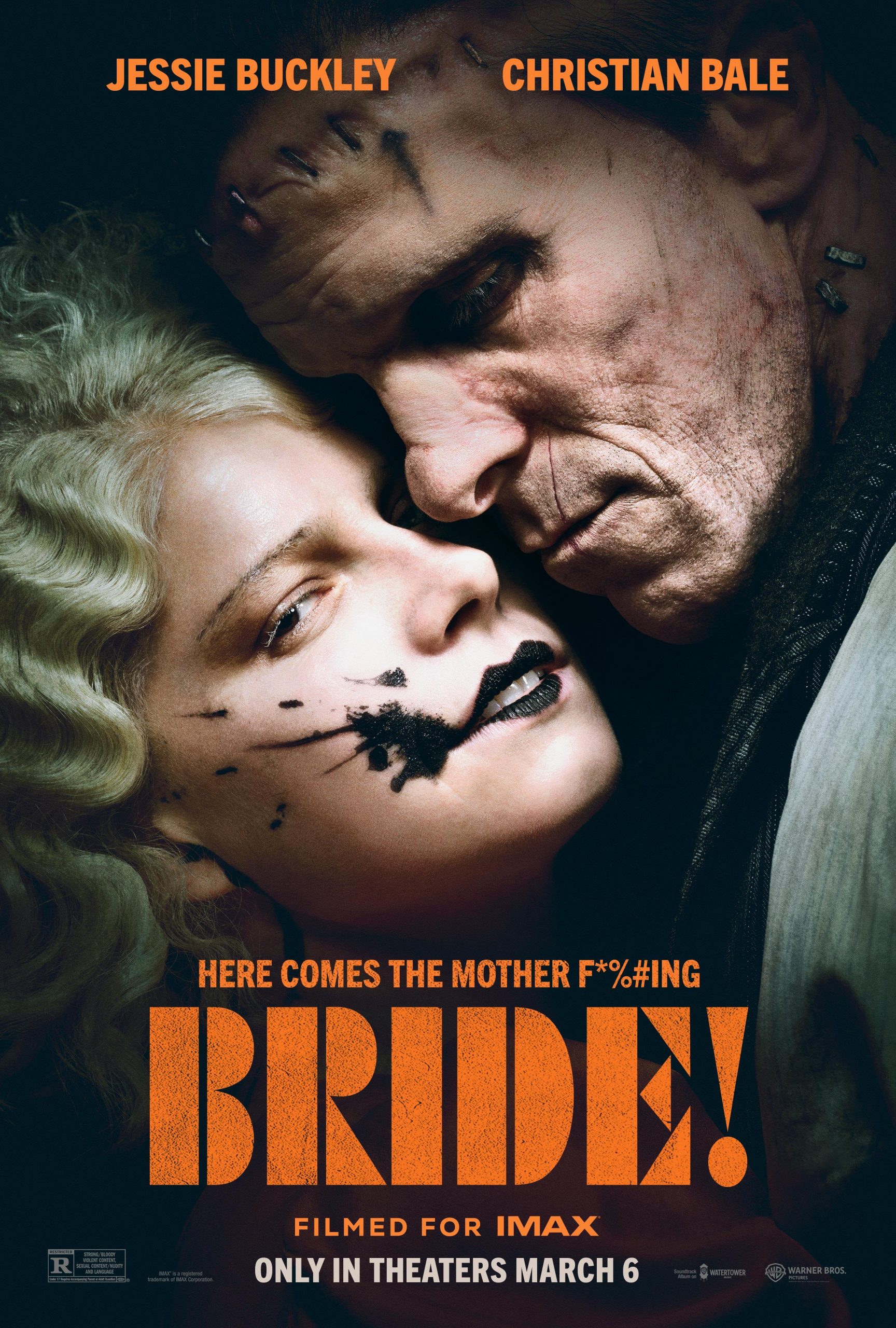
Starring: Jessie Buckley, Christian Bale, Annette Bening, Jake Gyllenhaal, Penelope Cruz, and Peter Sarsgaard
Grade: B+
As the titular character would say, “Oh, button up your britches, girl!”.
Maggie Gyllenhaal’s unconventional romance The Bride! is a creative reimagining of the famous character and a wild ride to watch unfold.
Summary
In 1818, Mary Shelley wrote Frankenstein on a dare.
Hidden in the shadows of the afterlife is the ghost of Mary Shelley (Buckley) herself. Speaking directly to the viewer, Shelley hopes everyone loves Frankenstein but says the story wasn’t the half of it. What she wanted to write and say, she couldn’t. She couldn’t even think it. By her own words, she had brain cancer and couldn’t write at all because of it, so she died. Immediately, she awoke to where she is now, the afterlife of sorts. Shelley has been there for centuries trying to get this tumor, dream, or story out of her head. Finally, something is happening. The words are beginning to come. Is it a ghost story, a horror story, or most frightening of all, a love story?
Through Shelley’s narration, she takes us back to 1936 Chicago. There, Shelley refers to the main character of her story as Ida (also Buckley) “until she finds her own name”. Ida is with a group of friends at a restaurant and she’s trying to be cool, calm, and normal. However, something is “cracking” inside of her, as Shelley puts it. Shelley notices the crack and realizes she can slip in and possess Ida. For Shelley, this is the only way to get her monstrous story told. Staring into the heart of the viewer, Shelley declares “Here comes the motherfucking Bride!”.
Ida is sitting at the table, and her friends are laughing and drinking. Two of which are Clyde (John Magaro) and James (Matthew Maher), along with many women. She kisses Clyde and the woman sitting next to him before pushing away James who tries to join in. James tries to give her an oyster, but she isn’t interested. James persists until Ida climbs over the table to his lap for him to feed it to her. As the group laughs it up, she becomes ill right after and pukes on James. Now, a lot of the people in the restaurant are watching. Then, Ida begins shouting different words in succession in a different accent (“Duplicity, cunning, cunning, foxiness, fraud!”). The possession has begun. Ida gets visions of Mary Shelley from the afterlife telling her to wake up, and Ida begins to twitch violently. Everyone asks if she is okay, and she comes out of it fine. However, this lasts only a moment before it starts up again, as a Shelley-possessed Ida spouts, “Stuck sick in the ground with a mouthful of dirt. You’ve got to sit sidesaddle to avoid ruining your prospects”. Crawling over the table, she then points out one of the guys there and suggests he’d fuck a man if the man was up for it. Ida screams loudly and gets the attention of everyone in the restaurant and asks if the woman near her is giving her man a handjob under the table, adding that she can decline if she wanted to. She sees mobster Vito Lupino (Zlatko Burić) at the bar and points him out to everyone, saying he is the real monster. She refers to herself as the “Canary” and how the dead know all the dirty stories involving him, prompting Lupino to gesture to Clyde and James to take her away. As she’s being thrown out, she yells at Lupino and questions if he will cut her tongue out too and how “even the commissioner can’t quiet the dead”. As Clyde gets Ida outside of the door, he yells at her for getting into it with a big-time mob boss like Lupino. Coming out of the possession momentarily but nearly falling apart as she does, Ida doesn’t know what’s happening to her.
James comes over and shuts the door behind him to ask the two what’s going on, prompting the possession to reengage. Ida begins ranting about the tingling sensation she’s feeling and how it feels like there is a “bee in my bonnet” until James slaps her. Ida slaps him back, and they go back and forth until Clyde separates them. Ida sees this as fair because of her phrasing, as it’s really Shelley who agrees that her verbiage was “pathetic, convention, par”. She invites James to slap her again and adds that there is a “pearl” in her “oyster”. Clyde slaps her and she takes a few steps back on the staircase. Ida then jokes that James has the kind of cock that looks like a belly button because it can’t be seen through his pants. When she asks if he’s a grower rather than a show-er, James punches her. Clyde stops James and tells him to get a doctor, as Clyde sees she’s possessed. Once James leaves, Ida continues to rant about random things such as her work, Italy, a narrative of a tour around Lake Geneva, and Frankenstein. She then begins to ask what this is and who James is. She then answers herself as she turns to say to herself “Darlings, be warned. A sequel is coming”, as Shelley is fully inside of her body. As the possessed Ida comments how everything will change and she has a lot more to say, James tries to calm her down. He gets closer to grab her, but the force causes her to slip. Ida flies down the staircase, breaks several bones including her neck, and dies. In the afterlife, Shelley says that if the people thought her Frankenstein story was scary, her next will have people stand up and yell, “HEEEEEEELLLLLP!”. Donning a fedora and a bandana over his mouth to conceal his face, but one guy still telling him to stay away when he asks for directions, Frankenstein’s Monster (Bale) finds his way to the home of Dr. Cornelia Euphronious (Bening). Introducing himself as Frankenstein as he was named after his “father”, Euphronious has him remove his hat. She then asks where he was born. Since he’s not sure how to answer this, she changes this to where he was “created”. He replies that it was Ingolstadt, Bavaria in 1819. Euphronious reminds him that it’s 1936, so it would make him well over 100 years old.
Frankenstein confirms this is true, though he’s not sure how to explain it. She wants him to remove his bandana. Though he doesn’t want to, she persists. Once he reveals his face to her, she’s as startled as expected, leading to Frankenstein to apologize and cover his face. Even so, Euphronious wants to run some tests. Frankenstein asks if he can have an audience with Dr. Euphronious, not realizing that it is her. He mentions her books Event Horizon and the Birth of Singularity and The Art of Reinvigoration and how he wrote a few times but never got a response. Once she explains that it’s her, she gets closer to him to shake his hand. Following this, Euphronious does tests on Frankenstein or “Frank” in her lab. While she looks at the scarring on his torso, Frank apologizes for his smell while adding that he’s read all her work on reinvigoration. He talks about her brilliance with the field mice and the moles. She is quick to add that she’s worked on cats as well. Frank didn’t know about it because these tests went unpublished and were clearly off the record. As Euphronious checks his neck for his signature bolts, Frank reveals that he ripped them out. Moving on, he comments how he’s a subscriber to her quarterly. Euphronious bypasses this and notices some serious wounds on Frank’s body. She asks if they hurt, but he just says he’s used to it. She’s fascinated by Frank and is happy he came and found her. She invites him to stay there at the Institute for continued observation, but this is not why he’s here. Frank says the real reason he came there is for “an intercourse”. Intrigued, Euphronious has Frank sit down by her desk, and he questions how much she knows about him. She comments how she’s read exhaustively about Dr. Frankenstein’s early work and “his monster”. When she says the latter however, Frank is visibly saddened and offended by the phrase. When she asks if this isn’t an accurate description, Frank details his troubles. Because of his situation, there is an entire garden of pleasures he has not yet had. She assumes he means “carnal pleasures”, and he confirms, among other things.
More importantly, he talks about just having a relationship, a communion. Euphronious likens this idea for a conjugal relationship to his desire for a bride, which gets a smile and another confirmation from him. Euphronious isn’t sure how she can help because it’s not like she has a mail-order catalog of dead women, so Frank implies that she could maybe create someone for him. To use her own terminology, he suggests she can “reinvigorate” a bride for him from the body of a dead woman. Euphronious scoffs at the idea and questions if this is more about sex, as there might be easier ways of getting to this goal. Just then, Euphronious’s maid Greta (Jeannie Berlin) enters, sees Frank, screams, and exits while Euphronious tries to tell her that she’s with a patient. Moving on, Frank says this is about loneliness. For him, it’s agony. She’s not sure where to go with this, so she again invites him to stay at the Institute for the time being. Later, Frank goes to the movies to watch the most recent Ronnie Reed film, as Frank idolizes the actor. He’s seen the movie plenty of times beforehand and mouths every one of Reed’s lines as he smiles. One person in the theater can hear him and tells Frank to be quiet, so he puts his hat and bandana back on and quiets himself. During the song and dance part of the movie, Frankenstein imagines himself as part of the backup dancers. Afterwards, he sees oddly dressed people standing outside of a nightclub and walks away. The next day at the Institute, Euphronious talks about how she doesn’t see this working because they can’t just go digging up bodies for him. A medical cadaver isn’t an option, and she doesn’t understand the idea of using pieces from many different dead bodies and sewing them together. She questions the thinking behind it, calls it grotesque, and suggests Dr. Frankenstein had some sort of fetish. Frank defends him, saying Dr. Frankenstein was trying to create something beautiful. This prompts Euphronious to comically reply how ironic this is before immediately apologizing when Frank stands to leave.
Euphronious questions what they would do even if they found a complete cadaver. She jokes about how Frank can put in requests for a redhead or someone with perky tits, and she could find a husband. Finally, Frank flips on her and declares that this is an emergency (“SOS! Fire! Fuck!”). He calms himself down and apologizes, adding that it’s been way too long since he’s had company. Euphronious says everyone’s lonely, but Frank explains how his situation is different. When they shook hands the day before, it was the first time ever for him and it was extraordinary. Euphronious says that he’s welcome to stay on for observation because she’s not going to put him out on the street. He can even stay a few days, with her stating how she will take good care of him. However, Frank pleads with her to help him. Euphronious questions the possibility of if his potential bride is monstrous or not what he wants, but Frank replies confidently that he will love her. Euphronious responds by bringing up all the things that could go wrong from a scientific or ethics standpoint, but Frank holds out his hand. He asks slyly if she’s a mad scientist and if she’s curious or not, and Euphronious begins to laugh. She is on both accounts. With this, Euphronious is in, and the two go out that night to the cemetery. They dig up the body of Ida and take her back to the Institute. They go up the stairs with Ida’s body over Frank’s shoulder to reach the lab and Frank accidentally knocks over a vase. After Euphronious tells him to leave it, Greta is on the first part of the staircase and sees them. In the lab, Euphronious has Frank take Ida’s clothes off, as she is using the stellar remnant model. Euphronious details how she’s harnessed the electricity from the streetlight, and they’re going to need to back up the voltage and short it so they can get a massive amperage. Since the lights go out at 5, she tells Frankenstein they need to access the aorta and the solar plexus on Ida’s body, so he tears the sheet off to get to her body.
Meanwhile, Euphronious spouts off about how they will “oppose the gravity reaction with neutron degeneracy pressure and short-range repulsive and neutron-neutron interactions. Assuming wave-particle duality, we’ll need to asymptotically approach the integral value of density”. As Frankenstein takes off the body bag covering Ida, he stops and deems her too beautiful. Euphronious agrees Ida is beautiful, prompting Frank to ask if they should stop for now and start up again tomorrow.
Just then, Greta knocks on the door to ask if everything is alright, and Euphronious assures her it is. After shutting the door in Greta’s face, Euphronious turns to Frank and comments that she can’t keep a dead body sitting in her office, which is fair. She says it’s now or never, so Frank relents. Following this, they set up the machinery and Euphronious has Frank flip the switch for the electricity. His nerves get to him, and he can’t do it until Euphronioius walks over to him to help him flip the switch (“To life”). The machine works and shocks the still possessed Ida back to life! His bride is here! Ida sits up and sees the two across the room. Once Frankenstein walks up to her, she coughs up a black liquid that gets around her mouth. Frankenstein tries to wipe it but stops once Ida starts saying a few random words like “lady” and “wife” once she hears Euphronious say the word “bride”. Looking around and putting her dress back on, Ida asks if they got wild with absinthe the night before. Ida says she needs to get home, so Euphronious asks where this is. Ida mentions her cousin who has the name of McBride. She is interrupted by her own nausea, but she says she’s fine and just needs some food. She steps off of the operating table but immediately falls due to her ankle still being broken from when she fell to her death. Frank tries to help her get up, but she refuses. Euphronious says she’s a doctor and tries to take a look at her legs. Frank can’t help but stare during her on-the-spot examination, and Ida stares daggers at him. Frank suggests Ida may have been in some type of accident once Ida comments how she can’t seem to put the pieces together where they are at. Euphronious offers for Ida to stay the night since it’s already late, and Frank is quick to say that he is more than happy to share his bed, as reading the room was never his strong suit. Still looking at Frank, Ida laughs at his suggestion of what happened being an accident. As Euphronious tells Frank to give them some privacy so she can continue to check on the condition of Ida’s legs, Frank can’t help but smile and share eye contact with an intrigued Ida.
Later, Frank goes to the movies to watch the same Ronnie Reed movie, and he continues to imagine that he’s in it. At the same time, Euphronious deals with Ida. Ida questions what’s a matter with Frank, and Euphronious asks if she is talking about Frank’s face. Ida wasn’t thinking this at all and seems put off by her even suggesting it. She questions why Euphronious locked the door, but she doesn’t reply. Next, Ida asks if “bride” means “married”, Euphronious says it means she’s getting married. In this case, it would be to Frank. Ida isn’t interested, as she doesn’t remember him. As Euphronious puts a leg brace on Ida, she tells Ida that Frank isn’t too bad. So, Ida questions why Euphronious hasn’t married him before yelling “Mate! Breeder! Groom!” right after. Later that night in a dream, Ida hears Mary Shelley’s voice inside of her head again and sees flashes of her through visions. Ida asks who she is, and Shelley rambles about her mother’s given name was Mary, her grandfather’s name was Wollstonecraft, her father’s name was Godwin, and her husband’s name was Shelley. Shelley asks if the name rings a bell, and Ida is aware of who she is. Shelley cackles as she tells Ida that Ida is her monster. Ida asks Shelley what her own name is because she can’t remember. Shelley says she knows it but prefers not to tell her. Ida grabs a light that breaks, her floating body falls back to the operating table, and she awakens from her dream in the now morning. Ida sits up from the operating table and sees Frank sleeping on the ground under it. She blows in his face to wake him up, and Frank wakes up frantically in defense mode and hits her. Immediately, he apologizes and tries to check on her, but she tells him to fuck off. Trying to calm things down, he playfully grabs an umbrella and acts as if it’s a cane that one of the dancers in the Ronnie Reed movie had. As he lays it across his forearm, he again asks if he can check to see if she’s okay. Ida asks how he got in the room since the door was locked, so Frank admits he broke in through the window. He outstretches his hand towards her face slowly, but she replies, “Slow down, mate. Shipmate, helpmate, stalemate, amalgamate, imitate, decimate, transubstantiate”. She interrupts herself with a burp before continuing “Sublimate, consummate, checkmate”.
Frank just responds, “Aye-aye, mate” before complimenting her vocabulary.
Suddenly, Euphronious unlocks the door to find the two and realizes Frank broke the window to get in after seeing the glass on the ground. At breakfast, Euphronious comments how the crystalloid solution has sustained Ida’s skin. She didn’t anticipate that. Nevertheless, she’s excited to run some tests today. However, Ida would prefer not to. Euphronious questions if she’s started to remember things a little bit and mentions her accident before encouraging her to eat some eggs, toast, and jam. Again, Ida would prefer not to. Euphronious asks if she wants to get some new clothes, but Ida gives the same response. Euphronious asks if she is referencing Elliot or Hawthrone, and Greta asks if it’s Bartleby. Euphronious tells Frank they have seem to have “invigorated” a well-read monster considering she’s quoting Hawthrone at the breakfast table. Ida responds by breaking the glass containing the jam and correcting Euphronious because she was actually quoting Melville. Psychologically testing Ida, Euphronious asks if she has upset her in some way despite making her this breakfast. Ida states, “A lifetime of lady lying. It’s the scarcity and depravation makes a hungry cunt. Ache, comment, crave, yen, yen, yen…” while she inches the plate of food towards the edge of the table, daring to throw it to the ground. As Euphronious tells her to stop, Ida again says she would prefer not to. Finally, Euphronious asks what she wants to do. Ida says she wants the door to be unlocked so she can go outside (“Blustery, Gusty, alfresco”) and challenges her by pointing out that she is sure she doesn’t live there. She wants out. Euphronious considers this impossible, so Ida immediately drops a glass mug on the ground, shattering it. Frank winks at Ida while Ida sits back down. That night, Frank helps Ida sneak out as they climb out of the building, though Ida nearly gives away their position by yelling random things at the sky. They go to the movie theater to watch the Ronnie Reed movie. Quietly, Frank tells Ida that Reed had polio as a boy, and they didn’t know if he was going to be able to walk.
Apparently, one of his legs are still shorter than the other one, so he has special shoes made for him to even his footing out for dancing. Ida jokingly asks Frank if one leg being shorter than the other is his kink. Frank is confused by the question, and Ida moves one of her legs upwards a little while she lays them on the seat ahead of them.
Afterwards, Ida leads Frank into the weird club he passed by the other night, and it’s packed. She asks if he wants to dance, but he says he doesn’t. Ida is quick to remind him that he does, messing with him by putting the umbrella over her arm just like he did that morning. She tosses him the umbrella and gets in-between everyone on the dance floor. Concealing his face with his hat and bandana, Frank goes to sit down. He watches her dance like crazy from a table, and he imagines her in a white dress with him in the suit from the Ronnie Reed movie and they dance together to the music from the movie. Later, Ida is in the bathroom and sees herself in the mirror. A woman near her asks what sailor gave Ida her tattoos. Ida doesn’t say anything. She just showcases her black tongue. Another woman next to Ida is drawing on her eyebrows in the mirror, and Ida begins to stare at her. The woman sees that Ida likes it, so she draws on eyebrows for Ida too. Following this, Ida is going crazy on the dance floor again, and the strobe lights are going off. Frank is now a bit drunk and comments to the waitress that Ida is his wife, though Ida is dancing with some guy. Either way, the waitress tells Frank he can’t keep the table all night. Several men begin to grope Ida at once, and she begins to yell about Lupino’s gangsters until Frank notices what’s happening and saves her. He rushes her out of the club, but two of the men follow and continuously mess with Frank. He’s polite at first and tells them goodnight, but they knock his hat off and slap him. When Frank goes to pick up his hat, one of the men kicks him in the face. The two men begin to sexually assault Ida, prompting her to bite one of them in the face. They throw her down and try getting on top of her, but Frank gets up and goes full Frankenstein. He smashes the one guy’s head against the wall and kills him. Then, he shoves the other on the ground and curb stomps his head in several times over, killing him too.
As Ida stands up in shock, someone takes a picture of the both of them. Ida grabs Frank, and they run out of there. While they run, Frank says this was not him because he doesn’t drink and he plays violin. They get back to the outside of the Institute, but Frank tells Ida to get out of there because he doesn’t want to get her into any more trouble. As sirens are heard, he begins climbing the fence. Ida isn’t sure what to do, but Frank is adamant that she goes. Frank gets inside and grabs his belongings such as a small book of some kind, money, and a newspaper clipping of Ronnie Reed. Once he takes the latter, he sees his reflection in the mirror and stops momentarily. Right after, he climbs back down to the sidewalk but sees Ida waiting by a car. Frank tells her to leave again and that she doesn’t want to get caught up with him. He comments how people love a monster, and there will be a mob. He’s been through it before and it’s terrible. Again, he tells her to go home, and he begins to run down the street. Ida calmly but sternly replies that she doesn’t know where she lives. Frank stops and turns back to her, outstretching his hand. She takes it, and the two run into the night. In another dream, Ida’s mind has an encounter with Shelley. Ida’s head is in a glass jar, and Shelley asks if she’s going to marry Frankenstein before cackling. Ida comments how she can’t breathe and can’t remember her name. Shelley spouts off random names in succession starting with “Martha, Winifred, Constance, Jane, Bride of King Kong. Queen Kong. Mrs. Jekyll. Mrs. Hyde. Mrs. Bride of Frankenstein”. Shelley deduces this isn’t quite right. Again, Ida’s severed head in a jar comments how she can’t breathe. Shelley replies that she’s being smothered, and they all are (“Brain fog. Brain dead. Pray for a brain attack!”). She encourages Ida to find her name and that a resistance to tyranny is obedience to God. As Ida demands Shelley reveal her name to her, her head is mushed up against the glass of the jar. Suddenly, Frank wakes up Ida from the dream and lights a match. The two are hiding in a train car. She blows out the match and complains about the lack of air. So, Frank opens the door to the train car they are on.
Ida is still panting, as she tells Frank how she had a dream she was being buried alive. Frank can relate. He’s had that type of dream before too. She asks what happened, and Frank questions if she remembers. Once he says it, she realizes she does remember. Just then, the train stops, as the cops are searching it. Knowing the cops are there for him, Frank rushes Ida over to hide behind some boxes. An officer in the distance is heard describing the killer as “part donkey, part man”, which is hilarious. The cop then says he had a huge “donkey dick”, pulled it out, and pissed on the bodies of the dead men. How did this rumor get started? Anyway, the cops laugh and joke about it and half-heartedly peak into the train car before closing the door. Ida sees Frank clutching the newspaper clipping, so she asks what it is. Frank shows her that Ronnie Reed is on it, and Ida replies in a 1930s news reporter voice “Well, his wonderful black hair and soulful eyes. Enough to make any young girl adore him”. Frank asks if she remembers him, but she responds in her normal voice, “No”. Next, Ida questions what kind of talkie star did she “shine to”, so Frank mentions Marlene Deitrich. She likes this and begins twitching and singing at the top of her lungs, as she can’t help herself. Frank tries to stop her, but it’s too late. It gives up their position. Even though the train is moving again, a cop jumps onto their train car at the last moment to investigate and sees Frank hiding. He brings Frank out at gunpoint, and Frank surrenders. He holds his picture of Ronnie Reed in front of his face. The cop shines his flashlight in Frank’s face and is so startled at Frank’s presence, he puts his gun back up and prepares to shoot while yelling, “Devil, be gone!”. Ida runs over, shoves the cop off the train, and he snaps his neck on the railroad upon impact, dying instantly. She sees what she has done and is stunned. The next day, Det. Jake Wiles (Sarsgaard) and his secretary Myrna Mallow (Cruz) are at the crime scene outside of the night club. Jake scoffs at people referring to the murderer as “Frankenstein” because he doesn’t believe it for a second.
Myrna says there were about 150 witnesses, along with a movie theater owner who said the guy that fit the description came in to see the same Ronnie Reed picture over and over again, The Dubious Detective. As Jake sees the destroyed head of the guy who got curb stomped and then takes a bite out of his donut, Myrna gives him the pictures someone took at the scene. It shows Ida with him, clear as day. Myrna details how Ida was heard mouthing off about Vito Lupino. After Jake notes that Ida has a busted leg, he is confident they will have this wrapped up in 24 hours. Somehow, I doubt that. In New York that night, Frank and Ida wander into a park and Frank takes his shirt off to jump into a fountain. Ida is confused because she thinks he’s taking a bath, but he’s actually taking pennies out of the fountain to use for cash and hands several handfuls over to her. Later, they are in an abandoned pool somewhere, with the water all drained out. She reads the newspaper and asks how to pronounce the “Frankenstein” name in a nod to Young Frankenstein surely. Once he details that he’s Swiss, Ida sees in the paper that they referred to her as his bride. She asks Frank what her name is because she can’t remember, and he jokes that it’s Ginger. After they both laugh, he tells her it’s Penelope Rogers. Looking at the paper, she replies that she likes the photo and comments aloud “Miss Penelope Frankenstein”. Out of nowhere, she asks if he wants to fuck because it might make it easier to sleep. He is stunned at the question, so she goes over to him and tries to initiate things. Startled and uncomfortable, Frank stops her and she replies, “Jeez, just trying to be friendly”. He apologizes to her. It’s not because he doesn’t want to. He’s just not ready yet. It’s too special to him, and he hasn’t earned it.
While the manhunt intensifies for the couple however, the romance will too.
My Thoughts:
After her first directing, writing, and producing effort five years prior with 2021’s highly acclaimed The Lost Daughter, Maggie Gyllenhaal follows it up with a feature completely out of left field in The Bride! A gothic romance based on the classic horror movie monsters Frankenstein and The Bride of Frankenstein, Gyllenhaal gives audiences a different take on the iconic character and her origin story and succeeds mightily with wacky visuals, a daring imagination, and an electrifying performance from Jessie Buckley.
Lately, everyone has been fawning over Jessie Buckley’s acting output as of late, but it’s for good reason. Buckley is an elite actress with range up there with the best the film industry has to offer. Hamnet was not lightning in a bottle. It may have been a coming out party for those who haven’t noticed her work prior, but she has been incredible for some time. Though The Bride! wasn’t as well reviewed critically compared to other productions she’s been a part of, Buckley’s bizarre portrayal of the protagonist is her most entertaining role thus far and will surely be recognized as something special years down the line. Unrecognizable, the actress switches between accents, attitudes, speech patterns, and cadences as she tries to bring the madness alive for the big screen, breathing new life into the forgotten and underutilized IP. The commitment is evident from Buckley and director Maggie Gyllenhaal. Clearly, this was a passion project to some degree for Gyllenhaal, as she centers the entirety of the film’s events to the subject at hand. Now, this may seem like an obvious decision for nearly anyone reading this because how else would you would tell a story about The Bride of Frankenstein? Well, for those film historians out there, the original 1935 classic that brought the iconic character to life (quite literally) technically only had her on screen for the ending of the movie. All of it was still centered around Frankenstein, as it was a direct sequel to 1931’s Frankenstein. The entire sequel was about the buildup to where The Bride of Frankenstein is famously created. With Maggie Gyllenhaal’s The Bride!, it takes the character and fully fleshes out her story to right the wrongs of the original, making it more of a female-centric narrative and giving the character a layered story like never before. It introduces Ida as an escort who hangs out with gangsters that have ties to mob boss Vito Lupino, how an afterlife-dwelling Mary Shelley came to possess her body, and everything that followed once she was revived by Frank and Euphronious and had to deal with two different lives and their consequences all at once.
She doesn’t remember what happened prior to her being brought back to life, so she has to not only wrap her head around Frank wanting to be with her and lying, saying they were married before her death and Ida having to trust whatever he says, but Ida also has to deal with all the gangsters who still want her dead for speaking out. It’s the story of a woman who has been through hell and back before her death and well after, dealing with pain in two different lifetimes that few could overcome in just one. Anytime Ida gains ground and finds some pathway to positivity, the terrible people she comes into contact with find a way to try and ruin her. Her screaming of “NOOOOOO!” in the fateful drive-in scene was a perfect, emotional encapsulation of the horrible life she has been forced to live and try to conquer. Just when she was this close to finding something good in her life, they take it away from her. The Bride! is a tale of a woman being a true victim of circumstances, lashing out and refusing to back down to the many evil forces that loom, and using her new lease on life to transform and accept who she is. No, she is not The Bride of Frankenstein. This minimizes her and defeats the point of this film, as only being known as the secondary star to her man. No, this is the woman blossoming into her own monstrous self, becoming “The Bride”. As Ida accepts it in her heart, Mary Shelley’s emerges from the shadows in the afterlife to help her embrace it, and it’s a great movie moment that if the film were a bigger success, would live on in the annals of horror movie history (“Not Ida, not Pretty Penny, not The Bride of Frankenstein. The Bride. That’s good. That’s who you are”). Because as famous as The Bride character is, as she’s one of the most recognizable movie monsters in the history of cinema, she’s only appeared in two other movies other than her debut. Compare this to how many films involving Frankenstein that we’ve seen over the years. The totals with him reach nearly 500, and that’s just with movies. There are still shows, short films, and other media that add on to the total count.
Considering how famous The Bride of Frankenstein is, it’s a travesty that audiences haven’t see more stories over the years that further her legend. The Bride! rectifies this injustice by adding layers to the character that didn’t previously exist and strengthens her overall place in film history with how her story is told. She may not have the aura the original Bride had, but the film itself is so entertaining that if it was recognized and retconned as the origin story for the character, no one should be mad. That’s how great Buckley is in the role and how well Gyllenhaal’s screenplay benefits the protagonist. It makes her something special, which is why fans should advocate for the film’s longevity and its efforts in general because her story is done exceptionally. Honestly, it can still work as a companion piece with the original too, albeit with some minor changes.
Other aspects of the screenplay are nowhere near as strong, which is what lowers the impact of the film overall. This cannot be stressed enough involving Peter Sarsgaard’s absolutely wretched performance as Jake Wiles, the detective on the case who doesn’t realize he’s after a former flame in Ida until he sees her at the Ronnie Reed party. He looks completely out of place for a movie that takes place in the 1930s. His performance is much too modern, and he tries to mask it by wearing a fedora and fails miserably. There is nothing “Chicago” about him, despite the character supposedly being a Chicago cop. He’s not sly, he’s not cool, and Myrna is right in her pointing out how unfunny he is when he tries his asshole act. Some actors can pull it off because they are charismatic enough, but Sarsgaard isn’t one of them. He even botches the lay-up of a line when the angry mob chases Frank and Ida out of the movie theater, and he comments the obvious to Myrna on how he thinks they should go that way. His delivery of the sardonic quip that any number of actors would have nailed without trouble was astonishingly bad. He’s so obviously miscast, the viewer will beg the question as to how he got through the casting process over a million other actors who would have fit the bill easily. There’s no way he had this good of an audition. Oh, right. He’s married to the director. Now, it makes sense, especially when Myrna mentions how Ida looked at Jake like they were old friends and a cocky Jake replies, “A lot of ladies look at me like that, even the ones I haven’t met yet”. Even within the context of this universe, we know he’s full of shit. Considering who the Jake character is written to be, Sarsgaard could not be more out of place. He is the most plain-looking person in a major role we’ve seen in years and is more unbelievable in his womanizing Chicago cop character as Christian Bale is playing a tall Frankenstein. Going along with this, his team with Myrna is disconnected from the heart of the movie drastically and doesn’t live up to what the other side of the story is doing in the slightest. Anytime the story shifts back to them, it bogs the picture down considerably. Plus, what is their relationship? Is Myrna actually a secretary?
Why is she calling all the shots if she is? She’s described as one by Jake and it says so in her character description in everything about the movie. Yet, she does all the detective work in every single scene and is ten steps ahead of him regarding this investigation. There is no exaggeration here. Jake is utterly useless. He’s just seen eating on several occasions and continues to say things that are wrong or will be proven wrong at some point. The big moment where he decides to resign for being a secret jerkoff himself, which came as no surprise, it’s more or less a solution that makes the viewer shrug (“Don’t fuck your witnesses, detective! Rookie mistake!”). Even if the Jake character is a big part in setting up Ida before her death, did they really need him that badly? Maybe if another actor with some personality were to play the role it would be a bigger deal from an emotional standpoint, but his exit from the picture was the definition of “Don’t let the door hit you on the way out”. On the other hand, the character is much more involved in the events of the movie than Myrna, so his exit, Myrna suddenly being a huge part of the climax, and Jake not reappearing in the big shootout moment at the Institute doesn’t make any sense. He has to be there to complete his arc. Having Jake reappear in the credits eating ice cream and opening the door for wrong women was just dumb. Seriously, why is Myrna suddenly the big hero? It doesn’t align with how the first half of the story is written. Obviously, Penélope Cruz is a bigger star than Sarsgaard, but the Jake character is directly invested in Ida’s life. Narratively, it doesn’t make sense for him to bow out without reappearing for the finale. Myrna does do all the actual detective work, but the character isn’t attached to the story like him. This disjointed section of the story is what hurts The Bride! mightily. It’s too uneven when it comes to the normal characters and lacks the enthusiasm the fantastical elements possess. It’s felt in the writing, the dialogue, and the performances. None of it aligns with Ida, Frank, or even mad scientist Euphronious, played be an excellent Annette Bening.
With The Bride!, they pay homage to The Bride of Frankenstein in a lot of ways. The most notable being the fact that Buckley plays both Mary Shelley and the eventual Bride just like Elsa Lanchester did in The Bride of Frankenstein. Though we’ll call the comparison a wash in regards to the two actresses’ performance as the Bride since Lanchester didn’t get nearly the amount of screentime Buckley did to flesh things out and because Lanchester is the foundation for the character, but Buckley gets a considerable edge when it comes to playing Shelley. Reimagined as not only an author of horror but a horrific character herself, Buckley portrayal and Gyllenhaal’s screenplay turns the writer herself into a monster, as the ghost who possesses escort girl Ida. Acting as the devil on her shoulder while also infecting more and more of Ida’s body with her powers from the afterlife, Shelley is essentially the real monster “Bride”. Instead of channeling her rage into her writing, she channels it into the reinvigorated Ida, a woman who already was unfairly discarded with because of mob boss Vito Lupino after being outed as one of the many women who were trying to aid in a case against him until it was dropped because he was too powerful and had the commissioner in his pocket. With Shelley and the many words and plights of the dead speaking through Ida or “Penelope”, she stands up for the fallen. It’s a partial revenge fantasy but also a call to arms for the many women who have been silenced by those in power (“Much nicer with a wet pussy Eddie, promise!”). She didn’t set out to be the face of a movement, but her actions in the heat of the moment start a revolution. After her and Frank are spotted at a 3D showing of Revolt of the Zombies, they run into a classy party filled with high-class and assumedly powerful people. Hilariously trying to blend in, the fearless Ida takes a tray and starts delivering food to people, and Frank attempts the same. He’s practically giddy about it, as the excitement he’s involved in because of “his bride” is something he’s never experienced. The love is evident. She may not be there just yet with him, but she can see how innocent he is and smiles back at him as they are serving.
Then, things stop in their tracks. Just when Frank thought he couldn’t be any happier, he sees Ronnie Reed in the flesh. As we know at this point in time, Frank idolizes the actor and has watched every single one of his movies several times over. Like a fan at Comic-Con, Frank tries to explain to Ronnie how he smiled at Frank in Manchester in 1917 during his vaudeville days, how Ronnie was radiant, and he still has the ticket from the event before saying that Ronnie would be glad to know he’s not alone anymore. Pouring his heart out to the A-lister, he credits Ronnie alone for his survival on the planet. Confused, Ronnie replies with an insulting joke about how Frank isn’t his type and it’s only magnified by the laughter of Ronnie’s friends behind him. In this one moment, Frank was as sweet and as genuine as he could be and just wanted to let his hero know how much he did for him, but Ronnie shattered his world with one half-hearted reply. Of course, this leads to the first real Frankenstein-like response that we haven’t seen since his outburst with Euphronious in the first act. Frank shouts and breaks things before stopping, moving oddly, and then doing his own version of “Puttin’ on the Ritz” where Ida joins in. The two dance like they are rebelling not only against the people at the party but society itself. As choregraphed dancers do their rounds, Frank and Ida are in the middle of it doing the same but putting their own spin on it, as Bale and Buckley have to maintain their characters’ styles and mindsets within the dance. Otherwise, the viewer may be even more confused than they already are. With this in mind, the two performers make it work by matching the beats of the professionals and the chorus line dancers but stick out purposely because of attitude in their movements, their bombastic personalities, and their combined energy that throws off the dancers around them. They are together with everyone, but the couple themselves are separate from them. Yet, they dance like no one is watching, as this is the moment where the two connect on an unspeakable, nearly spiritual level.
They play off each other like Frank was wanting all along. It’s just better than he ever imagined it would be. In this dance, they know they are being weird, but they are being weird together, which is why they go even harder with their steps and Frank is comfortable enough to get close, pour a drink into Ida’s mouth, then he drinks some, eats the glass, and spits it out in celebration. Once Jake and Myrna enter, and Ida stops once she makes eye contact with Jake, she knows they have to go. Frank is still in song-and-dance mode though and yells “Puttin’ on the Ritz!” before getting punched by a cop. After a scuffle, the cops all hold their guns on him, prompting Ida to grab one off the floor from the guy who was punched out and demand they let Frank go. This is where the revolution is spawned. Thinking on the fly, she brings out Ronnie Reed from the crowd at gunpoint and starts spewing what seems like nonsense out of context to the partygoers but is actually a frustrated Ida speaking with Mary Shelley’s influence draped over her, instigating further anger into her heart. She comments “Forced amnesia, huh? Well, I’ve got brains. Plenty of brains inside this firecracker, and she’s the brains behind that operation. This is a brain attack. Let him go!”. After getting Ronnie to get on his knees and he apologizes for whatever he’s done, Ida switches the conversation from violence to her telling everyone there how Lupino is paying off the commissioner. She names countless women who were found dead with their tongue cut out. Besides Jake, everyone is focused on her and not her words, prompting her to swing her gun at them to say “I’m talking here! You shoot whoever you want. You cheated and you won. The dead are angry”. She starts asking what random people there have done and realizes she knows the details herself because “They’re all here”. The dead have something to say, and she’s saying it for them. She is speaking for the “monsters”, but we know who the real monsters are, they are the ones who have gone unpunished and the still beating heart of Ida will not stand for it. Neither will the dead. The hair is raising off of Frank’s neck in the moment. He’s hanging onto her every word and is loving her fire.
Once a cop steps forward and Ida instinctively shoots him, Frank rushes her out of there after knocking down the chandelier as a distraction, and he excitingly tells her how incredible she was as the two are running outside. What’s intriguing about it is that Ida doesn’t know what she has done. She just comments how the cop looked so surprised and is unsettled over shooting him. It hasn’t entered her mind how much of an impact her speech had on Frank or more importantly, the general public. She didn’t go into it trying to begin a feminist movement. Even when she spots Greta later in the movie donning her signature makeup, she doesn’t react to it. She was speaking for the dead. The fact that it resonated with so many women however shows the strength of the character, the power of one’s voice and actions, how so many of these female voices have gone unheard, and how sometimes, you have to shake things up every once in a while to get your point across. Staying silent isn’t helping anyone. The less powerful people will continue to be shoved aside if they do. When Ida gets everything off her chest and continues to do so, women may find inspiration in The Bride! in the same manner men have watching movies like Man on Fire or Death Wish. It gets the blood pumping. You just can’t help it. You like to see these types of protagonists stand up against bad people. Now, the film isn’t condoning violence by any means, as Ida breaking in and out of her possession to get freaked out over what she has done is a big part of her arc, but for the viewer, the moments where she does lash out at these bad people, they can’t help but root for her personality split, as problematic as it is. She didn’t want any of this. She makes that very clear. However, with circumstances forcing Ida into all these different directions, she’s going to do something about it. Still, as she stands at a crossroads after fatally shooting the cop, Frank invites her in. He acknowledges what happened was terrible, as he has surely done terrible things in his earlier years as a monster, but just like he has learned to do overtime, he gives her the advice that has carried him into the 1930s in that, “There is nothing left to do now but live”. It’s exactly what she needs to hear. It’s freeing. She made her peace and doesn’t care who hears it.
Now, she can live and hearing it from Frank’s earnest sensibilities brings them closer together to create this gothic romance for the ages, solidified by their smiling and laughing at Jake when he has him in their sights with his gun but can’t get himself to pull the trigger. What follows is the macabre Bonnie and Clyde-like journey that is instrumental in helping Ida or “Pretty Penny” become The Bride. For the record, had this come out years ago, during Halloween, or both, The Bride! would have been a smash hit with audiences. From its feminist themes to the striking character and makeup design of Buckley’s Bride, this would have had a similar chokehold on costume parties and the convention scene as Margot Robbie’s Harley Quinn from Suicide Squad had. Even the revolutionary message Ida inadvertently sends through her actions would have done something. The only thing that didn’t really click was the calling card of the group being “Brain attack!”. It’s possible that it’s supposed to sound B-movie-like, but it’s just way too generic to land emphatically. Regardless, Warner Bros. didn’t do a good enough job marketing The Bride!. This film could have been a potential goldmine and a huge impact on pop culture had this been handled right. They should have plastered this movie and its mesmerizing imagery everywhere. Ida’s head in a glass bottle should have been made a poster and hung up in every Hot Topic in the country. Releasing the film during February did not help its cause either. Maybe a Valentine’s Day opening could have helped, as it plays with the toxic couple arc like Natural Born Killers or Sid and Nancy, but it’s nowhere near as dark, even with its wild sex scenes. At the same time though, it’s hard to say if this should have been the selling point either. After all, the message is more about the journey to becoming The Bride, not the Bride of Frankenstein, but The Bride, hence the title. It’s an important and clear distinction Mary Shelley makes to empower Ida as she settles into her new life, and it’s a welcomed flag-bearing decision from Maggie Gyllenhaal’s screenplay that again strengthens the lesser-used character than ever before.
More blood and gore were missing. Not that we would normally request this, but considering the subject matter, the modern audience, and the appeal it has to fans of the genre, it was severely lacking in “horrific” elements. A constant example is the surprising lack of blood or practical effects when weapons are used. Even in close range, they do much less damage than expected. When Lupino shoots James from across a restaurant table, there’s a mere wound on his head. There has to be more than that. Usually, this wouldn’t be a complaint worth nothing, but visceral violence would have fit this film and its appeal, especially with the intense fight scene in the alley after the club where Frank goes berserk on some men trying to sexually assault Ida. The only thing that got close was Lupino having jars of cut-out tongues, as it’s his signature when dealing with people who have crossed him.
Christian Bale’s Frankenstein or “Frank” may have been forgotten by wide audiences due to all the attention Jacob Elordi was getting for Guillermo del Toro’s Academy Award nominated Frankenstein, but Bale’s take on the character is exactly what Gyllenhaal needed out of him for her vision of this story. He’s quite the sweetheart and wouldn’t even be considered a monster had his appearance not looked like that. He’s intelligent and regularly goes about living life by being an adept reader and a lover of the movies. Since he was created in 1819 and the movie takes place in 1936, it’s a logical progression for the character and also can work somewhat as a companion piece or spiritual successor to the original movies The Bride! is based on. Frank himself acknowledges the past by vaguely commenting how horrible it is when he’s outed by the public because an angry mob can be awful, as he clearly lives in fear in his everyday life. It’s why he tries to avoid confrontation as much as possible to stay under the radar. Sadly, along with this approach to life, his loneliness hits an all-time high. Covering his face with a cravat and his hat covering the scars around his head gets him by, but he can’t interact with anyone, let alone touch them. He reveals to Euphronious that she is the first one to ever shake his hand. Still, he’s been on this planet for well over 100 years, so he’s bound to adapt and learn. Because of this, by the time he’s introduced and treks all the way to Chicago to meet Dr. Euphronious, he is a respectable gentleman of a man who is far from the unintelligible brute that stomped around Bavaria all those years back. He’s found his place in society while living in secret, but that’s just it. One can only do this for so long before they need company, and when the calm and collected Frank finally flips out on Euphronious because she’s not considering his plight, it resonates. When someone in a movie states how they are dying of loneliness in some romance drama, it’s just another example of drawn-out hyperbole. However, when Ida gets angry about Frank’s lies and he’s forced to explain himself late in the second act at the drive-in movie theater and he prefaces his revelation with, “I was dying of loneliness and I wasn’t going to survive”, he means every bit of it. People talk about The 40-Year-Old Virgin. Well, imagine being the 117-year-old virgin. Yeah, that’s enough to make anyone burst at the seams, literally in Frank’s case.
An underground rave in the 1930s must have been insane. I’m not sure how authentic to the time period it may have been because the music sounded modern in the scene, but it fit the unique vibe of the movie and specifically the moment. The same could be said about the out-of-body scenes like Frank and Ida appearing on the movie theater screens on two separate occasions, everyone inexplicably seeing it too, but having there be no follow-up. It doesn’t make any sense but adds to the creative presentation of The Bride!. The questions surrounding what the characters are privy to or not is also evident in the climax where Greta states, “Never was there a tale so full of woe as that of Juliet and Romeo. I saw the movie”. Mary Shelley replies “Never was there a tale so fine as that of the Bride and her Frankenstein”, and Euphronious hears it, even though the viewer is led to believe that only Ida can hear Shelley. It’s weird but very cool. Also, despite the climax not meeting the expectations of its build, the cut to “Monster Mash” in the credits was an excellent decision.
Along with Ida’s “revolting” scene where she stands in the middle of Frank and Jake, which leads to Frank getting comically jealous afterwards (“Insurrection, mutiny, outbreak, coup, I’m revolting!”), Frank lying and coming up with the story about how he proposed in her previous life was a great exchange and a unique one to explain how the couple thinks and how both of them are appealing to the other’s sensibilities. Bale’s Frank is relatively smooth for being a monster. It’s not until that comment about oysters does she start to doubt him. Nevertheless, it all leads to the dark interruption of Officer Goodman pulling them over to sexually assault Ida while reciting poetry (“Do you know what you need to open up a tight little oyster? A little mussel”). Between this film and Killers of the Flower Moon, Louis Cancelmi is going to make a career out of playing despicable creeps. He’s a great contributing factor to bring out more of the monster within The Bride. However, it still doesn’t answer the question as to why her and Frank abandoned the car in the middle of the road after the scene to run into a field on foot. There was nothing wrong with the car. On a side note, Ida’s idea to turn off the headlights during the chase after the drive-in and going straight into the corn field was a genius move.
If there were ever a time for a flashback, Euphronious’s revealing of her failures with her deceased husband George would have been the time. It would have added some nice emotional weight to her “disobedient geometry” story to relate to Ida’s love for Frank (“He didn’t remember me. He was off. He couldn’t find his mind. Broke his heart. So, I… I had to put him down”). Would it have been too much to ask for a Warren Beatty cameo here to pair him with Annette Bening? Yeah, probably. It wouldn’t hurt to ask though.
Finally, they did something cool, refreshing, and helpful with an intellectual property instead of just remaking the same story to death. If there are more movies Maggie Gyllenhaal has in the pipeline with the creative swing The Bride! has, she needs to be given more opportunities behind the camera. The second half of her career in Hollywood should produce big things, especially if this film is any indication. In a feature that is sure to be reevaluated by the masses, The Bride! dares to be different. Not everything the filmmaker tries to do clicks, but there is a lot of brilliance in the sections done right, such as the genius decision to flip in and out of the afterlife to give Mary Shelley a chance to be just as unforgettable of a character as the one’s she helped create. Most importantly though, Frankenstein and The Bride, as she should be known moving forward, are treated with care and given a strong backstory that totally changes the female icon for the better. Realistically, everyone knows Frankenstein’s story. Yet, the movie adds to his lore by having him live a long lifespan, allowing us to see how he would adapt in the earlier 20th Century. Then, all of it leads to the creation of a reinvigorated and remodeled origin story for The Bride that is as engrossing as it is entertaining whilst giving her a chance to meet her male counterpart at his level and become the equal star that she was destined to be. Now, both monsters are complete, and audiences can thank Gyllenhaal and the enigmatic Jessie Buckley for it. Other aspects of the narrative and the regular characters involved don’t hold up, but fans and casual viewers alike will be satisfied by the time the credits roll.
It may not be “relationship goals” per say, but maybe it is…


+ There are no comments
Add yours