
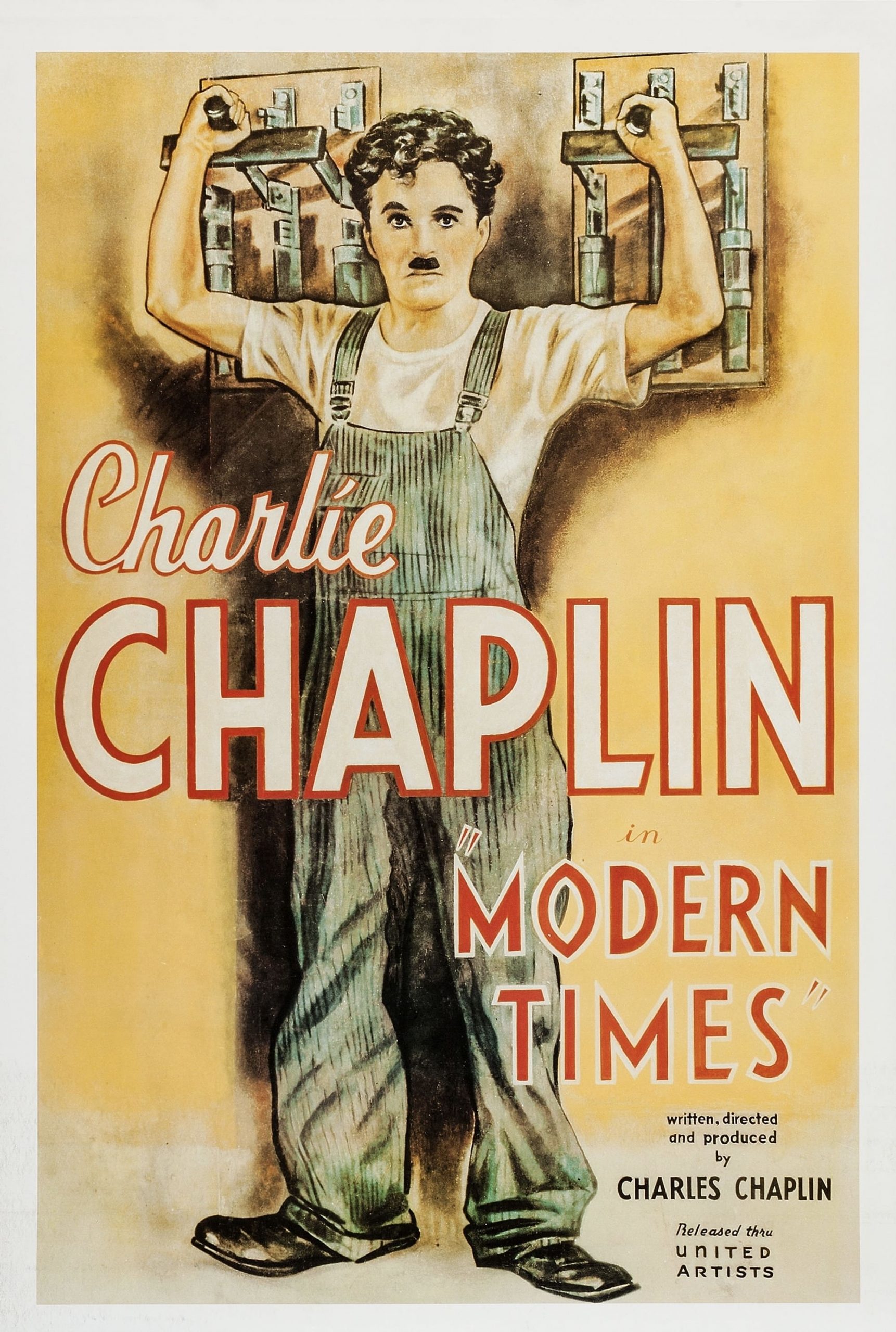
Starring: Charlie Chaplin
Grade: Classic
For the record, both City Lights and Modern Times are certified classics, but City Lights is still Chaplin’s magnum opus.
Summary
The film opens with a caption explaining the title.
“Modern Times.” – A story of industry, of individual enterprise – humanity crusading in the pursuit of happiness.
Beginning with a transition of a herd of sheep into factory workers going to work, we see a shirtless man inside the factor flipping on a switch. The President of the Electro Steel Corporation (Al Ernest Garcia) is in his office doing a puzzle. After taking a look at the newspaper, he switches through all of his security cameras to make sure all of his workers are working. He’s dissatisfied with Section 5, so he sounds an alarm to call over the shirtless man, and he communicates with him through a video screen without having to leave his office. He tells the man to get Section 5 to speed up the assembly line. The man flips a switch to do so. On the assembly line is The Tramp (Chaplin), Big Bill (Stanley Sanford), and another. The Tramp is working at a mad pace tightening bolts on some sort of machinery. The other two are working on the same objects. The Tramp lets up for a second to scratch himself, but the flow and pace in which they are working at is nearly screwed up for this singular second of a break. The Tramp catches up soon after, but his line manager starts yelling at him for it. As soon as the Tramp stops to protest, he’s yelled at to keep up, so he has to go back to work immediately to maintain the flow of the conveyor belt. Seconds later, a bee flies by his face, and he starts to panic trying to balance it all. A worker comes by to help him and slaps him in the face with a paper to get the bee away. It startles him and he moves off the line for a second, so Bill yells at him to keep up because he can’t do his job if the Tramp doesn’t do his. The Tramp catches up again but gets his wrench caught in a bolt and bumps into the two. Bill frees him, but he’s had enough of the Tramp’s antics. He gets the attention of the line manager, and the manager stops the assembly line to see what’s happening. The Tramp pleads his case of Bill being too aggressive, so the manager yells at Bill. The Tramp gets a little cocky with Bill after the manager leaves, so Bill threatens to beat him up. As the line starts up again, the Tramp kicks him in the ass.
Bill turns to attack the Tramp, but the Tramp points out how the line is moving and they have to get back to work. Following this, the President tells the shirtless worker to speed up Section 5 more.
The Tramp is able to keep up, but it’s time for his break. A guy subs in for him, allowing the Tramp to walk away. However, the movements are so ingrained into his hands and body, he still finds himself mimicking the movements as he walks away. He is able to shake it off, punch out, and go to the bathroom. He lights a match off his own ass and lights a cigarette while in the bathroom. He sits on the sink and tries to have a moment to himself until the President appears on the big screen in the bathroom, demanding the Tramp stop stalling and to get back to work. He punches back in and heads over to the assembly line. Seeing how the sub is hard at work, the Tramp takes his time before subbing back in. He files his nails for a moment until the sub yells at him to jump back on. As he does so, he lets up for a second, so the Tramp is quick to point out that he’s getting behind. It forces the sub to continue until the Tramp finally switches with him. Though the Tramp doesn’t listen, the sub yells into his ear before leaving. In the President’s office, J. Widdecombe Billows (Murdock MacQuarrie) shows up and plays a recording to introduce himself as the inventor of the Billows Feeding Machine, a device that feeds staff while they are at work, so they don’t have to go out for lunch. As Billows shows off the device and how it works to the President, the recording states how it will eliminate the lunch hour, increase production, and decrease overhead. Pointing out its aerodynamic streamlined body and swift movement, the recording talks about its soup plate. It has a compressed air blower, and there is no extra energy required to cool the soup. There’s a revolving plate with an automatic food pusher, a corn feeder, a device that allows you to shift from a high to low gear with the tip of a tongue, and a sterilized mouth wiper. There are other uses for it, and they want to demonstrate it on one of the workers to show the President it’s worth the purchase.
At lunch time, the assembly line finally stops, but the Tramp instinctively finishes the rest of the line and even tightens the lookalike buttons on a female worker who bent over to pick something up.
Bill grabs a bowl and pours his soup into it from his thermos. He goes to get more stuff out of his lunchbox while the Tramp attempts to sit down. He’s about to sit directly into the soup bowl before Bill stops him, pointing out where it’s at. The Tramp picks the bowl up to give it to him. However, his hands are still shaky from working on the assembly line, and he spills it all over the ground and onto Bill. Bill puts it on the bench and yells at the Tramp. He tries to sit down but its directly in the bowl because he forgot he put it there. Next, the President, Billows, and Billows’s workers all walk into the plant looking for a candidate to test Billows’s machine. The President chooses the Tramp, and he’s placed in a stand-up chair of sorts which only allows his head to have limited movement near the plate of food. There is no room to use his arms, so he’s completely at the mercy of this machine. After Billows explains the gist of the machine, they test it out. The machine tips the bowl of soup near his mouth, and the Tramp gets a drink of it before the machine moves to the meat. It feeds him a few pieces and then it moves on to the corn. Once each meal happens, the mouth wiper does its job. The machine spins the corn at a fast pace, so all the Tramp has to do is bite continuously to eat it all. Unfortunately, the machine goes haywire during the corn part. It’s too close to his face and is way too fast. The Tramp is force-fed corn at a million miles per hour, and Billows’s guys start to panic. They try messing with the machine and get it to stop. One man gets the corn machine away from the Tramp’s face. As soon as they turn it back on however, the machine goes right back to force-feeding the Tramp. This happens over and over again until the worker goes back to Billows to take a look at the machine’s innards. After some messing around with it, Billows decides they will start with the soup again. The soup bowl is pushed up, but it tips over directly onto the Tramp’s chest. The mouth wiper works well though.
Billows’s worker refills the soup bowl for them to try again. Unfortunately, the bowl flips all the soup liquid directly into the Tramp’s face and the worker’s face.
Billows takes off two bolts and places them on the snack plate without looking where he put them. He restarts the machine, and it feeds the Tramp one of the pieces of actual food, but force feeds him the bolts. After this, it shoves a plate of cake into his face. As Billows tries to fix things, the mouth wiper starts slapping the Tramp over and over again the face until he’s released from the machine. Panicking, Billows rushes over to the President to explain himself, but the President doesn’t think it’s practical, which is really underselling what just occurred. In the late afternoon, the President tells the shirtless guy to speed up Section 5 again. The Tramp is starting to fall behind again and is yelled at to work faster. As soon as he does get back to his position, he sneezes and falls behind again. He catches up until he gets caught up again, falling onto the conveyer belt itself to try and finish his job. He nearly falls into the hole the objects go into, so Bill grabs him by the feet to save him. While the Tramp still works vigorously at tightening the bolts, Bill starts yelling for help because he’s still holding the Tramp by his feet. He accidentally lets go, and the Tramp goes into the hole and goes in-between all the gear shifts. He even manages to tighten some bolts on the gears before the line manager reverses the conveyer belt to bring the Tramp back. Bill tries to approach him angrily, but the Tramp responds with whimsy, using the wrenches to act like he was tightening the worker’s nipples and nose. With a complete change in demeanor to something strangely happy but also unhinged, the Tramp finishes tightening the other bolts on the halted line. Two other workers come over to yell at him, but the Tramp uses his wrench to tighten both their noses. As they hold their noses in pain, the Tramp does it again to Bill, tightens more of the stuff on the assembly line, and stops when he sees the woman walk by.
He puts the wrenches by his ears and acts like he’s an animal towards her, so she just keeps walking. The Tramp chases her outside but stops upon seeing a fire hydrant. He starts tightening those bolts, so the woman flees.
Another woman walks by and she has buttons on her coat. The Tramp sees them and runs at her with his wrenches. She runs around the corner until she finds a cop, alerting him as to what’s going on. The cop chases the Tramp back inside the factory. The Tramp punches out and runs right into the shirtless worker who stops him. The worker tries to figure out what’s going on but has to do his job at the same time. He pulls certain levers and such, but the Tramp begins to wreak havoc by pulling switches and levers all over the device the worker presides over. The worker goes over to fix what the Tramp messed with, but the Tramp just goes to the other side and does the same thing. He completely screws up the machine and parts of it begin to explode. Seeing as how the Tramp has completely lost it, he doesn’t care and happily gets the worker’s attention to show him what he’s done. While the worker runs over to try and fix things, the Tramp sprays him with oil and skips into the plant. The President is trying to look at his security cameras, but nothing is working. The Tramp finds his usual co-workers on the assembly line and sprays them with oil too. The rest of the line force the conveyer belt to stop, and they all start chasing the Tramp. The Tramp eludes them and pulls the lever on the conveyer belt to restart it, forcing them to work again. They get right back to it in a panic until a worker pulls the lever to stop it again. The Tramp sprays them with oil when they try to chase him, and he pushes the lever back to make them work again before running away. Next, the Tramp goes to a different part of the factory, sprays them with the oil, and runs up some stairs. A manager tries to approach him, and the Tramp sprays him too. He jumps onto a crane and swings around the factory, and it leads to the President and all the workers gathering below him. They demand the Tramp come down, but he refuses.
The President has the crane lowered, so the Tramp hops off. Immediately, he sprays the President with the oil.
He sprays Bill right after. So, Bill and the cop pick up the Tramp by his arms and haul him outside. A medic from the mental institution is waiting for him. The Tramp sprays him. The cop takes the oil gun from him, but the Tramp pulls out a smaller one and sprays the cop with it. The Tramp gives it to Bill before he’s shoved into the back of the medic’s car. Sometime later, the Tramp is cured of a nervous breakdown but without a job, leaving the hospital to start life anew. Upon leaving the hospital, the doctor tells him to take it easy and avoid excitement. The Tramp walks into town and a truck passes by him while he walks. A flag falls off the back of the truck, and the Tramp notices it. He picks it up and tries to get the truck’s attention by waving it back and forth. Behind him, a communist demonstration marches down the street with their signs and flags. The Tramp walks forward down the street with the flag. Since the communist demonstration was already heading that way, they follow his lead. The cops show up on horseback and clear the place out, so all the demonstrators disperse while others throw things at the cops. The Tramp hides in the sewer until he pops out for a moment. The cops pull him out and assume he’s the leader of the protest, not realizing he accidentally stumbled into it. He tries to explain himself, but he’s arrested and thrown in the back of the police vehicle. Next, we are introduced to a child of the waterfront, Ellen Peterson (Paulette Goddard), the gamin who refuses to go hungry. Ellen snuck on a boat, and she steals a bunch of bananas. She tosses a lot of them to the kids in the harbor before the owner of the boat appears. Ellen runs across the other boats and is able to elude the owner who chases her. She eats a banana and smiles at the guy before fleeing. She goes back home to her little sisters to feed them. Unfortunately, they are without a mother, so Ellen has to take on the role and hands some bananas to them.
Just then, their unemployed father (Stanley Blystone) comes home, and the girls rush to different rooms. He takes a drink of water and sits down. He’s sad. The girls come back into the room to surprise him. They all hug, and Ellen shares the rest of the bananas with her sisters and her father. Languishing in jail and accused of being a communist leader, the Tramp is sent to his cell. He sits next to his cellmate (Richard Alexander) and isn’t sure what to make of him because the guy does look intimidating, though he’s sewing. The cellmate tries to thread the needle right next to The Tramp’s face, so the Tramp stands up in a panic because he thought the guy was doing it to try and attack him. The Tramp tries to stand up to avoid bothering him, but the cellmate realizes what the Tramp thought and moves forward to continue threading his needle. Realizing the cellmate meant no harm, the Tramp sits back down next to him. However, the jolt from the movement causes the cellmate to miss the needle. The cellmate shoves the Tramp to get him to stand up again, gesturing to him to sit on the top bunk. The Tramp agrees and goes to pull it down, but it slams the cellmate in the head and the Tramp falls down. The cellmate begins choking the Tramp, but they are interrupted by a ringing bell. All the prisoners step out of their cell and walk in a single file line to the cafeteria for lunch. The Tramp sits down next to his cellmate, and they are given their food. The Tramp tries to grab the half of a loaf of bread from him, but the cellmate stops him because he wants it for himself. They go back and forth grabbing it from each other until the Tramp is able to sneak a piece before giving it back to him. At the same time, the warden is looking for someone who has apparently smuggled in cocaine (referred to as “nose powder” here). He suspects one prisoner, and the prisoner knows it. So, he takes the cocaine and pours it into a saltshaker. Right after, the prisoner is taken away for questioning. The Tramp continues with his meal, but he wants salt.
He grabs the cocaine saltshaker from the table and uses it heavily on his food, not realizing it’s been altered. He even gets some on his nose after wiping his nose during it. Immediately reacting to the drug, the Tramp begins to react quickly and his mood changes. He starts eating quicker and gets more aggressive.
The cellmate tries to grab the bread, but the Tramp grabs it from him and eats some of it before slamming it back on the table. The cellmate threatens to punch him, but the Tramp flings his flood directly in the cellmate’s face. The Tramp uses the saltshaker and pours some of the cocaine behind him and some in his shirt. The guards whistle for lunch to end, and the group of prisoners all stand up and walk into a line back to their cells. The Tramp walks along too, but he walks in a circle from time to time without losing a step. Once they get outside their cells, the Tramp walks right out the door to the yard until he realizes what he did. He walks back inside, but his cell is locked. He wanders the hallway. Just then, two prisoners have some guards and the warden at gunpoint, and they get by the cells. One of the prisoners snatches the keys and releases the Tramp’s cellmate. The cellmate then puts the warden and the guards in his cell and shuts the door. The Tramp comes back around to where the cells are at and sees them. The one prisoner points his gun, but the Tramp shoves him into the cell back-first. The guy shoots at the Tramp several times, but he dodges them all. The warden and the guards grab the prisoner through the cell door. The prisoner drops the gun, so he tells the Tramp’s cellmate to pick it up. As soon as the cellmate bends over to pick it up, the Tramp uses the metal door to slam his face with it. The other guy swings at the Tramp, but he ducks it and levels him with a punch. He then uses the door to slam both of their heads into it, knocking them out. The Tramp grabs the guns from the ground and gives them to the guards before unlocking the cell door. The prisoners are taken away, and the warden shakes the Tramp’s hand. While outside, there is trouble with the unemployed and many workers are unhappy. Ellen and her sisters are picking up wood near the harbor, but they stop once they hear a gunshot. The crowd of workers run in different directions and Ellen runs over to see what has happened.
She finds her father dead on the ground. Because of this, the law takes charge of the orphans. They show up at the house to get the paperwork done, and the cop takes Ellen’s two sisters to the car. During the moment where all the officials are occupied, Ellen runs away.
A pardon is granted to the Tramp because of his heroic actions, and Sheriff Couler (Edward LeSaint) is to inform him. Now comfortable in his jail cell and being treated well by the guards, the Tramp is brought into Couler’s office and is served coffee. The minister (Cecil Reynolds) and his wife (Mira McKinney) pay their weekly visit while the Tramp sits and waits. The minister leaves the room with Couler while the wife sits next to the Tramp. He tries to be cordial with her, but she just stares at him while she has her coffee. Trying to act normal, he drinks his coffee, but the spoon ends up in his mouth like a straw, and he has to awkwardly take it out. Both of their stomachs start acting up loudly, so the wife’s dog starts barking at both of them. Once the wife has the dog walk away, the Tramp puts the coffee down and grabs a newspaper. He also turns on the radio. Unfortunately, the radio has an advertisement for gastritis. She takes a pill with some seltzer water that startles the Tramp for a moment. Finally, the minister and Couler come back, and the minister and the wife leave. Couler reveals to the Tramp that he’s a free man. Surprisingly, the Tramp doesn’t want to leave. Noting how happy he is there, he asks if he can stay longer. Couler thinks he’s joking and bypasses this. He gives him a letter of recommendation that will help him get work. Following this, the Tramp is able to convince a shipbuilder place to give him a job, and a worker gives him his first task. He is to find a wooden wedge similar to the one he has. The Tramp finds one lodged under something, so the Tramp take a sledgehammer to knock it free. Sadly, the wedge was there for a reason. Once the Tramp removed it, it makes a plank fall, and an entire boat is let out to sea. Everyone sees it and the Tramp stands there in shock. The Tramp knows he’s going to be fired, so he just grabs his stuff and walks out. Elsewhere in the city, Ellen is alone and hungry. She’s also shoeless. She stops by a bakery and stares into the window. On the sidewalk, she sees that the bakery is making a delivery.
Once the delivery driver brings some stuff in and leaves the back of the truck open, Ellen grabs a loaf of bread from the trunk and makes a run for it. The Tramp turns the corner on the sidewalk and Ellen runs right into him. They both fall to the ground. At the same time, a woman saw Ellen and snitches on her to the delivery driver. The delivery driver runs over to them and grabs Ellen, who pleads innocence. A cop shows up and the delivery driver tells him everything. The Tramp stops them and says that he did it, not Ellen. The Tramp gives the bread back, and the cop takes him away. As he’s been pulled away by the cop, the Tramp tips his hat to Ellen. However, the woman who saw Ellen do it won’t let up, and she tells the delivery driver that it was Ellen, not the Tramp. The two stop the cop and tell him that it was Ellen, so they all leave the Tramp alone and chase after her. Next, the Tramp gets two trays full of food at a restaurant while Ellen is apprehended. Once the Tramp is done eating, he gets the attention of a cop walking by the window by knocking on it from the inside. As the Tramp goes to the front register, he tells the cop to pay for the food because he doesn’t have any money. The cop grabs the Tramp and walks him outside. As the cop calls the police department, the Tramp buys a cigar from a stand and hands the rest of the cigar box to some kids who then run away. The cop is finished with the phone call and turns to see the Tramp smoking the cigar. The Tramp tells the cop to pay for it, so the cop takes the cigar out of his mouth and gives it back to the owner of the stand. He has to do it a second time too because the Tramp puts it back in his mouth right after. The cop then throws the Tramp into the back of the paddy wagon, and he’s hauled off with a bunch of other new prisoners. The Tramp accidentally sits in the lap of some older woman who shoves him off. He apologizes and sits down in another seat as a mustached man stares and burps at him.
The paddy wagon makes a stop, and Ellen is thrown in. Recognizing her, the Tramp gets up and gives his seat to her. He reminds Ellen who he is, mentioning the bread incident. She remembers him but then begins to cry. The Tramp gives her a handkerchief and sits down on the older lady who shoves him off again. He apologizes to the lady. As he gets the handkerchief back from Ellen, the paddy wagon hits a bump, and the Tramp falls back onto the lady who shoves him off again. Ellen has a burst of determination and goes to the front of the car to argue with the cop. The Tramp follows. At the same time, the driver narrowly avoids a car and swerves off the road and crashes. The Tramp, Ellen, and the cop fall out of the car entirely. The Tramp gets up first and wakes up Ellen, telling her this is her time to escape. The cop begins to wake up, so the Tramp grabs his nightstick and hits him in the head to knock him out again. Ellen runs but stops by a building and signals the Tramp to come with, so he does. Now, the adventure really begins.
My Thoughts:
In what would be the swan song of the Little Tramp character that defined Charlie Chaplin’s life and career up until that point, Modern Times matches the expectations of the highly regarded figure with a finale fitting of his legacy. Taking on the troubled dealings of the Great Depression with humor and a great story echoing the anxieties involved with the industrialization of America at the time, Chaplin churns out yet another classic that spoke to working class audiences worldwide when others ignored their cries for help.
Just as the citizens of America were struggling with the rapid modernization of society in every aspect in the 1930s, Chaplin was doing the same from an artist’s perspective and seemingly poured out his feelings into one of his best features, completing one of the best transitional films of a star’s career ever. When we say “transitional”, we are bringing attention to where the filmmaker was at during this period of time and how the production was a leap forward into a new phase in the actor’s career. Chaplin made a living and became a worldwide recognized name and face of the early years of Hollywood due to the success of his beloved character, the Tramp. This is why Modern Times is daring not only from a narrative perspective, but what it represents regarding the star himself and the risk he decided to take with the movie. At that point in 1936, Chaplin as the Tramp was the preeminent silent film star and featured in over 60 productions. With the silent persona, he ironically spoke to millions, as the appeal of the silent era was that Chaplin’s movies or any from that time period had worldwide marketability because of the absence of spoken language and having no need for it since the stories were easy to follow through miming and minimal dialogue cards. It’s part of the reason why Chaplin was as hesitant as he was in transitioning the Tramp character to sound because it would undercut the appeal of the character and potentially the box office. Unfortunately, if Chaplin didn’t experiment with sound when the technology was in the process of revolutionizing film, he also was risking being left in the dust. With this, Modern Times was constructed to be perfectly in the middle. It’s mostly silent, but it’s part-talkie to satisfy both crowds. Seeing where filmmaking was headed, the movie also served as the Tramp’s last adventure due to Chaplin more than likely not wanting to do a fully sound picture starring the character because it would fundamentally change what he was, a non-region-specific friend to all that anyone can identify with.
In Modern Times, sound is only needed to explain some plot developments early on such as the innerworkings of the feeding machine or the President of the Electro Steel Company barking orders. Other than that, no dialogue is necessary for Chaplin to tell such an endearing story. The only other time he goes back to dialogue is in the climax of the movie. To give audiences a shock to the system in a legendary moment in cinematic history, he gives the viewer the first and last time the Tramp ever speaks, magnifying why the scene is so special in the grand scheme of things. Trying to keep his job as waiter and entertainer for the cafe Ellen nabs a job at as a dancer, he lies his way in and is given a spotlight to sing for the customers. Not being able to remember the lyrics to his big number after accidentally throwing his cuffs off where the lyrics are written during his dance to introduce the song, the Tramp improvises by singing “The Nonsense Song” in three different languages. His energy and facial expressions fueling his complete gibberish to the sound of the music wins over the crowd, and he saves his job temporarily in doing so. You can’t tell the story of Hollywood and the art of filmmaking without mentioning Chaplin’s contributions to the industry. When you put his life and career into perspective going into Modern Times, you know why this scene in particular is as iconic as it is. It’s also a testament to how inventive Chaplin was. Knowing how worried he was in affecting the Tramp’s universal appeal, singing a song made of nonsense and mixed with other languages is his way of making him speak but also not saying anything, which still allows the character to appeal to everyone. Finding a way to satisfy himself, maintaining the legacy of his most beloved character, and adhering to the lovers of talkies and silent purists alike just shows you how brilliant of a creative the man was.
Then, there’s the story itself, which flawlessly satirizes the state of America at the time with minor political undertones. At the time, the movie was criticized for its political nature, but it’s tame in hindsight and arguably the general consensus regarding the middle and lower classes at the time. Really, it’s a fair critique of the era, as the prominent theme of the Tramp’s never-ending knack for finding himself on the street in-between jobs and jail stints aligns with the unfortunate lives lived by many in the nation outside the ruling class. As many of us know, life will chew you up and spit you out. Sometimes, it doesn’t matter how hard someone works to provide a living for themselves or for their family. It doesn’t get easier, and there is no room for weakness, especially during this timeframe right in the middle of the Great Depression. The wealthy want to be wealthier, so their whole focus is to streamline costs and make sure they cut any corners to adhere to their own personal goals, even if it may happen at the cost of their employees’ health or mental stability. In doing so, the state of the human beings that help them reach such goals are treated like cogs in a machine. As soon as one can’t perform, they are removed for someone who will and so on and so forth. At a time when regulations regarding breaks, off days, and things that are put in place to help the worker were almost nonexistent, most of the working class had no choice. They had to work for little pay in horrible conditions to provide a life. If they didn’t, a desperate worker would step in and take the job from them. It’s just how it was back then. The Tramp is this worker. In the first act, he spends all his time working tirelessly on the assembly line, doing the exact same job in every second of his workday. Though it’s shown through humor, the reality is not lost on us on how awful the inescapable evolution of the modern workforce is, with the Tramp letting up to sneeze or shoo away a bug and getting yelled at because it disrupts the assembly line’s pace.
His coworkers don’t see an issue with the work or rather don’t have time to complain because they know and accept that this is what life is for them. They have no choice, which creates this hellish environment for the Tramp to where he’s nearly driven to madness. His break before lunch time isn’t even a minute before he’s yelled at by his boss, who appears on a large screen in the bathroom to demand the Tramp get back to work. The constant stress on the body combined with the mind-numbing aspects of his role in the assembly line has the Tramp even mimicking the hand movements of the job when he’s not alongside the conveyer belt. It’s nonstop, with the only real break being a brief lunch, though decompressing while trying to eat is more difficult than people realize, especially for those who don’t work a physical job. It’s a job that puts the body through the ringer, and millions of Americans had to do so because it was the only options for the poor, the middle class, and the influx of immigrants who might not speak the language well or didn’t have the education to do anything else. When today’s generation looks pack at this time period to criticize how people acted, they shouldn’t be surprised as to why everyone was a smoker or a hard drinker with a life expectancy probably thirty years less than what it should have been. It was the only escape they got from the harshness of the careers they were forced to take on due to the lack of options. In just the first act, Modern Times exemplifies the blue-collar life and appeals to the American populace’s plight with its humor and without getting into the sadder, grizzlier details of living such a life. Then, to really jumpstart the narrative, Chaplin takes it a step further. Being dog tired but still trying his hardest to keep up, the Tramp falls onto the conveyer belt and goes into the machine in one of the most famous scenes in the history of cinema.
After this, the movie changes, the Tramp changes. Just like many of us are, the Tramp is swallowed whole by “the machine” and then shot back out a changed man, a man who has lost his mind due to life tearing him apart at the seams.
Embracing his mania and settling into the idea that life is meaningless, the Tramp simply accepts the “Fuck it” mindset and tears the place down with his silliness. He messes with the workers, the factory’s workflow, and he goes out of his way to screw things up for his own amusement. It’s whatever to him. They pushed him to the absolute brink, and he came out of it asking who cares. What does it matter? Is this all we have to look forward to? Is this it? The Tramp doesn’t have a family or a wife hanging over his head to force him to work harder and stay complacent, so it gives him just enough of space to allow doubt, stress, and anxiety to creep into his mind until it pours out his ears. With just this tiny bit of space, he explodes. Instead of everyone questioning why he got this way, they send him to an institution for mental clarity until he’s deemed well enough to rejoin society, an issue that is still a relevant and worthy topic of discussion even today to some degree. Nevertheless, the Tramp tries to choose the straight and narrow path moving forward, but it still costs him time and time again, like a flag falling out of a truck and he picks it up to try and give it back to the owner out of the goodness of his heart. Sadly, he’s accused of leading a communist demonstration and the riot that resulted, getting sent to prison as a result. It’s not the first or last time he ends up in jail throughout Modern Times, but that’s part of what makes the story as gripping as it is. Life has never kicked one down quite like how the Tramp is here, but he exists to give everyone hope. We may fall on hard times as things change and life moves at the rapid pace in which it does, but the Tramp proves every time that there is something waiting behind that corner worth pursuing. If it blows up in your face, you pivot, you go around, and you learn from it. If it works, then you bring it closer. Either way, it’s all part of the human experience, whether it’s at its best or worst. That is the universal appeal of the Tramp as well as the universal appeal of Modern Times.
Paulette Goddard is a standout. As Ellen, she might be the best love interest of any Charlie Chaplin feature. As opposed to the many actresses of her time, Goddard has a modern look to her that is very eye-catching. It’s hard to say whether she pulls this off by not being the typical platinum blonde co-star or not relying on the somber, Renaissance-like facial expression that was so prevalent during this era of Hollywood. Nevertheless, Goddard’s image onscreen is a revelation from her introductory scene. She could easily pass as a woman living amongst us today. On top of that, she matches a lot of the elements of the Tramp’s persona. Spending a majority of the movie barefooted, Goddard’s Ellen is whimsical in her own attempts of vagrancy, though with more of a sense of desperation and adventure rather than a series of misunderstandings and accidental happenings occurring. Early on, the viewer watches as Ellen finds ways to survive poverty and helps to support her family. In a loving but troubled home dealing without a mother, and a living father who can’t find work, she bides time by doing things like stealing bananas for food and trying her hardest to not get caught, risking her life daily. Again, it’s not an uncommon thing. The unemployment rates and state of the country during the Great Depression left so many starving, forcing people to do whatever it took to survive. As mentioned previously, jobs were scarce, which is why so many had to deal with whatever jobs were available, no matter how little the pay or poor the conditions. It was something, and that something was everything. We see it on the other side with Ellen’s father. He’s trying to get a job, but he’s one of the unlucky ones. People are at the gates of factories begging to get in but only a select few are given the opportunity. He’s not one of them and isn’t sure what to do, which is why the Ellen character is so attractive to the viewer, despite flirting with criminality. She’s doing what she can, scraping by day by day to help her family, as it’s the only thing she can do.
There is no way out of the situation. It’s the cards she was dealt with, and seeing her take charge as the oldest sibling and stepping up to help the family out of necessity makes Ellen’s part of Modern Times just as compelling as the Tramp’s. Just as the Tramp had the moment that changed his path in life, Ellen has the same once her father is shot in a crowd of workers who were desperately trying to get a job. The only thing Ellen’s father was guilty of was trying to provide for his family, but life had other plans. Again, the harsh reality of life chewed these poor people up and spit them out. With the law having no choice and not taking context or intent into account because life doesn’t give anyone a free pass, Ellen’s sisters are taken away because they are now orphans. Ever the headstrong survivalist, Ellen has merely seconds to react to this life-altering moment, again a reality that so many have had to face. It begs the viewer to think in their own heads how they would react, knowing what’s in store for the future or maybe even the unknown that is the future. Do you fold and accept what is to come, hoping and praying to stumble upon an opportunity or for someone to save you, or do you choose to survive by any means necessary given the small window presented? Instead of trying to fight the men off to save her sisters like the Tramp did in The Kid, Ellen runs and keeps running to escape. It’s not lost on the viewer that she left her sisters high and dry, but it’s not a point of contention within the story nor Ellen’s psychological state. In her defense however, she is sort of helpless in the situation and can’t be faulted entirely for her actions. It’s literally just the nature of the beast. It may look selfish for her to do so, but it does work in showing the desperate mindset many in the poverty level had and tried to channel into their quest to survive no matter the costs. Though a moment of reflection would have helped the depth of Ellen and her journey to at least acknowledge having to leave her sisters behind, it doesn’t lessen the effect of the narrative.
If anything, Ellen not looking back on such a devastating moment in her life lets the viewer settle into the “survival of the fittest” theme of Modern Times in that life waits for no man or woman. The goal is merely to keep moving, no matter what life throws at you.
It’s why the closing minute of the movie is as powerful as it is (SPOILERS, SPOILERS, SPOILERS). After the Tramp and Ellen almost secure long-term jobs but fail because life gets in the way once again, the two are uncertain of the future and what struggles they will inevitably face next. They sit on the side of the road. There is no place to go, or is there? Being in this state of uncertainty more than anyone in human history, the Tramp seems fine as he airs out his shoe. While Ellen ties up her clothes however, she begins to cry. As strong-willed as she is and despite overcoming so much, the viewer can tell in just this lone action how devastated Ellen is because she was that close to figuring out a life for herself. Getting that close and having the rug pulled up from under you when all you wanted to do was eat and live under a roof is a tough pill to swallow. At this point, she’s restless and on the verge of giving up. She asks, “What’s the use of trying?”, echoing the sentiments of millions of Americans through the generations. However, the soulful and strong-willed Tramp gives fans one last example of his undying optimism and heart that makes sure he gets back up, keeps trying, and continues his search for something, similar to the simple but beautiful finale of The Circus. Hearing Ellen’s negativity, the Tramp works to inspire, “Buck up – never say die. We’ll get along”. It’s enough for her to stand up alongside him, and the two walk together in the center of the road towards the viewer. In her face, we can see the unsure expression she still has. Just like us every day of our lives, what lies ahead in Ellen’s and the Tramp’s future is unknown. However, the Tramp sees this and has her smile. Realizing his positive spin on things is the right outlook to have, the two walk off into the sunset, giving worldwide audiences the perfect curtain call message to not give up. Life is hard, but there is always something. You just have to go out there and find it. That, ladies and gentlemen, is why Modern Times is a certified classic.
Besides all the great sight gags like the Tramp having the cow shoot out its milk, and stop doing so on command in the daydream sequence, or the decrepit shack Ellen finds for the two to live in and its falling apart when the Tramp tries doing anything in there (“Of course it’s no Buckingham Palace”), there’s one very funny line that doesn’t get enough love. After the Tramp and Ellen imagine what it would be like to have a house to live in together, the Tramp shouts, “I’ll do it! I’ll get a home, even if I have to work for it”, ironically acknowledging that stealing and scraping by can only do so much, despite it being the bread and butter of the character and the heart of his adventure with Ellen. Even funnier is the Tramp getting lucky enough to squeak into another factor job, only to nearly kill the Mechanic he’s an assistant for several times throughout the sequence like dropping his bag of tools into the gear shifts of the machine they’re working on. When the Mechanic is stuck inside the machine and the Tramp has him wait before he can help him out because it’s lunch time, there is no doubt you will be laughing at the absurdity of it all at some point during the running time. Chaplin’s ability to milk his physical comedy for everything that its worth and making a gag out of nothing is on full display here, like the Tramp swinging around the tool bag and moving with its momentum because of its weight. His way of balancing slapstick with deep pathos is truly something to marvel at. The same could be said of the action involved at the end of the climax when the Tramp and Ellen make a run for it to escape the detectives. Upon sprinting out of the cafe, the Tramp knocks down every single chair in the pathway behind him on the way out of the door, and it’s hilarious because this would actually work in stalling the detectives. In so many films, they overuse this trope in a chase sequence without making it look believably effective, but Chaplin flawlessly does it in 1936, proving there is no excuse for any action movie in the modern era that includes this scene to not follow his blueprint in terms of effectiveness.
Another great recurring gag that carries the Tramp is the simple story hack of just having bad luck. As great as the Tramp is at getting back on his feet, his ability to be in the wrong place at the wrong time is hilarious. Just as he’s getting used to his new job, the workers go on strike. While everyone protests in front of the cops, the Tramp accidentally steps on a plank that sends a brick flying at a cop, which lands the Tramp right back in jail. Even so, he picks up right where he left off once he’s released. Again, it’s all about adjusting and evolving instead of giving up. The theme can be seen in something as subtle as the gag where the Tramp’s chair goes through the floorboard. Instead of mentally breaking because of the financial state they’re in, Ellen just moves the breakfast table over some and the Tramp follows suit with his chair.
The effectiveness of seeing the characters having a moment of jubilation or relaxation is also an underrated element of the film. In its efforts to mirror real life, Modern Times works at a nonstop pace, and for two people living day-to-day, they aren’t given the luxury of letting up. If they do, they don’t eat. It’s that simple, which is why the Tramp getting his temporary job at the department store as the nightwatchman is such a great sequence. Besides the messing around on the roller skates where the Tramp nearly falls off the second floor due to blindfolding himself to show off, it’s sweet to see his first plan of action after locking the doors for the night is to bring Ellen in from the other entrance and take her to the convenience store inside to get some food. Even if he can’t relax himself because he has a job to do, the Tramp now has someone he wants to take care of, forcing him to work even harder to give Ellen this moment of peace. Following this and the aforementioned roller skate fiasco, he takes Ellen to the bedroom display on the fifth floor. Ensuring at least one night of comfortability in a cruel world, he has her sleep on one of the display beds and covers her in a robe, telling her that he will wake her up before the store opens the following day. Watching Ellen finally getting this singular moment of peace puts the viewer at ease in a truly special way. Seeing what she has been through up until this point and then seeing her sound asleep for the first time puts a smile to the viewer’s face like nothing before it. It’s as if your standing heart rate slows in the lone shot of observing the beautiful Ellen with her eyes closed, getting a stress-free sleep for the first time in a long time. Knowing she had the best night of sleep she’s probably had in years makes the viewer feel good. The follow-up of her waking up in a panic because a drunken Tramp didn’t wake her up in time, leading to her running out the door before the store opened was a moment that any one of us could relate to as well.
We all know that scary feeling when you sleep too good and you just know you’re late for something. For a movie made in 1936, it couldn’t have been depicted any better.
Besides the ending and the excellently done series of scenes of the Tramp dealing with being a waiter for the first time (shout out to that damn roast duck), the best sequence of the movie had to have been Big Bill returning and attempting to rob the department store after hours with his two gun-toting cohorts. The group telling the Tramp to stand still and he’s trying to comply but is still on his roller skates is legitimately hilarious and impressively done from a physical comedy standpoint. His falling back onto the upwards escalator and them telling him to stop, and the Tramp gestures as if to say, “What do you want me to do?” is laugh-out-loud funny. Three things did stand out as odd though. First of all, how did Ellen manage to make up a full breakfast of steak, bread, and coffee during their short stint living in the shack? Where did she get all of this? Second of all, why is the Tramp treated like a prick when he’s a waiter getting tripped up by a dog on a leash in a fine dining establishment? If this is a place where everyone is rich and wearing suits, who the fuck would bring a dog into this environment? Thirdly, did Bill’s partner in crime really need to shoot the cap off the liquor bottle? That seemed wildly unnecessary for a group of guys who don’t consider themselves burglars but rather hungry citizens.
The Tramp is for everybody. With Modern Times being the last movie to feature the legendary good guy, Chaplin’s creation leaves on the highest note possible. As the arc comes to its optimistic conclusion, despite everything that has happened to the main characters, the feelings of inspiration coming out of the film is hard to ignore. Life doesn’t seem so bad anymore. At any given moment, it all can turn around, as long as you don’t give up on the way there. To say Modern Times is a timeless film that still resonates today is an understatement.


+ There are no comments
Add yours