
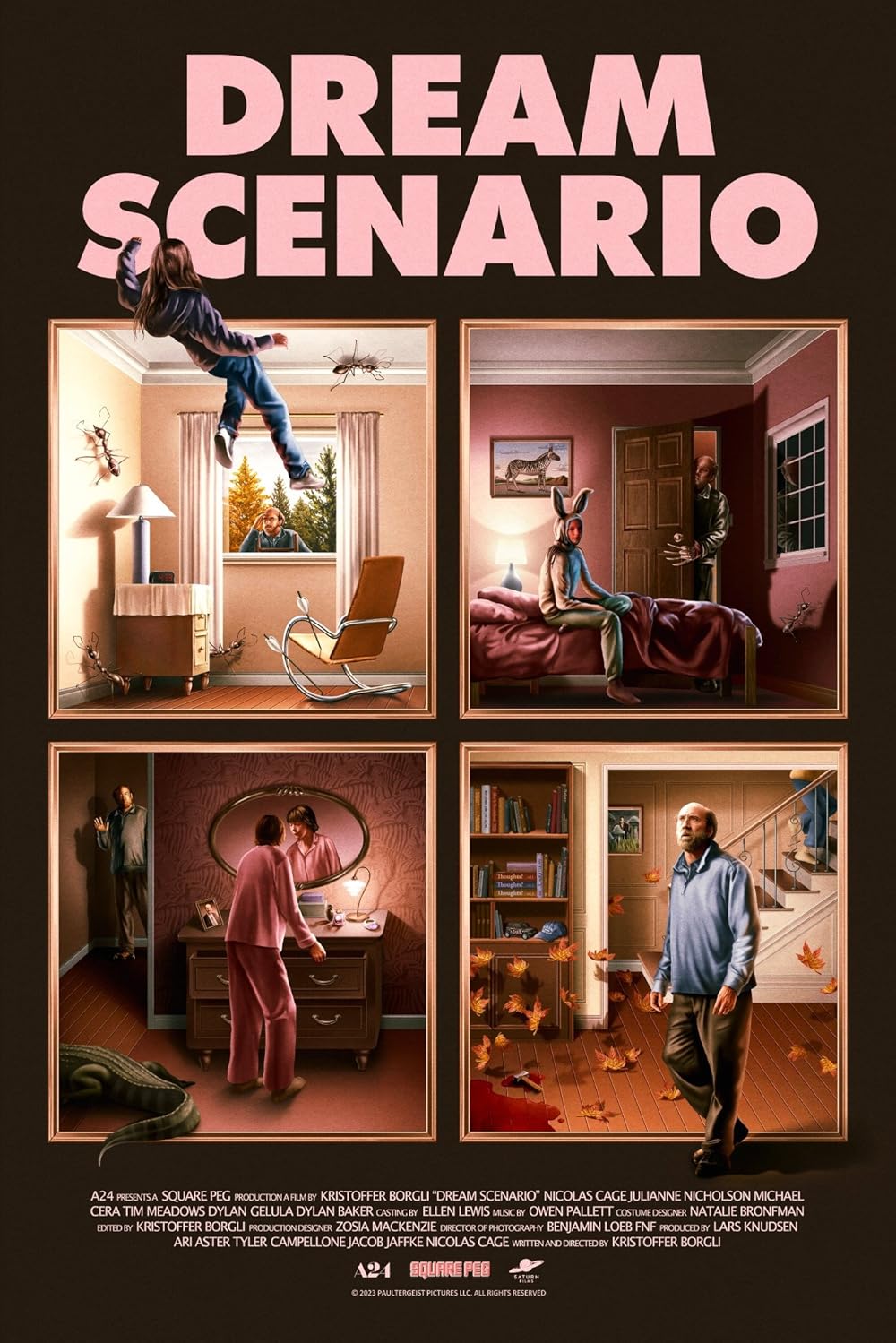
Starring: Nicolas Cage, Julianne Nicholson, Michael Cera, Tim Meadows, Dylan Baker, and Nicholas Braun
Grade: B+
Dream Scenario is funny, but it’s also quite the unexpected tragedy.
When they couldn’t even get his book title correct at the end and he just tries to embrace it because he has nothing left, you laugh but also can’t help but feel drained. One thing is for sure, this poor bastard goes through it.
At least the French love him.
Summary
Teenage Sophie Matthews (Lily Bird) has a dream about her and her father Paul (Cage). Paul is raking the leaves by the pool, and Sophie sits by a table outside watching. Suddenly, keys fall from the sky and fall through the glass table, breaking it. A body falls into the pool next. She asks for help, and Paul tells her it’s okay. However, Sophie starts flying into the air inexplicably.
At breakfast, Sophie is retelling the dream to her mother Janet (Nicholson) and Paul. Paul wonders why he didn’t do anything in the dream, especially because it’s the third time it’s happened. Why does he continue to just stand there and do nothing in Sophie’s head? Janet comments to Paul to not make Sophie feel guilty about her dream, but Paul continues to question things because he doesn’t want her to think that way about him. He mentions the time when she almost drowned and how fast he reacted, but she was 4 and was only told about it. She didn’t remember it. Sophie’s sister Hannah (Jessica Clement) is about to leave, so Janet reminds her that she is to stay and watch Sophie tonight. Hannah thought it was tomorrow, but Paul assures her that the play him and Janet are going to was tonight. Soon after, Paul tells Janet to meet him at the play because he’s not sure how long he will be with former colleague Sheila (Paula Boudreau). Janet wants him to record their conversation, and he considers it.
Paul is a college professor of evolutionary biology at local university Osler. During his lecture, he talks about how the black and white stripes on a zebra allow it to blend in with the herd. Predators need to identify their prey. They can’t attack the whole herd, so this tactic allows for the zebra to be hidden in the crowd. If you stick your head out, you make yourself a target. In the middle of this, he’s interrupted by two kids talking. He calls them out and relates what he’s saying to them. They made themselves a target by speaking when they weren’t supposed to, which allowed him to seek them out directly. Next, Paul asks the class if there are any instances of an evolutionary benefit to sticking out. Immediately, one student suggests mating. Following this, Paul goes to a restaurant where he has a reservation. The host is startled by his presence and asks if she knows him. He doesn’t, and the host just shakes it off, thinking it’s a case of déjà vu. Anyway, Paul waits for Sheila at his table and decides to take Janet’s advice, turning on the audio recorder on his phone. Soon after, Sheila shows up to meet him. They discuss her only being in town for a few days to visit her brother, and how she’s doing final revisions to publish her next paper. He asks her what publication she’s with, but Sheila wants to take a look at the menu. Paul insists, so she tells him it’s Nature. Visibly uncomfortable, Paul lashes out. After this, he’s in his car listening to the audio recording, regretting what happened. On the recording, he asks why Sheila never reached out to him, and why he’s not being credited because her findings on swarm intelligence and ant colony algorithms were similar to what he was doing in graduate school. He notes that she wasn’t even interested in networks back then and rather senescence. Sheila talks about expanding her interests over the last 30 years, but Paul continues by asking if she’s using “ant-elligence”, a term he coined. Sheila argues there’s a difference between talking about it and doing all the work. He retorts that he has been working and has a book, but he doesn’t have a publisher yet.
He wants to finish it before he takes it out because he doesn’t want to be influenced by any corporate agenda. Sheila asks to read a draft, so he jokingly asks if she needs more material. She asks him how much he has done, so he admits he hasn’t actually written anything yet. In the car while listening again to the audio, Paul skips through this part to when he just asks her to be credited. She responds by saying he doesn’t have to be a researcher and a professor, so he starts to plead with her. In real time, Paul turns the audio off in frustration.
At the play, Paul waits for Janet. Some guy smoking stares at him. Paul sees him and looks away. Janet appears and asks how everything went with Sheila, and Paul lies and says that she saw his point, but they are still going over details. Lying again, he says he didn’t record it because it felt unethical. During the play, Paul doesn’t engage with it and zones out, still distraught over what happened. After the play, Paul and Janet are stopped by Claire (Marnie McPhail), Paul’s ex-girlfriend. She greets them, and Paul explains how Janet is his wife and such. When Claire asks how long they have been married, Paul can’t remember, so Janet has to say it’s been 15 years. Even so, Claire brings up how Paul has been on her mind a lot recently, specifically popping up in her dreams. She talks about how he doesn’t do anything. He’s just there, even if the dream is completely unrelated to him. In one specific dream, Claire brings up how she was holding a friend who was dying in her arms after getting hit by a car. Then, Paul just came strolling by afterwards. Paul questions if he helps at all, but she assures him he doesn’t. Claire doesn’t blame him or anything. Her therapist just suggested she reach out to Paul to sort something out between them, possibly subconsciously. Janet wonders if Claire knew they were there, but she honestly didn’t, which is why Claire sees this as a sign. She asks to get coffee with him some time, so Paul agrees and puts his number in her phone. Claire sees the contact name and notes that Paul changed his name. It turns out, he took Janet’s last name. He defends it as their idea, but it was clearly hers. That night, Paul and Janet talk as they get ready for bed. Janet is annoyed with how Paul was blushing and stuttering when he was talking to Claire and she doesn’t trust her, but Paul thinks she’s overreacting. He says he’s just meeting her for coffee and tells Janet he loves her. Janet responds by asking if he’s ever fantasized about other women.
He admits he has, but he’s never cheated because he couldn’t handle the burden of having an affair. She laughs and agrees with this. Sometime after, Paul meets with Claire for coffee. They discuss the dream and how strange it was, but it’s a pleasant conversation. Claire asks if she can write about the whole thing since she’s a writer for The New Inquiry magazine. Paul notes she’s in publishing, but she refers to it more as an online blog that no one reads. On her blog, she usually writes about psychology, “Jungian stuff”, which gets a laugh out of Paul. This doesn’t surprise Claire. Even so, she insists she doesn’t want to write about Paul himself but rather the dreams. He’s okay with it but doesn’t want to be portrayed as an “inadequate loser” like in her dreams, so Claire can see he’s insulted by it. He says he’s joking and gives her the permission, though it’s obvious he is bothered by how people perceive him in these dreams. Following a pause, Paul brings up how Janet thought Claire may have had ulterior motives with their meetup and may have still had feelings for him, but she laughs this off. Paul heads back to the university and overhears two kids talking about seeing Paul in their dreams. He tries to talk with them, but they don’t mention anything about it. Confused, he goes into Brett’s (Meadows) office, the dean. He asks Brett if he’s been dreaming of him recently, and an equally confused Bret says he hasn’t. At dinner, Paul has eats with his family at the table, and he asks his daughters to put their phones away, so they can talk. They do, but as soon as Paul tries to engage in conversation, his phone starts ringing from a different room. He tries to ignore it, but the ring tone is loud classical music, so it bothers all of them long enough for Paul to get up from the table to hang it up. Unfortunately, he excuses himself because he has to take the call. It’s Richard (Baker), a well-respected colleague famous for his dinner parties. Paul is excited at first because he thinks he’s finally going to get invited, but this isn’t the reason for the call.
Richard just brings up that at his last dinner party, a friend there named Naomi told them about a dream she keeps having of one person who is “perfectly average” and a “remarkable nobody”. Naturally, she’s talking about Paul. She just doesn’t know it because she’s never met him.
She talks about how the person just shows up in the dream like an uninvited guest. Richard’s wife Carlota (Krista Bridges) adds to this, saying she had a similar dream, but it was about Paul specifically because he’s a friend of Richard. Richard is surprised by it too because he notes how boring of a person Paul is. Naomi asks Richard’s wife what he looks like, so she shows Naomi a picture of Paul and she’s in shock because she realizes that’s the guy. Paul faints and falls to the ground, and Janet and the kids go over to wake him up. Following this, Paul’s Facebook notifications are blown up with countless strangers messaging him about who he is and why they are dreaming about him. Looking through the messages, he wonders if Claire’s article linked his profile and that’s why this is all happening. Despite this, Janet notes how he’s kind of excited, especially once he sees a DM from the news wanting to interview him. Janet thinks he should take some time to think about everything before he does something drastic. Well, he doesn’t listen. Soon after, he’s on the news being interviewed, and he’s particularly giddy about the whole thing. It’s referred to on the news as a “dream epidemic” that scientists are struggling to make sense of. One person suggests it’s a dream version of the Mandela Effect. As the news details thousands of reports of seeing Paul in their dreams, Paul is on the phone with his mom talking about the mess, but he’s bothered because he doesn’t want to miss the segment. The rest of the family is watching the news. The next day in class, Paul enters his lecture hall, and all the kids there start clapping for him. He can’t help but smile, and he gives them five minutes before the lecture to ask him whatever. Each question is about his recent celebrity, and he’s excited to answer each one, though he still downplays things. He responds to them by saying he’s not sure why this is all happening, he enjoys his anonymity, and he jokes around a bit. Next, he asks who there is certain they have had a dream about him. It’s almost everyone. Interested, he wants to get deeper into the contents of the dream, so he has one student recall theirs. The kid talks about wearing a full tuxedo in a field eating mushrooms. Other people are there, and they are dressed in tuxedos too, but they all stand there, frozen in fear because this man is running towards him.
The kid hides behind a tree and sees Paul, so he tells Paul to hide. Paul doesn’t listen and takes a look at some mushrooms just as the kid gets attacked by the man. That’s all he can remember. Paul notes that in the dream, he’s looking at the mushrooms instead of helping. Intrigued, he asks for more examples.
One girl recalls being in a room being destroyed and Paul just walking by, another guy brings up one where he pulled out his tooth and Paul walked by and saw it, and some girl is being cornered by two alligators and Paul sees this and continues to walk. Paul asks the class if anyone there has a dream of him actually doing something, and there isn’t a single person there that does. Still, he encourages the others to talk about their dreams. After class, he takes pictures with a bunch of them. At breakfast the next day, Hannah takes a picture of Paul while he’s eating just to prove to her friend Kyle that Paul is her dad. Paul outs them as flirting and suggests he’s a cool dad now, and Hannah laughs. Sophie asks Paul to drive her to school, and he’s excited that she would even ask and accepts. At her work, Janet talks with her co-worker Chris (Al Warren), and Chris brings up the recent phenomena surrounding Paul, adding that his sister was starstruck when he said he knew Paul’s wife. After talking about how a podcast he listens to was talking about Paul and the topic of relating memes to dreams was discussed, Janet changes the subject to ask how his museum project is going. She wants to help on it, but Chris politely turns her down. Trying to get involved somehow, she suggests she can be a person to bounce ideas off of, so he accepts this. At home before they go to bed, Janet and Paul discuss this, but Janet lies and says Chris asked her to be on this project, even though she initially wasn’t. On the other side of things, Paul is happy to bring up that they have been invited to one of Richard’s dinner parties too. As they get into bed, Janet questions why Paul hasn’t been showing up in her dreams. Though Paul jokes that she gets the real thing and can’t have both, she’s not satisfied with the answer. He wonders what he can do for her and implies sex, so she recalls the time he wore the suit David Byrne of the Talking Heads wore in Stop Making Sense for Halloween. She found it weird and sexy and wants him to wear it and save her from something. Paul can’t believe this is her sexual fantasy. The sky’s the limit, but she wants him to wear a comically large suit. Janet just chalks this up to not being good under pressure.
They playfully talk about it, and Paul agrees to it before they start getting intimate anyway. Later that night, a stranger breaks into the house with a knife and tries to kill Paul in the bedroom. Paul wakes up after the guy announces what he has to do, and the whole family wakes up right after. Paul yells at Hannah and Sophie to go back in their room and to lock the door while Janet calls the police. Paul talks the guy down. The next morning, a law enforcement official tells Paul and Janet the man has had manic episodes in the past because he’s stopped taking his medications. He will have a psych evaluation and a court date, though he could be out on the streets after serving some sort of sentence, and it worries them. The official points out the dangers fame can give someone and how they need to be prepared. Paul doesn’t want to get a gun, but the official isn’t talking about this. He points out how they don’t have an alarm on the house, and they have an unlocked entry point. Since Sophie’s allergic to dogs, this isn’t an option, so the guy suggests more drastic measures like moving, and keeping their phone number and address unlisted. Janet refuses to move because she grew up in this house. The official brings up security cameras, tasers, and a multitude of other stuff just because he saw how helpless they were in this situation. Following this, Janet gets agitated with Paul because she knew some sort of strange consequences would come of his situation. At the university, Paul speaks with Brett and Brett sees her side of it because this is almost a warning shot that they faced. Brett doesn’t think Paul is helping and rather aiding the lunatics of the world with his popping on the news and television with his appearances. He thinks this is more the reason why he’s showing up in people’s dreams. Paul concedes this could account for some of it but not all. He adds that it’s not happening to Brett or anyone else and questions why, so Brett sarcastically comments that Paul only believes in metaphysics when it proves he’s special. Paul argues that this incident of someone trying to kill him was some random occurrence with one person, but Brett questions why he would still risk it.
Paul admits the fame can get his foot in the door to secure a publisher, allowing him to write his book. Brett thinks this is a midlife crisis, and Paul flips out on him.
In the lobby of PR firm “Thoughts?”, Paul sits and waits, still thinking about the attempted murderer situation. Molly (Dylan Gelula) appears to bring him up for the meeting. In the elevator, Molly admits she’s been dreaming of Paul every night. He jokes that he hopes he’s been behaving in her dreams, and she laughs and says it’s been the opposite. Paul is brought in to meet Trent (Cera), as he’s heading up the meeting. Trent adds that he’s been dreaming of this very meeting. Next, he mentions Molly’s weird dreams, and she blushes, and he introduces Paul to his colleague Mary Wiggins (Kate Berlant). The three talk about the “Thoughts?” agency and how they work to holistically pair brands and unconventional celebrities. Right now, they consider Paul to be the most interesting person in the world, something Paul revels in when hearing it. As Molly stares at Paul intently, Trent goes on about how anyone who’s dreaming could be Paul’s audience. Moving on, they ask him what his dreams and goals are, so he mentions how he wants to write a book. Trent and Mary talk about selling Paul’s life rights to get a six-figure movie deal. Then, they bring up how they are working with Sprite and maybe Paul could take a photo every night holding a Sprite can for Twitter. They can write a caption and everything in hopes of people dreaming of Paul and the product together. Mary talks about the easiness of it all. Even if it doesn’t work, they can lie and say it did and build stories around it. If none of it works, it could still be a funny story. Paul wants to talk about his book again, but Trent and Mary act like they have no idea what he’s talking about. Paul stresses that he doesn’t want to be known for just the dream thing, especially if he gets a Wikipedia page. When he talks about how he wants his book to revolve around his doctorate in the field of evolutionary biology, Trent shuts this down because the only reason he’s famous is because of the dreams. Trent thinks putting him in a different space entirely would be a hard sell, but Paul details that he’s already in the space considering he’s a tenured professor. To get a point of reference for a similar career trajectory, Trent asks Paul of other people he would like his career to be in the mold of.
He names Robert Sapolsky and Herman Tig, but they have no clue who they are.
Again, Trent isn’t sure Paul should take this hard of a pivot because he could lose his audience, but Paul doesn’t care about the fame. He just wants recognition for his work and wants to use this opportunity to open a door. Plus, he’s not interested in doing Sprite ads. Trent and Mary say they have other ideas, with one of them getting Barack Obama to dream about him. Paul is about to leave at this point, so Trent wants to start over with him. Following an awkward pause where Trent turns his chair around to face the window and then back to Paul, he admits he never dreamed about Paul. He just thought it would be a fun way to start the meeting. Regardless, he thinks they have something big here and considers the book idea. He calls it a “plant book”, but Paul corrects them to say it would be about “ants”. Trent is fine with it and reiterates that he does consider Paul the most interesting man in the world. Relenting, Paul also doesn’t want Sprite or any ads. Trent agrees but he has some other ideas for ads, and he wants Paul to hear out the pitches with an open mind. Paul agrees to this. After the meeting, Paul is in the elevator with Molly, and she wonders if he has any plans for the night. He doesn’t since he has an early flight in the morning. After a moment, Molly brings up getting drinks and she can come by his place if it’s easier. At the hotel, Paul calls Janet about the good news that they’re getting the ball rolling on the book, so Janet mentions how he just has to write it now. She also laughs when he talks about being called the most interesting man in the world and the potential Sprite sponsorship. While on the phone, Janet is interrupted by Chris. He’s at the house because their deadline is tomorrow. Paul asks where the kids are at, and Janet assures him they’re out trick-or-treating with Kyle. Janet congratulates him again, so Paul brings up the whole Obama thing to prove the meeting wasn’t just about Sprite, but she doesn’t seem as enthusiastic and tells him that he doesn’t have to impress her.
Feeling lonely and uneasy, Paul takes up Molly on meeting up for drinks at a bar. The downward spiral has begun, though the avenues the spiral takes his nowhere you can predict.
My Thoughts:
A bold satire that is simultaneously insightful on its commentary of the current mainstream society and also ahead of its time because its exploration of themes won’t likely be appreciated until years down the line, Norwegian filmmaker Kristoffer Borgli adds another eclectic film to A24’s growing catalogue of strange and unforgettable features in Dream Scenario.
Powered by another dynamic, Oscar-worthy performance by Nicolas Cage, Dream Scenario begins as this colorful comedy-drama with unexpected pivots in the story, allowing Cage to take a deep dive into the psyche of the character of Paul Matthews, as his life permanently and drastically changes with every decision he makes. At the same time, a lot of the issues are through no fault of his own. It’s just the price of fame, no matter how large or small it may seem to be. The lonely, insecure, sympathetic, mild-mannered Paul starts things out as a happy family man. He’s a tenured college professor and seems to enjoy his life’s work. Though he’s not outright about it, Paul Matthews is quietly unfulfilled. Like many of us, he still feels unappreciated for what he’s accomplished. He’s successful, he has a family, and he’s lived a good life, but there is a hole inside him because of this lack of recognition by his colleagues and seemingly his own family at times. A respected professor like Richard notes how boring and unremarkable of a person Paul is when discussing him at the dinner table with his friends, and the reason he’s doing nothing in these dreams people are having is because he’s seen by countless strangers as a guy who’s just there, a nobody. We can’t accept this either. Everybody is somebody and each individual has lived some sort of a life that many of us will never know about. It doesn’t mean these people are nothing just because a stranger isn’t interested in what a person does. The unfortunate reality is that some people do treat others or look at others as insignificant because of this reason. It’s a harmful way of thinking but a natural reaction. Paul Matthews is this everyman who isn’t looked at as anything special, but he’s special in his own way. Sadly, it seems that he is the only one who knows this. The pushing back of him finally getting his sought-after and deserved recognition is the most frustrating part of all of this, especially because the little to no help or backing Paul gets from people include those that he holds closest to him. For probably the first time in his entire life, Paul is getting special treatment from people who want to meet him or talk to him in some way, but Janet and Brett want him to hit the brakes on this almost immediately. Personal or professional jealously is never considered on their end.
They relate all the bad back to Paul, they don’t believe in his hype from the beginning, they never make him feel good about what’s happening, and they never throw anything resembling positive reinforcement or encouragement his way. Granted, worrying about the potential consequences of becoming a public figure are warranted, but can the viewer blame Paul? This is another film that puts you in the shoes of the main character. Consider his life and how he is treated before he becomes a celebrity. Paul is humble to a fault. It’s gotten to the point that no one cares at all what he’s doing, despite his research and doctorate in his field of study being an impressive rarity. The most frustrating part about society is that being humble is a perceived goal for those trying their best, but the dark side of it is that if you’re too humble and you downplay things all the time to not seem like a braggart, people start to perceive you and your accomplishments with the same middling response you give them when the topic is brought up. You say it’s not special enough times to enough people, people perceive it as fact. Perception becomes reality. Being humble, you are hoping for people to give you credit where it’s due, so you don’t have to talk about yourself. On the other hand, most people will never go that extra mile to give someone that credit because they don’t care enough to do so. It’s just life. In Dream Scenario, this is what Paul is going through. He has a doctorate and has done research into ant studies that no one has before, but no one cares. No one even looks in his direction. The one thing he’s good at is his studies with evolutionary biology and his specific field of interest in networks and how ants can lead to breakthrough studies, but they are completely stolen by Sheila. She assumes she can get away with it too because who would believe a “nobody” like Paul? Of course, Sheila denies it, despite her never studying it before and was uninterested in the field when Paul knew her in graduate school. He was the one who was its biggest proponent while she was studying another field of interest. Now, all these years later, the specific topic Paul was studying has become what Sheila is known for since she got her work published. This may seem minor to some, but people don’t realize how many doors open when a researcher gets any kind of work published.
This is when you become recognized in your field to some degree, and the opportunities that come with it are bountiful. She stole what got her to the dance from Paul and leveled up to get past him and subsequently more clout. She doesn’t have to give Paul an inch because she’s ahead of him and never has to acknowledge anything he did for her. With this. she denies wrongdoing and just passes it off as her still doing all the work, which takes a dig at him as it implies he didn’t and never would have. Even if we see him stall on the progression of his book which adds to fuel to her fire, that’s neither here nor there. It doesn’t take away from the fact that her credentials are fraudulent to some degree. This is enough to infuriate anyone, but Paul works his hardest to not cuss her out on the spot, preferring to keep things level-headed emotionally, to the best of his ability. It does get passive-aggressive early, but to get what you want, you can’t attack her either. All Paul wants in this early portion of the story is to be credited. He never asked Sheila to remove her name or say how much input he had. He just wanted to be credited because his name being attached to it alone could open a lot of doors for him to break through into the upper echelon of his colleagues, something he never says he wants but is clearly something he desires badly, as evidenced by how excited he is to talk to Richard and get invited to his house, along with all the recognition he gets from the public once the dreams start happening. We try to give Sheila the benefit of the doubt, but Paula Boudreau’s performance is so irritating in her flippant responses that there is enough to see there is truth to what Paul is saying. All of it is confirmed and justified once Paul finds Sheila’s newest published work stealing the term he coined in “antelligence” in his study of ants, making you want to punch a hole into the wall as a result. Only intensifying Paul’s mental anguish is the lack of support he gets from his wife Janet at seemingly every turn. Going along with so many other examples of the infuriating aspects of Dream Scenario, Julianne Nicholson’s Janet is one of the most aggravating wives I’ve seen depicted in recent memory.
At first, her concerns are warranted, and she only leaves these subtle details in her performance to foreshadow the cracks beneath the surface through her slightly off-putting expressions to how Paul is reacting to things, her general distrust of scenarios that are happening around them and to how Paul can be, and her downplaying any kind of positivity Paul sees in what’s going on. It wasn’t as noticeable in a first-time viewing, but Nicholson’s performance is that much more impressive on a rewatch, as you can see the inklings of where Janet will go and why it ties together in the manner it does. It can be viewed as early as the introductory sequence following Sophie’s dream. As a father and family man, Paul’s concerns of not wanting to be seen as a useless person by his daughter is a fair point of discussion. His questioning of it is just asking for deeper conversation and him wanting to unpack why Sophie’s subconscious may have painted him in this negative light. Not seeing past the surface, Janet immediately chastises Paul and tells him to not make Sophie feel guilty about what she dreamt. It’s not even about that, but she refuses to see it his way. It’s because there is a deep-rooted issue Janet has with Paul, and it slowly spreads to almost everything he does once the pressure is on. As the events of the story get darker and the public pressure continues to do the Matthews family in, it gets to the point where Paul can’t win with her. Janet finds a problem in every action Paul attempts or concern he raises and in a total reversal, she sees everyone else’s points as the right way to go. With every minute of screentime passing, Paul continues to win us over, no matter how scary or awkward things get for him or his family. It’s because he’s that much of a real person, shockingly so. Writer/director Kristoffer Borgli needs to be given a lot of credit with how much he cares and writes for the character, as Paul’s complicated, fully realized, three-dimensional personality is handled with considerable effort. Since so many of the beats of the film are unexpected, the viewer is hanging on every word and pivot Paul makes, with our empathy for him only growing that much more. Though the events unfolding are humorous in nature, it becomes less funny and more worrisome over time because of the pathos generated through Paul because how well we know him up until this point.
In a case of cinema proving once again how much it means to our collective consciousness, there is a particularly bitter moment where the characters seem to draw a line in the sand. Specifically, this is the scene where Paul and Janet meet with Sophie’s teacher. The teacher admits that other parents are uncomfortable with Paul’s presence, as this is during the timeframe where the dreams of Paul have turned into nightmares of him murdering the dreamers. Despite Paul never actually doing anything and it’s just people’s random thoughts while they sleep, she requests Paul not come to see Sophie’s play. This is his daughter, and he’s being punished for the thoughts others are having! Again, he never did anything that these people conjured up in their head, but this is how bad its gotten for him. It’s a case of accusations taking precedence over innocent until proven guilty, a common issue with society today. Though in Paul’s case, HE LITERALLY DID NOTHING! It’s completely unfair to ask him to not see his daughter perform because HE HASN’T DONE ANYTHING! Yet, Janet immediately agrees with the teacher without protest of any kind! Now, we don’t want to speak on what the perfect marriage might be, but how can you not defend your partner in a situation like this? Is that too much to ask? If it was an isolated incident, maybe we can hear Janet out, but this is the eye-opener, as you start to realize that she’s given Paul shit any chance she’s gotten. Even when he gets positive news like when he tells her about the potential book deal, the Sprite ad, and the Obama idea, she responds sarcastically to all of it, so she can’t even give him that! Now, Paul is being punished by something he hasn’t even done, and Janet knows this, but she refuses to defend her husband? Just as I spoke the words in my own head, Paul, as he tries not to lose it, aggressively asks his wife, “Why don’t u take my side Janet?”. Though it’s true Sophie shouldn’t have to deal with flack because she did nothing and doesn’t deserve, is that not the same thing Paul is arguing only for himself? The fact of that matter is that Paul is Sophie’s caring father, but Janet refuses to see the bigger picture or literally any other perspective that favors her own fucking husband!
She even doubles down in showing her lack of support for what Paul is going through by saying Sophie shouldn’t have to be punished just so Paul can make a point and “Don’t make us all die on your hill”.
A marriage between two individuals should be a united front. They can argue and make points to each other in private to find a solution they can both agree on, but where the line needs to be drawn is one an outsider tries to divide them. This is a test in a marriage to see how strong their foundation is, and Janet fails every single fucking time and only sees the fault in every situation in Paul. After Paul is forcibly kicked out of a restaurant and beaten by a guy who doesn’t want him there, Janet picks the wounded Paul up in their truck, one that has already been vandalized with spray paint by Paul’s students to say “LOSER”. During the ride, she barely checks on his condition and just suggests he be proactive and make a public statement of some kind to get people off their backs. This is fair because Paul’s whole family has been affected by this attention. Janet almost lost her job, Sophie is being bullied at school, Hannah is depressed, and they’re getting threatening phone calls. However, Janet’s lack of concern for Paul’s wounds coupled with this suggestion only adds to our suspicions that she refuses to see Paul’s side in any of this, even though he has still cared for his family throughout the mess. Paul balks at the idea of a public statement since he technically hasn’t done anything and is just trying to live his life, referring to her idea as “letting the terrorists win”. She just retorts that Paul is choosing to keep their family miserable instead. Again, Paul and a lot of us are the same as her constant pestering gets a response of, “Will you just fucking stop?”. Somehow, he is AGAIN faulted for a reasonable outburst to his unsupportive wife, and he has to sleep on the couch that night, with Janet even turning the lights off on him for good measure. How many times does Paul have to convince his own wife that he hasn’t done anything and doesn’t deserve such vitriol for random circumstances? This car conversation was specifically before the play too, so it’s just more of Janet being a massive cunt, plain and simple. What? Are we supposed to act like all of this justifies her hanging out with Chris and teasing cheating?
Get real.
Paul has taken the abuse online, in public, and in his own home, and he’s STILL trying to avoid getting violent or lashing out. The self-control this mild-mannered professor has despite life screwing him this outrageously is nothing short of impressive, and the whirlwind of emotions one goes through in watching Paul attempt to navigate through this mess he didn’t even cause will leave your head spinning as a result. Still, Paul can’t help but get emotional, especially after being told he can’t be there for Sophie by the teacher and his own wife. Deciding to take Janet’s advice, he makes a public statement in a video. Even though he shouldn’t have to, he goes through with it, just like he tried to help his students with participating in the cognitive behavioral therapy session. Here, he apologizes for those having terrible nightmares and relates to it through lived experience, as he too has a dream of a hunter version of himself trying to kill his regular self with a crossbow. He stresses that none of this is the real him, but the emotional toll of his mere presence upsetting people is becoming too much to take because he can’t do anything anymore. He pours his heart out on camera, speaking earnestly about not doing anything and why he shouldn’t be punished for it (“Am I not the biggest victim in this whole phenomenon?”). It’s as authentic and honest as Paul has ever been with himself, giving out his real feelings on the matter for the world to see. In yet another example of spot-on satire, Paul’s honest thoughts are deemed insufficient, even though he meant every word, and he’s further vilified for trying to make things better. Because the public doesn’t think it’s good enough, he’s still looked at as the bad guy, possibly worse than before. He can’t win no matter what he does! It’s today’s cancel culture personified. People want this and that from a public figure when they make a mistake, and when they do admit their faults and ask for forgiveness, no one EVER accepts the apology. No one EVER moves on. That person or celebrity always has this negativity black cloud over their head no matter what they say or do until they pass away. Please, try and argue it differently. You know it’s true, no matter how frustrating it is to see it presented onscreen in this particular narrative.
Never mind the response from the public, however. The response from Paul’s family is the most telling, furthering how deep of a hole he’s in and how he won’t be able to overcome it. Sophie is confused by the action of the video, Hannah considers killing herself out of embarrassment, and Janet has the AUDACITY to tell Paul that it was “completely insincere and self-serving”, driving a knife through his heart by adding how it’s embarrassing to be married to him at that moment of time. Mind you, this was Janet’s idea, but somehow, it STILL wasn’t good enough for her, despite Paul speaking his true feelings on the subject. All Paul wanted was credit for his work and to be respected by the people he cares for and his colleagues. He finally got the chance with inexplicably becoming a celebrity, but once he tried to capitalize on it, everything in his life turned upside down to where it’s worse than how it started. Paul is one of the most relatable main characters of the last five years of film in this regard. He’s the perfect example of someone who touts that they don’t care about this and that, they don’t care what other people think of them, and they just like doing what they are doing. In reality, they do care, a lot. They do care what people think of them, and they might be content with what they are doing, but they do want more. They crave it, even if they don’t tell anyone about it. They may not want to admit it to themselves either, as the regrets they have could consume them with perpetual misery. Sometimes, the regret they feel is so deep that it comes to pass and they become cool with how things turned out. Others, it might do them in entirely. This isn’t an indictment on this type of person either. A majority of people are like Paul Matthews, whether they want to admit it or not. We want to be humble and live a life worth living without too much attention, but we do appreciate and desire to be respected and appreciated for the efforts we put forth, especially when we’re goal driven people. It’s not necessarily about the attention that comes with it, but we all want those compliments thrown our way when it’s time to talk about these hard-earned accomplishments. It’s not a bad thing. It makes us feel good, as it’s the feather in the cap to the hard work and time we put in. Is that so bad to admit to ourselves?
The goofy Paul Matthews does have his faults and isn’t correct 100% of the time, but when one puts themselves in his shoes and his mindset, it doesn’t take much for the viewer to suspend their disbelief as to why he goes about things in the manner he does and why he’s unfairly painted as the victim. Even if he did play into the fame a little bit at first to get something out of it, why can’t he? Should he not receive any joy in life? After being considered a boring nobody by everyone, arguably including his family, he becomes the most interesting man in the world known by all and he’s not expected to be happy and try to use the attention for something positive in his life? Stop it. Any of us would go about things the same way. Yes, Paul is flawed but he is human, and he is all of us, which is why he resonates so much to the viewer. It’s also why the increasing frustrations of Dream Scenario dig deep. The themes of the other half of the film seeps through the story and its characters like a light rainfall on concrete, and its social commentary and overall message doesn’t become the torrential downpour it is until the third act. By then, it throws you off completely in understanding the overall message. This is where the daring brilliance of the screenplay and its themes take over. Though it does muddy the conclusion of the narrative itself and the message as previously mentioned, the courage in taking this risk is worth it to slap the viewer in the face with a wild finish that leaves us guessing. Plus, the oddness of the production allows for the film to take up space in our own subconscious, our dreams if you may. The Norio sequence is this story-stopping period, as it’s an advertisement for a fictional product placed right before the climax. It stands out because of how long it lasts, but it’s directly related to Paul’s experience, which has become history-making and world-changing in this universe. With this new product, social media influencers on the ad annoyingly talk about how the haters who don’t like the product just don’t understand it, though these are the same people who passively talk about Paul by and make sure he’s dead in the water with, “It’s insane that he could harness this power, just so he could terrorize people”.
The irony is not lost on us, as these idiot influencers don’t realize that they are the ones who don’t understand Paul and hate on him without knowing his story, just like how the public would probably perceive the Norio. It’s all about public perception, worrying about your own personal brand even if it means compromising your morals or ideals you hold true to yourself, following trends, and the consequences of never doing the research or looking into things deeper than the surface, which could result in the wrong people having their lives ruined in an instant if no one takes that leap or does the work. It’s seen earlier in the film too when Brett is forced to consult HR over this “lived experience” of traumatic nightmares involving Paul killing people and considering pausing the semester because of fictional imagery attached to Paul. It’s not fair to Paul that he’s being treated like a villain. Though it’s hard to say if he’s being too passive on saying that “everything” today is being considered trauma and people just need to grow up because the issue does need to be addressed, he is right on people needing to grow up in general. The coddling in this sense is maddening, and it’s ruining Paul’s life without him doing anything to deserve it. That has to be defended by someone, but it never comes. Everyone just piles onto him. No one fights for him, even though they know he didn’t actually do anything. It’s because whatever the majority of the public thinks, they have to follow it as gospel. Otherwise, they will be vilified as well. They are too afraid to fight for what they know is right for PR reasons, and it’s an awful, true-to-life eye-opening series of events that needs to be viewed and understood by the masses. More on-the-nose satire in the Norio sequence is seen with how these young influencers ironically talk about the benefits of the product, like how they see it as a positive that they can put advertisements or promote new music in people’s dreams along with visiting them. Keep in mind, they are getting paid handsomely to talk about such a ridiculous product, which no one acknowledges in real-life when it comes to moronic products and influencers. It’s so phony and scarily on-point to the social media generation of today that you laugh almost nervously.
In other cases, like when Hannah talks about the stuff on Twitter where people have been commenting about the nightmares involving torture and rape, one thing not considered by the characters but is a very real aspect of social media is straight-up lying to make up a story for attention or likes. It’s content farming, the whole basis for generating money off social media attention. Yes, people will come up with elaborate lies and stories to go viral because it can result in monetary gain if enough attention is garnered, which can allow for the user to not have a real fucking job. It happens DAILY! I know the running time can only be so long, but Dream Scenario is only scratching the surface of the fallacies social media perpetuates, along with the voices it gives to scumbag people.
Even so, the real satire is still found at the beginning of the advertisement, when the opening statement from the voiceover talking about Paul “violently attacking a middle school teacher” before disappearing from the public eye altogether. In reality, that’s not what happened, but public perception was so one-sided in the wrong direction at that point that it became fact. With this, the accusation made him look like a real-life murderer when the teacher accidentally smashed her own hand in the door like a dumbass. Because of this, Paul Matthews did etch his name in history, as the events of the film allowed for a revolution in dream science with the Norio, evidenced by CEO Brian Berg showing the device’s abilities by entering the dream of a “random 19-year-old boy in South Korea”. Unfortunately, Paul being credited for this scientific revolution puts his name forever in a negative light because only the nightmares and bad situations that arose during his fame are brought up when discussing the topic. Just like Chris Benoit, everything good that he did was forgotten about or disregarded post-incident. However, in Paul’s case, HE DIDN’T ACTUALLY DO ANYTHING!
Though it did irk me that Paul purchased the product knowing that the Norio’s marketing campaign regularly trashes his name, it did make for a great ending that tied everything together, so there’s that.
The direction of Kristoffer Borgli can’t be praised enough. His vision in presenting the eerie dream sequences and visions of characters is both striking and emotionally charged. That final conversation between Paul and Janet, with it switching back and forth to Paul imagining an emotional Janet embracing him as opposed to the cold reality of what actually happens is heart wrenching and incredibly done (“No its fine. I’ll see you when you get back”). Even subtle details like the somewhat off-centered camera filming Paul doing menial tasks during his short vacation from school, representing the slow descent into the mania of the latter part of the story, is a great choice. The imagery and art direction compliments the screenplay’s points in every scene like the shot of Paul sitting in the lobby of the PR firm named “Thoughts?”. The phrase is shown over and over again in the background as he thinks about what’s happening, and Borgli’s capturing of Paul’s feelings of dejection and loneliness in the moment is felt without words needing to be said. In another example of this, the scene in which his anger is nearing the surface following his disastrous meeting with Sheila and his going to a play with Janet, only for it to be completely silent around him because he zones out and isn’t paying attention, until a burst of applause is thrown to wake him and the viewer was done masterfully. Borgli had his hands all over this, and it’s a weird, unforgettable, fully realized production of a director putting his vision together through and through, even if the narrative loses its momentum in the third act. Just little details like the audio recording of Paul’s heated discussion with Sheila being played over the real scene, and it still sounds like its coming from a phone is just a sliver of the cool, artistic decisions Borgli made to spice even the most mundane scenes up.
As maddening as the story gets, Dream Scenario is a funny watch too, with Nicolas Cage still nailing his performance as Paul and how he’s one of the most awkward human beings alive. The nervous tics he adds like the head tilt when he messes up a joke or says the wrong thing were fantastic. And though it goes without saying, everything with Dylan Gelula’s Molly and the subsequent meetup at her place in an attempt to reenact her dream is one of the funniest, most uncomfortable scenes you’ll see this year, bar none. Very rarely have we ever seen second embarrassment caught on camera like that before, but this was hysterical. The sly jokes of having to pivot the marketing strategies focused on Paul after the nightmares began were amusing too (“You’re getting a response by… I don’t want to say alt-right…”). Paul tries to plead with Trent and everyone that he doesn’t want to be a controversial “culture war” figure and suggests doing charity, but Mary tells him “No” and Trent says it might seem “apologetic”. If that’s not an indictment on how far off we have gotten as a society, I don’t know what is. Lastly, the ultimate callback to the infamous David Byrne suit was genius, and strangely, serene with how its handled.
Dream Scenario is a bizarre comedy-drama that will irk the viewer just as much as it entertains, but its deeper meaning and comical social commentary of fame, pop culture, and the wishy-washy fickleness of the mainstream public are too shockingly authentic in its presentation to disregard the efforts of the narrative. Along with another legendary role by star Nicolas Cage, who balances the tones equally with a nuanced and heartfelt performance, Kristoffer Borgli’s underrated and surreal satire is one to remember.




+ There are no comments
Add yours