
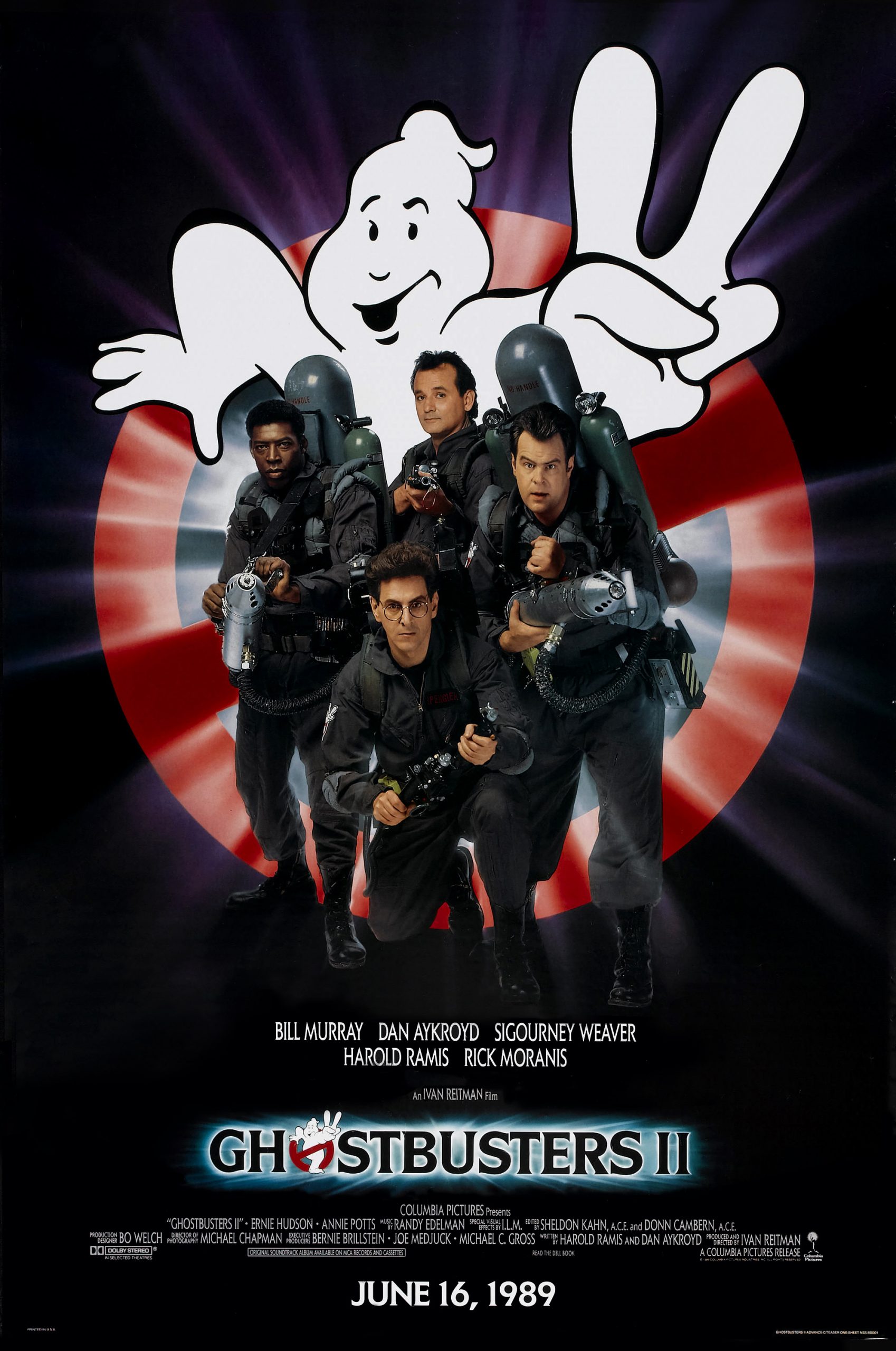
Starring: Bill Murray, Dan Aykroyd, Sigourney Weaver, Harold Ramis, Rick Moranis, Ernie Hudson, Annie Potts, Peter MacNicol, Kurt Fuller, Max von Sydow, and Kevin Dunn, with cameos from Brian Doyle-Murray, Cheech Marin, Bobby Brown, Ben Stein, Mary Ellen Trainor, and the Library Cop from Seinfeld
Grade: A
If the Ghostbusters needed work so badly in the five-year layoff period, why didn’t they just move business temporarily to New Orleans? They’d be up to their ears in jobs!
Summary
Five years after the events of Ghostbusters, we open to a pink slim oozing out of the crack of a sidewalk in New York City. Dana Barrett (Weaver) rides her baby carriage over it and doesn’t notice anything, as she rides up to her apartment. Next, she has building superintendent Frank hold her groceries for a moment before asking him when he will get around to fixing the radiator in the baby’s room since she asked him last week. He thought he already did it. As they discuss things further, the baby carriage starts to inexplicably roll down the street by itself. Dana chases it through the city streets in a panic. Finally, the stroller stops in the middle of a crosswalk. Before it gets nailed by a bus, Dana is able to catch up to it to grab her baby.
Meanwhile, Dr. Ray Stanz (Aykroyd) and Winston Zeddemore (Hudson) drive the Ecto-1 to a child’s birthday party because they are hired as entertainment. It’s all they got, as the Ghostbusters are now out of business. Dressed in their gear, Ray and Winston try to entertain the kids like party clowns, but they are booed and another kid named Jason tells Ray to his face that his dad thinks they’re full of shit. They try to sing and dance to their theme song, but when they include the kids, they shout how they’d rather have He-Man. Following the party, they walk to the car and Winston suggests they call it quits. Ray doesn’t want to because the holidays are coming up and that’s their best season. Still, Winston hits Ray with a reality check. The Ghostbusters don’t exist anymore, and he doesn’t think those kids will remember who they are a year from now. Ray doesn’t get it because they saved New York and arguably the world, but Winston points out how due to the Stay-Puft Marshmallow Man incident and blowing up the top three floors of an uptown high-rise building resulted in them being sued by every state, county, and city agency in New York. Even so, Ray recalls it fondly. At the same time, Dana goes to the Institute for Advanced Theoretical Research to speak to former Ghostbuster Dr. Egon Spengler (Ramis) over what happened with her baby and how the carriage suddenly stopped in the middle of the street. After he asks a bit more if there were witnesses, to which she replies “hundreds”, she assures Egon that she didn’t imagine this. He believes her. It’s just a scientist thing to look for the simplest solution first. While Dana is next to him behind this glass wall, Egon peaks into his experiment of a real-life couple arguing. He’s studying if human emotions actually affect the physical environment. It was a theory him and Ray had when they were still Ghostbusters. The couple in the room think they are there for marriage counseling, and Egon has had them wait in the same room for two and a half hours. In addition, he has been gradually increasing the temperature in the controlled room. It’s 95 degrees at the moment.
Just then, Egon’s assistant goes into the room to ask if they don’t mind waiting another half hour. The couple flips out but decide to stay.
Dana changes the subject back to her to ask what Egon thinks about her story, and Egon says he wants to bring in Ray if she’s okay with it. She is cool with it but is adamant in saying to not bring in Dr. Peter Venkman (Murray). They broke up on bad terms, and they lost track of each other after she got married. Egon laughs but is cool with it. He still sees Venkman occasionally, so Dana asks how Venkman is these days. Egon says he was “borderline for a while. Then, he crossed the border”. Dana wonders if he ever mentions her, but he is rather quick in telling her “No”. She admits she thought about getting in touch with Venkman after her divorce, but she’s distracted momentarily by seeing Egon’s “happiness index” test as some little girl holds a puppy. She gives Egon her phone number for future updates and again requests for him to not say anything to Venkman about this. Following Dana giving Egon a kiss on the cheek and leaving, Egon goes over to one of his assistants and tells her to change the variable by taking away the puppy from the girl. Venkman is now the host of a discussion/talk show World of the Psychic. He has two guests for this particular episode. One of them is author, lecturer, and psychic Milton Angland (Dunn). His new book is The End of the World, and Milton talks about how he thinks the world will end at midnight on New Year’s Eve this year. Venkman jokes that this isn’t great from a sales point of view because his book is just coming out and he won’t see paperback sales for at least a year. When he suggests it would have been better to predict 1992 or 1994 as the year the world will end, Milton stops him because he doesn’t consider his book a moneymaking scheme. He just has a strong psychic belief that the world will end on New Year’s Eve. Venkman turns to his other guest, Elaine (Chloe Webb). She has a strong belief that the world will end February 14th, 2016 (“Valentine’s Day. Bummer”). She got her date from an alien. She told her husband how she was in the Paramus Holiday Inn and an alien bought her a drink at the bar.
Elaine suggests the alien used some kind of ray or mind control device because he forced Elaine to follow him to his room. Apparently, in this room, the alien told her about the end of the world. Venkman isn’t buying this for a second and asks her to confirm that the alien had a room at the Holiday Inn because it sounds so ridiculous. She admits it may have been a room on the spacecraft made up to look like a room at the Holiday Inn, but she’s not sure. Addressing the viewer at home, Venkman closes by saying the whole problem with aliens is that you can’t trust them. Occasionally, you meet a nice one like Starman or E.T., but “usually, they turn out to be some kind of big lizard”. Next week, they’ll be talking about hairless pets and how weird they are. He says this after a PA hands him a sphinx cat. After the episode is over, he walks with his showrunner Norman and gives him shit for his guests, especially because he thought they were going to have the telekinetic guy who bends spoons. Norman says the guy cancelled and this was the best they could do on short notice. He also reveals to Venkman that no respected psychic will come on the show because they think he’s a fraud, something Venkman agrees with. Just then, Mayor Lenny Clotch (David Margulies) walks by and Venkman goes to greet him, but the Mayor’s assistant Jack Hardemeyer (Fuller) stops him. He knows who Venkman is and makes a snide comment about not seeing ghosts anywhere. Venkman brings up how they did a little job for the city a while back and how they got “stiffed on the bill”, which is an understatement. Even so, Jack bypasses the comment and tells him to stay away from the Mayor because he’s running for Governor next fall and he doesn’t want him to be associated with “two-bit frauds and publicity hounds like you and your friends”. At the Manhattan Museum of Art, Dana works there restoring paintings, and her boss Dr. Janosz Poha (MacNicol) flirts with her a bit as she does so. Changing the subject, she reveals to him that she is going to try and go back to the orchestra now that her baby is a little older. He asks her out to brunch so he can say goodbye, but she turns him down on account of an appointment.
Looking at her watch, she realizes she has to go right then and there. Once she leaves, Janosz says to himself that he thinks she likes him. After he states this, an old, full-size painting of Vigo the Carpathian (Sydow in voice but Wilhelm von Homburg in look) comes to life momentarily, with the face of the person popping out from the picture to look around. At Ray’s Occult Books, the bookstore Ray owns, Ray deals with some customers while Egon is there reading through some materials and bringing up things that could hypothetically be related to Dana’s situation. He points out one case in Berlin in 1939 where a flower cart took off by itself and rolled half a kilometer. There were 300 eyewitnesses. After the customer exits, Ray comments how he should look at Duke University’s mean-averaging studies on controlled psychokinesis, though Egon already pulled that book. In walks Venkman. He jokes with the both of them, and neither seem to be in the mood, especially Egon. He tells Ray to close up the place so they can grab some food, but Ray turns him down because he’s working on something. Even so, he says Venkman’s book Magical Paths to Fortune and Power came in, prompting Egon to sarcastically wish him good luck. Venkman asks them what they are working on together, and Ray vaguely talks about checking something out for an old friend. Venkman continuously asks who’s it for and Ray finally tells him it’s Dana after he presses the pressure points on Ray’s ears. At Dana’s apartment, she has a nanny take care of the baby while she practices with her instrument. The doorbell rings, and Dana greets and lets in Ray and Egon. Before she can close the door, Venkman walks in and starts to mess around immediately about giving them a “second chance”. Trying to keep things professional, she leads them to the baby, and they look to examine him first, along with his toys, the carriage, and wherever he sleeps. Dana lays the baby on the table and the two have a look at him while Venkman grabs her instrument and plays it like a guitar. She goes over to Venkman, and he asks about the fallout of her marriage because he heard the husband ditched her and ran off to Europe. Apparently, this wasn’t the case.
They did have problems, but he got a good job offer from an orchestra in London and took it. Venkman then reiterates that he ditched her. As Ray and Egon go through some basic tests with Dana’s 8-month-old, Venkman tells Dana she would have been better off marrying him instead. She points out how Venkman never asked her. Even when she would bring it up, he’d get “drowsy” and fall asleep. He sarcastically talks about how he’s sensitive and needs to feel desired, but she stops him and says she left around the time when he started introducing her as “the old ball and chain”. He agrees he has a lot of personal problems but assures her that he’s a professional when it comes to his job. With this, he goes over to the table with Ray, Egon, and the baby. They deduce that the kid is healthy. Dana takes Ray to where he sleeps. Egon follows but has Venkman get a stool sample for him (“Business or personal?”). As Ray and Egon investigate the kid’s room, they overhear Venkman making noises in the living room, so Dana goes to check on him. Venkman is just playing with the kid. She mentions the kid’s name is Oscar, and he jokes with her about the father before having her get the stool sample for him. Later, all four of them go to investigate the street where the carriage incident happened. She points out the spot on the street for them, so Venkman leads them and stops traffic to allow for Ray and Egon to scan it with their devices. They realize something is brewing under the street. Ray gets a 1,118 on the PKE, and Egon got 2.5 G.E.Vs on the gygometer. That night, they use a jackhammer to cut deep into an area on the street. Egon is stopped by some cops and is questioned why he’s cutting, and he stalls until Peter and Ray come out of a building with coffee. They both start acting like annoyed construction workers and argue with the cops until they leave them alone. Next, Ray takes a look at Egon’s work and sees he’s uncovered an old air shaft. However, they need a deeper reading and one of them has to go down there to get it. It’s going to be Ray.
At the same time, Janousz is trying to restore the Vigo the Carpathian painting but an electric shock hits Janousz from the painting and knocks him off the steps he was on. Then, Vigo comes to life and starts speaking to him. He refers to himself as the “scourge of Carpathia” and the “sorrow of Moldavia”, and he starts to command Janousz to do his bidding, which he accepts wholeheartedly. He declares now as the season of evil, and he demands Janousz find him a child so he can live again and be reborn into the body. Janousz is confused by the request of a child, but he is shocked with lightning again from the painting directly into his eyes, fully putting him into a trance under Vigo. Back at the hole, Venkman and Egon lower Ray down below while he’s attached to a harness. Underground, he finds a river of pink slime, probably 25,000 gallons of it. He also sees a sign for the old Pneumatic Transit system. He uses a device to get a sample. On the surface however, a cop shows up and approaches Venkman and Egon to ask what’s going on. Venkman tries to lie and tell the cop that the phone lines are down in Greenwich Village and how he’s got a million miles of cable to work through, but the cop points out how the phone lines are across from them. Pivoting, Venkman yells at Egon and acts like he told him the wrong spot. The other cop tells them they checked, and he knows they aren’t with Con Ed or the phone company. Pausing for a moment, Venkman then starts acting like he is fixing a gas leak. Ray collects his sample, but the pink slime starts to become alive. It starts grabbing at Ray’s feet, so Ray yells at Venkman and Egon to pull him up. Ray panics as they pull him out and he accidentally kicks a pipeline, breaking it and a subsequent powerline. It knocks the power out on the surface of the entirety of New York City. In her apartment, Dana goes over to Oscar’s room and tries to get him to go back to sleep, but she hears knocking on the door. It’s Janousz acting like he was in the neighborhood and how he wanted to check on her during this citywide power outage.
He asks if he can come in, but she turns him down. Once she locks the door in his face, he walks down the hallway and his eyes light up like flashlights. Venkman, Ray, and Egon have to go to court for screwing up the entire city. Judge Stephen Wexler (Harris Yulin) makes it clear that the law doesn’t recognize the existence of ghosts and he doesn’t believe in them either. He doesn’t want to hear any nonsense about this sort of stuff and just wants to stick to the facts of the case. Unsurprisingly, they call him “The Hammer”. To make matters worse, Venkman, Ray, and Egon hire the inexperienced Louis Tully (Moranis) as their lawyer. Louis tells them they are making a mistake because he only works with tax laws and some probate stuff occasionally. Plus, he got his law degree at night school. At the same time, Jack tells the opposing lawyer to put the Ghostbusters away fast and for a long time, and she thinks it will be easy considering the list of charges they are facing. Jack then makes a comment to Venkman about seeing him in a few years at his first parole hearing before taking his seat. What follows is Louis bombing the case through sheer nervousness and inexperience. His opening statement is poor and speaks on the time when they helped save him from being turned into a dog, making them all look stupid. Later in the trial, the opposing lawyer has the Ghostbusters equipment that was confiscated on the table, and she points out how they were under a restraining order that strictly forbids them from performing services as paranormal investigators or eliminators. She brings up a jar containing the pink slime to witness Fianella and has him examine the contents. He has been working for Con Ed for 27 years, and he’s never seen anything like it in his life. He assumes that whatever was down there, the Ghostbusters must have put it there. Ray shouts they didn’t, but Judge Wexler tells him to “shut up”. Following this, Venkman is on the stand and tries to mumble to Louis what to say during their questioning, but this is shut down quickly. The opposing lawyer demands to know why they would drill such a sizable hole in First Avenue.
After Venkman responds with a sarcastic comment and Judge Wexler threatens him with contempt of court, the pink slime in the jar bubbles up for a second. The lawyer asks again why they were digging the hole, reminding him that he’s under oath. Venkman goes on about how there are things in this world that go beyond human understanding, things that cannot be explained, and things that most don’t want to know about. This is where they come in. The lawyer questions if the world of the supernatural is exclusively their province, so Venkman is blunt with her…
“Sometimes, shit happens, someone has to deal with it, and who you gonna call?”
The crowd in attendance starts to cheer, but Judge Wexler shuts it down again. It didn’t matter. He had his mind made up before the trial even started. He finds them guilty on all charges, orders them to pay fines of $25,000 each, and sentences them to 18 months in the city correctional facility at Riker’s Island. While he’s saying this, Ray points out to Egon how the pink slime is bubbling up a lot when Wexler is talking. Wexler gets personal and goes on record to call them fake charlatans and how there is no place for tricksters like them in decent society. Egon tries to interrupt him to point out the concerning reaction of the slime as does Venkman, but Wexler doesn’t want to hear it and goes into full rant mode. The slime bubbles out of the jar, so Louis, Ray, Egon, and Venkman hide under the table in fear. The jar explodes and the ghosts of the Scoleri Brothers pop out in the middle of the courtroom. The ghosts try to attack Wexler in his chair, so he jumps over to hide next to the Ghostbusters. He reveals that he tried the Scolari Brothers for murder and gave them the electric chair. Wexler wants them to do something, but Egon sarcastically tells Wexler to tell them he doesn’t believe in ghosts. Just then, the Scolari Brothers pull up the table they are hiding under and throw it. They all run to Wexler’s office, but the door is locked. He demands Ray do something, but Ray tells him to talk to his lawyer. Louis points out the restraining order they still have to adhere to. As they watch the Scolari Brothers drag the other lawyer away, Wexler agrees to rescind the order and dismisses their case. With this, the Ghostbusters are back! They put on their gear, with Venkman initially worried if everything will work, though Egon says it should because the power cells have a half-life of 5,000 years. After some initial struggling, Venkman is able to hold the first one and Ray gets the other. Egon opens the trap, and they capture both ghosts.
With this successful return of the group, the ghost-busting business is booming again. With this, Janine Melnitz (Potts) is rehired as their secretary, they retake the firehouse station, Louis is brought in as their in-house attorney, and Winston rejoins them. They’re even running ads again, and Jack watches it in disgust. During this timeframe, Slimer reappears in the station and scares the shit out of Louis. Also in the middle of all their new missions, the Ghostbusters take more samples of the pink slime/plasma, as it still seems to be appearing sporadically throughout the city. Later, Ray and Egon have Venkman and Winston come over to show them an update on the plasma, as they’ve started to experiment with it a little. Placing it in a Tupperware right out of the microwave, Ray and Egon yell insults at it, and it bubbles up to the surface in response to every statement they make. It’s a psycho-reactive substance, so it responds to human emotional states. Venkman calls it “mood slime” and jokingly flirts with it, but it still bubbles up when he gets close. Egon says they’ve been running tests to see if they can get an equally positive reaction such as singing to it, talking to it, and telling it words of encouragement. Venkman sarcastically asks, “You’re not sleeping with it are you, Ray?”, but Egon and Ray look at each other awkwardly and change the subject. They decide to do a kinetic test, so Egon brings over a toaster and Ray places some of the plasma inside of it. Since it has been responding to music and particularly likes Jackie Wilson, they play “(Your Love Keeps Lifting Me) Higher and Higher” and the toaster starts popping and moving all over the pool table as if it were dancing. The next day, Venkman visits Dana at work. The guy who lets him in is surprisingly a fan of World of the Psychic, and it’s one of his two favorite shows. The other being Bass Masters. While Dana is there, the Vigo painting smirks at her. When she turns to look it, the expression changes back to the frown. She goes back to restoring a Gauguin painting, which is when Venkman walks in to greet her. Janousz is introduced to him shortly after, and Venkman takes a gander at the Vigo painting.
Janousz says he’s preparing it for the romantic exhibition and talks about how Vigo was the ruler of Carpathia and Moldavia, a magician, and a bit of a genius, though Venkman calls him a sissy. Dana cuts in and mentions how Vigo was a lunatic and a genocidal madman. She hates the painting and has felt uncomfortable ever since it came up from storage and for good reason. In her defense, look at that fucking thing! After Janousz tells Venkman to leave after he acts like he was about to paint a kitten next to Vigo, Dana tells Venkman that she gets the feeling sometimes that the painting is watching and even smiling at her. The two look at the painting, and Venkman seems to consider the possibility. That night, Dana prepares Oscar for a bath. She lets the water run as she takes Oscar’s clothes off, but the water turns into the pink plasma. It forms itself into some type of monster in the bathtub and Dana turns to see it. Freaking out while holding Oscar, she runs out of there and heads straight to Venkman’s apartment, telling him everything that went down. He lets them get settled and calls Ray, who relays what happened to Egon, as the two are still doing tests on the ooze. Egon recalls the Vigo painting that Venkman mentioned and tells Ray how he ran the name “Vigo the Carpathian” through the occult reference net and shows him a basic description of the evils surrounding the real-life tyrant. Enough is realized to the point where Egon and Ray both agree there’s a connection between Vigo and the slime. Right away, they’re going to have to take a look at Dana’s bathtub and more importantly, investigate this painting. Back at his apartment, Venkman lends a Joe Namath shirt to be used for Oscar’s diaper. They prepare for bed, and Venkman invites Dana to sleep with him, though she’d rather him move to the couch, so her and Oscar can take the bed. He accepts.
The next morning, Venkman waits at the museum as the rest of the Ghostbusters drive up in the Ecto-1. Ray gives Venkman notes from Leon Zundinger’s Magicians, Martyrs, and Madmen about Vigo the Carpathian. Egon adds how Vigo was born in 1504 and died in 1610 at the age of 105. However, he didn’t die of old age. He was poisoned, stabbed, shot, hung, stretched, disemboweled, drawn and quartered. The people hated him, and he had other nicknames like Vigo the Cruel, Vigo the Torturer, Vigo the Despised, and Vigo the Unholy. Just before his head died, his last words were, “Death is but a door, time is but a window. I’ll be back”.
Well, he’s back, and he’s back with a vengeance. It looks like the Ghostbusters will have their work cut out for them.
My Thoughts:
Ghostbusters II gets more disrespect than most sequels out there, but it’s not warranted. Expectations were high coming out of the first film, a generational comedy blockbuster. However, asking for something that surpasses one of the greatest movies of all time is unfair. As long as the core cast members returned and there were more ghosts in need of capturing, that was the baseline needed to retain fan interest at the minimum. Not adhering to this basic principle for a Ghostbusters property is why the 2016 reboot failed. All we want to see is the same group out there defeating evil and saving the world in any way they deem necessary, with humor sprinkled in when needed. This is why its existence alone made me love Ghostbusters II because like many, I just can’t get enough of these guys. Though some criticism is warranted due to the similarities in the turn of events in comparison to the movie’s predecessor, there is still a lot of positive components to the film that do not get nearly enough credit. Just like the river of pink slime representing all the negativity of New York City, critics and audiences focused on the things they hated rather than the good things about the sequel, along with just being happy seeing their favorite cinematic team back in action. Because of it, the co-creators took it to heart and didn’t return to their proton packs until 2021.
Shame on all of you.
Ghostbusters II does pick up where the first one left off, but the timeline of what has happened since the defeat of Gozer the Gozerian is not necessarily what we expected. In a perfect world, the Ghostbusters are heralded as the saviors of Earth and are treated like the iconic figures in pop culture that the franchise is in real life. Unfortunately, that is not the case. In a more cynical beginning disappointingly true to life, the legendary team was forced out of business because of bureaucracy and legal troubles. Instead of getting a pass because of their contributions to society like how superheroes are allotted in film, the group had to deal with the aftermath of the destruction they were involved in while saving the day. Firing unlicensed nuclear accelerators at ghosts in expensive buildings was necessary, but someone had to answer for the money lost. Despite everything they did for humanity, the Ghostbusters were sued to oblivion and received no backing of any kind. Now, they are all on to different things, though they remain friends. Egon Spengler went back to academia, Peter Venkman is now the host of a talk show, Ray Stanz balances his time between his occult bookstore and making appearances as a Ghostbuster at random events, and Winston Zeddemore accompanies Ray on the latter. Besides this, Winston doesn’t have much going on. Herein lies the most disappointing part of Ghostbusters II, the mistreatment of Winston Zeddemore and underutilization of Ernie Hudson. At this point, Winston is well ingrained in the lore of the franchise and beloved by fans, and it’s only furthered in the highly popular cartoon The Real Ghostbusters. For some reason however, the role of Winston is still heavily reduced, despite being the fourth member of the crew and having nothing to do outside of the ghost-busting business since he’s the only one who isn’t a doctor. Even when the Ghostbusters make their return in the courtroom scene to take out the Scoleri Brothers for Judge Wexler once he dismisses their case, Winston is nowhere to be found.
Perception is everything, and Winston not being included in helping with Dana’s request to investigate the baby or at least being there when the group is drilling a hole into First Avenue makes him look even MORE like the least important and least respected member of the group than he did in the first movie. At least in Ghostbusters, his role in the film made sense story-wise. They thought they were fine with just the three of them until they got really busy. So, they went out and got more help, which is why Winston was added midway through the film. All these years later, he still remained loyal to the team and never left, keeping the name of the group alive by performing with Ray at children’s birthday parties. Why isn’t he included more in the friend group in the first act then? You would think he would be just as irreplaceable as the others because of the bond they made working together, but Winston is barely acknowledged early on by Venkman and Egon. It doesn’t make sense because all four men should be comfortable enough around each other to have these conversations and meetups, but Winston is noticeably the odd man out until they announce the Ghostbusters returning halfway into the movie. Why isn’t Winston hanging out in Ray’s bookstore when Egon is over? Why isn’t he involved in doing some basic work with both men when Dana asks for help? Winston should be in the courtroom alongside the rest of the Ghostbusters and Louis Tully because he should have been there for the Ghostbusters’ first unofficial investigative mission peering into the sewer below New York City. Being on trial with them is the first thing the group should be doing together as a team. It’s a sign of unity, and Winston is a huge part of it because he’s the fourth guy. Though this sequence is arguably the funniest in the film, it’s more important than screenwriters Aykroyd and Ramis give it credit for. Making Winston an afterthought in such a pivotal scene makes the audience perceive him as nothing but fodder. This is disrespectful because he’s THE FOURTH GHOSTBUSTER! Treat him like it!
Sadly, Winston is just there in the crowd watching the trial and is nowhere to be found when the Scoleri Brothers come to life to terrorize the courtroom. It’s out of character for him and disrespectful to the foundation he laid in the original movie. Winston is an important part of this franchise. At the very least, there should have been a moment of screentime dedicated to showing Winston assisting in some way by either rushing the rest of the audience to safety or running outside to Ecto-1 to grab his proton pack and going back into the courthouse to help the group, just as Wexler allows them to act on it. For him to be disregarded as such after the opening sequence is upsetting. His character paid his dues, and the narrative should have reflected that to make him a bigger part of the journey the group faces. Ernie Hudson might not get as much screentime because he’s not the same caliber of star as the others, but the character being the fourth Ghostbuster in existence makes him very important within the franchise and should be written as such. Hudson has every right to complain about his role in the movie. Even though it’s a bit of a stretch for his character turn into this wealthy entrepreneur that helps save and fund the new Ghostbusters in Ghostbusters: Afterlife and Ghostbusters: Frozen Empire, I accept it as an apology to the actor himself because he did deserve better in this sequel.
As a major fan of the franchise and doing a lot of research on the production notes, it has been said that the direction of this sequel was affected heavily by the success of The Real Ghostbusters. Yet, this comes off as more of a cop out. Though it’s true that the sequel doesn’t include smoking, there’s less cussing, and the overall story is more thematic and philosophically positive rather than a straight supernatural sci-fi focus, it’s not as far off from the first movie as some would want you to believe. It’s a lot more like the original film than the cartoon by far. The only connection to the cartoon is that the tone is lighter, but that’s it. The cartoon treats Winston like a solidified fourth piece to the puzzle rather than the sequel making it clear that it’s a trio plus Winston (sometimes), Slimer is a live-in ghost and friendly team “pet” in a way in the cartoon, but he’s barely acknowledged in Ghostbusters II (and not even by name), and Janine and Louis start dating in the movie, but it’s not referred to at all in the cartoon, with Janine still being obsessed with Egon even when Louis joins the cast in Season Five. Lastly, the group as a whole is beloved and treated like heroes in the cartoon. Whereas in Ghostbusters II, most people still think they’re bullshitters that scammed legions of citizens, as evidenced by the kids at the birthday party and Judge Wexler’s response to the group. Instead of thanking the Ghostbusters, most don’t believe them or are still angry with them for all the destruction they caused to the city. The biggest problem with this, and part of my issues with elements of Ghostbusters: Afterlife and even Star Wars Episode VII – The Force Awakens, is that the contributions of the heroes are somehow lost to time or not believed at all only a few years removed from these true, world-saving events. I could see a parent not believing what the Ghostbusters did if the team only answered house calls and stopped ghosts in hotels and haunted houses. However, the finale of Ghostbusters was too massive for anyone to disrespect their efforts. The existence of a 50-foot-tall Stay-Puft Marshmallow Man brought to life and destroying New York City is not something that can be treated as some bullshit old wives’ tale.
This is too big of an event to act like it didn’t happen, so it just doesn’t work comedically or in terms of the story they created. If anything, it’s just agitating. How the fuck else can you explain the Stay-Puft Marshmallow Man? In the Ghostbusters universe, this was a real event. If it was real in this sense, it’s an incident that would be described in history books, as would the contributions of the Ghostbusters who would be treated like American heroes and figures in history. The explosion on the high-rise, the fight with Gozer, and the sky essentially reforming itself into a portal to hell during the climax of the first movie was seen by thousands of New Yorkers. Plus, it was covered by the news, so millions know about the day the Ghostbusters prevented the apocalypse! It was real, and they were all in danger until this group of four saved the world. It was well known! The city itself was covered in marshmallow fluff once the Ghostbusters destroyed the monster, and the citizens were covered in it. If it actually happened or not cannot be disputed because there was too much evidence to prove otherwise. They can’t just suddenly question if it happened because it did, plain and simple. So, some bitch ass kid telling Ray to his face that his dad thinks he’s a liar is insane, as is Judge Wexler still not believing in ghosts. How could one possibly not believe this following the events of Ghostbusters within the Ghostbusters universe? How could the group not have the respect and love of the citizens? This is a city that still reveres John Starks as a hero despite an all-time blunder in Game 7 of the 1994 NBA Finals, but the Ghostbusters are treated like dogshit after saving the world IN FRONT OF THEM? From a writing perspective, it just doesn’t make sense. The city may have negative people, but the Ghostbusters being thrown to the side by the citizens is illogical and doesn’t fit the profile of New York at all. They got everything else right about New Yorkers (“Lenny, have you been out on the street lately? Do you know how weird it is out there? We’ve taken our own head count. There seem to be three million completely miserable assholes living in the tri-state area!”), but the treatment of the Ghostbusters is not one of them.
They had a better run than Bernard King in New York City, but they get the Isiah Thomas treatment from the citizens? There’s no way.
Even the Mayor wants to avoid them until the eleventh hour, despite knowing firsthand the importance of their world-saving mission in the first movie. They shouldn’t have to jump this many hurdles to save the day again. Anyone can understand the apprehension from city officials because of the damage the Ghostbusters caused the first time, but they did stop the apocalypse and the Mayor arguably won his reelection campaign because of it. As humorous as the scene was when they finally get to speak to the Mayor (“We’d just like to say that almost 50% of us voted for you in the last election”), it becomes slightly agitating that they have to prove themselves all over again and are turned down once more. Getting sent to a mental institution was nearly a movie-stopping sequence because of how frustrating it was that Jack Hardemeyer was able to get away with that much. Either you make the sequence longer in general because of the comedic factor or remove it entirely because of all the legal ramifications that this would involve for the Mayor’s assistant to pull such a thing, considering how they went the realistic route in this sequel because of all the legal stuff that stopped the Ghostbusters from continuing their business post-Gozer. What they are saying may sound crazy, but going to a mental institution would fit the first movie’s actions much more since ghostbusting was a brand-new thing then. In this sequel however, how is it not taken into account that ghostbusting is real, three of the four of them are PhDs, and all of this supernatural stuff has already proven to be a real thing they all face? The idea of putting the four in a crazy house seems funny, but it doesn’t fit the world-building of the two movies because they would not be discredited this swiftly and illegally considering how they are public figures and have SAVED THE WORLD FIVE YEARS AGO! When Egon tells the doctor that he’s wasting valuable time because Vigo is “drawing power from a psycho magnatheric slime flow that’s been collecting under the city”, I just stopped at the first part. He is right, but it’s the script that is wasting valuable time! Venkman threatening to countersue to get out of the mental institution or making sure it doesn’t happen in the first place would make sense here, with him getting in the face of Jack and showing him up in typical Venkman fashion, but the handling of Venkman is another disappointing feature of the movie.
Knowing Bill Murray’s strengths and popularity, this sequel has him become the centerpiece of the comedy, and he makes it more important than the story and character development, using every known opportunity to throw in a joke or quip. They are funny, but Murray didn’t seem nearly as authentic in his performance compared to the movie’s predecessor. In the first Ghostbusters, Venkman is fun and gives off the aura of someone who doesn’t care, but he shows his heroic tendencies and toughness just when they need it and faces people like Walter Peck with a “Fuck you” type of attitude that shows why he’s the face of the group. Here, he never takes himself seriously to the point where the character loses a bit of credibility. He never has that moment where he rallies the troops or makes the viewer believe in the threat they are facing compared to the first movie. He had ample opportunity too considering Dana and her child are being held hostage, but he never takes it. Just an inch of seriousness when facing a real threat was needed to show the hero is here, but he goes almost full Bugs Bunny with it and the tension isn’t nearly as high as it should be going into the climax. Dana is right. Venkman is much better than he realizes, and he doesn’t give himself enough credit. Maybe, he should take himself just a little bit more seriously when it’s needed. Still, Murray is funny as hell and it’s always great to see Peter Venkman. Unfortunately, this sequel kind of lets us know that we may have seen the character’s peak in the first movie, and we won’t get to that level ever again. In the first movie, he was cool but an unusual enigma of a person who was so deadpan with his humor, no one knew if he was in-character with everyone he was interacting with or if that’s who he was in general. In Ghostbusters II, he knows he’s the funny one and is trying his hardest to meet the expectations. Granted, Murray is hilarious either way, but Venkman was more subtle with his humor and authentic in his reactions in the original. In the sequel, he’s attempting to be amusing, and it’s noticeable, which is why the overall performance is somewhat disappointing compared to his previous outing as the iconic character.
If the goals of the screenplay were apparently working to “avoid contradicting the cartoon where possible”, it doesn’t make sense from a timeline standpoint for the Ghostbusters to be out of work for close to five years in the movie, as the cartoon had them working heavily from 1986 to 1991, with only the last couple of seasons connecting the movie to the show and taking place after Ghostbusters II. If there was a concerted effort to make the cartoon canon, then the Ghostbusters would still be relatively successful to open the movie and regularly fighting off supernatural entities, ghouls, demons, goblins, and everything in-between. Actually, you could argue that this was the way to go for Dan Aykroyd and Harold Ramis’s screenplay. Maybe they should have taken more notes from the cartoon because those first couple of seasons showed the potential of what the Ghostbusters could be as the world’s preeminent protectors that can travel the globe, the ground, space, and in different dimensions to save humanity. A good portion of those episodes had a strong enough basis to be expanded into a movie with the live-action cast in this sequel or a third film. In the defense of Aykroyd and Ramis, the general idea of the pink slime representing the surrounding negativity of New York City (as it’s basically “pure concentrated evil”) and how it powers Vigo the Carpathian to come to life in attempt to take over the world is a good one, but the letdown is the Rocky V-like first act where they have to show the characters at their lowest, losing everything before they are built back up. Bureaucrats stiffing them with the bill of the high-rise being destroyed is funny and accurate, but having it lead to the Ghostbusters losing their business to start the movie and only regaining it halfway in works only as a solid joke rather than what the viewer wants to see narratively speaking. It’s still interesting and I don’t necessarily hate it, but it’s more or less a swing and a miss. For fans of the franchise, picking up right where they left off and having them get these weekly calls from the get-go would be a much better foundation to start with and could save a lot of time to allow for an entirely new story to develop.
This could allow for more character-building moments, depth between the relationships of the characters, time to show how serious the villain is, and how hectic life has become for the Ghostbusters, rather than them practically scavenging for work like with Ray and Winston.
With Murray’s performance as Peter Venkman, it was actually amusing to see him become a small TV star in the aftermath because it does fit his persona. The scene where we see him sarcastically respond to his guests was very funny, as Venkman doing anything resembling this is true to his character. The same could be said for the cartoon version of Peter Venkman of The Real Ghostbusters and how he would act given the same situation, as he’s all about the money, he’s lazy, and somewhat self-absorbed. The film version of Venkman isn’t that bad per say, but his ability to land on his feet in any situation, never worrying about his current situation, and as evidenced by how calm he is after him, Ray, and Egon are fired from Columbia University in the first movie, he would find a way to make a living in the easiest way possible with the credentials he already has. In addition, his relationship not working out with Dana Barrett isn’t too hard to believe considering his noted (though beloved) lack of maturity for a scientist (“If I had 24-hour support, I could have myself whipped into shape by the end of this century”). They did take it a step too far with Dana already being divorced with a kid though. Had Dana not moved on that much, it would allow for the possibility of their reconnection to be a little steamier and better yet, have it been looked at as fate. Then again, did they need to be split up in the first place? It’s not that we didn’t want to see Venkman work hard to win her back because his flirtatious efforts are always funny, but him focusing on Dana too much took him away from the team. The film is at its best when Venkman, Ray, Egon, and Winston are playing off each other in the heat of battle or investigation, but Venkman misses out on a lot of the actual Ghostbusters fun because he’s trying to win back Dana and treats it with more of a focus than Vigo the Carpathian. If the main character doesn’t really care all that much about the villain, why should the viewer? He skips out on the most important sequence of the film where the rest of the team tunnels down and runs into a ghost train, flashes of severed heads pop up to scare them and disappear, and they find the river of slime that represents the crux of the film and find out what it does.
Instead, Venkman decides to go out with Dana and just gets filled in on everything later because he cares so little about the whole reason the viewer is watching the film. He’s not even there when Ray and Egon almost get burned alive when investigating haunted pictures of Vigo and the door is locked by an evil spirit. Though it was a great way to give Winston something to do in saving them with a fire extinguisher, there’s no reason why Venkman wasn’t in the room alongside Ray and Egon to sell the seriousness of such a creepy mythical figure.
Keeping Venkman out of the loop because he’s seemingly too cool for it is just not a great way to sell the overarching threat of the movie. On their first mission back, Venkman is the only one not wearing the uniform, which further distances him from the team from the viewer’s perspective. When Ray, Egon, and Winston are in that tunnel, a ghost train that derailed in 1920 that killed hundreds runs right at them and through Winston to scare them. Egon sees this as some unseen force trying to stop them because they are close, but the scares just aren’t there because Venkman isn’t there to react to the severity of the situation. The events don’t worry the viewer into thinking something terrible might happen like it did in the first movie because the main character doesn’t care enough to be there. That can’t happen. This sequel was still good and at times great, but there were too many derivative elements to the story in comparison to the first film that stopped Ghostbusters II from progressing the franchise further into the future of what could have been an awesome comedy blockbuster that matched Ghostbusters‘ energy and unpredictability. The main issue of it was the love story because it took Venkman away from the team. As much as we love Sigourney Weaver and she was a huge part of the first movie’s success, her character isn’t nearly as necessary as the others. Plus, her performance in the non-comedic aspects left a lot to be desired. Watch as her baby gets stolen by a ghost Janousz from the ledge of her building. The lack of emotion was astounding. Really, the direction they go in is too much of a retread of the first movie and doesn’t break enough new ground to warrant the avenue the narrative takes. Baby Oscar (“Ahh! Named after a hot dog! You poor man!”) just makes it worse. Though some argue that it shows Venkman’s ability to be a father, a potential husband, and how much he’s grown, he comes off as even less mature in this movie than he was in the first. He’s just good with kids evidently. He’d be the “fun uncle” at best.
At the same time, the screenplay doesn’t do a great job with the romance either, despite such a heavy focus on it. Dana doesn’t want to see Venkman because they ended on bad terms, but she practically falls for his shtick almost minutes after he reenters her life. She notes how his refusal to commit led to them breaking up and his immaturity shows more than usual when she’s trying to have a serious conversation with him. Even so, Venkman barely has to try in winning her back. It doesn’t make sense because Dana spends the first act trying to convince everyone that it fell apart between them because he fucked around so much. What’s different in Venkman now, other than showing he’s good with kids? If anything, wouldn’t you argue he’s regressed? Shouldn’t he have to work a little bit harder in winning Dana over if they were to make this a big part of the story? The reality of it all is that they shouldn’t have been broken up in the first place. If they wanted to do the baby story that bad, Oscar should have been Venkman’s son. They could have gone in the same direction from a story perspective, but this way, the story could be more focused on the unit facing off against the threat at hand and the hurdles they have to face on the way there. With this, the “B” story with Venkman and Dana could be her just wanting Venkman to either take time off to spend with her and the baby since the others have a great handle on the business, or her wanting him to consider retirement because of the everyday danger his job poses.
This way, the focus is still all about ghostbusting, our favorite team of Venkman, Ray, Egon, and Winston, how they intend on figuring out the evil they face in Vigo, and the relevance of the pink slime. Keep in mind, they still pull this off effectively in the movie already, which is why the film succeeds overall. However, there are still a lot of derivative things that involve Venkman and Dana that just take Venkman away from the action and the main selling point of the movie. It has to be noted because this movie could have been even better had it been more focused on it. That is more the frustration rather than the quality of the sequel in general. With all of this being said about how things could have benefitted from going in a different direction, this is still a great movie. It’s still very funny, the chemistry of the cast is just as good as it was in the first, and the increased role of Annie Potts’s Janine beginning a relationship with Rick Moranis’s Louis Tully was a fun decision to keep them in the movie and give them something to do, adding a lot of humor to the story (“I used to have a roommate, but my mom moved to Florida”). Plus, the mythology and role of Vigo the Carpathian is a great one, highlighted by the dual performance of Max von Sydow doing the voice and Wilhelm von Homburg portraying the tyrant himself. It does not take much suspension of disbelief to see the oil painting of Vigo and sense the evil exuding from it (“Give me angry – GOOD!”). The design of the picture is incredible. If this painting were a real one and showcased at any museum or someone’s house, anyone walking by it would give it a double take and have a feeling of uncomfortableness just looking at the death stare of the ancient ghoul. Of all the designs, special effects involved, and creature ideas, Vigo was a tremendous success on all accounts. It’s a villain that lives in the subconscious because of how startling it is, and it’s arguably more memorable than Gozer. Yes, I said it. We need to celebrate the things this sequel did that adds to the legacy of the Ghostbusters franchise, and the presentation of Vigo is just one of the many great things about it because he’s a legitimately frightening presence for our heroes to face off against.
Ray almost becoming possessed by the gaze of Vigo was a missed opportunity. They should have taken it and ran with it. Apparently, there were deleted scenes that added to this part of the story, and it’s a shame they were taken out because giving Ray and subsequently Aykroyd time to explore this could have strengthened the development of the danger the Ghostbusters are facing. I will say that Harold Ramis was even funnier in this film than the first too. His deadpan reactions and jokes to some of the scenarios they face are just as funny as Venkman at times. It’s humor that only a character like Egon could make funny, like when Ray asks him if he thinks there is a connection between Vigo and the slime and he responds sarcastically with “Is the atomic weight of cobalt 58.9?”. The scene where the Ghostbusters go to the museum and Venkman messes around taking pictures was comedic gold, the montage of ghosts taking over the city was really cool (with the people who died on the Titanic even appearing), and the transition of the Mayor telling his advisors “Somebody get me the Ghostbusters!”, with Bobby Brown’s underrated “On Our Own” theme playing as the group puts on their uniforms while busting out of Parkview Psychiatric Hospital, was an iconic moment, one that we were all waiting for. It doesn’t stop there though. What follows is one of the greatest moments in the history of cinema. After they can’t crack the slime with their proton packs, the Ghostbusters realize they need positive energy to make a difference. They need a pure symbol to inspire the city, and it leads them to bringing the Statue of Liberty to life in an all-time movie moment that stands the test of time. The pure unbridled happiness and heart-warming positivity of the Ghostbusters standing in the crown of Lady Liberty, as it walks through the streets while Jackie Wilson is blaring through the loudspeaker, is about as cool as it gets. Just like I said in my review of the first Ghostbusters, scenes like this one are the reason we come to the movies. The group breaking through the ceiling of the Manhattan Museum of Art like a SWAT team was just icing on the cake.
Peter MacNicol was excellent in his supporting role, and the special effects were great for the time period too. Though the ending could have included more action to build up suspense to make the viewer think the Ghostbusters might lose, as one could argue they pulled things off just a tad too easy, the wholesome solution of the city uniting was sweet. It was probably considered corny back then since society as a whole was veering into darker and more cynical projects like Batman, and it more than likely affected the impact of Ghostbusters II. Nevertheless, the sequel has stood the test of time. Going in the opposite direction, with an upbeat attitude and focus on optimism in saving the day, may have hurt its box office or critics’ taste of the movie following its cynical but heralded predecessor, but time has made this sequel a beacon of light in the present day. Now, it stands alone as a great sequel that is different, but special in its own way.
Admittedly adhering to an eerily similar formula to the film’s predecessor and not progressing as much as fans expected in the interim does affect the ultimate grade of Ghostbusters II. In addition, there’s not a single area where the sequel improves on the first movie, as it’s not nearly as scary or as funny as the original. On the other hand, they got close in every department and that’s a major positive. It was never enough to surpass it, but it still succeeded on getting near it, with the sequel arguably being just as funny. Plus, they found an intriguing way to continue the series while retaining the entire cast and no one misses a beat in terms of chemistry. For that, we are thankful. It may not be the cultural phenomenon that the first movie was but asking for that every time a sequel is made is outrageous. If the viewer can put this aside and appreciate that the creators of the franchise were willing to return for the fans, they will see why this will always be the second-best Ghostbusters production in the entire multimedia franchise. It’s still funny, there are still a lot of moments that will be remembered fondly in Ghostbusters lore, and the overall theme of the importance of positivity in society is a heartwarming one. It might not be as adult humored as the first movie and nowhere near as thrilling, but anytime we get to see this cast of characters teaming up for another adventure, I’ll always be happy to tune in.
Also, if that renaissance painting of the Ghostbusters is for sale, somebody let me know. If not, someone hang it in the Louvre.


+ There are no comments
Add yours