
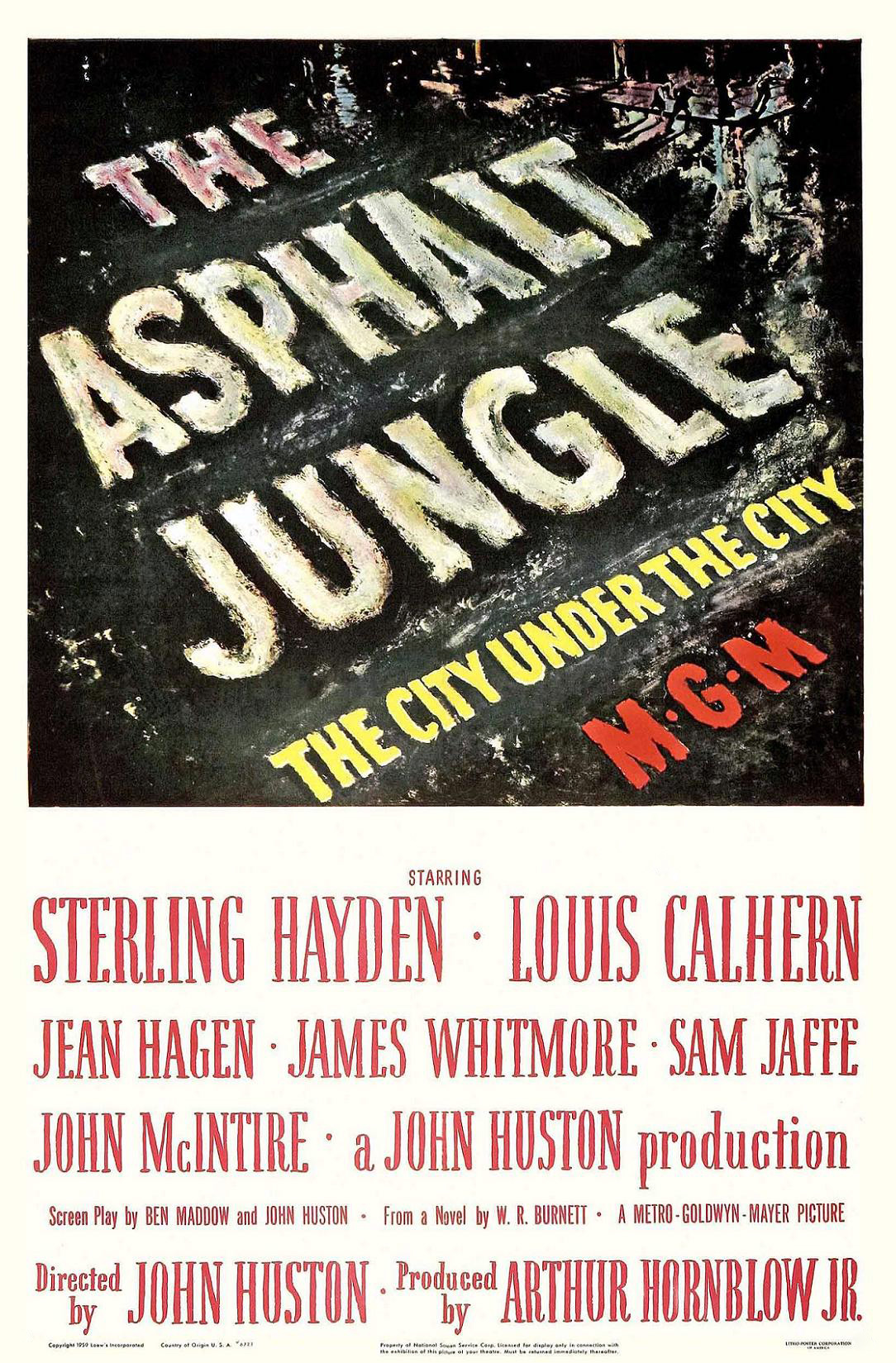
Starring: Sterling Hayden, Louis Calhern, Sam Jaffe, Jean Hagen, James Whitmore, John McIntire, and Marilyn Monroe
Grade: A
Considering how the movie operates and its every-man-for-himself attitude playing such a major role in the narrative, the title of the film is one of the best ever. It’s not only cool and marketable, but it perfectly encapsulates the events that unfold without revealing too much.
Summary
Cops are searching around town for a suspect. They don’t know who it is, but it’s the Kentucky born, 36-year-old William Trevor “Dix” Handley (Hayden). Dix sneaks his way through town on foot and heads over to Gus’s (Whitmore) cafe. He gives Gus his gun, and Gus hides it in the register. Two cops show up shortly after and ask Gus when Dix arrived. Gus doesn’t snitch and says he wasn’t checking the clock. After the cops frisk Dix and don’t find a gun, they consider searching the place. Gus tells the two they can’t without a warrant. Even so, they take Dix in and “book him on vag”. Following this, Dix is placed into a lineup with two other men, 37-year-old Karl Anton Smith and 22-year-old clerk William Doldy. Karl was arrested the previous night after calling the police station saying he murdered Catherine Smith, and Doldy was in possession of narcotics, had no previous record, and attempted suicide the night before with a necktie. Dix was arrested in 1937 for illegal possession of firearms. He was sentenced for 1-5 years but escaped state prison in 1939. He was arrested in 1940 and released in 1941. Lt. Ditrich (Barry Kelley) asks the victim if he recognizes the man from the stickup because he thinks its Dix. The man shares eye contact with Dix who gives him a stern look back. The man is too intimidated to admit it to Ditrich, so he says it’s not Dix. As Dix smiles, the man leaves the room and so does everyone else. Just then, Ditrich is told Police Commissioner Hardy (McIntire) wants to see him in his office right away.
Once Hardy has Ditrich sit down, he comments how there have been 39 thefts, 33 burglaries, 18 robberies, 7 assaults, and 5 morals offenses in the last thirty days and how it’s a record even for the 4th precinct. Ditrich says they know Dix is the one who’s been pulling off all the stickups and was in the lineup, but their witness got cold feet. He’s not sure what they can do, and Hardy gets angry saying they should freak out the witness even more by locking him up. He lambasts Ditrich for how he’s been working lately, saying that “the only merchants safe from harm in your precinct are those who take wagers on the horses”. He wants to know why the parlors are still operating. Ditrich argues that if he closes them, they will just open up again, so Hardy counters by saying he doesn’t close them hard enough. He wants Ditrich to rip out the phones and smash up the furniture, but Ditrich says people like to bet on the horses. He tries to argue the law, but Hardy doesn’t want to hear it. Moving on, Hardy asks where “Doc” Erwin Riedenschneider (Jaffe) is. Ditrich doesn’t know, but they will get word from their stoolies soon. Hardy lets him know Doc left state prison yesterday at 12PM and took a train to their city, with a time of arrival being 3:17PM. He stresses how all Ditrich had to do was spot him, stay with him for 24 hours, and lock him up if he didn’t register. Somehow, Ditrich lost Doc five blocks from the depot and now one of the most dangerous criminals alive is at large in the city. Ditrich comments that the two men on that detail should get medals for “dumbness”, but Hardy points out how Ditrich was the one who assigned the men, so he should get one too. With all of this being said, Hardy brings up three things he can do to Ditrich. He can reduce him to the rank of patrolmen and send him to the Five Corners, he can bring him up on departmental trial on charges of incompetence, or he can give him one more chance to make good on his responsibilities. For now, he gives Ditrich his final shot, so Ditrich thanks him. Elsewhere, Doc gets out of a taxi, and the driver lets him know they are in a bad area of town, adding that it’s probably not a good idea for him to be carrying his suitcase out in the open like that.
Even so, Doc presses on and goes to the door of bookie Cobby (Marc Lawrence). Doorman Timmons (William “Wee Willie” Davis) has him wait in the hallway and brings Cobby out. Initially, Cobby doesn’t know who he is, so he’s rather short with Doc and his talks about a proposition. It’s not until Doc mentions his nickname that Cobby changes his tune and invites Doc inside his office. Cobby offers him a drink, but Doc got over his habit when he was locked up. This doesn’t stop Cobby from having one though. Either way, Doc details his plan for a caper. It’s a big one. In fact, he is sure he could sell it for $100,000 on the open market, but that would be throwing money away. He’d prefer to execute it himself. It’s worth half a million dollars, possibly more. Of course, Doc would have to do some checking because his plan is a few years old, but not too much checking. As Cobby finishes his drink, Doc says he needs around $50,000 to operate. Cobby isn’t sure about this, but Doc brings up Alonzo Emmerich (Calhern). He heard Emmerich has money to invest and the way to get to him is through Cobby. Cobby confirms this to be true, but he has never thought of Emmerich in connection with this type of deal. Cobby excuses himself to call Emmerich. Wasting time, Doc puts on his glasses and looks at a calendar on the wall with pictures of women on it. Dix walks in, so Doc goes to sit back down. Cobby comes back in the room, and Dix tells him he wants to make a bet, but Cobby has to greenlight it first. Dix is in for $2,300, so Cobby says it’s fine because his tab is good for $2,500. However, that’s the limit. Dix is offended by this and promises to get the $2,300 for him immediately. Cobby tries to bring him back in for a drink, but Dix storms off. Once Cobby walks back in, Doc asks who Dix is. Cobby describes him as a small-time hooligan who is crazy for horse betting. His book keeps beating Dix, but he keeps coming back for more. Getting back on topic, Cobby relays that he spoke to Emmerich, and they will meet him tonight.
Currently, Emmerich is hosting a dinner party with a bunch of people, but he will be at another address later on.
Dix goes back to Gus’s, and Gus pets his cat while it lays on the bar. A customer complains about the cat being on the bar, talks about how he runs over cats when he sees them, and how cats get fed more than children today, so Gus asks him if he’s going to buy the magazine he’s reading. The customer refuses since he’s already seen all the women in it. A pissed off Gus throws the customer out of the cafe and threatens to beat his ass if he sees him running over a cat. The customer acts like he’s not scared of him, but Gus makes him flinch and run into his car to drive off. Gus turns to Dix and assumes correctly that Dix wants his gun back, but he refuses to give it to him, even goading him to attack. Dix assures him that he’s not going to because they’re cool. Gus offers advice to lay low for a while because the cops are heavy in the streets currently, but Dix is sure he can’t afford to do so. Gus offers to stake him but is surprised to hear Dix needs $2,300. Gus knows it’s for Cobby though, so he tells Dix to let him sweat it. Still, Dix doesn’t want to be in debt to Cobby because he wants to maintain his self-respect. Gus says he has $1,000 put away and tells Dix he can have it. On top of that, he will check to see if he can get another $1,300. In the meantime, he tells Dix to stay away from the boulevards, especially at night. He also lets Dix know the cops knocked over the clip joint where Doll Conovan (Jean Hagen) worked, Club Regal. Gus calls Louis Ciavelli (Anthony Caruso) to ask for the money to give to Gus, and Louis initially refuses on account of his family having to be taken care of. He flips out on the phone while his wife and baby are in the room. Right after he hangs up, he leaves the room, calls Gus back, and agrees to get him the money. That night, Doll goes to see Dix, so he lets her in. She sees him having a smoke and a drink, so she pulls out her cigarette. Once Dix comments how she has to learn to carry matches if she’s going to start smoking and goes to light it for her, she bursts into tears and apologizes for bothering him at this time of night. Just as she’s about to leave, Dix mentions how he heard about Club Regal getting raided, so she sits back down to talk about it. She smiles as she talks about it not being a big deal because it’s a clip joint and how annoying it was for the raid to happen the night they were supposed to get paid.
Once Dix fixes her a drink while one of her false eyelashes fall off, he correctly assumes she was locked out of her place. With this, Doll asks if she can stay with him for a couple of days. Though he’s not too excited about it, he relents. However, he tells her to not get any ideas. She agrees while taking off her other false eyelash.
At an undisclosed location, Emmerich has his meeting with Doc. Doc has his plan written out, as it contains everything from the observed routine of the personnel to the alarm system, to the locks on the doors, to the age and condition of the main safe, and everything else. Emmerich isn’t entirely convinced because everyone talks about their plans being sure things, but Doc brings up his known reputation and how he’s engineered some very big things. Cobby backs Doc up on this, but Emmerich ignores this and asks if Doc gathered all this information before he did his last stretch in prison. Doc confirms. He was ready to begin operations, but the cops nabbed him for a previous caper he almost forgot about, the Adelphia Finance caper that netted him $158,000. Emmerich questions whether Doc really believes there’s a million in this bank, suggesting there’s more. This would mean the take would be worth half a million to them in cash, as he knows just as they do that a fence will give them no more than 50%. Doc confirms this as well. However, he has three problems. He needs money to operate, personnel, and the disposing of the take. Doc suggests the helpers will be paid off like house painters. They will be told nothing about the size of the take because he knows men get greedy. Doc and Emmerich share a laugh because this means they will be getting most of it. Still, Doc needs three men. One will be the box man. They will pay him the most, possibly around $25,000. Cobby chimes in and says Louis can do it, as he’s the best box man west of Chicago, an expert mechanic, and has already been on some very big capers. From what he hears, Louis can open a safe like the back of a watch. However, he will cost some money. Doc says they also need a driver in case there’s a rumble. He should get $10,000. Lastly, they’ll need a hooligan. Though most of them are drug addicts or no good, Doc deems this position necessary. For a somewhat reliable man, he thinks they should get $15,000. This totals to about $50,000, so Emmerich asks how the take will be handled. Doc says they will get in touch with the best fences in the Midwest and deal with whoever makes the highest offer. It’s possible that one fence might not be able to handle the whole thing, so they could deal with 2 or 3.
Mulling over possibly a $500,000 take, Emmerich suggests he himself be the one to get in contact with a fence since he knows some people. He asks Doc to give him some time to see what he can do before Doc looks for a fence, especially since a few more days wait wouldn’t make a difference. Doc agrees, and Emmerich has Cobby advance Doc anything he needs along with a place to stay. As Emmerich walks the two out the door, he asks Doc how 7 years of prison was. Doc says it wasn’t too bad and that it was a matter of temperament. He didn’t cause any trouble, so the prison authorities appreciated it and made him assistant librarian. As Emmerich jokes that he wouldn’t make a good prisoner himself, Doc says he’s going to Mexico after this job as it will more than likely be his retirement. After they leave, Emmerich goes over to find his mistress Angela (Monroe) sleeping on the couch. She wakes up and asks why “Uncle Lon” is staring at her. He tells her not to call him that, but she thought he liked it. He did, but he apparently doesn’t anymore. They talk for a bit, and he suggests she go to bed because it’s getting late. She agrees and kisses him before walking over to the bedroom. Right after, Emmerich calls private detective Bob Brannom (Brad Dexter) to take a look at his books. He is owed $100,000 from a crop of people and wants Brannom to collect for him. He doesn’t want to hear about the details, only results. The next morning, Doll answers a call from Gus and relays the message to Dix that Gus says to come over anytime because he has something for him. As Dix wakes up a little, Doll brings him some coffee and mentions how he was talking in his sleep and said the name “Corn Cracker” very clearly. He reveals to her that this was the name of a tall black colt. He remembers his dream being on this colt’s back, his father and grandfather watching, and the colt jumping all over the place. In it, Dix stayed on, and he recalls being proud when he heard his grandfather comment how he was a “real Handley, that boy. A real Handley”. Doll asks if that happened when he was a kid, but it didn’t. In reality, Dix was thrown off the colt and into a fence after its first buck, and his father commented how this would teach him not to brag about how good he is on a horse.
Doll notes how it’s nice to see him laugh. Next, Dix says his ancestors imported the first Irish thoroughbred into their county. Their farm was in the family for generations, 160 acres, 30 in bluegrass, the rest in crops, a fine barn, and 7 brood mares. Then, everything happened at once. His father died, they lost their corn crop, and the black colt broke his leg and had to be shot. It was an awful year. He still hasn’t forgotten the day they left. Him and his brother swore they’d buy Hickorywood Farm back someday. As Doll comments how it must have been hard for him having to leave the place where he grew up and how she never had a home herself, but Dix ignores her and says how he only needed $12,000 to save it and almost made it once. He had more than $5,000 in his pocket and Pampoon was running in the Suburban. He put it all on his nose, but he lost by a nose. Doll tries to interrupt to tell him to drink his coffee before it gets cold, but Dix continues with his speech about how his luck has to turn around at some point and he’s going to make a real killing one of these days. When he does, he’s going to head home. The first thing he plans on doing is take a bath in the creek to get the city dirt off him. Doll gets noticeably anxious, so Dix asks what’s wrong. She denies any issue and just starts frantically cleaning his place because it’s dirty. Following this, Dix shows up at Cobby’s and gives him the roll of $2,300 in cash. He demands Cobby count it out, even though Cobby tells him he doesn’t have to pay it all at once. Even so, Dix demands he count it all because he’s still pissed off at Cobby making him look small in front of a stranger earlier. Cobby says he made a mistake and fixes him a drink. Then, he tells Dix to save his money, and he’ll let him know when the next fix is for the races. Just then, Doc is let in and Cobby introduces the two. Dix knows of Doc’s reputation. Once Cobby mentions that the whiskey is from Dix’s home state, Doc asks where Dix is from. He’s from Boone County, Kentucky, a place he is confident in saying has the best water in the USA. It makes the whiskey fit to drink. Dix finishes his drink and heads out. Cobby and Doc discuss Dix, how his gambling debt may be a point of honor for him, and Cobby laughing this idea off and calling him a small-time hooligan.
Knowing this what he needs, Doc asks him to confirm Dix’s hooligan status, and he does. He mentions how Dix will stick up cigar stores and gas stations and every cent of it will go to betting on horses. Cobby asks how Doc’s date was last night. Though he does say she was too drunk to be good company, she did reveal to him that Emmerich is broke. Cobby doesn’t believe this because he’s seen Emmerich operate for 20 years. He’s a lawyer who only handles the biggest cases. Plus, he’s got 2 houses, 4 cars, and 6 servants.
Still, Doc brings up the blonde he talked too. Cobby assures Doc that he can trust him over her. Suddenly, Ditrich walks in, prompting Doc to turn the other way. Ditrich turns and walks back out the door, so Cobby runs after Ditrich to stop him in the hallway. Cobby assures him that Doc was just passing through, but Ditrich tells him he didn’t see anyone because he wasn’t here. Even so, Ditrich tells Cobby he will have to stand still for an upcoming raid, meaning they will have to take Cobby downtown and book him. Cobby can’t believe this because he thought they were friends, but Ditrich explains how he has to because Cobby’s place is the biggest parlor in his precinct. The citizens know it, the newspapers know it, he knows it, and Hardy knows that Ditrich knows it. Putting money in Ditrich’s coat, Cobby brings up how he’s always been cooperative but he’s hitting him at the wrong time. Ditrich relents and tells him to close up tight, keep the place dark, and to not answer any phones. After Cobby agrees and Ditrich exits, Cobby goes back into his office, with Doc saying right away that the cop recognized him. Cobby assures him that Ditrich is on his payroll and is practically a partner. Even so, Doc says that experience has taught him to never trust a policeman. Just when you think one is alright, he turns legit. At Emmerich’s place, his servant tells him Brannom is there, so Emmerich tells him to bring Brannom in. The servant also mentions that Emmerich’s wife May (Dorothy Tree) isn’t feeling well, so Emmerich tells him to send for Dr. Houseman. Thankfully, the servant already did, so Emmerich tells him to tell May that he will see her later. Brannom is let in, and Emmerich cuts right to the chase. He wants to know how many debtors came through with what they owed. Unfortunately, they all had excuses. At most, 2 or 3 may come through as they “promised”, but it’s not looking good otherwise. Brannom reminds him he can’t go too far because a private detective can’t go around threatening people. He’d lose his license if he did.
Brannom says Emmerich will have to sue 98% of them, but this won’t due. Emmerich stresses how he needs to have the money immediately, prompting to Brannom to jokingly ask if he’s having girl trouble. Emmerich tells him to shut up, and Brannom gets serious in an instant, saying no one tells him to shut up. Emmerich apologizes and admits he’s flat broke. Brannom can’t believe he let Angela do this to him, but Emmerich doesn’t blame her. He blames his whole way of life. He admits he has an opportunity, but he can’t take it. After Brannom simply responds “tough”, Emmerich decides to let him in on the plan. After Brannom confirms he’s heard of Doc and mentions how he’s in prison, Emmerich explains how Doc got out last week and Cobby brought Doc over to him. Emmerich reveals to Brannom that Doc has a beautifully orchestrated plan to pull off the biggest caper to ever be pulled in the Midwest. He just needs $50,000 backing. They are taking Belletier’s. Emmerich says the rocks alone will be worth half a million, and he would be getting a third of the take. However, that’s not all. Emmerich has constructed a plan on his own to get it all. He could tell them that he fenced the stuff himself and promise them cash on delivery. When the time comes, he just wouldn’t have the cash. He would tell them he would just take a few days to raise it. Emmerich is certain he can get them to leave the stuff with him while they’re waiting. Then, he would take a plane to another country and disappear with it all. The gold and platinum he could melt up and sell as bullion. The rocks he could sell one at a time, as there wouldn’t be a hurry. It would last a lifetime. Brannom can’t believe he’s trying to work a double cross like this, but Emmerich is still going on about how he needs the $50,000 to get started. Brannom has an idea, but he wants to know what’s in it for him. Emmerich offers him a 50/50 split, so Brannom agrees to it. After they both acknowledge they can die from something like this, Brannom’s bright idea is to get the money from Cobby, as he can dig up money like this half-trying. Emmerich isn’t sure how to explain why he would need money, but Brannom says to leave it to him.
He knows Cobby likes to feel big, so detailing how he will be advancing money to “The Great” Alonzo P. Emmerich will goad him into doing it.
Back at Cobby’s place, Doc is with Louis and Cobby and asks what boxes Louis has opened before. He tells Doc a Cannonball, a Double Door, a few Fire Chests, and everything else. He also confirms that he can open a vault with a time lock and a relocking device. In addition, he uses seam over lock, he was involved with the publicized Shafter job, he supplies his own “soup” (nitroglycerin), and he can open any lock in 4 minutes. With this, Doc and Cobby let him in. However, Louis wants to know his cut, so Doc has to tell him that he will be getting a flat guarantee instead. Louis demands $30,000, but Doc said they figured $25,000. Louis is fine with this but wants $15,000 outright. Cobby tries to advocate for $10,000 down instead, but Doc agrees to the $15,000 and points Louis in Cobby’s direction to get his payment. Louis walks over to Cobby who sweats profusely while counting the money out for him. Louis asks who the other members of the team are, but Doc says they haven’t gotten them yet. Louis tells Doc that Gus is the driver they should get, and Cobby backs him up, especially because they can trust him under any heat they may face. Doc likes the idea and gives them the go-ahead to contact Gus. He asks if they have any ideas for the role of “hooligan” next. Cobby is thinking heavy Red Traynor. When Louis comments that he’s “taken the cure”, Doc says to rule him out. Louis turns down Cobby’s doorman Timmons for being stupid, so Doc suggests Dix. Doc sees him as a determined man who is far from stupid. Louis admits he doesn’t like Dix, but he never saw a hooligan he did like, referring to them as “left-handed pitchers. They all have a screw loose somewhere”. Even so, he supposes Dix is as good as anyone, especially since Gus vouches for him. With this, Doc says they’ll get him then. Louis prepares to leave, mentioning how his kid is sick again, but his wife keeps on taking him out in the morning when it’s cold because the baby has to “taste fresh air”. Louis starts to get riled up after he says this, adding that if she wants fresh air, she shouldn’t look for it in this town. He calms down for a moment to show Doc a picture of his baby at nine months, and Doc says he envies Louis being a family man.
Once Louis leaves, Cobby tells Doc that the good thing about Dix is that they can get him for cheap. Bypassing this, Doc wants Cobby to tell the truth. He wants to know if Cobby is using his money and not Emmerich’s. Cobby doesn’t think it makes a difference, and Doc agrees with him.
Cobby explains that the reason they’re doing it this way is because Emmerich doesn’t want this transaction on his books, and he’s not actually risking anything. He swears Emmerich is good for it in case of a “runout”. Doc slyly comments that Cobby doesn’t have a worry. Though he’s still sweating, Cobby assures him that he doesn’t. At Dix’s place, Doll is packed and ready to go. She found a place. Her friend who used to do novelty dances at the Band Wagon in Blanche LaRue is leaving town and is letting Doll stay at her apartment. The rent is paid until the first of the month. It just happened this morning. She nervously jokes how she couldn’t live off Dix forever, and he is glad he was able to help her out. Doll mentions how she could do something for him sometime, but he says she doesn’t owe him anything. When she goes towards the door, he offers her some money, but she declines because she doesn’t want to bother him anymore. She kisses him goodbye and exits. While she’s going down the stairs, Dix stops her and wants to know where he can find her if he wants to get in touch. She says she will be at 42 Merton Street, and they awkwardly depart. Dix goes back into his place to answer a phone call from Cobby who vaguely offers him a big job and to meet at Gus’s at 10PM. Later at Gus’s, Doc details the plan to Gus, Louis, and Dix. The soft spot is an old steam tunnel, the manhole is on the corner, they drop into the manhole at 11:45PM, Dix will cover Louis, and Louis is to break through the wall. It will take about 6 minutes to get into Belletier’s from the furnace room. Doc also mentions to watch out for the floor wires and how he is to make his way up the back stairs and jump the alarm system. This will take another 3 minutes. At exactly 11:54PM, Doc and Dix will come to the back door and Louis is to open it for them. They all agree to the plan and get ready to go home. Doc asks Louis how his kid is doing. Though he admits the baby had a fever the day before, he’s okay today. With this, Louis and Gus check out.
Dix goes to leave, but Doc stops him. Privately, he asks Dix what he knows about Emmerich. All he knows is that they call him “The Big Fixer”. Seeing that he can trust Dix, Doc lets him know that Emmerich will be taking the jewelry off their hands, but he doesn’t trust Emmerich. He admits he could be wrong about Emmerich, but it’s up to him and Dix to collect. Everything should go smoothly. If it doesn’t however, they have to collect. Dix assures him they will do so. With this, Doc says they will meet Emmerich after the caper, they will deliver the jewelry and get their money. The payment is to be immediate and in cash. Following this, they pay off and scatter. Dix again assures him to not worry. They will collect. Back at Emmerich’s place, Emmerich packs up a suitcase and gathers his passport. May hears him fumbling around and calls him into the bedroom. He’s in a hurry and says he has a business appointment, prompting May to question things because 11:30PM is pretty late for a business appointment. May goes on about how she’s not feeling well, but he’s not surprised because she hasn’t been feeling well for a long time. She admits she gets nervous, which leads to her wanting to stay back at the house, though she doesn’t like being all by herself. Emmerich tells her she’s not alone because they have servants who can come up anytime that she wants. Even so, May asks him to sit down and play Casino with her like the old days. He wants to but explains he can’t on account of his business, though he says he will come in later to play if she’s still up by then.
Of course, his business appointment is with Doc once the heist is over.
Firstly however, the caper will commence. Not without its hiccups, the bag will be secured. However, the aftermath is just what Doc was hoping to avoid.
My Thoughts:
The heist film subgenre would not be the same without the existence of John Huston’s The Asphalt Jungle, a trendsetting movie that would become the norm. Instead of going the usual route of making the criminal characters involved dirty, over-the-top lunatics with a thirst for awfulness and all things bad to an almost unbelievable degree that seemed to be a big part of crime movies pre-1950, The Asphalt Jungle is one of the first to take the sophisticated approach. Grounded in realism and led by an experienced intellectual straight from prison with a detailed plan on how to make things happen, audiences are treated to seemingly the first major caper with intelligent players who pull things off successfully but unravel within their own group because of a crucial chink in the armor, greed. With expert direction and a strong cast, Huston’s engrossing depiction of rising tension, suspense, and how a perfect plan can still crumble marked a turning point for crime movies moving forward.
With the time period in which it came out in mind, The Asphalt Jungle demands the attention of the viewer from the outset, as we see the main character and regular, everyday “hooligan” as he’s referred to in Dix Handley, sneaking around town being chased by the police. Though the city is never named directly, it’s that of a crime-riddled one. Gambling is running rampant, and all the important characters who encompass the story are involved in criminal dealings in one way or another. The intimidating Dix in particular regularly sticks places up for money. It’s what he’s known for. He hides over at Gus’s cafe because he’s friendly with owner Gus, who hides his gun for him. At first, Gus just seems like the overseer of the neighborhood who looks out for everyone, is aware of everyone’s lives but everyone likes him because he’s not a snitch, and he offers advice from time to time. Actually, this wouldn’t be a bad way to go with it, but it’s established soon after that Gus is cool with it all because he himself is involved in crime just as well. He moves money around for his friends who need it for gambling purposes, gets them all out of jams when needed, and he is the talented driver Louis and Cobby vouch for. Even though it has virtually no effect on the plot other than a monologue of vulnerability with Louis’s wife post-heist, he also has a hunchback for whatever reason. Even so, Dix acts nonchalantly until he’s picked up by the cops and is taken to a line-up for a store owner to identify the man who stuck him up. To further the world-building of this town engulfed in crime and unsavory people, Huston lines up Dix with two other suspicious men and gives just enough of a description of both of them to set the tone for how unsettling the environment is, and all the major players are. Everyone is suspicious and/or potentially dangerous, and it’s framed in a way where the viewer is drawn into this table being set by Huston of what this “Jungle” the title is referring to, and these people live in. It’s a jungle filled with animals, and the mindset of survival at any costs is what rules supreme. It’s a jungle the cops struggle with too because corruption isn’t just with most of the citizens in town.
It has bled into the force, with Lt. Ditrich being the biggest example of this. He takes bribes and is friends with Cobby, the biggest bookie in town. There isn’t a single money deal that doesn’t come through Cobby’s doors at some point. Additionally, he associates with all the noted criminals in town because they come to him for either an advance or to make a bet of some kind. His place is the most popular and successful in town, and everyone knows it. Early on, Ditrich realizes he can only keep his corrupt shtick up for a little while longer because Police Commissioner Hardy is hovering over him, forcing Ditrich to let Cobby know the facts. The streets know Cobby’s place is the one to hit, Hardy knows, and Hardy knows Ditrich knows. Basically, any cop worth their salary knows that Cobby’s betting house is the place to go and he is the person to see. Though Ditrich takes yet another bribe from Cobby to stay away temporarily, we all know it’s a matter of time before he makes it back there to strike down on the place. For the record, Marc Lawrence does a great job as eventual fink Cobby. After Ditrich ironically notes how he doesn’t drink on the job because it’s “against regulations” as if he hasn’t been involved in criminal activity for the entire movie, the two go for broke in the interrogation scene late in the story, and it’s the showcase the actor was waiting for. From Lawrence’s initial confidence turning into pleading, and breaking completely right after was excellently done, and the follow-up of Gus coming to the realization of what Cobby did, once he sees Cobby after being brought in, was one of the best moments of the film. Regardless, the reason the late interrogation has to happen is simply because Hardy is not dumb, and he means business. Following the police lineup scene, he gets in Ditrich’s face about his lack of results, despite them both knowing all the illegal betting going around. Without saying it, you can tell he knows Ditrich is up to something, but he’s still giving him a chance to make it right. The only strait-laced, incorruptible, no-nonsense character who holds the position of his job with the utmost respect is Hardy, and John McIntire is a standout in the role.
Despite him not being the focal point of the movie, he shines as the lone man on the side of good who will find a way to get to the bottom of things. Besides the caper itself and the woes of Emmerich, the scenes involving Hardy take the movie by force, reminding the audience the law will not back down. Late in the third act, Hardy gives the press an update on the case, which turns into an eloquent speech about law enforcement in general. Commenting on police corruption, he’s not surprised it exists, saying that the dirt they try to clean off is bound to rub off on some of them. Nevertheless, it might be 1 man out of 100. There are still 99 others who are honest men trying to do an honest job. In a powerful moment, Hardy turns on the police radios for the entire room to hear, one by one. He stresses to everyone there that they send cops to every one of those calls because they are cries for help, showing the importance of their job and how it’s a thankless one that is nonstop. People are getting cheated, murdered, robbed, raped, and it goes on for 24 hours a day, every day of the year, and it’s the same in every city in the world. It’s a moment that makes the viewer stop, think, and appreciate the role the police play in society with how Hardy reveals it in his sobering presentation. For all the bad cops that we have seen over time, there are plenty of good ones that don’t get nearly the same press coverage, even in movies and shows. It’s a cool scene to not only further highlight a character like Hardy but show the meaning and thought behind the other side of the law that is almost always deemed less interesting in film and television. For those who still groan at the spectacle Hardy makes for the press and are missing the point, he shuts off all the radios and brings up a hypothetical of what if there was just silence? What if there was nobody to listen to or nobody to answer the cries for help? Well, “the jungle wins. The predatory beasts take over”. If that wasn’t one of the greatest arguments in favor of the police’s role in society, I don’t know what is. It goes without saying that there are bad cops. It’s not something Hardy denies. On the other hand, he is there in this film to remind everyone that there are still a lot more good ones than there are bad.
Without them, the jungle wins, and that’s the last thing anyone wants. The Asphalt Jungle exists to depict said jungle, the predatory animals that live within it, and why there needs to be people brave enough to stop them for the good of society. The “animals” are the rest of the crew in Dix, Doc, Louis, Gus, Emmerich, and Brannom. Just like the real jungle, these very different animals have their own motivations and team up or attack each other in an effort to survive with their reward. With animals, it’s usually food. In The Asphalt Jungle, it’s the stolen rocks worth half a million dollars. However, they aren’t just criminals. They have their own reasons and are justified in some respects. Though Dix has his faults because he’s trying to make the money through gambling, he just wants enough to make it home to his farm in Kentucky to buy it back. Doc has his retirement in Mexico in mind, and Louis has a family to take care of. Even so, there will always be a bigger fish involved who wants more, and that’s the never-ending struggle of this jungle. One of these late inclusion fish is private detective Bob Brannom. Bearing a strange resemblance to Anthony Rizzo, Brad Dexter’s Brannom is an unusual addition to the main cast as time moves on. Despite being the only person who’s not an outright criminal, he has the wickedness of one and is untrustworthy just by his look. In his drunken state, Brannom magnifies his unpredictability by mentioning an inferiority complex and how he should have “gone into the money years ago”, as well as the intense standoff he has with Dix once him and Doc show up to Emmerich’s place with the rocks. Emmerich needing him to be a part of his plan intensifies the second act and really sets up the rest of events well, as Brannom’s intrusion because of his half-drunkenness is part of what leads to Emmerich’s downfall. All of it is just part of the world-building that is this city-wide jungle.
John Huston’s fascinating and ahead-of-its-time direction is on display throughout The Asphalt Jungle, but it’s never more present than the depiction of the caper itself. In an elongated, nearly silent sequence, Doc’s plan goes off without a hitch until they run into the first problem. The viewer truly feels as if they are watching masters at work, with Doc being as calm as can be under pressure because he figured out every detail for things to go as smoothly as possible. From where they parked the cars, to the timing of it all, to the underground tunneling to get into Belletier’s, and the film noirish style exemplified once the group finally gets into the place of business, the tension and suspense is felt throughout. Sam Jaffe does a great job as Doc, especially in the heist itself. He plays it straight and leaves very little margin for error. However, when issues inevitably start to happen, the dimensions to his performance become more noticeable, as Doc acts confidently to the men but shows just enough within the cigar smoke to reveal a slight, frustrated panic beginning to boil to the surface. Right after Louis blows up the doors with the “soup” and the alarms are heard in the distance, you can see it in Doc’s face that they are so close. He says it too, so the others are fine with continuing. Eventually, they hear the sirens, and Doc tries his best not to rush things, though the first disaster strikes when Dix takes out the watchman. The man’s gun falls and goes off, shooting Louis non-fatally. Still, led by Doc, they press through the rest of the plan to escape and climb out of the manhole to go in their separate cars, with Gus taking Louis and ringing in a doctor to help him back at his house and Dix accompanying Doc to go collect. It’s a wonderful sequence that makes the film’s style what it is.
Sterling Hayden’s performance as Dix Handley is shockingly average. He has the look of the part, but his Kentucky accent is weak and he’s not nearly as interesting in the second half of the movie compared to what he is introduced as in the first act. He’s overly aggressive when he doesn’t need to be and then turns around and tries to lovingly talk about his childhood as a farm boy right after. However, it falls on deaf ears because the one person he reveals this is Doll, a woman he treats like absolute shit (“How about a cup of coffee?” – “Make it or shut up about it”). He ignores almost everything she has to say to get out what he has to say to the point of parody. Granted, the frantic Doll is practically inhuman with the way she fawns over Dix and dedicates her life to him when he barely acknowledges her existence to his last days. Though I will concede this attitude is prevalent in a lot of films from this era, it’s weird how far Dix goes with it, especially considering how she’s willing to get a car for him and park it three blocks away, just so he can escape when the whole city is looking for him. All she wants is to go with him and even offers to drive since he’s wounded, and he’s still asking what good would she be. At this point, how has she not proven herself to him? Clearly, she’s crazy, as she’s willing to go out on the lamb with Dix despite not being in trouble, but he’s STILL not sure. His hand is practically forced when she becomes frantic about how she won’t let him leave without her, but a little appreciation wouldn’t hurt him. Part of it could be about how focused he is on making it back to his farm, but it’s hard to say how focused he was in the first place considering how much money he’s blown on betting on horses up until that point. If the heist didn’t fall into his lap, Dix would have been on the same revolving door of a plan he’s been on for years. Then, out of nowhere, he’s fully fixated on making it back home and nobody can tell him different? I don’t know. What I do know is that Doll needs a reality check. Really, the third act starts grasping for straws to extend the picture. To this day, I don’t understand why they stretched the scene out where Doc is at the diner with the German taxi driver and the girl dancing.
The conversation Doc has with the cops alludes to something, like when he wants to know how long they were waiting outside the window for, but it’s too vague to figure out. Maybe they’re trying to go for the emotional route, as Doc watching this girl dance might be the closest that he ever gets to seeing the young girls of Mexico, but it doesn’t come off that way in its execution. Gus’s emotional hunchback speech was weird too, but Maria noting the sirens “sounds like a soul in hell” and it being used as a transition to Emmerich dumping a body into the eerie black river at night was a great moment. Also, in a movie with very little humor to speak of, Hardy asking Andrews if Angela impressed him, Andrews concurring (“Very much. She’s some babe!”), and Hardy angrily explaining that this isn’t what he meant was unexpected gold.
The only character arc that was flawless from start to finish was Alonzo Emmerich. Louis Calhern is fantastic as the chink in the armor mentioned in the opening of this review. A noted financier, he is brought in to bankroll Doc and help deal with the fences afterwards. Everything changes once he realizes he’s broke, as it does all of us. He becomes desperate. Granted, he wouldn’t be broke if his debtors paid him back, but it’s the situation he finds himself in at the wrong time. One important hole to notice regarding his part of the story is that if he’s willing to engage in criminal activity for financial gain, why doesn’t he hire a heavy to ensure he’s paid back by all the people who owe him? Before he includes Brannom in his double cross plan, Emmerich has him go out to collect for him. Even though Brannom has an intimidating presence about him, he says he can’t do anything physical because he’s still just a private detective and could lose his license if he tries anything. So, why not hire someone to do something physical? Couldn’t all of this have been avoided? Though it’s acknowledged early on by Cobby that Emmerich usually doesn’t involve his business with criminal stuff like that, Emmerich took the meeting and is willing to make the crossover, so what’s stopping him from taking it further and hiring someone to be violent with his debtors? Him and Doc both agree there is no hurry to begin the plan yet anyway. Emmerich is just on the clock somewhat because he has to gather the 50k discreetly, so no one knows he’s temporarily broke. Still, he could just borrow money from Cobby to pay someone to collect for him, couldn’t he? Either way, the character’s life, his decisions, and how his lifetime of mistakes start to make the ground crumble from underneath him is the most engrossing part of the picture. Emmerich knows he messed up, and it couldn’t come at a worst time, but this one job can save him from everything. With his wife sick and his ditsy mistress hanging over his shoulder (“YIPE!”), Emmerich can make it all better. His downfall is his greed. When he could help with this job to save his finances and figure out his personal life as a result, he instead pushes past this. If he goes about this the right way, he could have it all, retire, and escape all of his problems by leaving the country.
If it goes down like how he plans, it should go off without a hitch. The key word is should, the biggest element of any heist movie that causes all things to fall apart in the most entertaining way possible.
With Emmerich specifically, this couldn’t be truer, as his fall is one of epic proportions. The failed double cross because of Brannom is excellent, highlighted by the palpable tension when the four are in the same room and Doc begins to sense Emmerich attempting his ruse when he reveals he doesn’t have the cash but rather the “assurance” of it. His sobering thoughts afterwards where Doc calmly explains why he was in over his head was great. Calhern’s stare, as Doc lets him live while demanding he contact the insurance company to get them to buy the jewels back for as “high as 25% of what they’re worth” is an odd strategy, but he plays it with such a saddened, they-got-me-by-the-balls type of way that it’s an awesome foreshadowing to his arc. His penchant for smoking a cigarette while trying to keep up his list of lies is done very well too, as you can see Calhern try to hide Emmerich’s panic while also showing why it’s becoming increasingly difficult as the cops become more suspicious with each passing day. You can tell he’s trying everything, even revealing to Andrews and Janocek that he’s cheating on his wife with Angela to use his being at her place as an alibi to protect him from what happened with Brannom. I will say that his defense of Brannom to make sure he wasn’t implicated in the heist was also a fantastic idea because it would throw off any investigating officer under the right circumstances because why else would Emmerich say that there’s no way Brannom could be mixed up in a burglary? Of course, this all leads to his phone call with Angela to let her know ahead of time to back him up on what he said to the police. Him explaining his reasoning for doing so as “just politics baby, good old dirty politics” was an amusing way to keep up the facade. Huston follows this up with a wonderful showcase of irony when Emmerich sits with his wife May after the cops leave and she talks about all those “awful people you come in contact with, downright criminals, I get scared”, thinking her husband is this good man caught in a rough situation. In reality, the viewer is well aware of who Emmerich actually is in relation to this. It’s exemplified with a close up on Emmerich’s face right after she comments this to which he replies, “Oh, there’s nothing so different about them. After all, crime is only a left-handed form of human endeavor”.
It’s all coming down. Emmerich can sense it, and the audience can feel it. The confrontation with Hardy seals it (“If I were you, I’d think up a few more charges. You might be able to make one of them stand up if you get an imbecile jury and the right judge”). Watching him eat shit after he tries to play tough with Hardy and then assuring Angela that she will go on plenty of trips in the future, subtly admitting his own fate, was just expertly written.
Well, that’s what he gets for trying to go to war with Rufus T. Firefly (“Emmerich!”).
Doc and Dix’s temporary partnership in the fallout was entertaining, and Dix turning into a henchman and protector of sorts was a cool way to build their friendship. Doc needed someone to be there, so Dix showing how useful he is in this final stretch was a good way to help out both men like when they encounter the cop on their walk or their detour at Eddie’s place. One part did confuse me, however. Before Doc departs from Dix and Doll, Dix gives him $1,000 in cash to help him along the way. Doc offers him $50,000 worth of stones, but Dix turns him down. Then, Doc offers to send Dix the $5,000 he is owed, and he just needs an address to send it to, but Dix tells him not to worry about it. So, what? He got nothing out of this and gave up an additional $1,000 on top of it all? How the fuck does this help Dix in any way?
“Burglar alarms start going off all over the place for no sensible reason. a gun fires on its own accord and a man shot, and a broken-down old harness bull, no good for anything but chasing kids, has to trip over us. Blind accident. What can you do against blind accidents?”
As Doc puts it, greed makes you blind. Half of The Asphalt Jungle makes sure the viewer internalizes this point. One quarter is luck, and the other quarter is reminding us that the environment’s most unsavory individuals will run rampant if left unchecked. John Huston’s crime film is an authentic, dark, and overall gripping story of the before, during, and after of a heist that could result in retirement for all involved. Though it has some problems along the way, the movie is a strongly compelling, colossal achievement of its time period who’s ripple effects have influenced a generation of stories, films, and filmmakers themselves.
Fun Fact: John Huston originally wanted Lola Albright for Marilyn Monroe’s part, but she was unavailable.


+ There are no comments
Add yours