
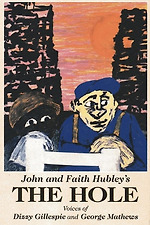
Starring: Dizzy Gillespie and George Mathews
Grade: B-
With some careful writing to flesh this concept out, The Hole could be turned into a great stage play to spotlight two up and coming actors. You wouldn’t need much of a budget either.
Summary
After the singing of some Irish song, we see two construction workers inside a hole, one white (Mathews) and one black (Gillespie).
Pausing from using his jackhammer, the black worker asks if the white one has insurance. Once the white worker confirms and loads up a bucket with rocks that’s pulled to the surface, the black one brings up the trick he’s playing on his wife. If he dies, his wife will be rich because he’s ensured. However, every anniversary and every birthday of hers for twenty years after his death, she’s going to get a telegram from him sent from Western Union. He says this as the white worker takes a look at the newspaper with a headline of “ICBM’s Were Set to Fire in Crisis”. As the black worker talks hypothetically about his wife with her boyfriend spending his money after he’s passed, the white worker questions who will write the telegrams. The black worker explains they are already written, and they will come every year. With this, he goes back to using the jackhammer, which disturbs the white worker as he tries to read. Pausing again from using the jackhammer, the black worker walks back over to relay a story. He was washing the dishes one day and he dropped a glass. His wife told him that he wasn’t thinking about that glass. He argues he was. It was just the grease on the glass that caused it to fall. Climbing up the ladder, the white worker says the actual reason he broke the glass was because he didn’t want to wash the dishes in the first place. He caused it to happen. Pointing to the crane above them outside of the hole they are working in, the black worker brings up the hypothetical of it falling on top of his head. Getting defensive, the white worker aggressively asks why it couldn’t fall on his head instead. As he says this, he slips down the ladder accidentally and his right foot lands in the bucket. Above the hole, a co-worker is trying to pull the rope for the bucket, but it’s too heavy and he’s confused as to what’s happening. Next, the black worker changes the subject to how much money “we” the government is losing.
The white worker asks why he said “we” the government, but the black worker is quick to respond, “I am the government”, pointing out how the Constitution says, “We the people of the United States…”. He rhetorically asks if he is one of these “we”, even if he doesn’t have a birth certificate. He asks who pays the President, but the white worker asks if he has a driver’s license instead. The black worker responds, “Do I look like I would have a driver’s license to you?”. During all of this, the worker above the tunnel is still pulling on the rope.
After another session with the jackhammer, the black worker asks the white worker what kind of dancing he does while the white worker is filling up the bucket. The white worker reveals that he partakes in regular ballroom dancing, the Fox Trot, and the Waltz, the latter being something he’s particularly good at. The black worker asks if he knows the St. Bernard’s Waltz. He acts like he does at first but reveals that he actually doesn’t. The black worker talks about it being a Waltz that foreigners do. A bit confused while he tries to grab the rope to tie to the bucket, the white worker questions if this “St. Bernard” is actually a foreigner because it’s not a foreign name. The black worker is confident that the “Saint” part is and asks if he’s here. Getting mad, the white worker points out how he obviously isn’t there. The black worker asks if he was here. The white worker replies, “You mean right here on on 3rd Avenue? No, he never was here”. Trying to prove his point, the black worker wants the white worker to confirm they don’t have saints over here. Yelling at him, the white worker confirms as such because they’re all dead. That’s why they are saints. After saying this, the rope gets tangled all over his body. Moving on, the black worker acts out the St. Bernard’s Waltz, mimicking the spin move along with how the accompanying music sounds. The white worker is still not sure how this makes it a foreign dance, but the black worker reiterates the “saint” part does. Just then, the bucket is finally pulled out of the hole. The white worker yells at his co-worker on the outside in Charlie to tell the crane man to take a look at the load, yelling how it’s right over the hole they’re in. The black worker points out how that crane could drop whatever directly into the hole, but the white worker is very aware, which is why he said something. He argues that the black worker wasn’t even looking at it, but the black worker assures him he was. It was just with his other eye. Next, the black worker comments how accidents happen.
However, the white worker argues that accidents only happen because someone wants them to happen. The black worker doesn’t buy this for a second, but the white worker knows they have statistics on the subject. He grabs the newspaper because this is where he saw it. Reading it aloud, the article states that 99% of people who get into accidents are trying to get hurt. The black worker doesn’t think the writer knows what he’s talking about, but the white worker thinks it’s the only way an accident could happen. Trying to poke a hole in his argument, the black worker comes up with a hypothetical. If he were to go walk across the street and get run over, would it truly mean he was trying to stand over there and get run over like a fool? The white worker sees it as reaffirming his stance because he clearly had some reason. Why would he cross the street in this scenario and not just stay on the sidewalk? It means he has an idea in his head that he wants to get hurt. Bringing up another scenario, the black worker mentions these radar screens they have now and how they get alerts in Canada and Alaska when they go off. He read in the newspaper how a piece of the moon fell off. As he says this, visuals pop onto the screen of nuclear bombs in facilities and a man sitting behind a radar machine of sorts at some kind of station. The black worker brings up a hypothetical of a piece of Venus getting knocked off, and “They think it’s one of those things coming from over there and intercontinental ballistic missiles…accident”. The white worker doesn’t agree at all because these people are stationed to prevent such an accident from happening, adding that the black worker is proving his point with his hypothetical. At this point, the visual of the visibly shook radar screen worker calls in a general to look at his screen.
Nevertheless, the white worker goes with the black worker’s hypothetical and brings up how the radar would warn them when the thing was coming. The black worker thinks they would go out of their way to take it out, but the white worker thinks they would watch and wait. The black worker questions the idea of it dropping and it being too late, but the white worker thinks it would burn up before it hits the atmosphere. The black worker argues they would think it’s something else, but the white worker says they do know on account of the radar screens. While he states this, an underground rat bites some piping, and it makes the radar go haywire. The black worker brings up how it could be a mistake or they could blow a gasket. The white worker suggests they would just put a new gasket in, but the black worker counters with saying “Suppose” they don’t know it. However, the white worker doesn’t want to hear it because the system would say the gasket is blown. The black worker counters with the simple fact that these machines can go wrong, mentioning how an A-bomb almost flew to Russia. Some fool could push a button. As he says this, the general starts pressing buttons to open up all the holding spots for the nukes, as he’s getting ready to send them out. Bringing it back to his point, the white worker asks if the bomb went. The black worker says the bomb was on its way, but it didn’t go. He notes how everything the black worker is saying is proving his argument because the bomb came back to which the black worker replies, “Suppose it didn’t come back”. As he says this, the rat pops out of the hole underground, and the general grabs the pipe from its mouth that it gnawed through. Knowing he nearly sent several nukes out in a panic, the general reverses his decision and closes all the bomb hatches, deciding against sending them out after realizing it was the rat’s fault.
Still, the white worker again says that the only reason they would send something out (meaning a bomb) is because they had it figured out. It’s a scientific thing. Those senseless bombings wouldn’t happen out of nowhere for no reason, would they?
Suppose they would…
My Thoughts:
There are many animated short films that have been lost to time simply because they are not something people regularly seek out. However, the genre has plenty of gems not only worth checking out but deserving of renewed interest and recognition. After all, they didn’t create the Academy Award for Best Animated Short Film for no reason. This is a serious art form. As far as Cinema Loco goes, we have been slacking in this department regarding the beautiful world of animation, which is why we are trying to make a concerted effort to rectify the situation. With this, 1962’s The Hole came into the conversation. Created by filmmaking duo John and Faith Hubley, The Hole consists of a two-shot of a couple of construction workers passing the time during the workday in a hole as they talk about a variety of topics. It’s an easy concept to grasp and is felt immediately upon seeing the setup. Even with its low-budget animation or on-purpose art design, it’s endearing regardless and a fun representation of the early 60s animated style some might be familiar with. In a modern context, some might be put off by its rougher art that looks unfinished to some degree, but it’s messier independent feel gives The Hole its identity and fits its presentation of two down and dirty blue collar workers discussing world events and thinking they have the answers.
As John and Faith Hubley’s films have been known to do, The Hole‘s dialogue is entirely unscripted and improvised by its two castmates in jazz legend Dizzy Gillespie and actor George Mathews, and this element to it is outrageously captivating no matter the content of what is actually said. It’s as if the conversation was recorded as the two went about their day, and the Hubley duo just made the animation to coincide with it, accordingly, turning the two into construction workers after the fact. It’s not a negative in the slightest. Actually, it’s why The Hole works as well as it does. The conversation flows like water down a drain, and the natural responses to each other’s thoughts and theories are wildly entertaining. This type of authenticity is just not something that can be accomplished in a scripted conversation. The pauses, the randomness of where the conversation goes, and the topics switching while the two keep up their pace at work isn’t something that can feel as natural as it does here unless it was captured in a “found footage” documentary itself. Even for an animated project, it’s real. If you’ve ever worked a labor job, this is exactly how these dialogue exchanges go. One co-worker will spout off theories on life that range from decent to “What the hell are you talking about?”, and the other co-worker who wants to pass the time to get to the end of the day will actually take the time to listen. Then, they will either argue or pack onto their odd theories or comments. Based off this basic premise alone, someone could write a screenplay with this spirit in mind, but it wouldn’t feel as natural or as seamless as it does in The Hole. If you were to transcribe the conversation being had between the two characters, it’s jumbled, not fully understood, some of it doesn’t make sense, and it’s nearly unfinished, but this lack of clarity at times is why the Hubley couple’s Oscar winner is as authentic and engrossing as it is.
It’s wholly and completely, a real-life conversation being captured. It’s one of those conversations someone has with a co-worker during a 12-hour shift that makes total sense in-context and could be even thought-provoking to a degree. In the moment, they take the time to listen and can tell where the co-worker’s thought process is to the point where even their mad ramblings are understood. They can see what they are getting at because they too are on a similar playing field when under the gun and tired. Despite this, if someone were to ask that worker to reiterate some of the conversation when they’re at home, it would come off as utter nonsense, resulting in the classic “I guess you just had to be there” type of response. In The Hole, the black worker trying to describe his hypothetical about encountering a man while having a pistol in his pocket is one of these specific examples because it’s not even worth describing here. It’s too complicated to even quote with the rhetoric he uses, but you actually see where he’s going with it when watching the short in context. Because of this, there’s nothing the viewer will take outside of The Hole to explain why it’s good or what takes place in the 15-minute runtime. It’s entirely a short film that needs to be seen all the way through to understand why it’s good. Otherwise, it will sound like nonsense to someone who didn’t watch it or has no interest in watching it and is just engaging for the sake of conversation. It just has a likability factor to it that works within the world it creates in its rather short time span.
One thing worth wondering about is if there were multiple conversations had in the recording studio, and they just selected the best ones they could to splice it all together to create the narrative. For example, when the white worker goes off about controlling accidents and how a bomb might go off but he has three kids to think about, he’s interrupted abruptly by the black worker mentioning how he’s thinking about moving from New York. It was such a random jump in the conversation that it makes you question how they recorded it. Even so, it just added to the humor of it all. The comedic timing of the pause after he says this, and the white worker calmly asking, “Where you gonna move to?” with its accompanying animation of how he looks in the moment was genuinely funny, along with their abrupt ending to their conversation about how things being different if he had a pistol and having his foot being stepped on by a bigger guy and the white worker asking him what coffee he wants. The black worker just stops and goes, “Regular”. It doesn’t sound funny reading the transcription, but it’s hilarious with how its presented and how they timed it. Again, watching it in context will make you realize why it works as well as it does. Another potential example of the splicing happens shortly after. When the black worker says he’s not going to move to the desert because it’s probably where they would drop a bomb and the white worker agrees with him on this theory, the audio volume jumps up and the black worker practically shouts, “DO YOU EVER READ THE NEWSAPER?”. It would seem like a sound mixing issue, but there is no other instance of this happening in the 15-minute short, which just adds to the theory that these dialogue exchanges were recorded at different times and spliced together.
As stated previously, this does happen a lot within a workday, but the number of topics the two bring up in such a short timeframe is admittedly suspicious.
Due to the excellent chemistry between the two actors, how noticeably comfortable they are with each other, and how quick-witted both are to keep the pacing up in each exchange, there are quite a few naturally funny moments that happen. Towards the end, the two discuss a man potentially having a heart problem and having a heart attack before he can stop the nukes from being sent. The white worker doesn’t think he would have a heart problem because the hypothetical man would get tested all the time, prompting the black worker to bring up the scenario of the man blacking out unexpectedly since it could happen. Finally, the white worker concedes the possibility since it technically could happen, leading to the black worker to set up the perfect callback to his original point of, “Accidentally, it could happen, right?”. It’s funny as hell because many can relate to working with this type of person or having a friend like this. It’s excellently depicted. Granted, the white worker still goes off on a rant to try and reiterate his argument, saying how he would only black out if he wasn’t taking care of himself which would mean it happened because he caused it, but it doesn’t make it any less funny. No one is really right in this situation. That’s not the point of the story. In another great instance, the black worker brings up yet another hypothetical of “Now if I walk out in the street…” and the annoyed white worker immediately responds, “Go ahead and walk out in the street”, prompting the black worker to ignore him and go on with his point, even though Dizzy Gilliespie was probably snickering to himself when this was recorded as George Mathews’s delivery on everything was hilarious. Going on that note, how the characters are animated are great too. With the way Mathews’s performance is in particular, the white character is drawn exactly to match his disgruntled, blue-collar voice, exemplified especially when his drinking is brought up and he looks down sadly at himself commenting, “I’m not overweight”.
The rest of the animation design isn’t impressive, but it is in fact by design, using its budget to its advantage while helping tell its story, like the blurry visuals of bombs and landscapes and such, along with the mess of nothingness that ironically is everything in the final thirty seconds of the short. On the flip side, the conversation about the disarmament conference was understood and was the motivating factor of the second half to get to the juicer exchange regarding the topic of accidental nuclear devastation, but it wasn’t all that amusing (“You mean the guys at the disarmament conference are too dumb to teach school?”). The other stuff involving the general, the rat, and the man watching the radar sequence while the two main characters continued to talk was also undercooked from a visual standpoint. They had the chance to do something fun with this element of the short to exemplify the most intriguing part of the conversation, but it was underwhelming instead of the enhancement it should have been. They had the characters right, but it gave off the impression that it was going to be more, which it wasn’t.
What makes it all worthwhile is the harrowing finale, where the viewer is let in on why the short finds a rent-free space in our subconscious. From the look on the two main characters faces after they scan the scene following the explosion to the beautiful but somewhat haunting folk song that the film ends on, there’s an aura felt in those final minutes that something momentous has occurred (“… sitting on top of the world”).
With great opening and closing music that perfectly set the mood, an engrossing premise and conversation between the two main characters that is as real as it gets, some solid humor, and subtle commentary on the Cuban Missile Crisis and the potential of nuclear disaster, The Hole does a lot with its time given and is worth checking out for those who champion the thought that less can be so much more if handled correctly.


+ There are no comments
Add yours