
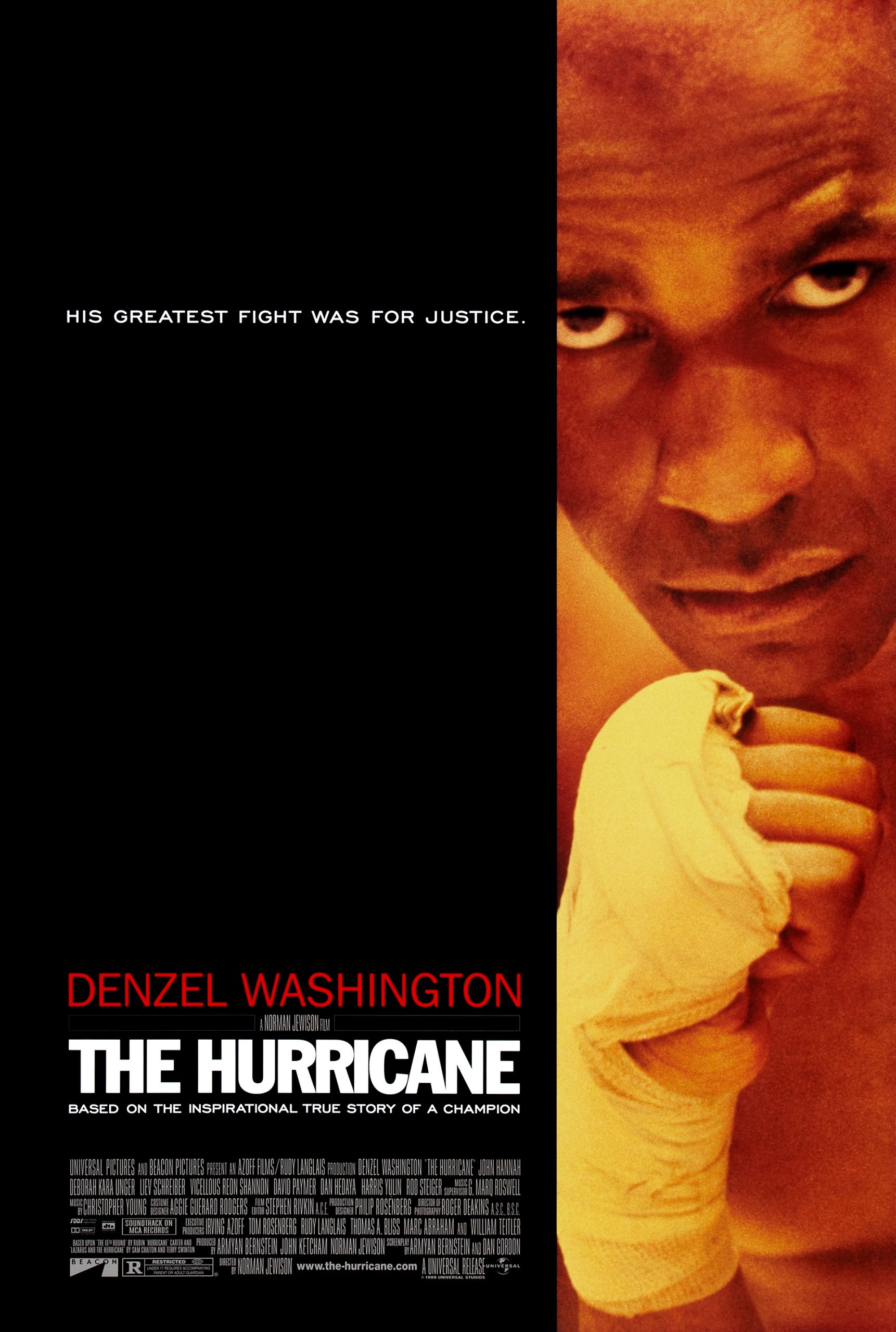
Starring: Denzel Washington, Vicellous Reon Shannon, Deborah Kara Unger, Liev Schreiber, John Hannah, Dan Hedaya, Vincent Pastore, Rod Steiger, David Paymer, and Harris Yulin
Grade: A
Though it’s unimportant in the grand scheme of things, the fur coat Carter dons going into the final trial is style personified. It’s like Denzel was channeling Frank Lucas years before playing him.
Summary
On December 20th, 1963, boxer Rubin “Hurricane” Carter (Washington) takes on Emile Griffith (Terry Claybon) for the welterweight championship. We then cut back and forth between this match and Carter at the Trenton State Prison in 1973. While in his cell, he prepares for the incoming guards about to attack him. He uses everything in the room for extra padding and puts them in his pants, over his head, and mouth and such, so he can absorb punishment. Going back to the match, Carter beats Griffith 2 minutes and 13 seconds into the first round by knockout. In the prison all those years later, a guard named Jimmy (Clancy Brown) stops the other guards from entering Carter’s cell, so he can talk to him instead, as they are friends. Jimmy is able to calm Carter down for a moment, and he asks him what’s wrong. Carter explains they are going to “toss my cell” and find his manuscript, but the book he’s working on is the only thing he has left. It’s the only chance he has to get out of there. Jimmy bypasses this and says he has to be the first person to enter his cell, so Carter tells him to line all the guards up because he’s ready for a fight. Jimmy wonders of the possibility if the manuscript wasn’t in the cell when they tossed it, implying Carter can hide it on him. Plus, Jimmy can make sure Carter isn’t strip-searched. He gives Carter his word. Carter agrees to comply, but he lets him know that no one is allowed to touch him, and Jimmy agrees. After a moment of silence between them, Carter asks Jimmy if he thinks he killed those people. Jimmy doesn’t know.
Flashing back to 1966 in Paterson, New Jersey, two men enter a bar and gun down the people inside. Alfred Bello (Pastore) sees the figures run to their car from across the street. Once they leave, Bello runs inside the bar to see what happened. Not long after, Carter and his friend John (Garland Whitt) get pulled over by a cop named Theo. John assures Carter he hasn’t been drinking, so Carter tells him that he will handle this. Carter and Theo are friends, so Carter asks what’s going on. Theo details that they are looking for “two negroes in a white car”, and Carter sarcastically asks if any two will do. Two more cop cars drive over to corner John’s car from all sides. Next, Carter and John are taken to St. Joseph’s Hosptial by the police. They are taken to a bloody man mid-surgery, and a cop asks the man on the table if he can identify Carter and John as the men who shot him. The guy can barely breathe, so Carter comments the guy said “No”. The cop tells Carter to move in closer, and Sgt. Det. Della Pesca (Hedaya) tells the guy to take another look at Carter. Carter knows Pesca all too well, as he’s been trying to get Carter in trouble for years. He calls Pesca out on it, and Pesca continuously yells at him to shut up. Carter knows he’s trying to pin these murders on him, and Pesca confirms it. He doesn’t care what accolades Carter has accomplished as a boxer. Unfortunately, Pesca won this round. All these years later, Carter is in prison for the murders, and he spends his time working diligently on his manuscript for his eventual book, The Sixteenth Round: From Number 1 Contender to Number 45472. In Toronto, Canada, 7 years later, Lesra Martin (Shannon) walks with Sam (Schreiber) towards a used book sale. Lesra can’t believe there are that many people there for a measly book sale while Sam talks about the positives of it. Inside the book sale, Lesra finds an old copy of Carter’s book and buys it for a quarter. It’s so cheap that he wonders how good the quality of the book is. Terry (Hannah) drives Sam and Lesra back, and he asks Lesra what book he chose. Lesra isn’t aware of Carter. All he knows is that the book is about some boxer. Still, Sam tells Lesra that “Sometimes, we don’t pick the books we read. They pick us”.
Terry drives them back to the place where they all live with roommate and co-worker Lisa Peters (Unger). The three have been homeschooling Lesra for the last eight months, and Lisa is on the phone with Mr. Broden of the Department of Education, who wants to stop the homeschooling because he can’t find Lesra’s high school records. Lisa hangs up in frustration after Terry, Sam, and Lesra walk in. Lisa asks Terry if he got The Other America at the book sale for her, but it wasn’t there. Lesra excitingly shows Lisa his book and gets to reading it soon after.
It begins with Carter talking about his childhood, a childhood he notes he “survived”. Paterson was a run-down city, and Carter details how the only way to survive was to learn how to handle yourself. In a flashback sequence, we see the 11-year-old Carter with his friends. They run by in the downtown area, steal some clothes, and mess with people before going to some forest area. Some old man appears and tries to molest his friend Donnique, so Carter throws a glass bottle at the guy and knocks him down. The kids start running away, but the guy catches Carter. He attempts to throw Carter into the nearby waterfall, but Carter is able to stab him with his switchblade several times and escapes. Sadly, Carter is later arrested and brought in for questioning. A cop named Ralph details Pesca on the situation, and both racists determine that Carter is a problem child. After Ralph comments how he knows what happened at the falls and tries to grab Carter, Pesca takes over. He asks Carter if he tried to rob the old guy of his gold watch, the guy fought back, and Carter stabbed him. He questions if there was anything else to it, assuming that the man’s story was true. Carter says he didn’t do anything. Pesca talks about how the man he stabbed is an important member of the community, and Carter is going down for what he did. Pesca promises to see to it personally. At the trial, Judge Anthony Rizzoli condemns Carter’s actions and says he has to be dealt with now. Otherwise, he will be dangerous as an adult. He even adds that he wishes Carter were older, so he could send him to the state prison. With this, he sends Carter to the state home for boys in Jamesburg from that day until he becomes 21. Those 8 years in Jamesburg was where Carter learned how to fight for his survival. Reading this in Carter’s book, Lesra thinks back to when he was at home in Brooklyn with his parents and when Terry, Sam, and Lisa met with them. Lesra’s father isn’t too pleased talking to them. Still, Sam talks about Lesra’s abilities and enthusiasm about learning and how he wants to go to college. Lesra’s mother notes how smart he is. Sam agrees, though he reveals to them that Lesra can’t read.
Lisa chimes in to say they can work with him intently for two years and get him ready for college in that timespan. Lesra’s father gets angry with the idea for some reason. Terry suggests Lesra stay with them since they have the room and they can teach him, adding that no one is here to replace Lesra’s father. Lesra’s father asks Lesra if it’s what he wants. Since he wants to go to college and sees this as his path, Lesra confirms this. Lesra’s father lets him, but it doesn’t stop him from making Lesra feeling bad about wanting to go to college. Lesra’s little brother Elston wants him to stay too, but his mind is made up. Flashing forward to Lesra reading Carter’s book again, he picks up right where he left off talking about Jamesburg. After 8 years there, Carter finally escaped the place. From there, he went straight to serve in the U.S. Army. During this time, he overcame his stutter and became a prizefighter. He came back to Paterson as the All-Army European Welterweight Champ. Soon after, he enters a bar. Mae (Debbi Morgan) and Judy take notice of him, and Judy tells her that Carter is a local from the area. Carter walks over to talk to Mae, but a man sits right in the seat he was about to sit in and talks to Judy. Carter threatens to beat his ass, and the guy gets up to face him. Fortunately for him, the guy’s friend calms him down. Mae intervenes as well and invites Carter over to dance with her. They hit it off immediately. He takes Mae back to her house and kisses her goodnight. He opens the door to leave, but two cops knock on the door looking for him. He’s confused as to why, and they grab him and bring him over to the car. There, Pesca is waiting for him, smugly questioning if Carter thought they weren’t going to find him. He adds that Carter still owes him time, and Carter is taken to prison. From that moment on, Carter made up his mind to turn his body into a weapon. He reignites his boxing training while studying hard, referring to himself as a “warrior-scholar”. To focus entirely on these two goals, he gave up everything else inmates would consider a luxury like movies, cigarettes, porno magazines, and anything else.
During this timeframe, he started to hate everyone and everything. On September 21st, 1961, Carter was released and vowed on everything holy that he would never come back to prison again. He spent almost half his time on Earth in jail at this point.
Back with Lesra, he is woken up for breakfast and Carter’s book is still on his chest. At the table, Terry asks if he got any sleep because his light was on all night. Lesra admits he can’t stop reading the book because it’s like it’s about his own life. Next, he asks why the three decided to get him out of Brooklyn and dedicate all their free time into helping him. They joke around with their responses, but Lesra gets serious and questions if they did it because he’s black and couldn’t do any of these things for himself. Lesra points out how Carter did everything himself. Lisa tells Lesra they didn’t do it because they felt sorry for him. They did it because they got to know him and realized he could accomplish things with help. She’s sure Carter had some help along the way, arguing that no one does things alone. Also, Sam points out that no one can learn anything for Lesra. He’s doing it himself. After this, Lisa goes to answer the phone, and Lesra talks to Terry and Sam about putting up a heavy bag because he feels like punching something. Later, Lesra is hitting the heavy bag with Terry and Sam outside while Lisa is inside reading Carter’s book. We flashback to Carter getting into professional boxing and specifically his fight with the undefeated Joey Cooper. Carter upsets Cooper in Round One. After the fight, Carter attends a party thrown in his honor, with him being named “Fighter of the Year” by the Sportswriters’ Association of New Jersey. By this time, he’s married to Mae Thelma and escorts her to the party where a bunch of reporters and fans are awaiting him. Inside his car nearby, Pesca watches Carter enter in disgust, still calling him a criminal and such. Sometime after, he’s sitting with a reporter in a bar discussing the riots, along with Carter’s friends Bucky and bartender Ed (George T. Odom). The reporter questions why Carter isn’t out there to protest what the cops are doing, so Carter jokes about considering killing some of the racist cops to make the reporter feel uncomfortable before he starts laughing. He tells the reporter that this comment was off the record, and Ed reiterates it. The reporter agrees, but the three men look at the reporter suspiciously.
One night, someone throws a brick through Carter’s window, waking up him, Mae, and the baby. Whoever did it drove off, and Mae gets angry with Carter because it was about his “off the record” comments that were printed anyway. She doesn’t want him talking about this sort of stuff publicly and chalks it up to his pride, and he doesn’t back down, confirming his pride is important to him. On December 14th, 1964, Carter is in Philadelphia fighting for the Middleweight Championship against Joey Giardello. It takes 35 minutes for the judges to come to a conclusion on the decision, and the commentator is confident that the clear winner is Carter. Unfortunately, Giardello is declared the winner by unanimous decision. A lot of the crowd starts to boo over the decision, and Carter walks away in disappointment. Afterwards, Carter is partying with a bunch of people at a bar, and John approaches him for a ride. Carter gives John his keys and allows him to drive his car, as Carter has been drinking. Of course, this leads to the moment where the two were pulled over and accused of murder from earlier in the movie. Carter and John are taken back to the bar where the murders happened, and the witnesses of Bello and Bradley tell the detective that Carter and John aren’t the guys. Later, they are taken in for questioning, and Pesca tells Bello he was in violation of his parole, but he doesn’t want to talk about the burglary he was involved in. Noting this, Pesca then turns on the tape recorder and says there was no proof of the burglary taking place, slyly doing this favor for him so Bello can help out with the case. Bello and Bradley understand what he wants. With this and the tape recorder going, Pesca asks if Bello can see any scenario in which Carter was the one involved in the murders, and Bello confirms it. Retelling his story, Bello remembers going out for a pack of cigarettes, he heard a couple of gunshots and saw two black men exit the bar. With Pesca coercing Bello into saying it, Bello says one of the men was Carter. At the trial, Judge Larner (Merwin Goldsmith) notes that though Carter has been consistent in his pleas of never committing these crimes, he was given a “full and fair trial by a jury of your peers”.
Unsurprisingly, all his “peers” on the jury were white people. Carter and John are found guilty on all charges. They are both given life sentences as John starts to weep. Mae is also hysterical.
In prison, the warden gives him the rundown of what’s about to happen, but Carter refuses to comply because he will not wear the clothes of a guilty man if he’s committed no crime. The warden tries to get tough with him, but Carter still refuses to put on the uniform, so he’s taken to the hole for 90 days right out of the gate. He’s even wearing his suit still. During this timeframe, he loses his mind and argues with himself while trying to fight off his aggressive side. Eventually, the 90 days are up, and he’s released from the hole. This is where he meets the guard named Jimmy. He tells Carter to shower up, and they can get him a cell with food and a bed. Once Jimmy confirms he will be wearing the uniform after his shower, Carter tells him to put him back in the hole because he still refuses to wear it. Jimmy tells him he could die down there, but Carter argues the same about being in a regular cell. Jimmy brings up the possibility of getting him pajamas from the prison hospital instead. Since it’s still prison-issued clothing, it would be cool with him. Since there aren’t any stripes or numbers on them, Carter accepts this, and they thank each other. Carter starts his journey. With this, a new strategy came to mind. He didn’t want anything or need anything that could be deprived from him. If punishment consisted of being locked in your cell, he chose to never leave his cell to deprive them of that weapon. He would not work in their shops or eat their food. He would study, and he dissected his entire case piece by piece, beginning with his initial arrest, the trial itself, and the verdict. Flashing forward to 7 years later, Carter is on the phone with his lawyer Myron (Paymer) detailing how he didn’t get a trial free from constitutional error and racial prejudice and everyone knows it. Carter demands a new trial and hangs up. During this time period, the media picks up Carter’s case and protests and demonstrations start to happen with Muhammed Ali, Joe Frazier, Ellen Burstyn, and Bob Dylan all there speaking on Carter’s behalf or making appearances. Mae makes a conjugal visit to tell Carter the good news, but he’s not very jovial considering how much time has been lost.
At this point in time, they’ve now lost two trials, and Carter recently lost his request to appeal. He has come to the conclusion that he has lost his fight and will die in prison. Mae tries to give him hope to hang on, but Carter doesn’t see a way out. He wants her to divorce him and to not visit him anymore. He doesn’t want to be the weight around her neck. When she says he isn’t, he tells Mae that she is the weight around his. She refuses to walk away, but he insists she let him go. He hangs up on her and walks out as she cries. At this point, Carter chooses to live only in his mind and spirit. We go back to the current timeline with Lesra finishing Carter’s back aloud, reading it to Lisa, Sam, and Terry. Right when he finishes it, he asked them what they are going to do about the innocent Carter. At this point, he’s been in prison for 15-16 years. Terry points out that Carter has said he’s innocent, which doesn’t prove anything. Sam adds that two juries found him guilty, but Lesra responds with how they were two white juries. Lisa argues that not all white people are racist, so Lesra counters with how not all black people are murderers. Lesra decides he wants to write Carter a letter to tell him how much the book means to him, and Sam nods. Lesra goes to his room to start writing his letter. Lisa gives him $10 to send in the letter to give to Carter in the case that he might want to write him back, giving him money for stamps. Eventually, Lesra sends the letter to Carter, and Carter becomes moved by it and writes back to him.
With this continued correspondence, a friendship begins. It’s the first step in inspiring Lesra to reignite the movement to free the innocent Carter once and for all.
My Thoughts:
Here comes the story of “The Hurricane”, and it’s a powerful one.
Norman Jewison’s moving biopic is a fascinating depiction of the life of Rubin “Hurricane” Carter, a former boxer whose legacy outside of the ring became more important than what he did in it. In a disgusting display of the American justice system at its worst, The Hurricane starts out as a harrowing tale of the constant presence of racism and unfair treatment this man faced his entire life and how this attitude shaped what he would become in his early years. Nevertheless, the spirit never wavered, resulting in the second half of his life, changing the film into that of an emotionally charged, soul-stirring internal battle Carter faces in overcoming the system once a brave group of people listen to his story and aid him in his quest to prove his innocence. Criticism has been sent its way over the years for certain aspects of Carter’s life being toned down, some facts being omitted entirely, and some notable historical inaccuracies in the story told. However, this should not be used to disparage such a good and at times, great film, especially since most, if not all biographical films do this in one way or another. Going down this route is an otherwise lazy way of critiquing such a beautifully told narrative and overall well-done production. The Hurricane is an inspirational drama detailing the life of an innocent man who finds himself in a war against society itself. It began when he was just a kid and continued into well past the prime of his life. Any average man would crumble under such dark and consuming pressures, but “The Hurricane” was no average man. With an Oscar-nominated performance from Denzel Washington in one of his most captivating roles, The Hurricane is one of the most underappreciated biographical films of its era.
Though it feels like it’s been said with almost every one of his succeeding films, Denzel Washington is mesmerizing in the title role. Capturing the trials and tribulations that Rubin Carter had to go through in a gripping performance both fierce and sorrowful, one could argue that this is Washington at his best, which is saying something when you take his entire career into account. Washington has a right to think he earned that Oscar over Kevin Spacy in American Beauty, all things considered. Right from the opening, the nonlinear narrative gives the audience a quick glimpse into the different stages of Carter’s life and mentality while showcasing the depth and versatility of Washington’s performance. With the way the story is told, it’s the type of role every actor would wish to play because it challenges them in attempting to tackle every emotion in the book along with playing a complicated, imperfect, real-life figure (“I’m in the penitentiary for murder, not attempted adultery”). It’s a difficult thing to pull off effectively and as authentically as Washington does in The Hurricane, but it’s a testament to his abilities as a thespian and why he’s one of the greatest of his era. At first, we see Carter in his early years. After escaping from Jamesburg and going straight to the military upon his exit, Carter comes back to New Jersey as a smooth and confident young man. He’s also tough as nails, possessing boxing experience he gained while in the army where he achieved great success. Per usual, Washington exudes confidence as Carter walking into that bar upon his leave from the army, and he shows he’s no joke, ready to beat the hell out of the first man that disrespects him by taking his seat. Thankfully, Thelma Mae calms him down and takes him over to dance. At this point, we see how Carter has evolved in these few short years. He put Jamesburg behind him and though he’s no pushover, he’s not the violent youth in need of guidance that he was portrayed to be. Not long after, the first run-in with Della Pesca post-Jamesburg happens, solidifying this never-ending battle between Carter and this racist detective who has an undying hatred for him. Pesca was based on real-life detective Vincent DeSimone, and it’s hard to say how accurate the portrayal of the real man was.
However, if it’s any way similar to the antagonist of this movie, this was one evil man. In a performance that goes under the radar in the grand scheme of things, Dan Hedaya is despicably good as Della Pesca. He’s so unnerving as Carter’s nemesis that it practically turns Carter into an angelic figure compared to Pesca’s demonic one. It goes without saying that the real Carter may not have been as perfect as he’s depicted here, but Jewison’s presentation of these characters allows Carter to be this sympathetic hero to the point where we don’t care about every detail of the realities of the situation. We just want Carter to get a fair trial, especially to stick it to that son of a bitch Pesca. Really, it’s a biopic done right, winning the viewer over by showing the unfair tactics Carter had to face his entire life. Following him kissing Thelma goodnight, it’s as if he put everything behind him. Then, he walks out and is immediately arrested, with the smug Pesca talking trash about how Carter thought he wasn’t going to be caught from escaping Jamesburg. Despite Carter putting this life behind him, he is thrown right back into it and has to deal with real prison time as a result. It changes him. He uses the time to weaponize his body, mind, and soul. Along with reigniting his boxing training, he starts studying hard to improve his mental game to make it as great as his physical gains. Showing the dedication he has and the mental fortitude that separates Carter from others, he gives up everything he considers a luxury during this timeframe, setting him up for how strong he will become in the future. Once he’s released, he vows to never go back. Through narration from his book, Carter details how he’s spent half of his life locked up. This is before the murders mind you. This by itself shows how dark Carter’s story is and how his worldview and perspective on society is much different than anyone has ever encountered. Knowing the transformation Carter faces in this point in his life, Washington matches it in every aspect by being in peak physical condition in trying to recapture the prime days of “The Hurricane”. He is a star in that ring, and it’s magnified by the presence of Denzel Washington. For those sports movie fans, keep in mind that the boxing sequences are few and far between because it’s not really the focus of Carter’s story.
Plus, some of the details are messed with to paint Carter as a dominant boxer that only lost his biggest fight against Joey Giardello due to racism. In reality, it’s well known that Giardello won definitively on both boxers’ accounts, and Giardello sued and eventually settled with the producers of The Hurricane for libel over the depiction of their fight. Nevertheless, this is more of a fun fact. Even if that wasn’t necessarily true, the way the sequence happens on film serves the narrative of The Hurricane well, inciting more of the vitriol we have for the challenges Carter continuously faces in the 1960s and 1970s. It makes scenes like Carter fighting to Gil Scott-Heron’s “The Revolution Will Not Be Televised” in black-and-white iconic, with Scott-Heron’s poetic words matching the anger and realities Carter faces on the mat and in real life. Following all of this, Carter has become a beloved celebrity around town but not by everyone, as Pesca still looms in the distance in an Emperor Palpatine-like manner, plotting and praying for Carter’s downfall. In a few moments of happiness, Carter enjoys himself at a bar, not realizing that the worst moment of his entire life was about to commence. That night, his life is turned upside down by being accused of murder, and after a trial with an all-white jury, Carter and his friend John are sent to prison for life. For the record, John is nearly forgotten about despite facing the same sentence Carter receives (minus one note of Carter praising his strength down the line for not lying and putting it all on Carter to get out). As stupid as it sounds, every time we went back to Carter in prison or talking to Lesra throughout the follow-up trials, I kept thinking, “Hey, what about that other guy?”. Is he not a part of this? Did these Canadians forget about him? Shouldn’t he be a part of all these visits too? I know John didn’t write a book, but he deserves some respect, right? For some reason, he’s kind of just thrown to the wolves when all the poor kid did was give Carter a ride that one fateful night. Most of the historical inaccuracies can be bypassed because the story is told so well but forgetting about John is a lot more frustrating in comparison.
Regardless, the film becomes something else entirely once Carter goes back to prison. Trying to stay a dignified man who refuses to conform or relent to his guilty plea, Carter sets the tone by standing up to the warden upon his entrance and refuses to put on the clothes of a guilty man. It’s in this moment that we see the hero Carter is, drawing a daring line in the sand as soon as he steps in a prison that he may be in for life. It would be easy to accept his situation to make things easier, but his spirit is too strong, something that has and will always define the man. He’s sent to the hole with his suit still on, and that moment not only mentally changes him, but showcases Denzel Washington at his most engrossing. As stated in the opening of this review, this role is that of an actor’s dream, with Washington’s scene in the hole showing why. Cracking in the constant darkness with his hair growing to show the time passing, Carter’s mental state splits and he starts arguing with different aspects of his personality, the no-nonsense tough version ready to fight, the scared version, and the thoughtful version. All three battle for places in his head as he tries to stay strong without feeling sorry for himself. In the shadows, Carter peers in and out, switching back and forth by yelling at himself “You fucked this up for everybody!” and himself responding with “Who is that?”. He’s trying to push down the hatred, but it’s too powerful and teeters with consuming Carter whole, with the quick cuts showing how fast the conversation is happening in Carter’s head. He tries to tell this dark Carter how he’s scared, but this Carter yells at him to shut the fuck up and how “I’m running shit here!”. It’s mesmerizing and a Grade “A” masterclass of someone on the verge of losing their mind but putting everything they have into fighting it (“What are we gonna do now?” – “I don’t know”). The viewer will hold onto every word. As he’s scared, we’re scared for him. When he’s angry and telling himself “I can feel the hate”, you can’t help but internalize these feelings because we know what he’s been through and how life has treated the man up until this point. Can he overcome such all-encompassing adversity?
The suicidal thoughts can’t help but take up space in his head when in the hole, like when he states “I wanna kill somebody” to which his angry self reminds him that there isn’t anyone in that cell but him. He has to literally yell at his inner voices “Get away from me!” before weeping. This is when the man and the film evolves from an intriguing drama into a spellbinding, award-worthy feature that demands your attention and action. It evokes a reaction in the viewer to become stronger themselves after seeing Carter refusing to be forgotten and continuously fighting, despite being wasted away for 20 plus years. How can we complain about our everyday lives after seeing the examples of sacrifices taken and the adversity against all odds that were overcome in The Hurricane? These are the types of conclusions one reaches once the end credits roll. Leaving the hole and moving back into regular prison life, Carter had a choice, but that spirit and dignity again refuses to waver. Despite how much damage it did, he refuses to wear the clothes of a guilty man. Thankfully, he accepts the hospital clothes instead on guard Jimmy’s insistence and because its different from the other prisoners. In just this early example, the mind proves to be stronger than we initially realized and may have given credit for. Because of moments like these, Carter evolves himself to continue down this path of unwavering strength and mental fortitude. He takes away their power and lives through his mind. He deprives the prison of their punishment by refusing to allow them to, making us understand how powerful Carter or anyone can be if the discipline and ideals are strong enough. He transforms into the most commanding version of himself detailing to the viewer that there is no more Rubin, no more Carter, only “The Hurricane”. It’s the only way to win this fight, the fight of his life. Still, he struggles, as any man would. He finds himself at his second lowest after losing subsequent trials, but there is a certain strength in his telling Thelma to move on and divorce him. He loves her and appreciates how she’s stuck around, but she can’t move on in life if every waking day is spent thinking about her husband behind bars. She will live in sorrow and misery. How strong of a man do you have to be to tell your wife to go on without him because there is no end in sight?
That face to face they have was emotional on a whole other level. At first, you can’t believe he would call her the anchor around his neck, but a second thought makes the viewer realize what is happening and what he’s trying to do. Just as he sees himself being this figure in Thelma’s background that won’t allow her to progress in her own life, Carter having to worry about her while inside is effecting him just as much. The emotional toll it’s taking on the both of them may not be worth it if he fails in his battle, and it would be unfair to either of them to continue down this path if there is no end in sight. It’s a terrible sacrifice Carter has to make, but it has to happen. In his situation, Carter also wants to remove anything from the outside to focus entirely on overcoming his battle. Sadly, this includes his own marriage. It’s not fair to her to have to worry about him, so he forces the action with this emphatic response (“I’m dead. Just bury me, please.”). All hope is not entirely lost but Carter is aware that it’s deadly close. On the verge of tears, he forces her to move on no matter how much she protests. That’s tougher than any battle most of us will face in a lifetime, but Rubin Carter has several moments in his life that would defeat any regular man. Remember, his cynicism is rooted in reality because of what he’s faced, and it gets to the point where he can say something like “Innocence is a highly overrated commodity” and even the most optimistic person in this world can’t help but see his perspective. None of us have been through what he’s been through, so people like the Canadians have no right to tell him otherwise. They can try and help all they want, but he’s the one doing the time. Carter is the one who still has to keep a brave face when he loses his appeal. Though he tries to stay strong, it’s exponentially difficult after suffering so many losses in a row (“I appreciate your kindness. I’m a prisoner. My number is 45472” – “The key to my survival lies in my ability to do the time”).
If anyone has any doubt in Washington’s should-be Academy Award-winning performance, watch that final meeting with his two lawyers in the “It’s time to move on” scene. The line delivery of “I’m 50 years old” before Carter storms off and mumbles his frustrations on how they need to go federal with the case because time is running up is one of the best of the decade (“Now either I get out of here…get me out of here.“). From an acting standpoint, it’s awe-inspiring. It’s the type of scene they show in a career montage of a star’s best performances. Another great example of this is when he’s gifted his old robe by Lesra and the Canadians, and he again fights his inner voice because he is afraid of letting these people in (“Don’t trust ’em Rubin”). His angry voice questions if he would trust a bunch of “white do-gooders” more than his violent self. The voices argue again. Part of Carter tells himself not to trust them, but the other part of Carter tells his hostile self to go, as he shadow boxes the hate and pain away as if he’s metaphorically taking on his real-life fight by physically boxing the air. It’s a great turning point of a scene that only adds to the performance.
Lesra, the “B” story involving his life, and how he gets to play this major role in Carter’s life is crucial in telling the story of The Hurricane, but it’s nowhere near as compelling at it needs to be to keep the momentum up of the movie. Plus, it yields more questions surrounding Lesra’s background than anything since we’re not nearly as attached to Lesra than we are Carter. It just makes the viewer question why these three Canadians single him out as this person of potential and why he looked more promising than any other random kid from Bushwick. Okay, so he has enthusiasm for learning. Is that it? How do they see someone who doesn’t know how to read but look past it because of “potential”? What was their indication that he could succeed and was a better choice than someone else? This isn’t a criticism in who Lesra Martin is but rather how he is portrayed on film because simplifying how he came into the picture does his character a great disservice. His backstory is overall confusing, and some details seem to overly dramatized to the point where you wonder how overplayed it all is. For instance, the whole flashback sequence of Lesra’s parents meeting with Lisa, Sam, and Terry just comes off as strange. We get Lesra’s parents are alcoholics, but Lesra’s father’s reactions in particular have no rhyme or reason as to why he’d respond in such a disruptive manner. The three talk about Lesra in a positive light and mention how bright of a future he has if they can help him along the way, and Lesra’s father accuses them of trying to replace him as Lesra’s dad. Then, he comes off as almost hostile over the fact that his son is trying to make a future for himself, making him feel guilty for it when he is walking with Lesra and his other son and future convict Elston. What the fuck is his problem? There has to be more of a reason for someone to react this negatively for their child having the audacity to succeed in life. I understand there are aspects of the movie that are fictionalized to tell this story in such a specific way, but this part felt almost insulting to increase sympathy for the Lesra character in an almost parody-like way. Who would sit there and argue, “No son of mine is going to college!”. What would one get out of doing that?
Going along with this note, what is the deal with these Canadians? Even Carter is skeptical of Lesra’s friendship with them (“Just yanked a brother up and took him to Canada. Just like that”). Lesra tells him they talked to his parents, and Carter questions if they are religious, hippies, or in a commune, which are valid questions really, but Lesra reveals the only detail we learn about their overall story in that they fix houses and sell them. They’re just people. Apparently, that’s it, but there is no way it’s as simple as that. Why would they take some random kid they don’t even know, pay for his travel, housing, food, his passport, and whatever legal stuff they would have to figure out, to move a teenager into a different country to live with three adult strangers, and they don’t get a single benefit to doing so? You’re telling me they did everything out of the goodness of their hearts like a trio of white knights? Carter is right to be suspicious of the details because this matter is never cleared up with the audience either. Anytime they get to Lisa, Sam, or Terry and their lives, something or someone changes the subject before we can understand why they have this undying motivation to help Lesra and then subsequently Carter to the point where they move to the United States and set up camp nearby to dedicate YEARS to help free Carter from prison with their own pseudo-detective work. Where are these skills even coming from? All we know is that they flip houses. How are they qualified tutors and amateur private investigators? It’s cool to see how they unpack the case and see the inconsistencies and lies told by the witnesses, but where is this coming from? Determination can only get you so far. There needs to be an explanation on a lot of the supporting cast and their roles in the story, but the lack of it is astounding. It’s still great to see them win Carter over because of how willing they are to help him (“We’re all in this together and we’re not leaving until we all leave” – “You’re beautiful”), especially after the thoughtful moment they share in moving to the States near the prison and flickering the lights on and off to show Carter how close they are, but something about the details of their lives seems far-fetched.
The developing friendship between Carter and Lesra dominates the second half of the film, but it’s just another example as to how multi-dimensional the movie is. It can go from a boxing movie, to a prison movie, to a detective movie, to an inspiring story between mentor and student in a heartbeat, but it never loses sight on its ultimate goal. It’s balanced to an incredible degree. As exciting as the other parts of the movie are, some of the best and most poignant moments come from the meetups between Lesra and Carter. Though they are visually the most stagnant, they are still the most powerful. It’s the capturing of Lesra being in awe of the aged and wise-looking Carter when meeting him for the first time, and the both of them being fearful for how their meetup will turn out to be that draws the viewer in. Many of us have talked about meeting our hero for the first time and how scary it could be, and they depict it beautifully here because the audience can sense the uneasiness between them due to the unknown, especially when Lesra comments how he thought Carter would be bigger and Carter is serious in saying that he’s bigger than Lesra but to not tell anybody. At first, we’re not sure if he already pissed off Carter, but then he changes his tune by laughing and inviting him to sit down with a warm, welcoming smile. It puts everyone at ease due to the charismatic Washington. Carter gives him credit for having the courage to come down to the prison by himself, so Lesra admits he was scared Carter wasn’t going to let him come down. Carter replies “Me too” because despite how strong of a man he is, allowing a stranger to come into his world when he’s been so guarded his whole life is a daunting task for anyone. However, he’s strong enough to reveal all the things he’s frightened of like the doors opening, the lights outside, and Lesra himself. The open and honest dialogue between them is passionate and invigorating stuff, fueling the inspirational themes of the film even more.
It’s like when Lesra admits that he doesn’t see his parents much because it’s hard, but Carter responds by saying he gave them hope with what he’s done and how he shouldn’t feel bad for moving on because “It is important to transcend the places that hold us”.
Carter is filled with life advice and overall wisdom. Even for writers, creators, and artists, his words about the magic of writing and how its a weapon “more powerful than a fist could ever be” are influential. Towards the end, Carter asks Lesra the same question he asked Jimmy at the beginning of the movie in that if he thinks he killed those people. When Lesra says “No”, Carter asks why, to which he responds with, “I just know”. Right there, the bond is solidified. There is something spirited with how authentic they are with each other. This is their first time talking in person following all these letters, but there is this chemistry between them where they can just sense each other’s honesty and real selves. Neither is putting on a front for the other in their conversation, and that’s why they are able to trust and believe in each other. This is how real friendships develop. Sometimes, you can just sense someone is a good person, and this is one of those times. Not everyone has the ability to do this in real life, but when it happens, it’s magical. In The Hurricane, it’s portrayed beautifully. When the prison photographer assumes they are father and son, the two just go with it and take a picture without protest. That’s special. With that, the sunshine Lesra brings breaks through the dimness of Carter’s life, and he becomes thankful every day that Lesra reached out in the first place. It gives Carter a new lease on life when he was close to reverting back to the darkness. It’s the only reason why he can’t help but feel moved when Lesra reaches out to Carter to show him a picture of his girlfriend and his high school diploma, to which he attributes to Carter himself (“Your friend and brother forever, Lesra Martin”). It’s strong enough that the nitty-gritty details of proving Carter’s innocence through investigation becomes an enthralling experience that makes the viewer plead for the desired resolution of seeing him finally freed. It makes Carter’s confident words to Lesra before the final verdict stay with the viewer when he calmly tells him, “Hate put me in prison. Love’s gonna bust me out”.
Goosebumps, just pure goosebumps.
Thank God for that judge to hear them out. Also, it’s kind of crazy that the state of New Jersey still tried to appeal to the Supreme Court to get Carter back in prison. Sons of bitches really.
On a less important note, I couldn’t help but laugh during Carter’s conversation with the Congo-born Mobutu in the prison cell when discussing white people. When Mobutu says not all of them are bad, Carter gives him this look like he’s saying, “Are you sure?” and it’s hilarious. The visual of Mobutu’s mother being 4’1” and his Watusi father being 7’10” stays in my head rent free though.
Emotionally gripping, rousing in its narrative, and quite stirring all-around, The Hurricane is a wonderful biographical drama about the real life of boxer Rubin “Hurricane” Carter. With yet another award-worthy performance by star Denzel Washington, this under-the-radar story is guaranteed to move even the most pessimistic person in some sort of way. Remember, don’t give up hope. As tough as life can be and how fierce the opposition is that you may face, do not give up on overcoming your situation. It’s possible. It make take time, and it may take help and trust from others, but it is possible. THAT is the story of The Hurricane.


+ There are no comments
Add yours