
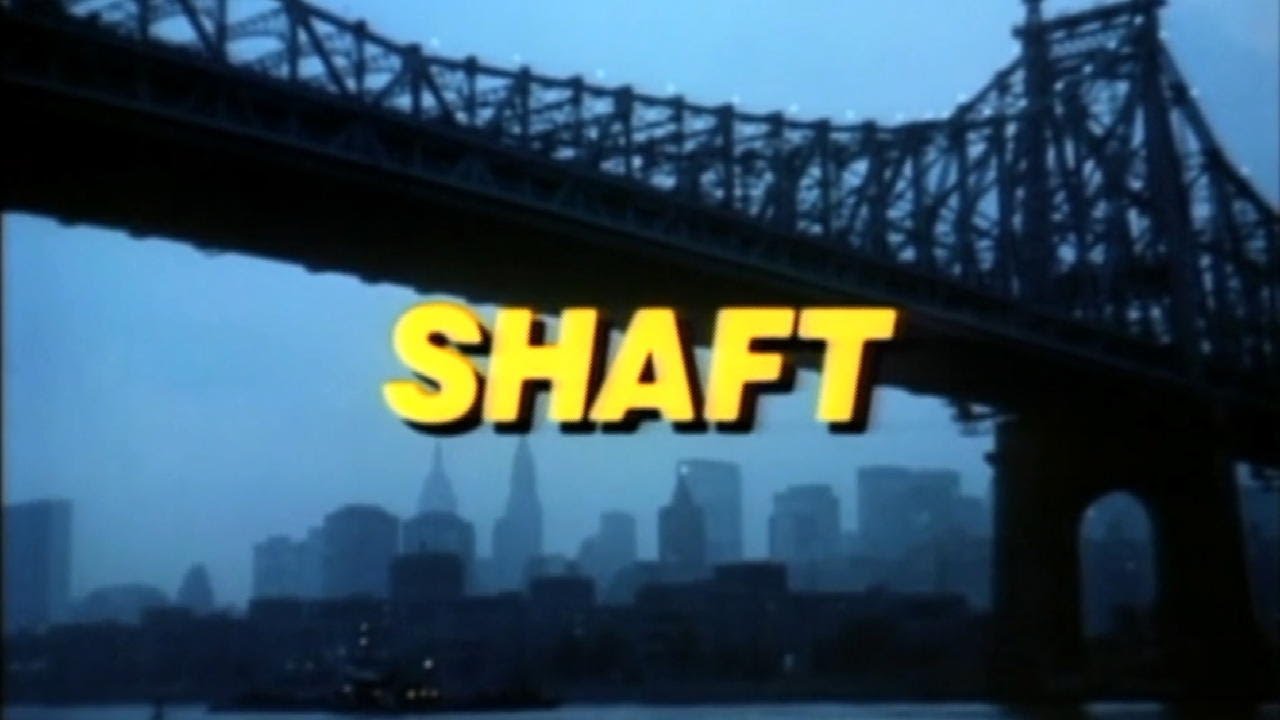
Starring: Richard Roundtree and Ed Barth
Grade: D
In just three years, we got Shaft, Shaft’s Big Score!, Shaft in Africa, and then the television series, Shaft. Piggybacking off the trilogy’s varied success and the cultural icon status of its main character, the decision was made to transition the character and star Richard Roundtree into TV star royalty at a time when the crime drama, mystery, police procedural, and private detective shows were all the rage. Though we’d much rather see John Shaft lighting it up on the big screen, the move made sense. If they were able to turn Shaft into one of the first black action heroes with the first movie, and later evolve him into the first black globe-trotting spy in Shaft in Africa, who’s to say he couldn’t be the first black lead in a detective drama on the small screen for CBS? If anyone could do it, it would be John Shaft. Unfortunately, the transition wasn’t what we thought it was going to be.
The pitch of making John Shaft a new Columbo type is worth the attempt, but the execution was poor. The team behind the Shaft television series either didn’t understand what made the character and the first three movies what they were, or they did know but didn’t believe it could succeed without watering down its identity. In effect, what resulted was a run-of-the-mill detective series that neither satisfied the fans of movies nor gain any new fans due to it paling in comparison to shows that do the formula better. The one thing the program could have had to set itself apart from similar shows like Columbo, Kojak, The Rockford Files, McMillan & Wife and McCloud is John Shaft himself. Who he is as a character and how he interacts with peers or adversaries is completely his own style, showcasing the Harlem attitude of toughness and resilience in the face of the rest of New York City as a whole. Stripping the character of these crucial elements to his personality and attitude takes away what makes him special, and the proof is in the pudding. The real Shaft could have found his niche alongside any one of those shows had they stuck to what made the franchise great. However, CBS just wanted to fit in rather than break the mold, and that’s what hurt it. Obviously, we know the series can’t have the same depiction of violence, language, and sex as the movies did, which is why the “Theme from Shaft” used in the show has Isaac Hayes’s lyrics removed, but that doesn’t mean the solution is to rip out the heart of the character. The edge can still be there! It just takes some creative maneuvering and a willingness to adhere to the foundation star Richard Roundtree laid with the character in the first place.
John Shaft wasn’t mean per say, but he had a dangerous aura, was stern, confident, and was suspicious of others and their intentions, and rightfully so given the time period and his line of work. When you’re a black private investigator running into skirmishes with criminals, the mafia, and the public relations nightmare that the NYPD can be at times, Shaft kept things close to the chest while building up his reputation as a tough, strait-laced man of the law. The only person he is friendly with besides the women he comes across is Lt. Vic Androzzi from the first Shaft, but he gives him shit too in an effort to still hold the upper hand in their unofficial partnership. In Shaft’s Big Score!, he becomes embroiled deeper in the war between the mafia and low-level numbers racket guy Johnny Kelly from Queens due to his friendship with Cal Ashby, and Shaft gets to the bottom of it due to his personal issues regarding his friend’s death and his relationship with Cal’s sister Arna. There, he still deals with Captain Bollin, another cop who hates Shaft despite them both trying to protect the law, and Shaft responds in kind to Bollin before solving the problem by kicking everyone’s ass his own way. In that sequel, he’s not really friendly with anyone since Androzzi is nowhere to be found. In Shaft in Africa, it’s the same deal. He’s only friendly with Aleme, a love interest who was strong enough to be his girlfriend in future installments but was sadly never mentioned again after the third film. As a fan, I’d like to think that Shaft was thinking about her in “Shaft and the Kidnapping” when he discusses with Elliot Williamson (Paul Burke) how he did love a woman once to where it was getting close to something, but she wanted him to slow down and transition into a normal work schedule, which Shaft wasn’t ready to do. He never names who the woman is directly, but if the timeline does follow the movies in the overall narrative, this would line up perfectly with Aleme. Nevertheless, Aleme is the only person he’s genuinely close with in the third movie. Besides that, it’s all business, as he’s recruited to stop a human trafficking plot.
Everyone else he comes into contact with is just an acquaintance. So, with the television series, it would make sense for John Shaft to have similar traits, especially since the show came out five months after the third movie. If the timeline is taken seriously and the show picks up right where the movies laid off, a stark contrast in the main character’s personality wouldn’t make sense. Sadly, this is exactly what we got. For some reason, John Shaft is calmer than ever before, and the production is lifeless compared to the usual, rougher energy a Shaft-related production usually has. Gone is the dangerous presence John Shaft had when he walked into a room in the first three movies. Now, Shaft feels like a different guy, a regular old investigator. It’s okay that he is more mature and collected, but it doesn’t feel like the John Shaft we fell in love with previously. He’s still a private detective, but he finds himself in and out of the police station in a friendly capacity in every single episode to the point where you’re wondering why he doesn’t just apply there. He’s even asked to be a witness for police secretary Laura’s (Judie Stein) marriage to Gerald Wallace in the final episode (Shaft and the Murder Machine). It makes you question what’s going on! Shaft is supposed to be a renegade, not working with or defending the establishment to the degree he does in this show! It’s a fundamental aspect of the character, but he’s practically a cop at this point. He is never seen going over the case at his apartment or his office, if it even exists anymore. Here, he’s basically just an unofficial detective on the force and is almost partners with his friend and series regular Lt. Al Rossi (Barth). Instead of the rapport he had with Androzzi in the first movie (the trash talking, minor tension, mutual respect, etc.), it’s nonexistent in the show. They’re buddy-buddy with each other outright. It feels wrong and almost crazy in a way based off of everything we were taught about the protagonist. It goes too far with it as well.
In one example, Shaft donates blood to save Rossi after he’s shot (Shaft and the Cop Killer), and Rossi bails Shaft out for $25,000 when he’s accused of murdering Sonny (Shaft and the Killing). What?! Who has that type of money for anyone, let alone someone who has rarely tried to hang out with you outside of work? Granted, Shaft knew Rossi’s wife too, so they were somewhat close, but it still doesn’t explain why Rossi was that willing to shell out $25,000 to save Shaft due to his own hunch that he’s telling the truth. They neuter Shaft’s edge that he has with the police in general, allowing for everyone else to give him shit, with him either laughing things off or just staring at them intensely. The only exception is when Shaft beat the hell out of Sonny in the parking lot, along with his cohorts, for calling him the n-word (Shaft and the Killing), but the key here is that Sonny was a pimp. In the best moment of the entire show, Grayson implies he will take Shaft out for trying to pry on his illegal gambling venture, so Shaft responds with a real Shaft line saying, “You know something Grayson? Being threatened brings out the worse in me” before pouring a drink on his table and staring at him while he does it (Shaft and the Hit-Run). You see the relation? They are still criminals, so it allows Shaft to take things a step further. When it comes to the police station and people who are supposedly on the good side however, he just takes it more or less, a far cry from the hero we know and love who is known to get in the face of cops when the situation calls for it. For instance, there’s no way in hell that the film version of Shaft would deal with such insulting pushback by Captain Brewster (Darren McGavin) in “Shaft and the Cop Killer“. It was so much that you’re fully convinced Brewster is a corrupt official almost to the final minute of the episode. Even when he reveals that he was actually a straight cop, you still don’t believe him. If he was actually a good cop, was calling Shaft a “mudslinging parasite” truly necessary when he was just trying to point Brewster in the right direction on the case?
Yeah, fuck off.
The fact that we never got to see someone punch that racist deputy who nearly cost Shaft the entire mission was outrageous too (Shaft and the Kidnapping). At the very least, Shaft should have flipped out on him at the end of the episode. Sadly, the sheriff makes it sound like he’s going to talk to the deputy rather than do anything significant. Shaft just smiles like this is satisfying somehow, but it’s all bullshit. The real John Shaft would tell that sheriff to bring that fucker out so he can yell at his lying ass in front of everyone! There’s also some continuity confusion too because Brewster claims he’s the captain of the precinct after finding Shaft ruffling through Rossi’s office while Rossi is in the hospital. However, in “Shaft and the Killing“, Captain Rigano (Val Avery) is running things and unsurprisingly, also doesn’t like Shaft. On an even more insulting note far off from the character, Shaft spends the first two episodes in sweater vests and ties with a suit jacket over it, and it’s appalling. Shaft wouldn’t be caught dead in such clothes. For such a minor detail, it was shocking how genuinely distracting this was because it made Shaft less cool, something that didn’t even seem possible three years prior. It’s something Walter Matthau would wear, not John fucking Shaft! It’s not until later in the show where his style comes back, but it’s still not on the level Shaft made famous. There’s not even one scene where he brings out the leather trenchcoat, and that’s just unacceptable! Fashion is an integral part of the character. It’s rather obvious, so them failing in this regard too is strange. On a side note, Shaft wearing sunglasses did not fit the look. Very rarely would you say that about a private detective or hero character not looking good with sunglasses, but this might be one of the rare instances of such a thing (Shaft and the Murder Machine). It made sense when he was trying to go undercover to create his “Johnny Woods from Chicago” persona complete with a toothpick (Shaft and the Cop Killer) but wearing it on a regular basis didn’t work. The silver car with the blue interior was very cool though.
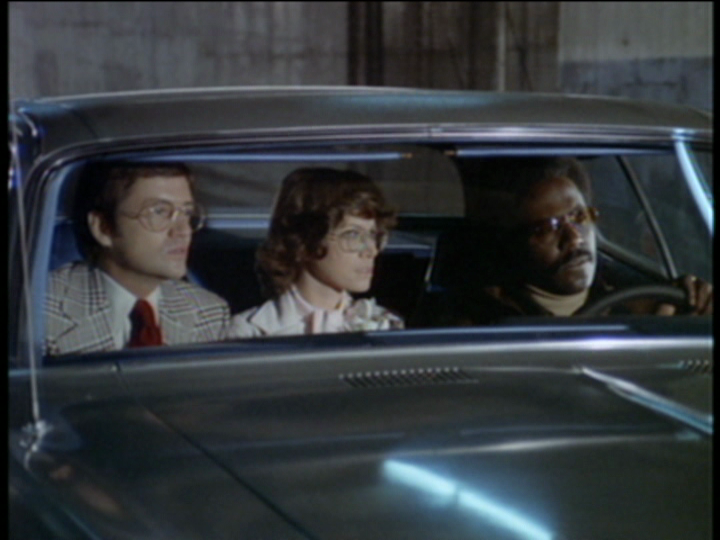
One thing the show did improve on was showcasing Shaft’s skills as a detective, as it’s the one thing the movies lack since they focus more on the action hero capabilities of the character rather than his intelligence and dedicated work as an investigator. This show serves to essentially show all the lesser cases John Shaft finds himself in on a regular basis. It does make the show relatively boring as a result because it’s just not what we’re looking for regarding a Shaft production, but it helps the lore of the character. For example, his way around the nun in the psych ward in acting like he worked there to call Dr. Helen Connors and getting her to reveal as much information through carefully placed statements to learn about Cunningham’s wife was great (Shaft and the Enforcers), as was the whole nail thing and the scarring in “Shaft and the Killing“, though it needed to be explained a hell of a lot better as to how he got there from a logic standpoint. His intuition and knack for suspecting the person who ends up being guilty by the end is damn near automatic, and Shaft’s ability to go undercover or trick the villains into thinking he’s joining up to figure out their whole operation is really well done too, showing off how much Roundtree has improved as an actor since 1971 (Shaft and the Cop Killer, Shaft and the Hit-Run). On a side note, he’s apparently forklift certified too (Shaft and the Cop Killer).
The only excuse I could see to explain Shaft’s “evolved” personality is if Shaft came back from the events in Shaft in Africa and was shook up about what took place, so he made a promise to himself to not pursue bigger international missions and “super spy” like activities because of how risky the last mission was. It could be something similar to Rocky Balboa’s reflection following the Ivan Drago fight in the opening of Rocky V, once he feels like he’s on the verge of death. Here, it could be a moment of reflection where Shaft tells himself that he needs to make a change in his life moving forward to try and be calmer regarding everyday cases once he realizes what was at stake in an emotional moment coming back from Ethiopia and France in such a crazy mission. It would be a major dramatic shift, and it would have to be acknowledged in the first episode “Shaft and the Enforcers” for the audience to understand why Shaft has changed so much. Had they done this to allow for the viewer to comprehend what Shaft has turned into, then it would have at least made sense. One line could have explained it! Not doing this and just jumping right into it when the last movie came out just five months prior is a slap in the face that’s strong enough to say disrespectfully, “This isn’t the John Shaft you remember. Sorry”. Then again, this suggested narrative to explain what John Shaft has become is only a way to give the writers an out. As much as this would have helped them for the goals of the show, this take still isn’t Shaft. Shaft coming home and being emotionally broken over what happened in Shaft in Africa isn’t something he would do. If anything, it would reaffirm the strong character’s motivations in his job and why he sees himself as the man who has to put an end to all these terrible people that exist in the world. Shaft looking vulnerable and taking a backseat in his work instead would give emotional depth to the character and would allow Richard Roundtree some room to show his improved acting skill, but it just doesn’t fit the character.
It would if this show happened in the 1980s and the character aged up because it would allow him to reflect on his past and acknowledge the horrors he saw in the world, but it’s illogical for it to happen 5 months after the last movie. Then again, if they were staying true to the character, his progression, and how that third movie broke open the possibilities for the character, this series should have never gone back to New York with Shaft returning as a regular private investigator. It should have turned into what we wanted all along. In an effort to raise the bar and expand the scope of the Shaft franchise, this series could have and should have picked up right where the Mission: Impossible series left off. It ended in March of 1973 that year, and Shaft started in October of that year. Shaft building on what began in Shaft in Africa and becoming an international superstar for television with world-saving missions was the next step or leap forward they should have made. Of course, there had to be a serious belief in the character and a production budget to reflect such a decision, but CBS was not going to do that. They were just trying to bank on the character being popular enough to get viewers without investing too much into the quality of the show. It’s a shame because the show could have been a trail blazing one just like the first movie was. Sadly, the idea was ahead of its time because this could have been special. However, does the timeline really take place after the third movie? In all of the research I’ve done on the show, it’s described as such, but the opening of “Shaft and the Kidnapping” is an edited version of the ending of Shaft’s Big Score! Following this reminder, they go into the news report of the incident and how Shaft has become famous, which bothers him and leads to him being called directly in helping with the kidnapping plot of the episode. If this show takes place after the three movies, this makes no sense that there is suddenly news coverage of a mission he solved a year prior being brought to light unless the show takes place in-between the second and third movies.
If this was supposed to be the only episode that took place after the second movie, it would need to be explained as well. Basically, we don’t know what the answer is. All of it confuses the overall narrative and arc of the franchise. Nevertheless, if it did take place in-between the second and third movies, it would explain why Ramila wants to recruit Shaft in Shaft in Africa. All he did was talk about Shaft’s reputation preceding him and such and why him and Gonder’s research led them to believe Shaft could pull that mission off. The events he solves throughout the Shaft television show would strengthen this arc leading to Shaft in Africa, if it’s retconned in that way of course. Too bad none of this is explicitly said by the creators because this would change everything from the overall arc of the saga.
The acting isn’t great. Some of the actors and actresses featured do a great job with the time given like Robert Culp as Marshall Cunningham or Ja’Net DuBois as former Shaft flame Diana Ritchie (Shaft and the Enforcers, Shaft and the Killing), but others hired are clearly TV actors with low-level TV movie performances. The biggest example is James A. Watson Jr.’s Officer Charles Tyler trying to show his anger by busting the stuffing out of a heavy bag in a boxing gym with one punch. Doing that is already borderline impossible, but to act like he’s in rage mode when his performance is as half-hearted as it is, and then he follows it with one of the weakest punches ever thrown, makes it straight-up laughable (Shaft and the Cop Killer). When the veterans are brought in, the improvement is noticeable such as the case with Tony Curtis in “Shaft and the Hit-Run“. He raises Roundtree’s profile and brings out the best in him in their crop of scenes together, instantly changing the energy of the episode. In addition, almost every male actor is sporting a toupee. Usually, this wouldn’t be a topic of discussion, but it’s that noticeable, like when Rozzi is shot on the sidewalk and Shaft goes to check on him (Shaft and the Cop Killer). The scripts don’t help either, as some episodes are slogs to get through, like the attempt for an emotional rollercoaster that spends more time in the courtroom than the streets in “Shaft and the Killing“. Some show flashes of excitement like the search for a stolen $3 million necklace, but there are too many decisions made that keep cutting out the legs of its potential like there being a whole group planning it, them all turning on each other until there is one guy left, and Shaft not even being the guy to take him out to end the episode (Shaft and the Capricorn Murders). In-between boring car “chases” or instances of tailing that just look like two cars driving on a street with a serious lack of suspense or intrigue in its direction or editing, they fumble too much for the show to overcome its faults.
If the action was strong enough or there were some good fight scenes or something, you could ignore the negative aspects of the show, but they botched those too. The only shootout really worth mentioning was when Shaft was on his back in the forest and shot two of the bad guys from the ground at the end of “Shaft and the Kidnapping” and the shootout with Kyle and his henchman that would eventually send Kyle through a window to his death (Shaft and the Killing). Other than that, there was the moment where he thew Sgt. Paul Turner into that hole to the East River (Shaft and the Enforcers). It’s a far cry from something like Shaft’s Big Score!
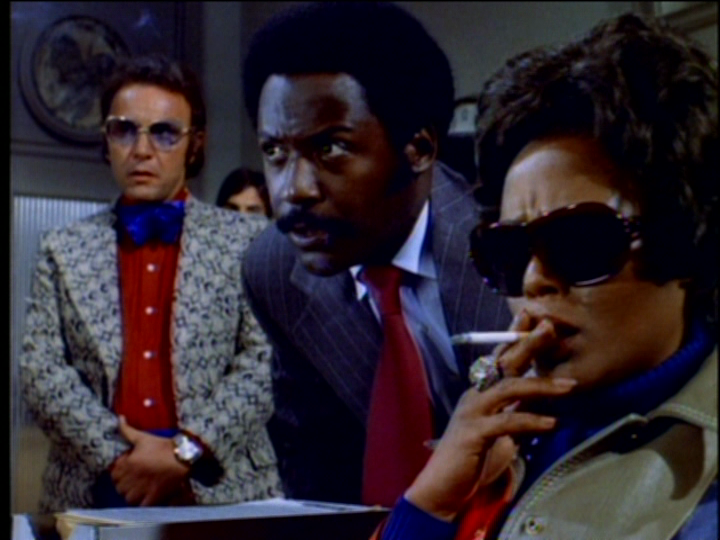
There’s not a lot of character development outside of the protagonist. Most of the dialogue consists of case details and exposition, especially by the villains who like to reiterate their plans to each other in an almost comical fashion (Shaft and the Kidnapping). Besides this, the dialogue is uneventful, and there’s a serious lack of Shaft quips, which is crazy since that’s kind of his whole bag. Other lines are hammered home to when it becomes funny. In “Shaft and the Hit-Run“, they try to explain David’s innocence by stressing how his job is “teaching Puerto Ricans kids English for no money” and he could never do what he was accused of because of this. It’s said so many times to explain the character’s kindheartedness that it begins to sound like a parody of a serious cop movie rather than a line used to show how nice the guy is. They even double down hilariously with David’s father Oliver being mad at David over it, as he explains to Shaft sarcastically how David said to him once that “Helping people is the most rewarding thing a man could do”, which inspires Shaft to take the job to help. There are also idiotic responses like Louise telling Richard how they’re going to catch him and it’s going to destroy the family if his role as a hired assassin is outed, and he responds “That’s why I do it! So, you’ll never have to worry!” (Shaft and the Murder Machine). How the fuck does that make sense? The same could be said when the bankers couldn’t comprehend how the sign-out of Joanna’s necklace was a forgery. She’s stressing how she never gave the power of attorney and there is a detective there with her, yet they’re still like “How can this be a forgery?”. It’s because she fucking said it! What could she gain from lying about such a thing? If she didn’t give the greenlight and is telling them this regardless of the signature, how could they not acknowledge they fucked up?
Most importantly, the action is about as basic as it gets. There are flashes of excitement but considering most of the episode is building up to something big, there’s not a single payoff to an episode that truly finishes things off in a satisfying, action-packed way deserving of the status of the main character, with the biggest culprit being the finale in “Shaft and the Murder Machine“. Considering the quality of the series as a whole, the buildup is done well but having it all lead to a one-minute climax of Shaft hitting the gas in the car, braking to slam Richard’s head on the dashboard, and shooting him with Richard’s made-up lighter weapon was too quick and uneventful to enjoy. It’s just one of the many examples of missed opportunities that stop the show from being greater than it is. Really, the reality of it all is that there are some episodes that could have been something great, giving us the obvious answer for the two best episodes of the show out of the seven total being “Shaft and the Kidnapping” and “Shaft and the Murder Machine“. With a production budget of a Hollywood movie and 20 more minutes of real action and violence fitting of a Shaft production, both could have easily been feature film sequels rather than basic TV movies. The race against the clock is felt in “Shaft and the Kidnapping“, like when Shaft sees the cop car drive by but tells Matthew that he has to risk it to make the phone call on time, sprinting to the payphone only to be seconds late. It proved that when these moments are handled with care, they showed how there was room to make something special. Both of these episodes had golden premises that could have been fleshed out for a full-length movie, but they were bogged down by the budget and the limitations of television and what content is allowed for the medium. This is especially the case for the final episode in “Shaft and the Murder Machine“, which basically serves as hypothetical on how John Shaft would fare against The Jackal from The Day of the Jackal.
Though there are some unbelievable aspects to it like how assassin Richard Quayle (Clu Gulager) pulls off his kill with a rolling grenade into a crowd of people that kill off his target and Judy’s fiancé Gerald Wallace but Rossi managed to walk away from relatively unscathed despite being physically closer, but there were some compelling aspects to his character arc that would have benefitted greatly if given the big budget movie treatment. The idea of Richard’s wife Louise finding out about his profession, how he has a whole family, and how he tries to justify it was twisted in an entertaining way. It’s an idea that deserved more care and was too good for the show. Again, they had a great idea, but it was still hampered because of it having to be toned down. As a result, the potential suffered. Still, you’re telling me Shaft having to search New York for an assassin hiding in plain sight wouldn’t have been worthy of a movie sequel? You’re lying to yourself. The best episode that maximized everything allotted given the limitations for television programming was “Shaft and the Cop Killer“. It may have been the most fully realized story and all-around production from start to finish. The first episode didn’t realize how good its idea was either, as the plot suggested something much more devious and unsettling than what it turned out to be. Once more, the execution of these episodes was just poor or didn’t reach far enough past the pitch to flesh out how crazy or entertaining they could be with it.
Ultimately, a serious lack of ambition killed the Shaft television series. Adapting John Shaft for television in all his glory could have been awesome, but this wasn’t what we were asking for. Watered down into a basic crime drama and detective show, the cool badass that is John Shaft wears a lot less leather and is too neighborhood friendly for TV. The violence isn’t what it needs to be, the toughness is marginal at best, and the attitude is almost gone, not having it on a consistent level until the finale when the case becomes personal. Again, had Shaft been aged up or this show came out 10 or 20 years later, it would align with the version of the character they clearly wanted to write. However, in 1973 and 1974, Richard Roundtree was still in his prime, and they gave him practically nothing to do. Actually, they gave him a lot to do. It was just so bland that it felt like nothing, a far cry from the previous installments. You combine that with stripping the protagonist of pivotal details that audiences loved about him, and it’s a recipe for a disaster. He still shows flashes of the legendary action hero, but the program is such a detraction of the character and the movies that it stopped the franchise in its tracks until it was revived in 2000.
The Shaft television series could have been what kept the legacy alive for years to come. Sadly, it did the opposite, nearly killing it for good.


+ There are no comments
Add yours