
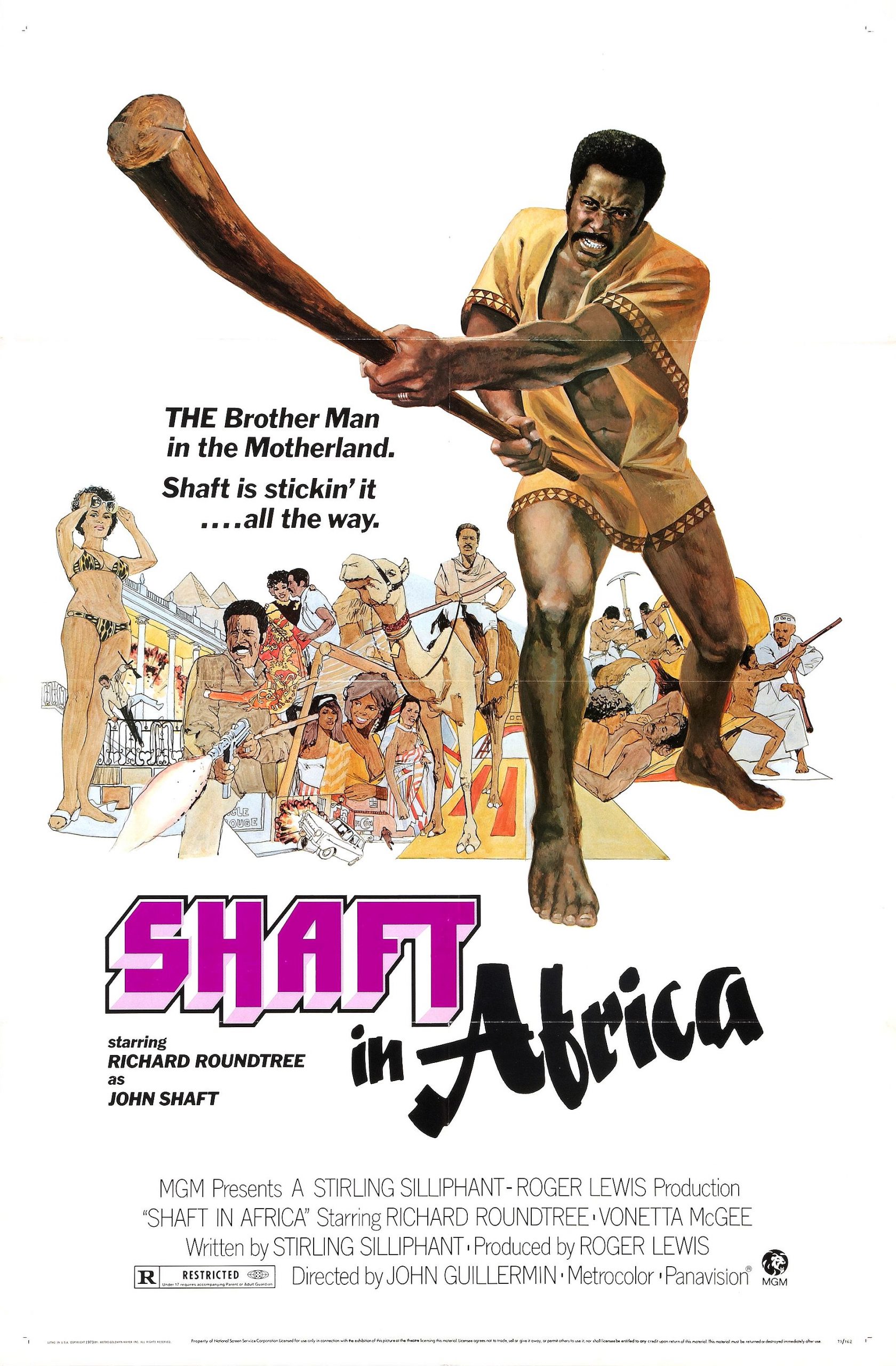
Starring: Richard Roundtree
Grade: A
The closing song into the credits asks, “Are you man enough?”. For John Shaft, the answer is a resounding yes.
Summary
On some massive property, an African man (A.V. Falana) escapes out of a mansion and is chased by several people until he’s caught, beaten down, and thrown into a car. Next, Amafi (Frank Finley) is in the back of his car arguing a money deal over the phone while his girlfriend/prostitute Jazar (Neda Arnerić) smokes beside him. Amafi apparently wants “750” in Düsseldorf by Monday. Once he hangs up, Jazar gives Amafi her cigar to smoke and starts giving him head. The phone rings again, but Amafi tells whoever is on the line to call back. Meanwhile, the African guy is brought to the fenced-in area of some unknown building while the guys that beat him up go inside. He’s left outside and handcuffed. At first, it looks like he’s trying to use the stone wall to break his cuffs, but we later find out that he actually carved a message into the wall in his language. Even so, Amafi shows up to the place and heads inside to tell his secretary that Smith is making a delivery on Monday to Düsseldorf, with 300 of them being from the Ivory Coast and the rest from Senegal. Angelo (Aldo Sambrell) enters to give him some papers confirming that the guy they captured is Emir Ramila’s (Cy Grant) son. He wants an example to be made out of the guy, so Amafi gives orders to kill the man. Angelo points out how Ramila has a lot of clout and they should be worried, but Amafi replies, “He can’t throw a spear from New York, can he?”. Following this, Angelo goes down and shoots the guy.
Over in New York, private detective John Shaft (Roundtree) is at the park getting in a jog until he sees some kids trying to steal the hubcaps off of his car. Once he chases them away, he gets back to his apartment. The parking garage attendant says some Africans were looking for him, but Shaft doesn’t know any. He goes to the elevator and the large, staff-holding Osiat (Frank McRae) is there waiting for him. Without saying a word, Osiat presses the button for a floor. Once Osiat exits the elevator, he tells Shaft to follow him. Shaft goes with at first but is able to move quick enough to jump right back in the elevator before the door closed to escape. Smiling to himself, Shaft takes the floor to his apartment and calls his secretary for updates. When she begins to talk about a client continuously calling, Osiat breaks down the door. Shaft draws his gun, but Osiat says, “You come”. Shaft hangs up after saying he doesn’t do business with strangers, and Osiat gets closer. Shaft tells him to freeze, but he doesn’t. Shaft shoots him twice, but he barely flinches. Osiat uses his staff to disarm Shaft, and Shaft responds by kicking him away. Shaft falls onto his chair and grabs the gun, but Wassa (Debebe Eshetu) enters and shoots Shaft with a tranquilizer to knock him out. He has Osiat lift Shaft over his shoulder, and the two kidnap him. Following this, Shaft wakes up naked in a barn next to some horses. He grabs a big staff and goes into a garage where Osiat enters still carrying his own staff. They immediately get into a stick fighting match, and Wassa appears by the doorway impressed with Shaft’s stick fighting skills. He tells Shaft that Ramila will be pleased, along with the fact that he’s already circumcised. The latter comment distracts Shaft, who was winning this fight for the record, and it allows for Osiat to knock Shaft out with a blow to the head from his staff.
Still naked, Shaft wakes up in a room full of sand and beaming lights covering the ceiling. Someone on the intercom details that it’s 110 degrees in the room. The man on the intercom tells Shaft to walk back and forth through the sand for the next 8 hours. If he survives, they will talk. Shaft jokes that he already has his tan and demands to talk now, but the man tells him to “walk or die”.
Instead, Shaft lies down and covers himself in the sand, cooling himself down. The man gives Shaft credit for the brilliance of the move and shuts off the lights. Emir Ramila opens the door to the room, and Wassa introduces Ramila as the leader of the Manta tribe in East Africa. Shaft considers it out of his turf, but Ramila tells Shaft that Osiat and Wassa will prepare him. Once Ramila leaves, Shaft exits the room and makes both Osiat and Wassa flinch before walking past them. Later, Shaft finally has his clothes back on and is taken to speak to Ramila. Ramila offers mineral water to him, but Shaft asks for scotch instead. Ramila talks about how he’s heard about Shaft, how he had to see it for himself, and had to know if Shaft was willing to kill a man. He notes how Shaft fired two shots at Osiat without hesitation, confirming he would go that far. Shaft wants to know how Osiat lived through it, so Osiat dumps the Kevlar vest on the ground. Shaft promises that the next one will be between the eyes. Ramila asks how good Shaft is with a stick to which Shaft cheekily replies, “Cat named Shaft ain’t gonna be bad with a stick”. Ramila walked into that one. Even so, Ramila goes on about how from his childhood, men of his tribe used the stick to herd cattle, ward off hyenas, and to fight. If Shaft was awkward with a stick, it would take too long to train him. Shaft declines whatever offer this is, but Ramila presses on by asking if he could survive desert conditions. Noting Shaft’s move burying himself in the sand, Ramila thinks he’s found his man. Shaft refuses and walks to the door. Osiat holds out his staff ready to attack, and Wassa points his gun to stop Shaft. Ramila offers him $25,000 for this mission of sorts. Shaft jokingly asks if its American or Hong Kong. Ramila tells him it will be $15,000 now and $10,000 later. Interested, Shaft asks what he has to do. Col. Gonder (Marne Maitland) enters and reveals that Shaft would have to become a slave.
Ramila explains to Shaft that Gondor is of the Central Police Authority in Addis Ababa, Ethiopia. He’s working with them and the Organization of African Unity. Gonder lets Shaft know that a good deal of time and money was invested in selecting him. Shaft doesn’t care and wants to hear about what he means regarding slavery, so Gonder gives him the backstory. Two months ago, a truck crossed the border from Italy into France. We move to a flashback where the truck catches fire, and the driver can’t stop it as a crowd approaches. A bystander gives him an axe, and he uses it to break the lock on the back of the truck. Once he opened the door, all the captured Africans jumped out of the back. When a cop showed up on the scene, the driver ran away and escaped. The French authorities gave the African men time to rest and such before sending them back to Italy, marking the incident closed. Coming out of the flashback, Gonder confirms to Shaft they were Africans. That particular group was smuggled in from the Ivory Coast to Italy and then into France. They were sent in to do hard labor that white Europeans refused to do. Shaft suggests they may have needed the money. However, Gonder says thousands are being recruited every month and there are no work permits, no social security, and they are deported if they complain. They work 16-hour days, 7 days a week for literal pennies. It’s basically modern-day slavery. Shaft wonders why they don’t just arrest the guys that are husting the people, but Gonder dispels this. They want the men at the top and they need a trained investigator. They need someone the bad guys don’t know to infiltrate their organization. To do this, Shaft has to let himself be recruited in Africa. Shaft questions why they don’t get an African investigator, but Gonder explains how the bad guys know all their men.
Shaft tells him to get someone who’s not an investigator, but they tried that too, prompting Ramila to explain that this is what his son did. He let himself be recruited in East Africa, echoing the opening of the film. Ramila reveals to Shaft that his body was found last week in Paris in a ditch.
Shaft thinks they will spot him from a mile away, but Gonder thinks they can avoid this if Shaft is briefed in tribal ways, along with learning the Manta dialect. Shaft is bothered by the difficulty of the latter and jokes, “I was 21 before I found out that ‘isn’t’ is another way of saying ‘ain’t”. Even so, Ramila brings in his daughter Aleme (Vonetta McGee) to coach him, and Shaft has eyes for her. Following this, Shaft and Aleme walk, as Aleme details things about the tribe and their ancestors while Osiat walks behind them as a bodyguard. Shaft chuckles at some of the details, but Aleme stresses the seriousness of it all, as his survival depends on how much he can remember. Later, the three are in an office where Aleme tests Shaft on terminology of their officials. Thankfully, he’s starting to pick things up. At the same time, Shaft is sitting on the same chair with her and flirting heavily. He suggests she send Osiat away so they can get intimate, but Aleme explains that Osiat has guarded her since she was a child. Sometimes, she thinks of Osiat as her living chastity belt, which is an insane thing to say. Shaft comments, “A man that size baby, that’s a whole lot of chastity”. They talk about customs regarding sex in their culture, and she talks about how she can have sex and marry after her clitoridectomy, meaning female circumcision. As she talks about sex being more about having children, Shaft sits next to her on the couch and brings up how she won’t know what she’s missing unless she gives it a “little wear and tear”. She flirtatiously asks if he’s volunteering and he replies, “You damn right”. They almost kiss, but Osiat puts his staff in between their faces to stop them. Osiat asks him where his stick is, so an annoyed Shaft tells him that it’s in another room, inviting Osiat to get it for him while he warms up. Once Osiat leaves, Shaft leads Aleme out of the room. Osiat comes back into the room and realizes what’s going on.
Osiat runs after them and takes the elevator because he saw the door close. Once he leaves, Shaft and Aleme appear in the hallway, as they never actually used the elevator. He leads her back into the room for a makeout session. Soon after, Osiat breaks down the door and shows up with Ramila and Wassa, only to find Shaft and Aleme acting like they are in the middle of a lesson. Seeing everything is fine, Ramila gives Shaft his first payment and his plane ticket. He is to leave in the morning. There is an awkward bit of tension between everyone in the room, as they all have their suspicions about Shaft and Aleme. Either way, it’s off to Africa!
On the plane, Shaft sits with some guy named Williams (James E. Myers). He tries to engage in conversation with Shaft, but Shaft acts like he can only speak Manta. Williams is cordial but realizes this isn’t going anywhere and goes to read his newspaper. Still acting like he can’t speak English, Shaft points out the words “standard oil” on the newspaper, and Williams is impressed he was able to say it. He asks Shaft if he’s heard of General Motors, but Shaft just replies, “Coca Cola”. Williams is silent and goes back to reading. After they land, Shaft sees Williams following him in the airport. Shaft goes to the bathroom to hide. He goes to the urinal, and the cleaning lady walks in. However, it’s actually some guy disguised as a cleaning lady, and he open fires on Shaft. Shaft runs into the stall and then goes under it to the next stall. When the guy opens the first stall, Williams appears and shoots the guy. Williams asks if Shaft is okay, calling him by name. Realizing Williams is on the right side, Shaft goes over to him. Williams tells Shaft to catch his plane to Addis Ababa. Shaft asks who he is, and Williams replies sarcastically that he’s not with standard oil, implying he’s with Ramila. Shaft piles on by guessing the dead guy isn’t with Coca Cola. Shaft then goes on his connecting flight to Ethiopia. At Amafi’s place, Amafi is with Wassa, a double agent. Amafi reminds Wassa that he said Shaft would never live to see Africa, but he’s been told Shaft has boarded his plane to Ethiopia. He wants to know Wassa’s explanation. Wassa says they had somebody with him out New York, and they took Wassa’s guy by surprise. He passes off Shaft as lucky, but Amafi tells him that luck can run out, especially for Wassa himself. Wassa tells Amafi to consider him a dead man, but Amafi reminds him that he was already supposed to kill whoever Ramila hired back in New York. That was their agreement.
However, Wassa says Ramila would have suspected him. Plus, he argues that Shaft seemed too dangerous on his home ground. Nevertheless, he knows things will be different in Africa.
Meanwhile, Shaft lands in Ethiopia. Upon arriving at the Hilton in Addis Ababa, a photographer approaches him outside to take a picture next to a lion. Shaft declines, but the photographer reveals he was sent by Gonder. So, Shaft goes along with the picture. He tells him all the poses he can do with the lion and how it’s safe, but the lion still turns its head rapidly towards Shaft to make him flinch. The photographer acts like he took the picture and hands Shaft a piece of paper, telling him privately to go at once. Shaft walks and then unfolds the paper. It says “IBEX”, a closed restaurant nearby. Shaft goes right to it and finds Gonder waiting for him. Gonder apologizes for the cloak and dagger tactics, but they had to adapt after the incident at the airport. Shaft sees a woman cleaning next to Gonder and questions if they can trust her. Gonder explains that it’s his cousin, so they’re cool. Gonder confirms that the man that tried to kill Shaft was an assassin with a long criminal record. In addition, Williams does indeed work for the good side. Moving along, Gonder admits they may have brought Shaft here for nothing because the opposition now knows about him, so the undercover mission is almost pointless. He will understand if Shaft chooses to call the whole thing off, but Shaft isn’t about to blow a job for $25,000. Noting how his ancestors were taken away from their homeland for scenarios like this, he thinks Shaft would have a stronger motive to do this job other than money. Shaft tells him that his ancestors weren’t in cotton but rather tobacco. Even so, Gonder gives him a big fighting stick to use. However, it’s different because it has 36 explosives and extra film in it. He also gives Shaft a new bag to use instead of the one he came with. It has food and a pouch containing a tape recorder. After he shows Shaft how to use it, Shaft isn’t sure about this whole thing because he’s not James Bond. He considers himself more like Sam Spade. Gonder ignores him and tells him to wear the pouch around his waist.
On top of that, Gonder gives him a big poncho and sandals to wear until he’s issued Western work clothes, if he gets that far. Shaft asks about a gun, but Gonder tells him he can’t have one. It’s too hard to conceal and it’s a dead giveaway if he’s searched. His weapon is the stick. He will also be given an English-speaking bodyguard in Kopo (Thomas Baptiste). Shaft thinks a bodyguard will be a giveaway too, but Gonder comments that everyone has a bodyguard in the territory he’s going in. Gonder shows Shaft the route on the map that should put him into contact with the recruiters. If he lives long enough to make it to Paris, there’s a phone number on the map he can use to call. Gonder stresses to memorize it and call the number the moment he arrives. Before Gonder leaves, he tells Shaft to burn the map and number before he leaves the room. In his African garb, Shaft goes on a public bus and converses with a lady who sits next to him. During this conversation, he notices the lone white guy in the back of the bus. On a later stop, the lady leaves and a lot of the bus clears out. The white guy moves up and sits in the seat directly behind Shaft. Eventually, everyone on the bus is sleeping, and the man sits next to Shaft and tries to stab him. Shaft was actually awake and is able to disarm him and kill him on the spot with precision striking. He closes the guy’s eyes and makes it look like he’s sleeping. Then, Shaft sits in the seat behind him. At some point, the bus stops for everyone to take a piss, and Shaft uses the stop to run off the bus. They drive off without him, with the dead guy in tow. Shaft uses his stick to take a picture of the dead guy’s passport and then starts walking down the dirt road. Sometime later, he stops by a pond and eats some of his food. A stray dog joins him and he appreciates the company. He gives it some food, and they continue the trek together. After this, a car starts driving towards him, so Shaft hides.
The dog stays in the road though and just stares at Shaft when he tries to motion the dog to get off the road. It forces him to give up his position to save the dog, and the car stops on the road right where Shaft is. Thankfully, it’s Aleme. She gets out of the car, and they kiss. Seeing a nearby abandoned hut, Shaft leads her to it. After they have sex, they discuss her getting away from Osiat, how she had to see Shaft, and how the bad guys know who he is. Shaft acknowledges they have already tried to kill him twice, but he’s not worried. Aleme asks if he was disappointed that she wasn’t a virgin, but he isn’t, even joking that she had some good teachers. Aleme says she has made an important decision because of Shaft, but Shaft recalls his father telling him to never make an important decision after making love. Still, she says it’s about her clitorectomy. She’s not going to let them do it to her. They get intimate right after. The next morning, Shaft leaves Aleme, and him and the dog continue on. Not long after, Shaft runs into his assigned bodyguard Kopo. Shaft is suspicious of him at first and tells him to pull out his hand. A confused Kopo does, and Shaft gives him a high-five. He’s all smiles and so is Kopo, with Shaft telling Kopo he’s glad to see him. They get to a small village, and the people all follow behind the two. They get to the district headman, and Kopo does the talking for him. They walk away, and Shaft asks what this was all about. Kopo details how this guy knows everything that’s happening around there. He said that the white man this week has taken their people from a town to the north. So, they will go north. Before they can leave though, the district head stops them and says that where they are headed, the sun stands two more times above their heads, meaning two men will die. Kopo laughs at this while he translates it to Shaft.
It doesn’t matter. They have no choice. So, Shaft, Kopo, and the dog head north. Now, Shaft is off to start his mission, but since Amafi and the bad guys know who he is, his head has to constantly be on a swivel because they will kill him any chance they get.
My Thoughts:
Widening the scope and the possibilities of the titular character, John Shaft becomes a James Bond-like figure with Shaft in Africa, and it’s the best adventure yet. With a better script, production values, and an originality to it that the first two movies never had, director John Guillermin (The Towering Inferno, 1976’s King Kong, Skyjacked) and screenwriter Stirling Silliphant (In the Heat of the Night; co-writer for Dirty Harry film The Enforcer and Sam Peckinpah’s The Killer Elite) take the reins of the Shaft franchise and push the creative limits to show the potential of what the series can be. It breaks the glass ceiling of the character, proving that the beloved hero can be more than just a New York private investigator and they were just scratching the surface previously. It may stray away from the underground nature of the first movie that made the series popular, but people need to understand that John Shaft shouldn’t be pigeonholed to just being Harlem’s finest. With Shaft’s Big Score! being the first test in stretching the limits of the protagonist’s abilities to see how fans would respond, Shaft in Africa takes another leap forward into making the character a mainstream legend worthy of a Bond type of legacy. The box office may not have reflected the refreshing take on the series, but this was more of a timing issue than anything else. First of all, it came out during the influx of blaxploitation movies that saturated the market Shaft helped start. Second of all, the mainstream blaxploitation Bond action film Live and Let Die undercut Shaft in Africa, coming out the week after. Third of all and arguably the most important, there may have been Shaft fatigue. In three years, three films were made to varying degrees of success and a television show was to follow that fall. All of it contributed to the third movie flopping.
Even so, let it be known that Shaft in Africa is the best out of the first three films and has an argument for the all-around best Shaft production.
Instead of facing off against the usuals of gangsters, shady New Yorkers with criminal ties, or annoying police officers who stick their nose into everything the protagonist does, Shaft in Africa finds the hero being tasked in stopping a massive human trafficking ring that’s a form of modern-day slavery. Initially, John Shaft has no interest. It’s out of his element and it’s hard for him to digest being a James Bond type of hero over The Maltese Falcon‘s Sam Spade type he considers himself to be, a point he even makes to Col. Gonder before the mission starts. Essentially, he plays the role of the viewer who is used to seeing John Shaft in a certain light, acknowledging that it might be hard for audiences to make this internal transition to buy into the next chapter of the series. What’s cool about it is that this third film does a great job in recognizing the legacy of the character that began just two years prior with the first Shaft. It’s as if they had the benefit of hindsight and knew the impact the protagonist already had on people and would continue to have decades later. Because of his abilities and his highly touted resume that has only been strengthened by the events of Shaft’s Big Score!, his status has risen exponentially to the point where he is sought after for this mission. It does make sense too when you consider the timeline of events and the evolution of the character throughout the years. He was already a popular local in the first movie. By the second movie, he damn near turns into a superhero. After solving so many cases through the years and during the interim period between films, his reputation as a private detective within this world is sure to grow to mythic proportions, making sense as to why outsiders are hearing how good he is and want to recruit him to start solving international crimes. This leads to Ramila and Gonder who are both in high-level positions in their own field and are desperate to stop what’s happening.
Through their own unbiased research for an investigator who could manage to pull this whole thing off and kick ass while doing it, they land on Shaft. This credibility given to the character in the first act by the supporting cast is an awesome way to recognize and solidify Shaft’s contributions to his world and the real-life fans who already consider him to be one of the greatest heroes of the decade. Now, his status is being put to the test, and he’s offered big money in doing so.
Taking Shaft out of his element is a cool way to refresh the series because though some don’t like making him a globe-trotting hero and spy, I would argue that this is exactly what they should have done with the character. He has built that much equity with the audience over these movies that they should go bigger with each movie. Why can’t Shaft be an intelligent badass like Ethan Hunt or Jack Ryan or someone considered to be as strong, sexy, and cool as Bond? They already set the world on fire with 1971’s Shaft by making a black hero everyone can get behind. With Shaft in Africa, they attempt to do the same thing but only take it further, pushing the iconic character into trying to become cinema’s first black super spy. It’s not only worth the try, but it also fulfills the expectations that came along with it. By widening the scope of the franchise, the plot is the most engrossing and action-packed yet and putting John Shaft in the center of it allows for him to do something no other spy character had done up until that point, going undercover in Ethiopia, a location rarely used on film. Had this third movie been the success it deserved to be, and the franchise continued in this direction, the sky would be the absolute limit, which is what they should have strived for had MGM really backed the series. This movie opens the eyes of who John Shaft can be. In a string of sequels, the protagonist could be recruited by different countries and agencies for covert ops missions, he could be a hired mercenary who takes out tyrannical leaders of fictional countries or finds himself in the mix with world leaders and fictional kingdoms that need his expertise to save the day on the down low. You could put John Shaft anywhere kicking ass and taking names, and it would be worth watching. It’s a travesty the franchise came to such a screeching halt in 1974 because they really were just scratching the surface of what could be. Once he gets to Paris, Shaft stomps into Inspector Cusset’s office and upon giving him the name of Amafi as the leader, he states sternly he will find Amafi himself because it’s personal.
Cusset tries to argue the proper way of doing things and how the law will handle it, but Shaft retorts “Fuck the law! What is the law doing for the guys who charge 100 francs a month to stay in a crap house like this? Why don’t you really clamp down on the slave trade?” before accusing the city of wanting the Africans to work on their roads and kitchens for little cost. It gets the wheels turning on who Shaft could be in terms of future international missions while showing the law how to do things the “John Shaft” way. Can you imagine Shaft dealing with Scotland Yard to find a terrorist or navigating the red-light district in Amsterdam to find a fleeing traitor from the United States? What if we found himself in the outback of Australia hunting down an assassin? Man, what could have been…
As great as it is to see Shaft in his usual attire, the third film’s test begins with this new location. Trading in the leather and gun for tribal garb and a long fighting stick, Shaft being stripped of home field advantage and his effects make things interesting because he’s more vulnerable than ever before. It forces him to showcase his hand-to-hand combat skills, his intelligence and intuition through his years of experience, and his abilities as a sleuth who is trying to be as under the radar as possible. It’s a new wrinkle of conflict, furthering the character’s development and making him that much stronger by the end as a result. At the same time, it’s not like he’s completely lost while being in Africa. Everything he learned in New York City and specifically Harlem has helped get him to this point and have led higher officials to deem him ready for such an assignment. Fully understanding the foundation he has laid as the star, Richard Roundtree reminds the viewer of his prowess early on and then eases them into accepting this huge step forward the hero is taking in reaching the appropriate next level John Shaft deserves to be on. With this overseas adventure, it’s proved without a shadow of a doubt that the franchise doesn’t need to rely on the backdrop of New York. All we need is John Shaft, and we will want to see it. Getting the secret job from the Central Police Authority of Addis Ababa in Col. Gonder, our beloved protagonist acts as a member of the Manta tribe on a job for the Emir Ramila, who has already lost his son in an effort to try and stop these terrible people. For the record, Cy Grant’s performance is a little gun shy. Considering how Ramila’s son is brutally murdered and he is stressing the importance of this mission, Grant was abysmal at trying to sell the gravity of the situation at hand. He did look the part of a dignitary though.
As Shaft tries to work out the kinks of trying to portray a non-English speaker while on the plane and the airport, he soon runs into the first attempt on his life, an assassin sent in by Wassa unbeknownst to the good side. Despite Wassa being one of the two people who is closest to Ramila’s inner circle, he’s a double agent working for the deviant of a man known as Amafi, the second-best villain of the franchise. Of course, the best is Christian Bale’s Walter Wade Jr. in John Singleton’s Shaft sequel from 2000. Frank Finlay is great as the immoral Brit who possesses a soul as dark as one must have to be the kingpin behind this vile operation, while also showing bizarre traits of being a sexual fiend who at the same time is incapable of having feelings for others. It’s only magnified when he’s in the vicinity off his partner Jazar, a woman who Amafi describes as “oversexed”. In the most jarring scene of the film, they are being driven by one of the sites, and Jazar tells the car to slow down so she can watch the Africans work their hard labor jobs. Just the sight of the group makes Jazar visibly horny, and Amafi gives insight into his strange outlook stating, “I’d give 10 years of my life if I can do that. To be able to see the world only in sexual terms and feel it the way you do”. It’s a head turning comment that yields a load of questions, but they are interrupted by Wassa who reveals that Shaft killed two more of their assassins. Pulling Wassa to the floor of the car and stepping on his neck, Amafi refuses Wassa’s request for Vanden to delay the departure of the boat on account of Vanden being “too weak in the stomach”. Instead, he demands Wassa kill Shaft personally due to his impatience with Wassa’s plans failing one too many times. Jazar chimes in to see if she can help, and Amafi doesn’t even look at her. He just asks “How?”. Jazar volunteers to divert Shaft’s attention to allow Wassa to try and kill him, but Amafi wants to know the real reason she wants to help.
In a twisted response, Jazar simply states that she’s bored and craves excitement. Finally, Amafi comes back to answering the questions we had with his private conversation with Jazar by detailing to Wassa how he doesn’t love Jazar. In fact, he doesn’t even like her, but she’s “the only person in the world that could get ‘it’ up for me”, which is why he keeps her close.
Think about that. This evil man is so devoid of feeling, touch, and connecting with humanity, he doesn’t even like the one woman who can give him an erection. Due to this technicality however, he keeps her around. It’s sort of a genius characterization because despite how off-the-wall it seems on the surface, it actually explains in full why a man like this could be the head of a modern slave trade, think of men as numbers rather than human beings, and have no qualms about their treatment as he goes about his day. He’s nearly asexual, almost completely focused on his job of recruiting Africans for back-breaking work and offering pennies in payment before finding more to ship out. After Amafi reveals these statements about Jasar to Wassa in such an unflinching manner, Wassa looks at him like he just found out he’s dealing with someone more insane than he initially thought. Following Amafi threatening to kill Wassa if anything happens to Jazar or Shaft is still alive by the next day, they drive off and the first thing Amafi states to Jazar is that he wishes he could watch her have sex with Shaft. The man is wild. He immediately follows it up by asking where she’s going to fuck him, and she tells him it will be on Vanden’s boat because she likes the way “it rocks you back and forth”. In case there were any questions as to how demented Amafi is, he tells her to get it on tape and to play it back for him on Friday when she returns to which she replies, “That’s a delicious idea”. Keep in mind that this is 1973. He’s not talking about a camera recording the affair but rather a tape recorder. The weirdo just wants the sounds! By the time they start discussing Amafi buying her an emerald if she does it and she asks how large it will be, the viewer’s eyes will be about as wide as Rodney Dangerfield’s due to how unexpected the revelations regarding this deranged power couple.
Really, you know you’re in for a treat when the villain tells his own girl to have sex with the hero and record it for him. This movie is uncharted waters for all of us. Later on the boat, Jazar tells Wassa to make sure Shaft hasn’t bathed because she wants him stanky, adding to the crazed kinkiness of the character. When Wassa wonders about the possibility of Shaft hurting her and how Amafi will kill him if this happens, Jazar threatens Wassa, telling him that if she doesn’t get to have sex with Shaft that night, she will tell Amafi that Wassa raped her. Again, we are in uncharted waters with this odd couple placed firmly at the head of the snake.
Another thing Shaft in Africa does better than the previous two films is the love interest. Vonetta McGee’s Aleme is the best Shaft girl in the entire franchise. She even had me smiling when she reappeared on the plane in the final minute because she had that much of an impact. An absolute beauty, Aleme actually has a developed personality and backstory that adds to the narrative. Being the daughter of the Emir, she’s tasked with teaching Shaft the ways of the Manta tribe and takes her job seriously, though she too is not strong enough to fight her attraction to the smooth hero. She’s basically a member of royalty and is seemingly dead set on a clitoridectomy, something I would wager has never been a plot point in any film before or since but is considered to be a serious family custom here. The fact that Shaft lays the pipe that well that she abandons the family tradition is hilarious. Even when he fucks Jazar, she practically falls for him and admits that he’s the first man to make love to her “like a man should”. Uncaring, Shaft responds hilariously, “Fantastic baby. I’ll write my congressman later”. He tells her to get dressed and she’s head-over-heels for him at this point saying, “Whatever you say John”. It’s the power of Shaft, or the power of “the shaft”. Take your pick.
They did shock the viewer with how well they introduce Kopo but only use him for a cup of coffee before his exit. That blow to the head Ziba gave him was brutal! Regardless, the supporting cast of this film is the strongest in the series thus far too. No matter how small the part, they all make their mark in the narrative, which is not something we can’t say about Shaft or Shaft’s Big Score!. From colossal cock block Osiat to the punchable Perreau, everyone plays a memorable part in the narrative and strengthens the film immensely.
In Shaft’s Big Score!, they use an obvious dummy in place of Andy when Shaft shoots him off that metal structure in the Navy Yard. In Shaft in Africa, Ziba kills Shaft’s dog with his stick, but it looks as real as it gets. I actually found myself replaying the scene because the dog looked that authentic. So, either this was just another step-up on the production values, or PETA didn’t screen the movie because there are some questions the viewer may have about this scene. Regardless, it leads to an awesome stick fighting follow-up scene where Shaft takes on Ziba in front all the Africans who are about to sign Marco Sassari’s paper to join their workforce for 200 francs a month, which we later learn the place they are housed in costs 100 francs a month. Even so, it’s just one of the many fight scenes that are exponentially better than the previous two Shaft outings and without question the most competent. They aren’t too over-the-top, and tension is allowed to be built to make the important moments feel stronger. It’s obvious that real professionals are behind the camera this time around. The difference in the consistency in the action sequences, and how much better its done with the same star but in desert locations, should show the viewer that it’s not even a question who did it better from a production standpoint. The choreography is better, it’s directed better, it’s suspenseful, and it’s pleasing from a cinematic standpoint. It raises the bar of the series with its action sequences, such as the short but intense fight with Shaft and Sassari once Shaft pulls him off the scaffold and they wrestle in the sand. It’s the most “James Bond” he’s ever looked, but he looks like he belongs. Ziba chasing Shaft out of the whore’s house (“No wonder they call Africa the mother country”) and through the village was pure adrenaline. The finish to it has Shaft cracking him with the stick and Ziba refusing to say anything because they will kill him to which Shaft replies in the most badass way possible, “The fuck you think I’m gonna do?”.
It’s funny too because he actually gets zero information from Ziba, despite the fact that he’s a crucial element to this operation. He just breaks Ziba’s wrist and bashes his head with a gun. Hey, that’s Shaft for you. Besides this, the third act finish is phenomenal, with the Shaft busting everyone’s ass at the former Gestapo Headquarters that Amafi now owns in the Chateau Montfort. It’s arguably the best action sequence and all-around climax of the entire franchise. The design of the underground prison was awesome, Amafi’s plan was diabolical and perfect to set up the epic blowoff, the buildup of anticipation to Shaft racing against the clock to try and stop him was as thrilling as it gets, exemplified by a great match cut from Amafi’s face to Shaft driving intently to the “castle mountain fort”, and Shaft giving the place hell as soon as he drives onto the property was the stuff of legends. It’s literally John Shaft at his absolute best.
By the time this happens, you completely forget about the plot hole of Shaft’s cover being blown on arrival, which begs the question as to why he’s able to get as far as he does while being “undercover” if the people in charge know who he is.
Adding to his legend, it was cool to see all the Africans act friendly with Shaft and give him props for beating the hell out of Ziba, someone who even Zubair doesn’t like and automatically wins Shaft brownie points with him for it. Going along with this, I loved when Ziba tried to threaten Shaft before leaving, and Shaft makes him flinch, getting a laugh out of everyone. It sounds like Ziba might be the Willy of East Africa! For the record, the humor is infinitely better here than it was in Shaft’s Big Score! too. The tone is fairly light all things considered, and Shaft keeps the energy up with his quips and snappy responses like Zubair asking him if he knows how to ride a camel and Shaft playing up his non-English cover replying, “No ride camel. Ride ass“. The innuendo is top tier with that one. The interactions he has with Jazar are hilarious too. When she brings him into her cabin on the boat, she tells Shaft that Wassa is planning on killing him before asking Shaft how long his cock is. Not in the mood, Shaft comically replies, “Baby, by now it shrunk down to 20 inches”. At first, I was proud of Shaft for not falling for Jazar’s tricks because the situation was too serious. She flirts nonstop with him, but he tells her confidently, “Baby you’re not turning me on. I got too many things on my mind”, acknowledging how life-or-death this mission is. After refusing to fuck her because he was going to take her as a hostage, she finally relents and gives up Amafi’s name to entice him to bed. When he asks her name, she honestly responds, “Does it matter?”, making you realize that it really doesn’t. Since he has everything that he needs, Shaft undresses, and there is an amusing shot of Jazar’s face in shock, implying his dick is massive. Did the movie need it? Not really, but it was funny. In this sequence alone, we see the evolved Shaft at his best. He gets the information he needs, fucks this girl, and manages to shoot the intruder from bed when he was acting like he was asleep. Simply put, that’s a bad mother-SHUT YOUR MOUTH!
On a side note, the shot of Jazar looking into the hole of the boat and making eye contact with Shaft who stares up at her is excellent, as was the tense moment of Shaft and Amafi on different sides of the wall holding their guns and meeting at the edge in a standoff for the ages. It’s an all-time favorite moment of the series in the middle of an epic climax. The film is a triumph in so many ways.
Despite being seldom talked about in the grand scheme of things, Shaft in Africa is the best film of the first three movies in the series, fights 2000’s Shaft for the throne of best Shaft production, and its story is the best of them all. Richard Roundtree takes the iconic character from the streets of New York to Ethiopia to France and becomes the black James Bond in the process. In doing so, he shows he absolutely belongs on that tier of hero, and the series itself had the potential to be something much bigger than they realized when the first film was released in 1971. Still badass, still charming, and still ultra cool, the creative and exciting Shaft in Africa shouldn’t have been the end. It should have been the beginning of a greater chapter in the saga.


+ There are no comments
Add yours