
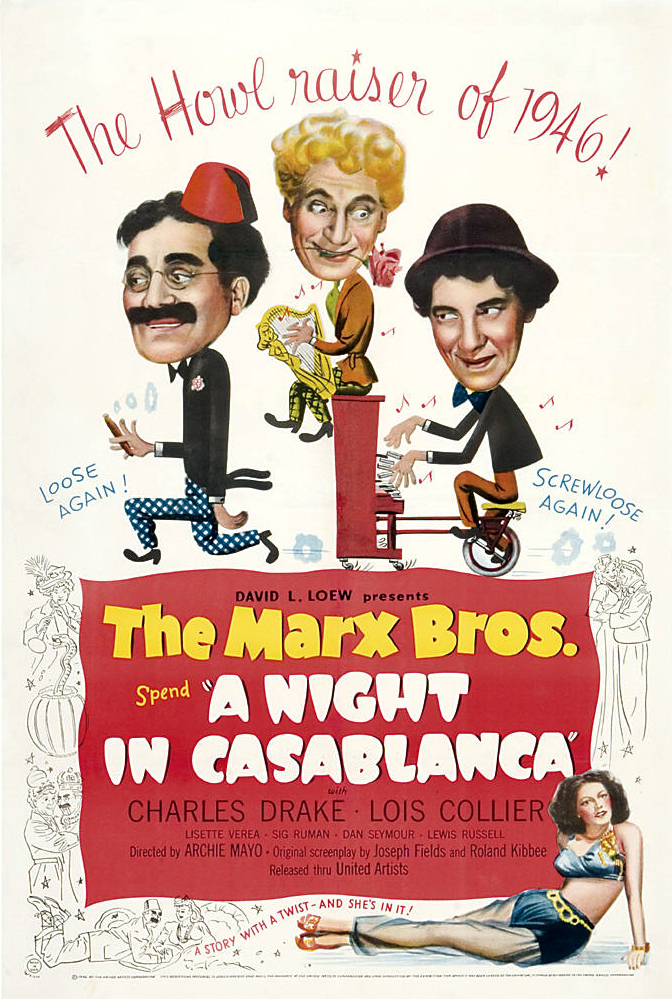
Starring: The Marx Brothers (Groucho, Chico, and Harpo)
Grade: A
You don’t hear this about many people, but Groucho Marx somehow looks natural in a fez.
Summary
In Casablanca, Morocco, there are a number of patrons at the outdoor restaurant at the Hotel Casablanca. The manager Rolazoides is served a drink by the waiter. Shortly after taking a gulp, Rolazoides falls to the ground and is pronounced dead on the scene. The two waiters share a glance, and the main one gives Henrich Stubel/Count Max Pfefferman (Sig Ruman) a glance to acknowledge the deed is done. At the police department, Prefect of Police Captain Brussard (Dan Seymour) is told over the phone how Rolazoides fell dead at the hotel. Dr. Fouchet thinks the manager was poisoned. Governor Gandaloux (Lewis L. Russell) is there with Brussard and knows Rolazoides was murdered, talking about how three managers of the Hotel Casablanca have now been killed in the last six months. Brussard relays to the department what has happened and for all suspects to be rounded up.
A cop finds Rusty (Harpo) outside leaning up against a building. He asks if he’s holding the building up and Harpo confirms, seemingly as a joke. However, as the cop pulls Rusty away, the entire building collapses.
At Governor Gandaloux’s office, Brussard questions a bunch of people before dismissing them. He tells Gandaloux that he’s never run into a series of murders with so few clues. The secretary Annette (Lois Collier) suggests they listen to Lt. Pierre Delmar (Charles Drake) and goes to get him since they don’t know who he is. She brings him and introduces them. He’s a reserve but wears his military uniform because it’s all he has. Brussard questions what he knows about Rolazoides, and Delmar counters with the theory he brought up previously to him. Brussard considers it more of an Arabian Knights fable. Still, Delmar is sure he’s correct. He tells Gandaloux how he was in Paris during the Occupation. The Nazis ordered Delmar to fly a plane to South America and forced him at gunpoint. The cargo was worth millions. It was all Nazi loot consisting of jewels, gold, and priceless paintings. He couldn’t bear to fly it out of French territory, so he cut off his fuel and crash-landed in Casablanca. He was interned, investigated, and when he got back to the plane, the treasure was gone. Gandaloux doesn’t see how it has to do with the murders, so Delmar explains how the Hotel Casablanca was controlled by Nazis. Brussard points out how its operated by the French government now, but this is Delmar’s point. Some group is trying desperately to gain control of the hotel. It can’t be for profit because it’s government property, but it might be connected with the treasure. His interest in all of this is that if the treasure is found in Casablanca, it will prove he acted as a patriot. Brussard interrupts to say they are not concerned with clearing Delmar’s name. Their only interest is solving these murders and finding a new manager. With this, Brussard dismisses him. Back at the Hotel Casablanca, Max, who is actually former Nazi in Stubel, lets the waiter into his room. He gives Stubel a message on a platter. He is satisfied with this and tells him to fetch Beatrice (Lisette Verea). As he gets his Nazi code book out to read the message, he calls for the valet, meaning Rusty.
Rusty doesn’t hear him though. He’s in a separate room within the place shining several shoes at once. Stubel is angry because Rusty didn’t show up immediately, so he goes back to find Rusty standing up against the wall with a brush under several of his body parts so he can shine all the shoes at once.
Stubel knocks all the stuff off the wall and yells at Rusty about how he told him to get the tailor two hours ago. Following this, Beatrice comes in with waiter Kurt (Frederick Giermann), and Stubel greets them. Stubel gives Kurt his decoding book to decipher the message because he’s not as quick with it as he used to be. Beatrice would have been there sooner, but she reveals Brussard has been questioning everyone who works at the hotel. Stubel doesn’t think it’s a big deal because he will be accepting the position of manager at dinner. Kurt says the message is from Schweigler in South America. As he decodes things, Rusty puts Stubel’s suit onto him but gets yelled at for putting the vest on inside out. Nevertheless, Kurt relays the message about Schweigler questioning the need for a delay as speed is imperative. Every lost moment increases danger, and the discovery of the treasure would be disastrous. Since Stubel is listening intently to Kurt relaying the message, he doesn’t notice that Rusty put his cane in-between his vest and put his hat on top of it to mess with him. Beatrice and Kurt stop Stubel to alert him to it, prompting Stubel to take Rusty into the other room to yell at him and hit him with his cane. He demands Rusty clean the other rooms. Rusty comes back with the vacuum cleaner and gets to work, but the nozzle gets too close to Stubel’s head, and it sucks in Stubel’s toupee. Neither man notices. Stubel comes out of the room ready to go, but Beatrice and Kurt note it’s too dangerous to go without his toupee because of the scar on his head. It would give up his identity. Stubel goes back to the back room and asks Rusty where his toupee is at, but Rusty just laughs at him. At dinner in the hotel, Beatrice sings for the crowd. Right after, Brussard and Gandaloux note how Stubel isn’t there yet, as they don’t know of his Nazi background or real name. They only know him as Count Max Pfefferman. Brussard doesn’t think “Max” has any intention of accepting and suggests they go. However, Gandaloux has an idea.
He will send a wire to the manager of the Desert View Hotel. Brussard thinks this is a good idea because the manager there is way out in the desert and could not have heard about these murders.
Somewhere in the hotel, the maid gives Annette the toupee to put in the lost and found, and they laugh about it. Annette goes to put it in the box but is shocked to see the stitching inside of it stating how it belongs to Heinrich Stubel. Somewhere in town, Corbaccio (Chico) is fixing clocks at his camel riding stand, and Rusty comes over to greet him. As they do their elaborate handshake, Brussard and Gandaloux watch from afar. Nevertheless, Gandaloux gets him ready to go because the new manager’s train arrives in five minutes. Corbaccio and Rusty overhear them, and Corbaccio notes how anyone who takes the manager spot there is a big sucker. Later, Corbaccio waits at the train station and tries to get the attention of anyone who is going to the Hotel Casablanca. One guy says he’s going there but when he reveals he’s not the new manager, Corbaccio rushes him along. Just then, Ronald Korblow (Groucho) comes off the train and approaches Corbaccio, but he is sure the hotel won’t let Kornblow in. Kornnblow asks if they let Corbaccio in. Once he confirms, Kornblow comments how he will put a stop to it since he’s the new manager. Changing his tune, Corbaccio takes his luggage from him and says he was sent there to greet him. Kornblow doesn’t trust him from the start and wants his luggage back, but Corbaccio insists. As they walk and talk, Corbaccio shoos away a street seller and talks about how those types of guys will take him to the cleaners. He however will take him to the hotel. Kornblow asks what his racket is, but Corbaccio doesn’t have one. He makes his living with camels. He uses them as taxis and is the President of the Yellow Camel Company. Kornblow assumes all camels are yellow, but Corbaccio says they have the Checker Camel Company too. He points out one camel with a checkered blanket draped over its body. Eventually, Kornblow gets to the hotel. Immediately upon entering, he sees a woman looking at something and rests his chin on her shoulder until she turns. As soon as she does, Kornblow doesn’t say anything, he just gives her a weird look while he walks away.
He walks right over to where there is a gathering of hotel workers, Brussard, and Gandaloux. Kornblow tells them to break it up and go to a poolroom or something. Once he introduces himself as the new manager, Brussard and Gandaloux change their tune and greet him. Kurt and the other waiter share an uneasy glance. Brussard and Gandaloux want Kornblow to address the workers about what he expects, but he’s expecting more out of the guests than them. Even so, he starts implementing ideas right away. He wants things to be sped up. Kornblow tells the chef that if a guest wants a three-minute egg, he wants it to be prepared in two minutes. If he orders a two-minute egg, give it to them in one minute. If he orders a one-minute egg, give him a chicken and let him work it out for himself. After everyone stands in confusion and Kornblow lights a match off his own ass to light his cigar, Gandaloux takes Brussard to the side and questions if there is some sort of mistake because Kornblow is ridiculous. Brussard knows, but he reminds him beggars can’t be choosers. Just as Gandaloux hopes Kornblow doesn’t have any more ideas, Kornblow talks about changing the numbers on all the rooms. Gandaloux argues the guests will go into the wrong rooms and urges him to think of the confusion, but Kornblow tells him to think of the fun. Trying to pivot, Brussard and Gandaloux show Kornblow where he will be staying, and he goes right to his desk (“Now gentlemen, I’m a different man behind a desk, as any stenographer can tell you”). Right away, he asks why they are burying the last manager and to not tell him it’s because he’s dead. Brussard assures him Rolazoides died a natural death and to not worry. Not buying it, Kornblow asks him what happened to the manager that preceded him. Brussard nudges Gandaloux, so he lies and says they caught him stealing money and they were forced to discharge him. Kornblow comments how they want a manager who doesn’t steal money, so he grabs his hat to leave saying, “Good day, gentlemen”. They stop Kornblow and try to pass things off as not being a big deal.
They change the subject to bring up his salary, and he’s cool with 500 francs a week. They also pick up his laundry once a month. Kornblow replies, “You wait that long, you won’t be able to pick it up”.
Meanwhile, Delmar is at a local bar, and Annette rushes in to show him the toupee because it might be a clue. Delmar notes how it’s from Kruss and Company in Berlin and how it belongs to Stubel. After they walk over to a private part of the bar since a bar patron/spy (David Hoffman) is listening to them, Delmar asks if they have someone at the hotel named Stubel, but she doesn’t know of any. Delmar correctly deduces that if they do, he probably changed his name anyway. He tells Annette how Stubel was a big-shot Nazi stationed in Paris. This might be the lead Delmar was waiting for. With this, he tells Annette to put the toupee back in the lost and found. He doesn’t think Stubel would be stupid enough to ask for it, but he doesn’t want to miss the opportunity. Unbeknownst to the both of them, the spy got closer and listened to their whole conversation. Back at the hotel, Stubel is marooned in his room with Beatrice and Kurt. He can’t believe how losing his toupee has pretty much stopped him from leaving his room because his scar would give up his identity easily. Beatrice has an idea and leaves. Kurt stands there while an angry Stubel grabs a sword off the wall and cuts flowers in half right out of a vase. They are interrupted by someone knocking on the door, so Stubel runs to hide. Kurt answers, but it’s just Rusty. Stubel assumes he got the toupee for him, but Rusty gives him a mop head instead. Stubel hits him with it angrily until Kurt wants a shot. Rusty dodges Kurt’s hits and gives Kurt a message on a paper. After dodging another swing, Rusty takes it back, rips it up, and throws it at him. Stubel suggests Rusty wants to dual Kurt, and Kurt is down. He gives Kurt a sword because seeing someone in pain would make him happy. Rusty runs into the back room and locks the door. Stubel has nowhere to go without his toupee, so he’s down to wait. After he yells for Rusty to come out, Rusty opens the door dressed like a baseball catcher. Kurt laughs because he doesn’t think this will protect Rusty from the finest swordsman in Bavaria, as he proclaims himself to be.
Wanting to go by tradition, Stubel grabs the other sword from the wall and asks them to choose their weapons. Rusty grabs both swords right out of his arms. He starts practicing with them until Kurt grabs the one sword from him, promising Rusty will get another cut because of the offense. Stubel has them go back-to-back and wants them to go back five paces. However, Rusty moves backwards with Kurt. They both turn side by side and lunge forward, prompting an annoyed Kurt to tell Rusty to go over to the other side. Rusty slaps Kurt’s sword with his and shows him that he had his fingers crossed. Finally, they begin. When Kurt gets into his stance, Rusty drops his sword. Right after, Kurt uses his sword to cut off all of Rusty’s catcher equipment. Kurt tells him to pick his sword up, so he does. Rusty slides right past him, but Kurt demands he stand still and fight. They do for a bit until Rusty whistles for them to pause. He then uses Kurt’s sword to sharpen his own. They get right back into it, but Rusty does well and starts making faces at him before he stomps on Kurt’s foot. This pisses off Stubel who wanted to see a one-sided beatdown. Jokingly, Rusty goes over to the curtain and pushes over one of the rings to indicate he won round one. Kurt gets mad and uses his sword to overpower Rusty, with Rusty lowering to the ground. Rusty drops the sword, takes off his catcher’s mitt, shows that he has dice in his hands, and rolls a seven. Stubel is getting angrier, so Kurt works harder at swinging his sword. Rusty blocks every swing, yawns, and even eats an apple while dealing with him. Once he begins smiling, Kurt becomes exhausted and stops. That night, Beatrice surprises Kornblow at his office to greet him. After she has him light her long cigarette while he smokes his cigar, they blow smoke into each other’s faces until Kornblow comments, “This is like living in Pittsburgh, if you can call that living”. She introduces herself and mentions how she stopped at the hotel to which he replies, “I’m Ronald Kornblow. I stop at nothing”.
She goes on about how she lost her diamond clip and was hoping it turned up in Lost and Found. Bringing her over to where they keep the Lost and Found stuff, he jokingly pulls out the toupee and how someone must have blown their top. She talks about how she loves Kornblow’s hair and runs her fingers through it while she stashes the toupee. Kornblow says she’s the most beautiful girl in the world and she asks if he really thinks so. Kornblow replies, “No, but I don’t mind lying if it’ll get me somewhere”. Moving on, she invites him to the Supper Club that night because she will be there and slyly comments how he wouldn’t say no to a lady (“I don’t know why not. They always say no to me”). Regardless, Beatrice says she will sing some opera to him if he comes and will be singing only for him. Flirting back, Kornblow comments how she doesn’t have to sing for him. All she has to do is whistle. After he watches her leave, he is reminded how he has to get his watch fixed. Beatrice goes to the elevator, and Rusty comes out of it with a comically long cigarette. She stops smoking her own to observe, and Rusty blows smoke bubbles in her face to taunt her. She gets into the elevator and looks through a monocle at him, and Rusty responds by looking through a bubble wand before blowing bubbles at her. He then starts biting at them. That night at the Supper Club, Beatrice finishes her performance and sits down with Stubel at his table. He lets her know they aren’t taking any more chances with Kornblow. They are taking him out tonight. He wants her to make a rendezvous with Kornblow in a quiet corner away from the hotel, preferably the Rue Lafayette. Kurt is there working as their waiter, though Stubel tells Kurt to find an excuse to leave there on time. Kurt is to drive the car and to make it look like an accident but ensure it be fatal. The spy from the random bar Delmar was at approaches Delmar and says he knows Delmar is looking for a man who sports a toupee. Delmar gets aggressive with him, but the spy wants money to reveal any information. Just then, Corbaccio and Rusty walk over to them. Still, the spy wants a few hundred francs. Delmar promises to pay him eventually, but he can’t accept this.
Delmar demands to know, but the spy refuses. Until Delmar finds a few hundred francs, the spy will be at the Brass Monkey. Corbaccio asks Delmar if he needs money, but Delmar is sure he will get what he wants without having to pay the spy. As Corbaccio and Rusty walk into the Supper Club, Corbaccio talks about being worried for Delmar and thinks they need to get him some money. Rusty tries to pickpocket some guy next to him until Corbaccio stops him. The two turn to see the host tell a patron they are full until the guy pays the host off. With this, the host lets him and his date in. Seeing this, Corbaccio has an idea. The two crawl in-between everyone and act like they are the hosts of the restaurant. Corbaccio starts taking bribes from everyone there and has Rusty set up tables for everyone who pays. As Rusty loudly moves tables and chairs around, Kornblow rushes in and makes his way into the club. He has the host take him to Beatrice’s table with Stubel. Just as he greets her, Rusty bumps into Kornblow and he stumbles into the table and accidentally splashes his hand in Stubel’s soup (“I usually put my foot into it”). While Stubel yells at him, Kornblow tries to clean it with flowers from the table. The host sees what’s happening and offers to take him to the back to fix things. After Stubel yells at Kornblow in German, Kornblow notes how good his German is. He talks with Beatrice for a moment and she asks for champagne. Kornblow looks at the menu. Instead, he orders a cheese sandwich for her and tells the waiter to charge it to her. They get up to rumba, and Kornblow has some random woman at a table hold his cigar for him. He comes back after circling Beatrice and takes it right back from her. At the same time, Corbaccio and Rusty grab tables and chairs and flood the dance floor while everyone is on it to get more people in. It gets to the point where the only people left dancing are Kornblow and Beatrice because everything around them is a table with two people at them. Beatrice suggests they go somewhere quiet to be alone to which Kornblow replies, “If I didn’t know your voice, I’d have sworn I said that”.
She tells Kornblow to meet her at the corner of the Rue Lafayette at 11PM.
Corbaccio laughs with Rusty since they have enough money now for Delmar to take care of the spy. One of the band members asks Corbaccio to take over for him since he has to make a phone call, and he accepts. Corbaccio gives Rusty the money to give Delmar and takes over on piano for a little while. Later, Delmar runs into Annette, and she tells him the toupee is gone and she doesn’t know who took it. She’s been trying to find Kornblow but doesn’t know where he is. Annette calls over Abdul to see if he knows where he went, and Abdul replies that he left an hour ago to the corner of Rue Lafayette. Just then, Kornblow walks over and is shirt is destroyed and he looks beaten to hell. Annette asks what happened, and he talks about being stood up by a woman and knocked down by a car. He just passes it off as the Casablanca drivers being terrible since the driver missed him three times. Finally, he had to climb a palm tree to avoid them, and the driver hit that instead. Annette introduces him to her fiancé in Delmar, so Kornblow asks why they haven’t gotten married. Delmar says marriage is impossible, but Kornblow replies, “Only after your married”. Annette corrects him to say it’s impossible for their situation. Delmar says it’s a long story, but Kornblow is down to hear it. So, he goes on about this treasure of Nazi loot hidden somewhere in Casablanca. In the hotel, Rusty wanders back over to Stubel’s room but stops before entering because he can hear him yelling at Kurt from the outside. He talks about wanting to kill him because there is millions in their reach and they can’t get their hands on it. Stubel has a new idea. If he were to find Beatrice with Kornblow in her room, Stubel could be an outraged fiancé of sorts. He could kill Kornblow in “self-defense”. Beatrice loves the plan since she knows how badly Kornblow wants to be with her. Hearing this, Rusty relays the plot to Corbaccio through whistling and charades, and they go out to try and put a stop to it.
They run inside the lobby and find Stubel ask Kornblow to arrange a plane for him to get to Tunis. Once Stubel leaves, Corbaccio and Rusty try to warn Kornblow about what’s happening. For some reason, Rusty is the one who is trying to tell him and does the same charade bit that only Corbaccio understands. Kornblow doesn’t get it, so Corbaccio tries to tell Kornblow in private about how someone is going to kill him and everyone in the hotel knows it but him. Corbaccio offers to be his bodyguard, saying he’s a bodyguard at night and he works on his camel business during the day. Kornblow brings up the hypothetical of being killed in the daytime, so Corbaccio says he will give him a free ride on his camel in this case. Getting back on topic, he says he can keep Kornblow alive for 50 francs a week. He doesn’t think it’s worth it. Corbaccio argues he will watch him like a mother watches a baby. Kornblower asks him if the mother is pretty. In this case, he will watch the mother and Corbaccio can watch the baby. Moving forward, Kornblow does eventually accept his offer and Rusty joins to help Corbaccio. Nevertheless, the Nazi activity is still happening in Hotel Casablanca because someone has to find the treasure.
My Thoughts:
Many thought The Big Store was The Marx Brothers’ grand finale and it was intended to be, but they returned five years later with the oft forgotten and underappreciated A Night in Casablanca. Due to the mixed bag of Love Happy three years later and The Story of Mankind only featuring the brothers in separate segments rather than the movie starring the brothers, A Night in Casablanca is the last real showcase of their genius in full. Though it’s true that the movie is not like their peak with Paramount or the fun they had in their movies with MGM, this movie starring the troupe is in yet another individual category much like RKO’s Room Service, though it’s even further removed from that. This comedy is an isolated outlier in their filmography, as it gives Groucho, Chico, and Harpo a plot to play in like never before and become the heroes they were always meant to be in one last hurrah. Though it’s still a comedy where the Marx Brothers enliven the Moroccan landscape with their usual brand of madness, the trio are involved in a full-on, comedic, action-adventure film stuffed with post-World War II Nazis, a hidden treasure, and murder.
Truth be told, it’s probably the most complete and structured screenplay of any Marx Brothers film, on par with Room Service. Now, this doesn’t mean it’s the best. As we have said plenty of times before, the Marx Brothers and their legendary contributions to comedy are the exceptions to the rule on how to write a movie, as they thrive best in loose plot structures and story beats that allow for bits, gags, one-liners, and dialogue exchanges to highlight the group’s vaudeville background and stage personas. Because of this, A Night in Casablanca might be the best narratively structured movie they have, but Marx purists will note that it’s not the best example of the enigmatic Marxian brand of comedy. This is what divides fans on the film and its place in history overall. Being the fans that we are of the brothers, we can appreciate this movie for being the unique outsider that it is. For the first time, the main plot is at its most involving. It’s not a simple, mundane location that allows for the Marxes to just run wild all over the picture. Though they do borrow elements from previous excursions as Groucho running a hotel or being in charge of literally anything is something he’s very used to and is probably the best use of his talents (The Cocoanuts, Horse Feathers, Duck Soup), everything surrounding his character is suspenseful and exciting, a Marx first no doubt. The set up is that they are in the middle of post-war Casablanca. The previously Nazi-run hotel at the center of it all is now ran by the French government, but their last three managers have been murdered. There is an elaborate scheme at play that involved hidden Nazi treasure, and the Prefect of Police in Captain Brussard and Governor Gandaloux are aware of it. However, they still need to maintain order since they don’t have enough evidence to arrest anyone. They just know they need to lock in a new manager for the Hotel Casablanca. Since they have heard of Groucho’s Ronald Kornblow running the Desert View Hotel and being out far enough that there is a good chance he hasn’t heard of the murders, they bring him in.
Funnily enough, it’s the first thing he asks about upon getting shown his office, but they come up with lies about what happened previously to the other managers and the subject changes quickly once Kornblow almost leaves after hearing they want a manager who won’t steal money. It’s amusing because Kornblow lies to them almost as much as they lie to him, as Stubel eventually reveals that Kornblow only ran a small motel in the desert, not the Desert View Hotel. He was just taking them for a ride as much as they were doing him. Part of this is why it’s still a great Marx Brothers movie as a whole. Besides the Nazi-related intrigue and treasure-focused plot, the brothers still have their fair share of fun that makes the picture worth seeing, and this is a story that allows their personas to face new challenges, quite like their western Go West. Per usual, as soon as Groucho’s Kornblow enters the hotel and starts laying down the law by requesting they change all the room numbers on account of all the “fun”, or chaos rather, that it will cause, we know we’re in for a treat. He may not be given the focus he had as Mr. Hammer in The Cocoanuts, but how the Kornblow character fits into the story and the anything-can-happen environment of Casablanca makes the character more important to the plot and that much more interesting as a result. The respected Count Max Pfefferman was on the verge of taking the manager position, but he couldn’t leave his room due to the losing of his toupee that covers the scar on his head, as his real appearance without the toupee would out him as former Nazi Heinrich Stubel. It’s all a matter of amusing happenstance, especially because Rusty works for Stubel as his bumbling assistant and is the reason for everything going haywire since he vacuumed up the hairpiece accidentally and didn’t even know. Though it’s not made a major deal, Rusty does knowingly work for a Nazi, or at least it’s assumed since he’s privy to most of Stubel’s conversations with Kurt and Beatrice.
Then again, if he did know, this would be a huge plot hole because half of the story is about how the good side doesn’t know Max and Stubel are one and the same. Rusty should know because he’s seen Stubel with and without his toupee and has heard his conversations with his group, but he doesn’t let anyone know. Is he that much of an absent-minded person, or did he really just not think to tell Corbaccio or Delmar this? He did forget to bring up that he knew where the treasure was until the jail scene after all. Nevertheless, Rusty just does it for work and doesn’t take the job or Stubel or Kurt seriously. It’s not until he overhears Stuble’s plot to kill Kornblow that he decides to tell Corbaccio and the two become Kornblow’s bodyguards in the interim. With Rusty and Corbaccio’s friendship with Delmar helping foreshadow what’s to come, this where the plot really begins to take shape in the midst of the already known theory of Delmar’s that the treasure is somewhere hidden inside the hotel and the Nazis are looking for it. Because of this, they have to worry about two things. They have to keep an eye on Kornblow, who seemingly invites the challenge because he keeps meeting up with Beatrice, and they have to find the treasure before Stubel or anyone does.
Keep in mind that neither Delmar, the authorities, Annette, Kornblow nor Corbaccio know Max and Stubel are the same person. Again, the jury is still out on how much Rusty knew. Even so, this is where the viewer gets to see more of the Marxian antics that they expect following the hilarious scene where Corbaccio takes over as host in the hotel restaurant to collect money for Delmar. Corbaccio oversteps his boundaries as a bodyguard as expected because though he was somewhat serious about Kornblow’s life being in danger, he also uses the situation to his advantage as any Chico character would like saying they need to test Kornblow’s food for poison (“This food doesn’t look any more poisoned than any other hotel food”). Naturally, this leads to the hungry Rusty eating a candle, miraculously holding the flame on his finger, and then putting it back onto the candle when he’s done. Anytime Chico draws Groucho’s ire, it’s hilarious, and they play off this a lot in the movie, especially in this scene. After Kornblow takes out the giant cork from the champagne bottle that doesn’t have anything in it and they take a bite out of his steak, he straight up tells Corbaccio he’s not sure if he’d mind being poisoned anymore. I’ll admit the joke of Rusty putting salt on the phone and Corbaccio telling Kornblow that he’s calling Salt Lake City was corny and Rusty and Corbaccio Lady-and-the-Tramping a breadstick was out of the ordinary, but it was a much-needed Marx sequence to jolt the movie back into what the audience came to see. After this, the viewer is treated to a load of funny scenes like Rusty collecting cigarette butts in his busted shoe while he cleans the lobby, Rusty managing to get the same number in roulette three times in a row to win money the hotel casino doesn’t have and Kornblow having full confidence in Rusty losing but also not caring when Rusty did win, and Groucho getting his best moment as hotel manager when dealing with the President of the Moroccan Laundry Company in Smythe.
Manning the front desk, Kornblow gets a call from a customer and takes it about as seriously as you’d expect saying, “You’ve been up in your room for 3 and a half hours and your trunks haven’t arrived? Well, put your pants on. Nobody will know the difference”. Smythe then shows up and wants a room for him and his wife but is such a prick about it, Kornblow wants to see their marriage license to prove Smythe isn’t lying. Once Smythe angrily talks about his credentials working for the laundry company, Kornblow is responsible for the best sight gag of the movie when he rips off his own shirt and tells Smythe to have it back to him on Friday. It’s classic Groucho, not taking any shit from anyone and absolutely destroying the antagonist in question with enough quips to make the man want to fight him. Just as Kornblow suggests he takes his business elsewhere and Smythe talks about his wife being with him and how Kornblow should be ashamed, Kornblow hilariously replies, “If this lady is your wife, you should be ashamed”. Smythe tries to threaten him by saying his attorneys will be there in the morning, but Kornblow hits him with the expert callback about how they won’t get a room unless they have a marriage license. It’s such a great aside that gives the fans a rightful showcase of Groucho at his best before jumping right back into the main plot with Beatrice on the phone inviting him back up to her room. The follow-up of Kornblow going straight to the elevator that Rusty is running, and they immediately get stuck in-between the 5th and 6th floor, with Groucho’s commenting “This could only happen to me” had me cackling. The timing and delivery of it was just perfect.
Rusty falling into where the treasure was hidden in-between floors of the elevator was genius, and it was a great way to get Harpo’s harp segue out of the way, as the placement of a harp in the midst of all this treasure actually makes a lot of sense. Besides this, the gag where Rusty comes back to the elevator five hours later to get Kornblow out by using an axe to break the cables should have ended with the two on the ground of the elevator and a quip from Kornblow about him seeing Beatrice sometime later. Instead, it ended with the two physically bouncing their upper body up and down to match the movement of the elevator crash wasn’t as funny as they thought it was. It just looked unnatural. Still, they make up for it with Corbaccio meddling with Kornblow’s attempt at a date with Beatrice while she tries to stall long enough for Stubel to get there to kill him. Stubel being minutes late in his several entrances and having to continuously read notes written by Beatrice on where they went next was a nice touch. Furthermore, I just love the simplicity of Groucho having to carry like 15 different items every time he leaves or enters a room (“These roses, I shall keep them forever” – “That’s what you think. I only rented them for an hour”). He has done this gag before, but it’s amusing every time and really adds to the constant pace these comedic sequences carry.
As much as we can appreciate this film as fans of the group, it’s hard to say whether or not A Night in Casablanca would give the brothers any new fans. If someone were to hear about the brothers’ younger years of pure cinematic chaos and they finally decided to observe one of their features, A Night in Casablanca is not the movie a fan should recommend first. It’s not that it isn’t a good film, it’s just not the Marx Brothers at their peak, meaning you may not get the full experience and understand why Groucho, Chico, and Harpo Marx are such comedic legends. A novice viewer may like it, but they won’t see the big deal. However, watching all of the brothers’ movies from the beginning on and then getting to this movie, they will see why A Night at Casablanca is such a cool outlier in their catalogue due to it being such a unique movie in comparison. As a standalone, it’s still an entertaining film regardless, but it’s just not on the tier of “Classic” like so many of their other comedies. Again, this is merely because they focused on developing things outside of the brothers. They knew they would carry the comedy of the movie, so there is a concerted focus instead on expanding the plot, developing the rest of the supporting cast and their roles in the narrative, how the subplots all work out within the comedy, and how well they position and portray the main villain, who is arguably the strongest of all the Marx Brothers movies. This way, they can let the comedy and the seriousness hit their marks seperately before it’s time to finally bring it all together, which they do shockingly well.
With this in mind, the comedy and the action adventure of the late second act and third come together nicely once Kornblow, Corbaccio, Rusty, and Annette are jailed on Stubel’s accusations once he is put in charge of the hotel by Gandaloux and Brussard, and Delmar is taken to be tried by the military authorities. Once we comically get some in-fighting where the characters blame each other for what happened until Corbaccio finally says it was Rusty’s fault for winning the roulette game which results in him crying, they realize the treasure is at the hotel after Rusty pulls out the Rembrandt painting of the woman. To get out, they put shaving cream in Rusty’s mouth and act like he has mad cow to get the guard over to their cell, with Corbaccio gagging the guy and hilariously telling him, “Keep quiet. We’re never gonna escape if you keep screaming”. With this, they start building the suspense and expertly intertwine it with the humor, as they break into Brussard’s office (“It’s a crime the way this jail is run”), intercept a call from Beatrice snitching on Stubel since he was going to go to South America without her, and the three go back to the hotel to solve the problem the Marx Brothers way while Annette goes to save Delmar. It sets up an excellent third act that no other Marx movie has, and it’s arguably their best. Seriously, it’s genuinely exciting and Groucho, Chico, and Harpo running through the lobby to get to Stubel’s room adds a gravity to the action that again is unlike any of their other adventures. Their messing with Stubel’s packing as they hide in the closet and the trunks and do so discreetly, adding an authentic anxiousness to the humor because they are inches away from being caught, is one of the last great cinematic Marx bits ever performed. For fans, it will no doubt put a smile on their faces as they see the brothers utilizing the anarchic humor that they thrive in for a truly heroic finish. We won’t spoil the elongated sequence in Stubel’s hotel room, but it’s fantastic, especially when Kornblow and Corbaccio throw Rusty out of the trunk to hide, Rusty knocking, and Kornblow replying “I’m sorry, we’re all filled up” just to get a quip in when their silence is imperative.
The timing, the reactions, the silence, and the chemistry of all the performers involved in the scene are unmatched. When followed up with the electric plane chase sequence and subsequent fight with these former Nazis while the group is risking death in a moving plane and a car placed side by side for all the marbles, it felt like a Marx Brothers dream scenario worthy of the big screen treatment. This was the finale the group could have ended it on, as it encompassed everything that was great about the team while giving them a serious and fun plot to allow them to go out like cinematic heroes. That we can all appreciate, as the image of Harpo flying the plane and Groucho and Chico flipping out right next to him was everything.
On a side note, had Rusty not flown off, Kornblow’s idea of just driving the plane on the ground until they ran out of gas wasn’t half bad.
A Night at Casablanca is a lost Marx Brothers gem that deserves much more love from fans and critics alike. Just because they set the bar so ridiculously high for themselves with their previous movies doesn’t mean this wasn’t a great Marx movie. Yes, it’s still funny, and the boys still shine like they always do, but the real treat is the film’s desire to be an event that Groucho, Chico, and Harpo have never had the chance to be involved in like some of their comedy peers. A Night in Casablanca is a never-before-seen adventure for the comedy group where they get a chance to fight Nazis and find treasure in a thrilling action comedy in Morocco while making us laugh throughout. Don’t let anyone tell you otherwise. They succeeded in their efforts, and the movie should be recognized as such.
With all of that being said, the original title Adventures in Casablanca was a lot better, especially since the story takes place over several days and A Night at the Opera already existed.



+ There are no comments
Add yours