
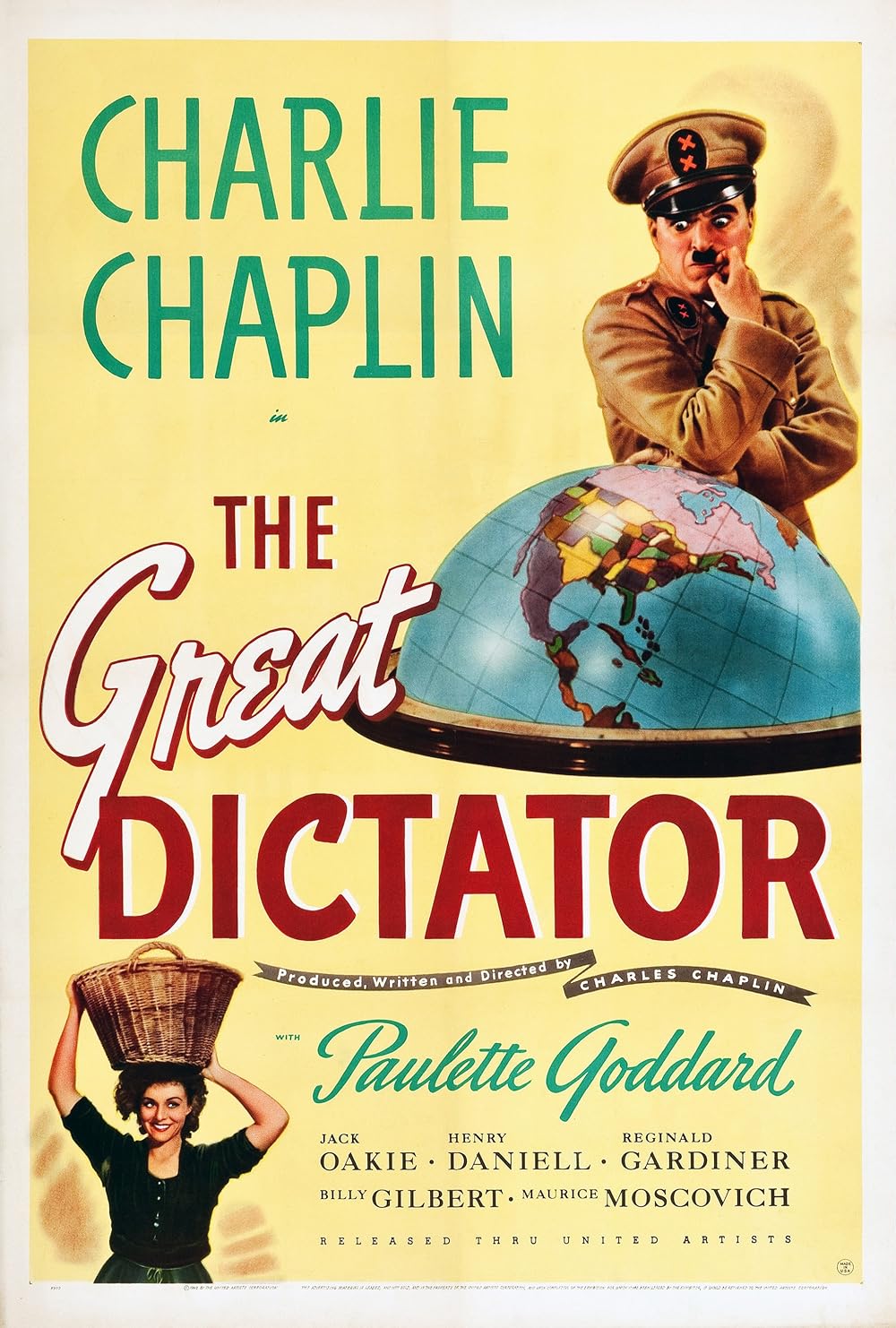
Starring: Charlie Chaplin
Grade: Classic
Shoutout to Commander Schultz for the risks he took by defying Hynkel to his face, getting accused of treason because of it, and fearlessly leading the Barber through the border of Osterlich on foot based on a lie. That dude had balls of steel.
Summary
“Any resemblance between Hynkel the Dictator and the Jewish Barber is purely coincidental.”
This is a story of a period between two World Wars – an interim in which Insanity cut loose. Liberty took a nosedive, and Humanity was kicked around somewhat.
During the first World War in 1918, the Tomainian nation began to weaken. Behind her lines, revolution began to break out. Diplomats were frantically suing for peace. Their army was still fighting on, as they were confident its war machine “Big Bertha” was invincible. It’s a cannon that could hurl a projectile 100 miles out. This was its first day making its appearance on the Western Front. Their target was only 75 miles away, the Cathedral of Notre Dame. A Jewish soldier (Chaplin) is the one who has the job to pull the trigger mechanism. They shoot the cannon, but the projectile explodes in some field since the coordinates were off. Once the Jewish soldier is told to go back to his position by his commanding officer, they try again. Unfortunately, the shell stalls and merely drops out of the cannon right in front of them. It was defective and didn’t go anywhere. The Jewish soldier looks at the others and they all shrug. The two officers decide they need to check the fuse, so they relay the message to the next guy who relays it to the Jewish soldier. Since no one is behind him, he realizes he has to do it. He walks over to check the fuse, but the shell spins around while he circles it. Before he can get to it, the fuse lights itself, so the Jewish soldier runs towards the others, and they all take cover before it explodes. Just then, they see planes flying ahead, as they are about to attempt an air raid. They are after Big Bertha. They send the Jewish soldier over to the antiaircraft gun. He does so but has trouble using it while he sits in position. It swings him all over the place as he tries to get it to work, and the gun swings around and almost hits his commanding officers. Once the Jewish soldier falls off, they yell at him. They are interrupted by a soldier relaying a message from Captain Snout. The enemy has broken through, so they want every man to get to the front. The Jewish soldier is told to report to Sgt. Blue.
He runs over to the trench and is given a bag with a hand grenade. Somehow, he doesn’t know how to use the grenade, so Blue gives him the direction rather quickly before moving on. Soon after, the soldiers are directed to get out of the trench, throw their grenades, and push forward.
Remembering how he is supposed to count to ten but not sure how quickly the ten seconds are, the Jewish soldier does so slower than everyone else. When he goes to throw the grenade, he winds up his arm but drops it into his shirt sleeve. Panicking, he frantically moves around his clothes to get the grenade in time. Just as he is able to throw it when a solider asks what he’s doing, the grenade blows up away from them both. He is given a rifle and lines up with everyone else. After he accidentally hits his fellow soldier in the foot when he plants the gun down for a moment, the group moves forward into the smoke. Quickly, the Jewish soldier loses his platoon and is by himself. Once the smoke clears, he finds a group and walks alongside them. Then, he realizes they are in fact the enemy soldiers. They realize it too and start shooting at the Jewish soldier while he runs back into the smoke to escape. Following this, he shows up to a destroyed building where one of his fellow soldiers is firing a gun from a wall. After detailing how he’s from the 21st Artillery Division, the guy has the Jewish soldier take his spot and says he will be back in a moment. He fires the machine gun for a little bit before he hears someone calling for help outside of the decrepit building. He goes out to see a fallen pilot (Reginald Gardiner) asking for help back to his plane. The Jewish soldier picks him over his shoulder, and he appreciates it, adding that he will see that he gets the Tomainian Cross for helping him. The Jewish soldier helps him into the plane, but the pilot realizes he’s too weak and requests for the Jewish soldier to stay with him and help fly the plane. Though the Jewish soldier has never flown before, he obliges. The Jewish soldier has to help the pilot put his hands into place on the throttle, as he is that weakened. They have to hurry too, as the enemy has now moved through the building the Jewish soldier was stationed in. They are able to escape just as the enemy gets through and begins shooting at them.
In the air, the pilot gives the Jewish soldier some dispatches. If they are able to deliver them to General Smelawful, Tomainia may win the day. The pilot laughs triumphantly after he says it but passes out right after, turning the plane upside down. The Jewish soldier wakes him up while they are upside down, and the pilot asks where he is. The Jewish soldier reminds the pilot who he is, and the pilot comes back to his senses. The pilot asks what’s below them, and the Jewish soldier says it’s the sun shining upwards, with neither acknowledging they are upside down. The pilot then asks how the gas is to which the Jewish soldier replies, “Terrible. It kept me awake all night”. The pilot explains he’s talking about the gas tank, so the Jewish soldier looks and finds they are almost empty. With this, the pilot deduces they must be close. He also wants to know the time, so the Jewish soldier checks his pocket watch to see it’s 11:59AM. In the middle of this, the Jewish soldier sees he can’t put his watch back because the watch is flying upwards. He thinks they’re defying the laws of gravity, as he still doesn’t know they are upside down. The pilot is on the verge of fainting again and asks for water, so the Jewish soldier pulls out a canteen and opens it. He sees the water going straight out of it, so he just hands it to the pilot. The pilot takes too long with it, and the water is all gone before he can get it to his mouth. Next, the Jewish soldier realizes his belt is too tight and tries to loosen it. Once he does, he flips right out and is barely holding onto the stick shift. With this, both men realize they are upside down to which the Jewish soldier responds calmly, “I know it”. The pilot tells the Jewish soldier to give him the stick, but he just notes it’s impossible in this moment. Even so, it doesn’t matter. They’re out of gas. As they fly down to the ground still upside down, the pilot calmly states, “Well, I suppose this is the end”. He offers a cigarette, but the Jewish soldier responds frustratingly, “Not now”. The pilot goes on about how its April and spring in Tomainia, his wife Hilda would be tending to their flower garden, and how she would never cut the daffodils because it was like taking a life. Soon after, they crash into a field.
The pilot lays on the ground near the plane and is alive, still talking about Hilda. He talks about Hilda loving animals and children until he realizes they have landed. He calls out for the Jewish soldier who emerges from the muddy pond still alive. He asks for the dispatches, and the Jewish soldier miraculously managed to hold onto them, pulling them out of his shirt. Soldiers come to the pilot’s aid, and the pilot tells them to take him to General Smelawful. He says if he doesn’t get the dispatches to him at once, they’re defeated. The solider however tells him the news. The war is over. They lost. The pilot can’t believe it. Following this, there are newspaper headlines of an armistice, and the Jewish soldier is seen being carried out on a stretcher and is seen in his hospital stay. Further newspaper headlines talk about peace, Jack Dempsey beating Jess Willard, Charles Lindbergh flying the Atlantic, the Great Depression, riots happening in Tomainia, and the Hynkel Party taking power in Tomainia. As the Hynkel Party takes power, the Jewish soldier, who is an ex-barber, is healthy again but suffered a loss of memory. He remained an inmate of the soldier’s hospital for many years and was ignorant of the profound change that had come over Tomainia. Dictator or “Phooey” Adenoid Hynkel (also Chaplin) ruled the nation with an iron fist. Under the new emblem of the Double Cross, liberty was banished, free speech was suppressed, and only the voice of Hynkel was heard.
In one of his speeches, Hynkel shouts to the many spectators how yesterday Tomainia was down, but today she has risen. Democracy is vagrant, liberty is odious, freedom of speech is objectionable, Tomainia has the greatest army in the world, the greatest navy, and they must sacrifice to remain great. Once he says they must tighten their belts, Minister of War Field Marshal Herring (Billy Bilbert) tries to show his loyalty by physically tightening his belt. However, as soon as the bigger man sits down, the belt unbuckles completely. Hynkel then addresses Minister of Interior Herr Garbitsch (Henry Daniell) and shares struggles of his early days with his two loyal comrades. After this, he gets intense talking about the Jewish people but ends his speech saying for the rest of the world, he has nothing but peace in his heart. The crowd cheers and salutes. The radio then pauses for station identification. This was all from the Parimutual Network bringing them direct from Tomainia of Hynkel’s address to the sons and daughters of the Double Cross. The English interpreter is Heinrich Shtick, Hynkel’s personal translator who is apparently reading from a prepared manuscript. As Hynkel greets the crowd, Herring shakes someone’s hand and bows. When he does so, it accidentally bumps Hynkel who falls down the staircase. Herring profusely apologizes, but Hynkel loses it on him and dresses him down in front of everyone. He tells Herring to ride in the other car when they go to leave. Before he gets in his car, Hynkel accepts some flowers from some young girls and a mother has Hynkel hold her baby for a picture. Hynkel poses for the picture with an uneasy smile and gives the baby back before wiping his hands with a handkerchief. The women all “Hail Hynkel” as he drives off. He returns to the palace along Hynkelstrata, the Avenue of Culture, where he will pass Tomainia’s modern masterpieces in the Venus of Today and the Thinker of Tomorrow. In the car ride, Hynkel asks Garbitsch how the speech was. He thought it was very good, though he thought Hynkel’s reference to the Jews might have been a little more violent.
He thinks Hynkel needs to rouse the people’s anger, adding that violence against the Jews might take the public’s mind off its stomach. Hynkel thinks its alright, as things have been quiet in the ghetto lately. Meanwhile in the Jewish ghetto, soldiers patrol the area. Mr. Mann (Bernard Gorcey) goes over and greets Mr. Jaeckel (Maurice Moscovich) and wishes him a good day, though Jaeckel doesn’t think there’s anything good to celebrate. Mann knows Jaeckel heard Hynkel’s speech, but he denies it while saying he has his own troubles. Still, Mann says he’s better off than others, bringing up the Barber. Of course, they are referring to the Jewish soldier in the opening of the film. Jaeckel notes how the Barber is still in the hospital and has been since the war. Mann suggests Jaeckel try and rent the barbershop for him, but Jaeckel says the Barber won’t let him. Every few weeks, he writes Jaeckel to say he’s coming back. Mann thinks it’s a pity it remains idle all these years, but Jaeckel doesn’t see why he’s worrying. With the taxes, he thinks the government will soon take it away from him. Next, he calls for Hannah (Paulette Goddard) to get his tobacco pouch from the mantel. The two men discuss how Hannah is a hard worker but can’t get a job. Her father was killed in the war, and her mother died last year. She can’t turn enough to pay the rent, but Jaeckel can’t just throw her out. Just then, Hannah brings him his pouch and tells him he will need more tobacco. She is about to go deliver Mrs. Shoemaker’s laundry, so Jaeckel gives her the key. Him and his wife Mrs. Jaeckel (Emma Dunn) are going out later, so he’s locking everything up in case the stormtroopers start their shit again. Hannah walks into town and sees the stormtroopers turn the corner. They break the window of a Jewish-owned business, and they steal a bunch of food from a small store, with one of the soldiers telling the owner sarcastically to charge it to his account.
Hannah questions why they don’t do anything about, speaking aloud how she would show them if she were a man. The soldiers start talking trash to her, but Hannah retorts how they are only tough in a group and none of them have guts to stand alone and fight. She questions if they only have a truck in case someone hits them back, so they threaten her. She dares them and points out how they pick on women and rob defenseless people. To mess with her, they decide not to “rob” and instead use the tomatoes they stole to throw at Hannah. They drive off laughing, and an emotional Hanna sees that the clean laundry is ruined, so she will have to do it all over again. At the military hospital, two officials go over the Barber’s file, how he has amnesia, and has been there since the war. He thinks he’s only been there a few weeks and has no idea what has happened in the outside world since then. His one interest seems to be his barbershop, which he believes he only left a few weeks ago. The man comments how the Barber will have many surprises waiting for him. Just then, they are told the Barber has disappeared, even though he was just about to be examined. The two officials aren’t concerned however and let it go since they don’t consider it a serious case. There is very little they can do for him anyway. Soon after, the Barber gets back to the ghetto to reopen his barbershop. He shoos away a bunch of stray cats out of the building, takes off the boards over the window that label it a Jewish-owned business, and he goes inside to ready the place. It’s not until he turns to see the barber chair where he realizes something is off because the cobwebs and dust is everywhere. His attention is diverted to a stormtrooper painting the word “Jew” on his window and leaving. Confused, he goes outside and begins to wipe it off, but the soldier comes back and kicks him in the ass. The Barber doesn’t understand why he’s being told to keep it there and is further confused when told to “Hail Hynkel and salute”. The Barber asks the soldier who he is, but the soldier responds by shoving him a few times. He tries to grab the Barber, so the Barber responds by taking the paintbrush out of his paint can and slapping the soldier with it.
The Barber walks back over to his shop where the other soldier is waiting. Assuming he’s a police man of sorts, the Barber tells him to arrest the soldier for assault. The soldier grabs the Barber and brings him over to the other one, and they try to attack him. The Barber slips and falls just as one soldier goes to punch him, leading him to punching his fellow stormtrooper (“You’ll hear from my lawyer!”). Hannah sees the commotion from right outside of her window and decides to help the Barber. She leans out the window and hits one stormtrooper with a frying pan in the head, dropping him. Once the other one pulls the Barber up, Hannah hits that stormtrooper with the frying pan too. Both men waddle back and forth. Unfortunately, the Barber gets right in the way when Hannah tries to hit the stormtrooper again in the head and she clocks the Barber accidentally. A dazed Barber dances up the street and then right back over to the stormtrooper. He tries to grab the Barber, but Hannah is able to hit him. The Barber places the man on the ground. Right after, Hannah apologizes for accidentally hitting the Barber and then goes on about how she enjoyed hitting the other two. She tells him to get out of there for his own safety, but the Barber wants to call a policeman. She tries to explain why he can’t until they both hear sirens in the distance. They are coming, though the Barber is still unsure as to what is going on. Hannah rushes out and brings the Barber into the courtyard outside of Jaeckel’s place. They hide, and Hannah covers the Barber’s mouth while the rest of the stormtroopers drive over and pick the two men up. They are still dazed, and one of the men tells the others how there was a group of them that attacked. The other asks what time it is. Once they leave, Hannah lets the Barber know she appreciates him fighting back, as she wants them all to do so. They might not be able to do it alone, but they could do it together. Moving on, the Barber walks back into his shop, as the side entrance is right where the courtyard is. Hannah follows him and realizes he was the Barber in the hospital Jaeckel always talks about.
They didn’t think he was ever coming back. She tells him how the stormtroopers will come looking for him and he needs to hide. So, she runs to get a key to the cellar. The Barber is still completely unaware as to how the world changed during his hospital visit. Just then, two stormtroopers enter the barbershop and the one man acknowledges that the Barber is the one they’re looking for. They salute and demand he hail Hynkel. The Barber asks who Hynkel is and is slapped because of it. They take him outside to kill him, but they want him to finish painting the “W” on the word “Jew”. They give him a paint bucket, but the Barber responds by throwing the paint directly in the one stormtrooper’s face. He slaps the other with paintbrush and runs. They grab him near Hannah’s window, and Hanna hits one of them with the frying pan again. The Barber runs back towards his shop for a moment, and the other stormtrooper trips and falls. The Barber runs back the other way but sees an incoming horde of stormtroopers blocking his path. They’re alerted by a whistle to stop the Barber. More come from the other side and then from virtually everywhere to grab him. They throw a noose around his neck and begin hanging him from a lamp post until Major Schultz pulls up. Schultz stands up from the backseat and asks for the first in command until he sees him covered in paint. Confused, he asks to speak to the second in command, but he’s covered in even more paint. Because of this, he directs his attention back to the first in command, asks what’s going on, and who told them they can hang people from lamp posts. The first in command admits no one gave them such a permission. Schultz says his orders were to keep the streets tidy and questions what the trouble was. The first in command tells him there was a Jew attacking stormtroopers and points out the Barber. Schultz walks over to him but quickly realizes the Barber is the one who saved his life.
Schultz is the pilot!
The Barber has no recollection of saving him, but Schultz knows what he did. He does consider it strange however because he always thought of the Barber as an Aryan. The Barber replies that he’s a vegetarian. Schultz reminds the Barber of how he helped him get away on the plane and they crashed, and it finally comes back to the Barber. Smiling, he asks Schultz how he’s been. Schultz turns to the first in command to ask what his friend has done, so the soldier tells him how their men were painting his windows and the Barber resisted. Schultz tells him any brave man would resist, and he apologizes to the Barber on behalf of his men. He says the Barber will not be accosted again and tells the Barber to let him know if he or any of his friends are in trouble to let him know about it. Just then, Hannah throws a vase off the roof, and it breaks over the painted-face stormtrooper’s head. Schultz demands to know who did it, and the Barber admits it’s one of his friends, so Schultz calms down. At Hynkel’s palace, Hynkel is in his office and finishes up with a letter. He has a soldier hold out his tongue to lick the envelope, so he can close it. Then, he gives the soldier the letter to mail. He goes into a room to stand on a platform to allow for his painter and sculptor to finish his portrait and bust of him respectively. Moments later, he is told Herring just got there to meet with him. Hynkel tells the painter and sculptor to pause again and goes back into his office to speak to Herring. Herring reveals they have made a serious advancement. They have a bulletproof uniform with material as light as silk. He has arranged for a demonstration in the anteroom. He promises it will only take two minutes. Hynkel says he can only spare one and goes into the room. In the room, Herring introduces Hynkel to Professor Herr Kermitten. Wearing the bulletproof uniform, Kermitten gives Hynkel a gun and encourages him to shoot. Hynkel shoots him and he falls. Apparently, the uniform isn’t ready yet. Exiting the room, Hynkel walks across the hall and nearly slips. A bunch of people see him and salute right after he trips. Next, he goes into a room to play piano.
He then freshens his breath and calls in an officer. He demands to know where his secretary is, and the officer replies that she’s in the outer office.
He tells the officer to call her, so the officer goes in the hallway and plays the trumpet loudly. Seconds later, the secretary runs in, and he wants her to take a letter for him. However, he then stops and grabs her. He tries kissing her and she screams “no” until she faints. He drops her on the chair and picks up a phone call. Herring calls from the Tower Room and says they have something marvelous. Hynkel goes over to the room right after where Herring introduces the most compact parachute in the world. It’s worn like an ordinary hat. Kermitten is wearing it and demonstrates by jumping out of the window. Unfortunately, it doesn’t work and he crashes below. Hynkel asks Herring why he wastes his time before going back to his office. Once there, he calls for Garbitsch. While he waits, he runs into the room with the painter and sculptor so they can get back to work. However, it only lasts a few seconds before he’s told Garbitsch has arrived. Naturally, the painter and sculptor are losing it because they still can’t finish their projects. Hynkel asks why they need $25 million for prison camps because they need every penny they have for the manufacturing of munitions. Garbitsch says they have had to make a few arrests, nothing astronomical of course, just a mere 5,000-10,000 a day. He passes them off as a few “dissenters”. They are flipping out about the working hours, the cutting of wages, and the quality of the synthetic food like the sawdust in the bread (“What more do they want? The finest lumber our meals can supply”). As Garbitsch talks about the conditions getting dangerous and how the people are overworked and they need diversion, Hynkel looks at himself in a mirror. Hynkel doesn’t see it as an issue. Garbitsch suggests he go further with the Jews and says he should burn down some of their houses and assault people in the ghetto because it would be diverting. Hynkel thinks they need to do something more dramatic and wants to invade Osterlich.
According to Herring, they can be ready in three months. Hynkel can’t wait that long. Diggaditchie of Bacteria in Benzino Napaloni’s (Jack Oakie) army might invade Osterlich before him. They must strike now. Garbitsch says they require foreign capital if so. Hynkel tells him to borrow it, but Garbitsch reveals the bankers have all refused. He does say one man might make us a loan, Epstein. Even though he’s a Jew, Hynkel says they must be big about it and just borrow the money from Epstein. Garbitsch thinks it could be difficult considering their policies towards his people, so Hynkel decides to adjust the policy. He tells Garbitsch to relay to Schultz that all persecution to the Jews must cease, at least until they have negotiated this loan. Back at the barbershop, the Barber is giving Jaeckel a haircut while Hannah cleans the floor. Jaeckel points out how quiet it has been recently and how bad it was when the Barber was unconscious in the hospital. He tells the Barber that he doesn’t realize how good of a time he’s having compared to how it was due to Hynkel’s reign. Jaeckel says they can go to Osterlich if things get worse since it’s still a free country. He thinks they will have to go sooner than later anyway. Even so, he thanks the Barber and is glad to have him back. The Barber admits business is slow. He opens the cash register but just puts the change in his pocket instead. Jaekel says the problem is that the men are in concentration camps. He suggests the Barber deal with women instead to get into the beauty parlor business. The Barber is barely listening, as he just looks at Hannah and smiles. She smiles back while he works. Since the Barber doesn’t know much about women’s hair, Jaeckel suggests he practice on Hannah and tells Hannah to get on the chair so the Barber can make her look beautiful (“Beautiful? What for?”). All three of them hear Mrs. Shoemaker call for her, so Hannah knows she has to get the laundry. Jaeckel says he will get it and tells her to stay, as he’s seen the way she looks at the Barber, implying she’s attracted to him.
Once he leaves, Hannah downplays it to the Barber and talks about how good the barbershop looks since they fixed it up, how she might want one someday, and how she has trouble saving money. She doesn’t think it’s a big deal because we’re here today and gone tomorrow. Next, she asks the Barber if he believes in God.
Before he can answer, Hannah says she does. She then asks if he would live any different if there wasn’t one because she wouldn’t. She argues that life would be wonderful if people would leave them alone. Things are looking brighter though, and she points out how it’s probably because of the Barber and how he saved Schultz’s life. They have been left alone lately, but she sees it as too good to be true. She goes on about how she’s only happy when she’s dreaming, how she gets carried away with daydreaming at times that she doesn’t know what she’s doing, and how they are alike in that they are both absent-minded. As he puts shaving cream on her face, she talks about how they say all great men are absent minded and some are smart, though her parents didn’t think so. Hannah tells the Barber he has an excuse being injured in war. However, she was born this way. Once she mentions how women don’t grow whiskers, the Barber realizes he was about to shave her face and the two laugh it off. Sometime after, he does Hannah’s hair up and she is very happy with the new look. She suggests he fix himself up too because he would look handsome, but he is modest about it and declines. The potato vendor is outside, so Hannah excuses herself to buy some. She puts it in her apron but trips on the sidewalk. Surprisingly, two stormtroopers help her up and collect her potatoes for her. They continue walking and greet the Barber while he’s outside. Hannah deduces something has happened since they helped her up. She talks to herself about how wonderful it would be if they stopped hating them and let them go about their business like they used to. It would be great because she wouldn’t have to move to another country. She loves where she’s at too much. Back at the palace, Hynkel has his secretary type up a letter but sees an error when he looks it over. He tries to get his pen out of the holder to correct it but loses it when it gets stuck. He has nothing else to write with. One of the stenographers offers to get him a pen, but he rips the letter in half and sends them away in frustration.
Herring runs in to tell Hynkel they have discovered the “most marvelous poison gas”. He happily talks about how it will kill everybody, but Hynkel wants to talk about it later. The two are told Herring’s secret agent is here, so Hynkel has her sent in. While they wait, Garbitsch enters and Hynkel asks what he heard from Epstein. Garbitsch says it’s encouraging, as their agent reports that all their board of directors are Aryans. The loan is bound to go through. The secret agent enters and states that the men are planning a strike at the arms factory. They were led by five men. Hynkel wants them shot, but she relays they already were. Hynkel is almost disappointed and asks how many were going on strike. She states how it was all 3,000 workers at the factory. Hynkel wants them all shot because “I don’t want any of my workers dissatisfied”. Garbitsch argues they are skilled craftsmen, and they should let them work until they train others. Then, they can shoot them. Hynkel doesn’t think they can afford to be lenient. However, Garbitsch counters with how the whole rhythm of production will be affected if they shoot them now. Hynkel relents. With this, Garbitsch tells the agent to instruct her operatives to spare the strikers to make sure they return to work, though they are to be marked for future reference. Herring says this is his department and he will attend to it, walking the agent out. Hynkel looks at the pictures of the strikers and notes how they are all brunettes. There is not a single blonde among them. Garbitsch tells him brunettes are troublemakers and are worse than the Jews. Hearing this, Hynkel demands they be wiped out. Garbitsch tries to calm him down, adding they should go small and not as fast. He thinks they should get rid of the Jews first and then they should concentrate on the brunettes. Hynkel goes with it and talks about how they can never have peace until they have a pure Aryan race. He wants Tomainia to be a nation of blue-eyed blondes. Garbitsch wonders about a blonde Europe, Asia, and America. Hynkel’s eyes light up thinking about a blonde world, and Garbitsch mentions it would be run by a brunette dictator.
With this, Hynkel realizes he could be dictator of the world. Garbitsch doesn’t think a nation would dare oppose him and considers it Hynkel’s destiny. They will kill off the Jews, wipe out the brunettes, and they will get their dream of a pure Aryan race. He goes on about how they will love Hynkel and worship him like a god. Hynkel gets excited at the thought but says he mustn’t say it, as he makes Hynkel afraid of himself. Hynkel becomes giddy about all of this and climbs up the curtain of his window like a monkey. Garbitsch continues about how Hynkel can be dictator of the world and how they should start with the invasion of Osterlich. After that, they won’t have to fight. They can just bluff. Nation after nation will capitulate. Within two years, he thinks the world will be under Hynkel’s thumb. Calmly, Hynkel tells Garbitsch to leave because he wants to be alone. After Garbitsch leaves the room, Hynkel slides down the curtain and walks over to his balloon globe (“Out Caesar, out Nolas. Emperor of the world”). He lifts the globe out of its holder and bounces it around the room, playing with it. The thought of dominating the world makes him feel like a kid in a candy store. Just as he’s done with his little dance and catches the balloon globe in his hands, it pops and he gets somewhat emotional holding the remnants of it.
The world may be in trouble if Hynkel succeeds.
My Thoughts:
Whether it was silent or sound, nothing could deter the Hollywood legend and one of the greatest artists and filmmakers of his time from adding yet another undeniable classic to his repertoire. Seeing the horrors of Adolph Hitler’s reign from afar during a timeframe where the United States was still neutral regarding World War II, Charlie Chaplin’s released his next passion project in The Great Dictator, an expert black comedy and political satire that is as funny and entertaining as it is important and influential.
The Great Dictator was a risky feature in a lot of ways. Evolving with the times, Charlie Chaplin decided to embrace the sound era with his 1940 classic, doubling down by retiring the “Little Tramp” character he made famous worldwide with his swan song four years earlier in Modern Times. Though many film historians and critics have debated whether the Jewish Barber character is the same Tramp just because of his looks and attire, this is merely coincidental. As cool as it would be for The Great Dictator to be another Tramp adventure that eventually finds the beloved figure in a mistaken identity situation that makes him the head of Tomainia at one point, and could still be looked at from this perspective without the overall effect of the story changing much at all, this is more fans making sense of the Barber protagonist in their heads. In reality, the character’s journey ended with the 1936 classic, a fitting end to one of cinema’s most endearing characters of all time. Even so, it’s a rather genius move for the protagonist of The Great Dictator to look like the Tramp as much as he does. It allows for Chaplin to return in a major way coming out of a four-year layoff period while retaining the audience that love the character he was for so long due to the Barber being ambiguous enough in his details that he could be mistaken for the retired persona. In effect, the protagonist satisfies the old crowd and the new viewers who aren’t attached to the old Chaplin as much and went into this wanting to see a fresh sound picture. Still, this was just the tip of the iceberg with the risks this production was taking. Making his first fully sound picture and taking on the difficult challenge of satire and political comedy is a tough transition for a comedian who thrives in a combination of slapstick, emotion, and romance. However, the intelligent and well-traveled Chaplin embraces it, curating every aspect of his first fully sound picture to create one of the greatest films of all time. As was typical with Chaplin, he wrote, produced, directed, and starred in the film and shot most of the movie at Charlie Chaplin Studios and there is virtually nothing he misses on, further validating his legend status as one of the best minds Hollywood has ever given a voice to.
Along with himself, some questioned whether Charlie Chaplin could make the transition successfully from the silent film era in general, as many stars attempted and failed. In addition, taking on such a controversial topic at the peak of World War II and Chaplin having doubts himself if audiences would want to see a movie about a dictator when the world was at war, there was a lot that could have gone wrong regardless of Chaplin’s own personal career questions. As crazy as it sounds in a sentence, one needs to also keep in mind that in the late 1930s and early 40s, two of the most famous people on the planet were arguably Chaplin and Hitler. Chaplin tackling such a major subject on film knowing that it would reach worldwide audiences at a time when one of the most evil and tyrannical men on the planet was in power, this is about as daring a project as any artist may have attempted. However, Chaplin was financially secure and had the freedom to take the chance due to his worldwide prominence, giving us the prototypical example of how a celebrity can use their fame for the right reasons, shining a light on the Nazis at the height of their power by tearing them down in entertaining fashion. Still, Chaplin crossing this bridge also invites the much talked about comparisons between the two figures in history such as how they were born four days apart, they both began their lives in poverty and later became two of the most recognizable people in the world, and they are the only two men in history to don that particular mustache, if you don’t count Michael Jordan in that Hanes commercial. Nevertheless, instead of Chaplin changing his own look to avoid such comparisons, he acknowledges it and uses it against Hitler to create the foolish antagonist of The Great Dictator in Adenoid Hynkel, the dictator of Tomainia. In respect to comedy history, we would be remiss if we also didn’t mention Moe Howard’s excellent parody of Hitler with his role as Moe Hailstone in the two Three Stooges shorts, You Nazty Spy! and I’ll Never Heil Again.
Technically, the former short was released before The Great Dictator, but Chaplin’s film was already completed by the time of said release. Regardless, Moe’s portrayal was just as funny and both him and Chaplin share the idea of doing their speeches in German gibberish but orating it in an angry, Hitler-like manner. As a fan of both men, neither should be chosen over the other as the “better” of the two. They are both fantastically done, as well as different enough to appeal to their own specific audiences, which is why they deserve separate but equal recognition for their same-year attempt at satirizing Time magazine’s 1938 “Man of the Year”. Still, it should be said that Moe’s standing historically as the first Hitler parody isn’t regarded as much because his character was a part of two shorts rather than a full-length feature like Chaplin’s. Don’t let that stop you from watching all three though, as we highly recommend it.
Chaplin has admitted since that had he known the true horrors of the Holocaust back then, he would not have made The Great Dictator. Though this is an admirable statement to make, it only further validates how difficult it was to create a feature like this, especially when trying to still make it a funny enough film to meet Chaplin’s personal and professional standards while effectively satirizing the surge of militaristic nationalism that was so prevalent at the time and doing so responsibly. It’s why The Great Dictator has the legacy it does and continues to impress years after the fact. It’s a balance only Chaplin can pull off this effectively, picking his spots from an emotional standpoint on when to get deeper and also when to embrace the humor of it all. It begins with the typical slapstick, as we see the Jewish soldier/Barber in the middle of World War I bumbling through a battlefield in classic Chaplin-like fashion. Even though it’s the first time we hear Chaplin speak on the big screen, it’s not jarring like it was for many silent film stars who got the chance to attempt a talkie. The Barber is polite, low-key in his responses and his subsequent misunderstandings, and it makes for a smooth transition, with the funniest early bit of the movie being the plane sequence where the Barber nearly falls out of the plane hanging upside down but manages to stay calm, hilariously deadpanning his responses to the pilot almost to avoid freaking out himself. His response of saying “impossible” when the pilot tries to get his hands off the stick and his timing of “Not now” when offered a cigarette on the way to what could be their death is laugh-out-loud funny. For those who have an aversion to black and white films for whatever reason but still want to engage in the genius of this era in cinema, The Great Dictator would be a great recommendation for bridging the gap to the novice.
This sequence in particular, which ends with the plane crash could very well be the selling point to this interested viewer, as it’s funny in any era with how Chaplin handles it from performance, to delivery, to the timing, to the set pieces used.
As the viewer is introduced to the Jewish ghetto where the Barber is from and all the supporting characters interact, we finally see the main attraction of the film in all its glory. The “Phooey” of Tomainia (instead of Führer) in Adenoid Hynkel makes his proud speech about the country rising from previous failures, liberty being disgusting, and freedom of speech being “objectionable” before going on about they have the greatest army and navy in the world and have to remain great moving forward. It goes without saying how relevant the egotistical and obsessive Hynkel character is even today. Still, after he talks about his Minister of War in Herring, who shares the same last name and job title as Curly in I’ll Never Heil Again, and Minister of the Interior and Propaganda in the aptly named Garbitsch (pronounced “Garbage” in the film), Hynkel throws in some lines about the Jewish people before ironically ending his speech on how he has nothing but peace in his heart for the rest of the world. When they pause for station identification, it’s noted that Hynkel’s personal English translator of his speech is reading from a prepared manuscript to further prop up Hynkel and the address is for all the sons and daughters of the Double Cross, the regime’s version of a swastika, which also bears a similar name to the area of land in the Three Stooges’ You Nazty Spy!, Double Crossia. Even so, this speech alone following the comedic opening battle sequence sets the satirical tone of the story outside of the Barber’s exploits. In a way, The Great Dictator is two different movies that only finally cross paths at the intersection point that is the final ten minutes or so. Obviously, Hynkel’s regime influences everything that happens in the Barber and everyone else’s lives, but we’re just talking about when it all finally comes together. Even so, it’s not something the viewer thinks about due to how well the story is told and how engaging all of it is. First of all, the audience can’t help but be captivated following the Barber’s journey, as he tries to assimilate back into society after his injuries from the plane crash.
Suffering from amnesia and missing years from his life due to his heroic actions saving the pilot, the Barber thinks he’s only missed weeks. In reality, it’s been years.
It forces the viewer to put the Barber’s shoes on to imagine themselves in this life-changing scenario. The Barber thinks he can pick up right where he left off and just reopen his business in the Jewish ghetto. To show the horrific realities of what was happening overseas in real life, the film depicts the innocent and aloof Barber returning to his neighborhood, wanting to get back to his normal life only to be smacked in the face of the reality that is Hynkel’s regime. What is this? What happened to their lives? Law enforcement officials are really painting “Jew” on his store and it’s not some group of hoods? He can get attacked by an officer, so he asks another for help, but then gets attacked by both of them for daring to not comply? Can you imagine the shock and confusion a simple or even absent-minded man, as Hannah calls him, may react to such terror and violence to him and his people simply for existing? It’s as if the Tramp himself has crossed into the sound world to attempt his usual comedic antics but is met with violent backlash and not knowing why. Impressively, Chaplin is still able to keep it as light as he can while depicting the grim reality of the period, as the Barber is able to stand his ground with the guards accosting him. Hannah also helps with her trusty frying pan, which she uses more than you expect in the movie. It’s not until later on where we get moments like the Barber and Hannah going on their first date and hearing Hynkel’s speech on the loudspeaker in town that it hits the audience how serious of a situation this really is. As the courtyard of friendly neighbors practically cheer on Hannah since they were happily anticipating her date with the Barber for some time, Hannah and the Barber walk down the street together and she comments how she doesn’t think Hynkel is such a bad guy after all, as this part of the movie takes place when Hynkel temporarily ceases his persecution of the Jews because he tries to get his loan for the Osterlich invasion from Epstein, an offscreen banker character with an unfortunate coincidental name when looked at through a modern lens.
Nevertheless, the Barber and Hannah walk up to a street vendor, and the Barber looks to buy two Hynkel buttons until they stop in their tracks to hear the broadcast of Hynkel’s speech. It’s played for the entire town to hear, and Hynkel makes it known he has reverted back to his old discrimination policies against the Jews. With how the buildup is to this scene, this is a huge moment within the context of the film, changing it from a regular satire with realism bleeding through to a portrayal of terror and suspense that threatens to swallow the film whole. Seeing the Barber politely shake his head before giving the buttons back and everyone in town scrambling in different directions, it’s a brilliant and startling moment never before seen in a Chaplin feature. The movie’s momentum doesn’t come to a halt either. If anything, it’s enhanced tenfold with this shock to the system, forcing the viewing audience to sit up straight in their seats just when they began to relax. The Barber and Hannah decide to call off the date and go back to the courtyard, but the Barber tries to be brave by yelling, “No!” before Hynkel’s fearsome voice is heard again on the speaker, prompting the Barber to jump head-first into a barrel. It leads to the two running back to hide, as the stormtroopers come down the street ready to take the town over once again. It’s intense, and you begin to get goosebumps when Jaeckel readies the men to stand in front to face the soldiers, as he says aloud that he’d rather die than go on living like this. It’s juxtaposed with the stormtroopers happily walking down the sidewalk destroying the town before getting into the courtyard and attacking the Barber. Eventually, the stormtroopers get out after they remember Commander Schultz’s orders to leave the Barber and everyone alone, but then the message is relayed that Schultz has been arrested and accused of treason. Just when they all thought they were safe, your heart drops hearing it. The same goes for the Barber who almost faints after hearing the news since Schultz was the only thing that stopped him from being hung in the middle of the street earlier in the movie.
With this, the stormtroopers head specifically for the Barber since they assume he is the reason Schultz was corrupted, and the Barber surprisingly wants to stay and fight.
At this point, he too seems to possess the attitude of Jaeckel, even if it may end in his death. Thankfully, they are able to pull him back and direct him to the roof for safety. In an emotional follow-up, he sits with Hannah on the roof and watches as the stormtroopers set his barbershop on fire. He can’t do anything about it because it would give up his position, so he just sits and watches as it explodes and slowly turns to ash. It’s a powerful and somber scene, as the Barber’s back is turned to the camera while Hannah tries to cheer him up by talking about how they can start over in the free country of Osterlich (“… And if we work hard and don’t eat much, we can save money”). However, the Barber can’t help but watch as his business and life is seemingly up in flames. Having the succeeding scene be an uncaring Hynkel play the piano was the chef’s kiss in depicting the evils of the man pulling the strings. With an unemotional bastard like Garbitsch influencing Hynkel to go harder on the Jews and Herring working (and failing) tirelessly in trying to improve their weaponry and technology, there is no stopping Hynkel’s regime unless they can get someone brave enough to lead them in a revolution. This of course is what sets up the engrossing late second act where Schultz escapes from prison, is hidden by Jaeckel, and begins plans for an uprising involving the Barber and the small group of Jewish men willing to discuss the plans to blow up the palace. The details of the actual plan aren’t divulged on too much by Schultz. He just points out the overarching focus. One of them will have to die to carry it out and to choose the “liberator” at random, he placed a coin in one of the puddings being served to the men. Watching as the men were on board at this point but their expressions change once they are faced with the possibility of one of them basically agreeing to be the sacrificial lamb of Tomainia with this pudding trick was a great storytelling device that duals as yet another great comedic bit for Chaplin and the characters to milk for all its worth, as they eat and all worry about who will be the unlucky one.
Even though Hannah put a coin in all of them to try and deter the group from wanting to kill people, it was cool to see that Jaeckel is the only one who was going to take on the responsibility head-on. Nevertheless, the news getting out of Schultz and the Barber being wanted for questioning and the stormtroopers making it back their way again leads to one of the best scenes in the movie, which includes the genuine freak-out moment where the Barber comically falls through the roof of someone’s apartment, apologizes, and exits their bedroom before coming within feet of the incoming stormtroopers headed up the stairs. He tries to laugh off seeing the couple in the bedroom again before attempting to climb back out the roof window, but the stormtroopers are there waiting for him with a captured Schultz. The main soldier asking how he is, and the Barber’s defeated deadpan of “Oh, so-so” makes the tragic turn to hilarity in an instant. Again, this is the genius of The Great Dictator. It knows when to make us laugh, and they amplify the humor when the scene allows for it. Certain moments and transitions allows for the pathos to take shape, and they don’t shy away from the seriousness of the situation, despite slapstick scenarios in the middle of the chaos. Furthermore, they are able to make Hynkel a horrible dictator but also poke fun at him in all the right ways to ensure he’s still the butt of the joke while being the main antagonist, leading to a finale where the Barber finds himself at the center of it all and wanting it to stop, pleading with the nation to end war and fascism. Some have argued that it was an overly political message that felt more like Chaplin taking over rather than writing a definitive climax to his narrative, but I would argue that he makes it work. This is the solution to the overall story, bearing resemblance to the ending of The Day the Earth Stood Still that no one complains about. Hynkel was already mistaken for the Barber in the woods and taken away. Even if that gets cleared up in the concentration camp eventually, Schultz and the Barber literally have no other choice in that moment of time but to follow through on the lie, with the Barber performing that speech.
It may have been Chaplin writing it from the heart, but it echoed the sentiments of the Barber character and what he’s seen since returning to the ghetto (“Our knowledge has made us cynical. Our cleverness hard and unkind. We think too much and feel too little”). More than machinery, we need humanity. More than cleverness, we need kindness and gentleness. Without these qualities, “life will be violent and all will be lost”. It’s a speech in which everything has finally reached a boiling point for the simple Barber, and he uses this once in a lifetime opportunity to tell the world what they need to hear, what they need to be reminded of like how there is room for everyone on Earth and life can be free and beautiful, but we have lost our way. In a message just as relevant now as it was back then, the Barber looks directly at us as he talks about how greed has poisoned men’s souls, has barricaded the world with hate, and has “goose-stepped us into misery and bloodshed”. Ironically, machinery that has given us so much has left us constantly wanting more. He goes on about how the hate of certain men who fear human progress will pass and dictators will die, which ensures that liberty will never perish. Then, he directs his attention to the soldiers who should not fall in line and be told how to live because they aren’t cattle. The idea of soldering is to fight for liberty, not slavery, referencing the fascist powers at hand controlling every aspect of their lives. Evoking the 17th Chapter of St. Luke, the Barber spouts how “The kingdom of God is within man. Not one man, not a group of men, but in all men! In you, you the people have the power! The power to create machines, the power to create happiness. You the people have the power to make this life free and beautiful, to make this life a wonderful adventure! Then, in the name of democracy, let us use that power! Let us all unite!”. Here, the emotional Barber speaks to his countrymen and the souls of the viewer as he uses what could be his life’s finale, calling for a fight for a new world and future worth living for. He calls out the dictators of the world for freeing themselves but enslaving its people and how they need to free the world and its national barriers.
Look at his face as he shouts to the soldiers to unite in the name of democracy. There is a notable sigh of relief that goes under the radar that is as telling as the speech itself. This Barber uses his one chance to get everything off his chest and to do his best to redirect the course of the war for better or worse, knowing he might die trying. It’s a beautiful, bone-chilling speech that felt like divine intervention. It was as if God was speaking through the Barber and putting him in a trance-like state to deliver His message, resulting in the Barber coming out of it in this moment after this rapid-fire burst of a monologue. Actually, this theory is almost further evidenced when he tries to speak directly to a crying Hannah right after, knowing she’s listening somewhere in the closing minute. It’s like the Barber did the first part for the good of humanity and then was allotted time to come out of it to send one final message to Hannah with his future unclear. It’s simply glorious, and it can stay with you for a lifetime. That is the power of cinema.
When the Barber is told “Your excellency, the world awaits your word” because they think he’s Hynkel, it’s almost as if Chaplin is pumping himself up for the climax, knowing it will speak to generations of filmgoers. Maybe that is a little self-indulgent, but it’s effective, nonetheless.
Adenoid Hynkel is such a great character. Chaplin’s rambling in gibberish like throwing in phrases like “Cheese and cracken!” and it sounding like German to the untrained ear was genius, along with all of the other details that further his characterization without him having to do a monologue in each of his appearances. Every idea is extremely well crafted such as Hynkel’s short temper in simply using a pen that gets stuck in its holder, the radio narrator’s propaganda used to introduce certain scenes, Hynkel’s obsession with his looks and how he’s seen looking into a mirror when talking with Garbitsch or testing to see whether he can pull off a cape, and how quickly the landscape of his country can change on a whim due to his flip-flopping on the Jew thing depending on if it can benefit him or not. There’s also his obsession with being positioned as the undeniable leader or baddest dude in the room and how that leads to the ultimate dick-measuring contest with Napaloni. Since his whole plan is to invade Osterlich, and just on the eve of him going through with it after securing the funds because of Herring (“Elephant”), they are told Napaloni beat Hynkel to the punch and has 60,000 troops on the border ready to invade. Even though Tomainia and Bacteria aren’t in conflict, Hynkel tells Garbitsch he wants to declare war on Napaloni and the country of Bacteria. As he’s about to sign the declaration of war and deals with the same pen from earlier and gets pissed off, Napaloni calls. Here, the mind games begin, as Hynkel tells Garbitsch to take the call instead (“He’s a little hoarse… No, no I mean he can’t talk”). Once Napaloni states on the phone that he won’t make a move without discussing things with Hynkel and Hynkel invites him to Tomainia in a sort of team-up parody of Hitler and Benito Mussolini, Hynkel decides everything will be geared towards convincing Napaloni to back off Osterlich, so he can invade the country instead.
Hilariously, Garbitsch asks what he should do with his declaration of war, and it takes Hynkel a moment to even remember what the paper was for to further depict his medieval madness. It results in Hynkel ripping it in half and stating, “Peace is declared”. It’s a genius scene, and everything involving Hynkel, who he is, how he acts with the public compared to his close officials, and how threatened he feels when he deals with a strong personality like Napaloni is flawlessly done. There’s also the globe scene, which makes the movie by itself, showcasing the twisted perspective of this brutal dictator and how he can find beauty and purity in world domination and in his role in world history in one of the most iconic scenes ever put to film.
It’s too bad we couldn’t see an extended conference of Hynkel dealing with the leaders of other countries within the world of The Great Dictator, as his interactions with Napaloni alone shows how much more potential comedic chaos could have happened. Even so, this whole section of the movie was brilliant. Napaloni refusing to step on anything but a red carpet upon leaving the train and the train jerking back and forth through no fault of their own was a great comedic beat (“Stay there until they’ve made up their minds”), and Napaloni trying to shake Hynkel’s hand while he salutes and vice versa, and the two jockeying for position in their photograph was classic Chaplin humor. The real gold came when Garbitsch tries to coach Hynkel on how to command the room subconsciously, so Napaloni feels Hynkel’s superiority, but they are thwarted by Napaloni’s bombastic style and ego bypassing every trap they lay for him. Among other things, they try and lower Napaloni’s chair and seat it next to Hynkel’s bust in front of Hynkel’s much higher table. Plus, they arrange for Napaloni to enter from the far end of the room, as it will all help psychologically in showing Napaloni who is the boss between them. Garbitsch even gets the psychological warfare down to the finer details such as being adamant that Hynkel must be first when entering or leaving anywhere. In an Oscar-nominated performance, Jack Oakie big-league’s Chaplin’s Hynkel by entering through the back door, slapping Hynkel on the back, belittling him with the nickname of “Hinkie”, and lights his match off Hynkel’s bust, overcoming their attempts at superiority with his own overbearing personality. It’s genius and watching it eat at Hynkel as he seethes and his arm slips off the arm rest while talking about his army because Napaloni threw him off that much is laugh-out-loud funny.
Small gags like Hynkel and Napaloni pumping up their chairs higher and higher during the shaving sequence and their sitting together in Hynkel Stadium to watch the testing of the military equipment were excellent gags too, especially the latter. It’s cool how we don’t even need to see the equipment itself. It’s focused entirely on the two world leaders trying to one-up the other with snide comments about each other’s countries’ advancements and their reactions. You can’t help but see how mad Hynkel gets when Napaloni talks about tanks going underwater and back on land, Hynkel having no idea this was a thing, and Herring confirming its existence but arguing that they are concentrating on flying dreadnoughts. Just the idea of something that advanced existing but Tomainia being behind on it, and Napaloni subsequently knowing about it almost makes Hynkel lose it. Then, when the two watch as the flying division does well and Napaloni assumes they are his, Hynkel proudly corrects him in that they are actually Tomainia’s. Of course, they crash right after, leading to Napaloni replying jokingly. “You’re right. They’re yours”. The gala in the ballroom where Hynkel tries to mess with Napaloni by dancing with his fat wife (“It will carry weight” – “You mean, I will carry weight”) and then charmingly insulting her is something I still use a variation of to this very day (“Madam, your dancing was superb, excellent, very good, good“). It may have been better than the argument/food fight between Hynkel and Napaloni over if Hynkel is to sign the treaty before Napaloni removes his troops or vice versa. As mentioned before, they still find a lot of humor in the ghetto scenes too. The best laugh of the film had to be the Barber almost getting hung in the street, Schultz saving him and reminding the Barber how they met previously, and the noose-wearing Barber smiling and asking in a heartfelt manner, “Well, how are you?”.
On a side note, considering all that was happening and how smart Hannah seemed to be, I will say that it was comically naive for her to take the news of Schultz and the Barber being wanted for questioning at face value (“Well, if it’s just for questioning, it can’t be serious”). She had to be joking there. Are we kidding?
Uproariously funny, heartfelt, inspiring, and certifiably iconic, Charlie Chaplin’s The Great Dictator is a magnificent film that succeeds on every theme it touches and every facet of its production without straying away from its entertainment value.



+ There are no comments
Add yours