
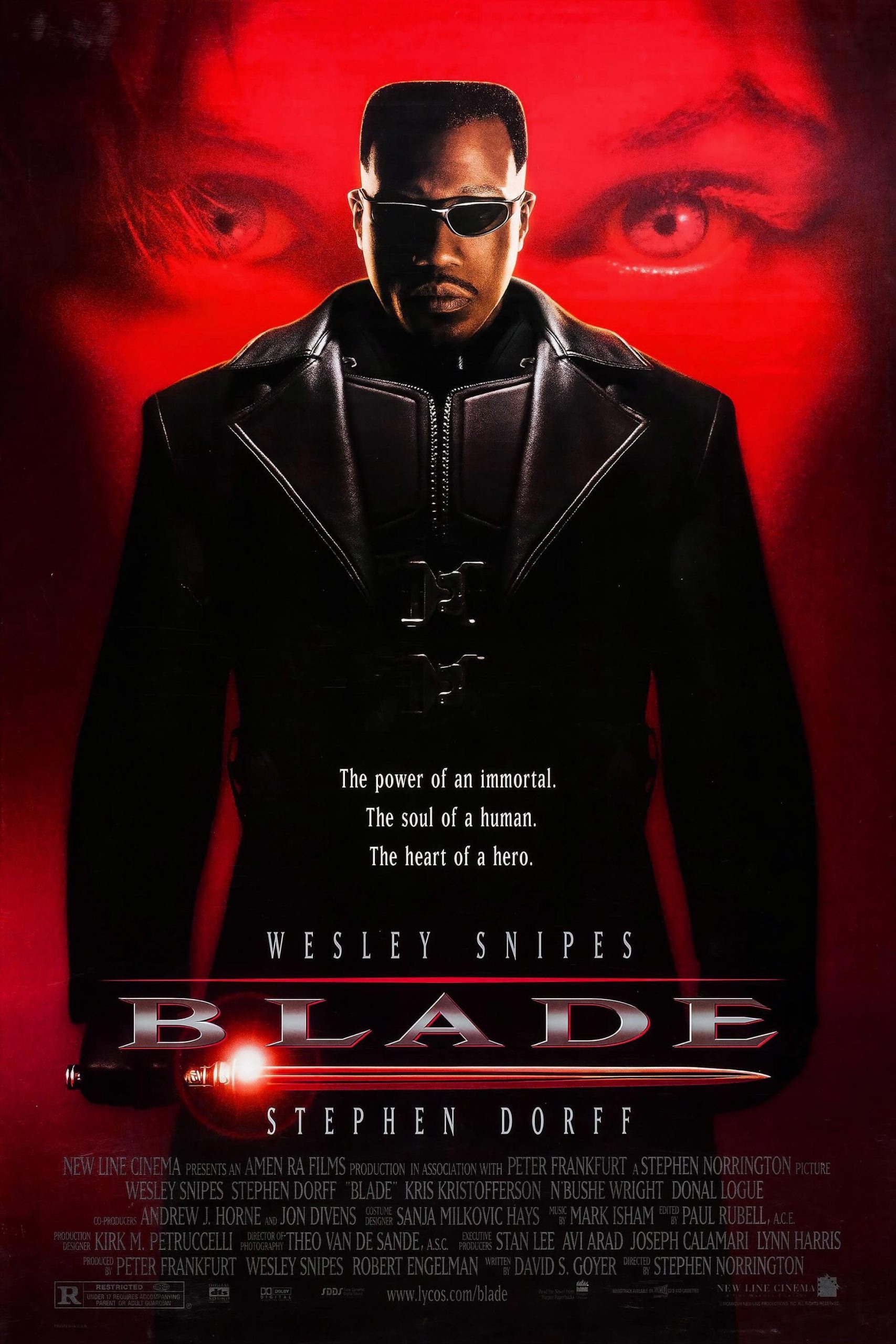
Starring: Wesley Snipes, Kris Kristofferson, Stephen Dorff, Donal Logue, and Udo Kier
Grade: B+
David S. Goyer giving Blade a samurai aesthetic and a sword to match might be one of the earliest examples of a movie improving on a comic book character because imagining Blade without a sword is practically sacrilegious now.
Summary
In 1967, a pregnant woman is being rushed to the emergency room. She is bleeding from the neck due to a vampire attack. She is dying, so they have to do an emergency c-section. The baby is saved, but she passes away.
The baby is who will become Blade.
In the present, a girl drives her unsuspecting date to a rave that’s in the back of a butcher shop. He quickly loses her on the inside, but the party is nuts, so he tries to dance with several women. After being turned down left and right, he notices drops of blood on his hand. He looks up while everyone raises their hands. The DJ outstretches his own hands to the music, and there’s a hand-painted sign behind him that says “Bloodbath”. Then, the sprinklers turn on. However, it’s not water. It’s all blood, and it sprays everyone. They’re loving it. The novice guy that just got there is freaking out though and everyone around him take notice since they are vampires. They start cornering him, so he tries to get out of there. Sadly, one of the vampires punches him in the face. He falls to the ground and starts crawling away as they kick him. After this, everything stops. The blood stops sprinkling, and the guy crawls to the feet of the odd man out, Blade (Snipes). All the vampires are shocked. They are very aware of the man known as the “Daywalker”, including Quinn (Logue). With his wide array of weapons on him, Blade begins killing vampires left and right. Some run away, but others try to fight Blade, only to be quickly dispatched. This even includes the DJ. Once the room clears, Quinn has a special vampire group attack Blade, and they are armed with crowbars. Seeing this, Blade pulls out his signature sword. Blade kills every last one of them. He shoots two stakes out of his modified shotgun directly into Quinn’s hands, sticking him against a wall. Blade tells Quinn he’s tired of chopping him up, so he’s going to use fire this time. Before leaving, he tells Quinn to give his regards to Deacon Frost (Dorff). He sets Quinn on fire, and the regular guy who isn’t a vampire tries to run. Blade grabs him and checks to see if he was bitten. Since he’s not, Blade leaves him alone. Once the cops and firemen show up and put out Quinn, Blade escapes.
Quinn’s charred body is brought to a hospital for Dr. Curtis Webb (Tim Guinee) to look at. He gives what they found on the body to hematologist Dr. Karen Jensen (N’Bushe Wright), his ex-girlfriend. She finds that the red blood cells are biconvex, which is impossible. Curtis points out how the polys are binucleated, but she doesn’t want to hear it. It’s 3AM, and she’s not in the mood for an elaborate joke. He assures her this is serious, as he has the body sitting in a morgue currently. Karen isn’t buying it and brings up how Curtis agreed to give her space post-breakup. However, he just wants her to come down to take a look at the body. She relents but adds that she doesn’t want to hear a word about their relationship. He agrees, and they go to dissect the body together. In the middle of it, Curtis asks if Karen has ever had second thoughts about them. Annoyed, she admits “sometimes”, but then she remembers how much of an asshole he was. Defensive, Curtis brings up how he gave her time off when she asked and how he’s trying. Karen tells him it’s over. Just then, Quinn’s charred body comes back to life, grabs Curtis, and bites him on the neck. Quinn jumps off the table and chases Karen into the hallway, biting her too. Thankfully, Blade shows up to finish Quinn off. He punches Quinn off of Karen. When he tries to come back at him, Blade cuts off Quinn’s arm with his sword. The cops show up and shoot at Blade. They hit him in his protective armor and he shouts back, “Motherfucker, are you out of your damn mind?”. They end up running, and Quinn escapes by jumping out of a window, landing in a moving ambulance, and exiting out the back door after scaring the patient that was inside. Blade sees Karen bleeding on the ground and goes to leave. However, he gets a flashback to his mother reaching out, as seen in the opening of the film. Because of this, he decides to take her in his arms to safety. The cops show up and open fire at him until he gets into a room. He looks out the window at the opposite building.
Then, he launches Karen out the window and to the other building to safety. The cops enter right after, but Blade leaps from building to building safely before picking up Karen and rushing her over for cover. She realizes her shoulder has been dislocated, so Blade pulls it back into place.
Blade then shoots cover fire at the cops who are still shooting from the window of the hospital building, and the two run into the stairwell to escape. Driving through the night and into the morning, Blade gets back to his hideout where he stays with weaponsmith and mentor Abraham Whistler (Kristofferson). Blade brings Karen over to the table and tells Whistler that she’s been bitten. Whistler says he should have killed her. Blade knows, but he didn’t this time. Whistler reluctantly agrees to help, but he tells Blade to watch her close. If she starts to turn, he wants Blade to finish her off or he will. Upon examining her, Whistler can see she’s on the border and will change in another hour. Grabbing a syringe, Whistler tells Karen that he is going to inject her with allium sativum, garlic. He also is blunt in that it will hurt a lot. Blade chimes in to tell Whistler that Quinn is responsible. Whistler refers to Quinn as Deacon Frost’s “little errand boy” and asks Blade if he got a lead on Frost. Sadly, he didn’t. Whistler injects Karen with the syringe, and Blade holds her down. Whistler gives her a 50/50 chance at survival if she makes it through the night. Meanwhile, vampire elder Gitano Dragonetti (Kier) holds a meeting with other high-ranking vampires and looks through pictures of Blade’s most recent killing endeavor. Dragonetti asks what the kill count was, but they don’t know. They just know Blade used a lot of silver. Dragonetti asks for Frost to be brought in. Once Frost is told by the doorman to enter, he lights his cigarette. In the meeting, Frost is told that he’s a disgrace to the vampire nation. Pointing directly to Frost’s big plan, the one elder lambasts his idea to break the treaty and gather in numbers because the human politicians will make their lives very difficult. He tells Frost that he would understand this if his blood was pure, adding how they already have enough trouble with Blade. Uncaring, Frost is barely listening while he smokes. Another elder tells Frost that his nightclubs are dangerous and draw needless attention to their kind.
He reminds Frost of their policy, but Frost calls it their policy, not his.
Dragonetti says their livelihood depends on their ability to blend in and their discretion. Frost thinks it’s time to forget about discretion. He argues they should be ruling the humans, not making back-alley treaties with them. He points out how humans are their food, not their allies. Even so, no one is happy hearing Frost’s words. Dragonetti says they have existed this way for thousands of years. Who is Frost to challenge their ways if he’s not even a pureblood? Frost doesn’t think this matters, but Dragonetti was born a vampire, as was every member of their house of delegates. He passes off Frost as being “merely turned”. Getting close to Dragonetti’s face, Frost says the world belongs to them, not the humans. Dragonetti ignores him and asks the other elders if they have any other business matters to discuss. The one guy brings up the offshore accounts before Frost interrupts to tell Dragonetti that he may wake up one day and find himself extinct. Frost then exits the meeting. Elsewhere, Blade goes to a drugstore he frequents. The worker notes how Blade is a week early. Blade hands him over his payment of a bag full of watches and talks about how Whistler says he is building up a resistance to the serum. The man is not surprised and gives him a new bottle to work with. Back at Whistler and Blade’s hideout, Karen has recovered and wakes up in a private room. She looks around and finds a wall with Blade’s many weapons. She touches his sword and jumps at its defense mechanism of several spikes pointing out of its handle. Whistler comments to Blade how he must be getting soft in his old age for letting Blade bring home a stray like Karen. Whistler thinks it was stupid but admits they may have lucked out. He checked her background and found out about her being a hematologist. She might be useful to them, though Blade doubts it. At this point, Karen is out of her room and overhears the two talking. Continuing, Whistler says he took a look at her notebook and thinks she’s onto something.
As Whistler prepares Blade for his serum shot, he reveals that he had to increase the dose to over 50 milligrams, which is dangerous. Blade doesn’t care though. Whistler puts a mouthguard into Blade’s mouth and lends his hand for Blade to grip before injecting him with the painful serum. Fighting the initial struggles, Blade is able to get through it. As he takes a breather, he makes eye contact with Karen. She starts running, so Whistler chases her. Despite his limp, he is able to catch up and corner her to stop. She asks who they are, and Blade appears behind her to ensure things are calmed down. As Whistler gasses up Blade’s car, Karen asks if she’s a prisoner there. Whistler assures her this isn’t the case. They just had to take certain precautions before they let her go. He explains to her that vampires are everywhere, the “hominus nocturna”. He reveals to her that they hunt the vampires and move them from one city to the next, tracking their migrations. They’re hard to kill and tend to regenerate. Karen doesn’t believe it, but Blade points out how she already met Quinn at the hospital. Karen asks if they use stakes and crosses, but Whistler says crosses don’t do anything. However, some of the legends are true. Vampires are severely allergic to silver. If you feed them garlic, they go into anaphylactic shock. On top of that, there’s sunlight and ultraviolet rays. With this, he shows Karen a heavy-duty flashlight and gives it to Blade to try out tonight. While Blade readies himself to go, he tells Karen that if she wants to live to see another day, she should be out of town by nightfall. She doesn’t know where to go, but Blade explains that she has been exposed to them. Because of this, the vampires are going to hunt her. While Blade packs his car, Whistler tells Karen there’s a war out there. Besides them and a few others, they’ve tried to keep it from spilling out into the streets. Sometimes, people like Karen get caught in the crossfire. Karen says she has blood samples and can go to the police, but Whistler says the vampires own the police. He goes on about how they are everywhere, and she may have seen them all the time but just didn’t know it.
She can’t believe they are just sending her on her way, but it is what it is. For her own protection, Whistler gives her vampire mace. It contains silver nitrate and the essence of garlic. He tells her to keep her eyes open and to be careful. Before he goes back to his work, he tells Karen to buy a gun. If she starts getting sensitive to daylight and becomes thirsty regardless of how much she had to drink, he suggests killing herself. After this, Blade drives her home. Back at the vampire hideout, Dragonetti makes his way into the archives and finds Frost sitting inside. He reminds Frost that he’s already been warned about the archives being restricted only to the members of the House. Dragonetti sees how Frost has a computer software trying to translate some ancient tablets, and he tells Frost he’s wasting his time because it’s a dead language and the ancient texts can never be translated. He notes Frost wouldn’t even understand them anyway. Having his headphones in his ears listening to some crazy techno, Frost just stares at him. Once Dragonetti starts yelling at him, Frost takes the headphones out and tells him to be quiet since it’s a library. Dragonetti slaps him and demands to know what he’s up to. Frost challenges him, questioning what he’s going to do. Dragonetti comments that Frost bores him and he leaves. Blade drops off Karen and reminds her to keep her eyes open because vampires are everywhere. Karen is confused by this because its daytime, but Blade drives off. She gets back to her apartment building and goes to the elevator. In front of her, there is a man and a woman with the same tattoo, and she notices it. She enters the elevator with them and the two stare at Karen. Once she turns to look at the man, he asks her how she’s doing. Karen doesn’t answer and turns back around, realizing she may be in danger. They exit on her floor and follow her. She pulls out her mace and turns to them, but they are gone.
She gets to her apartment and quickly packs up her clothes. Out of nowhere, Officer Krieger (Kevin Patrick Walls) appears and says the front door was open.
Krieger claims to be on a routine check, he knows who Karen is, and he brings up how her co-workers said she was kidnapped last night. Once he confirms Curtis is dead, he then changes his tune to say she will be dead too. He tries to attack, so Karen sprays him with the mace. He doesn’t go down however, as it’s more of an agitator. It turns out, he’s not a vampire. Blade appears behind Krieger and takes him out. As he punches Krieger, Blade tells Karen that Krieger is a “familiar”, a vampire wannabe. If a familiar is loyal enough and proves himself, his master might turn him. Karen realizes Blade used her as bait, but he just tells her to get over it. He slams Krieger through a table in the room and shows Karen the tattoo on the back of Krieger’s neck. It’s a “glyph”, a vampire cattle brand. It means Krieger is someone’s property. If another vampire tries to “bleed this little hooker”, then they have to answer to his owner. Looking closer at the glyph, Blade can see Krieger is owned by Frost, someone they have been tracking for a long time. While he questions Krieger about his master, he robs him too, as it’s the only way they can fund their exploits. However, he punches Krieger out when he finds that his watch is a fake. Following this, Blade and Karen take Krieger outside and look into his trunk to find he’s been blood running. Karen sees his briefcases are from the Hilbarn Clinic Blood Bank, a place she knows. Blade says they are owned by vampires and there is one in every city. Since they always deliver, he asks Krieger where he was taking it. He refuses to say anything, so Blade bashes Krieger’s head off the trunk. He gives him one more chance, but Karen thinks this is enough and tries to stop Blade from using his gun. With just this distraction, Krieger takes off running. Blade aims into the crowd of people on the sidewalk, but he isn’t able to fire in time before Krieger escapes. Furious, Blade tells Karen to wake up to the real world. If she wants to survive it, she needs to learn to pull the trigger.
He storms back to his car, but Karen joins him. Blade deems her useless, but she rushes into the car. She figures she has to stick with him, as it’s the only way she will stay alive long enough to find a cure for herself. Blade states there is no cure, but he relents and lets her come along. The two stakeout Krieger’s car into the night. Karen doesn’t think he’s coming back because she doesn’t think he’s that stupid. Blade says that when you understand the nature of a thing, you know what its capable of. Almost on cue, Krieger appears and runs to his car to drive off. Blade smiles at Karen for a second before following Krieger. On his radio, Krieger says he has a delivery in process, just had a run-in with Blade, and to clear out the clinic immediately. Eventually, Blade drives up to a low-key club and denotes a vampire mark on it. It means there is a safehouse around there somewhere, a place they can go with donors coming. He points out to Karen how the valets, the doorman, and the whore on the corner are all vampires. He can tell by the way they move and smell. Nevertheless, there are worse things out in the night than vampires. Of course, Blade refers to himself being this. Leading Karen over to the club, he reminds her that crosses and holy water don’t do dick and to forget what she’s seen in the movies. The focus is to use stake, silver, or sunlight. He gives her a gun to use. Though she doesn’t know how to use one, she says she will learn quick. He tells her the safety is off, the round is already chambered, and it contains silver hollow points filled with garlic. He tells her to aim for the head or the heart (“Anything else is your ass”). They get up to the doorman, and he asks Blade for his invitation. Blade smiles at Karen before sending the doorman through the door. They walk into this strange Japanese nightclub where there are women singing and performing dressed like schoolgirls. All the men in the audience see Blade walk in. Blade takes out a few guys before running into Krieger. He beats up Krieger into the kitchen and demands to know where the entrance is.
After getting a further beatdown, Krieger says the entrance is the big refrigerator in the room. Blade doesn’t believe him at first until he opens it to see the inside leads down a hallway. With this, Blade tells Krieger to relay to Frost, “It’s open season on all suckheads”, allowing Krieger to leave. Karen joins Blade, and they go through the entrance in the fridge. They go down the hall to the elevator and take it to the archives where the vampires keep most of their records. Blade tells Karen the vampires have their claws into everything including politics, finance, and real estate. They already own half of downtown. At Frost’s place, he’s hosting a party, but he’s in his room waiting on the computer software to finish the translation of the ancient texts. After a woman leaves his bed to join the party, the translation is finally complete, and the computer begins to showcase some larger plan at hand. He’s interrupted to talk to Krieger, so Frost leaves the room to rejoin the rest of the party. Krieger apologizes for coming there and says it was a mistake going to Pearl’s (Eric Edwards). He can tell Frost is disappointed in him. At the same time, Quinn is at the party and has made a full recovery. He’s hanging with two girls and asks if they want to meet Frost, talking about how they are practically brothers. Quinn tries to get Frost’s attention, but Frost just looks at him and keeps walking. Krieger tells Frost about how Blade was waiting for him and used Karen as bait. The one girl at the party comments how Krieger was stupid enough to take the bait, so he tells her to shut up. Krieger insists it’s no problem because they can get the girl, but Frost bites Krieger viciously and dumps him into the pool. With a bloody mouth, he makes out with the girl next to him. With this, he says to forget the girl. He wants Blade and tells Quinn that he wants Blade alive, though Quinn isn’t sure this is possible. Back in the archives, Blade and Karen find the blob-like record keeper, Pearl. Pearl talks to Frost on a video call about how he needs 12 purebloods to make the ritual work before Blade interrupts the farting mess.
Pearl tries to tell Frost that Blade is going to kill him and how Frost needs him, but Frost doesn’t care and tells Pearl to die with some dignity. Blade turns the video call to himself, and Frost knows Blade is looking for him. He sarcastically says he’s flattered to which Blade replies, “It’ll pass”. Frost hangs up. Karen readies the UV lamp as Blade prepares to interrogate Pearl. He says that he may only walk out of there with a tan depending on his answers. He points out the computer program on the screen of what Frost sent over and demands to know what it is. After Pearl says it’s routine research and even a video game, Karen shines the lamp on him and his skin burns like crazy. With this, Pearl reveals that it’s a fragment, a piece of the prophecy. When Blade asks what the prophecy is, Pearl acts like he doesn’t know, prompting Karen to fry him again. Pearl then states “La Magra is coming! The Spirits of the Twelve will awaken the Blood God!”. He tells Blade there is nothing he can do about it, at least according to Frost. Blade takes the file and tells Karen to keep the lamp ready to burn him again if he moves. He finds the storeroom, but Pearl says there is nothing of importance inside of it. Calling his bluff, Blade comments that Pearl shouldn’t mind if he took a peek inside, prompting Pearl to yell. Karen sees this as him moving, so she burns the hell out of him with the lamp. Blade blows the door to the storeroom open. They walk around and see the large ancient texts behind glass. Blade tells Karen these are pages from The Book of Erebus, the vampire bible. It contains everything, their entire history. Blade realizes La Magra must be one of their legends. Just then, Blade can sense someone running around the room. As Karen questions why Frost is interested in La Magra, Blade shushes her to find who is running. It’s a little girl, so he offers her his hand. Unfortunately, it was part of Quinn’s plan. He shows up with several more vampires, and the little girl kicks Blade through a plate of glass. He doesn’t fall though. He eventually takes her out along with a few others of Quinn’s group, but he’s eventually apprehended and held back by a tie around his throat. Quinn shows off his new hand that grew back and shows how they have Karen.
One guy brags that he has Blade’s sword, but the safety spikes pop out and cut off the guy’s hand. They all laugh it off though. After punching Blade several times, Quinn takes one of Blade’s silver stakes from his pants and stabs Blade in the shoulder with it since he owes him one. He then realizes that he owes Blade two, but Blade starts laughing and says he’s expecting company. Just then, Whistler shows up for the save. As Whistler shoots at everyone and throws a backpack bomb inside, Blade grabs Karen to escape. Quinn reminds everyone Frost wants Blade alive, and they pursue. Blade, Whistler, and Karen make their way to the subway tunnel just as the bomb goes off and kills several vampires chasing after them, along with The Book of Erebus. The shock throws Whistler down the tunnel, but Blade assures Karen that Whistler can take care of himself. Blade shoots at the vampires as him and Karen go to the other side of the tunnel. Quinn runs across right before the next train drives by and takes out two vampires. Quinn tackles the two, and Karen falls in between the walkway and the train. Blade tries to reach for her, but Quinn grabs him. He snatches Blade’s sword, but Blade kicks him, leading Quinn to drop it next to Karen. In the middle of this, Karen sees Whistler escape through the sewer. As Blade beats the hell out of Quinn, Karen stabs him. Blade smashes Quinn’s head up against the moving train, gets the sword from Karen, and he cuts off Quinn’s hand again. Quinn runs but more vampires come their way. So, Blade picks up Karen and grabs the end of the train to escape. Inside, Karen pulls Blade’s dislocated shoulder back into place. Then, he injects himself with the serum. Karen asks if he’s one of “them”, but he says he’s something else. Back at the hideout, Whistler explains to Karen that he found Blade when he was 13 living on the streets.
The young Blade was feeding off the homeless, as his need for blood took hold around puberty. Whistler took him for a vampire at first and almost killed him, but then he realized what he was. Blade’s mother was attacked by a vampire when she was pregnant. She died, but he lived. Unfortunately, he went through some genetic changes. He can withstand garlic, silver, sunlight, and he’s got their strength. By this time tomorrow, all his wounds will be healed. He still ages like a human though, as opposed to vampires since they age much slower. On top of this, Blade inherited their thirst. Karen thought the serum would suppress it, but Whistler admits his body is starting to reject it. All his efforts to find a cure have failed thus far. Whistler reveals that he had a family once, a wife and two daughters. Then, one night they came across a vampire who toyed with him, wanting Whistler to decide what order his family would die in. This is why he does what he does. They kill as many vampires as they can find, but it’s getting worse because of Frost. Something big is being planned, and Whistler would bet his life that Frost is at the center of it all.
It goes without saying that he would win that bet.
My Thoughts:
When discussing movies that not only defined a small period of time but also inspired the development of a niche part of the human population, there are two films in particular that are looked at as the defining examples of the late 90s. It’s The Matrix, and it’s Blade. If you were lucky enough to grow up during this timeframe, you are very aware of the chokehold these two films had on nerd and pop culture, Comic-Con goers, cosplayers, emo lovers, video game and computer enthusiasts, and above all else, the rave scene. The leather, the all-black fits, the darkness, an affinity for outlandish fashion and mythology, and how the aesthetic is basically an unofficial representative of the group of kids most avoided in the cafeteria back in high school, all of it can be rooted back to these two movies in some fashion, along with other similarly styled films and television shows. Nevertheless, Blade was and still is certifiably cool. Even if the film has plenty of fair criticisms regarding its screenplay and character development, its aura is not something that can be denied. For novice viewers and audiences unaware of the depiction of this subculture and the vampire/raver aesthetic that was popular at the time, it’s an eye-opening, trailblazing, genre-starter filled with shoot ’em up action and a superhero who is very much a late 90s legend. For fans who love the vampire mythos, are superfans of Marvel, or are one of those kids who started smoking cigarettes too early, listened to techno too much, wore black jeans into the summertime, or did all three, Blade was iconic. Its impact cannot be understated, and neither can the simplistically cool performance and seemingly perfect casting of action hero Wesley Snipes in one of his best roles to date.
If a young filmmaker is trying to figure out a straightforward but emphatic way to introduce a protagonist and cementing his aura and reputation on the spot without having to say much, Blade‘s opening sequence comes to mind almost immediately as the blueprint. There are so many vampire movies in existence, so it’s hard to keep things fresh from a cinematic standpoint. However, Blade‘s first ten minutes feels like a revelation with this in mind. It all begins with a great depiction of a rave in the back of a butcher shop that turns into a literal bloodbath filled with dancing vampires, with these visuals accompanied by its club music being exactly what is needed to shock the viewer. The fear sets in, as this innocent guy is about to be ravaged. He tries to crawl away but runs right into the feet of the titular character. Showcasing elements of a western gunslinger and a modern-day samurai, the unflinching Blade stands alone across from hundreds of vampires. With just minimal whispers and mumbling from the vampires, and Blade standing still in his signature black sunglasses, flat top, armor, and black leather trenchcoat, it’s the visual cue of all visual cues that shouts to the world Blade is “HIM”. In this vampire-riddled world where Blade is half-vampire and has all of their powers but is also half-human, he stands firmly in the middle as the only hero capable of stopping this potential apocalypse the non-pureblood Frost is trying to trigger that not even the elder purebloods want. According to Whistler himself as he stated when on the verge of death after being beaten bloody by Frost and his vampire crew, Blade is “The Chosen One”. It’s implied because of his status as the man in the middle, but hearing it from the well-travelled Whistler before the third act adds a certain level of gravitas that makes the superhero hit on the level of his peers that we hold in such high regard like Wolverine, Captain America, Black Panther, or even Spider-Man. With how they frame it here, Blade truly feels like the only man for the job in his universe. When they speak of the “Daywalker”, everyone knows shit is about to go down.
All these years later, he still commands the room, as Wesley Snipes’s presence in this role in particular is unmistakable, as evidenced most recently in Deadpool & Wolverine.
All the entertainment value stems from Snipes as the main character, and the production rides entirely on his back, which is probably why he was given so much power over the character in this film and its subsequent sequels as a producer. Regardless of how accurate his antics were on the set of the third film, his passion in playing the superhero and how crucial he was in the franchise’s success is yet another thing that cannot be understated. He earned the control he had, as his understanding of what the character needed to be is what made Blade and Blade II the successes and cult classics that they were. Part of it is why he may have been anxious about the infamous production of Blade: Trinity. Snipes laid the groundwork and spearheaded the success of the franchise while redirecting the cinematic fate of Marvel singlehandedly. By the time 2005 came around, what he saw was a bastardization of everything he helped build. Snipes had a passion for the character and had a hand in figuring out who he wanted Blade to be, what he would look like, and how he would act within the world created in the first film. The passion is palpable too, as Snipes owns it in an effortless manner due to his action hero status. He simply answers the call with his legitimate athletic prowess, fighting ability, and an undeniable charisma that bleeds through regardless of how much the character actually says in the movie or not. In contrast to other Snipes vehicles, Blade is a man of few words and keeps things straight to the point. There are moments where the actor fights to the surface like him comically yelling at the cops who shoot at him in the hospital with, “Motherfucker, are you out of your damn mind?” or his quick smile to Karen when he’s proven right about Krieger going back to his car. However, for the most part, Blade is ultra-serious. He has a real hatred of vampires, just like his mentor Whistler, and their motivations to work tirelessly in killing as many vampires as possible every single day does makes sense.
Exhaustion never comes into play because they live for this. It’s why Blade doesn’t have time for anyone or anything else and is also why it’s such a shock to Whistler as to why Blade brought Karen back to the hideout in the first place. Blade doesn’t have a reason why he didn’t just shoot Karen knowing she was infected. All it took was a flashback to his own mother, and he decided Karen needed to be saved in the moment when usually he would put her out of her misery before she turned. It’s a callback to the cinematic heroes of old, the men of few words who rode in and saved the innocent by kicking the ass of those who needed it. In today’s era, what seems to be popular is the wisecracking hero that pokes fun at the villain or any given situation enroute to saving the day like Deadpool or Iron Man. Blade is of the old guard however, a hero who exists to take down the evils rising to the surface and takes his calling as serious as a superhero should, if the situation indeed puts that many lives in danger as other characters stress to the viewer. Rewatching the movie today is almost a breath of fresh air just because the market has been oversaturated by the sarcastic protagonist who has a quip for everything. With Blade, it’s not presented in an over-the-top way either like some sort of B-movie actioner. The film is entrenched enough in its own mythos and presents it well enough to the audience that they buy in to how serious the characters take it. It’s a fundamental element to this first film that makes it as special as it is. It’s also partially why Blade: Trinity felt too disconnected from the rest of the series. For the record, Blade: Trinity isn’t terrible and there are plenty of positives about it that people avoid talking about for whatever reason, but it is still far and away the worst of the three movies. That can’t be disputed. Even so, it’s still better than Blade: The Series.
On the other side of the coin, the villainous side of things is nowhere near what it needs to be to match up to its hero. Snipes’s Blade is so domineering and strong as a character that a lot of the supporting cast merely exists to fill in the cracks in comparison. Donal Logue chews the scenery as a true recurring-henchman-in-a-superhero-movie would, but he doesn’t do or say anything that the viewer doesn’t expect. He tries to overdo the nastiness of Quinn and routinely gets his ass handed to him to the point where he becomes a comical sidekick of Frost by the end to unamusing results (“I’m gonna be a naughty vampire god!”). I suppose Logue bringing a recognizable face to the henchman role is noted as something, but it’s still relatively insignificant and not much different than the other henchman roles the actor has had in movies like Reindeer Games. In addition, he just doesn’t look like someone you’d catch in a rave and doesn’t offer much as Frost’s backup. Quinn has a lot of personality, but he’s not given much opportunity for growth, which is why we don’t care. He’s also physically bigger than Stephen Dorff’s Frost and neither click as a team. Since those two are causing the most destruction in the movie, the antagonistic side of things fight quite the uphill battle to look like they pose a threat. This is part of the issue, as the ultimate goal of Frost is treated like a big deal and is. However, Frost and his followers just aren’t intimidating nor look like strong enough equals to match the motivated hero. The real interest was the vampire House of Delegates who make all the decisions, have been making behind-the-scenes deals with humans for thousands of years to live together but in secret, and are born as vampires and look down on everyone else, including someone who turned like Frost. This idea really captures the imagination of the viewer and is a great way to show how deep this worldwide conspiracy goes and why Blade is such an important hero in this universe. Udo Kier does look like a vampire too, so there is no argument on his casting as the leader in Dragonetti.
It’s a shame this weirdly organized group of vampire elders who help control the world in a way take a backseat and get bitched out by such a lame dude like Frost.
As cool of a name as “Deacon Frost” is, the character just never feels like the threat to the world that he is portrayed to be. He is a decent agitator that spices things up from time to time, and he does well in portraying the mega chip on his shoulder due to the fact that neither Blade nor the pureblood vampires like him or his attention-getting, careless style. However, Stephen Dorff’s performance doesn’t make Frost look tough or vile. He is rather a stepson or middle child overcompensating to look edgy and dangerous. If Dorff was going for this, he succeeded. On the other hand, if this was the intention all along with the character, it doesn’t align with the world-dominating plot because a stronger villain or actor would still be needed to believably take the vampire elders hostage and face off with Blade. His plan is worrisome, but he himself is not. In the park scene, Frost tries to sound diabolically evil calling Blade an “Uncle Tom” for trying to defend humans when he’s a half-breed, how morality isn’t a concern when dealing with humanity, and that their race is just a function of natural selection, but Blade completely undercuts him by replying, “Looks like your mascara’s running”. It just reminds us how much of a bitch the character really is, and his words don’t carry the weight they are written to have. I actually didn’t like how intimidated Dragonetti seemed either when dealing with Frost because he wasn’t as unpredictable as the elders were making him out to be. Even in the climax when we finally get the one-on-one between Frost and Blade in the temple, he’s outclassed visually while standing across from Snipes. Though we try our best in suspending our disbelief in the sequence in acting like Frost’s newfound powers makes him an equal, there was never any doubt. Even so, let it be known that the final fight and the climax as a whole is fantastic and completely worth the watch, though this is more for its contribution to action cinema and those who are fans of the martial arts talents and badass persona of the star. This, they deliver on handily, which is why Blade has a lot of replay value.
The intricacies of the Book of Erebus are undersold, the backstory of the Blood God “La Magra” isn’t delved into outside of a line or two since it’s pretty straightforward what the goal is, some of the more interesting details of the vampire side of things are forgotten about rather quickly, or they are only given a small sample size of devoted time compared to the more complicated plots of other superhero movies. For example, I have about a thousand questions about Pearl, but he comes and goes, despite living in the archives and is treated as an all-knowing source of vampire history. As disgusting as he is to look at, he’s a character that deserves a bigger role to further other plot developments or to add to the world-building through interactions with the main characters. If anyone should have been retained in sequels to help move the plot forward, it was that monster. Plus, what about Pearl himself? Why in the fuck does this David Cronenberg creation look like that? What happened? How did he get that job? What does his work routine look like? Do the elders deal with him? Do they hold him in high regard or is he like the IT guy at the office there? There are so many questions that need to be answered or have implied answers through side comments or actions, but the character, along with many other details of the screenplay, are only disappointedly touched on at a surface level, despite the viewer being hooked and wanting to get deeper into seeing the scarier components of what Blade is facing. You can tell it’s a big deal when the elders try to tell Frost as a last-ditch effort that La Magra is a fairytale and he calls out their bullshit by retorting, “Then, why are you sweating, pureblood?”. Nevertheless, the ancient details surrounding the Blood God and why the elders don’t want him to be brought to life is still unanswered because would they not ultimately benefit like how Frost is arguing? Granted, they would face a war with humans since they would be breaking the treaty, but they would have the advantage, would they not? Why are they so vehemently opposed to even discussing the idea?
Nevertheless, the action delivers and is without a doubt the calling card of Blade‘s ultimate legacy. If the entire runtime consisted of Blade killing thousands of vampires nonstop, it would still be worth watching, as a majority of the best moments in Blade can be rooted directly back to the fantastically choreographed sequences like the opening, the subway sequence, the aforementioned third act in the Temple of Eternal Night, and the electric infiltration of Edgewood Towers. This was right up there with the ending, as Blade drives a motorcycle through the glass, wipes out everyone near with Uzis and a shotgun, and then takes his coat off to fight off two henchmen in a martial arts-laden scene. Using the EDTA coagulant used to treat blood clots that he repurposed as a serum/weapon, he stabs the one girl in the eye and then the other guy, and their faces explode like blood-filled ballons as he walks away. He might have finished the movie right there and saved the day had Frost not thrown in the curveball of Blade’s mother, which I’m still on the fence about as being an unnecessary twist or a missed opportunity. Seeing Blade stop in his tracks in that all-white room as she asks, “Eric?” was quite the moment, even if it’s questionable as to how Blade knows what she looks since she died during childbirth and he was living on the streets for so many years afterwards. Still, Frost revealing how Blade’s mother basically belongs to him and he’s the vampire that bit her which makes him Blade’s father in a way should be massive, but the combination of the script not hammering this point home to make Blade and the viewer’s blood boil and Dorff being underwhelming as Frost makes what could have been a game-changing twist in the film into nothing more but a decent plot detail. On top of that, they don’t do much with Blade’s mother other than in the third act.
While Blade is locked in this form of his body as he’s being prepared to get his blood drawn to power the Spirits of the Twelve to bring in La Magra, she cuts Blade’s shirt open, brings up how thirsty for blood he probably is, and caresses him to the point where he tells his mother not to touch him. It’s an odd scene with a lot of uncomfortable sexual tension between mother and son, and it just didn’t seem like the right way to go with it. Her explaining to Blade how the vampires are her people, how she’s one of them, how she died a long time ago as his “mother”, and how she throws it back at him saying, “I’ve hunted, I’ve killed, and I’ve enjoyed it. Haven’t you? I know you have” before using her heel to press the button that closed the body form onto Blade to begin the blood draining felt like they were just scratching the surface of possibilities. Truthfully, reintroducing the mother earlier wouldn’t have worked. The way they brought her back and the timing of it was a greatly executed, but the movie could have benefitted had she had a stronger presence in the proceeding events after she was revealed to still be alive. Frost should have made her one of his go-to girlfriends just to antagonize Blade, not just talk about it for one scene and move on. Frost essentially changed Blade’s entire life and could be looked at like a pseudo stepfather of sorts. How does someone who is supposed to be that much of a prick not milk this for every penny? This is a guy who used a child as a hostage in a park to try and convince Blade to join him, and then he threw her at a hot dog stand and onto a street to escape in one scene. He literally talks about how he sees human as cattle and pieces of meat and doesn’t think it matters how humanity’s world ends. Why doesn’t Frost try to go even lower when it comes to Blade after making it seem so personal early on?
N’Bushe Wright is wildly uninteresting and offers nothing to the production as Karen. Other than her being a hematologist which gives her enough of a reason to stick around, she is merely there to lead to the ultimate moment in Blade canon where she allows herself to be fed on to bring a bloodthirsty but reluctant Blade back to life for the final fight. Even so, anyone could have been inserted here, and the result would have been the same. In a potential franchise starter, Wright should have come in with the goal of being part of a sequel rather than putting together a by-the-numbers performance. Sadly, she went with the latter and treated it as a job and nothing more. She didn’t have to be a love interest or anything to make a difference, but she was average in the action scenes and in convincing us she’s a doctor. It was underwhelming, especially for the amount of screentime she gets. By the time Blade II comes around, her presence is not only NOT missed whatsoever, but you don’t even think about her. Karen fighting a returning zombie Curtis at the temple was fun, but that’s pretty much it. Truth be told, as solid as Kris Kristofferson was as the mentor Whistler, he doesn’t do anything you wouldn’t expect as the grizzled veteran of the vampire-hunting game. From an overarching story perspective, it didn’t make sense for Whistler to be a part of the sequels either. He was a big part of Blade, but the brutal ending to his character arc should have stayed as is. It still makes no sense how they justify his return in Blade II, and they do an even worse job of finishing him off in Blade: Trinity. The devastating sacrifice he makes in the first Blade is the hero’s finale that was the most powerful and set Blade up on the warpath moving forward (“Now walk away, you stupid son of a bitch… Walk the fuck away”). Acting as if he was turned in Blade II and kept as prisoner in a water-filled chamber for no discernible reason was just a dumb insertion to bring the second biggest star back for a sequel. Now, the bond between Blade and Whistler is understated since both men are too manly to admit what they mean to each other, which is fine. You just assume it’s a father and son-like relationship anyway just with how they interact, and it’s only confirmed by Scud in Blade II.
However, there just wasn’t enough substance or an emotional enough moment between them that hit the viewer in the heart as to why Whistler meant that much to the movie. Even when Karen mentions how Blade must have a lot of love for Whistler, Blade doesn’t give her anything stating, “We have a good arrangement. He makes the weapons. I use them”. It’s a tough guy answer and fits Blade’s characterization, but it’s almost as if they don’t know how to depict Whistler’s deathbed scene, as Blade just stares. Even after the gunshot is heard behind Blade when he walks away, he doesn’t even flinch, though his face does say a lot when he sees the bloody white sheet initially and looks forward as he unveils a beaten down Whistler, breathing out as he does so. In their defense, this is how the character acts from an emotional standpoint as Blade refuses to show such weaknesses, which is why this breathing out is actually a big deal in context, but they just don’t do a good enough job to show why Whistler is pivotal and needs to be brought back. He’s pivotal in setting Blade on his path and creating weapons for him, but his role is served in the first film. It logistically didn’t make sense for him to return in Blade II and didn’t feel necessary to the plot even after he does, and Blade: Trinity just washed their ass with the character just so they could use him to transition the audience to the new team members added to the cast.
By the way, if you want to see how weak Wright’s Karen and Dorff’s Frost are. Look no further than the scene following Blade watching the tape where it’s established that Frost has Karen. She sits with Frost and his girlfriend and tries to be tough, asking if this is the part where he turns her and she invites him to try because she will just cure herself like before. She tries to play mind games with Frost by mentioning his scar and how may have gotten it before he was turned and refers to him as basically an STD of the vampire world, but there is no ferocity or conviction in her delivery. Then, he flips out about being on top of the food chain, how the Blood God is coming, and she can’t cure the world, but his try-hard attempt in acting like a defensive tyrant is utterly hollow. Though there are plenty of these plot and character problems, they do a good job in boiling down the basics of vampirism in a conversation between Karen and Whistler however, with Whistler saying they drink blood because their own blood can’t sustain hemoglobin. This results in Karen seeing it as a genetic defect like hemolytic anemia and realizing they have to treat it with gene therapy and rewrite the victim’s DNA with a retrovirus. She adds how they have been using this on sickle cell anemia, and she injects herself to test it. It’s amusing as to how simple they make out the cure for vampirism to be with just this one strong-minded hematologist who has 1/10th of her supplies at hand. I didn’t even mind it either. It was well thought out and easy to digest. I’m just not sure why Blade doesn’t use it on humans everywhere moving forward in sequels since Karen proves that it works on the infected.
Still, Blade is a masterclass in stylistic filmmaking and editing. The costuming is fun, the extreme camera angles and fast cuts make everything feel frenetic and exciting, the brooding and shadowy cinematography is perfect for a vampire action film, and striking imagery of the horrific elements are all great examples as to why Blade is a fully realized production from a visual sense. When accompanied with its fast-paced techno and underground-sounding score, it’s unique enough that when you watch other similarly styled films, you find yourself automatically comparing it to Blade. Going along with this, I loved the fast-paced edit of the car chase. It was like drinking straight caffeine on an empty stomach. It should have been another signature of the franchise moving forward but was seemingly dropped in the sequels. The closest they get to it again is the final minute of Blade: Trinity, but it’s not the same and looks cheaper. With this first movie though, the special effects and CGI were great for the time, as the winged skeletons coming out of the elders’ body in the climax was crazy, as were the EDTA stabbed bodies that were exploding left and right and any vampire cut in half by Blade’s titanium and acid-etched sword.
On a side note, it was unintentionally hilarious how Karen brings up how Whistler told her about his whole background and Blade gets defensive replying, “You don’t know me. You don’t know anything about me!”. What? Whistler literally told her everything about him. This was a comical contradiction that didn’t even make sense. Granted, this exchange was probably placed there just for Blade to talk about his internal struggle with who he is since he has to suppress the urge to drink blood, how he spent his whole life trying to find the vampire who killed his mother, and how he feels catharsis killing them because it feels as if he gets a piece of his life back as a human. However, how they got there with Karen just mentioning how she knows this already, Blade saying she knows nothing, and then him just reaffirming everything she was told but with an emotional spin was funny. Admittedly, it was also pretty funny seeing the one girl bite Quinn’s stump of a hand when she was initially tending to it because she couldn’t help herself, and Quinn telling Frost how Blade is a bad dude and can have 20 guys around him and still throw shit at them. Frost yells back at him to shut the fuck up and to capture him alive because “It’s one guy on foot”, but the viewer can’t help but laugh at this too because this is Blade he’s talking about.
The Daywalker is one of the baddest sons of bitches to walk the planet!
Furthermore, there are just movie moments we live for as fans that the production just gets. Blade slicing off Quinn’s head after running directly into the middle of the temple before catching his sunglasses on cue was exactly that. He follows it up like it’s a video game, resulting in the climax that cannot be praised enough. From Blade and the one guy doing spinning kicks that don’t connect until Blade front kicks him down, to Blade dragging his sword on the ground while he runs at the sword-wielding Frost to the genius finish that he comes up with on the spot, there are far too many cool, action hero moments to count (“Some motherfuckers are always trying to ice skate uphill”). Even Blade in the snow in Moscow speaking Russian was awesome, so for all of the movie’s faults, there’s still so much to like.
Though many superhero films have surpassed it in all-time rankings, Blade and its main character still hold up strongly against its peers and will always be known as a legendary trendsetter of the genre. The action is awesome, its stylistically unique, highly memorable, and helped define an era while starting a new one at the same time. As far as the hybrid genre of action and horror goes, Wesley Snipes helps cement Blade as arguably its strongest example.
Fun Fact: In different stages of development, Richard Roundtree was considered to play Blade in a Mexico-set western. When the film started to be developed in 1992, LL Cool J was interested in playing the lead role. Head of New Line Cinema in Michael De Luca suggested Denzel Washington, Laurence Fishburne, or Snipes for the lead, and David S. Goyer was the one who pushed for Snipes. Patrick McGoohan was the first choice to play Whistler, and Jon Voight was also considered.


+ There are no comments
Add yours