
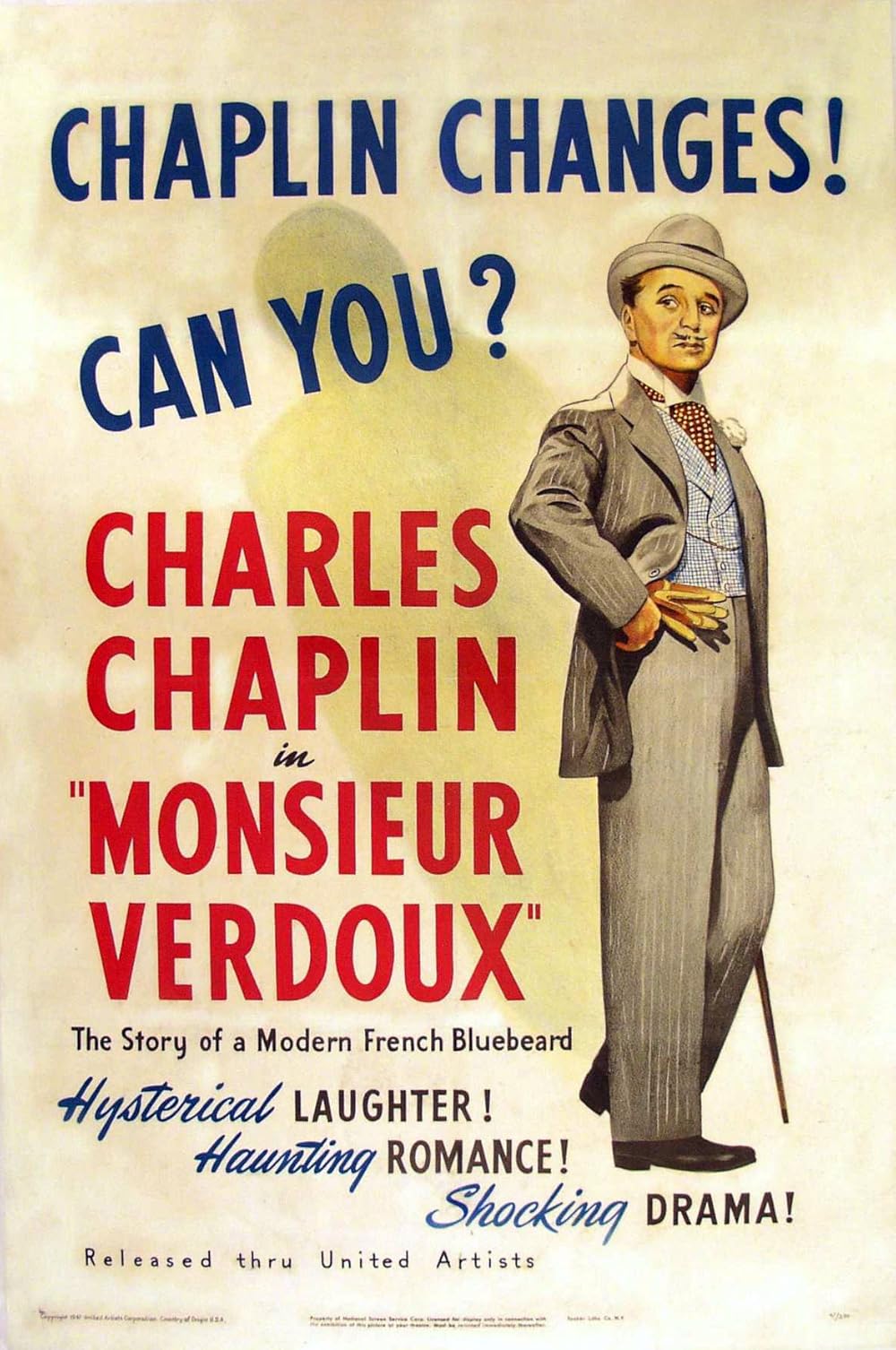
Starring: Charlie Chaplin
Grade: B
There’s also so many conversational gems from Monsieur Verdoux that you will find yourself genuinely wanting to add to your everyday vocabulary like someone asking Verdoux how he feels and he responds, “Very abstract”, or Marie Grosnay downplaying Verdoux’s compliments by saying she’s not as ethereal as all that. Of course, there’s also the delightful response to the question of how the world is treating you (“I could complain, but I won’t“).
Summary
Henri Verdoux’s (Chaplin) gravestone is shown with the years 1880-1937 on it. From beyond the grave, Verdoux narrates to say that for 30 years, he was an honest bank clerk until the Great Depression in 1930. That’s when he lost his job. This is when he became occupied with liquidating members of the opposite sex, as he puts it. He did it strictly as a business enterprise to support his home and family. Nevertheless, he admits that a career as a “bluebeard” is by no means profitable and only a person with undaunted optimism would embark on such a venture. Unfortunately, he did.
“What follows is history”.
At the home of the wine merchant Couvais Family in the North of France, Jean (Edwin Mills) tries reading his book while being distracted by his father Pierre (Irving Bacon) napping on the couch and the doorbell ringing. Carlotta tells Jean it might be a letter from his sister, but Gene doesn’t care. Lena (Almira Sessions) and Phoebe (Eula Morgan) try to get Jean to listen, but he refuses to budge. Phoebe decides to get the doorbell. She picks something up from the ground before she goes and then stands up, only to knock Lena’s tray of dishes everywhere. All three women blame Jean for this, so Jean finally goes to answer the door. As Lena and Phoebe argue, Lena accidentally lets some water from her tray pour directly into Pierre’s mouth, waking him up. He gets pissed off at everyone and Carlotta gives it right back to him. Jean brings over a letter from the Paris National Bank. Reading it, Carlotta details that the bank returned the letter they sent Thelma. Apparently, Thelma has drawn out all her money, closed her account, and left no address. Phoebe thinks they should call the police because it isn’t like Thelma to cut herself off from the family like this. Pierre thinks she can take care of herself, but Lena isn’t so sure about this since she went off to Paris and married a man she only knew for two weeks. Pierre still doesn’t think they need to get the police involved, but Carlotta points out how they haven’t heard from her in three months. Pierre just chalks this up to Thelma still being on her honeymoon. Lying on the couch, Jean jokingly wonders why anyone would want to honeymoon with Thelma for three months. Still, Lena isn’t sure about Thelma getting all of her money out of the bank. Pierre thinks her husband “Varnay” will have a grim task in trying to pry it away from her, but Phoebe points out what Varnay has accomplished so far. Already, Varnay has had Thelma give up her home, family, sell her business, and marry him. All of it happened in just two weeks. Of course, this “Varnay” is secretly Henri Verdoux.
Lena notes how Varnay has a way with women, and Jean comments how he would like to know his technique. Pierre doesn’t like how they’re condemning the man without even meeting him. However, Lena argues Varnay wouldn’t avoid them if he were honest. Phoebe knows something bad has happened to Thelma, but Pierre is tired of hearing about this. He doesn’t understand why, just because she hasn’t written them, they are assuming she’s either been robbed or murdered. Carlotta is quick to say that no one stated she was murdered, with Lena adding that they hope.
Phoebe wants to go to the police now, but Pierre tells them they’re all hysterical. Carlotta decides to agree with Pierre. They will wait a day or two. If they don’t hear from Thelma by then, then they will go to the police. Pierre asks where the picture of Varnay/Verdoux is, so Jean pulls it out of his suit jacket, as he carries it on him for some reason. They all look at Verdoux, and Jean points out how funny looking he is. Pierre comments how good of a salesman he must be with a face like that. At a small villa somewhere in the South of France, Verdoux is snipping flowers off bushes in his garden. One of the workers questions how long Verdoux is going to keep the incinerator outside burning since it’s been going like that for the last three days. Meanwhile, Verdoux walks and almost steps on a fuzzy worm. He carefully picks it up and puts it on one of the bushes before walking back inside the house. Soon after, the doorbell rings, so Verdoux opens the door to the mailman. He is delivering a letter for Thelma Varnay, the last name being Verdoux’s fake alias. He tries to sign for it, but the mailman says Thelma has to sign for it. Leaving the door open, Verdoux runs up the stairs and acts as if Thelma is in the bathtub and has her “sign” it. In reality, Verdoux signs it and talks aloud to make sure the mailman hears him. He runs back down the stairs and hands it to the mailman. Without any further issues, Verdoux gets the letter. Opening it in private, it is said in the letter that Thelma is getting the 60,000 francs as requested, which terminates her account at this particular bank. He counts the money faster than anyone has counted physical cash before and puts it in his pocket before making a long-distance phone call to Bellow and Company at the Paris Stock Exchange. Following this, he starts playing the piano until Louise (Christine Ell) knocks on his back door to interrupt him. She’s from the employment agency, as she’s looking for work.
After she confirms that she understands the work is only for a day or so, Verdoux goes on about her basic duties like cleaning out the drawers and dusting everything. Before she does however, he wants her to take down the curtains and put them in a certain spot he points out to her. They are interrupted by the phone, so Verdoux sends Louise off to work. He locks the door behind him and answers the phone. After hearing that it’s Bellow and Company, he introduces himself under his real name of Verdoux and says he wants to buy 500 shares of continental gas, consolidated copper, and 100 shares of central copper, the same 20-point margin. He also says he will wire the money, and it will be there in the morning. At the police department, the Couvais family meets with the Prefect of Police (Bernard J. Nedell) to discuss Thelma’s disappearance after marrying this “Varnay”. The prefect asks if they have any means of identifying him. They did, but Carlotta reveals that Lena threw it in the fire by mistake. Even so, Lena is confident she can identify him if she saw him. Jean says the same. The prefect takes this into account and they all exit. Afterwards, Det. Morrow (Charles Evans) mentions a peculiarity. In the past three years, 12 women have disappeared in different cities. The details are all similar to the case the Couvais family brought to them today. He says all the woman who have disappeared have been middle aged, had a small income or a little property, and they all married the same type of man. They joke that it could be the same man married to all these women. The prefect looks at some files and deduces that according to these dates, this man may have been married to half a dozen at the same time. They’re starting to consider it, but they aren’t sure what his racket might be and doubt these women will ever reappear. Morrow realizes Verdoux is a “bluebeard”, a mass killer operating in cities all over the country. The prefect tells him to calm down with the accusations because they’re going to need more evidence before they start telling the public such a thing.
Elsewhere, Verdoux is selling Thelma’s home, and a real estate agent (Arthur Hohl) shows up with the wealthy Marie Grosnay (Isobel Elsom) to take a look at the house. Verdoux invites them in and Marie is taken by the roses in the center of the room. After Verdoux talks about them being directly from his garden, he tells Louise to wrap up the roses to give to Marie as a gift. Verdoux spouts off all the amenities his home offers and mentions Thelma, prompting the real estate agent to offer his condolences.
Verdoux admits her passing was sudden, telling them that she had a heart attack while she was visiting her family. He wants to sell the house to get away from the memory of it all. When Verdoux pardons himself to pick up the phone, the real estate agent tells Marie they could get the place for nothing. Verdoux tells whoever to call back and rejoins the two. He shows them around and upstairs and begins to flirt with Marie more. He asks certain questions to find out that she doesn’t have a family and her husband is deceased. Verdoux bypasses this to show her Thelma’s bedroom while the real estate agent excuses himself to take a phone call. As they discuss how Thelma liked the sun shining into the room and Marie likes it as well, Verdoux incorrectly guesses that she’s a Scorpio. She reveals that she’s an Aries, so Verdoux goes on like that was his second guess and talks about being an Aries himself and how they’re old souls. Verdoux sees Marie coming here as destiny, and he wonders why she never remarried since companionship is essential to Aries people. Marie thinks it’s too late for that, but Verdoux considers this nonsense. He starts overtly flirting with her and talks about how lucky the roses were when she brought them close to her lips. Marie is flattered, so Verdoux goes for broke and holds her hand while talking about how he feels like he’s known her his whole life. She is not feeling the same way, but Verdoux is cornering her and showering her with compliments. Once the real estate agent comes back into the room, Verdoux acts like he saw a bee in the room and acts like he killed it. He tries to laugh it off but falls backward out of the window. He falls onto the roof but is safe. Once he climbs back in, Marie and the real estate agent decide to leave. Verdoux offers to send Marie a book on astrology if she’s interested, but she turns him down.
He doesn’t consider it a bother and asks where he can get in touch with her, so the real estate agent interrupts to say through their office. He sees them out and insists Marie take the wrapped-up roses on her way out even though she doesn’t want them. Later, Verdoux is on a train reading the Financial Gazette. Soon after arriving in Paris, Verdoux stops at a cafe and buys a flower to put on his lapel from some girl. A former co-worker and his friend Levine approach to greet Verdoux. They talk about the old days at the bank, and the guy asks Verdoux what he’s been doing since. Verdoux vaguely talks about the stock market while pulling out a wad of cash to pay for his bill, and the guy ironically states that he must have made a killing to which Verdoux confirms. Verdoux says now is the time to buy since everyone’s selling. After Verdoux departs, the guy tells Levine that Verdoux got a raw deal. He worked at the bank for 30 years but was one of the first people fired once the Great Depression started. Verdoux goes to his place and gives his leftover food to a cat outside. Once he gets inside, he runs upstairs to answer the phone. It’s from a company detailing how there was a big drop in the market and they need 50,000 francs from him by the next morning when the market opens. If he doesn’t, he will be wiped out. Not sure what to do, he looks through a small book he has in his jacket. He is reminded of Lydia (Margaret Hoffman). He travels by train in hopes of getting to her before the bank in her city closes. He gets to the house, and an angry Lydia answers the door, sternly stating how she thought he was in Indochina. He says he was and tries to explain himself, but Lydia is pissed. He’s been gone for three months and didn’t say a word to her. Verdoux lies and asks if she got his letters because he wrote her practically every day, but she didn’t. All she got was a telegram three months ago. Verdoux argues that it’s his business as an engineer. Lydia is starting to regret not finding that out before she met him. She asks if he wants something since that’s usually the only time she sees him, but Verdoux dispels this.
While checking his watch behind her back, he talks lovingly about her and how they shouldn’t fight. She talks about being too old for all this, but Verdoux thought he swayed her away from this kind of talk. He tries to talk more sense into her, but she doesn’t want to hear it and tells him to sit down. She wants to know what he was doing in Indochina, so he talks about building bridges. They ran into some trouble because the specifications for the super structure were all wrong and they had to draw up new plans. Then, they cancelled their contract on account of the financial crisis happening over there. He says it’s the worst they have experienced in years. Lydia doesn’t believe him because it’s not in the newspapers, but Verdoux explains they are trying to keep it quiet. His company was just tipped off in advance. Lydia doesn’t buy it, but Verdoux doubles down and says to wait until tomorrow because there will be a run on every bank. She’s still not going for it, and Verdoux says she shouldn’t worry about it compared to him. However, she reveals that every penny she has is in ready cash at the Mutual Trust bank. Acting shocked, Verdoux stresses that this bank is the worst of them all and she needs to get it out immediately. He rushes over to the clock to check what time it is while Lydia calls him mad. Verdoux explains how every bank in the country will be closed tomorrow. She’s not sure what she will do with the money, but Verdoux says they will figure it out later. Lydia doesn’t want 70,000 francs lying around the house and still is on the fence about this being a real thing, but Verdoux rushes her out the door because they’re running out of time. Later, Verdoux plays the piano and Lydia stares at her money angrily. She brings up how the clerk said it was all nonsense, but Verdoux argues that they wouldn’t tell her what’s actually happening. Lydia says she’d believe the clerk over him and questions why she couldn’t leave her cash in the safety deposit box.
Verdoux explains the possibility of a revolution happening if a crisis like this unfolds. A new government in this situation could confiscate everything. He argues that the best thing is to have it here where she can lay her hands on it. Lydia implies that he is the one who wants to lay his hands on it.
Verdoux ignores her and says she needs some sleep, but Lydia thinks she needs her head examined for listening to him. She wonders if burglars try to break in, but Verdoux considers this thought to be nonsense. They are lucky enough to not have any servants lurking around though. She’s still mad, so Verdoux challenges her to bring it back to the bank in the morning, and she intends to. She leads him upstairs and makes sure he locked all the doors and such to go to sleep. He assures her that he did. After talking lovingly about the full moon and Lydia tells him to go to bed, he goes into the bedroom and kills her. The next morning, he comes downstairs with the safety deposit box, counts all the money, pockets it, and leaves a message for the stock exchange to call him back. While he readies some coffee, he gets the call back and lets them know he will be wiring the 50,000 francs over, though he won’t be back in Paris just yet because he has to clean some stuff up. Sometime after, Verdoux returns to his real family. He greets his son Peter (Allison Roddan) and goes out back to his wheelchair-bound wife Mona (Mady Correll). He reminds Mona it’s their 10-year wedding anniversary and gives her a gift, the deed to the house and garden. Once Peter leaves with the housemaid, Verdoux and Mona discuss his work and how he might be able to retire in two years. Mona stresses that she would rather live in one room again if his work is affecting his health, but Verdoux never wants to do that again. Mona points out how they were happier then, but Verdoux asks, “Aren’t we now?”. Mona agrees they are but is unsure. She points out how over the last three years since he left the bank, he’s been under a terrible strain, and it worries her. She says his state of mind has been an issue and how he seems so desperate about everything. Verdoux considers it desperate times, with so many starving and unemployed. He adds that it’s not an easy task for a man of his age to make a living.
Trying to quell her concerns, Verdoux says he thinks of her and Peter when the world looks grim, and it makes everything better because they are all that he loves on this Earth. He wheels her inside and they take some time to relax. Peter puts slippers on Verdoux and questions why they don’t eat meat. Verdoux says they are vegetarians. As Mona confirms Maurice (Robert Lewis) and Martha Botello (Audrey Betz) are coming over that night, Verdoux tells Peter that Maurice is the one who owns the drugstore and is a very good friend. Mona also says that the Turners called to see if he can officiate an event at the church next Wednesday, but Verdoux says he has to leave for Leon in the morning. He realizes he’s sitting on the newspaper after Peter points it out and goes to read it, but Mona offers to read the headlines for him so he can rest his eyes. The headlines talk about depression worldwide and unemployment spreading through all nations, but Verdoux stops her because of how depressing it sounds. Mona is thankful that Verdoux has a job, and he aggress commenting, “If I lose one, I can always find another”. Just then, Verdoux tells Peter to not pull the cat’s tail. He says Peter has a cruel streak in him and ironically adds that he doesn’t know where he gets it from. Peter says he’s only playing with the cat and that the cat likes it, but Verdoux explains that he doesn’t like it and Peter plays too rough. He reminds Peter that violence begets violence. Maurice and Martha show up, and Verdoux invites them in. Maurice reminds Mona to take her medicine, and Verdoux comments how hard it can be to get her to do so. As the four make their way to the dinner table, Maurice assures Mona there is nothing wrong with the pills because he gives them to Martha all the time. Verdoux and Maurice talk about their work, and Maurice hopes Verdoux will be staying for a bit. However, Verdoux admits he has to leave on the first train that next morning.
The grind doesn’t stop for Henri Verdoux, as he has to work at a nonstop schedule to keep up his marriages and collect his money until it’s time to kill them.
My Thoughts:
Even with the mixed results it generated, the post-Tramp era of Charlie Chaplin is a fascinating one, with no Chaplin feature being more beguiling than his decision to direct, write, and star in Monsieur Verdoux, a stark departure from anything the legendary filmmaker has ever done. Based on an idea from Orson Welles about real-life murderer Henri Désiré Landru, Chaplin took the premise into a different direction and created a bold black comedy centered on a serial killer who manipulates his many wives to support his real family on the back end of the Great Depression.
Apparently, the only solution Verdoux could come up with after losing his job as a bank teller was this elaborate scheme of marrying women all over France, securing their finances when the time is right, killing them, putting a portion of the money into the stock market and putting the other portion away to support his real family. Though it’s a haunting thought due to how well Verdoux is able to pull this off for as long as he does, it’s all the more captivating with how it’s presented. Chaplin’s screenplay does a great job in showing off the multiple facets of Verdoux and how he turns a nasty career choice into a fruitful enterprise to the point where the action of killing is merely a means to an end. Through his trademark politeness and charm with all the women he encounters, his low-key cunning, and intelligence gained over the years, Verdoux gets away with his lifestyle for quite some time. After the intro, the viewer is thrown right in the middle of everything, as the gray-haired Verdoux is already well into his “business” exploits, having his system down pat to the level of an expert. Thelma is already dispatched and Verdoux nonchalantly counts all the money he stole from her, signs off on her mail while acting as if she were still alive, and is working on selling her house to make even more of a profit. After this, it’s on to the next one. Considering the time period in which the film takes place and the setting of France, the most shocking detail of Monsieur Verdoux is how wildly possible this story is. Granted, it is based off a real-life killer who did something similar, so this is only reaffirmed with the movie, but that doesn’t make the film any less unsettling in its accuracy. If someone were in both ways evil and smart enough to cover their tracks in the manner Verdoux does during the 1930s, they could conceivably pull this devious business venture off. Chaplin is excellent in the titular role too, bringing his comedic sensibilities and posh personality to what he thinks is needed to depict this character he created.
After all, this is a man who needs to convince the audience Verdoux can figure out a way to seduce dozens of women to where they are dying to get married to him. He doesn’t do it by simply being attractive. It’s his charming way with words and old school romance techniques that works its way into each woman’s subconscious, breaking them down with his persistence and what looks to be an innocent heart looking for love. Even the florist who overhears his phone call to Marie Grosnay swoons at his words because he’s that good at it. On top of that, Verdoux is not doing this for sexual purposes, meaning he’s not chasing Hollywood starlets due to their bombshell appeal. On the contrary, he’s targeting older women and basic women with issues of their own, due to their possessing of financial assets he can take advantage of. That’s the difference. He’s not a sexually repressed serial killer. All Verdoux is looking at is the dollar signs with each woman, gaining their trust, and slaying them once he deems it long enough to secure what he’s after. Because of this careful and deliberate system that he has cultivated since leaving the bank, it does make a lot of sense as to why Verdoux is able to lie himself to the top time and time again. Verdoux is calculated in everything he does and his ability to manipulate so many women in this runtime shows how he’s turned his plan of action into an artform. Even when these women are suspicious of him or aren’t interested, he finds a way every single time to get what he wants. We see this early on with Lydia, the one wife he has that is actually bothered by his presence at this stage in their marriage. As opposed to his relationship with Annabella or his real-life wife Mona, Lydia is disgusted by Verdoux’s in-and-out visits. He’s lost his trust with her because she knows he tends to only be there when he needs something, and it’s safe to assume he’s been there multiple times for money, now that we understand his whole game. Still, Verdoux can read people at an expert level. Despite being on a time crunch to wire money to the stock market before the bank closes, he comically finds a way to manipulate Lydia into believing him without having to convince her that he’s the wonderful man she married months ago.
This is part of the black comedy the movie surprisingly succeeds at, with Verdoux checking the clock frantically while standing behind the stewing Lydia and using key statements to course correct the path of the conversation to get it on track with the bank. Even though he doesn’t make her believe in him, he’s dishonest enough and ironically believable enough in his elaborate lies about the system crashing, the banks closing, and a possible revolution coming that he’s able to convince Lydia just enough to go to the bank to withdraw everything she has. Knowing he has everything right where he wants it, he kills her that night, calmly makes some coffee in the morning and letting the market know he’s wiring the money over. Next, he happily goes home to his wife and son the next day without a care in the world. Verdoux even has the audacity to tell his son Peter that he’s playing too rough with the cat and “violence begets violence”, despite the fact that he coldly murdered and robbed an old woman hours beforehand. The irony is part of the humor of Monsieur Verdoux, but it’s hard to say what the ultimate goal of the film is due to Chaplin being seemingly more interested in showing the human side of Verdoux more than the monster, trying to win the audience over and understand Verdoux’s plight rather than showing why he’s relatable to an extent but also admitting he deserves a trip to the guillotine (“However, I do not wish to lose my temper because very shortly I will lose my head”). Most of, if not the whole film, is Chaplin attempting to convince the viewer that Verdoux doesn’t really want to do this, but his hand was forced because he had to support his son and his wheelchair-bound wife. On top of that, Verdoux is whimsical, funny, is highly entertaining when dealing with anyone outside of his family and attempts to garner sympathy when he’s actually with his family, lovingly talking about his goal of retirement in two years like the atrocities he’s committing are worth it because he padded the bank.
One could argue that this is Chaplin’s way of exploring the twisted psyche of a killer because it does make sense in his head, with his mentioning of how he lived in a “half dream world and now I have awakened” and his wondering in his later years “if that world ever existed” explaining this. However, those are really the only two instances where he plays with this idea. This is why once the girl argues that life is beyond reason and they must go on to fulfill their destiny, he chuckles and begins to tear up commenting, “My destiny” because he is well aware of what he did. He’s not crazy in the slightest, which is why he is about to give up or accept his inevitable destiny that awaits him. It’s why this “twisted psyche” excuse doesn’t work, and it’s exemplified by the confusing ending which argues that the point of the movie was never about the killer not knowing what he did was wrong, especially since no one outside of the courtroom let Verdoux in on the reality of what he’s done. Instead, the final message makes Chaplin’s goal look as if he always intended on making his murderer in Verdoux look like a martyr fighting tyranny and the character gets this strange, respectable, almost cool, tragi-heroic finale. Chaplin calling out the injustices of world governments going to war and killing millions is a fair political statement to make but showcasing his loud stance by propping up a fictional serial killer to prove his point is about as tone deaf as it gets. It’s the wrong character and the wrong film to even make a statement like this. This is partly why it’s difficult to rate Monsieur Verdoux because it’s technically sound, strongly acted, and has a riveting narrative for the most part. It handles its black comedy elements well and does generate laughs in the middle of the protagonist’s grizzly reality, but the film’s refusal to condemn the character’s actions at some point seems to be a gross mishandling of the ultimate story. The main character himself arguing a political slant to make sense of his actions isn’t unheard of, but no other character or moment involved in the movie reminds Verdoux of the simple fact that both can be true.
Yes, he may have some valid points on war, but he’s not some counterculture activist. He is still a serial killer who is trying to justify his killings as a way to support his family, and no one proves him wrong. No one brings up a valid point to argue with Verdoux to maybe get him to concede he may have been slightly wrong or how he is an outstanding hypocrite. Verdoux trying to argue what he’s guilty of being inconsequential to the rest of the world’s actions is a false equivalency to the highest degree and is not only inappropriate but obnoxiously pretentious. Had the girl he reconnected with gave him some sort of look to make him feel somewhat guilty over lying to her about his real self, or the fact that he intended on killing her until he changed his mind because she had fallen on hard times, there may have been something there to at least ensure the audience will know that Verdoux is an evil bastard too even with his politicized statements. However, the girl looks as if she’s just sad Verdoux is on trial in the first place and just looks down because they were friends. Even with all of this happening around him, Verdoux is smiley and pompous as if history will vindicate him in the final frames, as this seems to be the intention with his last speech (“Nevertheless, upon leaving this spark of earthly existence I have this to say….I shall you see you all, very soon…very soon”). Making that iconic speech in something like The Great Dictator makes sense because of the plot and characters at hand, but the message doesn’t hold the same weight when the speaker in this film killed dozens of women by his own hands and robbed them right after. Even in private when he has a chance to repent with a priest, he doubles down and tells the priest that he’s at peace with God and his conflict is with man. It’s as if Verdoux’s motivations had nothing to do with his family anymore, even though that was the whole point to the first half of the movie regardless of the war. When the priest asks if he has any remorse for his sin, Verdoux replies, “Who knows what sin is? Born as it was from heaven with God’s fallen angel. Who knows the ultimate destiny it serves?”.
Yeah, that sounds eloquent and all, but 12 or so women were slain at your hands! Literally nothing you say can make us think to vote differently at the next election! It’s just like the guard says after coming out of Verdoux’s cell in that Verdoux talks as though he’s a saint, twisting everything with a lot of half-truths. Verdoux tells the one journalist how good and evil are arbitrary forces and how “too much of either will destroy us all”. When the journalist suggests you can never have too much good in the world, Verdoux counters with the trouble being that we’ve never had enough. This was an interesting argument, as was his comparison to what he did to the big picture (“One murder makes a villain…millions a hero. Numbers sanctify, my good fellow”), but it’s not as seamless as Chaplin makes it out to be because the actions of the main character, along with his lack of remorse for it because of his “Well, they did it more!” argument, can’t be forgotten. It comes off as a man trying to be a voice for worldwide audiences, but the reality of the argument is that it’s delusional, downright childish, and is presented in a ridiculously pretentious way in an effort to look as if the filmmaker is on a higher plane of thinking that we haven’t opened our eyes to yet. Really, everyone knows it’s a much more complicated discussion than that and can’t be boiled down to the message of Monsieur Verdoux, which is why Chaplin exits the picture looking like a douche rather than a world-travelled philosopher of our times. Why is he arguing weapons of mass destruction taking out unsuspecting women and children when Verdoux is in fact taking out unsuspecting women? It’s why Monsieur Verdoux is such a mixed bag, despite being as entertaining as it is. Chaplin refuses to fully commit to the monster side of things in the first part and then is already trying to convince us that he’s not all that bad. He can have likable traits to make sense as to how he’s able to win over and marry so many women with his persistence and charm, but at some point, his wickedness cannot be shied away from. The “business” side of Henri Verdoux’s life needs that crucial moment that makes the character who he is, but it’s not done strongly enough.
If anything, Chaplin seems to avoid the darkest aspects of the character that need to be in place to make sure the audience knows he’s an awful person, as all of the murders happen offscreen or are just implied through certain details. Obviously, we weren’t going to get a slasher movie in 1947, but Chaplin going out of his way to avoid the dastardly details of his killing of any of the women he sees is holding back to a fault. At most, they give the viewer a taste by showing his well-thought-out methods like getting the details on how to make the poison from his friend Maurice and having every intention on using it on some random woman as a means of testing or the admittedly amusing scene on the boat where he’s trying to find the right moment to kill loudmouth Annabella while they are out fishing but is stopped for a variety of reasons like a yodeler interrupting (“It’s a monster! Oh, that’s just me”). He even accidentally chloroforms himself when trying to prepare it for her, though he recovers oddly quickly. Nevertheless, it just jumps to the third act where the audience is supposed to feel bad for Verdoux after the stock market crashes and we see the World War II montage with real footage of Adolph Hitler and Benito Mussolini. As the aged and broke Verdoux wanders in despair, the Belgium woman he nearly killed but ended up befriending for one night is now rich because she married a munitions manufacturer, in one hell of a twist of fate for the two. She takes Verdoux for a meal to repay him for what he did to her all those years back, and he discusses her new marriage and asks if she loves him. She brings up how he didn’t believe in love previously and questioned where his “zest for bitterness” has gone considering their first meeting. This leads to Verdoux almost searching for a redemption arc without acknowledging who he was prior. He goes on about how he has no more use for his bitterness after giving up the fight and how he lost his wife and child after “the crash”. This is where the movie first begins to be confusing regarding its point. He never divulges what he means by this.
We are led to believe he’s talking about after the stock market crash where he lost his family, but he never actually explicitly says why. The news was never reported about him being accused of murder because of luck being on his side when Morrow confronts him at his furniture store and the police department telling the Couvais family to not go public because it would jeopardize the investigation. Knowing this, Mona and Peter didn’t leave because of news since it was never revealed to them. Morrow even confirms this. No one knew outside of the police and the Couvais family. So, did Verdoux actually lose his family because of the stock market crashing, or did he lose them because he had to flee to escape persecution? Did Mona divorce him because of the money lost? That wouldn’t make sense either because she made it very clear she would be okay living in a single room and being poor again if Verdoux didn’t have to work so much. So, how did he lose them? This is why his use of the word “crash” almost makes me think it was a car crash, but surely, he would have said it if it was. On the other hand, he vaguely mentions, “They are much happier where they are without living in this world of fear and uncertainty”. Doesn’t that sound like he’s speaking about the afterlife? Did they die in a crash then? What happened with his family? He keeps using the word “loss” when describing them, but he never says anything concrete. They are never brought up again either, and the rest of the narrative is spent trying to gain sympathy for the “poor little serial killer”. It’s frustrating to put it lightly, especially after he talks about being awaked from a dream, how he refers to his post-bank exploits as “a numb confusion, a nightmare”, as if he can just put all those pesky murders behind him and move on.
Even so, the humor was handled well considering the circumstances, with Kirstie Alley lookalike Martha Raye shining the most as the rude, energetic, talkative, free-spirited Annabella Bonheur. She was quite the funny monkey wrench in Verdoux’s plans. When he realizes she’s there at his wedding ceremony with Marie Grosnay, you’re going to be surprised as to how invested you are with the movie because you legitimately have no idea how or if he’s going to get out of it to avoid her. Along with his slap fight with the President of the Saltwater Fuel Company, this was classic Chaplin slapstick at its finest, and that final wide shot of Verdoux jumping the fence, Marie on the stairs, and the guy looking in the separate room for Verdoux was fantastic. In addition, the sequence where Verdoux prepares the poison for Annabella but Annette’s accidental meddling with his plans was as amusing as it was gripping. The fury in his face waiting on Annabella to die, but she just keeps annoying the shit out of him was hysterical (“Telephone my wife!” – “I’m right here!”). Separately, the stand-off he has with Morrow is electric. It’s not Pacino and De Niro sitting across from each other in Heat, but it bores a resemblance and it’s captivating with how Verdoux responds so professionally to all the information Morrow lays out to him. Besides this, it’s kind of amusing how deep into conversation Verdoux gets with Maurice about the lethal formula for veterinary work he heard about and his subsequent, on-the-spot “hypothetical” of a detailed plan of execution as to how he would test it on a real person and leave them at a hotel, even adding that there is always an autopsy when someone dies in a public place, so they’d find out the result without taking the risk. Literally no one suspects a thing about Verdoux in the scene, despite how long he monologues about the hypothetical and it’s hysterical in hindsight.
The backstories he comes up with for each alias and his quick response time is gaslighting before gaslighting was cool. I STILL don’t know if he was serious about the jewelry Annabella bought being glass or not because he could have just been saying that to prove to her that she’s easily swindled. At some point, you find yourself thinking, “Wait, is he actually a captain of his own ship?”. Just when someone like the lottery-winning Annabella questions a detail like how he said something about music being on his cargo ship and how out of the ordinary that is, Verdoux is quick enough on his feet to respond matter-of-factly that they have a radio. It’s funny watching the challenging dynamic he has with Annabella, as she’s dumber than the other women but too headstrong to manipulate, like how she refuses to let Verdoux in on her business dealings and didn’t fall for his story about the banks going broke that Lydia fell for. In an effort to show her strong personality but her obvious flaws as a person, she speaks highly about her belief in the Pacific Island Power Company and why she purchased a lot of stock in it. She argues how they make energy when the waves in the water go crazy, so Verdoux points a hole in the entire thing by asking what the company makes when the sea is calm. Comically, she just tells him to not be a pessimist. As annoying as Annabella can be, her scenes are easily the funniest section of the movie, especially with how much she tries Verdoux’s patience to the point where he bows out of a club because of how obnoxious she’s being to buy chloroform from the drugstore across the street, as it was that easy back then. Seeing how they make her ignorance a virtue isn’t something you see often either, so I appreciate the unique approach with the character.
In the pivotal first meetup with the Belgium girl, Verdoux speaks on his wildly ignorant perspective on women that makes you question if Chaplin believes it to a degree. However, he makes up for it at the end of the scene when beauty is found in the midst of the many soliloquies Chaplin’s talkies tend to ramble on with. The girl admits she was beginning to lose faith, but then his kindness happened and it made her want to believe all over again. Knowing his initial intentions, Verdoux replies, “Don’t believe too much. This is a ruthless world, and one must be ruthless to cope with it”. Being the glimmer of hope humanity needs in such a bleak movie, she argues that it’s a blundering and sad one but “yet a little kindness can make it beautiful”. With a smile like hers, even Verdoux can’t help but comment, “You better go before your philosophy corrupts me”. Only a girl like this can change the mind of a serial killer. It’s the power of a good woman I suppose, or the power of a woman who spent three months in jail for pawning a rented typewriter.
Along with the recurring transition of the shot of the train moving and the creepy blurt of music that accompanies it to maintain the pace Verdoux works at, another major positive was the phenomenal closing minute. There is something so captivating about its simplicity, and the feelings in the pit of your stomach as the protagonist breathes with his eyes closed as if he’s been freed in his own mind before he is walked out.
You know what? I kind of want some rum right now.
Tackling the difficult task of making a black comedy centered on a subject matter based on a real-life serial killer, Charlie Chaplin’s Monsieur Verdoux is a whirlwind of a film with an enticing story and main character that garners a surprising number of laughs in the process. Yet, it’s idiotic anti-war themed finale confuses the overall tone and message of what was otherwise a great film. Even if the discussion being brought to light is a strong one, giving a serial killer the moral victory is a deplorable way to get the filmmaker’s thoughts across. Despite this sourness in its conclusion, it’s a great watch and really worth it just because of the shock and intrigue of it all and how different it is from anything the legend of cinema ever did. Monsieur Verdoux may be forgotten by many, but it is slotted firmly in second behind The Great Dictator in the discussion of Chaplin’s best talkies.



+ There are no comments
Add yours