
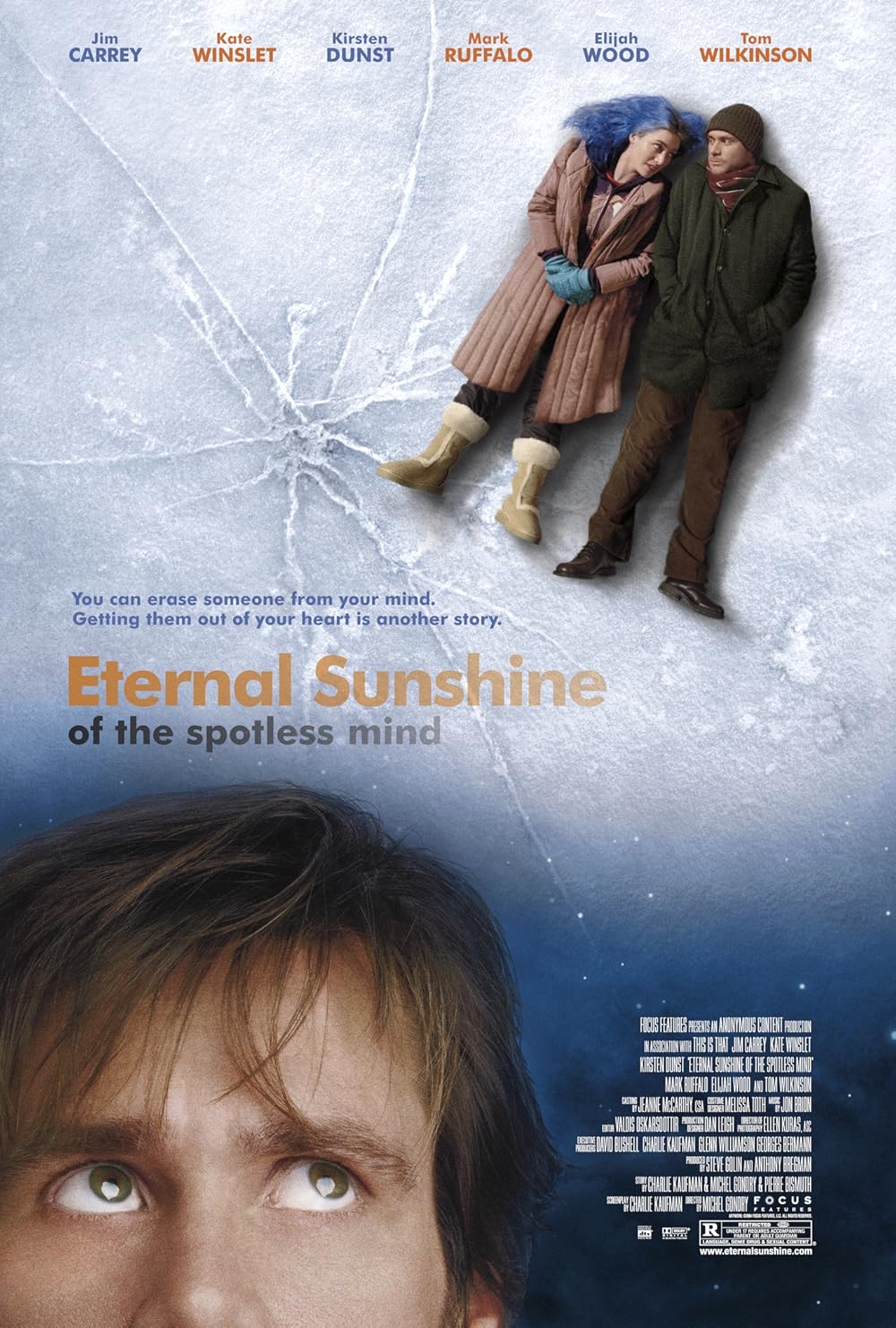
Starring: Jim Carrey, Kate Winslet, Kirsten Dunst, Mark Ruffalo, Elijah Wood, Tom Wilkinson, and David Cross
Grade: A
If you were wondering, the descriptive and extremely memorable title to this film comes from poet Alexander Pope in his poem Eloisa to Abelard:
“…How happy is the blameless vestal’s lot!
The world forgetting, by the world forgot:
Eternal sunshine of the spotless mind!
Each prayer accepted, and each wish resigned…”
Summary
One morning, Joel Barish (Carrey) wakes up and is already in a somber mood. Adding to his personally misery, he finds that his car was clearly side swiped on the driver’s side by the car parked next to his in the lot. He writes a note sarcastically stating, “Thank you” and puts it under the guy’s windshield wiper. Next, he goes to get on the train for work, as he narrates how it’s Valentine’s Day, a holiday invented by greeting card companies “to make people feel like crap”. Joel decides to ditch work on a whim and goes onto the train to Montauk. He doesn’t even know why because he’s never been an impulsive person. After calling in sick, he goes to a beach where its freezing, and he starts writing in his journal. He notices a page is ripped out, but he doesn’t remember doing it. Even so, he details how this is first journal entry in two years. He walks along the beach and thinks to himself how badly he wants to meet someone new, though he notes how he’s incapable of making eye contact with a woman he doesn’t know. As he says this, he spots a woman (Winslet) wearing an orange jacket walking along the beach. Continuing his walk, Joel considers getting back with his ex, Naomi. She did love him. Following this, he goes to a nearby restaurant to continue his writing. While there, the blue-haired woman whose name is Clementine, the same woman from the beach, is in her own booth and pours alcohol into her coffee. He sees this and they share eye contact, though Joel shies away quickly to continue writing. He is bothered with how he can fall in love with any woman he encounters who shows him the least bit of attention. At the train station, they see each other again. This time, Clementine initiates the interaction by waving at Joel from a distance. He smiles and waves back a couple of times but doesn’t try to talk to her. On the train, Joel draws a picture of her sitting in her seat. Unprompted, Clementine finally greets him and goes over to sit in the seat in front of him to talk. Coincidentally, they’re both getting off at Rockville Center. She wonders if she knows him, asking if he ever shops at Barnes and Noble. He has, so she thinks that’s where she knows him from because she’s been working there for years. Joel questions this because he’s sure he would remember her, but Clementine says it’s probably her hair. The color changes a lot.
Right now, it’s “Blue Ruin”.
They go on talking about hair colors, and the company that comes up with the funky names for it, but the conversation goes sideways a few times because Joel’s responses are interpreted negatively by Clementine when he’s just trying to be nice. Despite this, she still finally reveals her name as Clementine to him but doesn’t want to hear any jokes about her name. He’s not sure what she means, so she brings up Huckleberry Hound, as he used to famously sing “Oh My Darling, Clementine”, but Joel has never heard of him. She’s shocked, so she sings a portion of the tune for him. Still, he doesn’t know it. He does call the name pretty while mentioning it means “merciful”, as the word is a form of clemency. She corrects him and says it doesn’t fit because she’s a “vindictive little bitch”. Again, Joel tries to be nice and comments that he wouldn’t think that about her. Strangely, she is bothered by this and questions him further. Once he adds that she seems nice, she takes this in the wrong direction too with how she doesn’t need nice and criticizes the description. Soon after, she apologizes because it’s been a rough day for her and appreciates his niceness for the time being. He’s weirded out and tries to get back to his writing, so she takes the hint. Playfully punching his arm, she takes off. Following their exit at the stop, Joel drives by and finds Clementine walking on the street, so he offers to give her a ride. They smooth things out during the car ride, and she apologizes again, bringing up how she’s not crazy. He didn’t think she was. He drives her back to her place, and she invites him inside for a drink. He accepts. Eventually, she brings over two drinks she calls “Blue Ruins” and hands one over to him while beginning to flirt. They sit on the couch together, and she brings up his quiet demeanor, which Joel attributes to his boring life of working and going home. Even his journal entries are uneventful. Clementine sees herself as anxious because she’s always worried about not living life to the fullest and not taking advantage of every possibility. Joel knows the feeling, and they start to get closer. Now, she’s flirting with him even more, snuggling closer to him on the couch and talking about how she’s going to marry him and how they should go on a night picnic and such, but he still seems uncomfortable and gets up to leave.
Still, Clementine gives Joel her number and tells him to wish her a happy Valentine’s Day when he calls. He smiles at the thought. He gets home that night and calls her, and they are both elated to talk to each other. The next night, they go out for a walk on the frozen Charles River. Though Joel is hesitant to step on the ice, Clementine’s encouragement leads him to walking over to her on it. They lay down on the ice and look up at the stars, with him pointing out a fake constellation as a joke. In the early hours of the morning, Joel drives Clementine back to her place, but she wants to sleep at Joel’s house. He says it’s cool, so she goes inside to get her toothbrush. While she’s inside, a man (Wood) approaches Joel and asks if he needs help with something. They talk for a bit, but Joel is just as confused at his line of questioning as we are. The man deals with Joel’s responses and leaves.
Next, we jump to sometime later where a crying Joel is driving at night. He throws a tape of sadder music out the window while he drives, though he’s clearly shaken internally. As Joel walks to his apartment, some guys in a van see Joel and note him as “159” before laughing and pointing at him. Joel notices them but ignores it to get inside to his apartment. Joel’s neighbor Frank (Thomas Jay Ryan) jokes with him when they are getting their mail that he only gets Valentine’s Day cards from his mother. He gives Joel credit for having Clementine and asks if he has any plans since the holiday is a day away, but he sadly responds, “No”. Joel cuts the conversation short because he has to go to bed, but Frank is confused because it’s only 8:30PM. Even so, Joel gets inside, puts on his pajamas, and takes his pill. However, he spots the van from earlier outside of his apartment watching him. Inside is that man who approached him earlier and another (Ruffalo). They barge into Joel’s apartment with equipment and a helmet of some sorts and find Joel passed out on the ground. We then see a Joel in a sort of dream-like, flashback sequence where we see him talk to Frank just like he did earlier, though the image of the neighbor is blurred while he’s fully in focus. Next, we jump to Joel talking to his married friends in Rob (Cross) and Carrie (Jane Adams) about how Valentine’s Day is three days away, but he’s been having some problems with Clementine. He wanted to resolve it and called her, but she changed her number. Still trying to fix the issue, he buys her a gift for the holiday and goes to her work but saw her with some other young guy. When Joel approached her, she acted like she had no idea who he was. She then kisses the guy she’s with, Patrick. This is the man that approached Joel earlier in confusion, though he doesn’t make the connection. Rob and Carrie try to console Joel in different ways, with Rob offering a joint and Carrie suggesting he see this as a clean break. Joel considers going to Clementine’s house, but Rob tells him not to, which Joel agrees since it would make him look desperate. Rob and Carrie disagree on what to tell Joel and fight in front of him by vaguely mentioning their own relationship problems until Carrie storms out of the room. Since he can’t think of another solution, Rob gives Joel a letter from an envelope. It states:
“Dear Mr. & Mrs. Eakin.
Clementine Krucsynski has had Joel Barish erased from her memory. Please never mention their relationship to her again.
Thank You.”
Rob doesn’t know the details when Joel asks, so the confused Joel goes to Lacuna, Inc., the company responsible for this. He walks into this rather mundane office and finds receptionist Mary (Dunst) on the phone with a customer. At the same time, he notices letters, similar to the one Rob gave him, being printed out as he stands there. He’s there for an appointment with Dr. Howard Mierzwiak (Wilkinson), so Mary gives Joel some form to fill out. Once Mary takes Joel back, they run into technician Stan Fink. He was the other man with Peter when they barged into Joel’s apartment after he passed out. Joel is brought to talk to Mierzwiak who apologizes over the letter because Joel should not have seen it. Joel assumes this is all a hoax, but Mierzwiak explains that though he can’t show him evidence because their files are confidential, the procedure of erasing a portion of one’s memory is real. Apparently, Clementine was not happy with Joel and wanted to move on. Following this, there are quick time jumps from Joel telling Carrie about the doctor visit while Rob loudly builds a birdhouse in the same room, Joel crying in the car by himself, and Joel going right back to Lacuna and barging into the back area to speak to Mierzwiak again. He demands they erase Clementine from his memory. Though Mary argues it’s their busy season and he has to wait, Mierzwiak allows it to happen and takes him into his office. The first step is for Joel to collect anything he has in his possession that has some association to Clementine. They will use these items to create a map of Clementine in his brain. This can include photos, clothing, gifts, books she may have bought him, CDs they may have bought together, journal entries, etc. Joel is to empty his home and life of Clementine. After the mapping is done, their technicians will do the erasing in his home tonight. When he wakes up in the morning, it was be as if nothing had happened and a new life will be awaiting him. The next day, Joel walks into Lacuna with two garbage bags full of Clementine’s stuff while Mary tells a customer over the phone how she can’t have the procedure done three times in a month. Soon after, Mierzwiak brings Joel in and comments how February is usually a busy time for them because of Valentine’s Day. He introduces Joel to Stan while Stan is in his lab working with a patient.
Inside the lab is an older woman propped up on a table with some device around her head while old timey music is being played.
In his office, Mierzwiak interviews Joel about Clementine. This is where Joel talks about how he met her. A couple of years ago when he was still dating Naomi, Rob and Carrie invited them to a party on the beach. Joel doesn’t like parties, and Naomi couldn’t go. Still, Joel went anyway. This is where he met Clementine. Just then, Patrick falls on the ground while the two are talking. Following this, Mierzwiak takes Joel’s vitals while saying that there is an emotional core to our memories. If you eradicate the core, it starts this degradation process. By the time Joel wakes up in the morning, all the memories they have targeted will have withered and disappeared as “in a dream upon waking”. Joel questions if there is a risk of brain damage, but Mierzwiak explains how technically speaking, the procedure is brain damage, but it’s on par with a night of heavy drinking. Following this, Joel is taken to a special chair for Stan to work on creating a map to Joel’s brain. To test things, Stan pulls out various items from Joel’s garbage bags to test his reactions. Stan pulls out a snow globe, and Joel starts to tell the story behind it before Stan stops him. It’s better if Joel just focuses on the memory stemming from it rather than describing it out loud, as it gives Stan a better emotional readout. They go through each individual item from the garbage bags, as Stan and Mierzwiak work on the computer. Going through this, Joel’s mind races and time is a blur. Eventually, we jump forward to after Joel passed out and Stan and Patrick are working on him in his apartment, with Joel attached to their special equipment. Stan asks Patrick to check the voltage regulator, but Patrick says everything seems fine. Even so, Stan is worried that he’s not “wiping as clean as I’d like here” and he has Patrick check the connections. At this point, Joel is having an out-of-body experience through different timelines and locations. First, he’s wearing his pajamas, but he’s in the Lacuna office. He tries to approach Mierzwiak but is shocked to find himself on the other side of the room still working with Stan on mapping the brain. Mierzwiak responds to him and comments how this response is fairly normal. Then, he turns to Joel in the other side of the room and tells him how they will dispose of all the items he brought, so he won’t be confused by their unexplainable presence in his home.
As he says this response, the out-of-body Joel says Mierzwiak’s words at the same time as if he already knew what he was going to say. Going back momentarily to where Stan and Patrick are working on Joel in Joel’s apartment, the name “Patrick” rings in Joel’s head when Stan says it. The version of Joel sitting in the chair mouths it, and the out-of-body Joel says it over again, wondering who it is. After Joel continues to see the version of himself in the lobby, and outside while sitting in the chair, an anxious Joel starts to freak out until the story shifts to the apartment scene where Stan and Patrick are working on Joel. Despite being passed out with the special helmet on, Joel audibly says to himself “Patrick” unbeknownst to Stan and Patrick. As Stan and Patrick talk about the long night that they have ahead of themselves, Joel imagines the last time he saw Clementine. She came home drunk at 3AM after wrecking Joel’s car, and he was up waiting for her. She doesn’t care and thinks he’s really mad because he thought she was out fucking someone, but Joel explains he assumed that what’s she did because it’s how she gets someone to like her. She storms out of the house, and he chases after her while apologizing. Suddenly, it ends, as Stan deletes the memory of it. Stan tells Patrick that Mary is coming over. Patrick likes when Mary is there, but he thinks Mary doesn’t like him, which Stan dispels. Patrick considers bringing his new girlfriend over, and Stan is cool with it. They have a couple of beers while Stan is working and Patrick continues to try and bring up his girlfriend, but Stan doesn’t want to hear it. In Joel’s memory-like world, he drives after Clementine and offers to give her a ride home while the world is falling apart around them. He insists he will be happy because he’s erasing her like she did to him, but he parks and still can’t believe she did it to him. He runs after her while trying to say she will be gone by the morning, but she disappears. Then, she reappears going the opposite way on the sidewalk. Patrick’s conversation with Stan in real time is heard in Joel’s dream, where Patrick is offended at Stan’s laughing at Patrick’s comments about his girlfriend. He also asks Stan who’s better looking between him and Joel, but Stan tells him to stay focused. Joel looks into the sky as he hears the conversation happening.
As Patrick reminds Stan about how they worked on Clementine last week and how she was Joel’s girlfriend, Joel sees Clementine reappearing again on the other side of the sidewalk in the opposite direction. Meanwhile, Patrick reveals how he fell in love with Clementine when they were working on her. He goes on about how beautiful she looked, and he stole a pair of her panties, prompting Stan to freak out and tell him not to tell him this stuff. Patrick tries to explain that the panties were at least clean, but Stan tells him to stop and to get back to work. In Joel’s lucid memory state, he looks over at the other side of the street and sees himself laying on the ground. In reverse, he flies back onto a couch and is transported to a previous memory of himself eating Chinese food with Clementine on said couch. He smiles at her, though he hears Patrick again talking to Stan in real time talking about how he found Clementine after the procedure and asked her out. Joel doesn’t know how to react hearing this. Stan tells Patrick how unethical it is but when he brings up how Patrick stole her panties again, they both start laughing. Joel tells Clementine someone is there, and they stole her underwear, but she says she doesn’t see anyone and continues to eat. He walks around and finds himself in a different location entirely. His food disappeared too. He gets on the ground and plays dead as a joke while Clementine walks in looking for her boots, recreating a different memory of his. She doesn’t find it funny and storms out while saying she should have left him at the flea market, with Joel sadly cleaning up his face after she exits. In the flea market memory, Clementine brings up wanting to have a baby. Joel doesn’t think they’re ready, but she just thinks Joel isn’t ready. Once he questions if she thinks she can really take care of a kid, she gets offended, and they get into a huge argument. Eventually, Joel storms off while she’s yelling at him, and her image becomes blurry as he stays in focus. In real time, Mary shows up to the apartment to hang with Stan and Patrick. She’s cold with Patrick but goes over and kisses Stan. She makes herself and Stan and drink and toasts with a quote from Nietzsche from Beyond Good and Evil, “Blessed are the forgetful, for they get the better even of their blunders”. She found it in her Bartlett‘s, a book of quotations she has.
Mary comments how Mierzwiak will be in the book someday, and Stan agrees. As the three drink more, Mary questions if Joel can be woken up, but Stan assures her that he can’t. In Joel’s memories, he remembers being woken up by Clementine who wants him to open up more to her. She doesn’t think Joel trusts her. Though he still has his eyes closed, he responds by stating how constantly talking isn’t necessarily communicating. She gets bothered by this and insists she just wants to know him better. According to Clementine, intimacy is about sharing things, and she gets mad over Joel’s comment. They continue to talk while other voice over memories are overlayed of Clementine wanting to read Joel’s journal if he has nothing to say about thoughts, passion, or love. Sometime after, he is writing in his journal about having dinner at Kang’s again on the date of November 19, 2003. He wonders if they are the couple people feel sorry for at restaurants. As she takes a swig from the bottle, Joel knows she’s going to be “drunk and stupid” now. Just then, she passively aggressively tells him to clean his hair off the soap in the shower. Before she refers to it as repulsive, he correctly guesses her verbiage. Suddenly, Joel is distracted after hearing Patrick from an unknown distance calling Clementine in real time. She’s extremely anxious and confused on the phone. At the same time, Joel is having visions of seeing Patrick in Barnes and Noble talking to Clementine. He tries to approach Patrick and attempts to turn him around, but since he doesn’t know Patrick’s face because he only saw him the one time outside the car, he doesn’t know Patrick in the dream. With this, he can only see the back of Patrick’s head, even when he flips him around. Joel finds himself in a different location and sits at a small dinner table, while hearing Clementine’s voice on the phone ask Patrick if she’s ugly and whatnot. In real time, Patrick asks Stan if he can leave for a bit to calm Clementine down. Stan tries to protest, but Mary insists he go, and she will help Stan instead. Patrick sees this as further evidence that Mary doesn’t like him. Even so, he goes to see her, calling her by a cutesy nickname of “Tangerine”.
Back in Joel’s memories, Clementine shows up at Joel’s place with dyed orange hair. Joel likes it and says she looks like a tangerine. As Joel jumps off the bed, it suddenly hits him. How does this Patrick know to call her that? At the same time, Stan and Mary share a joint on break and lay down on Joel’s bed on both sides of him. Stan is talking about The Clash’s legacy while Mary praises Mierzwiak and what he has given the world with his ideas. Patrick goes to Clementine’s house, and she is freaking out over a myriad of reasons like getting old and her skin not looking good, amongst other things. He consoles her, and it leads her to suggesting they got to Montauk or Boston on a whim. He’s down to go next weekend, but she wants to leave immediately. While this is going on, a high Stan and Mary dance on Joel’s bed while he lays there asleep, with Mary in her underwear. Patrick calls to tell Stan he can’t come back tonight because of Clementine, but Stan says it’s fine because he has it under control. Right after, Patrick searches through his bag while waiting for Clementine to get ready, and he pulls out a gift from Joel detailing his time laying on the Charles River with Clementine and how happy he was at that time. When she gets into the room, he puts it away and pulls out an early Valentine’s Day gift. He doesn’t know what it is but acts like it’s part of the surprise. It turns out to be a necklace she actually likes, which surprises her because she’s never been out with a guy who has given her jewelry she’s actually liked. What she doesn’t know was that this was Joel’s gift. Patrick saved the garbage bag of memories and is using it to win over Clementine.
This has only just begun. As Joel continues to reexperience his previous memories with Clementine as they are erased, he starts to see things from a different perspective at the wrong time, racing against the clock to try and keep her in his head somewhere. At the same time, things only continue to go wrong with the Lacuna employees while they work on Joel, and it effects their own personal issues and the business itself.
My Thoughts:
As is the case with many Charlie Kaufman penned films, Eternal Sunshine of the Spotless Mind is one of those movies that for a variety of reasons, stays with you, and ironically, your memories. Along with an unmatched visual presentation due to the brilliant work of director Michel Gondry, the story explores the peaks and devastating valleys of love, romance, and relationships and how it can change someone’s outlook on their lives and who they are. Should they live a life of regret? Is it better to forget that a bad experience or time in life happened, or should one appreciate the experience and use it to help mold their own personal character? Should we have the ability to mess with our own realities to perfect our lives and run away from conflict or does this border on heresy, as modifying such events and how you view things can be looked at as almost unnatural to the human experience? Then again, can these events that happened be that awful to where we should have a right to remove them entirely from our consciousness? This is a movie that plays with all of these stances and is why many leave the film a different person. It forces the viewer to change their own personal perspectives on such philosophies or at least consider the alternatives in a world where it’s possible, as the main character is given this choice through technology.
Because of the heartbreak suffered in his fallout with Clementine Kruczynski, Joel Barish wants to remove the memories of her presence in his life entirely. Like many who have been in these relationships before, Joel’s assuredness in making such a life-altering decision doesn’t seem out of the ordinary, as his brokenness is evident. Why live in constant misery if it can be removed altogether for a price? What he doesn’t realize is the “price” he’s paying isn’t just about literal money. It’s not that simple and never was. The results of such a procedure were never fully comprehended at first thought, but once it is understood, the reality of permanent erasure becomes a frightening decision with unexpected consequences and realizations. Yes, the bad times were terrible, but as Joel walks through his lucid dreams and memories, he is reminded of the best of times just as well, when he was at his most happy. He’s in the middle of this impulsive decision he made out of anger and sadness, but things change quickly when he is reminded of and relives these memories of when he was never happier with the love of his life. When those positives are being removed too, the grief overcomes him and the awareness of what he’s done sets in. In the midst of this personal journey, even the worst times he experienced over the years are reimagined and looked at from a different perspective. He starts to value certain moments for what they were while he begins to reconsider his own decisions. Could he have done better? Should he have done something else instead? When thinking of the night he first connected with Clementine in an uninhabited house on the beach in Montauk, he recalls the memory as Clementine invites him upstairs. He admits he should have stayed. He was scared, so he didn’t go through with it. It’s this regret that the characters live with and have to reveal to themselves to move on, acknowledging their own faults and responsibilities for how things turned out. Life is filled with regrets. People try to argue that we can’t live with regret because it shapes who we are, but we also can’t ignore how we truly feel about a moment or person from our past.
Refusing to admit the realities of how one felt at the time and lying to yourself to turn everything into a positive is more or less a coping mechanism. Every experience does lead to something, but it’s okay to feel or admit regret years after the fact. Disregarding it as a negative outlook isn’t living a truthful life. It’s ignoring reality because it’s uncomfortable. Seeing Joel relive his experience and confess this truth to himself and this imagined Clementine is freeing, powerful even. As this point in time, Joel knows it’s coming to an end, as the erasure is almost complete, but his grief turns into acceptance (“This was the day we met”). He looks at Clementine mournfully like she passed away, but he smiles and looks at the situation like a time machine where he is given one last opportunity to relive this moment with her. In a subtle but emotional exchange, she states, “This is it, Joel. It’s gonna be gone soon”. He knows, but he’s cherishing these final moments of his memories with her. When she asks what they should do knowing that it’s all coming to an end quickly, he simply responds, “Enjoy it”.
The question is if Joel regretted going through with the procedure because of what it would do, but this isn’t a simple answer either. Obviously, Joel’s true feelings over wanting to stop things early on became evident, but the path in which the character took in trying to fight back and save these memories reignited his interest in Clementine and the impact she had on his life. It reminded him how much he did love her and all the baggage that came with it. Sometimes, all we need is a little perspective. In effect, maybe Joel did need to go through such a life-altering procedure. As morbid as it may sound to some, showing how their love for each other persisted no matter what, though not without its troubles and complexities, proved that it was meant to be. They were drawn to each other not by chance but by fate, and as sad as the film can be at times, the romance is authentic. Still, it’s a harrowing premise and truly terrifying when you take a deeper dive into it. Though some who have faced the darkest or most traumatic experiences in relationships could very easily say that they would go through with the procedure on a whim, could they really? This is a narrative that demands the viewer’s attention and needs to be engaged with on an intellectual level to understand the real dilemma Joel faces. Though this is the case with a lot of his films, this idea Kaufman presents and how dire the consequences are in practice doesn’t seem to be as thoroughly comprehended by regular moviegoers as it should be. A portion of your LIFE will be missing once these memories are erased. Time is forgotten completely, and the bad, the good, and everything that came with it are gone forever. Everything learned or enjoyed is GONE. It now never happened. You are taking items, journal entries, pictures, and anything else that can be tied to the person you want to forget and are using it all to remove the experience entirely. In effect, it removes this entire timeframe completely from the person’s life. If it was a regrettable, one-time experience, sure. Such a permanent decision is more understandable because it was one singular moment. Here however, we’re talking about a real relationship that went on for a couple of years. The things that happened between them are a lot more valuable than they realize.
When you’re collecting all of these memories to be discarded, having pictures deleted, and telling the doctor from start to finish how things began and subsequently fell apart, how would you feel? When you’re on that chair recalling the memories from little gifts and letters, when does the regret set in, if it does? Once it becomes real as it does for Joel, could you go through with it?
It sounds a lot easier until you put yourself in Joel’s shoes and face the realities of the matter yourself. As Joel sees his memories erase as he reexperiences them, he realizes how important Clementine was to him and he starts to reconsider their legacy in his mind. At the same time, we can’t help but see it from this angle too. Everything he learned from Clementine or from being with her will all be erased because he will eliminate any trace of her. He’s so heartbroken to start that he’s willing to lose everything he’s gained from their relationship and potentially regress as a person just to forget her. It’s not until he remembers certain moments like kissing her and calling her pretty after she recalls a time when she was a kid and she thought she was ugly does it start to change him. During this, she asks for Joel to never leave her, and he pleads with Mierzwiak to just let him keep this one memory. Again, it’s when the reality sets in. It’s followed by that pivotal moment where they lie down on the Charles River, and he’s just happy, admitting he never felt that before (“I’m exactly where I want to be”). It’s beautiful, but then she’s pulled into darkness as the memory is erased. It’s there when he shouts that he wants to call it off and yells in his mind, asking if anyone can hear his pleas. It’s at this time period in the movie where we too start to reconsider everything. Just like in real life, we are reminded how every moment means something. The smallest gesture or comment can make someone’s world as well as break it, and it can stay in someone’s subconscious, forever effecting their own outlook on life as well as how they look at you. Though this film focuses on how this happens specifically within a relationship, as the protagonist recalls feelings of how he felt at the time, it can happen with anyone, even strangers. Another crucial element to the story is that in some cases, no matter how dark or destructive a relationship gets, there is this human need to keep trying. Whether it be with the same person or someone new, no matter how badly the last relationship ended, there’s always this unexplainable and psychological need within the human mind to keep trying their hand at love.
We fall on our backs in some cases, but we always pick ourselves up and continue to try and try again in some fashion. It’s one of the universally inspirational traits all humans have, even if it is buried deep with some more than others. Despite the difficult task it creates for itself, the introspective screenplay of Eternal Sunshine of the Spotless Mind is able to convey all of these feelings and the inner chaos following the fallout of a bad breakup without forcing us to be swallowed up completely in the ever-present misery of Joel’s reality. Though the somber tone of the film sets everything up, as the protagonist tries to erase the memories of his rocky relationship with the beautifully troubling Clementine out of spite, he is again reminded of the good times as he does it. It’s where the nonlinear narrative thrives. Utilizing its science fiction premise to the fullest without succumbing to being branded as a “sci-fi” film, the idea is used as a backdrop to make the movie a deep, emotional, personal, and inarguably mesmerizing romantic drama through a twisted, surrealistic story that champions love just as much as it explores certifiable heartache. Considering its nonlinear narrative and the events unfolding in reverse chronological order, it is complicated from a conceptual standpoint and can be dense enough to warrant a second viewing, but this is more of an encouragement rather than a knock. Just like virtually all productions stemming from arguably one of the most creative screenwriters of our time in Kaufman, Eternal Sunshine of the Spotless Mind is unlike any movie you may ever see. Because of this, it might be hard to digest if the viewer isn’t in the right headspace or mood. This cannot be stressed enough. At the same time, they may not be nearly as affected if they haven’t been through some type of emotional trauma or heartbreak in life. However, with each rewatch, it has the ability to be understood from a different perspective, which is its biggest attribute. With each passing year, new experiences and downturns are had. Because of this, the film continues to prove itself as a timeless feature, as certain plot developments or reactions become that much more relatable as we age.
Though the entire production is already a triumph, the fact that the movie can reach this “timeless” moniker that very few films have, show just how impressive a movie it actually is. It’s an intelligent and difficult script to pull off, but Michel Gondry’s thoughtful and daring direction matches the imagination of the story, raising the bar with bold visuals that can feel warm and inviting in one scene while terrifying in others depending on how Joel is interacting with his environment. Every turn is unexpected. Though it takes a bit for the viewer to get their bearings on how the story is structured, the camera work and mise-en-scène accompanying it are just as innovative as the screenplay itself and keep the viewer engaged with widened eyes throughout. It’s a shame Gondry and Kaufman didn’t work on more projects together because they seem to be the perfect blend of each other’s talents. Certain things shouldn’t work as well as they do, but every creative decision made in terms of presentation only adds to the overall value of the picture such as the distorted audio, atmospheric music that sounds like its being played in reverse, the scenes filmed in a “found footage” type of way when Joel is navigating through shadowy locations of his mind to represent how unclear and dark his memory is, or the horror film vibes the gradual degradation of his memories gives off. It’s unforgettable, jarring, and hair-raising, creating authentic suspense because the viewer can never predict where the story is going next. It’s almost hard to keep track of where we are in the timeline, but the audience can’t help but enjoy the ride, or puzzle really. Then, you have other startling visuals like Joel not being able to see Patrick’s face when he turns him around because he doesn’t really know him and can’t remember him, or once the memories fade, previous memories are revisited and recreated by Joel with blank faces. The accuracy in Gondry’s vision in recreating a disjointed and at times inexplicable dream is incredible.
There are some scenes that don’t translate like Joel transporting to his 4-year-old self, hiding under a table wanting his mother and Clementine becoming an invited guest in the room, but the weirdness is a big part of the film’s appeal and Kaufman’s charm. It does sort of make sense because the idea is Clementine suggesting their next place to hide her would be a memory she wasn’t a part of, but the execution of that scene in particular is uncomfortable to say the least. The humiliation scene made up for it though.
Playing against type, Jim Carrey is a standout as Joel Barrish. Though it’s not a secret anymore that he’s an incredible dramatic actor, Eternal Sunshine of the Spotless Mind was the world realizing he’s an Academy Award worthy talent. The Truman Show was just the beginning. Watching the heartbroken Carry be so subdued, restrained, quiet, and vulnerable shifts the drama to another level. The internal pain he is suffering from is very real. Just Joel’s little soundbites stemming from his journaling, his constant second-guessing of himself, and his severe lack of confidence sets the tone in every scene and showcases to the audience how deep of an understanding Carry has for who Joel Barrish is and what he’s been through. It’s one of those performances that reminds the viewer how powerful Kaufman’s eloquent lines can be when portrayed with a quiet, melancholic demeanor. Joel can’t have a moment of happiness because he’s forced to bring himself back to down to earth, or at least his cynical view of it. When he shares eye contact with Clementine and she smiles at him, he flinches and looks down immediately before asking rhetorically in his journal why he falls in love with every woman he sees who shows him the least bit of attention. He’s so dejected that he can’t let himself enjoy the smallest of things. Carrey delivers these lines with raw emotion and makes everything mean so much more. It’s not an intricate line overstuffed with outstanding vocabulary or philosophical jargon used in a pretentious manner (that’s saved for Mary’s quoting of poems). It’s just a comic star known for overacting revealing his heart to the audience while channeling an authentic, standoffish, awkward and above all else, real person that is stuck in perpetual sadness. As the story progresses and the audience learns more about Joel, we get goosebumps at certain voiceovers from Carrey like, “This is the last time I saw you”. He says it in such a sorrowful manner, it cuts deep before it even commences. Following the final montage of memories sped up, he’s in the backseat of Rob and Carrie’s car and that final exchange in-context encapsulates the entire film along with its two main characters.
Carrie: “I saw you talking to someone pretty.”
Joel: “She was nice.”
Rob: “Yeah, man. Who was that?”
*Joel smiles*
Joel: “She was um, just a girl”.
In-context and how its delivered, this simple exchange means everything.
Not to be outdone is Kate Winslet as the now iconic Clementine. She checks off all the boxes for the stock character cinema fans know as the “Manic Pixie Dream Girl”, the exciting female love interest who is unpredictable and forces the male character to love and appreciate life and its opportunities. Though part of Clementine is this, Kaufman takes the stereotypical character and explores her faults and vulnerabilities as well. In the usual Hollywood film, her outgoingness and impulsive decision-making leads to happiness for the short-sighted male character. Eternal Sunshine of the Spotless Mind introduces her in this manner but shows why she’s just as problematic as the “normal” guy. She dispels the ideal behind her basic attributes by detailing to Joel’s face that “Too many guys think I’m a concept or I complete them, or I would make them alive. I’m just a fucked-up girl who’s looking for my own piece of mind. Don’t assign me yours”, shooting a hole directly into the stock character to reveal she is learning how to live life just like everyone else and faces the same problems too. As fun as it is to dye your hair and be unpredictable, Clementine’s mood swings, carelessness, screwy tendency to misunderstand things or freak out over small situations, while downplaying bigger life events, wear thin on Joel. She gave him her speech about who she was before they got closer, but he admits in the same scene where she delivers it that “I still thought you were gonna save my life, even after that”. He still fell for the look and his idea of what she was rather than listening to her directly. Really, it might be his fault. The potato sculptures were an obvious red flag. The differences between them becomes a line in the sand over time. In one scene while the two are in bed, extrovert Clementine questions him about certain things and how he keeps to himself, but he responds with one of the best lines of the film, “Constantly talking isn’t necessarily communicating”. Truer words have never been spoken. Though their communication between each other isn’t great, Clementine’s most persistent issue is her ability to ramble about a myriad of issues without detailing her innermost problems (“What a loss to spend that much time with someone only to find out that she’s a stranger.”).
With Clementine, this is just the tip of the iceberg. What was cute before becomes a lack of maturity as time passes, and her unique personality starts to become wishy-washy to Joel. He enjoyed learning about her eclectic habits, but she’s so free-spirited in that sense that it becomes an annoyance. She’s not the picture-perfect dream girl that makes up for his mundane personality that he or many nerds have seemed to have thought over the years. If anything, Clementine is a takedown of the Manic Pixie Dream Girl, a sobering reminder that none of us are the perfect person that others are holding out for and vice versa. Life isn’t a movie. Really, Clementine’s imperfectness or our partner’s imperfectness is ironically what makes them perfect in our eyes. That is what love is all about. When Joel is reminded of her negative attributes, he comes to this realization as well. After she apologizes in his memory for deleting him, she reminds him she’s impulsive, with him noting that’s what he loves about her. Everything he thought before is all turned around once again when Joel realizes how much he does love her and cherishes those times together.
In addition, Joel is correct in one thing. The name “Clementine” is magical. Shout out to Huckleberry Hound for making this all possible.
Besides the more emotional aspects of the screenplay, Kaufman’s explanation of eliminating someone’s memory is underrated too. Early on, Joel asks Mierzwiak if there’s any risk of brain damage, but he explains that technically speaking, the procedure is brain damage, but it’s on par with a night of heavy drinking. Why is this the perfect explanation to such a wildly scientific idea? With that simple but fantastic description, you’re satisfied for some reason, despite the real science behind it not being fully explained. When Stan tells Mierzwiak that he already went through the “c-gate” when they temporarily lose trace of Joel’s map, you nod like you know the ins and outs too. It’s just enough to buy into the premise and go back to the meat of the story. Going along with this, the “B” story of the film involving the Lacuna workers and how it all ties together was done immaculately. At first, you’re not sure why the story deviates from Joel, but as the film progresses, you’ll be surprised with how entrenched you become in the overall story and its shocking details as a whole. By the end of this bizarre, chaos-inducing night watching these clowns work, you kind of want Joel to call up the Better Business Bureau. Then again, if no one can remember their work or what happened, it pretty much saves them from this avenue.
Sons of bitches. You’re fucking lucky, Patrick!
*It took 18 minutes for the opening credits to roll. This had to be noted because of how rare it is because I cannot recall another film doing this. It goes along with the movie’s offbeat style, throwing you into the confusing action right off the bat and then pausing for a few minutes right after the initial few scenes. It was strange, but it worked.*
Trance-like in story and style, the imagination of Charlie Kaufman combined with a stylistic and dream-like visual flare for the fantastical from filmmaker Michel Gondry, Eternal Sunshine of the Spotless Mind is a bold, enigmatic feature that explores the relatable themes of love, heartbreak, memory, and how it can all intertwine. It’s a lucid madhouse of sadness, bitterness, romance, and confusion, but the ultimate message seems to holdout for the hope of true love and how our best and worst of experiences are all part of our own personal fate. Some things are meant to be. However, if it doesn’t work, we’ll just try again. It could be different if we give it another go round, right?
Wait, is that love, or the definition of insanity?
I suppose that’s up to you.
Fun Fact: Nicolas Cage was the original choice to play Joel in the early stages of production but was unavailable. Director Michel Gondry envisioned Björk as Clementine first but she turned it down after reading the script, and Winona Ryder also met with Gondry for the role. Seth Rogen auditioned for Patrick, which does make a lot of sense actually.





+ There are no comments
Add yours