
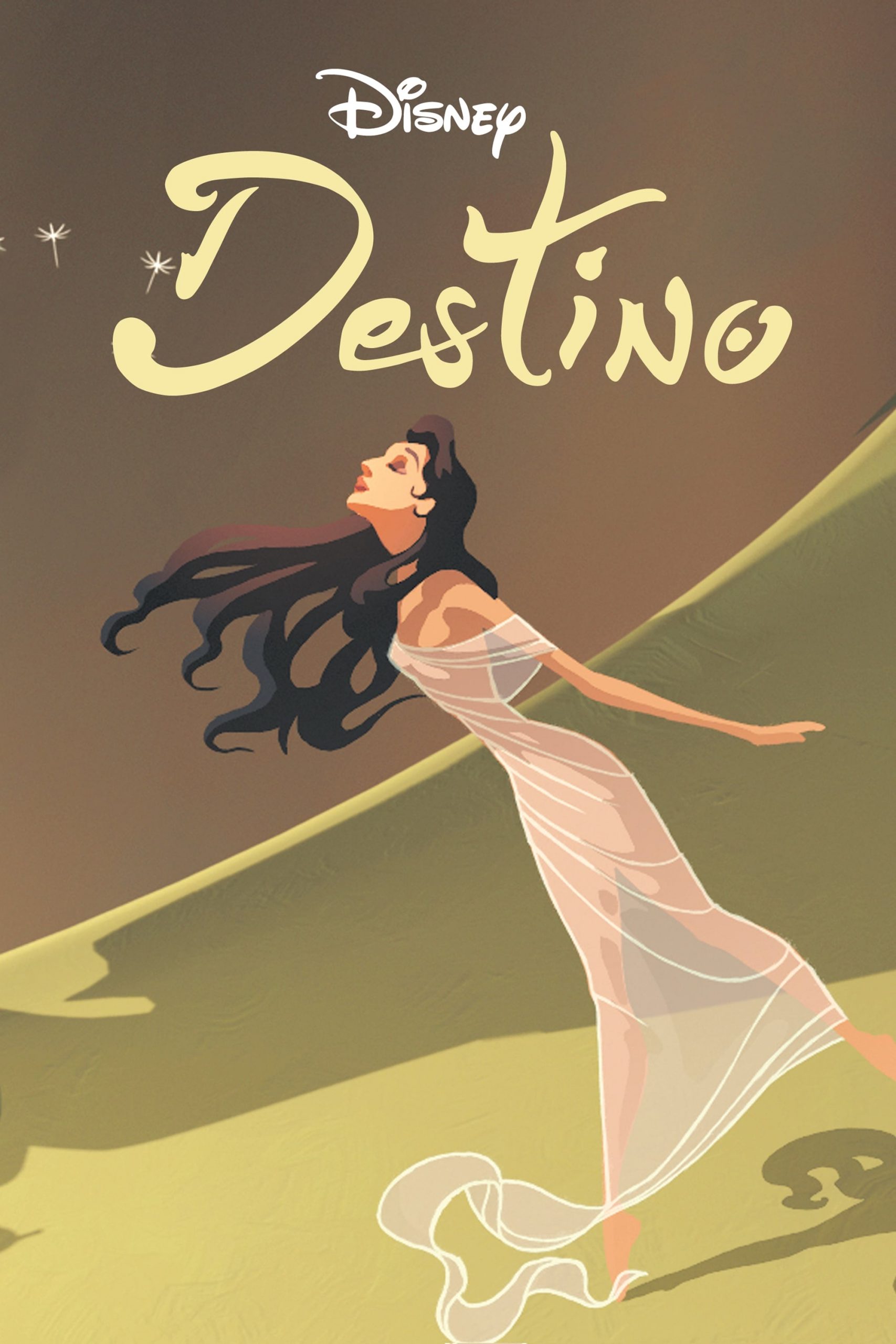
Starring: Dora Luz and Jennifer Esposito
Grade: C-
“In 1946, two legendary artists began collaboration on a short film. More than half a century later, their creation has finally been completed”.
This was Salvador Dalí and Walt Disney.
Summary
Accompanied by the piece “Destino”, a naked Dahlia walks towards a statue of Chronos in a desert-like landscape. The statue is in the shape of a triangle with a clock under one of Chronos’s hands and a bird on his fragmented chest. Dahlia looks at it and closes her eyes. Dreaming of a nighttime landscape, she imagines becoming larger than the statue, picking it up, and bringing it into her heart. Inside her heart, we zoom in and see Dahlia on the same statue in place of Chronos. The hands on the clock melt off, light up, and come towards her. Now wearing a see-through dress, she stumbles away and comes face to face with Chronos and tries to kiss him. He melts and turns into a group of moths, prompting her to look away in sadness. She realizes she is now on this giant spire and runs up it. As she goes, she encounters other strange statues like a figure holding a glass, a body with the head of a dandelion, and more statues of people doing poses. Getting to the top, she walks past a group of alien looking statues, each with one eye. The lead one has a hand pointing out of its eye. Dahlia gets her dress caught on the outstretched hand. This stops her and she hides in a conch shell, with the clothing coming off her as she does it. The shell falls of the spire, which is where we see another giant statue across from the one that she is falling off of and a black and white checkerboard floor. As the shell falls into some sort of netting, Dahlia jumps out before she is stuck there too and lands on a giant part of the statue that looks like a phone. She jumps to another phone and the one behind her disappears. She looks down and sees a shadow on the ground coming from another nearby statue in the distance. The shadow looks like a bell, so she walks towards the shadow and matches her silhouette to it, realizing she fits it perfectly when outstretching her arms. She gets down to her knees and dives into the shadow of the silhouette. She disappears momentarily and reappears as part of the silhouette with her black hair being noticeable in it. She comes out of it and leaps into the air, with a new dress that was created out of the silhouette. As this happens, a small rock from Chronos falls to the ground. Where it lands, there is a lighter silhouette seen momentarily. Dahlia dances freely. When she flips her hair up however, her head turns into a dandelion. She continues to dance with her dandelion head and pieces of the flower start to fly off.
A bird comes out of the Chronos statue, and everything turns dark. The clock stays lit, but the hands of the clock disappear. Chronos falls off the statue. Next, light melts off the clock and attaches itself to Chronos and he becomes alive, shedding the statue from his body as if it were a skin. Now, how will he react when he sees Dahlia?
My Thoughts:
The fascinating history of Destino is more interesting than the short film itself, but the blame can’t be placed on Roy E. Disney and company. The fact that he unearthed such a cool piece of art and history and went out of his way to complete it shows you the love the man had for cinema. It could have been forgotten to time, and no one would have said a thing. Most didn’t know Salvador Dalí and Walt Disney attempted to work together on an animated short film, but the fact that they did cross paths, it got to the storyboarding and test footage stage, and it was ultimately shelved yields a thousand questions that will sadly never be answered. Still, Destino existed, and seeing it completed with the help of some great animators and the original studio artist who worked with Dalí on the unfinished product in John Hench is about as close as we will get to the real thing. Dalí’s surrealism influence is evident throughout the imagery of the short, especially with the awe-inspiring Chronos statue, the dandelion head of Dahlia, bugs turning into men riding bicycles with bread strapped to their heads, the number of clocks and time being an ever-present theme of his work, and those weird Dobby-like creatures that touch the white ball, bringing an all-white, mannequin-looking ballerina version of Dahlia to life. On the other hand, part of it is underwhelming. Maybe the expectations that came along with a surrealistic icon like Salvador Dalí working with animation legend Walt Disney were too high, but the results were not as engaging or as complicated from a narrative standpoint as fans may have expected. Now, this isn’t to disrespect the artists’ legacy nor the ones who were tasked to complete it years after the fact. Had Dalí and Disney worked together and figured out the kinks, there’s no doubt that this could have had Fantasia levels of extravagance mixed with surrealism on the level of Dalí’s greatest works. Unfortunately, they didn’t.
With Destino being cancelled and serious focus never being dedicated to it in the interim period, a lot of the ideas that were probably had when the concept was first thought were lost to time. Hench trying his best to recall ideas from an eight-month period between 1945 and 1946 can only get you so much. Without the spearhead artist and creator, the magic is gone with it. Everyone else is left scrambling, leaving the team behind the 2003 short film to pick up the pieces the best they can while creating a story that makes sense of Dalí’s imaginative genius. Strangely enough, they do too good a job at making sense of it all. Though this might be too strong of an assumption without knowing him personally, Destino doesn’t meet the standards of Dalí’s trademark uniqueness and bizarre way of showcasing his art. If it were to align more with his style based off of what we’ve seen from him, the story and its moments should leave a bit more questions and varied interpretations. Instead, Destino is straightforward enough that it makes us question how far this strayed away from Dalí’s ultimate vision, as we have to assume he would have swung for the fences like he did with every other piece of art he was involved in. Again, this could be just an arrogant hypothesis for someone who thinks he knows Salvador Dalí, but it just seems too mundane to truly be considered 100% Dalí. For instance, Chronos turning into a regular man in the story works with the narrative, but him subsequently turning into a baseball player to hit the head of the mannequin, like a bat hitting a ball, seems almost expected. That isn’t the route someone like Dalí would normally take, who specializes in the avant-garde.
On a side note, I loved the shot of Dahlia and Chronos on two different playing fields separated by a wall, and the sand decreasing to reveal their dilemma. It was a great way to show time running out on their attempt at love, with Dahlia looking for a way to get to him and vice versa.
Initially, the animation is a cool mix of traditional animation and computer-generated imagery like with the intro involving the Chronos statue, but it gets less impressive as time moves on. The delayed reaction of Dahlia moving her head is shotty-looking, it’s not as emotionally involving as the story suggests, it relies entirely on the song to conjure up some semblance of emotions, and the pace is surprisingly slow for six and a half minutes. It doesn’t have to be an exciting forbidden love story per say, but there’s not much going on to captivate the viewer other than the group of one-eyed aliens and the aforementioned conjoining of two mutant-looking things that look like Dobby from Harry Potter. If Salvador Dalí’s name wasn’t attached to the product, it would have come and went without notice, guaranteed. The finished production was living off of name value and storied history alone. Saying this is worthy of being nominated for an Academy Award is ignorant and purely because of a lack of competition. With that being said, the theme played throughout was beautiful. The vocals and old-timey feel to it as “I know you are my destino” are sung was harmonic, and it really finishes the short off in a sweet way. A slow dance to “Destino” in real life would be poetic, whether its captured on film or not.
Despite its shortcomings, Disney going out of its way to bring Salvador Dalí’s Destino to life is the stuff we live for as fans of cinema and art, even if it wasn’t as crazy as Dalí fans may have wanted or expected. We could sit here all day and discuss what could have happened if this were released in the 40s and it were successful. Could it have been the start of a potential partnership, with Dalí making a concerted effort to transition more into films and animation? Could Walt Disney himself see the potential in more mature animated productions and taken the company into a different direction with this in mind? It’s hard to say, but something about Dalí trying to figure out fresh, strange, and imaginative ways to translate his odd ideas into film in some way is just more fascinating than Destino itself. There was so much unrealized potential in picking the man’s brain and giving him a budget to create moving art for generations to try and interpret. Destino was a small sample size, but we are happy the production was released from the vault and completed simply for the sake of it seeing the light of day. Even if it didn’t live up to the hype and was arguably hollow at times, there’s still enough in this short film that made us smile and wonder to ourselves, “What if?”.




+ There are no comments
Add yours