
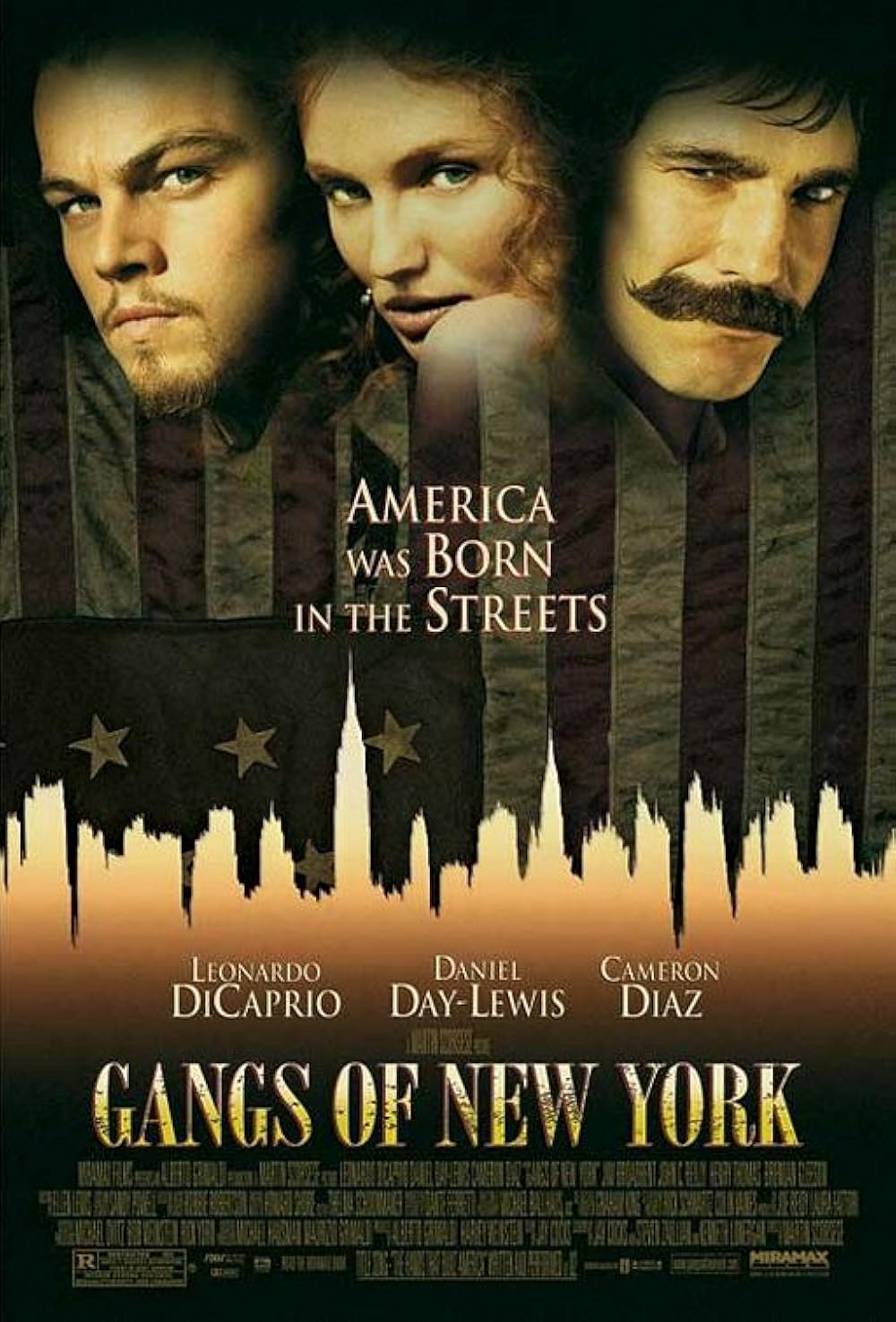
Starring: Leonardo DiCaprio, Daniel Day-Lewis, Cameron Diaz, Liam Neeson, John C. Reilly, Brendan Gleeson, and Eddie Marsan
Grade: A
We need to talk about Gangs of New York more. It’s as simple as that. Irish American history is fascinating.
Summary
In the slums of the Five Points in New York City in 1846, Priest Vallon (Neeson) shaves with a straight blade and cuts himself. He hands it to his son Amsterdam (Cian McCormack) who tries to clean the blood off it until Priest tells him never to do that. In a narration, the adult Amsterdam (DiCaprio) talks about how he only remembered about half of these early moments in his life. The other half he got from dreams.
Priest gets ready for battle and does a prayer for St. Archangel Michael. He notes Amsterdam’s necklace and quizzes Amsterdam on who is on it. It’s also of St. Michael, the angel who cast Satan out of Heaven. With this, Priest leads Amsterdam through the hallways of a bunker created inside the Old Brewery building, with the rest of his soldiers joining him, ready for war. Three of them are “Happy” Jack Mulraney (Reilly), Hell-Cat Maggie (Cara Seymour), and McGloin (Gary Lewis). Another boy named Johnny (Andrew Gallagher) runs up to Amsterdam to ask what battle is happening. Amsterdam explains it’s the Natives against the Dead Rabbits. Amsterdam, Priest, and all of them are part of the Dead Rabbits. This is exemplified by another soldier alongside them holding a stick with literal dead rabbits attached it. Priest leads everyone to the exit. Before leaving the building, he offers Monk (Gleeson) “ten per notch” to join them in their battle in a last-ditch effort. Monk accepts and kicks open the door, with all of them leaving the Old Brewery building and coming outside into the snow. Priest walks the men out and sends Amsterdam away to hide. Soon after, William “Bill the Butcher” Cutting (Day-Lewis) shows up with the rest of the Natives. He is unimpressed with Priest’s group until the rest of them join, like the O’Connell Guard, the Plug Uglies, the Shirt Tails, the Chichesters, and the Forty Thieves. With this, Bill takes off his top hat and has someone take his coat before he pulls out his weapons and makes a speech about how they chose this ground to settle who holds sway over the Five Points. He sees his Natives as the rightful owners of the area and the Dead Rabbits as foreigners who are defiling it. Priest publicly accepts the challenge of the Natives to the roar of his faction. With both Bill and Priest seeing themselves fighting with God on their side, the two sides engage in a bloody battle. Amsterdam watches it all from a distance along with a few other kids.
In the midst of the battle, Bill fatally stabs Priest. A horn is sounded, and everyone stops fighting, as Bill gathers everyone’s attention to what just happened. Amsterdam runs over to Priest and Priest holds his son’s head in his hand before telling Bill to finish the job. Bill obliges and stabs him once more before putting the knife in Priest’s hand because “You may need this across the river”. Bill announces to everybody that ears and noses will be the trophies of the day, but no hand shall touch Priest, so he can cross over to the other side whole. Monk steps in because he still wants what is owed to him, grabbing his payment off of Priest’s dead body while Amsterdam is pulled away. Bill sees this as fair, though admittedly indelicate. Once Monk leaves and says “My sympathies” to Amsterdam, the others ask Bill what they should do with Amsterdam. He tells them to give the kid to the law and see that he gets a good education. The guys let Amsterdam say goodbye to his father, but Amsterdam grabs Priest’s knife and swings it at them before escaping. He runs back to the Old Brewery where Johnny lets him in. Johnny takes out one of Bill’s guys with a staff, hitting him hard in the knees. As Amsterdam runs to the depths of the place to try and hide from Bill’s guys who are in hot pursuit, Bill is still outside talking to everyone. He gives Priest credit for dying a noble death but says that the Dead Rabbits are done and outlawed. No one is allowed to speak their name from this point on. Sixteen years later, an adult Amsterdam leaves Hellgate, the House of Reform on Blackwell’s Island. Despite words of forgiveness being preached during his time there, revenge is very much on his mind. As soon as he exits the place for good, he tosses the Bible off a bridge into a body of water. In the second year of the Civil War, when the Irish Brigade marched through the streets, New York City was full of tribes, war chiefs, rich and poor. As Amsterdam narrates this part, Bill is seen walking through the streets of a parade celebrating slavery’s end, though there are also protesters complaining with signs trashing Abraham Lincoln. Bill talks to his cohorts about how they should have ran a better candidate against Lincoln when they had the chance.
The angriest talk during this time was about the new Conscription Act, the first draft in Union history. After some of his guys fight some black men for standing there, Bill throws a knife at a picture of Lincoln, sticking it right in the face.
Amsterdam details how the Irish came to New York following the Great Famine and were not welcomed by the locals. Amsterdam himself only came down two hours downriver from Hellgate, but they treated him like an immigrant because to the Natives, they were all the same. As Amsterdam walks alongside the actual immigrants coming off the boat, someone gives him a card to vote for Tammany. Tammany Hall was a political society of democrats. Their main politician was William Tweed (Jim Broadbent). New York loved and hated him. Those trying to be thieves couldn’t help but admire him. As he says this, we see Bill and his guys meet with Tweed in his office, refusing to shake Tweed’s hand when he offers it. Following this, Amsterdam details the Five Points and its many nicknames of Murderers’ Alley, Brickbat Mansion, and the Gates of Hell. As Amsterdam comes back into the main area in town, Monk spots him from a distance. Amsterdam goes on about how the Reformers would come every year to try and preach, but the Five Points got worse every year “as if it liked being dirty”. Amsterdam finds that the Old Brewery has turned into a church of some sort for Rev. Raleigh Pastor (Alec McCowen). It’s a mess in there, but Amsterdam bypasses everyone and heads downstairs to the depths of the building discreetly. Meanwhile, Bill and Tweed continue their meeting, with Tweed commenting how he shows up at the waterfront with hot soup for the Irish as they come ashore to build a political base. Bill is aware of Tweed doing this, but he admits he’d shoot every last Irish immigrant down if he had the guns for it. He talks about how each of the Five Points are basically a finger. When he closes his hand, it becomes a fist under Bill’s rule. He tells Tweed that any time that he wishes, he will turn it against Tweed. Tweed brings up their civic duty in figuring out the many public offerings they need to focus on and how they should work together in making this happen for the good of the people, wishing for an alliance between the “Tammany Family” and Bill’s faction. This is mostly because he wants Bill to be the enforcers in town. Bill argues that Tweed already has the police under his payroll so he should get them to do it, but Tweed is adamant that the appearance of the law must be upheld, “especially while it’s being broken”.
While this is happening, Amsterdam finds a secret pathway in the basement of the Old Brewery and finds the knife that was used to kill Priest those many years ago, as Amsterdam stashed it in a secret compartment in the floor. He also finds his old necklace of St. Michael and prays for the strength for what he must do. Two guys approach Amsterdam mid-prayer and attempt to rob him. He takes the first guy named Jimmy (Lawrence Gilliard Jr.) out and holds a knife to the other one. Amsterdam then tells them he doesn’t want to fight after the guy sees the necklace in Amsterdam’s hand. The guy notes how good Amsterdam is with a smile, but Amsterdam gets out of there. Outside, the guy approaches and outs him as Priest’s son. It turns out that this guy is an adult Johnny, the little boy that helped Amsterdam escape as a child. He thought Amsterdam was killed. Amsterdam loosens up after realizing who he is and explains how he was locked up until recently, though he tried to escape a lot. It took so long because they added on time every time he tried to escape. Johnny asks what he’s doing back, and Amsterdam just says he misses the place before walking past the Bowery Boys. Johnny takes Amsterdam to Paradise Square and updates him on the area. The gangs around town are the Daybreak Boys and the Swamp Angels, who work the river looting ships, and the Frog Hollow shanghai sailors down the Bloody Angle. The Shirt Tails used to be rough but have lost their edge as of late, “lolling around Murderers’ Alley looking like Chinamen”. Johnny recalls Hell-Cat Maggie trying to open up her own grog shop but drank all her own liquor and was thrown out on the street. The Plug Uglies are from somewhere deep in the old country. They got their own language, and no one understands what they’re saying. They love to fight the cops too. There’s also the Night Walkers on Ragpicker’s Row. They work on their backs and kill with their hands. They’re so “scurvy, only the Plug Uglies will talk to them”. The Slaughter Housers and the Broadway Twisters are a “fine bunch of bingo boys”. Johnny himself used to run with the Little Forty Thieves until Bendrick the Cockroach took over. He’s got some sort of sickness, so they say that if you try to leave the gang, he hacks up blood on you.
Moving along, Johnny notes how the True Blue Americans call themselves a gang, but all they do is stand on the corner and damn England for everyone to hear.
Amsterdam stops Johnny to ask if anyone has the “sand” of the Dead Rabbits, prompting a worried Johnny to tell him not to say their name, as it died with Priest and was outlawed ever since. Amsterdam responds by saying he was told while he was locked up that the Natives celebrate their victory against the Dead Rabbits every year, which Johnny confirms. Actually, Bill has to invite you himself. Otherwise, you don’t go. From his barbershop, Monk observes the two talking. Just then, Jenny Everdeane (Diaz) bumps into Johnny. She tries to engage in short conversation with the both of them, but they don’t have much to say. Amsterdam says they’re more “deep thinkers” as a joke and winks at her. She laughs and departs with her friends. Johnny tells Amsterdam that Jenny is the “finest bludget in all the Points”. Amsterdam admits she’s pretty, but he tells Johnny to check his pockets because he correctly guesses that she lifted his watch. Johnny admits he let it happen, and he lets her take things all the time. That night, there’s a fire in town, but Amsterdam narrates how the locals love a fire because it allows them to loot. If the cops came along, then you really got a show. The Municipal Police fought the Metropolitan Police, and the Metropolitan Police fought the street gangs. There were 37 amateur fire brigades, and they all fought each other. As one fire goes on, Tweed leads one of the fire brigades in with the goal of getting it done before the Black Joke group gets there. When the Black Joke arrive, Tweed sends his group to fight them, and they get into a massive brawl while the fire goes on in the background. Despite it being some woman’s house, Johnny leads Amsterdam into the burning building to grab whatever they can. The place is already being looted by numerous individuals inside. While this happens, Tweed argues on behalf of the Americus Fire Brigade that this burning building is under his jurisdiction, with the leader of the Black Joke only holding jurisdiction in the Bowery. The leader of the Black Joke thinks they’re winning, but Bill shows up with his crew to help Tweed defeat them. Amsterdam sees Bill from the window.
Tweed tries to go back to fixing the fire, but Bill points out how the place is almost burned to a crisp, so there is nothing of value in there. Realizing this, Tweed directs his team to the building next door and argues that they can’t let the fire spread there. With this, he tells them to take whatever they want from that house. The owner of the house tries to argue that there isn’t anything wrong with his place, but he is promptly punched in the face by some guy. As the fire grows inside the woman’s house, Johnny is trapped, so Amsterdam finds a way over to his side of the room, saves him, and gets him out of the house just in time. Johnny is able to steal a music box too. Once they get outside, Bill notices the two while they walk away. Later, Johnny takes Amsterdam to his crew, with Jimmy being one of them. The main guy has Amsterdam pull out whatever he took from the house. Their racket is that they bring whatever they take there, they fence it, Johnny takes their tributes to the Natives, and they chop up the winnings “each to his equal portion amongst the gang”. Amsterdam can’t help but make a smart comment to the leader, which almost instigates a fight. Everyone stops however once “Happy” Jack Mulraney enters the building. He’s now a constable. Amsterdam looks at him and instantly remembers him from that fateful day all those years fighting alongside Priest. Jack takes a look at the haul and considers what he’s going to take from them. The leader asks Jack to leave enough for them to give to Bill, but Jack hits him. He hits Johnny’s hand too when he tries to save his music box from him. Jack picks up the music box, investigates it, throws it down, takes a helping of what they stole, puts it in his hat, and leaves. Following this, Amsterdam narrates how the Natives essentially celebrate the killing of his father once a year at Sparrow’s Chinese Pagoda on Mott Street. Amsterdam goes there discreetly and interacts with one of the Chinese men that runs the place to be let in. Since the Chinese hate the Natives more than they do, he is let in the back. He interacts with more of the Chinese clientele about what goes on there.
Amsterdam comments how a drum rolls and Bill downs an alcoholic drink set on fire. Amsterdam plans on going to the celebration and killing Bill in front of everyone.
At Satan’s Circus, Johnny goes to where Bill is playing cards at to pay his tribute. McGloin tries to take it from Johnny forcefully until Bill has him stop. Amsterdam is in the room but stands on the other side to watch from a distance. Bill asks Johnny where Amsterdam is from since he’s unaware that he’s Priest’s son. Johnny says he’s not from there, so Bill calls Amsterdam over before telling him to stop midway through the room. Amsterdam sees a portrait of Priest in the background on the wall. Bill notes how Amsterdam can’t look him in the eye and tells Johnny this isn’t an admirable characteristic. Amsterdam looks at McGloin and instantly remembers him all those years back fighting alongside Priest. Just then, Bill gets mad at Harvey (Richard Graham) for his low bet during their game of whist, so he stabs his hand with a knife. Changing the subject, he gives Johnny credit for his willingness to “burn for his swag” and questions how he may do on water, bringing up how there is a Portuguese ship lying low in the harbor that’s been quarantined for three weeks. He wants Johnny to get there before the Daybreak Boys strip it. If he does it, he may have more jobs lined up for him. Johnny accepts and leaves. After this, Bill asks Amsterdam what his name is. When he tells him, Bill refers to himself as “New York” and to never come into his company again empty handed. Then, Bill tells Johnny to take Amsterdam along with him for the job because he might save his life again. Later, Amsterdam and Johnny go by boat to approach the ship, with Johnny noting that the Daybreak Boys will slit their throat if they catch them. Amsterdam doesn’t like the harbor at night, especially after they started sending the bodies of the fallen soldiers there. Still, Amsterdam, Johnny, and Johnny’s crew get on the ship at night only to find that the Daybreak Boys have already been there. They look around a bit until a guy pops out and fires his gun into the air with Amsterdam yelling at Jimmy just in time for him to move, though the guy falls to the ground right after because there is a knife in his back. Amsterdam runs to check the inside of where the guy came from and sees that everyone there has been killed. There’s nothing left.
The group goes back to their boat, and Amsterdam takes the dead captain with them and sells the man’s body for change later to a local hospital. They headline The Police Gazette and are now going by the Ghoul Gang. At Bill’s place, Bill gives them credit, though he struggles with reading a bit. McGloin thinks it’s low for them to do that to a body, but Bill likes it. They could have left with nothing. Instead, they made a periodical of note, which apparently is a good thing. McGloin refers to them as a couple of “Fidlam Bens”, people who steal anything dead or alive because they can’t work for themselves. Amsterdam doesn’t like the term but asks if he’s calling them chiselers. McGloin goes with it, so they start getting ready to fight each other. Everyone takes bets beforehand, and the two go at it while everybody watches. During the fight, the portrait of Priest falls off wall and hits the ground. Eventually, Amsterdam is winning while fish hooking McGloin, so Bill has the two separated because he’s seen enough. He goes up to Amsterdam and gives him a cold rag to hold to his head. Then, Bill turns to McGloin and implies that he will kill him. As he talks, he puts Priest’s picture back up. Bill continues to give McGloin shit for losing, but Amsterdam just watches Bill, remembering the battle from all those years ago. Following this, Bill walks with Amsterdam and Johnny outside and talks about how much Ireland sucks, though he says “no offense” to Amsterdam. Amsterdam goes with it and says he doesn’t have a problem because he was born here and how all he knows of Ireland is the talk of others at the orphan asylum. Bill asks where his forbearers were born. Amsterdam says he’s been told Kerry, but he lost proof of it in his language at the asylum. Bill can relate because he was raised in a similar establishment himself. Now, he owns everything in town. Everybody owes him and everyone pays him. Later, Amsterdam walks by a recruitment area where they’re trying to convince young men to volunteer to become a soldier and bypass the draft entirely. During this timeframe, you could buy your way out of the draft for $300, but nobody had that type of money.
Also, the recruiters were too scared of the gangs to come after them.
After Amsterdam steals an apple from a food stand, Jenny approaches him. He tells her right away to not run into him, as he’s onto her. Even so, she falls into him anyway and apologizes. Once she leaves after Amsterdam confirms that he sees everything is in order on him, he finds that something was still stolen from him. He runs after the trolley she goes on. While on the trolley, Amsterdam watches Jenny flirt with some random guy and lift several items from him as they talk. She gets off on her stop, and Amsterdam follows her from a distance. Jenny is a bludget, a girl pickpocket. She’s also a turtle dove, a woman who goes uptown dressed like a housemaid, picks out a fine house, and goes right through the back door to rob you blind. He sneaks into the house to watch her at work and then approaches her outside of the house to demand his necklace back. She kicks him twice before pointing a knife into his neck. Amsterdam calls her bluff and dares her to do it. She takes too long to make a decision, so he disarms her and puts the knife on her, demanding the necklace. She opens her coat to show the many necklaces she has stolen because she doesn’t know which one is his, so he goes ahead and snatches his from her. He closes Jenny’s coat himself and asks if he can walk with her, so she accepts. The two discuss working together in this part of town, her telling him that he’s too rough for this area, and how she works alone anyway. To Amsterdam’s shock, she doesn’t pay Bill anything though, as they have a “special arrangement”. Next, she tells Amsterdam she doesn’t want to see him again, so the two go their separate ways. After this, Amsterdam narrates how sometimes the uptown gangs come to them. The Schermerhorns were one of the oldest families in New York and wielded a decent amount of power in their own right. As Jack shows the family around, they wonder how safe they are in the Five Points. To prove to them his status, he hangs his pocket watch in the town square next to a dead body, promising that no one will touch it because they know it’s his. Just then, the family runs into Bill, Amsterdam, and everyone else. Jack tries to introduce them, but Bill is aware of the family and publisher Horace Greeley (Michael Byrne) who is with them. He greets them all and ensures their safety to one-up Jack before they depart. Privately, Amsterdam tells Bill that he hates crushers, and Bill assures him that Jack won’t do a thing unless he tells him to.
Monk walks by and asks Bill if his watch would be safe hanging on that lamppost. Bill challenges him to do so to find out. He asks who Amsterdam is, and Bill just tells him it’s a new guy he added to his group. They go to walk away, and Monk tries to lift up his hat to see what Amsterdam looks like, prompting Amsterdam to push him off. Monk assures him he didn’t mean harm and was just trying to see his face before leaving. While they walk in different directions, Amsterdam finally remembers Monk from the battle. After this, Bill butchers his meat while telling Amsterdam how much one can learn from it. After giving a fresh cut of pig to some old woman he refers to as mother, even though it’s not his actual mom, he shows Amsterdam the body parts of a pig and how it’s the same as a human. He points to the places on where to stab the pig with his knife and then gives it to Amsterdam to try. Amsterdam pauses for a moment and sees the newspaper clippings around the room detailing the Natives’ win in the Battle of the Five Points. He also recalls Priest giving him the blade he used to shave with. Next, Amsterdam goes through with stabbing the pig in certain areas Bill wanted him to, and Bill compliments his strategy and form. Later, Tweed tells some guys in his office that they will bill the city $5,000 a month for supplies and services for which they will receive 10%. They are interrupted by Bill who walks right into the office with Amsterdam and Johnny behind him. Bill tells the two to wait outside. Privately, Johnny tells Amsterdam that Bill has taken a liking to Amsterdam, but if he’s planning on doing something, he doesn’t want any part of it. Amsterdam assures Johnny that he’s trying to make his way in life after being in Hellgate for 16 years. In the office, Tweed tells Bill that he can’t get anything done with the constant complaints sent his way about crime in the Five Points, so he suggests they hang somebody unimportant to quiet everyone down temporarily. He’s thinking 4 back-alley amusers with no affiliations. Bill obliges and rounds up a group to be publicly hung.
One of them is a friend of his named Arthur (James Ramsay). They greet each other, and Bill offers him a dollar for his locket. After Arthur says it was his mother’s, Bill offers $1.50 and he accepts. Since he’s going to be hanged, an extra fifty cents sweetening the deal doesn’t make any sense, but that’s how it goes.
Following one of the men pleading his innocence for everyone to hear and in front of his wife and son, the four men are hung. Amsterdam and Jenny are visibly bothered by it. This is just a slice of the violence that happens every day in the Five Points. Still, the goal has not changed. Amsterdam continues to work closely with Bill and gains his trust along the way, but he’s only waiting for the right time to strike.
My Thoughts:
Everyone talks about the usual suspects regarding Martin Scorsese’s best work as a filmmaker and rightfully so. However, this can be dangerous when discussing a true auteur with such a storied legacy in film. When it’s done ad nauseum, loads of other great movies the legendary director has spearheaded have fallen through the cracks and lost to time. Such is the case with Gangs of New York, a movie that could be any director’s best ever. Unfortunately, it is considered lesser-than just because it’s doesn’t hold up to the unbelievably high standard Scorsese unintentionally set for himself due to so many all-time great features he’s made previously. With an impressive attention to detail regarding the time period, an incredible capturing of a forgotten time period in America’s violent and bloody past, an immersive and meticulously researched production design, and a wonderful cast of characters that bring it all to life, an argument could be made that Gangs of New York may have very well been the best film of 2002. It sure as hell is among the top five.
Shifting away from his focus of Italian Americans in New York, Martin Scorsese instead showcases the struggles the Irish faced upon coming over by boat in search of the American Dream. It’s a time period not depicted nearly as much as one would expect on film, though its history is often discussed. Many may recall George Catlin’s famous 1827 oil painting The Five Points and how it captured the chaos of the notorious slum during that time period (“You can always hire one half of the poor to kill the other half”). Scorsese and his team use the painting as inspiration and emulates its energy to create this tale of survival of the fittest, revenge, corruption, and tyranny. Those who came over sought riches, but many found themselves in poverty quickly after, turning to criminal exploits, underhanded tactics, and violence to stay above the line, living fast and free. It was an atmosphere where anything went, at least that’s how it’s portrayed, and it is felt from the very beginning. In one of the most memorable opening sequences we’ve seen in a long time, we are introduced to the world that is the Five Points with an in-house war in broad daylight between Priest Vallon and his group of loyal Irish Catholic immigrants known as the Dead Rabbits taking on Bill the Butcher and the Anglo-Protestant Confederation of American Natives. After watching this film, the sounds of that flute and those drums as the Dead Rabbits prepare for battle is one that stays with you. It’s a hair-raising sequence and an all-time tone setter, as we see how serious this forgotten war was for all these characters and how it changed the trajectory of everyone’s lives. It was important enough for everyone in the Five Points to be involved, along with a literal priest in the highly respected Priest Vallon who led the charge into battle after doing a prayer for St. Michael. Considering the gravity of the moment and how the character’s influence is felt throughout the rest of the film, there could not have been a better casting choice than Liam Neeson for the pivotal role. With his stature and the respect that he commands with his presence, it embodies who Priest Vallon was for everyone in the Five Points, so much so that his name holds weight to anyone in one of the most lawless areas in the country, years after his death too.
He even garners respect from Bill the Butcher, the dastardly antagonist of the film and arguably one of the best villains ever put to screen. After defeating Priest and the Dead Rabbits, no one can oppose him, and he knows it. Bill rules the Five Points with an iron fist, and he works with the corrupt Boss Tweed (“We’re burying a lot of votes here tonight”) to dominate the area, going about things the way he prefers just because his band of gang members help Tweed when he needs it. It results in him residing as the untouchable local overlord whom everyone has to bow to. There is not a single thing that can happen without his approval, and that includes from the police or the local government over at Tammany Hall. The lowliest of criminals and regular citizens that live within the Five Points all have to pay a share of their earnings to Bill to avoid death or a serious ass kicking. To make matters worse, the corrupt officials that are supposed to be protecting the city, like with constable Happy Jack, also drop by from time to time to take a helping from the local criminals on top of Bill. It’s hell on Earth, and Bill relishes in being Lucifer overseeing the town while sitting on his throne. Despite not being impressive physically, Daniel Day-Lewis is outstanding in the role, making Bill this terrifying embodiment of evil and all that is wrong with the Five Points and this era of criminality. From sending a severed pig’s head to Monk’s place to let him know it’s happening today to spitting on the ground in front of the Dead Rabbits at the man’s funeral, Bill is as wicked as they come. The facial hair, the one eye, the top hat, and the unique accent congruent with the time that seemingly doesn’t exist anymore all work together in creating a villain worthy of the nickname, “The Butcher”. In another Oscar-nominated performance, Daniel Day-Lewis steals the movie from this star-studded cast as a bastard of a man who makes his intimidating presence known with any movement he makes.
It can be in an obvious way, like when a man tries to assassinate him in the theater and Amsterdam is able to react quick enough to mess things up, so Bill only receives a non-fatal wound. In front of everyone there who surely would want him dead but can’t admit it, Bill tastes his own wound and demands whose man he is to get to the bottom of this. When Amsterdam listens to the man’s final words and tells Bill that the man is making his peace with God because he’s on the verge of death, Bill intervenes in a fury, saying to hell with it and that the man is to make peace with him instead. To fuel his words of evil, Bill takes the man’s rosary beads and throws them, demanding to know who he is with. When the guy speaks unintelligibly, Bill doubles down (“I’m going to teach you to speak English with this fucking knife”) before taking the man’s vest and questioning the cheering crowd if he will take it as a souvenir once the guy dies. Despite the chaotic scene and the blood on himself and the ground, he demands intermission to be ended and for the play to be continued, and everyone just listens. He’s a monster and even at his most vulnerable, he still survived an assassination attempt. This is a man in control and possesses a power and confidence that is horrific enough to make you worry for the well-being of the protagonist in Amsterdam, who is still trying to find the perfect time to strike. In other instances of Bill’s intimidation tactics, it’s more subtle or even unrealized, like when Amsterdam wakes up in bed with Jenny and Bill is sitting at his bedside in a rocking chair with the American flag draped over him, a striking image to say the least and the second-best of the film next to Jenny nonchalantly sitting in that cave of skulls when Amsterdam is speaking with Monk. In a monologue that cuts deep but also garners respect and understated admiration from the protagonist, as well as the audience in hearing his emotional words, Bill goes on about how he’s 47 and has stayed alive this long because of fear and the “spectacle of fearsome acts”. Someone steals from him, he cuts their hand off. Someone offends him, he cuts out their tongue. If someone dares rise against him, he has no problem cutting off their head, sticking it on a pike, and raising it high for the streets to see.
Keep in mind, this is someone who has an annual toast of an alcoholic drink set on fire in honor of Priest Vallon as if he’s a fire-breathing dragon.
The conviction in Day-Lewis’s words is that of one of the greatest actors of his generation and makes Bill an antagonist of epic proportions. He’s right. Fear preserves the order of things. In an unexpected moment following this part of his speech, Bill reveals a bit about himself and explains his undying respect for Priest Vallon whom he refers to as the last honorable man he killed. He details to Amsterdam how they lived by the same principles and the only thing that divided them was faith, a constant theme the story goes back to and is played with a lot in Bill’s case. Despite being a murderous and hellish presence over the Five Points, Bill sees himself as a man of God doing what is necessary and prays before the final battle for strength. He even tells a whore he hasn’t had before to not call him by his Christian name because she hasn’t earned the privilege. It’s as if he sees his role in the town as means to an end but doesn’t see himself as one that will burn for an eternity, even though he very much will. Still, he goes on about his respect for Priest since he’s the one responsible for making him blind in one eye, referring to it as “The finest beating I ever took”. After this, the harrowing insanity of his perspective helps us understand what kind of man he is and what drives him to continue. He brings up how Priest spared him after taking out his eye because he sees this as Priest wanting him to live in shame, and he calls him a great man for it. Think about that. He was blinded by life for a reason by his enemy, but the psychological intention behind it that only he has come to the conclusion to is enough for him to respect it. It means more than the actual killing, which is probably why he’s satisfied with beating down and branding Amsterdam when he fails in his assassination attempt because the humiliation that stems from it. Being deemed unworthy of his “noble name” and a “base defiler” and getting a series of headbutts from Bill after he spat blood in his face, Amsterdam’s fate cannot be as simple as death. Bill sees it as too easy. He wants the psychological edge. In addition, he wants to make a point of Amsterdam’s treachery (“He ain’t earned a death at my hands. No, he’ll walked amongst you marked with shame. A freak, worthy of Barnum’s Musuem of Wonders”; “God’s only man, spared by the Butcher”).
He’d rather Amsterdam live in his failure every day instead, so it carves deep into the psyche. However, it goes back to his words in this monologue. The fallout and decision to keep Amsterdam alive mirrors what happened with Bill and the reaction to his eye. By Bill’s own venomous admittance, he cut out his own eye and sent it to Priest and would have cut both of his eyes out if he could fight him blind. Then, he buried his enemy in his own blood, adding that Priest was the only man he killed worth remembering. This exact thought process is something Amsterdam keeps with him subconsciously, as he takes the same path of revenge going into the bloody climax of the film. The multilayered performance of Daniel Day-Lewis is something to behold, and what is insane is that he STILL manages to find the soul of such a merciless human being to the point where you can see elements of Stockholm syndrome developing out of Amsterdam like right after that monologue from the rocking chair. After Bill pours his heart out to him, states that he never had a son, blesses Amsterdam, kisses his hand and puts it on Amsterdam’s head before leaving, the protagonist sobs to himself. He has created a bond with his diabolical human being responsible for killing his father and putting him in Hellgate for 16 years, but yet hearing how much the son of a bitch respected his father, his values, and how he cares for Amsterdam like his own son, make him rethink everything about his goal. By his own account, everyone including himself was working for Bill, took a piece, and said, “Thank you sir”. It stops being an elaborate ploy and starts to become a job he appreciates. Why else would he come with a solution of having Bug-Eye Moran’s 75-round boxing match take place on a boat outside city limits, so it could happen legally, and they could avoid the Metropolitan Police? Why go out of your way to stop an assassination attempt from some random guy if it was going to accomplish his goal, just in a different way than expected?
Well…
“It’s a funny feeling being took under the wing of a dragon. It’s warmer than you think”.
The protagonist gets a little too comfortable in his rising stock, whether he wants to admit it or not. Sure, one could argue that Amsterdam wanted to kill Bill himself, but it starts to become a question as to whether he reacted in that moment by instinct as Bill’s underling, he didn’t have enough time to think it through, he subconsciously felt the need to protect him without realizing it, or if Amsterdam truly felt like he has to be the one to kill Bill and no one else. On paper, it seems like it’s the latter, but the answer in-context is not nearly as obvious, which is why the film is so engrossing. Though the viewer will never admit it outright, the performances and story are told so well, we can’t help but think of the possibility either and question if Amsterdam should just roll with Bill from then on. It’s not that we support Bill’s actions in anyway, it’s just that the bond becomes so strong that we can’t help but go through the Stockholm syndrome-like struggles the main character is going through at this moment in time. We know we’re supposed to hate Bill, but why does it get harder in these rare moments of vulnerability? It’s part of the storytelling and acting genius of Gangs of New York. Though some have hurled criticism Leonardo DiCaprio’s way for his Irish accent, I didn’t think it was nearly as egregious as some other examples. Plus, his raw, emotional performance as Amsterdam as he works his way up Bill’s ladder to gain his trust to get the ultimate revenge was fine work to carry the picture. He really did a great job in making the street-smart main character come across as rage-fueled son living, fighting, and doing anything he can to survive in the Five Points. Is he a man who we want to see leading an army of a revived Dead Rabbits, or is he close enough in winning us over simply because Bill needs to be stopped? Either way, DiCaprio’s casting made sense and his scratching and clawing down his path of vengeance to cut the head off the snake, and eventual engagement in guerrilla warfare, helps bring out bloodlust in us. In addition, watching him go head-to-head with Daniel Day-Lewis in the only time they share the screen is worth the price of admission alone.
The mind games the two play, the bond they share, and the two brutal fight scenes they have is everything audiences have clamored for. It’s not only because of these the two characters that have been tied together in a civil war 16 years in the making, but also because these are two acting heavyweights that are arguably the greatest of the profession in the last thirty years or so. For the record, Cameron Diaz added to the star power of the film but was more or less a throw-in that could have been played by anyone. Her believability as an Irish woman was a letdown, and the character’s importance in the story is unclear. Jenny mildly helps in toning down Amsterdam’s aggression, but she causes enough stress leading up to it that arguably negates it. You can see how unnecessarily conflicted Amsterdam is after she reveals her backstory with Bill to him after he was already going through it following Bill’s emotional speech to him minutes prior. Besides Johnny’s jealously of her being attracted to Amsterdam, which leads to Johnny snitching to Bill about his true intentions, Jenny doesn’t offer much to the story other than that great scene where Bill toys with the both of them with his “Butcher’s Apprentice” knife trick at P.T. Barnum’s show. On the other hand, Jenny being excited about the Gold Rush and wanting to go to San Francisco, pointing out on a map that the shortest way to get there would be to go around South America was hilarious.
Maybe stick to bludgeting instead of geography.
Adhering to the unofficial rule that there can’t be a movie about the Irish without Brendan Gleeson being involved, the actor does a great job in winning us over, making us think he’s a bastard, and then winning us over again in one fell swoop as Monk. At first, you think he’s a traitor who aligned himself with Bill like Jack and McGloin because why wouldn’t you? It’s all about survival anyway. His intentions become especially murky following Priest’s death, rifling through his pockets seconds after the man was killed (which turned out to be more considerate than we give him credit for when the object he took is unveiled), but he shows his true colors when the time is right and we can’t help but respect his toughness and what he’s been through (“I got 44 notches in my club. You know what they’re for? … to remind me what I owe God when I die”). In the cave scene where Amsterdam recovers, we also get an intriguing philosophical question that we don’t see coming at that point in the film that carries much more weight than even the characters give it credit for. Though Monk speaks about Priest’s name with respect and talks about how he tried to carve out a corner of the country for his Dead Rabbits, he wonders aloud if Priest would have wanted more had he lived longer, as if to imply he may have become “Butcher-like” over time. Up until that point, this is never considered because we see Priest as this hero who died in the heat of battle, but it makes the viewer think of the possibility. Considering the overbearing criminal heart of the Five Points, who’s to say that Priest would be absolved from such behavior? Technically, Bill is a religious man too and look where he took things. We’d like to think that we have a good judgment of character and believe in Priest fighting for good and by proxy Amsterdam, but comments like this make us realize that the line between good and evil is much thinner in these slums regardless of what religious branch one follows, as evidenced by moments like when Amsterdam kills Happy Jack and a huge cross is seen, along with him crucifying Jack in the town square.
It’s not only his background that strengthens the supporting cast of the movie, its Gleeson’s performance as Amsterdam’s return-to-form righthand man that helps the film to the finish line in all its bloody glory. Amsterdam was right. He was an Irish candidate for sheriff worth voting for.
As insanely lawless and backwards as it is onscreen, exemplified by Johnny’s demise apparently being the only logical solution the characters can come up with, the atmosphere of the Five Points and its everyday anarchy recreated by Scorsese is a lot of fun. Despite the main story at hand, what goes around the principal cast adds to the rich presentation of the forgotten historical period, like the army recruiters giving immigrants citizenship on the spot and immediately signing them up for the military with the very next document they get, an audience at a stage play about Abraham Lincoln hurling vegetables at the actors in protest of the union but also to entertain themselves, forcing people with violence to vote a certain way which both sides are guilty of and results in Monk winning by 3000 more votes than there are voters, and people seemingly having regular gang wars in public spaces. How organized and willing they are regarding the gang wars is also amusing. Once the challenge is accepted by both parties, they have a meeting where the leaders of their respective gangs discuss the terms of the battle, and it’s one of the best scenes of the movie, with Bill giving Amsterdam credit for accepting any weapon except pistols, ensuring maximum brutality. I also enjoyed the constant use of irony like with Amsterdam praying with a knife before he attempts to murder Bill, McGloin’s racist rantings in the church after praying for his mother, and the Reformers holding a celebratory dance at their place the same day as a hanging of four people. You can’t help but laugh when Reverend Raleigh tells Amsterdam when regular services are held and he responds, “Go to hell”.
Mobs, rioters, looters, cops firing on civilians, civilians killing soldiers, whores, gangs, and everything in-between, the Five Points was its own world within New York. Anything went. It was kill or be killed and scavenge for anything that was available. The stories involved in this short period of our history is fascinating, but yet forgotten today. The final moments of the movie seem unconnected at first because of its focus on the bigger picture rather than the characters, but really, it puts everything in perspective in a bone-chilling way. Despite everything that happened, with many important people being prominent figures at the time, others fighting for certain causes, loves being had and lost, and countless deaths over the years, the final seconds remind us that no matter what happens, we are a mere footnote in the context of the world. No matter what was accomplished or who failed in their goals, time will pass and it will be like none of us were ever here. Just like that, our entire lives can be chalked up to less than 0.00000000001% of Earth’s history. All of it can be forgotten and lost to time, especially if no one cares to look back. Though it’s hard to say if the point is for us to walk out of this realizing that nothing matters, or it’s actually a call to arms for all of us to look into our own personal histories, cultures, religions, and the stories of our family tree and ancestors, but it does leave a lasting place in our memory as we see a modern-day New York in the closing shot. Gangs of New York is not without faults, but the violent, engrossing, intense historical epic is still one of the movies of 2002. With Martin Scorsese’s prints all over the magnificent production design and story, and Daniel Day-Lewis churning out yet another all-time performance, this authentic and raw presentation of the life Irish immigrants faced in the Five Points in 1800s New York is a film that captivates from its opening battle sequence to its closing riots.
Fun Fact: In the early stages of production in the 1970s, Malcolm McDowell was considered for the lead. At one point, Robert De Niro was set to portray Bill the Butcher but had to leave due to scheduling conflicts, as did Willem Dafoe.


+ There are no comments
Add yours