
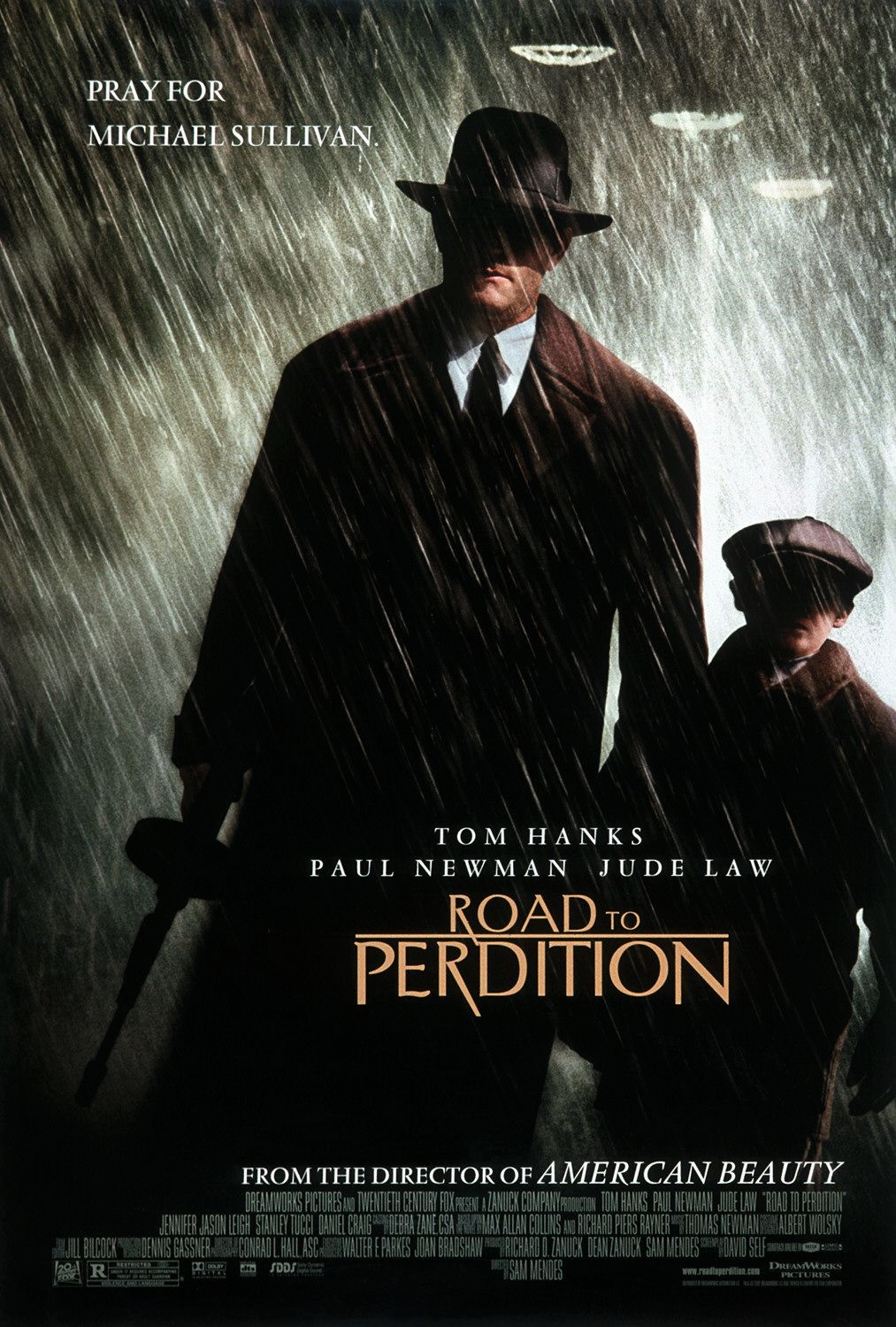
Starring: Tom Hanks, Paul Newman, Jude Law, Daniel Craig, Tyler Hoechlin, Stanley Tucci, Jennifer Jason Leigh, Dylan Baker, and Ciarán Hinds
Grade: B+
Tyler Hoechlin does a solid job with what’s asked of him in a rather difficult film for someone his age, and he does well with Hanks as his father. However, does anyone else think he looks like he would be the son of Ciarán Hinds and his character of Finn? Physically, there is enough of resemblance there that it almost needs to be addressed.
Summary
Michael Sullivan Jr. (Hoechlin) stands on his beach, and he narrates how there are many stories about Michael Sullivan Sr. (Hanks) and how some say he was a decent man. Others said there was no good in him at all. However, he once spent six weeks on the road with his father in the winter of 1931. This is their story.
We flash back to how it started. Michael Jr. rides his bike home in the winter, does a mail route, and stops by a pharmacy run by Mr. Miller, who looks at the kid suspiciously because he knows he’s up to no good. As Miller goes to get his payment, Michael steals something off the counter. Following this, he heads home and plays with his brother Peter (Liam Aiken), throwing snowballs at each other. Their mother Annie (Leigh) watches in delight from the house. Later, the kids are doing their homework at the table. Annie notices how Michael is struggling with math, so she promises to help him with it later. She just wants him to fetch Michael Sr. for dinner. Michael goes to find him, and he spots Sullivan from his bedroom. He takes his rosary out of his pocket and his gun right after. Michael sees it but doesn’t say anything. He tells Sullivan that dinner is ready, and Sullivan thanks him calmy without looking in his direction. Later, the family has dinner together and pray beforehand. Following this, Sullivan is driving the family to the wake of Danny McGovern. Because of this, he tells Michael that he doesn’t want to see him playing dice. At the wake, Peter is too scared to look at the body, so Annie comforts him to the side. On the other hand, Michael goes with Sullivan right up to the body for a prayer, with Michael curiously looking at the ice surrounding the casket. Sullivan explains how it’s used to preserve the body. Michael also notices the quarters placed on the body’s eyes before Sullivan crosses himself. They turn to a jovial John Rooney (Newman), who greets the family. He’s the mob boss Sullivan works for. He hugs Michael and Peter, and the three go into a private room to shoot dice. John loses to Michael playfully and lets Michael get his money from his jacket pocket upstairs in his study. Michael finds the room, but John’s son Connor (Craig) is in there smoking a cigarette while laying up on the couch. After Michael tells him why he’s there, Connor tells him to come back later because he’s busy. Later on in the wake, John does a speech about how he’s happy to see everyone there and how it’s been a lonely house since his wife Mary passed. Right now, it’s only him and Connor.
John admits it would be dishonest to say he knew the deceased in Danny well, but the hurt is still there regardless. Noting how Danny’s brother Finn McGovern (Hinds) will remember his story, John brings up Danny on the high school football team in the championship game. With only seconds to go and down six points, Danny tackled his own quarterback. This gets a big laugh from the crowd. He leads a toast right after and then brings Finn over to do the next speech. Finn admits Danny’s faults but talks about his loyalty and how he would never tell a lie. He thanks John for everything he’s done for the town and brings up how long he’s been working for John without any quarrels or disagreements. Once he starts to get emotional, Sullivan starts to inch closer to Finn, especially after he compares John’s rule over the town to God over Earth. Finn starts to peel back the curtain on John’s dealings, so Sullivan cuts the speech short, and the music starts playing to drown out his words. Connor and a few others help Sullivan walk Finn outside. Before they put Finn in the backseat of a car, Finn tells Connor directly that once he buries his brother, he will deal with Connor next. Once the car drives off, John approaches Sullivan and Connor and asks if everything is fine. Connor assures him that it is, and he will have a talk with Finn, adding that Finn probably just had too much to drink. Despite Connor’s protest, John tells Connor to take Sullivan with him for said talk. He doesn’t want things getting violent. Sullivan spots Michael watching them from the porch and looks away. Following some dancing inside the house with everyone, John plays a somber song on the piano for everybody. Sullivan sits down next to him and plays the other side of the piano. Connor smiles along with everyone but is obviously jealous at how close they are. After they finish playing, Peter asks Connor why he’s always smiling. Annoyed, he tells Peter that it’s because “it’s all so fucking hysterical”. At night, Peter wakes up and tells Michael that he had a nightmare about John’s house, but Michael tells him that it’s just a house and to go back to sleep.
Peter asks Michael if John is rich like Babe Ruth, and Michael says he’s richer. Next, Peter asks what their father does. Michael tells him that he works for John. When Peter questions why, Michael explains how Sullivan didn’t have a father, so John looked out for him. Peter still wants to know what his job is, so Michael explains how he goes on dangerous missions for John, which is why he has to bring his gun. He then lies and says the President sends him on missions too because Sullivan was a war hero. Peter calls him out for making this up, but Michael denies this. Peter then quotes Connor aloud adding, “It’s all so fucking hysterical”. The next morning at the breakfast table, Sullivan tells Peter he can’t make his concert because he’s working. Peter wants to know what he will be doing, and both his parents look at him sternly for the backtalk, with Annie telling Peter how Sullivan is working to put food on their plate. After a few shots of Michael staring off into the distance at school thinking about his father’s dealings, we see Sullivan go out that night in the rain. He picks up Connor and reminds him they are just supposed to have a talk with Finn. Already drinking, Connor replies, “Sure”. Unbeknownst to the both of them, Michael is in the car and is hiding under the backseat. Sullivan and Connor load their guns in the car, and Michael can hear it from where he’s hiding. He gets into the front seat once they leave, so he can watch. He then decides to get out of the car to watch up close, walking up to the building to watch their interrogation of Finn through a peephole. Finn agrees to calm down, but Connor can’t help but call Danny a liar, which sets Finn off. He says he will get to the bottom of all this because he knows something is going on. Connor walks towards Finn, so Finn’s guys put their guns on him. Finn calms it down but is adamant that Danny never stole from John. He checked the books. He never sold any booze to anyone. Every single barrel was accounted for. Even if he did, he asks where the money would be. Connor doesn’t know, so Finn accuses Connor of the same crime.
Finn brings up all the time Connor has been spending in Chicago, so Connor shoots him in the head. This forces Sullivan to back him up and mow down all of Finn’s guys. Michael sees the whole thing. As Sullivan yells at Connor for what just happened, they both see Michael behind the peephole, but they don’t know who it is and chase after him. Michael runs off but can’t get past a fence and just sinks to the ground as the rain gets even heavier. Sullivan catches up and lowers his gun once he sees who it is. Once Sullivan gets a confirmation that he saw everything, he tells his son to not speak a word about it. After Sullivan explains how his son must have been hiding in the car to Connor when he catches up, Connor asks if Michael can keep a secret. Sullivan tells Connor sternly that he’s his son, so Connor says this is good enough for him. With this, Connor decides to walk home, adding how it’s a perfect night for a stroll. Clearly, he knows he has leg-up on Sullivan. Sullivan drives his son home, and Michael asks if Annie knows. Sullivan responds that she knows he loves John and how John gave them a home when they had nothing. They owe him. The next morning, breakfast is tense. Michael doesn’t eat and excuses himself from the table in a haste after being asked to clear his plate. Annie can tell something is wrong, with both boys leaving the room. Privately, Sullivan tells Annie that Michael was hiding in the car when he went out last night and she’s horrified. He assures Annie that he spoke to him, and it won’t happen again. At the same time, John pops by for a surprise visit. Peter greets him happily while Michael takes his bike out only to run right into John. John brings up their “secret”, but he’s referring to their dice game at Danny’s wake. To honor their bet, he gifts Michael a coin. Michael takes it but leaves immediately after to go to school. Following this, John and Sullivan go to a bar to talk about the incident, with Sullivan insisting that Michael understands and everything will be kept under wraps.
John is surprisingly cool with everything and tells Sullivan how it’s tough for his son to see that, but he wasn’t going to be able to protect him forever from this sort of thing.
Meanwhile, Michael gets into a fight at school. Later, John and all the higher-ups in the mob talk about how Finn’s operation will be divided up locally among two territories that John will select personally. With this, Jack (David Darlow) thanks Alexander Rance (Baker) for coming despite his busy schedule. Apparently, Rance met with Jack and John earlier to make another bid for their involvement in the unions. John reiterates what he told Rance before in that “what men do after work is what made us rich. No need to screw them at work as well”. Before the meeting is ended, John asks Connor if he would like to say anything about the incident with Finn. Connor apologizes for it all but jokes, “Two wakes in a month. What can I say?”. John is angry because they lost a good man. He wants Connor to try his apology again. He starts by saying he would like to apologize, which prompts an even angrier John to slam the table. He demands Connor try it again, so Connor stands up and says, “Gentlemen, my apologies”. It’s a tense scene, and Sullivan just watches it all, sitting separate from the table but near it. One man changes the subject to bit borrowers and how there are far too many outstanding debts going around, so John gets Sullivan attention. Sullivan comments that all he needs are their names and to tell him who to visit. John adjourns the meeting and takes Sullivan upstairs to talk. While everyone leaves, Connor sits in his chair in anger. At school, Michael is forced to write over and over again “I will not fight with other boys” on the chalkboard. That night, Connor stops Sullivan before he leaves. Because John forgot to tell him, Connor gives Sullivan an envelope. It’s a reminder for Tony Calvino (Doug Spinuzza) since he’s light again. Sullivan asks Connor if he’s coming with, but he can’t because he’s essentially under house arrest for a while. Connor apologizes to Sullivan over the Finn incident, but he doesn’t respond really other than an “All right” and drives off. Sullivan goes to see Calvino and his appearance alone freaks out the doorman who is well aware of Sullivan’s reputation. Helping him out a bit, Sullivan tells the doorman that it might be a good idea to frisk him before he walks in.
The doorman gets his gun, and Sullivan lets him know that it’s the only gun on him. The doorman takes him through the lively club and to the back before bringing up his own background as a boxer, asking if Sullivan can put in a good word for him with John to maybe be a bodyguard for him. Sullivan responds “Sure” for which the doorman is grateful. The doorman goes into Calvino’s office and lets him know Sullivan is there, so Calvino gets his gun ready by putting it under a book and tells the doorman to stay in the room with him. Sullivan enters and gives him a letter on behalf of John. Calvino reads it and looks confused. Sullivan looks concerned, and they all share eye contact at some point. Sullivan sees Calvino’s gun hidden on the table. When Calvino tries to spring for it, Sullivan grabs it first, shoots Calvino, and shoots the doorman. Sullivan grabs the letter to read it, and it only says one sentence:
“KILL SULLIVAN AND ALL DEBTS ARE PAID“.
Sullivan immediately thinks of his son and calls home, but the phone is off the hook. Annie is drying off Peter from his bath, and a masked Connor walks into the bathroom. He kills both of them. As this happens, Michael comes home on his bike and hears the gunshots. He gets to the porch and sees Connor coming downstairs. Connor takes off his mask and walks out the front door while Michael hides in the darkness on the porch. Once he leaves, Michael goes upstairs to check on the family. Soon after, Sullivan drives home in a hurry. He goes inside and sees Michael sitting at the dinner table in silence. Sullivan runs upstairs and finds his slain family and sits down in agony. Michael walks up to check on him. They share a glance in silence. At John’s place, John flips out on Connor for what he’s done. Connor insists the kid would have talked, but John hits Connor over and over again before hugging him and saying, “God help us”. At the same time, Sullivan collects their things and tells his son that this house isn’t theirs anymore. It’s an empty building. They drive to the Hotel Florence, with Sullivan noting to his son that the mafia will be coming after them and he has to protect him. He’s about to go inside, but Michael doesn’t want him to go. Sullivan gives him a gun and has him wait inside the car. He doesn’t want it, but Sullivan forces him to take it. He tells him there are 6 shots. If he’s not back in a half hour, he is to tell Reverend Lynch at First Methodist Church what happened. He also says to NOT go to Father Callaway. Sullivan goes inside the place with his gun and finds Jack. Jack pulls out a briefcase with $25,000, adding that John wants to give Sullivan more if he needs it. Bringing up how he has friends in Ireland, Jack gives Sullivan advice to take Peter and leave. Sullivan reveals to him that Peter is dead. He wants to know where Connor is, but Jack tells him that Connor is in hiding. Even when Sullivan points a gun at his face, Jack can’t tell him because he’s dead either way. He pleads that he’s just the messenger, so Sullivan wants him to send a message to John. With this, he shoots Jack. He gets back to the car and grabs the gun from Michael, with his son seeing the blood on his hand when he reaches out.
Now, the two are off to Chicago to see where Al Capone stands on the matter, as well as offer his services to Frank Nitti (Tucci). After Nitti turns him down, he lets John know what happened, resulting in Nitti being allowed to send in demented hitman Harlen Maguire (Law) after him. With nowhere else to go, Sullivan decides the only safe spot to take Michael is his sister’s beach house in Perdition. Unfortunately for them, their escape from Sullivan’s old life won’t be as simple as that.
My Thoughts:
Based off the graphic novel, Road to Perdition is a mafia film with themes stronger than the genre it falls under. Though it’s about the mob, gangsters, and hitman violence, it’s more about the relationship between fathers and sons, the act of murder or violence and how one reacts to it, consequences of actions, regret, loyalty and the trouble that can come with it, and how each theme bleeds into the other due to the characters at hand being involved in a profession that complicates it all. The title of the movie may yield questions from the naked eye, but just like many of the details within the story and its morally complex characters, it has a double meaning. Michael Sullivan wants to take his son to Perdition, Illinois because that’s where his sister’s house is and they might be safe there. At the same time, “perdition” is another term for eternal damnation, something Sullivan assumes he cannot escape because of what he’s done, but also a state in which he can prevent his son from going down now that he has this limited time with him. This is the road they have to take to achieve their goals both literally and metaphorically. With gangster violence and a star-studded cast overlaying the emotional weight of this path, Sam Mendes’s quiet, less-is-more approach to the crime drama’s source material may not be fulfilling for every fan of the genre, but it does add dimensions that aren’t seen a lot in a cinematic culture that usually glorifies the life of a gangster.
Tom Hanks stars as the ruthless enforcer known in mafia circles as “The Angel of Death”, a moniker that tells us all we need to know about him. It’s not like Michael Sullivan Sr. boasts about it either. We only get glimpses of Sullivan showing off his skills before shit hits the fan. He goes to work at night, and his two sons don’t know what he does, though Michael Jr. does have some sort of an idea, especially after seeing Sullivan put away his gun. However, Sullivan keeps the details of his career from them and speaks very little about himself, almost to the point where he’s numb to an emotional connection to them. He does love his family, but the combination of being a hired killer and having to keep that from them leads Sullivan to struggle in interacting with his kids, as there’s only so much vulnerability he can show, and he hasn’t been programmed to opening up due to his work. Even when Michael hugs him at the farmhouse, Sullivan appreciates it but isn’t sure how to react at first. It’s as if this type of love is foreign to him, and he’s learning how to be a real father as the two travel, rather than him just being a husband and provider, which he is in the first act. We can see his struggle in approaching serious conversations too like when he has to talk about the difference between Michael and Peter after Michael accuses Sullivan of loving Peter more and how they were treated differently. For reasons such as this, Sullivan is closed off in a figurative and literal sense. Regarding the latter, he’s even filmed in the first act like we are intruding on his privacy, as he’s seen with the door half-closed or only for moments at the breakfast table where he’s subdued, serious, and straight to the point in conversation. Actually, the most important killings he carries out are shot in ways that mask the gore or the action, which is part of the criticism of the movie that I can’t help but acknowledge as disappointing. The intentions of filming it this way are clear like the scene in which Sullivan faces off against John in the rain. At some point however, you have to give the people what they came to see. The shock with Harlen’s appearance in the third act works with how the momentum of the story is winding down to a near stop. Nevertheless, there needed to be more involved with Connor, whether the depiction of it is more “true to life” doesn’t matter at that point.
Considering what the movie is promising and the perceived talents of the main character, we have to see it carried out in a cinematically pleasing way at some point in the film. A quick machine gun takeout of John’s boys in the rain didn’t suffice. In their defense, the shot of Sullivan emerging from the shadows of darkness was cool (along with the later mirror shot of Connor in the bathtub), especially because the viewer and the two main characters know what has to happen next in that moment of time. However, more moments of front-and-center acts of barbarism would have helped the movie, especially considering Tom Hanks is the star. It’s obvious that Hanks chose the role not because he wanted a chance to play the guy with a machine gun who kills with ease. Clearly, the attraction was to the complications Sullivan faces because of that and what his life turns into once he has to escape this professional identity that defines his legacy in an effort to protect his son and last living family member from the forces of evil he was working with. From an actor’s standpoint with his touted resume, this is the stuff that attracts a superstar talent such as Tom Hanks. With all that being said, the reason more violence and killings needed to be carried out onscreen rather that a step above being implied or barely shown wasn’t because of this insatiable desire for bloodlust in a mafia movie. No, it’s because of the casting. Hank’s performance is greatly in tune with the character when he’s interacting with his family because his emotional dejection is handled well. However, when it comes to Sullivan actually killing people, it’s just hard to see Hanks in this light. It’s difficult to suspend our disbelief in seeing Tom Hanks being this “Angel of Death” that scares people when he walks into a room. If we see more of how vicious Sullivan can be when carrying out some of these killings and do so with as little emoting as possible, we can buy into what they’re selling. Unfortunately, these scenes are few and far between to the point where sometimes we can see the character, but other scenes remind you it’s just Tom Hanks with a mustache.
Even so, the viewer isn’t completely removed from the story, as Sullivan’s focus in moving with silence with his family is done proficiently enough that we know it’s something that has rolled over from his job. Just like a real enforcer, all of Sullivan’s best work is done under the radar, cleanly and professionally. It’s why he’s trusted by John Rooney, the mob boss who acts as a surrogate father to Sullivan and has given Sullivan everything he’s ever needed in life. It’s why Sullivan possesses such a loyalty to the powerful John, a nice old man on the surface that rules the town with an iron fist behind the scenes. Everyone is kind of in on this fact, but it’s downplayed in public for obvious reasons. Still, John isn’t just some domineering presence that everyone shies away from. He’s a multilayered secondary or even tertiary antagonist that doesn’t want to be an antagonist, getting to the point where the viewer resonates with his words and his private reactions to what is happening. He’s just on the side of the villains because the circumstances that unfolded forced his hand. He cares for Sullivan just as much as Sullivan cares for him. When Finn acts out at his brother Danny’s wake and tries to disrespect John for being the one who sent the orders to carry out Danny’s killing, John is surprisingly forgiving. He doesn’t want Finn to be killed on top of Danny. He just wants Sullivan and Connor to talk to him to straighten things out, albeit with intimidation tactics or some violence if needed. When Connor fucks everything up by killing Finn out of frustration, John is just forced to deal with the consequences of his son’s actions and move forward. He is furious with the action, but what can he do? It’s his son. When Connor kills Sullivan’s wife and other son, John is enraged. He didn’t want the hit sent out. He already talked and smoothed things over with Sullivan and believed in Sullivan’s words that Michael would be sworn to secrecy. Everything was fine. Sullivan believed John’s positive response to the mess as well because they were so close. They were ready to move past it. Unfortunately, Connor just called the audible out of panic and John is again forced to make up for his son’s mistakes. What makes Paul Newman’s mob boss character different is that everything John does in the story is with reluctance, a rarity for a character like this. He is too understanding and respectful to allow for senseless violence in his old age.
An overarching Irish mob boss with this level of honor and respect to all the people he interacts with is fitting of the casting of someone of Newman’s stature and how he was looked at this point in his career.
When it’s about business, John Rooney’s seriousness shows, but he is much different when it comes to strong-arming, as he gives second chances to many people. The moral dilemma that further divides him, besides his already noted personality in regard to his work, is his father/son dynamic with Connor. He is well aware of Connor’s erratic personality and how unfit he is for the position he’s in. However, it’s still his son (“Sons are put on this Earth to trouble their fathers”). He can’t kill or fire his own son, no matter how badly he screws up. John can’t bring himself to do it or allow someone like Sullivan to carry it out when he knows EVERYONE would be better off without Connor’s destructive presence around. Still, it’s just impossible. For younger audiences, this concept might be hard to grasp because the answer of killing Connor seems so simple, but those with kids know exactly where John is coming from. A father not only never wants to be in a position where their child passes before them, but to be the one who pulled the trigger on top of that? That’s a line that is never crossed, especially for religious folk, mob or not. When one crosses into this territory, that is a feeling that can never leave you. It’s like when Michael Corleone had Fredo killed in The Godfather Part II. Once he crossed that line and had his brother killed, Corleone could not be saved and it’s something that stayed with him to his final days, living in regret. That was just between brothers too. Here, John Rooney is facing the same dilemma with his son but cannot and will not go that far, despite being looked at as “Corleone-like” for the Rock Island area of Illinois. The internal struggle he has to deal with extends to Sullivan too because he sees him as another son. After Frank Nitti tells John about Sullivan’s intentions, John can’t make the decision because of how much he loves Sullivan, asking aloud, “God help me. What do I do?”. The defining line, and the only one he can take in this situation because someone has to die, is when Nitti brings him back to reality. He asks John what he would do if Sullivan were “just some guy”. It’s hard for him to see Sullivan in that way, but it’s the reality of the situation and he has to acknowledge it.
It’s a reminder that though their relationship goes back years, and he deeply cares for Sullivan and his family, this is the business they’re in and Sullivan isn’t blood. It is what it is. John has to choose between his actual son and a damn good person. Even when faced with the facts from Sullivan himself when he comments later “This ends with Connor dead no matter what”, John doesn’t dispel the possibility but hits him with principle responding, “You are asking me to give you the key to his room so you can walk in, put a gun to his head and pull the trigger, and I can’t do that”. No matter what, a real father has to choose their son every time. This is why he painfully tells Nitti to make it quick once he’s prompted. Nitti questions if Michael should be taken out too, but John refuses this notion even when Nitti brings up the possibility of Michael growing up and wanting revenge as an adult. Seeing this is where John draws the line is a fitting characteristic for this seemingly benevolent mob boss and caring father who battles this balance of honor and his career more than most mob bosses would care to. It’s why we can’t help but understand the struggles Sullivan goes through in their final two scenes together, and why they are such huge moments for the movie. He doesn’t want to do this and neither does John. They both know Connor is the problem, but hey, that’s family and someone has to be killed for this all to end. It is what it is. Even if the audience wants to challenge these themes to make themselves feel better, they can’t help but see it from their perspectives in consideration with what’s at stake and who they are, in combination with their line of work (“This is the life we chose, the life we lead! There is only one guarantee: None of us will see Heaven”). Questions like these and how these characters respond to the events is part of what makes Road to Perdition the compelling crime drama that it is. Again, it’s a movie about the mafia, but the themes and familial issues take precedence over the expected shootouts and violence. Though the missed opportunity with the movie is that both could have been accomplished, it’s still a quality drama without it, with the acting talent and production design coming together to meet what Sam Mendes and his team wanted the focus of the film to be is done so in a respectable manner.
With Conrad L. Hall’s brooding, Academy Award-winning cinematography, the atmospheric lighting that adds an emotional dimension to every scene that matters, and less dialogue than you may ever see in a gangster movie, Road to Perdition really takes a concerted effort in reminding the audience how effective the visual medium of film can be in contrast to the many wordy screenplays seen in the modern era of cinema.
Though some scenes could have benefitted from a little more just so the viewer doesn’t feel too emotionally distance from Sullivan and Michael, there are other examples as to why it was a better decision than it may have been given credit for. Along with the emotional phone call where Sullivan asks how the funeral for his family was and tears up hearing Sarah’s response before abruptly cutting the conversation short (“We’ll see you soon”), there are other examples that weren’t even put to screen. Apparently, Mendes omitted a scene from the final cut where Sullivan explains his background to his son. In the filmmaker’s defense, it wouldn’t have fit the character’s approach to his own life. Michael is already aware of what he does after seeing it firsthand. After Annie and Peter’s murders, the glance they share is enough to set up what’s next without having to have the conversation about John, Connor, or Sullivan’s years of work for the mafia. The same could be said of the minimalist conversation Sullivan has with Michael after the murder of Finn. The audience can get there by connecting the dots, and it’s not hard to believe that the inquisitive Michael can get there too, considering how much he has already seen by the time the rest of the family is killed. In terms of the dialogue, the less-is-more approach with the screenplay was the correct decision. It’s just how the violence is captured that is upsetting. Yes, this technically was by design, as the intention was for them to be quick to reflect how real gun-inflicted murders are. Even so, giving us only a series of small tastes and never giving a big violent payoff, especially to the characters that have earned it, is a disappointing decision that hurts the entertainment factor regardless of its respect to authenticity. To be fair, making a killing satisfying to please the viewer goes directly against the point of the film and Sullivan not wanting his son to be attracted to such evils, with every major kill in the movie’s focus usually being on the witness or the one who pulled the trigger rather than the victim, but come on! We stayed sitting for this long, and we’re invested. At some point, you have to give us something.
More action or suspenseful sequences similar to the one between Sullivan and Maguire at Rance’s hotel would have made a world of a difference. That was expertly handled, and I loved the decision for Maguire to get glass in his face during the shootout and still carry the visible wounds for later in the movie.
Another excellent decision in relation to seeing rather than saying comes from the quiet but figuratively loud series of shots where Michael reads The Lone Ranger and can’t help but get emotional. Road to Perdition exists as one of the few examples where the REALITY of real-life murder and the killing of bad people is depicted in strong contrast to how the media portrays it with protagonists in gangster, cop, western, or action movies. Knowing his father’s work involves a gun, Michaels wants to believe in Sullivan as a hero and even tells his brother Peter that their dad goes on missions for the President. It’s not until he sees Sullivan commit real murder that Michael realizes death isn’t as desensitized as pop culture makes it seem and that if he was faced with the same heightened sense of danger, he may not have it in him to be that “Lone Ranger” figure (or really, a killer like his father). He starts to show inklings of a potential career criminal while he’s with Sullivan on the road being his getaway driver for the bank robberies, but part of the story’s focus is to play with the question of what will Michael grow up to be based off these crucial six weeks he spends with his father. Now, his role may have been a tinge smaller than what the viewer is expecting, but Jude Law as Harlen Maguire is a welcomed change of pace for Law’s usual brand of roles. His disturbing aura mixed with the strange music when he takes photographs of crime scenes (“I shoot the dead”) or finishes the job in some cases (for a solid rate of $1,600 I might add), were all great insertions in livening up the suspense and danger the characters face in pursuit of safety. Maguire is the total opposite of Sullivan, which is why the scene at the diner where they interact for the first time is a heart-pumping one. It’s the first time we see Sullivan sweat or react with slight fear because he’s nearly caught with his pants down, and it makes for true excitement in the moment. Side note, Maguire’s intelligence is understood with that moment where he tells the operator he was cut off to get the location of Sullivan’s phone call, but it’s a little hard to believe he found that diner they stopped at in the middle of nowhere so easily.
Going along with this, the idea of robbing the dirty money from Al Capone’s banks in Chicago so he is forced to listen to Sullivan is also a stretch. Did he really think he was going to get out of that clean without repercussions? Granted, there weren’t a lot of solutions available to Sullivan, but thinking that Capone was going to bend over backwards to help him after the destruction he caused instead of eventually sending yet another person to hunt him down is a little crazy. Then again, it was a fun departure in seeing some humor like with Michael struggling with learning how to drive or Michael asking for his share of the money and realizing he could have had more afterwards, especially when compared to an otherwise dark and dreary film whose feelings of sadness are only magnified by the constant presence of rain.
Also, for the record, when Sullivan yells at Michael in the cornfield after they narrowly escape Maguire, and Michael argues that Sullivan thinks it’s his fault this all happened, with Sullivan assuring him this is not the case, let me be the one to say it: it is. It’s 100% his fault. He was the one who decided to sneak in Sullivan’s car to watch him kill someone. That was the beginning of the chain reaction. Let’s not lie to ourselves because he’s a kid.
Thematically rich and a great attempt at doing something different with the usual premise, Road to Perdition is a well-told tale of a father trying to prevent his son from becoming too much like him. It’s in the guise of a revenge flick with the skeleton of a 1930s gangster movie, but the importance lies in the subtext, so it may not be initially appreciated on a first-time viewing. Still, it’s a good movie with flashes of brilliance when looked at through the lens of director Sam Mendes’s intentions. In Paul Newman’s last onscreen role, and Daniel Craig at his most despicable, Road to Perdition is a forgotten gem that should be discussed and analyzed more in film circles.
Fun Fact: Alfred Molina was approached to play Al Capone but turned it down due to conflicts with Frida. The role was omitted from the final cut anyway.


+ There are no comments
Add yours