
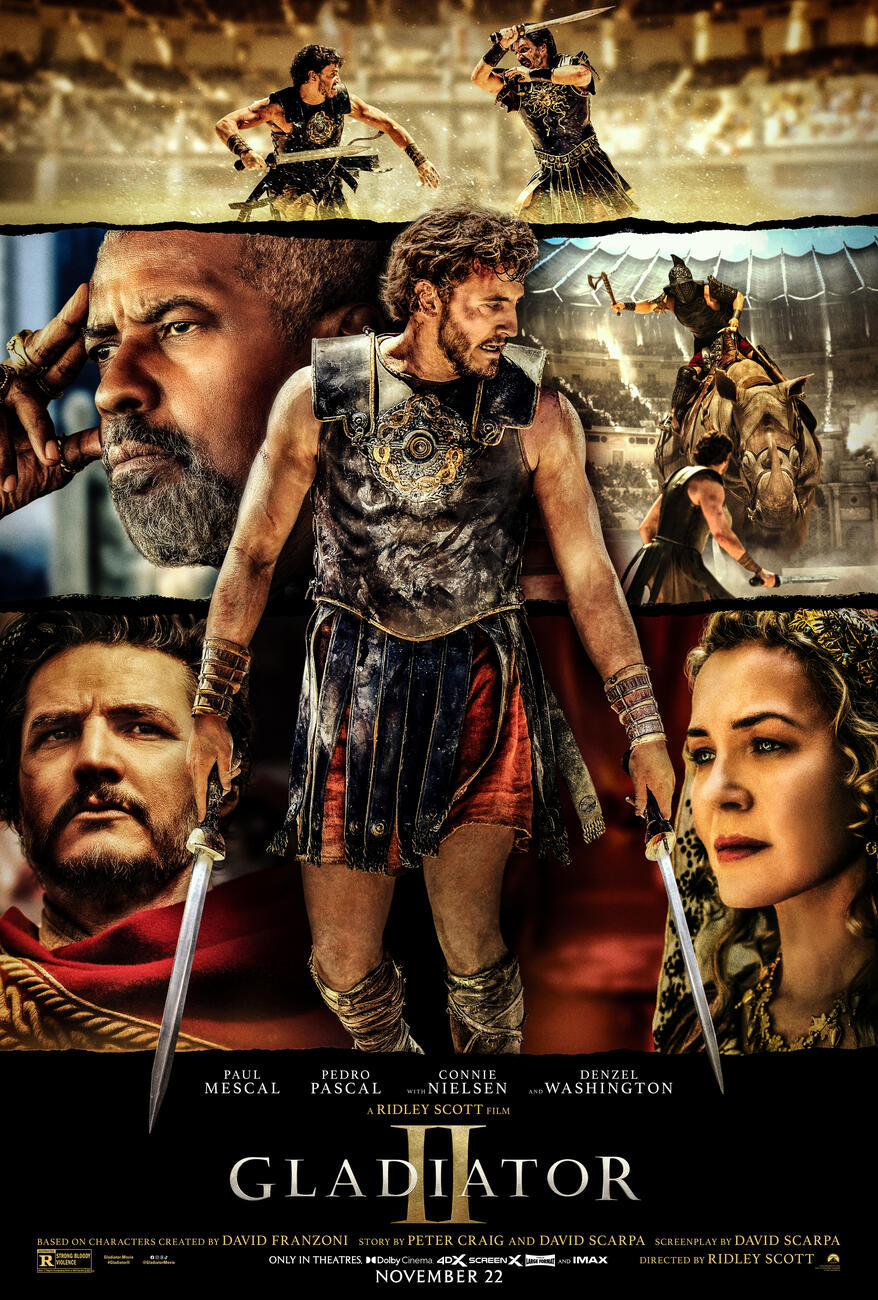
Starring: Paul Mescal, Denzel Washington, Pedro Pascal, Connie Nielsen, Joseph Quinn, and Fred Hechinger
Grade: A+
Following one of Hanno’s victories, Dr. Ravi (Alexander Karim) tells him more men die from infected wounds than in the arena. It’s a throwaway line that leads to Hanno getting to smoke some opium while Ravi stitches him up, but I could totally see that. Can you imagine how little precautionary measures these guys probably went through following a battle?
Summary
16 years after the death of Marcus Aurelius, his “dream of Rome” has been forgotten. Under the tyranny of twin emperors Geta and Caracalla, corruption flourishes. Their ruthless aggression spreads like a plague throughout the empire. The fall of the Great City is imminent. Only the hopes of those who still dare to dream remain…
In Numidia in 200 A.D., we go to Hanno (Mescal) tending to his chickens, pouring the seeds into his hands and rubbing them together. He goes over and kisses his wife Arishat (Yuval Gonen). Horns sound in the distance, so they realize it’s time to go to battle. They help each other put on their respective gear in preparation. In the center of the town, Jugurtha (Peter Mensah) speaks to his soldiers, with Hanno and Arishat being among them, as they prepare to go to war against the Romans. After the soldiers make offerings, Jugurtha notes to Hanno that he didn’t make one today. Hanno says he prefers to sacrifice a Roman instead, which gets a chuckle out of Jugurtha. Right before the battle commences, Hanno and Arishat give each other their rings, so they will symbolically be with each other forever. Following a kiss, they go to their respective positions. Leading the Roman army by boat, General Acacius (Pascal) is near. As this happens, Hanno gives a speech to his ground troops and how this is the last free city in Africa Nova and to listen to his commands. Soon after, the battle begins and Acacius leads the charge from boat to land. In the midst of it, Arishat shoots an arrow through the neck of a soldier next to Acacius. With this, Acacius demands his soldiers take out the archers, and he specifically says, “Kill her!” when pointing to Arishat. The Romans shoot and kill Arishat with an arrow, and Hanno sees the whole thing. While he’s distracted from her death, he’s knocked over the head by another Roman soldier, and he falls off the bridge wall and into the water below. While he’s unconscious underwater, he sees Arishat being taken away by Death. He yells and runs towards her to stop it, but he’s too late. She says she will wait for him. Moments later, he wakes up on the shore of the water. The battle is over, and the Romans won. Hanno stands, sees the sea of dead bodies, and finds Arishat’s body in the water. He holds her and weeps until he is taken away, though he snags half of the arrow from her body that killed her. Later, the Romans burn all the dead bodies in front of the citizens, Jugurtha, and Hanno. Acacius officially declares the city for the glory of Rome, vae victis (“Woe to the conquered”).
The next day, all the captured are branded by the Roman soldiers and enslaved. This includes Hanno and Jugurtha. On the boat, Hanno helps make a splint for Jugurtha’s arm. Though he appreciates his care, he tells Hanno that he’s ready to be taken away from this life because he’s not ready for what’s coming next. After giving Hanno his condolences for Arishat, he talks about how he remembers when Hanno was first brought to them from the desert. He embraced everything they taught him and his soul was replenished after getting Arishat’s love. He tells Hanno to not let them change who he is. In a flashback, we see Hanno as a child playing soccer with his friends until Roman soldiers ran up asking for his whereabouts. By the time they showed up, Hanno sprinted home to tell Eama. She tells him to go on alone and to never let them find him. He escaped and the village was burned. Going forward to the present, the boat arrives in Ostia, the port of Rome. Acacius is greeted by the city upon his entrance, and he goes right to Emperor Geta (Quinn) and Emperor Caracalla (Hechinger) to tell them he took Numidia in their names. They crown him with laurels to honor him. To honor his conquest, they tell Acacius there will be games in the Colosseum. Acacius says there is no need because serving the Senate and the people of Rome is honor enough for him. Geta comments that his humbleness doesn’t align with his accomplishments. Still, all Acacius requests is to get a break to spend time with his wife, prompting Caracalla to bring up the privileges they already give her but she’s not here for the celebration. Geta also tells Acacius that Persia and India must be conquered as well. Acacius isn’t too pleased and comments that Rome already has so many subjects that must be fed. Caracalla says they can eat war, and Geta throws his sword into a pool at the center of the room. Geta says Acacius’s triumphs will be celebrated as a tribute to the Roman people. With this, he holds out his ring, forcing Acacius to kiss it. In Antium in the outskirts of Rome, the slaves are brought in, and the citizens start throwing stuff at them upon arrival.
Master of gladiators Macrinus (Washington) is brought into the arena in Antium to watch the gladiator battles. Then, Hanno, Jugurtha, and several other slaves are brought in with the crowd booing them heavily. Monstrous baboons are let loose into the arena for the slaves to fight, and darts are shot at the monkeys to make them angrier. Jugurtha just accepts his fate and goes down to a knee. He is quickly mauled to death, and Hanno takes on the monkeys that killed him. Hanno gets into a one-on-one fight with one in particular and bites the monkey’s arm and chokes it to death with the chains around his wrists. Macrinus watches it all and says he’s buying Hanno. At night, Acacius goes to see his wife Lucilla (Nielsen), Maximus’s ex in the first Gladiator. Following this, Hanno is brought into a compound Macrinus owns where all the gladiators hone their craft. The trainer Viggo (Lior Raz) tells the group how the arena turns slaves into gladiators and gladiators into free men. He takes a look at each slave individually and notes something about them, with Viggo recognizing Hanno because “He eats monkeys”. When it comes to lunch time, Hanno sits down to eat, and all the others start making monkey noises at him. He can’t help but chuckle. Later, Macrinus is in front of all the slaves and he calls up Hanno to talk. He speaks all languages and wants to know what Hanno speaks. He refuses to say anything. Macrinus accepts this since violence is the universal language and he tells Viggo to put him through his paces to see how well he can fight a man instead of an ape. Viggo takes Hanno on. He is armed with special gloves while Hanno is armed with nothing. It’s close at first, but Hanno gets the edge towards the end and is about to take him out until Macrinus stops it. Following this, he has Viggo bring Hanno to him privately. In his place, Macrinus notes his build and talks about how choosing gladiators is an art. Some choose brute force or entertainers, but Macrinus chooses rage. He sees it oozing out of Hanno and sees great potential as a gladiator in him. Finally, Hanno speaks and says he won’t fight for him. Macrinus agrees with this statement, but it’s because he is only putting Hanno in the ring. Hanno either fights or dies. The choice is up to him. Macrinus does question who’s head he can give Hanno to satisfy his fury. Hanno brings up the entire Roman army, getting a laugh out of Macrinus who knows that’s impossible.
Hanno’s follow up is Acacius. Macrinus tells him that as long as Hanno uses his fury in his service, he will find a way to arrange this. If Hanno serves Macrinus, Macrinus promises to serve him. However, if Hanno denies Macrinus, he will die. Privately, Acacius tells Lucilla that his patience with Geta and Caracalla is at an end. Hearing this, Lucilla tells housekeeper Leta (Amira Ghazalla) to go to her quarters to make sure their conversation is between them. Acacius goes on about how terrible he feels about all the people in Numidia mourning the dead. He just wants it all to end. He doesn’t want to waste another generation of young men for Geta and Caracalla’s vanity. If he fights another campaign, he wants it to be to depose them. His troops will arrive in Ostia in 10 days. He promises to Lucilla that all of them are loyal to him. Adding fuel to the fire, Lucilla adds that Geta and Caracalla do not have the support of the people. Macrinus attends a party held by Thraex (Tim McInnerny), and they discuss the upcoming games and how nothing happens in Rome until he’s “tasted it first”. Hanno is brought in, and he asks Viggo what his purpose is here. Viggo is vague and just says he will find out soon enough. Back at the party, Thraex has been hearing about Macrinus wanting to stand for election to the senate and asks him about it. Macrinus denies this, adding that he doesn’t even know how to use an abacus. Changing the subject, he asks Thraex to confirm that its customary to make wagers at these affairs because he wants to bet a thousand gold denarii. Thraex convinces him to bet two thousand gold denarii, and he’s down. Thraex then takes control of the party and sets up a battle in-house. Geta and Caracalla are there to watch. He brings out his fighter Vichek and Hanno is his opponent. Macrinus confirms to Geta that this is his gladiator. The fight is to be three rounds in hand-to-hand combat, but Caracalla demands they fight to the death and to be given swords instead. Before it starts, Hanno pleads with Vichek not to go through with it for the others’ amusement, but Vichek goes right into attack mode. After a solid back and forth, Hanno stabs and kills him. Geta is impressed and asks Hanno where he’s from.
Hanno refuses to say anything, so Macrinus steps in and tells Geta that Hanno is from the colonies and his native tongue is all he understands. Undermining him, Hanno uses this opportunity to stare into the eyes of Geta and quote Virgil’s Aeneid with, “The gates of Hell are open night and day. Smooth is the descent and easy is the way, but to come back from hell and view the cheerful skies in this the task and mighty labor lies”.
Macrinus smiles and tells Geta that it’s Virgil. Caracalla is amused by it and appreciates Macrinus’s surprise. Geta agrees with this statement, but he seems much more bothered about Hanno’s disrespect. He mentions how he can’t wait to see him perform in the arena. Macrinus agrees and gets Viggo to send Hanno away. Later, Hanno is lying in a bath for recovery, and Macrinus gives him two gold quarters before asking who taught him to recite poetry because he knows he didn’t learn it in Africa. Hanno admits a captured Roman officer did. Hanno was a guard for him, and the guy would tell them tales to pass the time. He questions where Hanno is from, but Hanno doesn’t see the point in talking about it if his future is dying in the arena. On top of that, Hanno wants to know what use he has for Roman money. Macrinus reveals that a gladiator can buy his own freedom. With this, he can get a slave of his own. When Hanno starts to ask what Macrinus has done for Roman money and how he was promised a head, Macrinus exits while telling him to earn his keep. When he does, he can have anyone’s head. At night, Lucilla looks at a bust of Marcus Aurelius and asks for his protection and guidance. With this, she meets with the senators discreetly. One of them is Senator Gracchus (Derek Jacobi). Acacius lets everyone know the plan. They are to take back the city on the final day of the games. His army waits for his command at Ostia, five thousand soldiers loyal to him. They will enter Rome and subsequently the Colosseum where they will arrest Geta and Caracalla for their crimes against the Senate and their people. Thraex thinks it’s ambitious and risky. Gracchus mentions that Marcus Aurelius talked about restoring power to the senate but that was a generation ago. A lot has changed since then. The people have not seen hope for many years. After Acacius argues that with time and guidance that it’s possible, a weary Gracchus pledges his loyalty to Lucilla. Thraex backs her as well. On the Gateway to Rome, the slaves are taken in a cage. Upon entrance into the city, they note a statue of a wolf with the two cubs below it. Hanno tells the others that the twin cubs were outcasts left in the hills to die.
The wolf found them and suckled them on her milk. They were raised by the animal. It’s in their blood. One slave questions how he knows this city so well. Hanno explains that he doesn’t. He just knows the chaos they bring and how they infect everything they touch. Meanwhile, Macrinus rides into Rome on a chariot to meet with Thraex who still hasn’t paid. Thraex hasn’t forgotten but he clearly doesn’t have the money. Macrinus decides to help him out a bit and offers another wager of double or nothing on the next battle. They drink to it after a handshake agreement. Viggo leads the slaves in to where all the gladiators are kept. Soon after, the first day of the games commence, with the MC talking about how this is all to honor the Roman army’s victory over the barbarians of Numidia and Acacius himself. Geta invites Acacius away from Lucilla as the crowd cheers to place him front and center alongside himself and Caracalla. He tells Acacius to speak to the crowd, so he does. After his speech about praying for Rome and its people needing bravery, they chant his name. Following this, Hanno and the others are led into the arena and introduced as the stable of Macrinus of Thysdrus. Representing Geta and Caracalla is the undefeated Glyceo the Destroyer (Chris Hallaways). The fan favorite Glyceo comes in riding a rhinoceros. Hanno takes charge and tries to lead the team like a general against Glyceo. The one guy who didn’t want to listen is of course killed first by Glyceo and his rhino. Stopping for a moment, Hanno takes dirt from the ground and rubs it into his hands. Lucilla takes notice. Glyceo charges towards Hanno, but Hanno counters by throwing the dirt dust into the air to temporarily blind the rhino, causing the animal to charge headfirst into the wall. Hanno is still knocked down by it, but he suffers minimal damage. A wounded Glyceo fights Hanno on foot. Watching, Geta asks Caracalla if the fighter is the poet from the party, but he doesn’t remember. Geta starts quoting the poem, and Lucilla finishes it for him. Macrinus is observing them as she has this revelation.
Glyceo has the upper hand, but the crowd chants for mercy. In the box, Caracalla wants blood, but Geta asks Lucilla if they should show mercy. She agrees, so Geta gives the thumbs up. The crowd cheers, but Hanno refuses this and yells, “No mercy!”. Geta tries to go on about how his life has been spared by the gods, but Hanno would rather face their blades before he accepts Roman mercy. With this, Glyceo goes for the kill, but Hanno defeats him with a fatal stab. When the crowd starts chanting for Hanno to kill him, Geta allows it and does the thumbs down gesture. Using two swords, Hanno cuts off Glyceo’s head. The crowd cheers Hanno’s name. Afterwards, Hanno tells the other gladiators that the road to freedom doesn’t go through the arena, it leads to death, pointing out the body that was brought back. Viggo sends everyone back to their cells. The rest of the gladiators cheer on Hanno. Following this, Lucilla goes to her house and recites Virgil’s poem and weeps. She takes out a book and remembers the horses Scatto and Argento before recalling Maximus’s death at the end of Gladiator. Before his body was carried away, he asked if Lucilla’s son Lucius was safe, which she confirmed. However, in the flashback, we are shown what happen while he was being carried away. Lucilla brings Lucius over and they scurry to a place in private. She tells Lucius that he is the heir to the throne now, but there are men who want to kill him, so they can take power. She promises to bring him back as soon as its safe. Lucius questions why she can’t come with him, but Lucilla says she has to stay here for his sake and for the sake of Rome. She tells him she loves him as she cries, and a soldier helps Lucius on a horse before he heads off into the distance. She realizes Hanno is Lucius, all grown up. With revenge on the mind and Rome potentially going through a change in power once again, Hanno/Lucius looks to be following in the footsteps of what Marcus Decimus Meridicus did all those years back.
My Thoughts:
It may not be the Oscar winner the first film was, but Gladiator II is a great sequel that proved a lot of doubters wrong on if this world was worth revisiting considering its risky potential in tarnishing the first movie’s legacy. Due to an awesome cast led by a star-making performance by Paul Mescal, who has carried the torch from Russell Crowe admirably, and violent and spectacle-laden action fitting of the Colosseum, Ridley Scott’s continuation of his epic Roman tale reminds us that there is still plenty of fun to be had in ancient times. For the record, it’s not better than the original Gladiator due to the sequel arguably being a slight retread of the original movie’s plot, as well as it not having the emotional weight that carried the actions of the main characters, but the new set of characters are engaging from top to bottom, the performances match it, the action is just as badass as the first movie’s, and the politics between the crop of villains makes for an interesting “B” story that livens the story just when we start to notice the similarities between Hanno/Lucius’s journey compared to Maximus Decimus Meridius’s quest 24 years previously.
In his first big-budget action film, Paul Mescal commands the screen and looks to be at home. Whether Mescal’s Hanno/Lucius is with his wife, fighting a battle as a leader of his army, looking for vengeance for all that is lost, or taking a chunk out of a fucking monkey, he owns the performance and makes Lucius Verus Aurelius the new star of what has now become a franchise. When that third film comes around, we’ll be there, as long as Mescal returns. Even if there are certain similarities to Maximus Decimus Meridius, Lucius has quite the uphill battle in his own right that does set him apart from the original star (“The odds are always against me. Don’t worry old man”). Plus, it’s not like this story is almost exactly the same as previous protagonists in the series like how The Force Awakens was with A New Hope, the worst example in recent memory. The relationship between Gladiator and Gladiator II is noted, but it’s not nearly as egregious. In fact, it’s a solid steppingstone to reintroduce the world and give the audience an easier transition to its group of new characters. Though what he’s been through wasn’t as devastating as what Maximus had to endure, Lucius’s arc is terrible in its own right and actually a lot more complicated. When you take a look at his entire story leading up into the climax of this sequel, Lucius has been through hell. As it’s revealed halfway into the movie, his mother Lucilla sent him off into hiding immediately following Maximus’s death because she knew people were going to try and kill the child to secure the throne since he was the next heir. She promised to bring him back once things were deemed safe. Apparently, she couldn’t go with him for his sake and for the “sake of Rome”, reasoning that reeks of bullshit. Calling back to my review of the first Gladiator, everything Lucilla does or says pisses me off and it doesn’t end here. This is her reasoning for sending of her son into the fucking wild? A couple of vague statements and choosing Rome over her flesh and blood after previously sacrificing everything for him to keep him alive in the first movie? She just sends him off for his sake? No, that’s not a good enough reason. Fuck the city at that point. She can’t leave? I don’t buy that for a second.
Your kid should always come first, especially over a fucking government job. What horseshit.
Of course, Lucius is pissed off when he sees her! Why is she shocked at his reluctance to accept her apology? On top of already leaving him as a kid, which led to him being practically raised in Africa Nova and had to learn on the spot to become a warrior, she still had 15 fucking years to reach out to him to at least CHECK to see if he’s okay. Yet, she didn’t, which is probably why he doesn’t even acknowledge his real name for most of the movie. There has not been an ounce of contact between the two before she sees him at the Colosseum fighting for his life and she still wasn’t entirely sure if that was even him at first. Piling on to Lucius’s misery, his mother’s new husband killed his wife, he is enslaved and he was then forced to become a gladiator after losing in battle. It would be hard to look at Lucilla, just as it is for Lucius in that cell when she confronts him. Then, following up her question of if he has a family, to which he reminds Lucilla that her husband killed the love of his life, Lucilla has the audacity to bring up how Rome “drowns in its own blood” as if he is supposed to give a fuck. Instead of taking this route however, he points out the irony in how they still enjoy the “pleasures” of the Colosseum which basically encourages the violence. When she brings up his real name, he tells her that it’s not his name, and he doesn’t have a mother he can remember, though he knows exactly who she is. She tries to apologize, but we almost want her to shut the fuck up at this point. Thankfully, Lucius hits her with the effective statement of “If your son were here, he would say not to grieve him for he would not be the boy that you sent away. That boy is dead”. That is where Lucius is at mentally, and it’s totally understandable. Lucilla trying to make things right, while the two are standing in his prison cell after he’s lost everything, falls on deaf ears for good reason. She tries an emotional response by hoping he can gather his father’s strength in Maximus if he doesn’t want his mother’s love, but she also adds the INFURIATING line of “You may think I betrayed you…”. Think? No, we have the evidence. You did. I agree with Lucius.
GET OUT!
It literally got to the point where when Lucilla tries to plead with Geta to stop Acacius’s run as a gladiator by promising, “Any honor I have, I will give it to you”, and he responds how it’s too late for that, I sided with the evil emperor! You played both sides and got burned. Sorry, this is on you Lucilla. If you ask me, this has been a long time coming and her eventual fate was unsurprising to say the least. On the other hand, the twist involving Acacius’s was. For the record, Lucilla’s reconciliation with Lucius once she gifts him the ring that was passed on from Marcus to Maximus to Acacius was much more deserved than the reconciliation scene between Lucilla and Maximus in the first Gladiator. In the first movie, them kissing felt wrong considering Maximus’s family’s recent death drove Maximus’s actions the entire movie. However, where Lucius gets to at this point in the film and him understanding how fate brought him back to the ground Maximus died in, and how its fate that has led him back to Rome to achieve the destiny all these previous characters have wished for with Rome, was a logical step in his character arc at that point in time. Once this is understood, Lucilla’s words mean a lot more about how she doesn’t want to lose him again. He may not think he has the strength of the legendary Maximus, but it’s there. He just didn’t unlock it until he truly internalized his mission in life. It’s felt when Mescal is able to match the power in simplicity that Russell Crowe set the standard for in 2000. When Ravi asks who he should say sent him when Lucius gives him the ring, he states with an understated thunder that made all of this worth it:
“I am Lucius Verus Aurelius, the Prince of Rome. I am summoning the army to the defense of the new republic”.
For movie fans, this is the type of stuff we live for.
Macrinus is right about a lot of things like the “thymos” or smoke and also that rage is Lucius’s gift. The rage is instilled in Lucius, and it’s so strong that it pushes him to overcome adversity very few warriors have faced other than Maximus all those years ago. It’s the only explanation for him being able to take out a rabid monkey as easily as he does. Though it may not have been to Macrinus’s liking by the end, he was also correct in that Lucius’s rage would carry him to greatness. All of this happens in the midst of political turmoil that should have been removed after Maximus died, but it never ends in Rome. On his deathbed at the end of the first movie, Maximus had Senator Gracchus reinstated in an effort to reach the dream of Rome that Marcus Aurelius wished for before he passed. Lucilla doubled down to Gracchus to make sure Maximus didn’t die in vain. Apparently, Gracchus took all of this in and did jack shit with it to where Rome is back in disarray a generation later. Plus, he still serves in the Senate, so he watched it all happen. Maximus’s actions only led to temporary relief despite his dedication to Rome, saving it, and it costing him his life in doing so. The extravagance of the Roman Empire is still there, and the conquests are still happening regularly due to the respected work of General Acacius, who may not be as legendary as Maximus was as a general, but he fucked his ex, so there’s that. However, the chaos at the top may arguably be worse than what Commodus did in his short time on the throne. Though he was just as bloodthirsty and had a temper that could not be quelled, imagine there’s two emperors like that but one is similar to Commodus in that he takes everything as disrespect and his brother of equal power is certifiably insane and takes enjoyment in death and killing. That’s where Rome is at in Gladiator II. Maximus wouldn’t stand for this, and neither does Acacius, a man of honor that we wouldn’t expect after watching that opening sequence. Despite being the man who eventually takes over the mission passed on from generations, Lucius isn’t focused on that to begin with because he hasn’t been a Roman in a long time and harbors hatred for what the city has done for the trajectory of his life. In addition, he has to deal with his enslaved gladiator status because of Acacius, which is why revenge is his one and only goal until things change later when more is revealed to him.
To add to the interweaving of subplots is Macrinus, a former soldier who served under Marcus Aurelius in his African campaign and current master of gladiators with a secret plot to take over Rome with a few careful steps that he’s been planning for quite some time. By design, Denzel Washington’s role as Macrinus was downplayed in its marketing in effort to not see this coming, but it’s not really a surprise because we know Washington isn’t taking a bit part just to be in the movie. The role was going to turn into something substantial at some point, and it becomes more engrossing as Macrinus’s role in the plot increases. At first, he is introduced as a character similar to Oliver Reed’s Proximo in the first movie, as he takes a liking to the protagonist and takes him to the games in the Colosseum for his ultimate goal of revenge on another main character. However, the similarities end there. As Proximo slowly turned into a good person, Macrinus’s devious intentions start to show, and the “revenge” angle extends past Lucius and is revealed to be part of Macrinus’s motivations as well. At first, the seeds are planted with Thraex and the increasing tension between the two due to gambling debts, as Thraex can’t stop losing to Macrinus. Then, when the timing is just right, the arms dealer playing both sides in Macrinus shows his true colors, and it’s an awesome series of scenes like when he walks in and just takes Thraex’s house since he owes $10,000 denarii and subsequently demands what he knows at the same time (“I know why. I know who… pack… quickly“). When he plays the devil on the shoulders of both brother emperors (“No testimony can be more damming than a brother against a brother”) and then influences the volatile Caracalla by saying his pet monkey Dondus’s life may be threatened if Geta blames him in front of the Senate was beautiful to watch unfold. Really, all the calculated moves of Macrinus in the third act are pure genius, and it makes the sequel something entirely different than the expected story of vengeance up until that point. Washington is reveling in his role, and it shows. He shines every time he’s onscreen, showcasing an ability to be a fun-loving face around the leaders of Rome, as well as an intelligent, diabolical menace who gives us just a small enough series of details to foreshadow his real plans, like with his continued touching of certain items in the kingdom every time he walks into or exits a room.
It’s like he wants to feel it before he owns it and is exciting even himself as he does so. It starts to become more noticeable when Macrinus feels the throne after the Senate hearing when Caracalla hilariously appoints his pet monkey Dondus as counsel and Macrinus promises to restore order if he gains control of the Praetorians. It’s just another iconic performance that Washington can seemingly do in his sleep at this point. You know he’s one of the few antagonists to watch out for, but he’s so engaging with whatever he’s saying that you can’t help but try to understand his perspective. His argument for gladiator battles in that “A man can choose to fight and stay alive. It’s the same in life as it is in the arena” is actually pretty sound. Plus, his reveal for his motivations to secure the throne to Lucilla are said with such conviction, you can’t help but give Macrinus the nod. The writing for this sequel is top notch really, and it’s just magnified by its performers, as it should be. Even the smallest of conversations are special, as evidenced by the tension-filled moments between Lucius and Macrinus in private when Macrinus accuses Lucius of possessing Roman blood and he counters with wanting to know Macrinus’s real name before he traded it for a Roman one (“You’ll never know. I have a destiny. The gods delivered you to me. You will be my instrument”). The only line that did feel misguided was Acacius telling Geta that he doesn’t care if he’s forgotten because “Everything is forgotten in time. Empires fall, so do emperors”, mostly because it came from a heroic character and it undermines the main mantra of the whole film in that what we do in life echoes in eternity.
Though much has been said about the inaccuracy of the staged naval battle in the Colosseum to recreate the Battle of Salamis between the Trojans and the Persians, it was insanely cool. Actually, Ridley Scott’s imagination in all of the exciting action sequences did not miss, so though it may not be as emotionally gripping as the first movie, it’s still massively entertaining and was worth seeing on the big screen because of it. What’s just as awesome as the bloody fight scenes of the arena are the sequences of the city’s unrest, complete with rioting and all the scenes involving rising tension captured well onscreen. The walkout of Acacius into the Colosseum while he’s being cheered by the people at the same time as he’s being described as an enemy was a great moment too. It was like a walkout for a pitcher in the World Series. Honestly, this is probably how Ricky “Wild Thing” Vaughn felt like in Major League. It’s like Ridley Scott was just chasing the idea of creating moments in cinema history and nailed it, as evidenced with the shock of Macrinus playing with the obviously fake severed head or Lucius actually using the wooden sword. It was just so entertaining.
Besides this, I wasn’t necessarily enthralled by the views of the afterlife in Gladiator, but it was a lot more moving than what is presented as the afterlife in Gladiator II, with the exception of the final minute.
One thing that bothers me about long-awaited sequels, a lot of times, screenwriters prop up the sequel by disrespecting the foundation laid be the original movies before them. Though I keep going back to it, Rey’s entire story arc in the Star Wars sequel trilogy is a great example of this annoying trope. What was great about Gladiator II was that it respected everything Maximus did in Gladiator, it is talked about at length by plenty of characters how respected and loved he is by Acacius, Lucius, Lucilla, and even Ravi, who saw him fight as a gladiator and spoke about how magnificent he was. In a cool scene, Ravi reveals to Lucius how many still talk about him in secret and what he did, with Lucius recalling his own conversation with Maximus when he was behind bars, detailing his armor and how it had his two horses Argneto and Scatto on them. Lucius speaks of his legend and how Maximus was kind and “bowed to no one”, leading to Ravi showing Lucius his grave and his armor with the quote over his tomb of “What we do in life echoes in eternity”. Small details like this and the respect it gives the original film is what makes this sequel so much easier to like and our new protagonist easier to digest for devoted fans of the original. It doesn’t feel sacrilegious when he takes on the armor Proximo gave Maximus a generation ago, it’s one that we the viewer deem him as worthy in carrying the mantle with strength and honor. Unlike everyone trying to convince us that Rey was the savior of the Star Wars universe all along because we are told ad nauseum to accept it, Lucius EARNS his place and carries the torch proudly to the point where we get goosebumps when he rallies his gladiator troops (“There once was a time when honor meant something in Rome. It doesn’t exist now, and we must find it. Where we are, death is not. By my sword, strength and honor”), Basically, this is how you do a sequel of a beloved original film right.
“A man does not become emperor by bloodline alone. It must be taken by force and kept by force. Are you such a man as this?”
Yes, yes he is.
Gladiator II isn’t the generational film the first movie was, but it succeeds so well in its intentions of continuing the story in its own unique way that it strengthens the legacy of Gladiator and all its characters while setting the series on a new and exciting path. The dream of Rome that Marcus Aurelius had, that Maximus Decimus Meridius spent his life defending and died for, lives on in in newcomer Lucius Verus Aurelius. For that, we’re thankful and we can’t wait for Gladiator III.
Fun Fact: Timothée Chalamet, Austin Butler, Miles Teller, and Richard Madden were all considered for the lead role. Barry Keoghan was set to play Emperor Caracalla but had to drop out due to scheduling conflicts with Saltburn. Additionally, Djimon Hounsou was going to return but also had to exit due to scheduling conflicts.



+ There are no comments
Add yours