
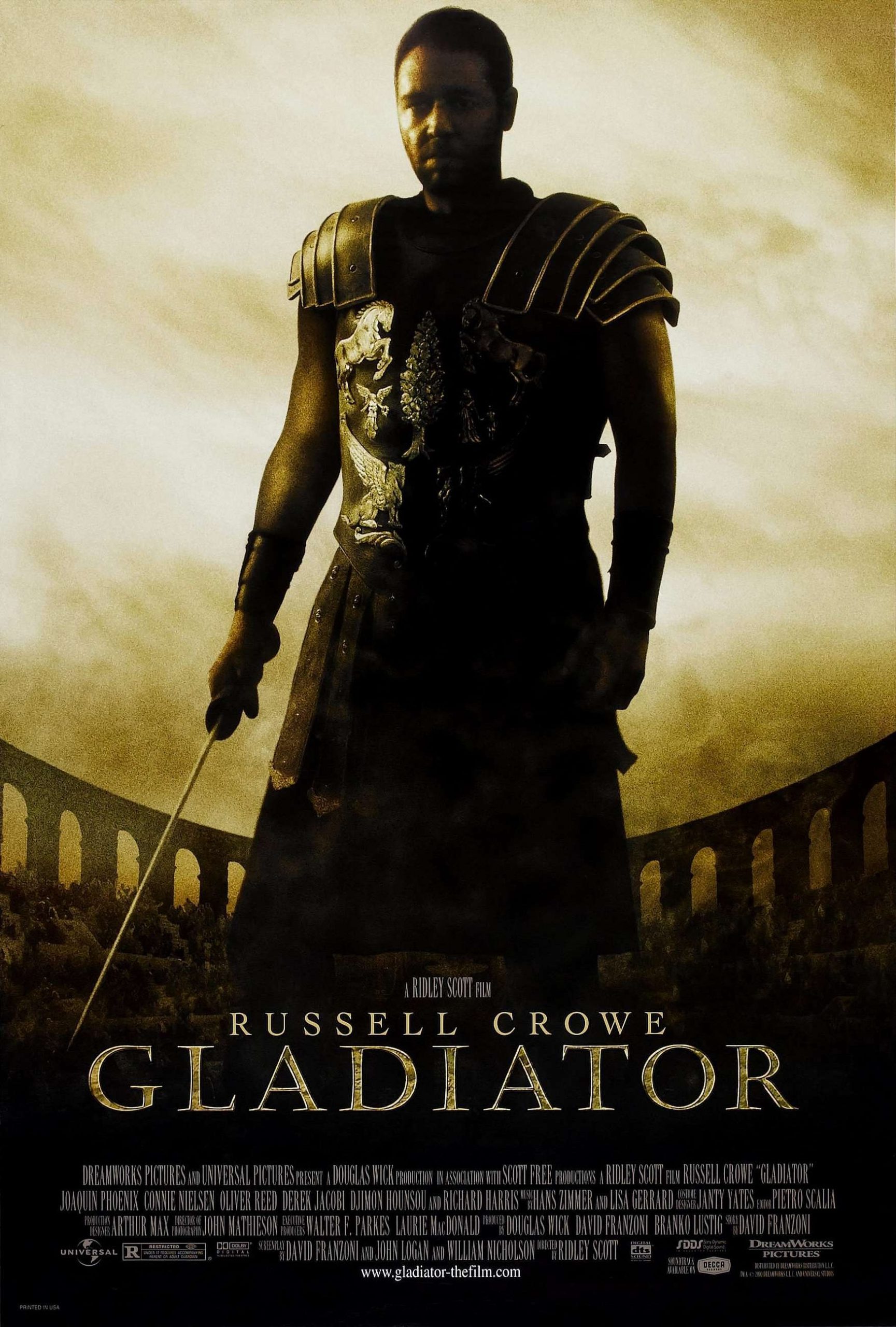
Starring: Russell Crowe, Joaquin Phoenix, Connie Nielsen, Oliver Reed, Djimon Hounsou, Richard Harris, and Sven-Ole Thorsen
Grade: Classic
All things considered, Falco’s advice to act like a snake at the bottom of the ocean and wait until the enemies reveal themselves by initiating things with nibbling is surprisingly sound advice that can be applied to real life. It’s too bad it went to the villain but still.
Summary
At the height of its power, the Roman Empire was vast, stretching from the deserts of Africa to the borders of Northern England. Over one quarter of the world’s population lived and died under the rule of the Caesars. In the winter of 180 A.D., Emperor Marcus Aurelius’ 12-year campaign against the barbarian tribes in Germania was drawing to an end. Just one final stronghold stands in the way of Roman victory and the promise of peace throughout the empire.
After General Maximus Decimus Meridius’s (Crowe) hand is shown brushing across long blades of grass in a different time, we cut to Maximus in a forest area in Germania. He walks into his camp, and all the soldiers he walks by take a knee and show respect. Maximus asks how long their messenger has been gone for, and the guy tells him it’s been nearly two hours. When he asks Maximus if they will fight, he just says they will know soon enough. Just then, Quintus (Tomas Arana) yells at a solider to move the catapults because they’re out of range, but Maximus assures him the range is good. Suddenly, the messenger comes back on his horse headless. The leader of the barbarian tribe appears with the rest of his army with the messenger’s head in hand. He throws it towards them. Quintus mentions to Maximus that people should know when they’re conquered. In their defense, Maximus questions whether Quintus or himself would concede this given the same situation. Well, fair point. Lowering to the ground, Maximus picks up some dirt and rolls it in his hands. It’s time to go to war. The generals wish each other “strength and honor” before readying themselves for battle. Maximus gets on his horse and gives one directive to Quintus:
“At my signal, unleash hell”.
On horseback, Maximus readies his troops deep into the forest with Quintus waiting with the other soldiers for Maximus’s signal. In his speech, Maximus tells them that three weeks from now, he will be harvesting his crops. For everyone else, “imagine where you will be, and it will be so”. The battle commences, and its chaos. Still, Maximus leads the Romans to victory. On top of the hill, Emperor Marcus Aurelius (Harris) watches it all. In a horse-drawn carriage, Marcus’s son Commodus (Phoenix) asks his sister Lucilla (Nielsen) if Marcus is really dying. She comments that he’s been “dying” for 10 years, though Commodus points that he wouldn’t have sent for them if he weren’t really dying. Marcus has even summoned the senators. Commodus is confident Marcus will officially announce him as his successor, and he has a plan to honor Marcus with “games worthy of his majesty”. They arrive to their destination, but Commodus is told that Marcus is still at the front. He’s been there for 19 days. The wounded are still coming in. On the battlefield Maximus just laid waste to, Marcus congratulates Maximus on his victory and for what he has proven. He asks how he can reward Rome’s greatest general, so Maximus just wants to go home. As the soldiers show their appreciation to Maximus when he holds up his sword, Commodus shows up on his horse asking if he missed the battle. Marcus corrects him by saying he missed the entire war. Commodus congratulates him and offers to sacrifice 100 bulls to honor him. Marcus tells him to save the bulls and to honor Maximus instead because he won the battle. Commodus hugs Maximus and calls him a brother for his triumph. Next, Commodus tries to get Marcus to come with him, but Marcus excuses himself to leave. He struggles to get on his horse as an annoyed Commodus watches him. Maximus goes over to Marcus to make sure he’s good, and Marcus comments to him, “So much for the glory of Rome”. At night, there is a celebration held where all the soldiers and people of importance are at. Valerius (John Quinn) asks Maximus if he’s going back to the barracks or Rome, but he tells Valerius that he’s heading home to his wife, his son, and the upcoming harvest. Quintus can’t imagine Maximus being a farmer, but Maximus cheekily comments that dirt cleans off easier than blood.
Commodus interrupts their conversation to introduce Maximus to Senator Gaius (John Shrapnel) and Senator Falco (David Schofield). Commodus jokingly tells Maximus to beware of Gaius because he will pour a honey potion in his ear and you’ll wake up one day and continuously say, “Republic, republic, republic!”. This gets a laugh out of Gaius and Falco before Gaius does point out that Rome was founded as a republic. Going along with this, Commodus says that in a republic, the senate has the power, which is why Gaius is all about it. Falco asks if Maximus favors the emperor or the senate. Maximus responds by saying a soldier has the ability to look his enemy in the eye, which doesn’t really answer the question. Gaius brings up how with an army behind him, Maximus can be extremely political. Maximus just laughs off his implications, as Commodus takes Maximus in a different direction to talk privately. He tells Maximus that he needs people like him to save Rome from the politicians, noting his touted resume. He wants to know if he can count on Maximus “when the time comes”, implying when Marcus passes away. Maximus reveals to him that when Marcus releases him, he intends on going home. Though Commodus agrees that no one has deserved it more, he leans in and tells him not to get too comfortable because he may call on him soon. Changing the subject, he tells Maximus that Lucilla is here, and she has not forgotten him. In her tent of sorts, Lucilla is watching Maximus in the crowd. Marcus walks in to talk to her and comments that she could have been an excellent Caesar had she been born a man. The two discuss why she’s been brought here. It’s to deal with her brother, as he will need her now more than ever, though they don’t say why. The next morning at one of the snowy camps, Maximus surveys the scene and greets people. He also sees Commodus practicing sword fighting with a group. He is directly in the center fending off all of them. Marcus sends for Maximus who shows up to his tent. Marcus goes on about how for 25 years, he has worked to expand the empire. He’s only known four years without war since he became Caesar. He wonders the point of it all. They sit down and talk, with Maximus pointing out that he’s out in the freezing mud with 5,000 of his men. On top of this, 3,000 of them have been bloodied and cleaved and 2,000 of them will never leave.
With this, he refuses to believe they fought and died for nothing. He tells Marcus they fought and died for him and Rome, prompting Marcus to ask what Rome is to him. Maximus says he’s seen the rest of the world and it’s cruel and dark. Rome is the light. Marcus says he has not seen what the world has become but also brings up how he’s dying. When a man dies, he wants to see there was some purpose to his life. Marcus questions how the world will speak of his name after he passes. Will he be known as a philosopher? A warrior? A tyrant? He wonders if he will be known as the emperor who gave Rome back its true self. He’s not sure if his vision will last through the winter. Insisting on whispering now, he asks Maximus to tell him about his home. Maximus speaks about his house being on the hills of Trujillo, it being simple, having pink stones that warm the sun, having a kitchen garden that smells like herbs in the day and jasmine in the evening, and a giant poplar containing figs, apples, pears, black soil, grapes, and wild ponies that his son loves. Marcus smiles hearing this and asks how long it’s been since he’s been home. Maximus replies, “2 years, 264 days, and this morning”. Marcus admits he envies Maximus, as it’s a home worth fighting for. Before he goes home, Marcus requests one more thing from Maximus: Become protector of Rome after he dies. He will empower Maximus to give power back to the people of Rome and to “end the corruption that has crippled it”. Maximus declines the offer, but Marcus says that this is why it must be him. Maximus suggests a senator that understands the city’s politics, but Marcus argues that Maximus hasn’t been corrupted by the city’s politics. Maximus brings up Commodus, but Marcus admits Commodus is not a moral man, something he knows Maximus knew since he was young. He is adamant that Commodus does not rule. He even tells Maximus that he is the son he should have had, and Commodus will accept his decision because he knows Maximus commands the loyalty of the army. Maximus decides to think about it, so Marcus puts the pressure on him by saying he hopes he agrees by sunset. After Maximus exits, he runs into Lucilla outside. She knows Marcus favors Maximus.
She wants to know what he talked about with her father, but Maximus only says that Marcus just wished him well before he goes home. She knows he’s lying, and they go back and forth about their previously failed relationship before she brings up how Commodus expects Marcus to announce his succession in days. She asks Maximus if he will serve Commodus like he’s served Marcus, but he just says that he will always serve Rome. She talks about remembering him in his prayers, flirting with him. However, Maximus shuts this down by saying he was sad to hear about her husband’s death and how he mourned him. He also hears that she had a son, Lucius. He’ll be nearly 8 years old just like Maximus’s son. He thanks her for her prayers and walks away. At night, he prays for God to guide him to where he’s supposed to go and to protect his family. Following this, he talks with his servant Cicero (Tommy Flanagan) and says they might not be able to go home after all. Meanwhile, Marcus tells Commodus that he will choose Maximus to be his successor and he will hold everything down until the Senate is again ready to rule because he wants Rome to be a republic again. After Marcus notes the disappointment on Commodus’s face, Commodus replies by bringing up how Marcus wrote to him once about the four chief virtues: wisdom, justice, fortitude, and temperance. When Commodus read the list, he realized he had none of them. However, he has other virtues: ambition, resourcefulness, courage (not on the battlefield to his own admittance but there are other forms of it), and devotion to his family and to Marcus. He notes that none of his virtues were on Marcus’s list and sees it as Marcus not wanting him as his son. As Commodus begins to weep, he talks about searching the faces of the gods for ways to please him and make him proud. Pointing out the lack of love that Marcus has shown to him over the years, he questions what he has in him that Marcus hates so much. All he ever wanted to do was to live up to him. An emotional Marcus goes to his knees to explain that Commodus’s faults as a son is his own failure as a father. They embrace, but it turns into Commodus suffocating Marcus in anger until he dies.
Following this, Maximus is woken up in his sleep to meet with Marcus urgently. He is brought to Marcus’s tent, and Commodus delivers the news that Marcus is dead. Maximus checks on Marcus’s body asking how he died while Lucilla holds back tears. Commodus explains that he went painlessly and that he stopped breathing in his sleep, but Lucilla can tell something is up. With this, Commodus, acting as Emperor, asks for Maximus’s loyalty and to take his hand. He says he will only offer it once. Maximus walks right past him, so Commodus gives Quintus a stare. Quintus follows Maximus. Privately, Lucilla slaps Commodus but takes his hand right after, pledging her loyalty to him. Maximus tells Cicero that he needs to seek counsel from the Senate and wants him to wake Gaius and Falco. Cicero goes and gets Maximus’s sword in the other room while Quintus tells Maximus how his actions with Commodus weren’t very “prudent”. Maximus doesn’t care and tells Quintus that Marcus has been slain. Quintus is sure he died of natural causes, but Maximus becomes suspicious and questions why Quintus is armed. Suddenly, Quintus calls in the other guards to grab Maximus, ride until dawn, and execute him. A hidden Cicero shares eye contact with Maximus and is about to give him his sword, but Maximus shakes his head not to. Maximus wants Quintus to at least promise him that he will watch after his family, but Quintus tells him that his family “will meet you in the afterlife”. After a quick vision of his family, Marcus is taken into the forest by the guards. They have him kneel before execution. In his head, he prays for God to watch over his family. Before they go through with it, he asks for a clean death, a soldier’s death. They decide to oblige. The one guard goes behind him to stab through his neck, but Maximus reacts quickly enough to head butt him, take the sword, and take out both guards. He throws the sword and takes out another. Then, he calls out for a Praetorian guard, who comes at him on horseback. The Praetorian cuts him heavy, but Maximus takes him out too. With this, Maximus escapes the area on horseback and takes another horse with him.
Wounded and seemingly on the verge of death, he rides back to his home in a hurry. At the same time, the Roman soldiers on Commodus’s directive beat Maximus there, kill his son and wife, and destroy his home completely. He shows up after everything happened and falls to his knees. Crying, he finds that they crucified his wife. Eventually, he passes out on the property and is taken by slave traders. He wakes up in a cage with fellow slave Juba (Hounsou). Maximus touches his wound, but Juba stops him, tells him that they will clean it, and to wait and see. He also gives him the sound advice to not die because they will feed him to the lions since they are worth more than they are. After they clean Maximus’s wound during the trip, all the slaves are taken to Roman province Zucchabar. There, gladiator trainer Antonius Proximo (Reed) is told by a slave trader that he has dealt with before that he has a new stock. Though he’s angry with the guy for selling him two giraffes that won’t mate, he agrees to go and is shown the group. He has a new match coming up, so he takes a look around. He asks Juba what he used to do, and Juba replies that he was a hunter. The slave trader says he found him in a salt mine in Carthage. Next, Proximo walks over to Maximus and sees the mark of the legion on his arm. They question whether he is a deserter, but the slave trader doesn’t care, mentioning how he’s a Spaniard. Proximo offers $1,000 for 6 of them. The slave trader balks at this, as he considers the Numidian worth $2,000 alone. Proximo goes to walk, but the slave trader wants to negotiate. With this, Proximo offers $2,000 and an additional $4,000 for the beasts. It’s accepted, and the men are caged and taken to Proximo’s home. There, he tells the group how he only purchased them to profit from their deaths and they will be trained as gladiators. During training, each man tests their skills with Hagen (Ralf Moeller), and Proximo evaluates them with certain paint colors to describe what level they are at. The first guy is given yellow, and Juba is given red. When it’s Maximus’s turn, he tosses the sword to the ground and refuses to fight. Hagen hits him a few times to try and fire him up, but he just takes it. Proximo stops it before Hagen swings again on account of Maximus’s time coming eventually, allowing Maximus to leave.
Privately, Maximus takes a look at his wound, which has now started to bleed again because of Hagen hitting his arm. Juba questions why he doesn’t fight, but he doesn’t answer. When Maximus tries to peel off his mark of the legion, Juba asks if it’s a sign from his gods and if it will anger them if he messes with it. Hearing this, Maximus laughs and nods, cutting this part of his skin off completely. Sometime after, Hagen tells Maximus that the gods favor him and that red is the gods’ color, adding that he will need their help today. Right before the men are to have their first combat experience as gladiators, Proximo gives another speech. He notes how some have refused to fight, but everyone changes their minds once they get out there. He gives them the advice of killing each other to get the adulation from the crowd. After a few more words about going out like men, Maximus picks up the sand from the ground and rubs it into his hands. The gladiators line up behind the gate and get ready. One of them weeps and actually pisses himself, so Maximus takes a step back to get away from him. They wage war with other gladiators kept there and in front of the live crowd. It’s a brutal scene where only Maximus, Juba, and Hagen come out alive. Meanwhile, Commodus has his coronation back in Rome, and the citizens are not happy. Senator Gracchus (Derek Jacobi) stands with Gaius and Falco and comments that Commodus enters Rome like he conquered something when he’s done jack shit. Falco tells Gracchus to give him time because he thinks Commodus could do very well. Gracchus asks him if he will do well for Rome or for him, to which Falco doesn’t answer. He just tells Lucius to go over to Lucilla because it’s what she would like. Once Commodus comes over to greet the men, Gracchus is quick to remind him that they have to address the many problems of the city. Following this, a meeting commences with Commodus at the center of it. Gracchus heads up the meeting and brings up the first issue of basic sanitation for the Greek Quarter to combat the plague, which is already springing up there.
A half-interested Commodus interrupts him to say that Marcus spent all his time studying, learning, and reading scrolls from the Senate. All the while, he argues the people were forgotten. Gracchus counters with the senate representing the people because they were chosen among the people to speak for the people. Commodus insults them by saying he doubts the people eat as well as Gracchus or have the mistresses Gaius has. He thinks he understands his people, so Gracchus sarcastically invites him to teach them through his “extensive experience”. They start to argue to the point where Commodus threatens him in front of everyone, prompting Lucilla to interrupt and send Commodus away on the account of him being tired. She gets the list from Gracchus for Commodus to take a look at with a promise that he will attend to every problem Rome has. Privately, Commodus talks shit about the Senate to Lucilla, and he thinks aloud how it should just be them two running Rome. She tells him to not even think of such an action because there’s always been a Senate, but he argues Rome has changed. It takes an emperor to rule an empire. She still wants the people to be at least left their traditions, but Commodus calls them illusions. Commodus talks about how Marcus’s war against the barbarians (according to Marcus himself) achieved nothing, but the people loved him. Lucilla points out how people always love victories. He questions this because nobody saw the battles and wonders why they would care about Germania, but Lucilla says they care about the greatness of Rome, a vision. Commodus has a vision for Rome that he thinks the people will love him for it. With this, they will forget about the Senate. What’s the idea? Well, 150 days of gladiator games held in Rome. Gaius isn’t happy with this decision and speaks to Gracchus privately over it. Gracchus surprisingly gives him credit. Still, Gaius thinks Rome would be laughing at him if they weren’t scared of his Praetorians. Gracchus argues that fear and wonder are a powerful combination, and Rome will be distracted by it fairly easily. Even if he takes away their freedom, they’ll still roar.
The beating heart of Rome is “not the marble of the Senate. It’s the sand of the Colosseum. He’ll bring them death, and they will love him for it”.
As this goes on, Maximus starts to gain a reputation as a gladiator and becomes respected by all the fellow gladiators, much like how he commanded respect as a general. He starts to be referred to as “The Spaniard” as well. At one event, he takes out a group by himself, slicing off the head of the last guy. He throws one of the swords into the crowd and yells at them, “Are you not entertained? Is this not why you’re here?”. He follows it up by throwing his other sword down and spitting on the ground. The crowd cheers him on. Following this, Proximo sends for him and brings up how Commodus has arranged for a series of spectacles to commemorate Marcus, which he finds funny because Marcus was the one who closed them down and forced Proximo to go from village to village to continues his business. Now, they’re going back to where they belong, the Colosseum. Proximo talks about it with such love before revealing that he used to be a gladiator himself and won his freedom, with Marcus allowing it by touching him with a wooden sword called a “Rudius” and gifting it to him. It’s still in his home. Because it will give him a chance to stand in front of Commodus if he succeeds, Maximus agrees to pursue this route and be Proximo’s prized gladiator champion. Proximo is happy and now wants Maximus to learn directly from him. His first nugget of advice is that he wasn’t the best gladiator back in the day because he killed quickly. Rather, it was because the crowd loved him. If Maximus wins the crowd like Proximo did, he will win his freedom. Understanding this, Maximus promises to win the crowd and “I will give them something they’ve never seen before”. Proximo lets him use his old vest, and the two go off to Rome. Now, the vengeful Maximus will do everything in his power to succeed as a gladiator to get to the REAL goal of revenge on Commodus for taking everything away from him.
My Thoughts:
In 2000, Gladiator was everywhere. A massive success both critically and commercially, Ridley Scott’s historical epic carried the gravitas and extravagance of the sword-and-sandal films of years past while updating the genre for modern audiences with intense action, a depiction of violence accurate to the time, Rome at its best and worst, and Russell Crowe in a role that certified his stardom in Hollywood. Above all else, what’s most interesting about Gladiator is that it has become a landmark film of cinema and is considered to be one of the greatest movies of its era despite possessing a formulaic revenge story as a plot, basic characters, and a predictable series of beats that leads to an expected finish. However, it’s what it does with its on-paper averageness that makes it such a striking and enjoyable tale of vengeance. Its formulaic plot serves as a blueprint, but it’s not even something that crosses the viewer’s mind in-context due to the movie’s powerful imagery and direction, the second-to-none production design, the moody cinematography, and larger-than-life costumes and set design that bring the age of the Roman Empire to life. The characters might be basic in their roles, but they are clearly defined, and the actors maximize their performances and get everything out of the page to make the film’s story something special, in combination with Ridley Scott’s vision and how well he covers every other aspect of the production. Lastly, the beats are predictable, but it doesn’t make the movie any less iconic, as its one of the most satisfying pictures to come out of the “revenge” storyline arguably ever.
There is power in silence and subtlety, and this is where Russell Crowe sits as General Maximus Decimus Meridius, one of the greatest movie heroes and protagonists of all time. Internalizing the honor that comes with his status and his city, the understanding of his importance in that role, and the responsibility one would have as Rome’s greatest general, Crowe exudes an understated confidence and force with his role as the protagonist. Watch as he owns the room or any battlefield that he finds himself in. It’s not that other soldiers or his peers bow or follow him because they are ordered to. Maximus commands the respect of everyone he cross paths with because he is a natural born leader and everyone can just sense it. It’s more obvious when he’s leading his Roman soldiers into battle, but it’s translated to the viewer with just the way Crowe moves in his performance. It’s his star presence that the audience can sense just as much as the soldiers can sense as they fall in line for their fearless leader. However, it’s further solidified when Maximus is in gladiator mode. At first, he refuses to engage until his hand is forced, as he is placed directly in front of the live crowd to fight for his life. At that moment, the instincts kick in, and he leads the other gladiators because he knows it’s the only way. As time moves on and he continues to claim victories out of necessity, all the gladiators follow his rule naturally, like a general leading his troops. He doesn’t demand for them to follow him. He simply proves himself so much that he cannot be denied. During the recreation of the second fall of Carthage in the Colosseum, Maximus asks before the Romans come out who among them has served in the army. Once some of them confirm and one even says he served with Maximus in Vindobona, he explains before the battle commences how they have a better chance at survival if they work together. It’s not Maximus telling them all to listen because he was a general at one time, it’s Maximus laying out the facts and giving them the option. He doesn’t even say that he should be the leader. Nevertheless, it’s the fact that he’s willing to speak up in that moment to give them the option is how it naturally comes about.
They follow his directives and win, going completely against what is supposed to happen in the battle historically, with the gladiators who were playing the barbarians in the battle defeating the Romans instead of being slaughtered like they were supposed to. It’s because the difference maker was Maximus leading the charge. In another example of the respect he commands, one of the Roman soldiers tell the gladiators to drop their weapons once Commodus comes down to greet them, but they don’t move an inch until Maximus nods to them to make them do so. Despite threats from the ROMAN ARMY, these gladiators are willing to listen to Maximus wholeheartedly and without question because of who he is and how he proves himself to them without having to speak aloud of his resume, which is an extensive one at that. That is power in subtlety. It’s not an imposing height or an impressive, Conan-like physique that makes the hero who he is. Maximus Decimus Meridius is a legend because the aura he generates with the simplest of movements, lines, or actions. Constantly throughout Gladiator, Maximus carefully chooses his words to exemplify the emotional weight his character carries with each statement, as well as how good Crowe is. Though part of it may have been an actor working to perform uninspired dialogue and trying to make the most of it, it’s a moot point because it works. If anything, it just furthered Crowe’s legacy in making Maximus a cinematic legend. He can make hokey speeches like hyping his gladiator cohorts by telling them there is nothing to lose “For you are in Elysium, and you’re already dead!” cool. In most movies, it might be hard to believe that five thousand Roman soldiers are willing to risk their jobs at the hands of the emperor just because of their loyalty to one general, but the presentation of Maximus and how incredible Crowe is in the role makes the viewer believe to the point where we want to fight alongside him (“How soon before they are ready to fight?” – “For you, tomorrow“).
In one of the biggest moments of the film, Maximus is about to finally stand across from Commodus while still donning his MF DOOM mask and holding an arrow in his hand. We know what he wants to do and are waiting anxiously to see how he will proceed. Basic movie logic will tell us that it won’t go down this quickly into the movie, but there is a part of us that is wondering how the hero will get out of this if he does manage to pull it off. When asked his name, Maximus states, “My name is gladiator”. Next, he turns his back to Commodus, who demands he reveal himself. In the moment that he takes the mask off to show that he’s still very much alive, all Maximus does is restate the plot to Commodus, but Crowe does so with such a quiet ferocity that it’s ICONIC:
“My name is Maximus Decimus Meridius, commander of the armies of the north, general of the Felix Legions, loyal servant to the true emperor Marcus Aurelis. Father to a murdered son, husband to a murdered wife, and I will have my vengeance in this life or the next.”
Adding to his legend, the crowd recognizes Maximus and chant loudly enough in succession for him to live, forcing Commodus’s hand to keep him alive. Even as a slave, Maximus is too respected to be denied and even the emperor who can’t stand him and already tried to have him killed is forced to relent. It makes Maximus not only a legend in this story but an icon of film, with his name being cheered by his fellow gladiators in the staging area being the cherry on top. It’s like Lucilla states, “Today, I saw a slave become more powerful than the emperor of Rome”. He stood across from the most powerful person in the world and walked out unscathed because he’s “The man”. That’s special. It would be easy for Commodus to just kill Maximus on the spot, but it’s Maximus’s adherence to strength and honor that keeps him alive. Commodus notes how they love Maximus for his mercy. If he were to kill him, it would make Commodus look even more unmerciful and Maximus would turn into a martyr that could incite the Roman people. The double-edged sword of it however is mentioned by Falco in that “Every day he lives, they grow bolder”. It’s quite the paradox, and it’s a great way for the story to continue instead of just having Maximus accomplish his quest for revenge and call it quits (“I have only one more life to take. Then, it is done”). It’s just another reason why this revenge arc is much more different than its given credit for. Other cool wrinkles in the story that help the story move past what many have perceived to be a “formulaic” plot are Gracchus not trusting Maximus to just dethrone someone like Commodus and leave right after because he fears switching out one dictatorship to another (“I will kill Commodus. The fate of Rome, I leave to you”), Proximo starting out as a dick but turning into the reason Maximus gets as far as he does (“Proximo, are you in danger of becoming a good man?”), which was a great curtain call on screen legend Oliver Reed’s career, and Commodus’s own vanity preventing him from moving past Maximus and instead directing all his focus towards him, which results in his own undoing. To be fair though, the initial stabbing before the final fight was a genius bad guy move.
For the record, the young Joaquin Phoenix is fantastic as the whiny, ego-driven, evil son of Marcus Aurelius. Along with his outward wickedness, his seething anger beneath the surface can be felt the same with just the way he reacts when he hears Lucius playing “Gladiator” instead of “Legionnaire” and how Lucius would rather be “Maximus, savior of Rome” rather than Julius Caesar. The intimate and intense scene where Commodus details the stories of Marc Anthony and Emperor Claudius and how Claudius was betrayed by those closest to him, but he knew something was up, as he stares daggers into a teary-eyed Lucilla was phenomenal work. Only Phoenix could state such a tyrannic monologue with such conviction like the one where he refers to himself as “Commodus the Merciful” before dictating how Lucius will stay with him moving forward and how he will die if Lucilla even looks at him in a manner that displeases him. Piling on, he brings up the hypothetical that if she “decides to be noble and takes her own life”, Lucius will still die. Then, because he’s still mad about being friend-zoned by his sister, he demands Lucilla provide him with an heir of pure blood, so his progeny will rule for 1000 years (“Am I not merciful?!”). Ladies and gentlemen, that is a villain, the perfect antithesis to the near comic book-like hero that is Maximus. Rounding out the cast with acting veterans like Richard Harris and the aforementioned Reed was a great way to beef up the supporting story arcs. Even Djimon Hounsou has his moments, becoming the close confidant of Maximus when he needs it most (“Now we are free. I will see you again, but not yet, not yet”).
The only character that didn’t live up to the standard the movie set for itself was Lucilla. Her allegiances swayed back and forth, she played so coy at times that the viewer can’t distinguish whether she’s playing with Maximus or not, and she doesn’t do a great job of convincing us she doesn’t want to have sex with Commodus, especially in the beginning of the film. At times, it’s like she’s flirting with him, which probably isn’t something she should do if she never wanted to entertain the idea in the first place. In the first act, she flirts with Maximus almost deviously and wants him to be a part of Commodus’s staff, assuming that he will take over for Marcus. It’s not until she correctly assumes that Commodus killed Marcus is when she starts rethinking things. However, she fights for him so often, especially with the Senate, that you don’t know where she stands. Commodus talks about how he was lied to in Germania because they told him Maximus was dead. If they lied to him, then he sees it as disrespect. If that’s the case, they could never love him, which is his ultimate goal. Instead of keeping him away from these murderous thoughts that could potentially result in vengeful actions costing everyone involved, Lucilla decides to rile him up further by saying he must let the legions know treachery will not go unpunished. Why even put it in his head if she’s that worried and her ultimate goal is to dethrone him with the help of Maximus? Wouldn’t her influence over her brother be better utilized in downplaying his angry thoughts, just so she can delay a disaster? They didn’t have to be on a time crunch if she didn’t blow it this badly! It would make no sense for someone with her motivations to practically put a sword in the man’s hand and say, “You should do something about it” and then following it up by pleading with Maximus that the bad guy needs to be stopped. She’s the one who encouraged him! Even if she didn’t mean it, saying shit like that doesn’t help! Maximus is right to not trust her because we don’t even trust her. In a scene that happens after Maximus’s identity is revealed following the Colosseum battle and he’s put in a cell, Lucilla visits him. It happens right after her the aforementioned conversation with Commodus.
Considering the timing of it, this is a crucial and intense moment that could get them both killed if they were spotted by the wrong people. Yet, her opener to him is, “Rich patrons pay well to be pleasured by the bravest champions”, as if this isn’t the most inappropriate time possible to make a flirty remark to someone who is currently a slave and her goal is to convince this guy (who doesn’t like her to begin with) to lead an insurrection after his fucking family has been killed BY HER BROTHER! Maximus reminds her that his family was burned and crucified while they were still alive, and she has the audacity to say she knew nothing, as if it absolves her completely from all this and we are now supposed to trust whatever she has to say. What? First of all, the viewer only knows Commodus for like a half hour before Maximus’s entire family is killed on his orders. It doesn’t take us a lot to believe Commodus ordered this directly, but somehow his own sister is trying to convince us that she had no idea this is how it went down? Yeah, kindly fuck off. Second of all, she wanted Commodus to take over for Marcus in the first act. She was the one who tried to get Maximus to fall in line ahead of time, acting as a devil on his shoulder in that camp scene. Now that Commodus has revealed his true intentions as emperor, as if she didn’t see this coming but everyone else did including Marcus himself, she’s trying to distance herself in a complete role reversal? Yeah, no one would buy what Lucilla is selling given the same scenario. There are too many red flags and inconsistencies for anyone to believe in what she’s saying. Though we know based off the movie’s events that she’s telling the truth at that point in time, there’s still enough evidence that it makes us question her even at her most vulnerable. For her to play both sides to such an extent and walk out as unscathed as she did was actually infuriating and arguably unbelievable. Even when the two kissed before the prison break, it felt wrong, underserved, and badly timed considering the death of Maximus’s family still being fresh in everyone’s minds.
Again, most of the screenplay works with because of how well the actors perform some of the more basic aspects of it, but the only time it really stands out is with Lucilla and her wishy-washy character arc that wins over no one and who’s role only allows Maximus to get to the finish line. Then again, I did appreciate the rest of her conversation with Maximus in that cell scene in question. When he reminds her that his son was innocent in all of this, her great response of, “So is mine. Must my son die too, so you’ll trust me?” was enough for all of us, Maximus included, to hear her out for a second. It’s too good of a point to ignore. Their countering of points continues with how she thinks the gods have spared him, but Maximus argues that he’s still at their mercy and only holds the power to amuse a mob. However, as the two continue to argue, Maximus’s anger with her and her dipshit brother is just more justified. Why doesn’t Gracchus or even Lucilla herself kill Commodus? They can get closer to him, they can get it away with it without question as Commodus has proven that with the way he killed Marcus, and it would be infinitely easier than attempting to spring Maximus from prison, which is only proved later on and results in countless more deaths.
As previously mentioned, all action sequences are as epic as advertised like the prison break and the suspenseful raising of the platform with Maximus and Commodus on it, with the two practically acknowledging in their conversation that this is the end of the movie before they face off. Still, the best sequence may have been Maximus’s walk-out into the Colosseum without the mask to face off against Tigris and his awesome helmet and armor. Maximus fending off tigers and beating the son of a bitch bloody before refusing to kill him just because Commodus gives him the “Thumbs down” gesture, with an all-time image of Maximus standing above Tigris and a slain tiger is one of the most badass things you’ll ever see. It’s not even the strongest thing he does either. That comes right after when Commodus tries to goad Maximus into attacking him with “They tell me your son squealed like a girl when they nailed him to the cross, and your wife moaned like a whore when they ravaged her again and again and again”. How he is able to restrain himself because of the bigger picture is true strength.
In a fantastic recreation of the ancient Roman times in a throwback of a movie, director Ridley Scott delivers an intense epic with heart, action, and love powerful enough to carry our hero through the toughest of battles as he fights to see his family again. A legendary film fueled by a peak Russell Crowe, Gladiator reminds us that mortals might be shadows and dust in the grand scheme of things, but if we do what is right and fight to the very end with strength and honor, it can create a positive legacy that will last a lifetime.
Fun Fact: Mel Gibson, Tom Cruise, and Antonio Banderas were also considered for the lead. Gibson turned down the role because he was already committed to The Patriot. Jude Law auditioned for Commodus, and Jennifer Lopez auditioned for Lucilla. Lou Ferrigno was originally offered the role of Tigris of Gaul.



+ There are no comments
Add yours