
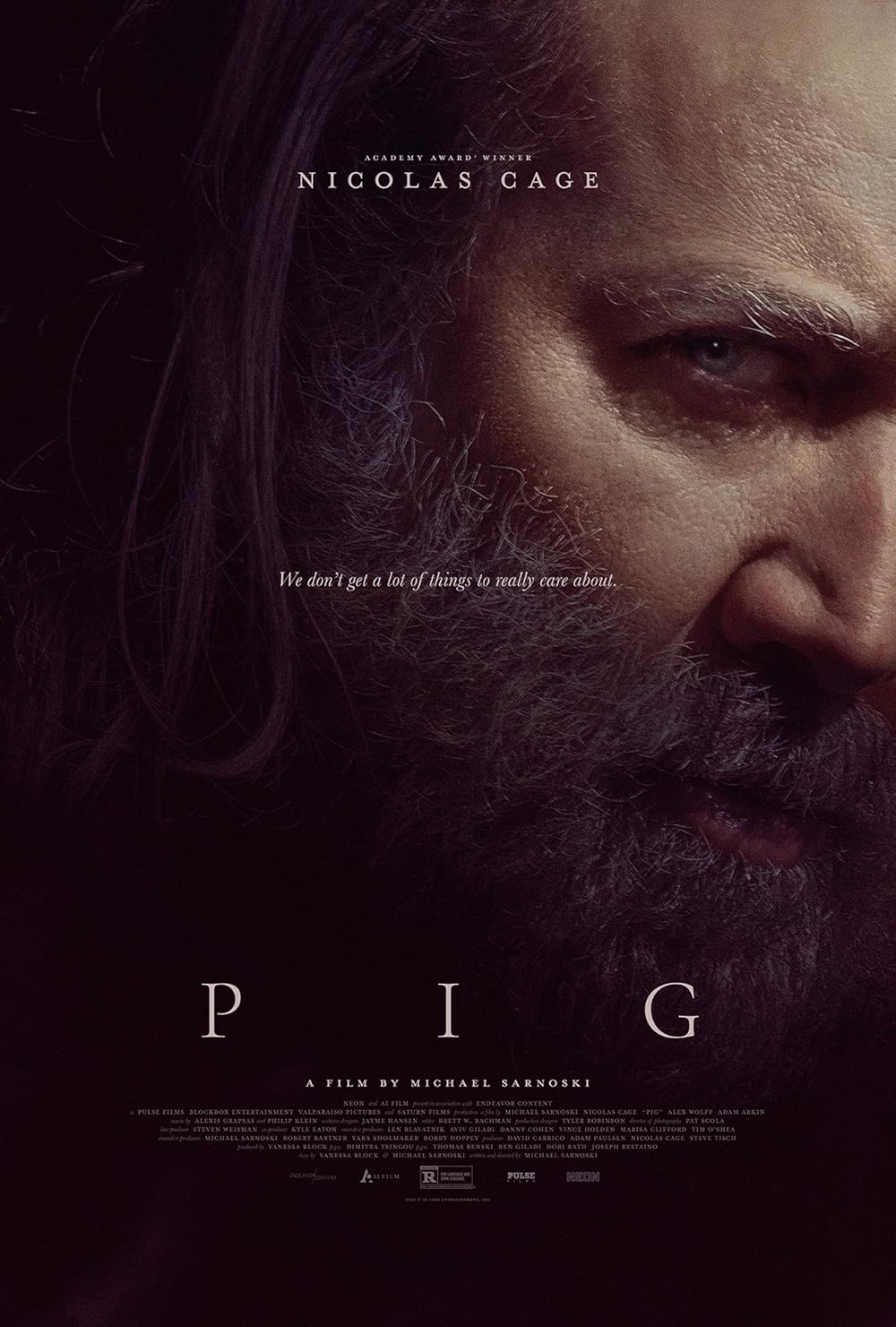
Starring: Nicolas Cage and Alex Wolff
Grade: A-
For the record, Rob doesn’t fuck his pig. He makes that very clear in case you were wondering.
Summary
Part One – Rustic Mushroom Tart
Deep in the forests of Oregon, Robin “Rob” Feld (Nicolas Cage) gets his foraging pig from his cabin, and the two go truffle hunting. Rob uses his knife to test some dirt but doesn’t find anything. Next, the pig walks along ahead of him and finds some, so Rob gives some truffle for the pig to eat as a reward. Back at the cabin, he makes a dish for both of them to eat using the ingredient. The next day, the wealthy Amir (Wolff) pulls up to Rob’s cabin, disrupting Rob’s peace with his sports car and obnoxious personality. After shooing away the pig from his car, he goes over to Rob to pick up a cooler of truffles. He takes one out and sniffs it, excited. He questions if Rob wants a camp shower or a phone installed in his house because he’s worried that he will find Rob dead one day. Not even looking up at Amir, Rob goes back in his cabin and shuts the door. Annoyed, Amir says he will meet him next Thursday, calling him an asshole on top of the reminder. Inside, Rob rummages through his things and finds a tape labeled “For Robin”. Confused, he puts it in his tape deck. It’s the voice of an unknown woman laughing and telling Rob that she’s trying to surprise him. Immediately, he shuts it off. Thinking about it later on, he tells his pig that he’s doing okay. That night, he assures his pig that the noises outside are just coyotes and tells him to go back to sleep. Following this, he puts his knife down and puts his stereo system on his shelf. In the middle of the night, Rob is woken up by his pig making noises at the door. He goes over and calms down the pig. Right after, he walks near the door and two unknown tweakers break in through the front door, attack Rob, and steal the pig. Before falling to the ground, Rob looks out the window to see the truck leave. The next morning, Rob wakes up on the ground and sees that his place his destroyed. His door is open too, held open by a pot. Following this, Rob takes the tarp off his rarely used truck and drives out in search of his beloved pig.
Unfortunately, his truck breaks down soon after driving it, so he ends up walking into town instead.
Upon getting in, he goes straight to a diner and asks for Marge. The waitress reveals Marge died ten years ago. Pivoting, he asks for a phone. Though he confirms he doesn’t plan on ordering anything when she asks, she still lets him use it. Rob calls the only person he can: Amir. Amir honks the horn for Rob to hurry as soon he gets to the parking lot. Once Rob gets inside in the car, Amir notes Rob’s facial wounds from the attack and asks if it hurts. Rob just looks at him. Moving on, Amir details how this isn’t his problem, but Rob lays down the facts. If Amir wants his truffle supply, he needs his pig. With this, Amir has to drive Rob around. They get off to an uneasy start, with Rob turning off an annoying motivational tape Amir is listening to, Amir turning it back on, and this continuing. Sometime after, Amir leads Rob through a forest to meet with another truffle hunter, Mac (Gretchen Corbett). As soon as Amir gets near her, she lets him know that she doesn’t like when buyers come out to the sight. Amir asks if she knows where the couple with the green pickup is, but Rob corrects him and says it was turquoise. Mac notices Rob’s wound but then says that the couple hasn’t been around for a few weeks. She asks what they did, but Amir downplays it as some misunderstanding they have to get figured out. Interrupting again, Rob tells Mac that they took his pig. Once he tells her that it’s a truffle pig, Mac becomes incensed. She has Wicky take over her station and leads Rob and Amir to a trailer where she argues with a couple about digging her sites. Mac outs the two tweakers for poaching by taking Rob’s pig, but they say they don’t even have the pig anymore. They don’t know who has it either. Some man just paid them for it. All they know was that he was wealthy and drove a black car. Back in the car, Amir assumes that this is it and Rob will just find a new pig, but Pig explains that no pig can do what his did. Rob wants Amir to take him into Portland to find this “city guy”. He might know someone who knows the industry.
Amir refuses to take him into the city because that’s where he does his business, so Rob asks if he’s afraid. After vague explanations as to why he can’t and Rob pestering him, Amir concedes and drives him into Portland. Once they get to this specific bar, Rob asks for $10. By himself, Rob walks through and heads to the back where there is some tent outside. There, Edgar (Darius Pierce) sits. Rob gives him some food and asks if he’s heard anything about a pig. Edgar bypasses this and talks about remembering a time where Rob’s name meant something. Today however, he has no value. Amir walks in and sits down behind Rob. Edgar tells Rob he doesn’t exist anymore. He hands the food back, but Rob ignores him and leaves. Amir goes to follow, but Edgar asks Amir if he even knows Rob’s real name. Amir just looks at him and leaves. Rob and Edgar go back to the car. Through Amir’s questioning, Rob reveals that he used to live around there. Amir is actually shocked he knows Edgar. Since he doesn’t have a watch, Rob asks Amir what time it is. After he says it’s 9:15PM, Rob tells him they are waiting until midnight. They go to the back of some restaurant, and a worker named Dave (Sean Gustavus Tarjyoto) pops out. Right away, Amir tries to wait in the distance. Rob details how he needs to get inside and mentions Amir as his friend, prompting Dave to call out Amir. Amir tries to act friendly and refers to Rob as his dad’s Buddhist friend, but Dave stops caring and allows Rob to walk in. Rob walks through the kitchen and into the front, telling a confused Amir they are going to the Hotel Portland. Amir doesn’t think this place exists. In the storage room of the restaurant, Rob refers to Amir as his “ride” and nothing more when he starts complaining, and it leads to Amir flipping out over his rudeness, adding that he would be the only person who would notice if Rob died at this point. As Rob tears some stuff off the shelf, Amir goes to leave, so Rob tries to be nicer and let him on some details. The Hotel Porland was torn down in the 1950s. It’s now the Pioneer Square, but they just covered up this subbasement, so it’s all still there under the park. That’s where they’re going. Since he’s now in the loop a bit more, he helps Rob moves the shelf that’s covering the wall.
They go inside and it leads down a staircase. As they walk down, Rob tells Amir to stay back if anything happens and has him turn off the flashlight on his phone, saying his eyes will adjust. Apparently, Edgar has been running fights for restaurant workers for 30 years. If your name means something, they will bid high. That’s all he sees. It’s at this moment where Amir realizes he doesn’t know Rob like he thought he did. Upon walking in, some guy named Dennis wins $500 beating a guy up in 10 seconds. Edgar tries to announce the next matchup, but Rob interrupts with a whistle that gets everyone’s attention. Him and Edgar stare at each other in silence as Rob writes his name on the cardboard for all to see. It’s written in all caps “ROBIN FELDS”. People start laying down their money. With this, his opponent is chosen and they face off. Putting his hands behind his back, Rob just takes every punch unprotected. He doesn’t fight back. He just takes it until Edgar’s timer goes off. The guy continues after the timer until Edgar whistles, and two guys pull the man off. Amir watches in horror at what just transpired. An injured Rob goes over to Edgar and mentions that he’s looking for his pig. He’s handed an address. Following this, Amir helps Rob back to his place and lays him down on the couch. He gives him a cold compress.
Part Two – Mom’s French Toast & Deconstructed Scallops
The next morning, Rob wakes up to Amir making breakfast in the room for the both of them. He partially burns it and apologizes because he doesn’t cook very much. Rob gives Amir the address Edgar gave him. It’s Finway’s, a popular restaurant Amir knows about. Rob asks him to get a reservation for lunch, so he’s cool with it. Changing the subject, Amir brings up how when he was a kid, his parents used to do a date night thing. It wouldn’t happen a lot because Amir’s dad was always busy. Plus, they would always come back fighting or screaming at each other. His mom would be mopey too. One night however, they all went to one restaurant in particular and they came back so happy. They couldn’t stop talking about the food and wine, and they would reference it years later, even after the huge chef that headed up the place disappeared. He notes how it was Rob’s spot, as Rob was the famous chef who disappeared. Amir points out how people still talk about it. Rob asks what happened to Amir’s mother, and he somberly reveals she killed herself. According to him, it was going to happen eventually just because she was always in a saddened mood. Amir goes on about how his father was tough though, which is why his business is so good. An emotional Rob takes this in and gives him a speech about how life is fleeting and death is the inevitable in the most eloquent, drawn-out way possible and Amir looks at him in awe. Then, Rob gives him the pro tip of using stale bread next time for French toast. Shortly after, Rob looks at a newspaper headline of Amir’s father Darius (Adam Arkin) on the fridge titled Portland’s Own ‘Rare Foods King’. In the bathroom, Amir prepares himself for his sales pitch on truffles, lambasting a woman named Katie and his own father, adding that his father’s supply has usually been in a cooler for three days. Amir then stares at himself in the mirror and calls himself “The King of the Jungle”.
Afterwards, Amir is doing a truffle deal with a butcher while he works and brings up how the man is friends with the sous chef at Finway’s (David Knell). Once the man confirms, Amir asks if he get him a reservation there. The butcher points out how it’s Amir’s dad’s spot, and Amir lies and says his dad knows about it. He explains how he’s not going there for business either. He just has a friend in town. The butcher walks around it by saying how busy they are, so Amir offers half off of his truffle order. Still, the man refuses. However, he stops in his tracks once Amir says his “friend” is Robin Feld.
Despite being gone for so many years, the name Robin Feld still holds a lot of weight as the best chef many in the area have ever come across. However, it means nothing to Rob himself. He just wants his pig back and to be left alone in the forest. Until he gets some answers however, he will not give up.
My Thoughts:
In Michael Sarnoski’s ambitious directorial debut, the unique Pig utilizes the rarely explored on film Pacific Northwest and the world of truffle hunting as its foundation, while star Nicolas Cage captivates in his most subtle and moving performance in years. Exemplifying the emotional complexities of the protagonist in the understated manner the character is written to be, it’s clear Cage possessed a deep understanding of the film’s efficient screenplay and its overwhelming themes of grief, tragedy, love, and loss. In a movie where silence speaks volumes, Pig is a dramatic and unexpectedly poignant experience.
If audiences haven’t tuned in for Nicolas Cage’s acting renaissance of the 2020s, they are missing out. Though I would argue he never lost it, as he makes even the most basic direct-to-streaming film worth watching because he refuses to phone it in for a paycheck (a true actor’s actor), Cage has been on fire to start the decade. A lot of the productions Cage has starred in recently have not been given the wide release they have deserved, but it needs to be acknowledged how great of a run Cage has been on in terms of all-around performances. In Pig, he is grizzly forest dweller Robin Feld. Back in the day, Rob had it all as the top chef in Portland, Oregon. In a world of pretentious restaurant goers, critics, and the hollow members of high-class society, he stood tall as THE guy when it came to food. According to Amir and seen by many of the people they come across, the locals still talk about his work to this very day, which is why his name still carries a lot of weight in food circles. As we see throughout Pig, everyone stares in silence when Rob’s full name is mentioned. He’s a local celebrity, a legend that everyone in the city looks to as a star who represents this part of Portland, similar to how RoboCop is treated in Detroit or a streetball player who played at Rucker Park in the 1970s is treated in Harlem. However, as opposed to most local celebrities, Rob has never wanted nor needed fame. Really, he detests this aspect of his life. When he was a chef, he cooked and made dishes out of love, the art of it. Things like fame or clout never mattered to him. If anything, it disgusted him to the point where he didn’t want to be a part of it anymore. If you’re doing things for reasons other than love or passion, you’re doing it for the wrong reasons. He sees the fakeness in everyone, and the awful and disingenuous behavior that persists in them. This is why he’s so blunt. He calls it as he sees it. Life is too short to waste time with people who don’t want to talk to you or are trying to get something out of you. A lot can sense it or assume it right off the bat, and Rob is one of them. Following years of customer interaction and dealing with the terrible people in the city, Rob has become such a master at it that it has ruined his outlook on humanity itself.
It’s because of his years of experience that Rob doesn’t have patience anymore for what human beings have turned into. In addition, he refuses to conform. He refuses to change for anyone because these people just aren’t real to him. Who is he trying to impress? This is all temporary, life and all. To coincide with this damaging but surprisingly eloquent thought process, Rob retains the same look throughout the entirety of the feature. He retains the facial wounds he suffered from getting beat up at the beginning of the movie by the tweakers, and he keeps the same clothes on the entire time. Though part of this is to stress how relentless he is in his pursuit of his pig, it’s also to remind the audience how little he cares for his outward appearance because it’s meaningless in the grand scheme of things. Rob has fully accepted that he is in the final chapter of his life following the death of his wife. Even so, it’s this all-consuming combination of the grief of losing a loved one, the only thing he loved after her in his pet pig and it being stolen, and his general disgust for humanity that further removes him from everyone to where he’s nearly a foreigner on his own land. To regular people, he’s miserable, old, rude, and uncaring. However, as the narrative reveals more with each scene and interaction, and context is given regarding how Rob became this recluse who use to be on top of the world, you understand why this squealing little animal means more to him than initially realized. Just like in John Wick, it’s not necessarily about his pet being killed. It’s about what the animal represents to him, the story behind it, and what it meant in that specific time in his life. Since his wife passed away, the last connection Rob has made with anyone, or anything was this pig. She was everything to him. He loved her. Part of it can be traced to his feelings for the passing of his wife, as his unresolved grief may have transferred over to the pig’s presence, which is why he has never been able to accept her death. In a way, the crumbs of what was left in his marriage exists with his pet/owner relationship. This is why the climax is as heart-wrenching and revealing as it is, along with its buildup, presentation, and Cage’s magnificent performance. As sad as it is, it’s almost freeing too, for the characters and the viewer. Through the watchful eye of director Michael Sarnoski, he handles the powerful material delicately but gets everything he wants out of it without having to stab the heart. Really, it’s the work of a storyteller beyond his years.
Rob never got a chance to come to that level of acceptance to move on with his life, which is why he’s been living in perpetual misery ever since, projecting these feelings onto these city people without understanding their stories. At first, he’s just as rude to Amir as he is with everyone else because he assumes he knows who Amir is and what he’s about. Rob sees the fancy car, the clothes, the wannabe attitude, and his wanting more in his career to satisfy his ego. It’s why he sees Amir as just another one of “them”. Early on, it’s why Rob only sees Amir as a ride around town since Amir is his only real contact to the outside world. To make sure he helps, Rob forces his hand. If he wants Rob’s truffle supply, he has to drive him. It’s not until Amir demands to be let in on details where Rob loosens up a bit. Following this, Amir loosens up as well, especially once he sees Rob go through an underground fight club for restaurant workers and takes every last punch just to get information in a wild scene. The next morning, they seem closer. There is a chemistry building. They aren’t necessarily friends just yet, but there is something resembling a friendship or a mutual understanding building. In a telling moment where Rob realizes Amir is more of a sympathetic person that he gave him credit for, Amir talks about the difficulties of his parents’ marriage before his mother killed herself over breakfast. It pains him to reveal this, especially when we find out the truth later on in the film, but the fact that he’s willing to share this information with Rob because his work meant more to Amir than they BOTH realized is a cool moment. In a way, they have had a deep connection for years without ever knowing it, and the subtleness of Alex Wolff’s performance cannot be praised enough. It may go under the radar with how much Cage’s commands the screen, but Wolff is fantastic at being able to trick the audience into thinking he’s this typical douchebag, showy, salesman character that is some prick brought along for comedic effect to play off of Rob’s seriousness, but you will soon realize that this would be discrediting Pig‘s efforts as a whole if you really thought that THIS was what the movie was about. It’s not a buddy picture. It has those elements and there is humor because of their difference in personalities, but it’s a mere 10% of why things happen as they do.
The two characters and their connection go much deeper than that and learning more about Amir lets us in on his naked self. The flashy salesman is actually inexperienced and is nowhere near as slick and cutthroat as he portrays himself to be. As time moves on, the cracks of his persona start to show. Due to his relationship with his business-minded father Darius, Amir has a severe lack of confidence, which is why he has to listen to motivational tapes and tell Rob that he doesn’t need his dad’s help twice over lunch. Behind closed doors, he is a vulnerable, scared kid trying to put on a front to look tough and become the businessman his father will want to work with some day. He begins the movie as this douchebag you want to look past, but by the end, the viewer wants to put a hand on his shoulder to tell him that it’s okay and he doesn’t need his prick of a dad to be successful. The scene at Amir’s place where he lets Rob in on his early life and how they connect to Rob’s old restaurant also serves as a great way to plant the seeds of how terrible of a person Amir’s dad really is, something Amir downplays a lot but the carefully chosen verbiage and physical cues he uses makes it obvious. At Finway’s restaurant Eurydice, this slow burn of a friendship continues, with Amir telling Rob right away how they aren’t supposed to be there because he’s not supposed to step on his dad’s sales. Rob questions why he doesn’t work for his dad to begin with, but Amir explains that he will once he’s more established, which is clearly the decision of his father. Not losing his blunt style while feeling comfortable enough to be honest with Amir knowing what they know about each other, Rob comments how his dad sounds terrible before sticking his thumb in the food on the plate. Amir gets defensive and sarcastically says they can’t all live in the woods, but Rob doubles down and just says that he’s doesn’t sound very supportive. It’s Rob bringing people back to reality when they need it most, his strongest quality. Amir can tell himself all he wants that he’s sure his dad knows he can make it on his own, but sometimes, we need someone to call a spade a spade. His dad is an asshole (“I control myself very well, but I don’t think you understand what I am”). For the record, Adam Arkin’s Darius does a better job at being a nasty villain in limited screentime than Esai Morales did as Gabriel in Mission: Impossible – Dead Reckoning Part One or in Mission: Impossible – The Final Reckoning.
It just goes to show you that a massive budget doesn’t matter in creating an antagonist that makes the viewer seethe. In addition, his unexpected counter to Rob asking if he was always like this or did it just happen after his wife died, to where Darius asks him the same thing was genius too. It’s another great example of how carefully crafted this screenplay is, showing how one event can send two people on such staunchly different paths in life and in mindsets moving forward.
Rob doesn’t see himself as being an angelic figure doing “God’s work” or anything. It’s just Rob being Rob. He’s not Amir’s angel on the shoulder. He just has no patience for the bullshit, calling it how he sees it before moving on. Rob doesn’t do it to benefit himself. He’s just over it because of everything he’s experienced in his own life and the trauma he’s been through, and he doesn’t want to waste another moment being in fake places or speaking with fake people any longer. It happens when he talks with Darius, and Darius just goes on about how Amir can’t handle this business and he’ll be fine with a desk job. Rob doesn’t defend Amir because it doesn’t matter. He straight-up tells Darius he doesn’t care. He just wants the pig back. That’s Rob. Somewhere in the midpoint, Amir unofficially wins Rob over somewhat, but Rob responds in this way at Eurydice because he sees this awfulness in Amir’s father without ever meeting the guy. When he does meet Darius, he’s vindicated and Amir’s eyes are opened to it. Regardless, Rob’s approach happens with anyone he deems necessary to talk to longer than the given amount. In the extended sequence in Eurydice, he interrogates Chef Derek Finway about the whereabouts of his pig after having the waitress bring him out. After Finway walks around Rob’s direct line of questioning, talking about how he always respected Rob, how there are high expectations for his restaurant, and truffles are a big part of the winter menu, Rob tries a different approach. He changes the subject to ask what the concept of the restaurant is. Biting, Finway gives this pretentious response of taking local ingredients of the region and deconstructing them to make the “familiar feel foreign, giving us a greater appreciation for the food as a whole”. Rob gets real with him and asks if this really is the kind of cooking he likes. Finway’s immediate response is “It’s cutting edge, very exciting, everybody loves it!”. It’s this exchange specifically that shows how great this script is in depicting the fakeness of everyday conversation. Rob asks for a straight answer of if he likes cooking this stuff, and Finway responds by walking around it and talking about how everyone else loves it. It’s not until Rob asks the same question again where Finway confirms he does. Rob senses the facade instantly, and the viewer picks up on it too with Finway’s overt enthusiasm.
It just screams of bullshit. Where is the real person? He’s hiding somewhere in there, and Rob knows how to get him out.
In the best scene of the movie, Rob reminds Finway how he used to talk about opening an English pub when Finway used to work for Rob. Finway tries to deflect to talk about how successful his current restaurant is, but Rob presses on and asks why he didn’t go through with it. When he continues, Finway finally cracks, admitting it’s a terrible investment and nobody in Portland wants pubs there. Keeping him going, Rob asks what his signature dish would have been and Finway responds without hesitation, “Liver scotch eggs with a honey curry mustard” to the point where he starts laughing anxiously. Finway doesn’t know how to handle this shock to reality Rob gave him and how he gave up on his dreams to be looked at as a success. Clearly, it still eats at him every day considering how quickly he was able to rattle these details off when Rob brings it up, and it probably kills him to put on this metaphorical mask to act like this is what he wanted. To close out the scene, Rob hits him with a knockout punch of reality, the one he lives in and people are afraid to embrace. Like an unflinching stake to the heart, Cage delivers this monologue with such conviction, the audience laughs nervously just like Finway because they’re not ready for this truth either. “They’re not real. You get that, right? None of it is real. The critics aren’t real, the customers aren’t real, because this isn’t real. You aren’t real. Why do you care about these people? They don’t care about you. None of them. They don’t even know you because you haven’t shown them. Every day, you’ll wake up and there will be less of you, and you live your life for them, and they don’t even see you. You don’t even see yourself”. Robin’s honesty in pointing out how we don’t get a lot of things to really care about in life and how Finway is wasting it for people who could care less if he lives or dies is a hard-hitting truth that brings tears to his eyes. Nevertheless, that’s Rob. He saw a bright-eyed dreamer that used to work under him (until Rob fired him for constantly overcooking the pasta), and now he sees another person who wasted their meaning AND life goals to appease people who don’t matter. This is what’s wrong with today’s culture. This is the fundamental aspect of everyday society that Rob cannot stand to live in anymore, which is why he secluded himself in the forests of Oregon and has every intention of making it back there once this is all over.
… But first, where’s the pig?
Though we know the story won’t pick up until Portland comes into play, it’s important to set up the life Rob lives to open of the film to really capture the solitude of the forest. With just his pet pig to interact with, Rob is content. It’s not that he’s beaming with happiness living in the woods or anything, but he would much rather remove himself entirely from society instead of interacting with these terrible people who are all out for themselves. There aren’t neighbors in sight nor visitors. He makes his living by selling truffles to Amir and goes right back into the house, living in his cabin with his pig and enjoying his seclusion in the forest. In certain instances regarding the forest sequences, there is an authentic and delicate beauty behind watching a muted Nicolas Cage interact with his environment. Magnified by a warm and inviting score and Pat Scola’s surreal capturing of the Oregon forest, there is a newfound beauty in scenery that the viewer begins to value, just as Rob does. It’s the autumn look, the serene sounds of the water and wind, and the appearance of nature at its finest that is strikingly captured in its small instances, combined with Rob existing in his element, that bring out this love and appreciation for the protagonist’s perspective in contrast with what the city has given him. Seeing him at peace brings the viewer peace. This is why the finale is such a hair-raising, mesmerizing sequence where Rob heads back and sits on his bed in a moment of somber acceptance. It’s as if everything was leading to this one, simplistic, nearly silent moment, but it means the world to this character in-context.
Pig isn’t devoid of humor either. Rob looking like a crazy homeless guy stealing a bike off a kid’s porch and screaming at the kid when he tries to get up because he’s focused on his mission was hilarious. On a side note, the scene with the other kid at Rob’s old house was a fun idea, but it may have been the only thing I would have left out as it was visually jarring, and it was just hard to believe the kid would not have ran away in terror at Rob’s general appearance. Even if the persimmon tree had something to do with his connection to his past life, it didn’t feel significant enough leave in the final cut nor necessary in telling all facets of the story.
Part of Rob’s acceptance was seeing Helen’s bakery. He saw the changes, and it was like he was sent through a time machine. Still, there is this muted reaction Rob has to it all that has a different energy about it, as if he’s smiling and giving her the greenlight without actually doing it. It’s something only a true actor can pull off. It’s this aura and slight look Cage gives that speaks volumes, along with a simple, yet earnest delivery about how he liked her idea of getting rid of the curtains. It’s seen again in the cooking sequence when Rob acts as the father Amir never had in showing him how to prepare their dinner. Rob’s passion and love for the art of cooking exudes through action. He doesn’t need to smile or laugh to show it. Instead, Rob expresses his passion with how serious he goes through his preparation. He cares deeply for what he does, and it translates well in his performance, along with excellent use of some folksy music to accompany it. Part Three – A Bird, a Bottle, & a Salted Baguette may be melancholic in its events, but there is a silver lining to it all that makes Pig the experience that it is. Despite all that happens and everything Robin goes through, there’s this final conversation he has with Amir outside of a diner. Following their up and down journey and the rollercoaster they have been on together, Amir asks if he’s okay. Rob pauses for a moment, but then responds “Yeah”, delivered in this subtle way where it’s like we can finally feel that Rob has been relieved of the mental burden he has carried throughout the entire story. Again, there is power in the silence of this production. For people that try to criticize Nicolas Cage and say all his performances are over-the-top, there is no doubt they have never seen nor understood Pig.
You know what? I think I want to walk home now too.
Michael Sarnoski’s Pig uses a barebones premise and a compelling protagonist to take the audience on a dramatic journey that explores tragedy, trauma, and greed, as well as it champions love, care, and kindness. The film may not be what the viewer is expecting if they walk into it blindly, as the premise sounds like a setup for an action movie. Be that as it may, for those struggling with loss, heartbreak, or are looking for the other end of the tunnel in spite of it all, a film like Pig showcases the journey of these stages in quite the idiosyncratic way, leaving the viewer sitting in silence by the time the credits roll.


+ There are no comments
Add yours