
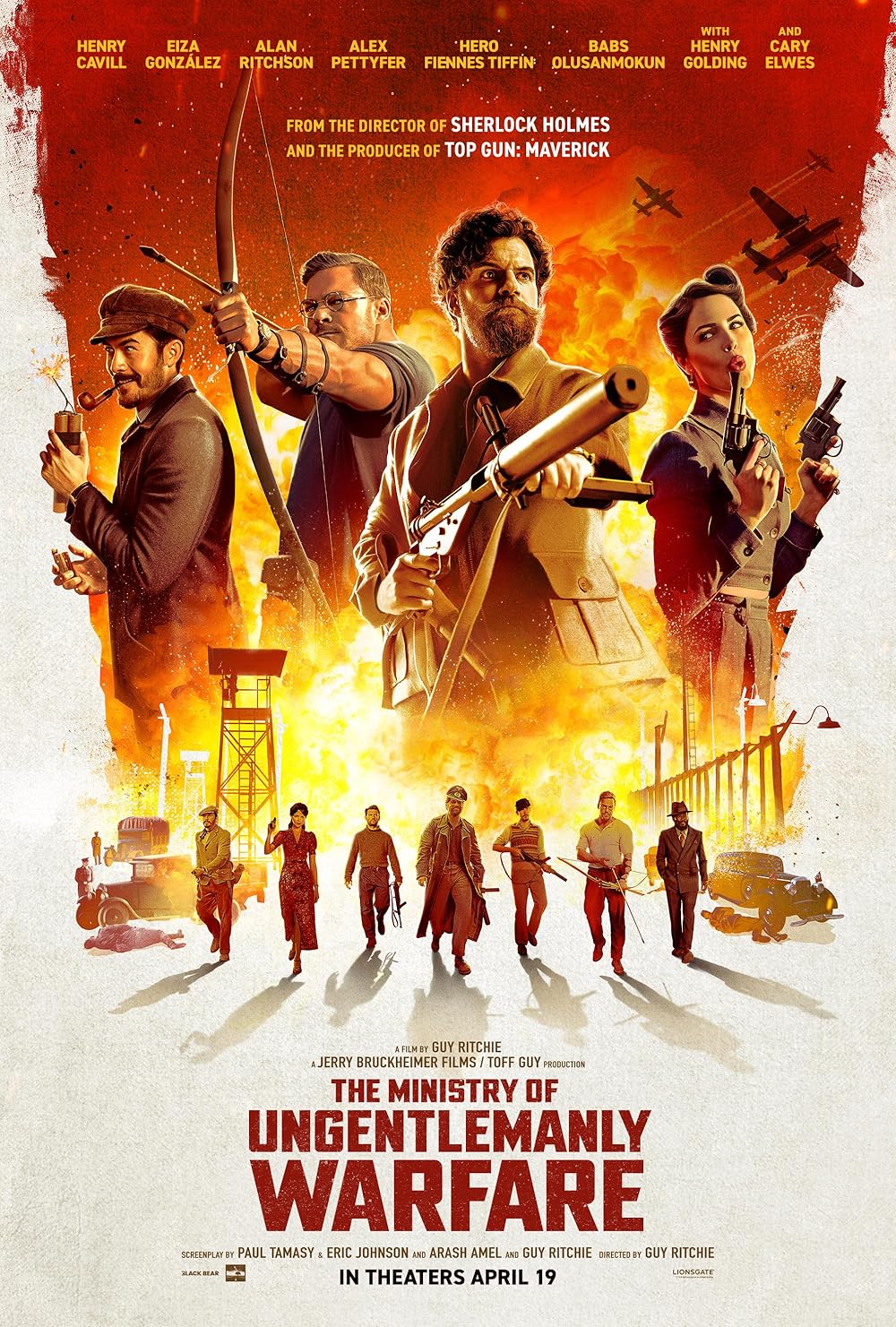
Starring: Henry Cavill, Alan Ritchson, Eiza González, Henry Golding, Cary Elwes, and Alex Pettyfer
Grade: C+
Who would have thought that we would get to thank a man named “Apple” for crippling Hitler’s Atlantic fleet of U-boats?
Summary
To open things, it is said that the basis for the story was taken from Winston Churchill’s confidential files declassified in 2016.
In the Nazi controlled waters of the Atlantic Ocean in 1942, Gus March-Phillips (Cavill) and Anders Lassen (Ritchson) are on a boat boarded by Nazi officers. Anders invites them to search the ship, and Gus explains that they are only there to sail, nothing more. After giving the officer their papers and passports, they confirm there is no one else on board. Anders tries to be friendly with the officer, but the man only gets angrier and has everyone point their guns at him and Gus. They start laughing at the officers, and it eases the tension. The officer is still mad though because this happens to him a lot, and he has his soldiers douse the boat in lighter fluid. He gives them the chance to either swim to shore or take their chances on the boat. Eventually, Henry Hayes (Hero Fiennes Tiffin) is discovered hiding in the cabin below and he uses the opportunity to start shooting Nazis. The distraction below allows for Gus and Anders to kill everyone else on deck until Henry joins them. They look over at the Nazi warship nearby and taunt them by using the officer’s dead body to wave at them, prompting the Nazis to fire from their cannons and miss. Freddy Alvarez (Golding) pops out of the water and assures them things are cool because he already rigged the Nazi ship with explosives. Though the Nazis do get another shot off from their cannons, the entire ship blows up seconds after.
25 days earlier, Winston Churchill (Rory Kinnear) shows a newsreel to his advisors updating them on the Nazis doing major damage as of late. After shutting it off, Churchill details his plan. The Germans cut off their supply chain with U-boats, so they are to cut off the supply chain to the U-boats. Through their intelligence agents, they have found a way. The entire servicing, repairing, and rearming of Hitler’s Atlantic U-boat fleet is operated by two Nazi tugboats Bibundi and Likomba, and an Italian supply ship in Fernando Po, Duchessa d’Aosta. He needs men who are willing to sink those ships. They can’t air-raid Fernando Po to sink the ships because the Germans have positioned themselves in a Spanish colony, as Fernando Po is a neutral territory. If they attack the colony, the rest of unoccupied Europe will join the Nazis. With this in mind, Churchill makes it clear they will not be playing by the rules. This mission is unsanctioned, unauthorized, and unofficial. If they are captured by the British, they will be thrown in jail. If the Nazis find them, it will be torture and death. Brigadier Gubbins (Elwes) says he has just the man to lead them in Gus, though he’s currently incarcerated in London at the Special Operations Executive HQ. Sometime after, Gubbins is speaking with Marjorie Stewart (González), Richard Heron (Babs Olusanmokun), and Lt. Commander and future creator of the James Bond franchise in Ian Fleming (Freddie Fox) about who Gus is, commenting how he has a bad attitude, he’s bold, he’s a killer, and he has great leadership skills. Marjorie and Heron aren’t sure how good of an idea this is, but they are all desperate. Gus is brought in to meet with them all. Gubbins comments how Fleming used to be at naval intelligence, but he works for Gubbins now. After Gubbins mentions the basics of Gus leading a team, he invites Gus to have a cup of tea. Instead, Gus pours himself up some scotch from Gubbins’s collection while pointing out how unpopular he is with the current administration. Still, Gubbins says it’s precisely why he’s the right man to lead this mission. It’s Operation Postmaster, an effort to neutralize the German U-boats in the North Atlantic. The U-boats need fuel, torpedoes, and carbon dioxide filters. Without them, they can’t dive or hunt.
The target is the Duchessa a’Aosta, an Italian ship the Germans have been using to refuel, rearm, and replenish CO2 filters for the entire fleet. She’s hidden off the coast of West Africa in Fernando Po. They want Gus to lead the team to sink her.
As Fleming is stating the second half of the mission to him, Gus steals a box of matches, a cigar, and a lighter before dragging his seat to the other side of the room to sit down in front of them. As he sips on the scotch, Fleming says they will be posing as fishermen sailing the west coast on board a trawler with explosives to destroy the Duchessa. Gubbins introduces Marjorie and Heron as the two who will be working undercover on the island. Heron is already established on the island, as he runs several businesses like a casino bar. Heron says that high-ranking Nazis are his most valued clients. Marjorie is an actress and singer and has been training with them for two years. She will be posing as a gold trader from New York. Her mission is to seduce and distract the island’s commanding officer Heinrich Luhr (Til Schweiger). She’s motivated too, as her mother’s side of the family were German Jews and “were the first to go”. They have 44 days until the Nazis move their operation. They won’t find them again, so they can’t waste this opportunity. With this, Gus wants to put together his team. He knows who he wants, but he does describe them all as “mad”. Gubbins admits they need to be and asks for their names. First is Irishman Henry Hayes, a smart young man who hates the Nazis because his older brother, who was a friend of Gus, drowned after a U-boat sank his fishing trawler. Gus has taken him under his wing ever since and describes Henry as cunning, quiet, and wily. He’s also a magnificent sailor and Gus trusts him. If they plan on sinking a ship, they’ll also need frogman Freddy “The Buzz” Alvarez. Gus says he can swim across the channel with his feet tied together, though he’s a convicted arsonist and a “terrible misery” unless he’s destroying something. Still, he’s very good at blowing things up. Next, they’ll need the “Danish Hammer”, Anders Lassen. He grew up wrestling bears and hunting elk on his family estate. He’s a legend with a bowie knife and a bow and arrow. He ran away at 18 to fight the Nazis after the Gestapo tortured his brother to death, turning up on their shores to fight alongside them. According to Gus, Anders is an uncontrollable mad dog with 100 creative ways to kill a man.
Lastly, Gus wants Geoffrey Appleyard (Pettyfer). Fleming isn’t surprised Gus mentions him, which is why they sent Apple on a reconnaissance mission to Fernando Po. Unfortunately, the Nazis nabbed him on his return. Even so, Gus sees this as all the more reason since Apple knows what they need to know. Apple is a master planner, a master survivor, a chess grandmaster, and a surgeon with a blade. They spent two weeks together in a Dunkirk foxhole. If it wasn’t for Apple, Gus would still be there today. Gus says if Apple isn’t on his team, there will be no mission. Despite this, Gubbins says this is impossible because Apple is being held by an entire German garrison on the island of La Palma. Gus cheekily replies that La Palma is on the way. Gubbins thinks this is insanity, but Gus says to let him worry about that. Looking at Gubbins and Fleming, Gus also notes how he wants to get a coat like theirs. Following this, Gus walks out with the coat on, lights a cigar, and offers another to one of the guards. When the one reaches for it, Gus pulls it away and laughs, walking off.
The story shifts back to the opening after the explosion Freddy set off in the Atlantic Ocean. They are only 18 days away from reaching Fernando Po. Now, Gus tells his crew of Landers, Freddy, and Henry what they are all doing there. Below the deck, Gus tells them how this is an unofficial mission and how they will be in trouble if the Germans or British pick them up. He adds that Apple is the final piece to their crew, as he’s responsible for securing this information. However, he reiterates that he’s being held by the Germans in La Palma. Their first part of the mission is to save him. Regarding Marjorie and Heron, Gus tells his crew that those two are heading towards Fernando Po now to confirm the ships are filled with supplies, so they know they’re worth blowing up. In the Nazi controlled Cote D’Ivoire in West Africa, Marjorie and Heron travel by train. After they order food, they observe some drunken Nazi soldiers sitting at their own table talking. When one finally puts his briefcase on the ground next to his seat, Heron cues Marjorie. She walks down the aisle towards them. One soldier approaches her and tries to flirt. During the conversation, she drops her trick briefcase on top of the Nazi one, as it’s an open cover mechanism designed to scoop it up. Once the superior officer tells the men to leave Marjorie alone, she walks past them. However, the officer stops her by telling her a crime has been committed involving her suitcase: a lady must never carry her own baggage. He tries to be gentlemanly and offers to take her bag for her, but Heron steps in and takes it off her hands. He accepts this and allows for them to go to their cabin. They lock the door behind them. Marjorie opens the suitcase and looks through the materials inside. At the same time, Heron calls Special Operations Executive HQ in London to get a hold of Gubbins. Marjorie goes through the Duchessa‘s manifest and spouts off each item on the list to Heron who sends it to HQ for Gubbins to confirm. There are 400 B-grade torpedoes, 5,000 tons of diesel, and 10,000 carbon dioxide filters. Gubbins sends the information to Fleming while Marjorie and Heron pack their things up before exiting the cabin. They walk back into the food car and Marjorie distracts the German officer by thanking him. This allows Heron to use the trick briefcase to drop the Nazi briefcase right where it initially was after he feigns tripping near them. Like clockwork, Heron and Marjorie sit down just in time for their food to arrive.
In Chequers at the Prime Minister’s War Room, Viscount Algeron (James Wilby) details to Churchill how Adolph Hitler has made them an offer, but they must step down their army, surrender their Navy, and accept Nazi rule. Otherwise, he promises total destruction of Britain and her empire. He suggests they take the deal while they can, and the Air Marshal agrees because Hitler has more men, bombs, and machines. They won’t survive much longer. Even so, Churchill refuses. Had they have been able to achieve peace through surrender, they would have done it already. Surrendering to Hitler will do no such thing. Churchill knows they need the Americans, but they will never enter the war if they already appear to be on the losing side. Though the rest of his advisors still press him to concede to the Nazis, he refuses and dismisses them. Following this, Churchill meets with Gubbins and Fleming. Gubbins has the manifest and confirms the Duchessa is fully laden with supplies to keep the U-boats operational indefinitely. If they are going to sink her, now is the time. Gus’s team is on their way. If anyone can do it, it’s them. With that being said, Gubbins tells Churchill that if they’re discovered, parliament will remove him from office. Churchill knows this and just says they better hope they aren’t discovered. In La Palma in the Canary Islands, Gus and his team sail nearby. Gus details the plan to them for the night raid. They may face around 50-60 men, but none of them are intimidated in the slightest, with Gus commenting that it gives them all 15 kills each. In the day, they discreetly sail to the shores of La Palma and hide near the camp while Gus looks through binoculars to see what they’re dealing with. He sees the Gestapo arrive, so Freddy assumes they could be there for either torture or extraction. If it’s extraction, Gus is sure they’ll never see Apple again. Because of this, they may have to go in earlier than expected. Just as he says this, two wandering Nazi soldiers spot the group. Anders shoots them both with arrows. After he reveals himself from the bushes, Anders comments that he’s already killed two others. Gus realizes they have less than 7 minutes before those soldiers are missed. Taking matters into his own hands, Anders starts shooting down more Nazis with arrows, so Gus just has Freddy help with the fence. They grab their guns and head into the camp.
Gus has Henry go with him, and Anders goes with Freddy in the other direction. While remaining stealthy, the two groups start killing Nazis left and right all over the camp until Anders blows up the inside of one area with a grenade, alerting the camp of their presence. Freddy also gets control of the big machine gun in the center of the compound and takes out everyone who starts running out of the buildings. After Gus steals a stylish Gestapo uniform to wear, Anders enters the building where Apple is being held. He takes out everyone inside and cuts out the last guy’s heart. Gus enters right after and greets Apple. The others follow. Following Freddy noting the condition of Apple’s bloody nipples from the torture, Apple asks for them to unplug him, as he was being electrocuted by a car battery throughout this entire sequence. Gus, Anders, Freddy, Henry, and Apple all head out. Once they get to the outskirts, they blow up the entire compound. At Fernando Po in the Santa Isabel Harbor, Marjorie and Heron arrive. Heron points out how all the Nazi soldiers in town, the guns, and the S-boats are all new. It was much more than they planned for. She thinks they will need more help, so he says to leave that to him. Right now, her focus is on Heinrich, a man Heron says is worse than a Nazi. As he says this, Heinrich is spotted by the two leaving a building following a gunshot with blood on his shirt. When he wipes up his hands, he laughs manically. Following this, Heron and Majorie are brought into Heinrich’s office where Heinrich comments how he’s disappointed in Heron because he saw 16 crates in his warehouse that haven’t been shipped to the mainland yet. Heron assures him they will be delivered by the agreed date, but Heinrich is annoyed because it still takes up valuable space. For this, he expects a significant reduction in his fee. Heron says he can do 5% as a gesture of good will, but Heinrich wants it to be 20% and refuses to haggle further. Marjorie interrupts to say 5% is more than polite considering there hasn’t been a breach in contract in the first place. Following some back and forth, Heron says that Marjorie is the gold contact from New York he told Heinrich about.
Even so, Heinrich says he already has a “satisfying arrangement”, though he invites them both to have a seat. He puts on some music, they share a drink, and Marjorie impresses with an excerpt from a story she recites in German, which Heinrich finishes.
Heinrich asks how much gold Marjorie wishes to move, so she says as much as he can find. Even so, Heinrich reiterates how he already has a very profitable arrangement and prides himself on keeping harmony. He wonders why he should entertain her offer, so she tells him that he will make a lot of money and will have fun while doing so. She also says that if she doesn’t make good on her word, he doesn’t have to pay her. He considers it and sends them on their way. Privately to his soldier, he admits Marjorie is smart but thinks she’s possibly too smart, as he chuckles. Marjorie and Heron walk by a random building nearby and see a naked man inside, tied up and beaten. A visibly shook Marjorie tries to light her cigarette after while Heron gives her props for how she handled herself with Heinrich. He helps her light it before adding that he will make sure the harbor is empty when the boys arrive. To do that, he will throw a costume party at his club for the officers and a second party at the dock for the soldiers. Everyone likes Heron’s parties except Heinrich. Of course, that will be where Marjorie slides in. Now, it’s 15 days to Fernando Po for Gus and his crew. Apple is getting his bearings on the details of the mission. Looking at the map, he mentions how they’re sailing alongside La Palma currently, and they will sail around German-controlled Africa and to Fernando Po, just north of the equator. This is the shortest route possible according to Apple or rather the best route because the goal is to not be seen. Henry comments that their goal is not to be seen “again”, prompting Apple to ask Gus what he’s on about. Gus downplays it and mentions Apple’s nipples being attached to a car battery to change the subject. Apple chalks it up to bad intelligence but say it was worth it to watch the “heart-snatcher” at work, meaning Anders. Anders jokes he’s more of a lover than a fighter. Then, he messes around by saying Henry wouldn’t have to worry about his sexual advances, but Freddy might. They go back and forth until Apple corrects the course of the conversation by saying the longer route is what they will be taking to get to Fernando Po. They will be there in 15 days, and Gus agrees with the decision.
The plan is in effect. Unfortunately, they will soon find out that their window has shrunk by three days because of a change in circumstances and more Nazis being unexpectedly brought to the island. With time running out and the opportunity potentially closing with a new caveat seemingly added daily, this mission is in even more jeopardy than they initially realized. It will take serious improvisation to figure it out. Thankfully, our heroic undercover team is up to the task.
My Thoughts:
Over the last five years or so, Guy Ritchie’s most impressive trait has been his ability to get so many of his productions greenlit while his contemporaries struggle to get their passion projects off the ground. Though painfully derivative of his own work with each subsequent film, the director is consistently working and deserves credit for pulling this off at the very least. Even so, the passively entertaining The Ministry of Ungentlemanly Warfare is ultimately a disappointing, paint-by-numbers, team-up action comedy that was nowhere near as good as the promotional material suggested.
For a movie based on a true story and features a protagonist who is looked at as the real-life inspiration for James Bond since he crossed paths with future author Ian Fleming (who plays a role in the movie no less), something with higher stakes or suspense would have made sense. All the ingredients are there to make this something special. The team-up war picture is one of the most underrated subgenres of the action film, World War II as a backdrop makes any movie instantly exciting, Guy Ritchie being behind the scenes virtually guarantees an entertaining blend of action and comedy, Henry Cavill is charismatic, funny, and ultra-cool as Gus March-Phillips, star-on-the-rise Alan Ritchson plays to his strengths as an action star with quirky humor, and Eiza González and Henry Golding are always a treat to watch even if their casting doesn’t make any sense from a historical standpoint. Despite all of these great things it has going for it, we’ve seen this type of movie done better and about a hundred times over. The one the thing The Ministry of Ungentlemanly Warfare had to differentiate itself from its similarly themed films was that it was rooted in fact, but they blow it by underserving its story AND its calling cards that were a big part of its selling points. Even though it is based on a real death-defying mission, it’s mishandled enough to where it still feels like an inauthentic, B-movie war film. On top of that, it never feels “death-defying” in the slightest. To an almost comical degree, we are constantly reminded in the first half of the movie that the mission is unofficial and unauthorized, and Gus’s team will either be jailed by the good guys or tortured and killed by the bad guys if they are caught. On paper, this alone should make their mission that much more difficult AND invigorating as a result because of the near impossibility of blowing up a massive ship while near a Nazi-infested island. However, Guy Ritchie’s incessant focus on his own style of screenwriting filled with ironic humor and deadpan quotes that it keeps the viewer in such a passive, lazy state that none of these characters seem like they are in any real danger. Even in the darkest of moments, Gus barely flinches or blinks when they are being shot at by a thousand soldiers on the harbor. Barney Ross from The Expendables wouldn’t even react like that, but Gus is apparently too cool to show any type of weakness. He just calmly takes cover. How is the audience supposed to act like they’re in trouble if the protagonist reacts like this to gunfire AT ALL TIMES?
Considering how Gubbins and Churchill himself stress the importance of taking out Hitler’s Atlantic fleet with this potential attack of the Duchessa and how its failure could lead to Churchill’s removal from office, the audience should be biting their nails hoping for the heroes to pull off this masterful plan. With added twists here and there like the boat being reinforced and a slight change of plans having to be made under the gun because they’re too far in, the viewer should still be at the edge of their seat hoping that Gus’s team will pull off the impossible. Even if history buffs are aware of the outcome, the mark of a good storyteller is still being able to have an audience suspend their disbelief and engage with the narrative whether it is based on fact or not. Nevertheless, The Ministry of Ungentlemanly Warfare has an astounding lack of suspense. The characters are so cool under pressure that it becomes maddening, teetering on the edge of boredom. Things happen too smoothly. Even when there is an added wrinkle in their plans, there is an immediate reaction that saves the moment like Heron getting caught planting the bomb. First of all, for an experienced spy, him leaving the door open to the machinery area made him look like a moron because it’s like he was asking for trouble. Then, when we finally think the team of heroes are going to face a serious problem with his capture, Heron dispatches all of them and everything continues to stay on track. They are so well prepared that the excitement surrounding the gravity of the events are almost removed entirely. Even the climax is a mixed bag. For the concise as well as confined action sequences of Apple and Adebayo shooting incoming sailors and Anders mopping the floor with everyone else in the boat with an axe (“I hope that’s not your blood Lassen” – “I hope so too”), they film Cavill as if he’s some 60-year-old star actor that refuses to look weak, despite not being physically capable of being the action hero he once was. If you’re a fan of action cinema, you know the movie stars we’re referring to. It’s not that Cavill was asking for it either, it’s just that this is the way they portray the character. All of his action sequences and shootout scenes involve him nonchalantly walking outside and killing every person with one shot and making amusing comments as he does it.
He takes little to no damage whatsoever and might not even break a sweat while doing so. Even when Henry gets shot in the shoulder, it’s played for laughs and there’s not a single viewer who will be remotely affected by his potential demise if it were come to fruition, mostly because we know for a fact that he will be fine. On the other end of it, they even botch the slow burn of Heinrich’s inevitable figuring out of Marjorie, which SHOULD have been the most terrifying part of the story but instead treads water until the good guys manage to get out of it completely unscathed. It’s like Ritchie was too scared to go deeper or more intense with the subject matter, despite dealing with the subject of World War II and Nazi villains. Actually, this is another major gripe with the film as a whole. Going along with the movie hammering home certain lines to stress the importance and daring nature of the mission but still failing to make the audience believe in the words because of its lack of suspense, Heinrich Luhr is described as being “worse than a Nazi” by Heron. With a description like that, one would assume that Heinrich is an absolute menace that scares others on the island with a mere look. However, Ritchie’s penchant for silliness and having Marjorie hold the upper hand in their back-and-forth in every single scene they share together makes Heinrich 1/10th of what he should be and needs to be for this movie. He is never allowed to be this monster they are all supposed to be worried about and never has the moment that defines him as a threat. The story is all about everyone else in the ensemble, but the sole antagonist that could ruin their plans doesn’t have a single scene in which he demonstrates how much of a savage he can be. Just one of Anders Lassen’s action sequences where he brutally murders a bunch of Nazis with a blade could have easily been given to Heinrich to shock the audience to the horrors he brings to the table. Him just vaguely washing his hands of blood, Heron talking about how bad he is, or Heinrich responding carefully to Marjorie because he’s not sure if he trusts her or not doesn’t turn the character into the all-encompassing threat he needs to be, or they act like he is.
There needed to be a scene where a group of soldiers or citizens of Fernando Po are rounded up for doing something against the Nazi party or whatever, and he just slaughters them without question. Even if the place is a neutral territory, he can just add to it by forcefully telling his subordinates to clean it all up and make it quiet or something. They could pile onto this by having Heron and Marjorie be in the room with him but not being able to do anything because it would blow their cover too early in the mission. Just like that, Heinrich Luhr fits the description of “worse than a Nazi” much more because we are privy to him at his most dastardly. As it stands however, Anders Lassen kills more people with a smile on his face than the villain does and even cuts out a man’s heart for fun. Do you see where the disconnect lies? Having this evil and intelligent opponent played like a fool by Marjorie from start to finish sans for a 2-minute period in the climax only fuels the biggest problem of The Ministry of Ungentlemanly Warfare in that the audience never sees the characters as being truly under duress, despite going undercover in a neutral territory in a mission to stop Nazis on an insane time crunch. This premise should have been a layup regarding its action, but it turns into a half-court shot that only goes in on the fifth try. Really, the only way Heinrich could have made his character fit the material he was given was if he played the role over-the-top and deranged to offset the cool, calm, and collected nature of Marjorie and Heron, as it would throw them off big time. Plus, it would make Marjorie work harder because she has to seduce this insane person who can flip out at any given moment. That would have been a thousand times more compelling than what transpired. Moreover, it would have made things less predictable, and the character was practically asking for it when he delivered arguably the funniest line in the movie when he suggests to Marjorie that they have their own party, “a dark party… a dark Nazi party”. At that point, Guy Ritchie should have just gone all-in in making Heinrich weirder and less stable with each subsequent scene, but the unimaginative way it played out instead was too dull for us to truly be engaged with this part of the mission.
This is crazy too since their part is arguably harder to pull off due to how meticulous their planning has to be for Gus’s team to finish the job.
Despite the importance of Marjorie Stewart’s role in the mission, the character is written as a cliché and does virtually nothing we wouldn’t expect her to do. She outsmarts the villain at every turn, seduces him long enough to keep him wrapped around her finger until the time is right, and has the inevitable moment where she shows she’s better than what all the men give her credit for by outshooting everyone on Kamp Billy’s compound with a wide variety of weapons. She’s practically a stock character of the action genre, the co-star who is given a huge role in the story but is mostly included simply because there’s not a single other female in the cast. Even if it fit with Marjorie being an actress and singer and all, her big moment where she distracts Heinrich with a live performance felt like it was in the wrong movie too. The character as a whole is just a missed opportunity in making the mission more anxiety riddled. They could have at least livened things up by teasing her romance with Gus, but besides one great line by Gus in the aftermath of the climax (“Overdressed and undressed at the same time”), they shy away from it completely, which is a shame because the story could have used some spiciness. Now, part of us wants to give Guy Ritchie a pass at the lack of suspense because it’s possible that the real-life mission went along so swimmingly that he wanted to maintain how realistic it was, but if the historical context and reality of the events mattered to him, than the casting of Eiza González makes zero sense, with Marjorie being a white woman from London who didn’t actually play a role in the field action of the mission. The point is that if Ritchie is taking this many liberties with the fact-based story, he has even LESS of an excuse for the film as a whole to be as elementary, predictable, and uninspired as it is. It could have been a great wartime team-up movie that was The Dirty Dozen for the 2020s. Instead, it was perfectly fine in settling for a basic action comedy with a great cast and an efficient but lazy execution.
As a movie fan, we would have loved to compare The Ministry of Ungentlemanly Warfare positively to films like Inglourious Basterds, The Great Escape, Kelly’s Heroes, The Guns of Navarone, Where Eagles Dare, and lesser-known movies like The Sea Wolves, The Dogs of War, or Hell is for Heroes. On the other hand, Ritchie could have gone full tongue-in-cheek and made the movie an ode to the stylings of B-movie war team-ups like The Wild Geese or Escape to Athena. Sadly, he straddles the fence and satisfies neither, while the production as a whole has less creativity in it than almost all those movies that came before it. It really makes us wonder if the film may have reached its true potential had it been a brutal, grounded, straight action, espionage war drama in the vein of something like Fury and with a different director entirely or had Guy Ritchie just sacked up and adjusted his stylings to figure out what side he wanted to play in more. Considering all that the movie COULD have taken from past Hollywood productions similar to it and how much freedom the plot offers on the way to its ultimate mission, it’s shockingly pedestrian and that’s what hurts the most for someone who used to be one of the more unique writer/directors in the film industry, when looking back at his earlier work. Lately, Ritchie has churned out movies like a factory, and the passion and imagination are almost nonexistent. It’s not that his films are devoid of entertainment. In fact, every one of them have a crop of positives attributes. However, their lack of ambition in being more is what hurts them. The potential is evident with each production, but Ritchie doesn’t swing for the fences like he used to. Now, it’s as if Ritchie sticks to a formula that guarantees a movie will make back its budget and nothing more, with this movie being ironically the exception. Guy Ritchie fans can argue all they want, but the originality and flare the filmmaker used to have is close to gone. Don’t believe me? Watch Operation Fortune: Ruse de Guerre and this film in succession and tell me how it’s not almost the EXACT same movie, with nearly the same beats, but in a modern context. Cary Elwes playing the exact same character with a different name is the cherry on top.
Again, it cannot be stressed enough. The Ministry of Ungentlemanly Warfare had everything going for itself to be something special, but it’s a derivative feature taken from hundreds of different movies that do the same thing better, with Ritchie even copying his own work in the guise of a “new” World War II movie.
The only one with any semblance of flair is Henry Cavill. With a cool, antihero vibe to him and a callback to the classic, maverick, action hero protagonists who don’t play well with others, Cavill is effortlessly charming as Gus March-Phillips. Watching him befriend Kamp Billy by bringing up his cricket exploits and playing to his ego was gold (“One eye on the boundary, one eye on the pub”), and how he wins over everyone he meets is indicative not only of the character, but the screen presence of Henry Cavill himself because we buy into it without question. Plus, he just says everything in such a sophisticated and sly but friendly way, you want to imitate him.
Gus: “If I had it my way, a shot will never be fired.”
Kamp Billy: “And how often do you have it your way?”
Gus: “… Depends on who you ask, old boy.”
If Henry Cavill’s take is anything close to how the real man was, I could see where Ian Fleming was inspired. Every quip is amusing, and it’s always awesome to see him mowing down Nazis. Had this been a fictional character, a trilogy of Gus March-Phillips movies where he goes behind enemy lines with his crew in similar adventures but in a snowy location like Where Eagles Dare or in World War II-era Tokyo would have been awesome to see. He is strong enough to lead his own franchise, and you kind of wish it could have happened, especially after hearing the franchise-starter statement from Churchill in his final speech, “What is to be done with this unruly company of who do not obey orders, who seemed to have form their own ministry of ungentlemanly warfare? From now on, they work for me”. Damn, what could have been, you know? Unfortunately, that’s the catch with using a real-life person as the star of the show, as you can’t really do that. Still, Cavill’s performance makes the film as entertaining as it is, but the frustrations that come with it is that the screenplay still underutilizes the character and doesn’t give him much to do outside of some cheeky comments (“Fair enough. Games up, commander. Can’t blame a girl for trying”) and a series of scenes where he shoots a bunch of faceless Nazis with such ease that it’s almost boring. His performative efforts and natural charm in making what could have been an all-time character are completely wasted with this lackluster script that refuses to go any deeper than the labels of “action” and “comedy”. How he doesn’t have any steamier dialogue exchanges with Marjorie since we learn in the credits that they got married in real life was also a dumb decision for a movie that was sorely lacking in depth. Really, there are only two moments where the viewer becomes remotely intrigued in learning more about Gus other that what we already know. One is where he tells Billy that Marjorie and Heron will make it, but it’s obvious in his eyes that he’s not confident on this one. The second moment is when he loses it on his crew for questioning WHEN the news of the Duchessa being reinforced happened because asking these questions doesn’t change the fact that they have to pivot.
The fact that there are only TWO of these rare examples of a change in expression and showing his personality beneath the surface, and they only last seconds, should tell you why they missed the boat on developing the protagonist to his fullest potential.
Also, they did well with Winston Churchill’s penchant for inspirational speeches, but Rory Kinnear’s attempt at playing the iconic figure in history was a caricature of the man. The prosthetic work was outrageous to look at, it seemed as if he could barely move his face, and his jarring delivery in speaking makes the viewer squint at the screen in confusion as to what in the hell is he doing. Regardless, Churchill telling Gubbins to invite Admiral Pound to his home if he has a problem with his continuing of the mission was badass, as was Gubbins telling the mole to fuck off. That was classic Cary Elwes if I’ve ever seen it. On a minor note, the scene where the British commander from his ship tells Gus to leave was funny (“Well, thank God you have your wooden ship and 5-man army!”).
In yet another example of a ragtag group of ruthless misfits of war teaming up to kill bad guys, The Ministry of Ungentlemanly Warfare fits in with its contemporaries with its idea but misfires on its execution, despite having so many elements in its production that could have made it great. With director Guy Ritchie having trouble deciding whether to do a “Guy Ritchie film” instead of a more serious war approach to fit its subject matter, the film loses sight on the big picture almost entirely. In what could have been one of the better films of the year becomes passive entertainment that will be forgotten sooner rather than later. Henry Cavill still shines in spurts, but his presence is almost sobering in hindsight because it shows what could have been had the production followed his lead. In addition, it’s not as serious nor as thrilling as it should be in its attempt to honor its real-life source material. The pro coming out of The Ministry of Ungentlemanly Warfare is that it serves as a reminder that there are still plenty of chances to do a movie like this over again. There are hundreds of war missions out there not yet captured on film and many that have yet to be discovered, with this one being a prime example as the information regarding its details was only released to the public recently. With this subgenre of action being a lost art, maybe we’ll get a better suited director and screenwriter to try and make what audiences were underwhelmed with here, in a different feature entirely.


+ There are no comments
Add yours