
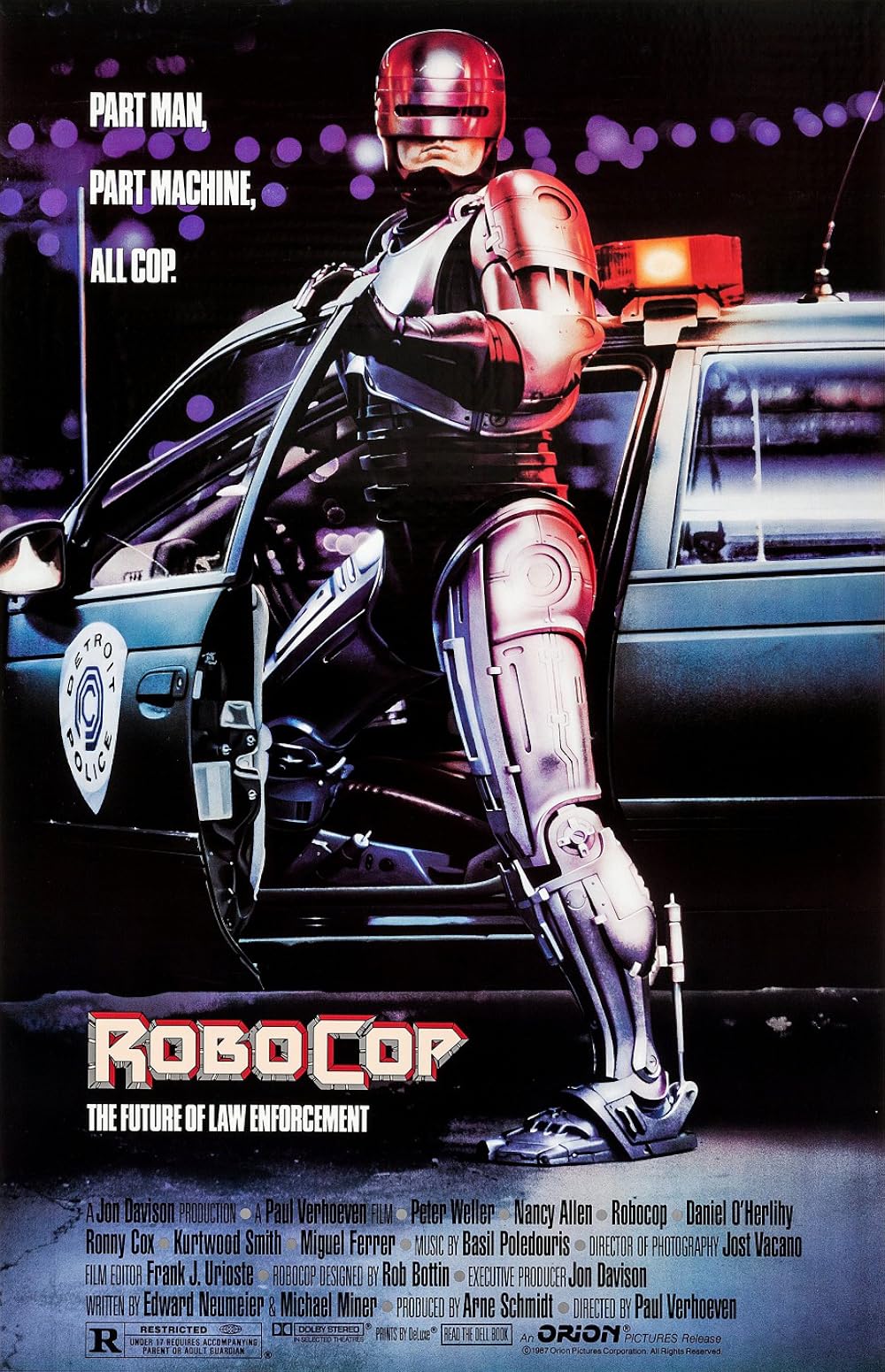
Starring: Peter Weller, Nancy Allen, Kurtwood Smith, and Ronny Cox
Grade: A+
The prosthetics and makeup used in RoboCop were Oscar-worthy. Unless you work in the field, you will marvel at how they made Alex Murphy look like a machine once he takes of the helmet. He was right to tell Lewis that she may not like what she’s going to see, as his creepy features attached to its mechanisms was more jaw-dropping than when Darth Vader removed his helmet on his deathbed in Return of Jedi.
Lewis was being very nice when she commented how great it was to see Murphy again. I would’ve told him to put the helmet back on.
Summary
In a near-future dystopian Detroit, we open with news show Media Break.
“You give us three minutes, and we’ll give you the world.”
The news anchors Casey Wong (Mario Machado) and Jess Perkins (Leeza Gibbons) detail stories about the threat of nuclear confrontation in South Africa escalating because the ruling white military government over the besieged city-state unveiled a French-made three-megaton neutron bomb and affirmed its willingness to use it as the city’s last line of defense, and the US President’s first press conference from the Star Wars Orbiting Peace Platform had a power failure that resulted in the staff experiencing weightlessness. They go to break, and a commercial for the Family Heart Center is shown where they talk about heart transplants and how they have a new line to pick from, how there are extended warranties, financing options, and how it qualifies for a health tax credit “… and remember, we care”. We go back to Media Break, and Wong details a story about three dead police officers, and one critically injured. Police union leaders blame Omni Consumer Products, OCP, the firm which recently entered into a contract with the city to fund and run the Detroit Metropolitan Police Department. Next, they show a clip from Division President of OCP Dick Jones (Cox) where Jones coldly points out the risks in being a cop that everyone knows and to not do it if you’re not up for it. Moving back to Wong, he says Officer Frank Frederickson escaped the crime scene and identified his man, even though he was seriously wounded. The man Frank identified is Clarence Boddicker (Smith), unofficial crime boss of Old Detroit who is now sought in connection with the deaths of 31 police officers. He is at large while Frank is fighting for his life in the hospital.
Good luck Frank!
In Detroit at the Police Precinct, Metro West, Sgt. Warren Reed (Robert DoQui) argues with a suspect’s lawyer and the district attorney over a recent criminal being accused of attempted murder and how they both want the charges lowered to something less serious. Reed refuses and throws them both out. Right after, Officer Alex Murphy (Weller) enters the precinct and introduces himself to Reed, as he just transferred from Metro South. The no-nonsense Reed tells him to suit up, so he goes back to the locker room. There, other officers wonder if there is any word on Frederickson, but there isn’t. He’s just listed as critical still. A cop greets Murphy and asks what got him transferred. Apparently, OCP is just sending a lot of new guys there, nothing more. Overhearing this, another cop who just finished his shower criticizes OCP and thinks they will run the force into the ground. When they get to the lockers, the cop from the shower suggests they strike, but Reed walks in just as he says it. Everyone goes silent. Reed walks over and takes Frederickson’s name plate off the locker. He passed away in the hospital. Reed tells everyone the funeral is tomorrow. The department has requested all officers not on duty to attend. Any donations for the family will be given to Cecil (Laird Stuart). As Cecil cleans out the locker, Reed goes on, aggressively telling them all that he doesn’t want to hear any talk about a strike because police officers don’t do that. Reed grabs Murphy, and they go back to the main lobby where Officer Anne Lewis (Allen) brings in her suspect with another cop. The suspect fights them both until Lewis takes him out. Reed brings her over and introduces her to Murphy, her new partner. Murphy gives her props for what she just did, and she appreciates it. They walk to the car, and Lewis wants to drive until Murphy knows his way around. Even so, Murphy messes with her by taking the driver’s seat before she can and jokes that he usually drives when breaking in a new partner. At OCP Headquarters, three executives discuss the meeting they’ve been called to in the elevator. Donald Johnson (Felton Perry) tells Kinney (Kevin Page) it’s a big one. He thinks they’re greenlighting Delta City, but Bob Morton (Miguel Ferrer) is positive this isn’t it because they never do anything ahead of schedule.
Bob is confident it’s about Jones getting the 209 Series online and he just wants to show it off. Johnson knows this is bothering Bob, but Kinney hasn’t heard of the project. Johnson explains to him how the ED 209 ran into serious delays and cost overruns, so the CEO referred to as “The Old Man” (Dan O’Herlihy) ordered a backup plan. It was to light a fire under Jones’s ass, but Bob got the assignment. Even though no one in Security Concepts took it seriously, Bob argues it was a better plan.
As everyone shovels into the meeting room, Jones speaks with the Old Man who is inquiring about the police issue. Jones explains how their union has been bitching ever since OCP took over, but they’ll figure it out. The Old Man begins the meeting right after and tells all they executives they will begin construction on Delta City in 6 months. It will be where Old Detroit now stands. The Old Man goes on about how Old Detroit is riddled with crime, and they have to get rid of it before they employ the 2 million workers that will come to Delta City. Bob aggressively claps in agreement, and everyone slowly follows because of how loud he is. Although shifts in the tax structure have created an economy ideal for corporate growth, community services and in this case law enforcement have suffered. The Old Man thinks they should give something back, leading to Jones taking over this part of the presentation. Jones brings up the great track record of OCP and how they have succeeded in gambling in markets traditionally regarded as nonprofit. This includes hospitals, prisons, and space exploration. He reminds them how they currently have a contract with the city to run local law enforcement. In Security Concepts however, they believe an efficient police force is only part of the solution. They need something more, a 24 hour a day police officer. A cop who doesn’t need to eat or sleep, who has superior firepower, and the reflexes to use it. With this, he introduces them to what he sees as the future of law enforcement: the Enforcement Droid 209. It’s a giant, walking robot weapon. They activate it, and the ED 209 steps into the room, freaking everyone out. Once it stops, Jones says it’s a self-sufficient robot, it’s programmed for urban pacification, and it’s only the beginning. After a successful tour of duty in Old Detroit, Jones thinks the ED 209 will be the hot military product for the next decade. To test it out, Jones brings up Kinney to simulate a typical arrest and disarming procedure.
He loads a gun, gives it to Kinney, and turns Kinney to have Kinney point the weapon at the ED 209. Kinney points the gun, and ED 209 demands he put down his weapon, giving him 20 seconds to comply. He does, but ED 209 just gives him 15 seconds to comply, not registering that he put the gun down. Jones’s team tries to shut everything down, but they have trouble while they panic. Soon, everyone in the room starts freaking out, and Kinney tries to hide. Unfortunately, ED 209 brutally shoots him down in front of everyone. The Old Man just puts his head down in shame. He tells Jones he’s very disappointed. Unfazed, Jones think’s it’s just a glitch and a temporary setback, but The Old Man can’t believe what he’s hearing. They are supposed to start working on Delta City in 6 months, but this incident could cost them $50 million on interest payments alone. Bob uses this opportunity to interrupt, bringing up the RoboCop program he’s developed at Security Concepts as a contingency for this sort of situation. Jones tries to tell Bob to talk to him later about it, but the Old Man stops Jones, arguing they may need a fresh perspective on things. He wants to know how long it will take, and Bob says they’re ready to go now. They’ve restructured the police department and placed prime candidates according to risk factor. He’s confident they can go to prototype in 90 days. The Old Man is happy to hear this and tells Bob to collect his staff because he expects a full presentation in 20 minutes. Once he leaves, an angry Jones shares a glance with Bob. Following the meeting, Bob brags to Johnson about the whole thing while they go into the elevator, though Johnson warns him that Jones will be coming for him. Bob doesn’t care, saying Jones fumbled the ball and he was there to pick it up. Johnson changes the subject to say it’s too bad about Kinney, but an uncaring Bob chalks it up as life in the big city. Johnson questions when they officially start on the RoboCop program, and Bob says it will be as soon as “some poor schmuck volunteers”.
In uniform, Murphy sits on the hood of the police car and spins his gun around his finger like a western gunslinger. Coming out of the restaurant with coffee for the both of them, Lewis compliments his moves. Murphy explains how he got it from a cop show his son Jimmy (Jason Levine) watches called TJ Laser. Every time the guy takes down a bad guy, he does the move, so Jimmy thinks every cop should do it. Not wanting to disappoint Jimmy and wanting to be a role model for him, Murphy picked it up himself. He admits he gets a kick out of it as well. They hear a distress call on dispatch, so Lewis cuts the conversation short and takes the driver’s seat. In a boxed van, Clarence Boddicker looks at the money his group stole, but it’s all burnt because the guy had to blow the door off to get to it. While Boddicker flips out on the guy because it’s basically marked now and worthless to them, driver Emil (Paul McCrane) lets them know there’s a cop on their tail. They can’t outrun them, so Boddicker tells the driver to slow down instead. In the cop car, Murphy calls for backup and readies two pistols. They say backup’s ETA is 15 minutes. At the same time, Boddicker gets all his guys ready with their weapons. They open the back door and start firing, but the cop car somehow isn’t there. Emil points out that it’s on their right. From the passenger side, Murphy gets into a shootout with Boddicker until Lewis dips back and goes behind the now opened boxed van. Murphy shoots Boddicker’s guy Bobby (Freddie Hice), and he can’t get up. Instead of helping him, Boddicker has the crew throw Bobby at the cop car, smashing their windshield and forcing Lewis to temporarily stop. The van goes to the old mill in sector 3D, so Murphy and Lewis follow. Unfortunately, backup is still unavailable at this time, as there’s an estimated wait time of 20 minutes now. Murphy gives Lewis the option, so Lewis gives the greenlight for them to go in after Boddicker’s crew. Upon exiting the car, they separate. Lewis finds Joe (Jesse D. Goins) and points a gun at him while he’s taking a piss. He asks her if he can zip up his pants first. In the moment that she looks down, Leon punches her off the platform they’re standing on, and she falls into a pile of garbage. Murphy walks in on Emil and Dougy (Neil Summers) watching TV and points his gun at them. Dougy still reaches for his, so Murphy guns him down. Emil surrenders.
As Murphy tries to arrest Emil, he asks Lewis if she’s okay through his earpiece. She is just getting up from her fall however and is too messed up to respond.
Just then, the other members of Boddicker’s crew show up all around Murphy with their guns and turn the tables on him. Boddicker appears and toys with Murphy until he finally blows off Murphy’s hand. Then, he invites the rest of the crew to shoot him all over. Lewis recovers but can’t get to Murphy in time and just watches the gunfire from afar while hidden. Wanting to get on with it, Boddicker finishes the job by putting one in Murphy’s head. Boddicker and his group leave just as Lewis goes over and examines Murphy. He’s airlifted and taken to the hospital. While the surgeons work on Murphy’s lifeless body, he still somehow gets visions of Jimmy watching TJ Laser, his wife (Angie Bolling), both of them together waving goodbye, Boddicker’s crew collectively shooting him, and Boddicker shooting the final shot. In the darkness, the nurse officially clocks the time of Murphy’s death at 6:15PM. Sometime after, Murphy is awake again, but it’s seen through a different, computerized perspective. Surgeons and robotics professionals are working on his body and perfecting it. At one point, they are happy to tell Bob they are able to save his left arm, but he’s mad because they agreed to total body prosthesis. He demands they lose the arm. He looks down and questions if Murphy will understand anything he’s saying, but the engineer tells him it doesn’t matter because they are going to wipe his memory anyway. Bob asks Johnson what he thinks, so Johnson points out how Murphy signed the release forms when he joined the force and he’s legally dead. He thinks they can do whatever they want to him. With this, Bob tells the others to get rid of his arm. They shut Murphy down and prep him for surgery. In spurts, Murphy turns on and off, skipping periods of time to show Bob’s team’s updates on him. In one instance, they talk about his outer skin is being made of titanium laminated with Kevlar. The others invite Bob to shake the robotic hand to test it, and it nearly breaks Bob’s hand. Apparently, the force of the hand is nearly 400 foot-pounds and can crush every bone in his hand. They attach the arm to Murphy’s shoulder. In another instance, Murphy wakes up during a New Year’s party, and the team comes over to mess with him, with one woman kissing him.
Sometime after, the time finally comes. Bob is presenting Murphy to a group of executives and how it has the fastest reflexes modern technology has to offer, onboard computer assisted memory, and a lifetime of on-the-street law enforcement programming, officially introducing him as “RoboCop”. Bob leads his team into Metro West with all of their equipment, and Reed demands to know what’s going on. Bob tells him it’s official OCP business and to get lost. Reed starts yelling at them for all the bullshit they are facing but stops, staring in shock as RoboCop walks into the building. Everyone follows Reed’s lead and stares. RoboCop is led to the backroom and is told to sit in this special chair when he is at rest. Also in the room is Bob, who is told how they can track RoboCop at all times with a special GPS device they have. They give it to Bob. Inquiring about how RoboCop eats, the engineer tells Bob that RoboCop’s digestive system is very simple. They have a processer that dispenses a rudimentary paste that sustains his organic system. Johnson tries it and tells Bob it tastes like baby food. Next, they test RoboCop’s targeting system by holding a pencil in different areas and watching him respond, they test his voice stress analyzer, and Bob asks RoboCop directly what his prime directives are. Robocop answers:
- Serve the public trust.
- Protect the innocent.
- Uphold the law.
Through RoboCop’s lens however, we can see him detecting a fourth directive, but it’s labeled classified.
Later, the cops are practicing in the shooting range, and everyone stops to watch RoboCop. With his special pistol, he completely destroys his target to perfection. He brings his gun back, flings it around like Murphy used to do, and puts it in the compartment in his thigh. Lewis sees the flinging motion and starts to connect the dots on who this is. Bob goes into the main lobby and tells Reed that RoboCop needs a car. Reed throws the keys in his direction, but RoboCop catches them and heads out by himself. Soon after, a man tries to rob a mom-and-pop convenience store at gunpoint. RoboCop comes in just in time. The man shoots at him, but every bullet bounces off his armor. RoboCop breaks the guy’s gun. When the guy tries to run, RoboCop clotheslines him into the fridge. He thanks the old couple for their cooperation and leaves. RoboCop continues his night of fighting crime and finds a woman being assaulted by two men. The one guy threatens to kill her with a knife, so RoboCop shoots through the women’s skirt to shoot the guy in the dick. The other guy surrenders seeing this. The woman hugs RoboCop who notes her emotional state and tells her that he will notify a rape crisis center. Next, former city councilman Ron Miller (Mark Carlton) is in city hall with a gun and hostages. The news is there, and cops from all over surround the building. Miller has Mayor Gibson and his staff hostage on the second floor. The belief is that Miller has killed one of the hostages so far. The news reporter tries to interview Lt. Hedgecock (Michael Gregory) on the scene over the course of action they are taken, but everyone’s attention is diverted to RoboCop’s arrival. All the reporters try to talk to him instead, but he ignores them and tells Hedgecock to keep Miller talking while he goes inside. Hedgecock gets on the mic and tells Miller they will give in to his demands. Miller comments how he’s not to be fucked with, he wants fresh coffee, he wants a recount of the votes, and no matter how it turns out, he wants his old job back. In addition, he wants a bigger office, a new car, and he wants the city to pay for it all.
Hedgecock humors him by asking what car he wants, so Miller says he wants something with reclining leather seats that goes really fast and gets really shitty gas mileage. Hedgecock suggests the “6000 SUX”, and he accepts it. When Hedgecock concedes to everything and offers an extra gift, Miller finally sees this as Hedgecock being patronizing. He grabs Mayor Gibson and puts him up to the window with his gun. RoboCop busts through the wall to grab Miller, he brings Miller into the room he was in, and punches him, sending Miller out the window and to his death in front of everyone. In short order, RoboCop becomes a phenomenon. On Media Break, he’s the main story, as Perkins talks about how RoboCop is OCP’s newest soldier in their revolutionary crime management program. They show a clip of RoboCop meeting children at an elementary school in Old Detroit and a reporter asks if he has a message for kids watching at home. It’s simple, “Stay out of trouble”. After a story about a joint raid between Americans and Mexican nationals against rebel rocket positions in Acapulco and a commercial for inappropriate family board game Nukem, Wong details a story about how labor leaders agreed to sanction construction on OCP’s Delta City, thereby creating an estimated 1 million much-needed jobs, despite questions about worker safety in dangerous Old Detroit. They show a clip of Bob’s press conference where he is now the OCP Vice President of Security Concepts. Though he can’t comment on Delta City because it’s not his division, Bob states that at Security Concepts, they are projecting the end of crime in Old Detroit within 40 days. There’s a new guy in town. His name is RoboCop.
Afterwards, Bill gives Bob credit for his rise in the company and invites him to play handball sometime. Bob turns him down because he has some models coming over. The two talk on their way to the special bathroom where they need key cards to get in. Bob has one now since he’s an executive, and they talk at the urinal about how pissed off Jones was. Bob does give Jones’s reputation credit, but he calls it a smokescreen, refers to him as a pussy, and says he’s old and they’re young “and that’s life”. Just then, all the other executives in the bathroom run out in a hurry. It turns out that Jones was in the stall and overheard everything Bob said about him. They turn to see an angry Jones leave his stall, and Bill pisses on himself but exits, lying and saying he’s late for a meeting. Jones tries to intimidate Bob by commenting how he remembers when he was young with OCP and would make fun of the Old Man, calling him names like “Boner”. Even so, he always had respect and knew where the line was drawn. He says Bob crossed it by insulting him and the company with “that bastard creation of yours”. Jones had a guaranteed military sale with ED 209 that would have them selling spare parts for 25 years. He didn’t care if it worked or not. Responding as smug as possible, Bob said the Old Man thought it was pretty important. Jones calls the Old Man sweet but reminds Bob that he won’t live forever, and Jones is the number two guy in OCP, implying he will take over at some point. He grabs Bob by the hair and tells him he fucked with the wrong guy. Bob shoves him off and tells him he’s out of his mind. Before leaving, Jones tells Bob that he better pray his “unholy monster” doesn’t screw this up.
Thankfully for us, RoboCop does, by having the “audacity” to still retain his humanity deep inside.
My Thoughts:
RoboCop is probably one of the most misunderstood movies of all time. Due to where the franchise ended up going after the first film, audiences only remember it nostalgically for the titular character and the over-the-top violence that made it a legendary entry in the science fiction and action genres which helped define the 1980s. However, it’s much more than that and it’s rather obvious too, which begs the question how it was misconstrued by so many. The only explanation that seems plausible is critics just seeing clips of RoboCop shooting bad guys and assumed what it was, a regular, shoot ’em up action movie where good prevails over evil by way of vengeance and murder. Though this is an element of the narrative, it’s nowhere near close to telling the whole story of the completely realized production. Then again, we can’t fault generations for missing the point, as director Paul Verhoeven famously passed on the project a couple of times because he too missed the subtext within the screenplay until his wife had him look into it deeper. After watching the entire multimedia franchise in succession, Paul Verhoeven’s RoboCop is entirely its own thing, utterly different from everything that followed in the series. Along with satisfying fans of action cinema and sci-fi and achieving cult classic status in doing so, RoboCop is additionally a dark and unexpectedly humorous satire of corporate greed, economics taking precedent over morality, the war on crime, commercialism, and the glorification of violence and military culture in the media rolled into one.
The OCP corporation trying to take over is the central starting point of the movie. Everything that happens in this film and any other RoboCop-centered production is rooted back to this idea, along with its many evil and unsympathetic characters who prioritize their own standing in OCP rather than the repercussions citizens will face because of their decisions. Though it does kind of take away from what we crave most, which is watching RoboCop kick ass, it’s essential in showing the overpowering evils in control that the people face in plain sight every single day. America itself is at the mercy of corporations prioritizing profit over everything, and the film’s antagonists represent the exact same problem in the world-building scenes of RoboCop. It begins with the Old Man, who wants his dream of Delta City to be made by any means necessary because the profit it will give OCP will be astronomical, a baseline story that influences the events of RoboCop 2 and subsequently RoboCop 3 that takes place after the Old Man’s death. His number two in Dick Jones sees his prized ED 209 project as getting there, as it will fix law enforcement in Old Detroit’s worst areas, despite its kinks causing a death in the office during a presentation. Now, this presentation scene in particular should be the marker for the audience as to why RoboCop isn’t just about ultraviolence on bad guys being a “good” thing. Tossing a grisly murder to the side as meaningless in the manner it plays out is obviously a satire of the genre it represents and is a clear critique of corporate greed. Once Kinney is shot a million times by ED 209, the Old Man just tells Jones he’s disappointed, and Jones passes the whole thing off as a setback or a glitch that can be worked though. Their nonchalant discussion and misdirected emotions regarding what happened and their focus on OCP’s priorities is their way of showing why they are going so over-the-top with the violence. No matter how far the characters go, it means nothing to them. It’s a way of chastising these corporations and even the federal government on how they have enacted policies to serve themselves in the guise of helping the American people. The idea of the ED 209 is a positive one, but it’s obviously not ready for the public yet considering it killed an unarmed man as soon as it was turned on.
Yet, Jones explains the real reason to Bob in the bathroom. Who cares if it worked? As long as they secured a deal with the military, they could make money off the spare parts for years. It’s all about the profit. Everything is! If the profit margin is messed with in anyway due to public relations issues or faulty products that find the company being criticized in the media in some way, that is when they have to act. OCP never acts in RoboCop unless they see a potential for their machine messing things up (“You’re our product, and we can’t have our products turning against us, can we?”). It’s usually because the programming is almost too good at its job, something really highlighted in the 2014 remake. After Jones pinpoints RoboCop as the problem that needs to be stopped, he enlists Boddicker’s help, knowing his background. He convinces him to do so by promising him carte blanche to run the criminal underworld of Delta City once it comes to fruition. The whole point of Delta City is that it’s supposed to be a crimefree utopia, but that was never going to happen with OCP because they don’t care. It’s about the profit at all costs! It’s like how the “unemployed person” interviewed on Media Break said, it’s a free society, except there’s nothing free and no guarantees. You are on your own. Everyone is out for themselves and their position in life. It’s the law of the jungle, and that’s how corporations operate behind the scenes.
Its excessive use of weapons, violence, and cops bordering on vigilantes to get things done work for cinematic satisfaction but is also a commentary on the state of its glorification in media. Elements of Dirty Harry, Death Wish, and Cobra are evident in RoboCop. Though it revels in these marvelous and gory action sequences in its own right, it’s exaggerated to the extreme for a reason. There’s also a litany of cheesy lines like Emil commenting their cliché bad guy plan to Dougy in that “We steal money to buy coke. Then sell the coke and make even more money”. They’re not even hiding it! The use of Media Break was an ingenious way to not only show the numb responses of the news media when tragedy strikes, but it also serves as an entertaining way to transition to the next scene in the film. It’s yet another thing that becomes a staple of the franchise, and it’s welcomed, as it’s a really creative way of getting from one part of the story to the other. For the record, it’s use in this movie is the most realistic depiction of the news segments and does a great job of working in the commercials with the narrative, but the RoboCop production that does it the best is the 1994 television show surprisingly. Regardless, the 1987 film also succeeds with its heavy critiquing of commercialism, with amusing commercials for products like the car named the “SUX” or board game Nukem (“That’s it, buster! No more military aid!”), a game similar to Battleship in concept but includes world politics. Further highlighting entertainment’s way of making war and killing “fun”, the commercial subtly calls it another “quality” family game from the Butler Brothers, following a kid yelling at it that Pakistan is threatening his border.
The only thing I never understood is the weird TV program everyone seems to love with the ugly-looking, glasses-wearing star hanging out with hot women and continuously falling back on his catchphrase, “I’d buy that for a dollar!”. The line becomes a recurring gag in the franchise too, and I don’t know why. In addition, the scene where Boddicker just instigates shit with Sal is great (“I got the sales organization. I got the muscle to shove enough of this factory so far up your stupid wop ass that you’ll shit snow for a year!”), but him dipping his fingers into Sal’s wine glass and sniffing it during his speech, and Sal immediately drinking from the glass right after may have been the most perplexing moment of the movie.
In addition to the sharp takes on the culture of 1980s America, the mythology of the main character is a cool one to watch unfold. The character arc of Alex Murphy is Frankenstein’s Monster-like to OCP and to the people of Detroit, but his journey is subconsciously Christ-like to the viewer, hidden beneath all the sci-fi jargon and gunfire. After he’s viciously gunned down and declared dead in the worst way possible, echoing Christ’s crucifixion with how savage it was, Alex Murphy’s remnants are used to work as the makeup of RoboCop. Everyone treats him like he’s Frankenstein’s monster. Despite the facials of a human being, they refuse to acknowledge him as a man. Annoyingly enough, despite all the times he proves to everyone that he is, this subject is still being tackled in RoboCop 3, as if none of his previous missions meant anything to those in charge or his public persona in general is forgotten about for some reason by new hires in OCP like Bradley Whitford’s Jeffrey Fleck. It legitimately doesn’t make sense since RoboCop is technically the only successful product in law enforcement they make. It’s said directly by Johnson in RoboCop 2, and it remains true by RoboCop 3. The remake is a different story, but in regard to the original canon, Alex Murphy as RoboCop is the only creation that succeeded. How in the fuck did Fleck still have to be taught about his origin? Was he not alive previously? It could be the continued deterioration of the writing with each sequel, with each movie becoming less intelligent and more straightforward but going back to this so often is lazy. Even so, doing it in the first film makes sense, as it serves as the character’s origin story. Johnson reminds Bob how Murphy signed the release forms and he’s technically dead, so they can do whatever they want to him. Because of this, they wipe Murphy’s memory and get rid of his arm, something the doctors originally managed to save. The executives in charge do everything they can to remove the human from the human and completely recreate the cop in the image of OCP, instituting a face for law enforcement in the process. What they don’t account for is the resurrection of Murphy. It wasn’t just the last bits of him that survived. The soul did too.
Now, this is one thing critics and fans alike have discussed over the years due to the inconsistencies of each succeeding sequel in the series. Is he still Alex Murphy and it just takes him awhile to recognize it? Is Murphy indeed dead but the use of his body gives the cyborg his memories and makes him think he is Murphy, which is good enough? When he first takes off his mask and speaks with Lewis in the old factory, he mentions Murphy in the third person and brings up Murphy’s wife and son, asking what happened to them. Once Lewis says they moved after the funeral because the wife thought he was dead, RoboCop states the conundrum that defines his character, “I can feel them, but I can’t remember them”. What’s strange about his line in context with the rest of the movie is that it’s presented as the opposite for most of the narrative, as he does remember all of these moments in his life. Constantly getting flashbacks to these crucial moments before he became RoboCop is what motivates him in the second half of the film, like when he gets visions of Boddicker and his crew killing him and experiences physical pain recalling it while sitting in his chair doing tests. After he arrests Emil and enters the records room, using his data spike to access the computer files by sticking it in a port, he looks through Emil’s records and all his known accomplices, which leads him to Boddicker and his rap sheet. On it is where he’s labeled as a suspect in the murder of Alex Murphy, and RoboCop makes the connection himself, remembering Lewis say to him, “Murphy, it’s you”. His memory is what allows him to connect the dots, and it’s verified when he finds his old address on file and visits his previous home that is now up for sale. In the desolate house, he recalls the warmth that use to exist there when he used to be the old Murphy hanging out with his son and wife (“I really have to tell you something… I love you”). RoboCop feels and remembers it all in that moment, which is why he goes through such a whirlwind of emotions during this sequence and punches the television in anger. It has to be Murphy. Even if he retained 10% of Murphy’s remains as a cyborg, the programming used didn’t create its dreams. That has to be Alex Murphy still fighting to the surface. It wouldn’t make sense otherwise.
This has to be the reason why OCP is so adamant on wiping the slate that is his mind clean, just to make sure the emotional problems are removed. Actually, if it wasn’t Murphy, and RoboCop is indeed a robot with an identity problem, the franchise itself becomes less interesting and more depressing as a result, so I refuse to believe this hypotheses people bring up. In addition, Lewis almost always refers to him as Murphy, as if to tell the viewer that this is still him. One can also wonder if the robot just thinks he’s Murphy because of the composite parts and believes it has a human spirit but really doesn’t, something that can never actually be confirmed if this was the intention. Really, it’s hard to say and might be entirely on the audience as to what they want to accept. In the first movie however, the answer we are led to believe is that Murphy himself was resurrected in the creation of RoboCop and OCP didn’t realize this as a possibility, especially because they wiped the memory anyway in case it was to happen. Nevertheless, the human spirit persisted and couldn’t be denied in its motivation to make things right. In a way, it almost makes Alex Murphy an angelic figure, with his return to Earth as RoboCop being that of a purveyor of justice and all that is good, as well as being seen as this archangel of protection that the people revere, something RoboCop 3 and RoboCop: Prime Directives do a great job in building on. In its application of religious themes, RoboCop coming to the realization of his eventual revenge arc, when his previous life as Murphy forces its way to surface, is strangely akin to the idea of judgment day. On top of that, there’s Emil screaming how they killed him and being in shock once he realizes it’s Murphy, and RoboCop subsequently walking through fire like a supernatural being to shoot Emil down. The comparisons are evident. It sounds crazy because we’re referring to RoboCop of all people, but again, you have to engage with the film on a different level than other action movies. It’s much smarter than the viewer realizes, and its parallels and thematic illusions are really fun to analyze. It makes use of a clichéd revenge narrative that we’ve seen plenty of times before and after and takes it into a fun and ludicrously over-the-top, chaotic, sci-fi actioner that serves the masses with its entertaining shootouts and car chases but is slick in its mythos and criticisms of contemporary culture.
As great as the subtext can be, let’s also not forget about the fun parts of RoboCop and why we love it so much regardless of where everyone stands on the topics the movie may parody or explore. Even if writer Edward Neumeier and director Paul Verhoeven worked on the production with the intentions of satirizing the hollowness of life in America at that time, they cannot act as if they were surprised at the reception and popularity of the ultraviolence of the feature AND its awesome main character. Call it nerd lore or an obsession with science fiction, the character is cool, from the design of his suit to the action he finds himself in. The themes aren’t lost in the running time, but the viewer would be lying if they said the bloodthirsty action sequences highlighted in the movie didn’t excite the viewer, as RoboCop enacts his revenge on the evil people who run Old Detroit. Tell me right now you didn’t think it was ice cold when RoboCop goes through Sal’s drug lab and starts hitting bad guys with no-look gun shots, a shot above his head that he also no-looks, and a spin move or two, killing every last person in there. Then, he follows it up by angrily sending Boddicker through several windows in succession to get a confession out of him? It was simply awesome! Even with a full understanding of why the violence was so over-the-top, we as fans of cinema can’t help but be fully engrossed at scenes like that, as well as the stop-motion/live-action fight sequence between RoboCop and ED 209, which was really well done considering the limitations. The way RoboCop tries to slowly dodge rockets being sent his way, and his eye being exposed but fighting ED 209 through grit and thinking outside of the box in redirecting its arm to shoot its other arm off was a great way to show off RoboCop’s capabilities in hand-to-hand combat. Plus, it was unintentionally hilarious to see ED 209 smack him into the air because of how helpless he looked, as well as ED 209 squealing like a pig after falling on its back down the stairs and not being able to get up. Seeing RoboCop look at it in confusion before booking it was very funny.
RoboCop finds a way to not only acknowledge how sadistic and soul-blackening violence can be like in the barbaric killing of Alex Murphy in the first act, Boddicker showing up to Bob’s place on behalf of Jones (“Bitches leave”), or the destruction of Old Detroit for no reason with Boddicker’s crew wielding the Cobra Assault Cannons post-police strike, but it works in other ways too. Moments like Murphy’s death are so dark that it becomes poignant, as we can’t help but hope and pray Murphy is somewhere in that mechanical suit because he didn’t deserve to go out like that. The scene where Hedgecock gets orders to take him out and gets hundreds of officers to shoot him in the parking garage at OCP Headquarters is another example of this working in both ways. At the same time, it’s also ironic because RoboCop instituting nearly the same level of capital punishment is cheered on by the viewer, whether we want to admit or not. When he tells Boddicker he’s not going to arrest him anymore, implying he’s there to kill him, we smile ear to ear. Yes! Take him out! Finish the bastard! It’s the audience in the Roman Colosseum all over again. When the ass-kicking is handed out to someone or something we consider bad, we want to see it happen. It’s only human nature. It’s like ED 209 pointing out how RoboCop illegally parked on private property, so he uses the Cobra Assault Cannon to blow ED 209 up. The ED 209 represents evil at that point, so we don’t mind the destruction. If anything, we enjoy it. Really, they knew what they were doing. Neumeier and Verhoeven can play coy all they want, but they saw the potential in the marketing bonanza of the character. Action figures, video games, cartoons, shows, and several sequels later, it didn’t really matter that everything following 1987’s RoboCop didn’t carry the same weight in its screenplay. The character was a made man at that point and could survive in any scenario he was put in, much like Alex Murphy itself. Though nothing that followed reached the same success or achieved the same legacy of the first movie, and it can be attributed to the lack of adherence to the original’s point, I can’t criticize the rest of the franchise too much for trying to capitalize on the sci-fi and action movie market. It’s easier to make, it takes less time, there’s always a chance for a wider audience to come see it, and it makes things less complicated to understand.
RoboCop succeeds for being all of that and being a great satire at the same time, but the other RoboCop-related productions being focused more on the character and its genres were still more entertaining than people give it credit for. It lacked the substance of the original without a doubt, but it was always passable entertainment in different ways simply because RoboCop was involved. With the ultra-cool helmet, one of the best weapons in cinematic history, a series of catchphrases that bring back memories and become a staple of the franchise (“Dead or alive, you’re coming with me”; “I have to go. Somewhere, there is a crime happening”), and just the all-around badass action figure-like design and backstory of the character, it’s hard not to follow his adventures no matter the content. He’s a man and a cop, not a product, and it’s a joy watching RoboCop serve the public trust, protect the innocent, uphold the law, and win over his fellow cops because of how good he is (“He’s a cop for God’s sake!”). Bob scoffed at his engineers suggesting they take RoboCop offline because he had a “dream”. Two sequels, a remake, two cartoons, a TV show, and a miniseries later, and we can’t help but thank Bob for letting it go, as his one decision became the start of a legacy.
A real unexpected result is Kurtwood Smith’s revelatory performance as Clarence Boddicker, one of the most sadistic sons of bitches to ever grace the screen. Very rarely do you see an actor exude this aura of not holding any regard for human life, but Smith is insanely good as the callous and swaggy kingpin of Old Detroit. Though the over-the-top nature of the rest of his crew was a tad too much, especially with Joe’s cackling, comic book-like laugh that was too exaggerated for even this movie’s tastes, Smith’s Boddicker was deliciously evil on a whole other level. He’s so good at being bad, he’s the prime example I look to when we talk about the viewer craving the ultraviolence of the movie. It’s because Boddicker is that dastardly. There is no better moment then when he’s brought in by RoboCop after finally being arrested, and RoboCop tells all the cops that he’s charged with being a cop-killer. Unflinching and outnumbered, he looks at all of them and spits blood defiantly on Reed’s desk before saying, “Just give me my fucking phone call”. The man even blows up Joe’s brand-new stolen car as a joke, and they all just move on afterwards to hunt RoboCop and forget about it. It’s a maniac leading several other maniacs! It’s a magnificent performance that should be studied by actors who want to embody villainy in a “B-Movie” type of role and make it something special. Not to be outdone, Peter Weller does a surprisingly good job as the protagonist. I don’t think it’s understood by many how difficult of a role this is. It sounds simple in that he’s just playing a robot, but this is an oversimplification of what is being asked of him. First of all, he has to garner enough of a reaction in the first act to win over the audience to who Alex Murphy was, a good-hearted family man and cop trying to do the right thing. Next, he has to embody being a cyborg, a machine who has human characteristics but is mostly a robot. Then, he has to balance the two once his memories start to come back to him, and he has to elicit sympathy as well as an emotional vulnerability beneath his clunky costume and a helmet that covers his eyes. Incredibly, Weller does so in spades.
His stoic, intelligent, and monotone delivery in the way he already speaks may have been part of the reason he was cast in the role because it didn’t take much for his tone to change into the robot part of the character. However, the way Weller delivers certain lines of devastation (“Leave me alone”) and use very subtle facial expressions and movements, he is able to make it a fully realized and thoughtful performance as a broken man, a broken cyborg, and a great action hero. At the same time, we are privy to the heart of Murphy that still persists through everything he’s been through, along with who he has become as RoboCop. How good Weller does in his role is only magnified in multiple revisits of the movie, especially after seeing the attempts of Richard Eden and Page Fletcher. At first, the initial thought is, can the performance really be all that different in who plays RoboCop? It shouldn’t be that difficult, right? After watching the entire franchise, it turns out that it was that hard, and no one did it better than Peter Weller.
One detail I would have removed entirely was the discussion surrounding RoboCop’s sustenance. The idea of him eating this thick, baby food-like paste is disgusting. He never actually does it on camera in the entire series, but the thought out of it is just awful. Had they not even broached the subject, I would have never gave it a second thought. Going along with things that weren’t needed, the film also contains what I consider to be one of the most unnecessary sequences in the history of cinema. In the climactic battle at the steel mill between RoboCop and Lewis taking on Boddicker’s crew, RoboCop sidesteps Emil driving his van towards him, and Emil crashes into a vat of toxic waste that was just sitting there. He falls out of the back of the truck and stands to reveal the toxic waste reacted to his body immediately, turning him into a freaky mutant, Quasimodo, Sloth from The Goonies, literal fucking monster that might be one of the most grotesque things I’ve ever had the displeasure of seeing. I legitimately said to myself, “Somebody kill this fucking thing!”. Mutant Emil goes to Leon and pleads for help in this asthmatic voice, and Leon gets the hell out of there because Emil might be the scariest creature of the entire fucking decade. Emil starts running like a hunchbacked chicken into the open and by the grace of God, Boddicker is driving by and smokes him, blowing up his body into pieces and thankfully putting him out of his misery by accident. Why in the fuck was this in the movie? To this day, I have no answer for this. There is never a single moment in the entire franchise that matches up to how insane this sequence is, and I don’t care to ever see it attempted again. I do not care how well it did with test audiences either. Actually, what the fuck was wrong with those guys? This was one scene that should NOT have made the final cut. It made no sense, it didn’t help or hurt the story, and it didn’t lead to anything of note. It was pure shock value, giving us nightmares for no payoff. There’s no way of convincing me why this should have stayed in the feature.
Subverting audience expectations in what could have been a run-of-the-mill action sci-fi extravaganza while also pleasing this crowd at the same time, the gory RoboCop stands the test of time, becoming more appreciated with each passing year. With that being said, it’s similar to Tony Rome in that the character is better than the movie itself. RoboCop is definitely one of the best movies of 1987, but it has too many hangups to reach the grade of “Classic“. The main character however is one of our favorites, which is probably why the rest of the franchise isn’t graded nearly as low on Cinema Loco compared to what other critics have given it.
Fun Fact: David Cronenberg, Alex Cox, and Monte Hellman were all given an offer to direct at some point. For the role of RoboCop himself, Arnold Schwarzenegger, Tom Berenger, James Remar, Rutger Hauer, Michael Ironside, Keith Carradine, and Armand Assante were considered. It was decided that Schwarzenegger along with a few others were too physically imposing to be believable in the costume. Peter Weller chose RoboCop over King Kong Lives. Weller was also fired at one point due to disagreements with director Paul Verhoeven, and Lance Henriksen was considered to replace him, but since the costume was designed for Weller, he was encouraged to figure things out. Stephanie Zimbalist was supposed to be Anne Lewis but had to drop out due to commitments to Remington Steele. Kurtwood Smith auditioned for Boddicker and Dick Jones. Michael Ironside was also offered the role of Boddicker but turned it down. Apparently, Howard Stern was also offered an unspecified role but turned it down.


+ There are no comments
Add yours