
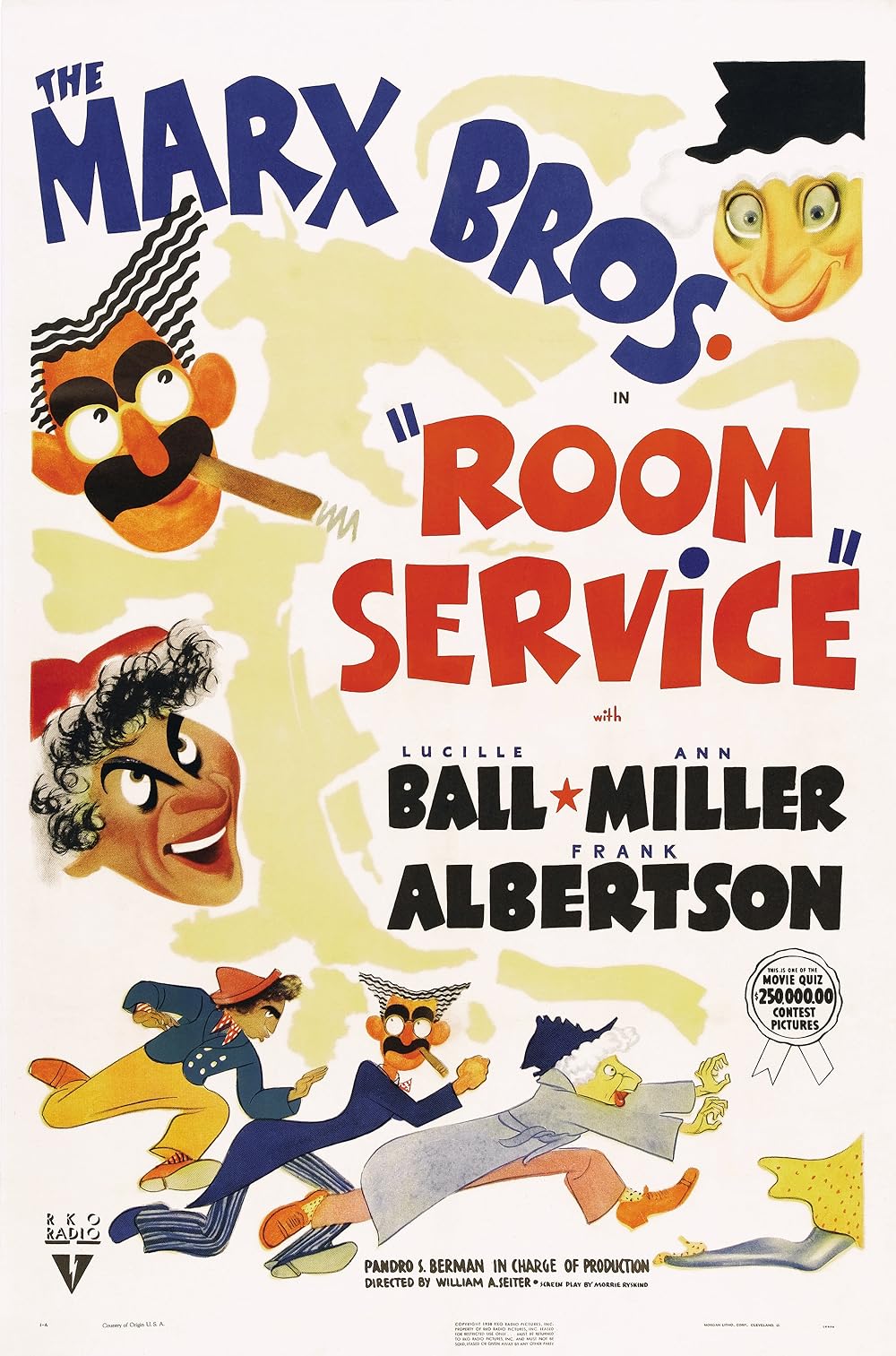
Starring: The Marx Brothers (Groucho, Chico, and Harpo) and Lucille Ball
Grade: A
The driving force behind Room Service is that our main characters go to great lengths to avoid paying a hotel bill.
Is that not the most Marx Brothers thing you’ve ever heard?
Summary
At the White Way Hotel, theater producer Gordon Miller (Groucho) is in the restaurant area and pays for his bill with a check, unsure if it will work. The waiter Sasha Smirnoff (Alexander Asro) is an aspiring actor and knows Miller’s company has been rehearsing on the 19th floor. Because of this, he asks if he can play the part of the Polish miner. Miller declines to consider. He is then made aware of a phone call from his main actress Christine (Ball). He is given the phone, and Christine talks about how she will be late due to her other job working for Morton Fremont. Miller tells her to make the rehearsal as soon as she can because he knows he can make a star out of her, though he reminds Christine that she only invested $250 in the show. After he hangs up, Miller is stopped again by Smirnoff who wants to show him what Russian critic Yakubovich said about his interpretation of Uncle Vanya. He reads it off in Russian to a barely listening Miller, and Miller asks when Yakubovich said all of this. Smirnoff said it was just before he was shot. He starts to dance around to show Miller his other skills. Miller joins in until hotel manager and Miller’s brother-in-law Joseph Gribble (Cliff Dunstan) enters the room, prompting Smirnoff to run off and Miller to stop. As Miller walks towards the elevator, Gribble goes on about how he should have never allowed Miller into the hotel. Miller promises he will pay his bill as soon as he finds backers for his show. Miller heads into the elevator to get to his room, and Gribble follows, adding they are in a terrible spot. Supervising director Wagner (Donald MacBride) is downstairs inspecting the books. Miller thought Wagner wasn’t expected for another two months, but Gribble explains his appearance was unexpected. As they get into Miller’s room, Gribble says it won’t take long for Wagner to find Miller’s $1,200 bill. Gribble knows he won’t be able to explain it, and he will lose his job if Wagner finds out that Miller is his brother-in-law.
Miller suggests he say that it was a business proposition where Gribble would get 10% interest in the show to house him and 22 of his actors. Miller argues that he did beg to get in on it, but Gribble says he was railroaded into it by Miller and Flossi, Gribble’s wife.
Miller tells Gribble to keep Gribble’s wife’s name out of this, reminding him that Flossi is his sister on his mother’s side. Just then, Miller’s assistant Binelli (Chico) enters and says rehearsal went wonderful, though he still thinks the play itself is terrible. Right after, Binelli picks up the phone to call room service, but Gribble tells him he can’t eat there anymore. Miller decides he’s just going to leave. Gribble says he can’t let him skip out and says he will have to leave his luggage, so Miller has the idea to wear all of his clothes. He tells Binelli to wear three of his suits. As Binelli calls Faker Englund (Harpo), Miller lays out all his clothes on the bed and threatens Gribble over all 22 of his people leaving. The actors can’t be held responsible for the bill because it’s all charged to Miller, so if he’s out, they will have to switch everything from one bill to 22 little ones. Binelli lets Gribble know he has a phone call. It’s Wagner who wants Gribble right away. Hearing this, Miller says he will be out of the place in 15 minutes. Gribble storms out. After 17 years in the hotel business, he can’t believe he has to pull a stunt like this. As he leaves, Miller and Binelli are putting on several of Miller’s suits. Miller asks to stay with Binelli, and he’s cool with it. However, he will have to sleep on the shelf. Binelli has the floor because he can’t get the bed out of the wall. Faker walks in to help and already doesn’t have a shirt on underneath his trenchcoat. It’s not because he was prepared. It’s just that he doesn’t believe in shirts (“Oh, an atheist, eh?”). As Faker puts on some of Miller’s clothes, Miller considers staying with Faker, but Binelli says Faker’s place at the Metropole is the worst schlock house on 8th Avenue. Plus, he’d have to sleep sideways there because Faker lives with four other guys and they’re packed in like sardines. As Faker finishes putting on several suits, he tests some of Miller’s cologne and even drinks it. Christine shows up and can tell they’re about to run out again. However, she tells them the good news.
She found a financial backer in investing agent Simon Jenkins (Philip Wood).
Earlier, he walked into Christine’s workplace to get an interview with Fremont. He has money to invest in a play. Christine talked him out of doing business with Fremont and to talk with Miller instead. She even gave Jenkins a copy of the play Miller is producing “Hail and Farewell”, which he’s reading that very minute. Miller isn’t sure what to do because if he stays in the hotel, he might lose the cast. Binelli notes that if he doesn’t however, he will lose his backer. While Christine stresses how he must be there once Jenkins shows up for the meeting, they hear a knock on the door. Quickly, Miller, Binelli, and Faker put on large coats over the numerous suits they are wearing, and Miller answers the door. It’s Davis (Frank Albertson), the author of “Hail and Farewell”. Miller downplays the state of the room and introduces Davis to Christine, their lead actress. After Miller introduces him to Binelli and the “brains of the organization” in Faker (that’ll give you an idea of the organization), Davis says he will go back downstairs to register. Miller questions if he intends on checking in at the hotel, leading to Davis to reveal he doesn’t have any money. He was depending on Miller’s advance. Miller acts like he’s flowing with money but then adds that Davis should go back home and he will send for Davis a week before the play is to open. Unfortunately, Davis says he’s gone from home for good, as he’s burnt his bridges. When Miller suggests he could still go home if he wanted to, Davis admits his mother seemed happy when he left. Christine uses the phone to ask when the next bus to Oswego is. Davis tries to protest, but Miller acts like he’s doing Davis a favor. Miller, Binelli, and Faker rush Davis out of the room, so he starts to think they have lost interest in his play. Miller assures him this isn’t the case, but Davis threatens to have Fremont buy it. Miller changes his tune and brings Davis back inside the room. Due to the situation and his secret lack of funds, Miller says Davis will stay in the room with himself and Binelli.
Before Davis can say anything further, Miller insists, so he accepts. Miller asks if he has any money on him so he can put it in his vault, but Davis only has 67 cents. When he says he will go and wash up, Binelli jokingly tells him to go ahead because they’re already washed up. Before she leaves, Christine tells Miller that she is going to ask Fremont for an advance on her salary. As Davis goes into the bathroom, Faker looks through Davis’s luggage, and Miller and Binelli start taking off all the suits since they are going to stay. They are interrupted by a phone call from the police. Miller gives the phone to Binelli since they were asking for him. To Binelli’s surprise, he’s told he’s being dispossessed. He grabs Davis’s typewriter with an intention to pawn it for money, but Miller stops him because he wants to pawn it too. Binelli explains that the cops want to give him a ticket because his moose head is blocking the fire hydrant.
Why does he lug around a giant moose head? No one knows.
Binelli is able to wrestle the typewriter away and gets out of there. Davis looks around at his stuff all over the place, so Miller explains that he had a valet lay out his things. Miller says he will register for Davis and how he will be back if anyone calls for him. After Miller leaves the room, Davis calls the We Never Sleep Collection Agency to tell them how he got behind on his payments on the typewriter and they turned it over to them for collections. Now, he requests for them to send a man over because he can pay off the remaining balance. Miller’s secretary Hilda Manney (Ann Miller) shows up to talk to Miller but is greeted by Davis instead. After some conversation and pleasantries, Davis realizes her name reminds him of an Oscar Manney when he was in Oswego, as Oscar used to give him piano lessons. They find out it’s a small world after all because that’s her uncle. They sit down together and he offers her some chocolate he got from the train. In Gribble’s office, Wagner berates Gribble over his mishandling of Miller’s bill, especially now that he’s under the impression Miller skipped out on it. Wagner angrily reminds him the credit limit is $500, but Gribble explains how Miller strung him along by showing him backers and telegrams. He says he will have Miller arrested if he catches him, but Wagner doesn’t care. He will charge Gribble the difference between the limit and the loss, which would be exactly $700. As Gribble protests (He literally says “…I protest!”), Wagner doesn’t budge because he was sent there to put this unit on its feet. If he succeeds, there is a vice presidency waiting for him, and he’s not going to let anyone stand in his way. Because of this, he plans on going to Miller’s Room 920 to find out the details for himself. Meanwhile, Hilda brings up how she wants Smirnoff to be hired as an actor, as he was a big star in the Moscow Art Theater. She was going to bring it up to Miller, but figures Davis is the second-best option. She thinks Smirnoff can play the father role in the play.
Davis misunderstands Hilda’s interest in the man as a sexual thing and comments how he can’t picture her with a middle-aged man like that, but she laughs this off, explaining how she’s only doing Smirnoff a favor. With his smile returning to his face, Davis is down to hear Smirnoff’s audition. She thanks him and goes to leave. Davis continues to talk about this potential audition and asks for Hilda to be there too. She’s cool with it and suggests they go see Smirnoff now, so Davis goes with her. Just as they get onto the elevator, Wagner and Gribble exit the other elevator and enter Miller’s room. Wagner doesn’t understand why they checked in Davis without cleaning the room. Wagner isn’t sure what’s going on in this hotel, but he swears he will get to the bottom of it. Gribble wants a chance to investigate, but Wagner doesn’t want to hear it. He already let Miller move in and 22 other cast members he can’t even find. Suddenly, Binelli opens the door carrying his large stuffed moose head. After Wagner incorrectly guesses that Binelli is Davis and then Miller, he turns and flips on Gribble. The phone rings, so Wagner decides to take it. At the same time, Binelli tells Gribble how tough of a time he had trying to get the moose head through the revolving door, though Gribble doesn’t want to hear it. Wagner is told on the phone that the 22 cast members are in the dining room having dinner and charging it all to Miller. He storms out. Afterwards, Gribble asks Binelli what happened because thought Miller was going to skip, so Binelli reveals how they are expecting a backer now, so they changed their plans. Just as Gribble brings up how he has to pay $700 now, Miller enters to tell Gribble they have a backer. Gribble is still pissed off however and begins to mention Miller’s registering of Davis to the room. Davis enters on cue and Gribble demands to know if he has any money. Davis admits he doesn’t, but he assumes Gribble is from the collection’s agency.
Gribble reveals he’s the hotel manager and mentions to Davis the $1,200 bill. He states Davis will have to pay half of it if he’s staying there. Davis is confused as to why he owes $600 and he just got there, so Miller and Binelli try their best to change the subject.
Persisting, Gribble outs Miller for being broke and ruining him. They argue until Miller gets a phone call from backer Jenkins. He’s on his way up to Miller’s room, so Miller and Binelli try to make the room look nice. Miller also tells Gribble to relay to Wagner to behave himself or he will buy the hotel and make him a bellhop (“No, that’s too good for him. I’ll make him a guest!”). Miller rushes Gribble out of the door since this meeting is really happening, so Gribble relents even though Wagner told him to not leave the room. Miller turns around to see a saddened Davis and asks him what’s wrong. Davis feels duped because Miller said he was a great manager. Miller argues that he is, adding that a great manager never puts his own money into a play. Still, Davis doesn’t feel right about it at all. Binelli tells him that every honest producer has a backer. Jenkins finally shows up, so Miller introduces Binelli as his treasurer and Davis as his author. Being as novice as he is, Davis greets Jenkins and talks about how he’s never met a backer before, prompting Miller to interrupt to change the subject. They get right down to business. Jenkins likes the play and says he is an investing agent for a very wealthy man. However, there is a young woman involved. Hearing this, Miller correctly guesses that she wants a part in the play and sarcastically states the guess came to him in a dream. Moving on, Jenkins says the man he represents is willing to offer $15,000 to back the play. Miller and Binelli lie and say it’s a little skimpy, but they will be able to scrape by with it. Miller adds that Davis won’t mind writing in a part for the woman, but Davis refuses to change a line. He even says Shakespeare didn’t change a line, prompting Miller to tell him Shakespeare didn’t owe $1,200. Miller suggests she play one of the miners in the play instead of Davis changing a line, but Davis reminds him that all the miners are men. Miller is quick to respond, “Do me a favor Davis and keep sex out of this conversation. I’ve never produced anything but clean plays”.
Jenkins states he will sign the papers once Miller has them in order and he will hand over the check at 10:30AM the next day. Miller suggests the meeting take place at Jenkins’s office, but he questions why it can’t be in Miller’s room. He’d rather not meet in his office because of the dangers of publicity due to his client’s position. He accidentally bumps into Binelli’s moose head and thinks it was Binelli until he points it out to Jenkins. Moving on, Jenkins reiterates the time for tomorrow. Miller wonders if it can be tonight, but it’s not possible. After Jenkins leaves, Gribble shows up, and they tell him the good news. However, Gribble says they need some type of payment today because Wagner is furious. Christine shows up to tell Miller his cast is in the lobby because they’ve been locked out of their rooms. Miller tells Gribble if he loses his cast, he will sue Wagner. If he loses his backer, he’ll kill him. The three discuss what to do next. Miller suggests the cast stay in the ballroom overnight, but Gribble doesn’t know what to do if Wagner finds them. Binelli says they’ll just start dancing if Wagner goes in there. Gribble accepts this and gives the keys to Miller. Christine takes them instead and heads out. Davis starts packing to go, stressing how he can’t lose his clothes because it’s all he has. Wagner walks in and everyone stops. After Gribble tells Wagner who Miller is, Miller demands Wagner reopen the rooms on the 19th floor for his cast because they’re his guests and he’s responsible for their bill. Wagner counters by asking who’s responsible for his bill and questions if its Davis. Binelli says he is responsible for Davis. Wagner sees Davis’s luggage and accuses him of skipping, but Davis tells him otherwise. Binelli and Davis then unload everything out of Davis’s luggage to prove it. Wagner turns to Miller and demands a substantial payment. Miller promises to give him the entire $1,200 tomorrow, but Wagner refuses. He wants something immediately. Miller brings up how he has an empty theater that he hasn’t been able to rent for three years.
This is his chance to change that. Miller tries to get him to wait until tomorrow, but Wagner isn’t interested and gives him 20 minutes to clean up his bill. Otherwise, he will lock him out. He also tells him to not try to stay in the room because he will force him out.
He threatens to send in painters or fumigators, prompting Miller to reply that he should have sent in fumigators weeks ago. Wagner sends Gribble out and goes to follow. Before Wagner exits, he states aloud how he will get this hotel out of the red, even if he has to check into every room himself. Faker walks in with his cot and all his stuff and whistles to tell Binelli what happened. Apparently, he was kicked out of his apartment for owing six months’ rent. As Faker hangs up his birdcage, Miller realizes Faker is also staying in the room with them, which now makes it four people in total. Miller points out how they have to figure out a way to keep their room until the next morning or they’re doomed. Davis says they need to sleep in shifts. Binelli takes the night shift, and Miller takes the day shift. While Davis goes to the bathroom, Miller comes up with an idea of one of them getting “sick”. Binelli likes this because they won’t be able to kick out a sick man on account of the law. Miller agrees and reminds him how he had “kidney trouble” at the Astor and “gallstones” at the plaza. Miller tries to get Binelli into the bed, but Binelli isn’t registered to the hotel. Neither is Faker. Once Davis gets out of the room, Miller, Binelli, and Faker look at each other. They grab Davis and throw him on the bed, as Miller explains how he has to play sick or they’ll lose the room. As they forcefully strip Davis, they tell him he has the measles. Davis says he’s already had the measles, so Miller comments that it’s a relapse and tells Faker to get the iodine to give him measles. Davis wants to think about this and tries to fight them off, but Faker body slams him back onto the bed and they cover him with the sheets. Davis questions why he can’t “have” a disease with his clothes on, which is a fair question. However, they ignore him and Faker uses the iodine to draw dots on his face to make him look like he has measles. Binelli thinks the dots should be bigger, so Faker puts the iodine into his mouth and spits it out through a strainer. It covers Davis with dots.
After Miller gives Faker a hot water bottle to put on Davis’s head, he goes outside to see if the coast is clear. Unfortunately, he spots Wagner with security. They are coming to throw them all out. Miller runs back inside to get everyone ready. Once Wagner and security get to the door, security leaves because they see the hand-written “measles” sign on the door. Seeing this, Wagner realizes he lost this round. Later, Davis and Binelli look outside the window and see food being delivered to the hotel. Davis is starving, though Binelli is quick to remind him they all are. Davis argues that they are used to it, which makes it different. Apparently, Davis has never gone 18 hours without food. Uncaring, Miller comments “All a matter of will power if you just make up your mind”. Miller asks Binelli if he wants to play Pinochle, but Binelli would rather concentrate on food. They wonder if they can pawn anything, so Miller suggests Binelli’s giant moose head. Binelli refuses. He talks about how he shot it and ate it up to its neck, but he refuses to part with the rest of him. As Miller jokingly says if he could get his watch back that he would pawn it again, Binelli and Davis talk about how hungry they are, with Davis insisting his mother is the best cook in Oswego. To try and solve the problem, Miller calls room service under an accent, acting as house physician “Dr. Glass”. He says they need food immediately to help the sick man in the room. He even lies and says he has a tapeworm. Unfortunately, Miller is told the tapeworm will have to register, and Miller hangs up. Davis reminds Miller that he said Faker was coming up to the room with a turkey he won in a raffle, so Binelli suggests he’s getting it stuffed. Miller corrects Davis. He didn’t say he won it. He said he’s going to win it. Faker is running the raffle, so he has a pretty good chance at winning it.
Davis goes on about how they have taken advantage of him and pawned the silver frame off his mother’s picture, stole his roller skates, and they took 67 cents out of his pocket when he was asleep. Miller argues that he had to feed a cast of 22 people. Still, Davis points out how he wasn’t here 10 minutes and they pawned his typewriter and it’s not even his. He still owes money on it and might be arrested now. He starts feeling weird, so Binelli says it must be something he ate. They hear a knock on the door, so Miller and Binelli get Davis into the bed. Miller answers the door, and it’s Smirnoff. Davis greets him, and Smirnoff checks on him because he sees how sickly he looks. Davis tells Miller and Binelli that he promised they would hear him read for the part of the father in the play. Miller and Binelli take a look at Smirnoff and start to realize they can use him. Miller asks if he can get them a meal from the hotel. Smirnoff isn’t sure because they cut Miller off from room service, so Miller suggests he deliver the right meal to the wrong room “accidentally”. Pressing him with how Davis needs it, how it will help his stance on potentially getting a great part in the play, and how it may lead him to Hollywood, Smirnoff agrees to get them a meal. For some reason, Davis sees a lot of talent in Smirnoff, and Binelli jokingly agrees saying that he saw him hold 12 dishes at once.
So far, things are looking up. However, the job of stalling for time until they get their money to pay the bill and make this play happen will not be easy with Wagner lurking around. Still if anyone can figure out ways to waste time, it’s the Marx Brothers.
My Thoughts:
The seemingly forgotten Room Service is an interesting entry in the Marx Brothers’ filmography in that it’s the only movie that wasn’t specifically written for the legendary team, as it was based on the play by Allen Boretz and John Murray. Fans will notice too, as it’s evident in a lot of moments throughout the narrative that would usually serve as comedic opportunities for the brothers. Nevertheless, this should not be considered a plug-and-play in the slightest regarding the Marx’s involvement in the movie. The reason the retired Zeppo Marx, working as his brothers’ agent in real life at this time, brokered a deal with RKO to produce the film adaptation of the 1937 play is because this narrative is absolutely a Marxian plot. Of all the scripts going around Hollywood at the time that were being made into features, Room Service might be the closest thing to a Marx Brothers premise cultivated from outside hands. It might not be at the level of “Classic” that many other Marx movies have reached, but it’s another great Marx Brothers comedy that should not be as under-the-radar as it is in the grand pantheon of their filmography.
Room Service is for the crowd who like farces and comedies that thrive on chaos but have found that the Marx Brothers’ Paramount movies were too much or thought their grandstanding MGM features included too much fluff. RKO’s film lands itself firmly in a separate category, with most of the action taking place in main character Gordon Miller’s hotel room. This may sound boring to some, but it is in fact based off of a play after all. It’s not out of the ordinary for a theatrical production to do this. If anything, it’s expected. Plus, where they lack in filming locations they make up for in stage-like fashion with its constant run-ins with characters, interruptions, and perfectly timed cues to keep the energy up throughout the narrative at hand. With a stage play, you have to maintain audience interest if there are only a few locations used, which is where the writing has to thrive through witty dialogue, great timing, bizarre happenings and misunderstandings, and well-defined characters who play off each other well but also reaffirm the plot in funny ways. Within this confined structure, the film succeeds greatly, and the screenplay’s use of the wacky and hilarious talents of Groucho Marx, Chico Marx, and Harpo Marx are expertly done. Even if there are some missed opportunities for Groucho to spout off a line or two at antagonist Wagner that he no doubt would not miss on had it been a Paramount or MGM feature, it doesn’t make the movie worse. Now, could it have been even better had they given the Marx Brothers room to improvise? There is no doubt in our minds. Chances are that if they had been given the reins, this crucial decision could have taken Room Service into the coveted tier of “Classic“. However, that wasn’t the goal here. It becomes obvious when Groucho’s Gordon Miller utilizes his gaze more often than not when dealing with Wagner’s threats. Clearly, there was a concerted effort to adapt the stage play as best they could without veering too far off from the foundation the source material already laid.
Because of this, it actually does well in being a nice change of pace, utilizing a goofy but rather normal story and infusing it with the chaotic comic energy of Groucho, Chico, and Harpo to help make the story a lot more interesting. In a lot of ways, the only real knock contemporaries have about Marxian movies is its loose plot structure, as it usually takes a backseat to the comedy. For us fans, we prefer it this way, but regular audiences have trouble feeling comfortable with this lack of structure, surrealistic humor and happenings, or flat-out nonsense. In hindsight, Room Service serves as the answer to these critics and proves the brothers can make others’ material work just as well as their own and shine while doing it. There are no musical interludes, no Chico playing the piano, and no Harpo playing the harp. This is just a regular story with a tinge of mania. Even if the brothers are somewhat restrained compared to previous and forthcoming efforts, they still garner a bevy of laughs in one of 1938’s best films. In terms of the roles they play in the plot, the brothers are cast well. First of all, Groucho is excellent as the broke theatrical producer, as it echoes quite a bit of his cheap business manager Otis B. Driftwood in A Night at the Opera. As Gordon Miller, he tries every way possible to skate around his bill, delay any consequences knowing most are inevitable, maintain his image as the well-off leader of his cast and crew despite his actual financial status, and figures out any way to not blow off his big payday knowing how close he is. Despite facing a $1,200 bill and potential jail time once Wagner gets involved, it’s hilarious watching Miller lead the charge in trying to find any and every way possible to keep his hotel room and make his play come to fruition. He’s fully confident in that it will all pay off too. He just needs a little time to prove it with his big show.
For those looking for a modern equivalent, the animated Sing seems to have either knowingly or unknowingly drawn heavy inspiration from Room Service, with Matthew McConaughey’s Buster Moon parallelling a lot of Groucho’s Gordon Miller.
As stated previously, the focus is for Miller and his crew to waste time, and it’s hysterical in seeing the lengths he will go in making this happen. It’s all about the short term and figuring out how to buy another hour, as Miller becomes the personification of “We’ll cross that bridge when we come to it” regarding the consequences of his team’s actions. Whether it’s forging Wagner’s signature on a check to fund the play when mysteriously wealthy Zachary Fisk backs out or having Davis hilariously fake a suicide attempt and then doing a service on the spot in the unforgettable climax (“Swing Low, sweet chariot”), Groucho is the perfect person to play this scheming main character. His recurring joke of seeing something crazy and claiming it as a scene from the second act of the play was funny every time, especially when he used it while watching Faker chase around the live turkey in the room. As Faker tries to hit the turkey with a bat and misses badly and Jenkins comments how he doesn’t like it, Binelli has the viewer laughing out loud claiming they can just put in a different scene if he’s not a fan. To cap it off, Faker accidentally smacks Jenkins with the bat and knocks him out, with Binelli asking Miller what they should do. Knowing Binelli has been acting like Davis’s fake doctor to Wagner and Dr. Glass in the main room this whole time, Miller quips “Don’t ask me. You’re supposed to be the doctor”. As is expected, Miller has all the best lines of the movie. In another classic Groucho moment, the group is told by Davis that Jenkins plans on stopping the payment on the check because he only endorsed it to get out of the hotel room. Miller talks about how he’s going to sue the hotel for $100,000. After Binelli replies how he doesn’t have a leg to stand on, Miller goes on about suing Zachary Fisk and Jenkins, but Binelli points out how Jenkins didn’t sign the contract, prompting Miller to wonder, “There must be somebody I can sue”.
His playing off of Chico is one of the biggest positives coming out of the movie, as Binelli is alongside Miller for every step of the way as his assistant and treasurer. Usually in Marx Brothers movies, Chico’s character and Groucho’s always have an uneasy partnership, with Groucho’s character finding himself in a situation where he has to work with Chico’s character regardless of how annoying he finds him. In a fun change of pace, Chico’s Binelli is his righthand man who encourages the lawlessness at every turn and doesn’t question any criminal act for a second. He’s already been to jail, so it doesn’t matter to him. He’s down for every scheme they have coming and usually aides in taking it a step further. It’s like when Timothy Hogarth shows up from the collection agency for the typewriter. Miller immediately lies about how they took Davis to the mental institution, and Binelli takes the cue and doubles down on the lie by furthering details in rapid fire responses once Hogarth questions things further. As soon as Hogarth brings up how he heard Davis got in from Oswego yesterday, Binelli is quick to respond, “No, he escaped from Oswego”. Right as Hogarth changes the subject to being there to collect the $42, Miller tells him he will never get it and Binelli is right there with him to tell Hogarth that Davis tore up all his money. Miller piles on with how Davis took the money to the madhouse with him, so Binelli adds that Davis likes to hear the little bell ring when he uses it. The vaudeville-like humor never gets tired, and there are no two better performers for such comedy than Groucho and Chico. On a side note, as funny as this was watching Groucho and Chico make mental mincemeat out of Hogarth, Philip Loeb’s performance was strange. Look at his face when he says he will have to take back the typewriter. If you didn’t know this situation, you’d think this guy would want to fuck it.
When he realizes he has to go to the mental institution to fetch Davis, he smiles like he’s sexually excited about going there, adding that he’s never done it before but has his orders. Why didn’t the director tell him to stop with whatever the hell Loeb was implying as an actor, knowing this was probably a conscious choice?
Even if the movie wasn’t written specifically for the Marx Brothers, the adjustments the screenwriters made for the adaptation to suit the comedic stylings of the brothers paid off. Watching the characters of Miller, Binelli, and Faker all try to be professionals for the sake of the play but show their true, desperate, scavenger-like selves throughout is never tiresome. It’s like when Glass realizes Faker isn’t sick and is on the verge of snitching while Miller pleads with him to just wait a day to tell Wagner and he refuses, so Binelli takes Glass’s bag and throws it in the bathroom. Even if they are dressed professionally, the two are anything but. They are more than willing to get dirty in pulling this goal off, as we see laugh out loud seeing Binelli give Miller the eye to signal him to help attack Glass in the bathroom to prevent word getting out. It’s actually darker in a sense because the stuff the Marx Brothers do in this film to stall are quite morbid from an outsider’s perspective such as making Wagner think there are not one, but TWO dead bodies in the hotel due to suicides he caused. This time around, the brothers’ characters have very few redeeming qualities but are so damn funny in their low-life approach to pulling this play off that we don’t care. It’s why after seeing the con man-like approach Miller has with everyone leading to his meeting with Jenkins to get Zachary Fisk’s money, his confident and purposely ironic delivery of “Mr. Jenkins, you have my word, and you know what that’s worth” is one of the best lines of the movie, as the viewer is well aware a shyster like Miller’s word is worth absolutely nothing, along with Binelli. As soon as Davis goes to the bathroom upon getting there, both men and Faker are fighting to steal and pawn off his typewriter. That’s who we are dealing with in Room Service. All of them are barely scraping by, as seen when the group demolishes their stolen meal from Smirnoff to the point where they’re eating off each other’s plates.
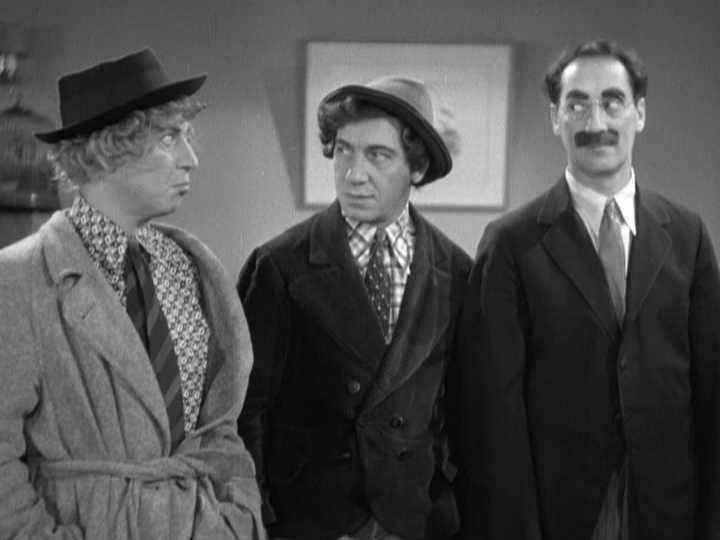
Even on the night of the play, Miller is willing to risk it all to the very the last minute by defrauding the bank and attempting to keep it secret until they come up with the fake suicide plot that takes the movie to the next level (“If only we had some money we could bribe those hotel dicks” – “Maybe the hotel could advance us some”). It’s the type of ridiculousness we love and expect from the Marxes. At some point, it makes you think how it wasn’t originally written for them. If anything, their involvement with this production was fate. The whole contract signing scene was the funniest in the film, along with the aforementioned scene where the turkey is let loose in the hotel room and Harpo’s horribly misses each time with his bat and breaking every vase in the area trying to hit it. Then, there’s the disorderly sequence where Wagner brings Dr. Glass into the room since he thinks Davis is faking his sickness, and Miller and company are forced to adjust because Davis is hanging out with Hilda, prompting them to put Faker in his place and act as if he’s upgraded to having a tapeworm instead of the measles since they can’t find the iodine. Wagner questions how it’s changed so quickly, and Miller just says he’s not responsible for complications and Davis has laryngitis too. Hilariously, Wagner points out how Faker isn’t Davis because he met Davis yesterday, only for Miller to quip he aged 10 years because of the service in the hotel. Wagner tries to counter with how his hair wasn’t red yesterday, so Binelli adds that it’s a red tapeworm. In the middle of Binelli stubbornly acting as Faker’s doctor to argue with Glass’s questioning while Miller and Gibble deal with Wagner, Hogarth returns to bring up how Davis is gone. To continue their lie of Davis being a lunatic, they immediately tell Hogarth that he’s been transferred to the county hospital and to go there before they transfer him again (“Hail and Farewell!”). Christine joins in on it and they all shake hands.
It’s moments like these and a bound-and-gagged Glass popping out of the bathroom in the middle of the argument that stalls the contract signing that shows the overloaded anarchic fun that takes place in this forgotten gem of a movie (They’ve kidnapped him!” – “He may be left over from the last convention”).
As previously mentioned, there are comedic opportunities for Groucho that seem obvious from a fan perspective that he doesn’t take simply because of the structure of the movie. For example, when Davis gets angry about Hogarth and the collection agency thinking he’s crazy because they might send a letter to his mother, Miller points out how it doesn’t matter because his mother knows he’s not crazy. Now, this is a logical response from Miller or any character in quelling the character’s concerns, but what Marx Brothers fans make take issue with in Room Service is that a Groucho character would surely have a quip here closer to, “At that point, it’s her problem”. Groucho’s Miller being one of the most normal and logical characters he’s ever played is where things get a little disappointing, even for someone like myself who likes to defend this film more than most ever would. On the other hand, they make up for it with how Miller messes with Wagner once he finally gets the check from Jenkins. He could just hand it over to Wagner to pay all the money he owes, but he calls Wagner’s hotel shaky and asks Wagner how he knows they won’t go into bankruptcy, with Binelli adding how will they know if Wagner’s credit is good, immediately getting cocky after getting the money, despite knowing they were dead broke minutes before. Thankfully, Miller agrees to sign it over once Gibble pleads with him to pay a bill for once in his life, but he automatically requests the best suite in the hotel. Wagner agrees to give him the bridal suite, and Miller replies in typical Groucho fashion, “Alright and about three brides”.
Even if someone like Groucho was restrained, Harpo’s role as Faker didn’t miss a beat in terms of what he usually brings to the table. Other than the bit with the doll, Faker fills in the cracks of the narrative with his sight gags of frantically eating several bananas or a sandwich with the rapper still on it, his hard-slapping Wagner on the back after Wagner does it to him when they are both laughing, and his starting a fire when Binelli merely suggests it as a possibility and they all panic and put it out. His role in faking the second suicide to make Wagner feel like a piece of shit was absolute gold too (“Wagner drove me to my death just as he drove Leo Davis”). When Miller and Wagner are dragging what Wagner thinks is a dead body and a woman walks past them and they all look at her, along with Faker, there’s no doubt you will be cackling at the antics the brothers find themselves in.
For fans of comedy and its history, the legacy of this movie also gives us the only opportunity to see the Marx Brothers team up with fellow comedic legend Lucille Ball. Granted, it’s way before she took off as one of the brightest comedic talents in the country, but it’s ultra-cool seeing this rarity, nonetheless.
The only thing that never works but the film tries painstakingly in trying to make it so is Wagner’s old-timey catchphrase of “Jumping butterballs!”. It cannot be stressed enough how awful this line is. It was a product of the time so it can’t be blamed too much, but it’s simply dreadful. It’s so old fashioned that it makes the viewer cringe every single time the character says it. There’s so much in this movie that works, but this line in particular is so over-the-top corny that it immediately reminds the viewer they are watching a 1930s comedy in the worst of ways. In Donald MacBride’s defense, he’s one of the most memorable antagonists the Marx Brothers have ever faced on film. It’s a surprisingly strong performance and his Wagner is a great foil to Miller’s exploits. Nevertheless, there was absolutely no need for such a god-awful catchphrase. It totally undermined what was otherwise a good performance. Besides this catchphrase nonsense, a viewer from the present could legitimately enjoy this feature, though they will find the Davis character to be an unbelievable goober of epic proportions. The naivety of Davis becomes similar to nails on a chalkboard early. After knowing Miller for longer than 10 minutes, is he really that clueless in not seeing why he finagled that meal out of Smirnoff? He literally asks, “You mean you promised him the part just to get a meal out of him?”. Dude, grow up. On top of the ridiculousness in him meeting Hilda one day and intending on marrying her a week later and no one seeing an issue with it, the man has the audacity to try and start an “Author!” chant during the showing of his own fucking play! Then, Hilda has to remind Davis the play isn’t over yet. What? He wrote the damn thing! How does he not know this? God, this kid was insanely annoying. In all honestly, Wagner’s catchphrase and the obnoxiously stupid traits of Davis, despite both men being likable actors otherwise, are the only two reasons why the film doesn’t reach the “A+” grade.
With so much being said about this being a Marx movie grounded in realism compared to their other endeavors, one thing that didn’t fit was Glass being shockingly understanding about being attacked and tied up in the bathroom by Miller and Binelli. It works as a “deus ex machina” sort of solution in that he sticks up for the good guys, arguing that Wagner drove them to do what they did because Miller was in the midst of a perfectly legitimate business deal that Wagner mucked up, but there’s no way Glass would have been okay with how they went about things, considering the attitude he walked in with in the first place (“You’re not Miller’s brother-in-law too?”).
Darker in its humor but just as frenzied as ever before, the hilarious Room Service may not have been written as a Marx Brothers movie, but you can barely notice the difference. It’s a comedy that cuts out some unnecessary staples of their other films, plays to their strengths, and stays on task as the story amusingly ties itself up to a perfect bow in the finale. It may not be Duck Soup or anything, but it’s more than worthy enough to live up to the standard of what it means to be a Marx Brothers film. If you’re trying to recommend the movie to someone who isn’t a fan of the Marx Brothers, understate the events that unfold and boil it down to what it’s truly about. Realistically, it’s one of the greatest examples on film of creativity, problem solving under pressure, and the importance of teamwork. Technically, you wouldn’t be lying, even if it is a colossal oversimplification of the madcap happenings of Room Service. However, if you’re talking to someone who isn’t a fan of the Marx Brothers and are trying to sell them on watching one of their movies, just stop talking to that person. They aren’t worth your time.



+ There are no comments
Add yours