
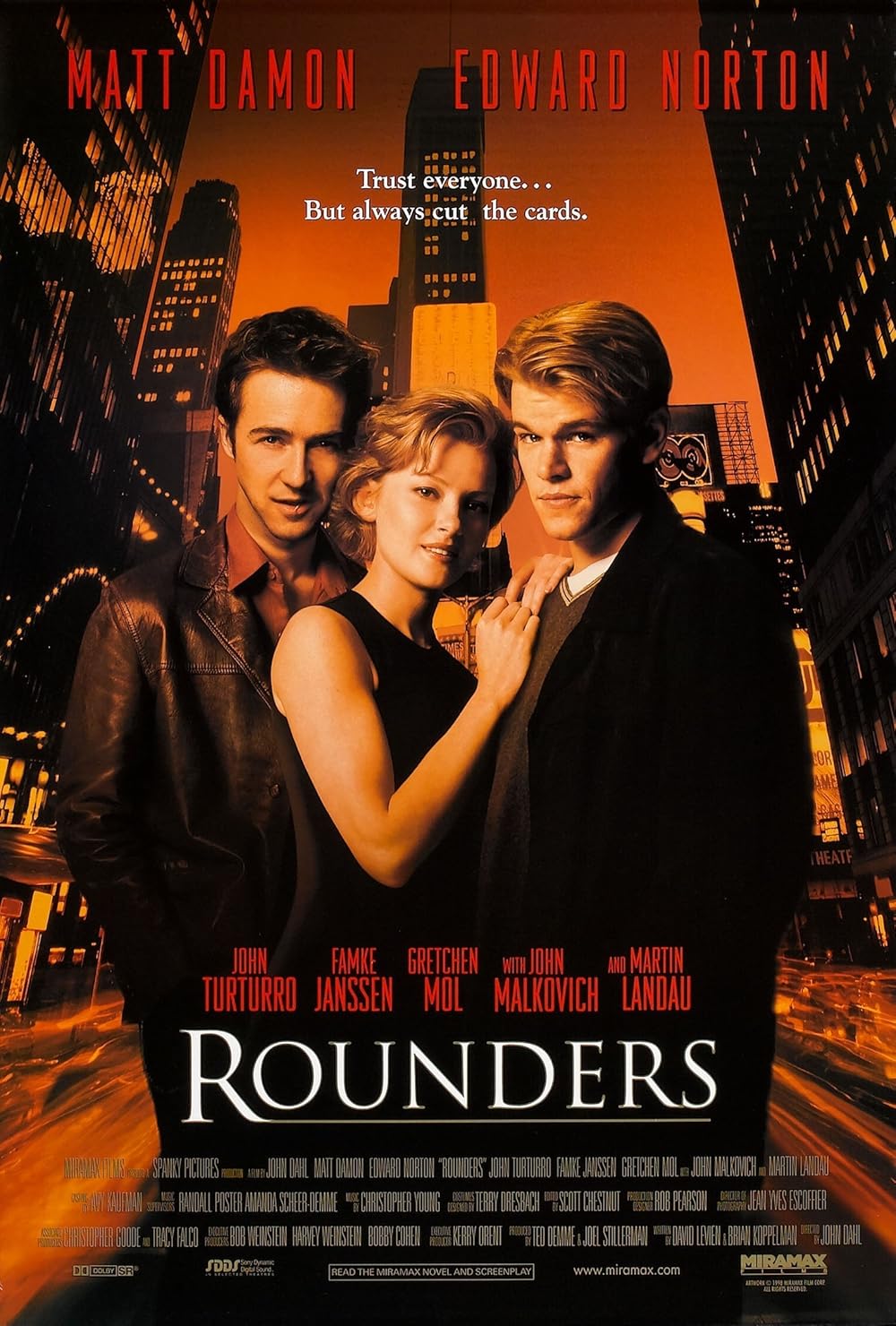
Starring: Matt Damon, Edward Norton, John Malkovich, John Turturro, Famke Janssen, Martin Landau, Gretchen Mol, and Johnny Chan
Grade: A
Watching the smile leave Mike’s face when Worm walks into that game with the state cops lives in my head rent free.
Summary
In New York City, Mike (Damon) wakes up in the middle of the night and gives a goodnight kiss to his asleep girlfriend Jo (Mol). Next, he grabs several stacks of cash hidden in objects and places all over the house. In a narration, Mike details how if you can’t spot the sucker in the first half-hour at the poker table, you are the sucker. People around here play for a living. You don’t gamble. You grind it out and achieve the goal of one big bet an hour. Get your money in when you have the best of it and protect it when you don’t. This is how Mike has paid his way through half of law school. He has become a true grinder, winning a little over time. The problem with being too careful however is that your whole life can become a grind.
Mike goes to an underground spot run by Oreo-loving Russian gangster Teddy KGB (Malkovich). KGB assumes Mike wants $500 worth of chips tonight, but Mike lays out all his money and wants $30,000 worth of chips this time around. KGB is connected to the top of the Russian mafia. According to Mike, he is the one guy in the game you don’t want to fuck with. If you’re looking for a high-stakes game though, KGB’s is the only one in town. Everyone there knows Mike as a small-time player, but it’s going to change tonight. Mike sees New York legend Joey Knish (Turturro) walk in the room and Mike puts his hat over his chips. Knish is known as a rounder, earning his living at cards since he was 19 years old. Knish goes straight over to Mike and takes the hat off his chips, asking if he’s holding it for someone. Since their kind of friends, Mike jokes that he’s holding them for Knish. Knish laughs but doesn’t think Mike should bring them into play because the group that is there tonight are serious card players. He could lose a lot. He thinks Mike is preparing to go to Las Vegas, but Mike walks around it. Mike insists he knows what he’s doing, even though Knish tries to throw out cheaper places to play out that are much safer. Seeing that Mike isn’t changing his mind, Knish lets him be. Mike’s game is No Limit Texas Hold ‘Em. The minimum buy-in is $25,000. It’s a game that doesn’t happen a lot outside of casinos, which is why this place attracts big-time players. Mike refers to No Limit Texas Hold ‘Em as the “Cadillac of poker”, detailing how each player is dealt two cards face down with five cards dealt face up across the middle. These are the community cards that everyone can use to make the best five card hand. The key to the game is playing the man, not the cards. He goes on about how there is no other game in which fortunes can change so much from hand to hand. Some professional players don’t play No Limit because they can’t handle the swings. Some like Doyle Brunson consider No Limit to be the only pure game left.
As Mike narrates this, a No Limit game is being played. Both Mike and KGB are at the table. Over time, they are some of the very few still playing. Mike raises and KGB calls. At this moment, Mike just got a “top two pair on the flop” and he wants to keep KGB in the hand. Against your average guy, he’d set up a “bear trap” where he would hardly bet at all and let him walk into it. KGB is too smart for that, so Mike decides to over-bet the pot and make it look like he’s trying to buy it. He could play back at him, and Mike would get paid off. With this, he bets $2,000. KGB eats an Oreo and calls. Seeing this, Mike guesses that KGB has a flush draw. Mike unveils a full house. KGB bets $15,000, so Mike calls for time. It’s a ploy though, as Mike wants KGB to think he’s pondering the call when in reality he’s thinking about Las Vegas. Mike goes all-in because he doesn’t think KGB has the spades. KGB admits he doesn’t have the spades while he goes all-in too. With his comment, Mike can already tell he fucked up. KGB reveals that he has aces full, winning. Mike sits in shock. He lost everything. Knish takes Mike outside to talk. Mike can’t believe it. He lost his case money and tuition. Knish tries to encourage him by saying he’ll be back sooner than he realizes, but Mike says he’s done. Knish offers to stake him with a standard deal of getting 50% of the winnings. If he loses, it’s on Knish. Still, Mike is sure he’s done and asks if Knish still has the truck. He does, and he takes Mike to it. Nine months later, Mike is working a regular job thinking every day about how he came up short. He’s had this picture in his head of him sitting at the big table playing at the World Series of Poker with Doyle to his left and Amarillo Slim to his right. He let that vision blind him at the table with KGB. Now, he’s nowhere close to Vegas. Currently, he’s working this job handed down from Knish to rounders who forget the cardinal rule:
Always leave yourself outs.
Focusing fully on his studies and his job, Mike delivers some packages to a corner store and has a friendly conversation with store manager Ernie. At City Law University, Mike narrates about the Judges’ Game, a private poker game between a rotating group of 10 or 12 judges, prosecutors, and professors. Mike heard about it before he was even in law school. They all have money, and Mike comments how awesome it would be if any one of them were to owe him favors. The only problem is that no one can get into the game anymore. A rounder named Crispy Linetta ruined it for everyone by playing in their games until they found out he was a professional player. After that, he couldn’t cross the street without a legal hassle. His regular club Forshay’s got shut down, and it opened in 1907. Just then, Mike interrupts the game to deliver a book to his professor Judge Abe Petrovsky (Landau). They joke with Mike, and Abe brings up how Mike will be lead counsel over a case Judge Marinacci (Tom Aldredge) is presiding over next week. Abe suggests Mike might be a clerk for one of the men at the table in the summer. In his head, Mike gives them credit for being great minds, but he can see obviously that no one there is a real card player. A bunch of guys call on a hand, and Mike takes it upon himself to raise on Abe’s behalf, even though Abe admits he would’ve just called. Mike knows the risk with what he just did, but he can’t help himself. Once Marinacci says the bet is $20, Mike bets it on Abe’s behalf again, and these guys can’t believe it because he’s only seen half the hand. Mike is confident he knows what they’re holding and Abe’s chances, but Marinacci refuses to believe it. Upping the stakes, Mike bets that he can guess what he’s holding and wants his summer clerkship in his office if he’s right. Agreeing to it, Marinacci says he’ll put Mike at the top of the list if he does. With this, Mike explains that Marinacci was looking for that third three, but he forgot Professor Green (E. Matthew Yavne) folded on the fourth street “and now you’re representing that you have it. The DA (Michael Lombard) made his two pair, but he knows they are no good. Judge Kaplan (Beeson Carroll) was trying to squeeze out a diamond flush, but he came up short, and Mr. Eisen (Richard Mawe) is futility hoping that his queens are going to stand up”.
Everyone is amazed at him being completely right, and they all laugh and end the game. Abe only had a busted straight, but Mike assures him that’s enough to win. Marinacci invites Mike to sit down with them, but he says he doesn’t play cards and says goodbye to Abe since they’ll see each other tomorrow. After he leaves, Marinacci says he likes Mike, and Abe admits how smart he is. Following this, Mike drives his delivery truck home and notes how hard it was to leave the game. However, he still considers himself retired. He can find games to play easily, but he’s made promises and is just a law student now. He goes home to Jo in the early hours of the morning, and they greet each other. Getting ready to go to sleep, he talks about how the nights are killing him. She reminds him that it never used to be that way for him, but he argues his card-playing was different since buy-in was around 8PM and the morning would come quickly. He brings up the good news about potentially being up for a clerkship with Marinacci because he impressed him by reading his hand blind. Jo is bothered by it since he was in the atmosphere of a card game, but Mike argues that she was the one who said he should use his poker skills in the courtroom. She meant more about using his head with how he can calculate odds on the spot and how he reads people. She sees what he did with Marinacci as conning his way into a summer job, though Mike sees it as networking. Jo laughs, but she points out the dangers of going down this path. Her example is that of an ex-college athlete getting a job at the DA’s office as long as he never misses a lawyer’s league game. If Mike gets in this way, he might always be a hustler to them. She drops it momentarily after he insists that he didn’t play. Before Jo leaves, Mike asks if he can take the jeep tomorrow because Worm (Norton) is getting out of prison and he was going to pick him up. She’s cool with it but can’t believe he’s still friends with someone with the name “Worm”. As Mike says he’s like his brother, Jo slams the door shut. The passive aggressiveness is real.
Mike met Worm at the Dwight Englewood Preparatory Academy in New Jersey. They were the only two there who didn’t have a trust fund. Mike’s dad was a custodian there. That’s the only reason they took Mike. In prison, Worm is playing poker with his fellow inmates and beats them in another game, winning a bunch of cigarettes. One of them tells Worm he’s not walking out of there with the cigarettes, but Worm assures them he’s not going to smoke them. If they want them back, he invites them to trade something for them or try to play double or nothing tomorrow. Just then, a guard opens the door questioning what Worm is still doing there because he’s already been processed for release. He smiles at the inmates and gets up to leave, so the other prisoner gets mad because Worm doesn’t even smoke. However, Worm is mad because he won them fair and square. After their continued pestering, he gives the cigarettes back but adds that if they are determined to die of cancer, they should learn how to play cards. The other prisoner notes how it’s not good to add insult to injury because it could come back to haunt him, but Worm says it’s not going to happen in this lifetime. With this, he tells them all to enjoy their time. As Worm gets his stuff to leave, Mike narrates how Worm’s dad did the grounds at the prep academy when he wasn’t drunk. When he did get drunk, Mike and Worm would do them. Of course, that’s not all they did. Usually, they would be working some sort of scam on all the students, and it was orchestrated by Worm. They’d be selling dime bags of oregano, nunchucks, and firecrackers from Chinatown. This secured their lunch money. As he says this, Worm asks the guard where the rest of his stuff is, so he hands Worm his toothpick in a plastic bag. As Worm shaves in the mirror, Mike continues about how they got caught when they went for more than just pocket change. They had the starting five of the basketball team take a dive against Friends Academy. The point guard is the one who cracked and snitched on Worm. Worm had to go before the school board, and they offered him a deal to rat everyone else out in exchange for going lighter on him. Worm didn’t say anything and got expelled while Mike graduated.
As he says this, Worm dumps the rest of the cigarettes out into a garbage can before walking out of the prison. He sees Mike waiting for him, and they pick up right where they left off. Worm is initially impressed by the jeep, but Mike admits he borrowed it. Even so, Worm excitedly tells him about prison during the ride and the economy inside of cash and trade. He kept three games going at once. One was with the white guys, one with the black guys, and another with the guards. He had to take enough cash off the white guys to lose it to the guards, so they can keep doing him favors. At the same time, he had to skim enough cigarettes from the black guys to trade and keep the “style I’ve grown accustomed to”. All the while, he had to avoid getting his ass beat. He was working completely alone on it. As Mike drives, he sees hints of a tattoo, so Worm shows him the tattoo. It’s an ace card imprinted on the inside of his forearm representing an ace up his sleeve. In addition to this, he shows slivers of his sleight of hand tricks that he’s gotten really good at. Changing the subject, Worm asks if Mike’s game is still sharp, but Mike reveals to him that he’s not playing anymore. He details the story about playing KGB, who Worm refers to as “The Mad Russian”, and losing it all. He didn’t want to tell Worm while he was inside because he didn’t want to dispirit him. Still, Worm wants to get him back in there, but Mike is adamant he’s done. Worm brings up a spot he knows they can play at, but Mike just says he will drive him there and doesn’t want to be a part of it. As soon as they pull up to the place, Worm tries to explain his plan. There is a girl named Barbara (Melina Kanakaredes) inside that he almost fucked before he went to prison, and she works as a hostess for all the trust fund kids who go there and play. She got him in by introducing him as a cousin who loves to gamble but wants to learn poker. It sounds good, but he needs the stake to get started, so Mike gives him $220. Worm balks at this because it will only allow for around 11 bets, so Mike says to forget this game, and he can take him to the city tomorrow. Worm can’t forget about this game because he’s already behind and needs to make money quick.
Mike wonders what the hurry is, so Worm admits there are five others who were eagerly waiting Worm’s release from prison. He owes around $10,000.
Trying to convince him, Worm adds that he can get started with Mike’s money but only if they work on it together. It’s tough, but Mike says he can’t on account of the promise he made. Worm is fine with it. He’ll just have to make some moves during the game earlier than he would like. He’ll see Mike in the city tomorrow. Before Worm departs, he tells Mike how great it was to see him. As Mike drives away, he stops in the middle of the road to think. In Confessions of a Winning Poker Player, Jack King said few players recall big pots they won, but every player can remember with remarkable accuracy the outstanding tough beats of his career. Mike turns and drives back to the spot Worm is playing at. In this moment, he can hardly remember how he built his bankroll. He can only think about how he lost it. As he walks into the building, Barbara greets him and says that Worm did say Mike would be running a little late. Clearly, he already knew Mike was going to change his mind. With this comment, Mike can’t help but laugh and follow Barbara into the room the game is being held in. When they walk, Mike tells Barbara that he will just keep Worm company and not actually play, but Barbara lets him know this isn’t going to work. There’s a new play at hand. Mike is going to be Barbara’s boyfriend who’s looking for a regular game. Mike tries to say he’s not much of a card player, but Barbara calls him out on his bullshit because Worm already told her about him. As Mike smiles, she tells him that her cut is 25%. She lets him into the game, and the play begins. Worm deals, and the game is “Chicago”, a stud game where there’s a “high split in the hole and it’s half the pot”. It doesn’t take long for Mike and Worm to regain their previous chemistry at the table, using tricks that would never work in the city like signaling, chip placing, trapping, and the old “best hand” play. Mike likens it to the backcourt tandem of Walt Frazier and Earl Monroe. Mike admits he could probably crack the game straight-up, but there’s no risk in this room.
Some may look at Worm’s mechanics as immoral, but Mike recalls Canada Bill Jones saying, “It’s immoral to let a sucker keep his money”.
Mike notes how good Worm has gotten and how his technique is flawless. However, his judgment is a little off. A few times, Mike had to “fold the case on him” just so it wouldn’t be obvious. He does give credit to Worm with how well he plays the role of a loser. By the end, Worm exits the table on a loss and acts like he’s mad with Mike’s streak of good luck before leaving. After everyone leaves, Mike walks with Barbara to Worm who’s waiting in the car. Mike gives Barbara her cut of $300, and Worm is excited to talk about the next game they can come to. Mike assures him it’s a one-time thing on his end, but Barbara tells Worm the next game is in two weeks. Worm kisses her goodbye and walks with Mike to the car. Mike questions how he knew he was coming back, and Worm brings up how Mike’s favorite actor is Clint Eastwood, referencing The Outlaw Josey Wales and how “he always doubles back for a friend”. In the early morning hours, Mike and Worm get back to the city, but Worm wants Mike to get him straightened out before he departs. With this, Mike takes Worm to a private spot with some serious card players, and he gets real with Worm because he doesn’t want him to try any tricks, as it could get him into some trouble. Upon getting into the spot, Petra (Janssen) greets Mike. She says the computer tried to delete him last week, but she knew he’d be back. Mike assures her he’s not playing and introduces Worm. She goes to answer a phone call, and Worm notes the button she has on. Mike says she’s wired to the precinct because they have them on the payroll. Rejoining them, Petra tells the two that the group playing currently are playing 20-40 forced rotation. It’s the only game going right now. Mike sees it’s a big game if Fat Grady is playing. Even so, he’s not doing it, disappointing Worm. Once Mike leaves, Worm asks Petra for $2,000. She’s not sure, but Worm says Mike is good for it and he is confident he will triple it in a half hour. Mike gets back to his apartment, and Jo is up waiting for him. They’re about to leave, but Mike wants to jump in the shower and invites her to go ahead and cover for him until he gets there. Bothered by his lateness, she accuses him of being at a card game with Worm, but he lies and says he wasn’t.
When Mike hops in the shower, Joe looks through his pockets and finds a wad of cash and puts it by the mirror.
Jo meets with the others to discuss the case, and Mike shows up late and acts like it’s not a big deal, though he gets a lot of passive aggressive comments from Jo and the other guy in the group. Suddenly, they are interrupted by Joey Knish who needs a word with Mike. Knish takes Mike outside to talk about Worm going around to his old spots like Chesterfield’s ruining Mike’s reputation with every lousy second he deals. Knish tried talking to him, but Worm saw right through him. Mike is about to go get Worm, but Knish says the group he’s playing with are at the end of a 36-hour session and can’t see straight, so it’s fine. They walk for a second until Knish adds that if Worm is still there by the time Roman (Slava Schoot) and Maurice (Goran Visnjic) play, he’s going to wish he was still in prison. Mike excuses himself and runs to Chesterfield’s to get Worm. Through narration, Mike talks about how the greatest propositional gambler of all time in Amarillo Slim held to his father’s maxim: “You can shear a sheep many times but skin him only once”. Mike knows this is a lesson Worm has never bothered to learn. During his game, Worm is angering the group of Russians with his attitude and tricks, winning yet another game as he does it. Mike shows up and he greets Maurice who’s playing with Worm. He invites Mike to play because he’s going to prison for four months starting tomorrow, and Mike wishes him well. He pulls Worm from the game to talk outside, and Worm is bothered because he’s up $8,000. As Worm walks over to get a hot dog, Mike lets him know that he already has a sign on his back because of how he played, so Worm correctly guesses Knish ratted him out. Worm tells Mike to stop listening to Knish, noting how Knish sees all the angles but doesn’t have the balls to play one. Mike argues that this is why Knish hasn’t had to work in 15 years, but Worm sees grinding it out like that as work. Mike thought so too but now he knows what real work is considering what he’s been doing. He asks Worm if he’s going to find a job like going back to his old thing of illegally printing credit cards and going back to prison because of it. Worm corrects him and says he was distributing, not printing. Either way, he promises he’s not going back to prison, and he doesn’t want Mike to worry.
Mike takes him away from the hot dog vendor and gives Worm the advice of being smart. All the places in Manhattan keep books. If Worm is listed as a “mechanic”, he’ll get the shit kicked out of him and won’t be able to get a game anywhere in New York. Worm gives Mike credit for seeing the big picture, but that’s just not him. He doesn’t play the game straight up, only to get a real job if he loses. On his own admittance, if he sees a mark, he takes them down. It’s the way he lives, and he has no problem in saying this. Mike knows this and gives Worm credit for teaching him all the angles, but he’s not in the position Worm is in right now. He talks about Roman and Maurice being real Russian outfit guys that he shouldn’t be fucking with, even if they aren’t as bad as KGB. He wants Worm to go back in there and lose his money back to them, but Worm refuses because he needs the money. Mike suggests playing out in suburbia or to Swan Meadow to play in the golf pro game. Worm likes the latter idea and finally agrees to lose the money back to the Russians. He wants Mike to meet him at Stromboli’s in a half hour, but Mike declines because he has a meeting and then has to go to Queens to load the truck. Worm is annoyed with his new “working man” attitude, but Mike doesn’t let up and tells Worm to make his losing to the Russians look good. Naturally, Worm doesn’t listen. At the end of his playing, he cashes in $10,000 worth of chips. Petra tries to take the $2,000 she lent him, but Worm wants all of it. Petra tells him that usually only credit players leave with their profit. Otherwise, “the juice starts” and Mike gets five points a week. Not giving a single fuck, Worm is cool with it and just tells her that they’ll owe her. Meanwhile, Mike finds Jo in a bar because he was looking for her, but she didn’t want to be found. She tells him how the rest of the group waited a long time for him, but he argues it was just him missing one meeting. She says it’s not about that, bringing up the reason for her leaving that morning in finding the wad of cash in his pocket. He insists it’s not what she thinks, but she knows he’s lying.
She storms out of the bar, so Mike admits he played but downplays the game as practically playing whiffle ball because of how easy it was. He couldn’t lose, but Jo doesn’t want to hear it. She stood by him through everything when he lost it all, and she doesn’t want to go through that again. Mike argues that this isn’t always about gambling, bringing up how the same five guys make it to the finals of the World Series of Poker every year. It’s not because they are lucky. It’s a skill game. She wonders why he would lie then, and he counters with how she wouldn’t understand. He goes on about how for the first time since the match with KGB, he felt alive. She can’t believe what she’s hearing and storms off. At night, Worm is at a strip club, and gangster Grama (Michael Rispoli) approaches him. Worm happily greets him and says he’s considering putting him back on the pay roll and to get back to him in two weeks, but Grama is on his own now. He reminds Worm how a lot of people were angry when he went to prison. Worm knows, which is why he’s trying to put together a roll. Grama ignores this and continues with how a lot of people were coming to him asking if he could help or if he knew how to find Worm. With this, he got to thinking, and Worm responds sarcastically to this comment about how it’s big that he’s thinking. Grama grabs him and drags him to the bathroom. He tells him that instead of the $15,000 he owes to five guys, Worm owes $25,000 strictly to Grama. He consolidated Worm’s outstanding debt. Worm protests at the up charge, so Grama starts beating the hell out of him. Worm points out how they were partners, but Grama corrects him and says that he was Worm’s lackey. What Grama did was go partners with KGB, as he’s backing Grama. Worm doesn’t believe it because KGB has plenty of guys, but Grama reveals that he jumped at the chance once he heard Worm’s name. Now, Grama has a great deal on him, thirty cents on the dollar because there’s not a lot of faith in Worm in the “business community”. Worm says he’ll scrape something together this week, but Grama takes all the money he has on him and punches him again in the stomach before leaving.
Mike meets with Abe at a bar, and Abe gives him credit for the card game the other night, though he is disappointed in him missing his group meeting today. Mike wants to give him an explanation because he feels Abe is owed that, but Abe is fine with it. He just tells Mike to work harder next time, prepare, and smooth things out with the others. Mike thanks him and is about to go, but Abe invites him to stay for a drink. He gets a bottle of gin and pours one up for him as he asks how Mike was able to figure out everyone’s cards. Mike goes through it step by step. He was watching when the cards came out, and he watched the players react to the cards, which is how he knew the DA made his two pair and Judge Kaplan missed the flush. He was watching their eyes when they checked their river cards, as their faces tell him everything. Abe is amazed because he never thought playing cards could be this complicated. Seeing his interest, Mike starts to give him more tips. If he wants to play premium hands, you only start with jacks or better split, nines or better wired, three high cards to a flush. If it’s good enough to call, you have to be in there raising. You also have to be aggressive, tight no doubt, but aggressive. He sees this as Abe’s style and suggests he think of the game like a war. Abe jokes that Mike is never allowed to their game again, and Mike doesn’t blame him. If he were in a game like that, the cards wouldn’t even matter. He could play it blind. On that note, Abe wants to tell him a story. He brings up how the men in his family have been rabbis for generations. It was supposed to be his calling, and he was considered to be a prodigy. The elders said he had a 40-year-old’s understanding of the Midrash by the age of 12, but he knew he could never be a rabbi by the age of 13. This was because from all he understood of the Talmud, he never saw God there. He tried to lie to get through it because people were counting on him, but he couldn’t. Mike gives him credit because what he’s doing is a respectable profession, but Abe says it wasn’t to his family.
His parents were devastated with his decision, and his father sent him away to New York to live with distant cousins. Eventually, he found his life’s work in law. He felt deeply inside that this is what he was born to do. His parents never got over it though, and his father never talked to him again. Still, he doesn’t regret it. He doesn’t see it as a choice but rather what he was meant for. Referencing the last thing he took from the yeshivas, “We can’t run from who we are. Our destiny chooses us”. Following this, Mike goes to his apartment and finds Worm spitting up blood outside. Worm doesn’t give him the details. He just wants to stay over, so Mike allows it. However, he wants Worm to tone down his shtick because things haven’t been great with Jo lately. The two walk inside but see Jo has moved out. She even took the fucking bedsheets. Worm can see Mike is down and tells him how she was in the wrong until Mike cuts him off because he doesn’t want to hear the bullshit. Still, there is one thing that makes Worm feel better when he’s down: rolled-up aces over kings and check raising stupid tourists, taking huge pots off them playing all night, high-limit Hold ‘Em at the Taj Mahal.
Fuck it. Let’s go. Let’s play some fucking cards.
My Thoughts:
There are very few subgenres of film as richly engrossing as the underground world of gambling, card playing, and poker. Even passive card players and non-gamblers can find excitement in these types of movies because for the most part, the team of filmmakers and screenwriters behind them have a deep understanding of these worlds and know how to bring it to life for mainstream crowds in a cinematically pleasing way. Rounders is a good example of a movie that attracts audiences with its cast and general sports-driven story about a player losing it all and trying to find a way to get back to the top, but it also does a great job at teaching novice viewers the ins and outs of the game that only rounders and pure players would know, so much so that many professional poker players have given the film credit for its accuracy. Some have even referred to it as the “best poker movie ever made”. Though Rounders isn’t as complete from an all-around perspective, the reputation it has as a cult film isn’t far off, as there is no other Hollywood production in existence touching such topics that explains the game itself better while doing so in such an absorbing manner. Atmospheric, stylish, tense, funny, anxiety-inducing, accurate and filled with great characters, Rounders is a fun and exhilarating watch, as well as a nice lesson on finding out one’s true calling in life.
The best friend duo of Mike McDermott and Lester “Worm” Murphy is one for the ages. It’s a lot more relatable than most of us would like to admit. The clean-cut Mike has worked to turn his life around after losing everything he had and is doing great in law school now that he’s locked in. He was on the rise as a poker player and had dreams of playing in the World Series of Poker in Las Vegas someday, but after the devastation he suffered in the opening of the movie, he puts it all behind him. As much as the audience wants to get back into the card playing right away, it’s a great starting point because losing it all and seeing how Mike reacts to it is totally understandable. Think about it. What would you do if you lost $30,000 in a single hand while you’re in college and struggling as is? No matter how good you might be, this would be enough to force anyone to make some serious life changes. A full-on depression coinciding with it would make even more sense. How can one have any sort of confidence in themselves after making that big of a gamble and losing? Because of this, Mike makes the decision to play life like he does cards, straight up. With the help of his girlfriend Jo, who to her credit stayed by his side after he fucked up on such a colossal level, Mike and Jo are doing well together in law school. It’s not until Mike drops in to see Abe and his colleagues playing cards where he gets a taste for what he used to love, reading everyone’s hands blind just because of how attentive he is and how experienced he is with the game. He passes it off as networking to Jo because it does get him in with Judge Marinacci, but it’s only foreshadowing a return to the table at some point down the line. Still, Mike is adamant he’s done with it, as he’s still shook from losing to KGB. He thinks about that failure every single day, and it’s hard not to. The real problem happens when Worm comes back into his life. Freshly out of prison, Worm has not changed a single bit.
Edward Norton’s ability to play unsavory characters is known by audiences worldwide, but there’s something about Worm specifically that’s different. Maybe it’s because I’ve had a few “Worm-like” friends in my life that makes the character hit too close to home, but Norton is fantastic as the shyster friend always looking for a scheme or an edge of any kind to prey on others and get what he wants. He’s just as loyal to Mike as Mike is to him, but that’s the only connection they share as far as personalities go. Worm is the polar opposite of Mike to his core. Worm dresses in louder clothes, does not care who he offends, will make a scene if he needs to, is only looking out for himself, and flat-out refuses to see the bigger picture in any given situation. Why grind things out like Knish and play everything low-key when you can go big and make as much as possible in the shortest amount of time? Despite Knish making a career out of playing it safe, Worm doesn’t respect it and makes it well known to the respected Knish (“Keep grinding out that rent money!”). If you see the angle, go for it. It’s all about being in the moment with Worm. He goes into a game and looks at a poker table like a snake slithering through grass in a field of mice. Though Mike plays the game straight up, Worm sees it like a broken mirror and goes down every shard of glass to find a pathway where he wins out. What Worm doesn’t get is that nearly all professional players know the angles, especially the players him and Mike come across. However, it’s the unofficial rule of playing it straight with serious players that Mike gets and Worm doesn’t. Then again, Worm is intelligent enough to know what he’s doing. He just doesn’t care because he wants to get his money and get out. He says it time and time again. If he sees an edge, he takes it. Fuck it. If they don’t see what he’s doing or they don’t do anything to stop him, then they deserve to lose. On the off chance the player does notice what he’s doing, Worm will double down and play innocent to the bitter end, like in the anxiety-inducing game with the off-duty state cops.
That scene ends with Worm being called out for fixing when he was base dealing the deck, resulting with him and Mike getting the holy hell beat out of them in a hilarious sequence. Following the bloody beatdown that leaves Mike without a single dollar of his winnings, Worm simply states to Mike that he took a shot and missed. That’s his only response. It is what it is. We’ll get ’em next time. Worm has to take the edge if he sees it. It’s something ingrained in his DNA, so he goes through with it every time and operates under the assumption that he won’t be killed for doing so. He can handle getting his ass kicked though and doesn’t change for anyone. He’s unabashedly Worm and cannot help himself when it comes to playing cards. Worm is the type of guy that even if he was told ahead of time what was going to happen, he’d still do it because he still thinks he can overcome it. If not, he’ll land on his back, get up to his feet, and try it again. For someone who can’t fight, it’s crazy to have this level of confidence, but Norton pulls it off as he embodies the character’s life mantra. Worm doesn’t care about his reputation in the poker underground and thinks his ruining of Mike’s reputation in all the gambling houses is overplayed when it’s made out to be a big deal by Mike and Knish. He just sees things differently and will not change for anyone. It’s almost respectable as to how he sticks to his guns, no matter how badly he screws up. Even when Mike drags Worm to Grama to try and smooth things over and make a deal to save their lives, where it’s basically understood that they need to play nice with Grama so he hopefully gives them a chance, Worm still can’t help but cuss out the gangster to make things worse after Grama starts talking shit to him (“You know what Grama? I need your fucking charity like I need your cock in my ass!”). He’s a risk-taker who can’t help himself and doesn’t have any regard for anyone he fucks over, but somehow, Norton’s “Fuck it” attitude and complete detraction from the likable and bright-eyed Damon makes Rounders a cool movie with an authentic friendship at its core that makes it all work.
The genuinely good dude vouching for his screw-up best friend who continuously disappoints him in real situations may not seem like it’s worth it, and some viewers will question why Mike vouches for him so hard, but many can speak from experience in saying that this friendship is so relatable it hurts. As bad as your friend can fuck things up, you still can’t help but remember the good times and why the bond was shared in the first place. It’s because of these memories that Mike created with someone like Worm where he can’t just give up on him. For better or worse, Mike’s early life hangouts with Worm helped shape who he was and who he became as an adult. Plus, Worm taking the rap and refusing to implicate anyone else in having the basketball team take a dive that led to his explosion from school and Mike being safe shows how Worm’s loyalty runs deep and vice versa. No matter what his best friend does, Mike can’t forget him and throw him to the side. He’s like a brother. He’s too loyal to Worm to a fault, which is why he’s willing to go to bat for him until Worm’s debt becomes his as well because of his willingness to back his oldest friend. Mike was even willing to pay off his debt beforehand had he known about it, but Worm never wanted to consider it because he refuses to be a leech, which shows how the son of a bitch does have some internal values and isn’t nearly as bad as he comes off to others. Mike knows Worm better than anyone else and knows he’s a much better person than people may give him credit for. This is why he can’t help but do everything he can to make sure his best friend is good. Despite Worm’s debt being entirely his own fault, Mike never blames him. Instead, he calls Grama a “turncoat motherfucker” when Worm tells him what happened. No one wants to get to the point where they have to give up on their best friend, but that’s the important lesson learned in Rounders, other than finding one’s true passion in life. It’s that the trouble we get into when we’re younger can be overlooked. These experiences have to happen to help us become better adults. At some point however, growing up is in order.
Mike gives Worm the benefit of the doubt more than anyone since he just got out of prison, and they laugh together and enjoy the good times like there was no time lost between them. However, the battle lines are eventually drawn. Mike has gotten to the stage in life where he needs to be at to grow. He knows how to approach poker just as he approaches life. Once he realizes Worm has not changed, will not change, and has arguably devolved in this frame of mind, despite everything he’s been through, it’s time to cut ties no matter how much you love the guy. The warning shot is the scene in the church where Worm downplays his debts, despite hiding there to avoid Grama. Mike tries to get serious with him and bring up how Worm used to go there as a kid to hide from problems he caused like fucking a fellow student’s mother, prompting Worm to miss the point and laugh because she was a “good-looking older woman. You gotta give me that!”. Mike gives him the harsh truth about his character by foreshadowing how he’s “fixing to go down hard and it almost seems like you want it”. Truth be told, this line is an accurate description of this type of person. It’s almost like they are asking for trouble with how they live life. Regular people can’t understand the “Worm” mindset, but strangely enough, these types do exist, as frustrating as Worm is as a movie character. He still argues that Mike is worrying too much and insists he’s going to turn it all around by adding, “No one’s gonna drop a garbage can on me”. It’s not until Mike responds, “No, you’re gonna move out of the way, and it’s gonna land on me” where Worm realizes his actions are directly affecting his friendship. It’s all falling back on Mike since he’s vouched for him at every turn, resulting in Worm apologizing and admitting how embarrassing it all is. It’s just enough to show Mike and the audience how there is a small sliver of hope left in his character to find redemption. It’s all the narrative needs to keep Worm in the story and for Mike to raise the stakes by offering himself and his reputation to Grama to help out Worm. That’s loyalty. Mike knows he’s all Worm has in this life, and he can’t give up on him that easy.
Even during their final conversation, Mike is hoping they can figure out some sort of plan, but Worm arguing it will blow over if they leave makes it all click in Mike’s head. It’s an underrated and overlooked scene that really puts their friendship into perspective for the audience and for the protagonist. Still, the movie is at its best when these two hit the tables as the best of friends and make mincemeat out of a group of inexperienced poker players who don’t know what they got themselves into, along with the great sequence in Atlantic City at the Taj Mahal when all the rounders take care of some tourists without Worm. It’s like sharks smelling blood in the water. Regardless, Mike and Worm are too much fun together, and it cannot be argued no matter how unlikable Norton’s character is to some. With Mike playing things innocently and Worm playing the role of the “loser” while dealing the cards, every card game scene they have together is so much fun. Even when Worm sits in and watches Mike plays his games straight to his annoyance is great (“Look at you. One 64-hour session and you need a nap!”). When they’re not on the tables, their conversations are still as engrossing like when the aforementioned scene where Mike finds Worm hiding from Grama in the church. In a good mood, Worm challenges Mike to a game of HORSE for $50 a letter to which an angry Mike replies, “Yeah, if I win, are you gonna pay me back with my own fucking money?”. Of course, another great example is when they go back to the apartment to find Jo left. Worm goes on about how Mike walked the line for her and the minute he wanted a little bit of his life back, she walked out. He tries to philosophize a saying with, “In the poker game of life, women are the rake”, with Mike getting mad by asking him what the fuck he’s talking about. Worm admits he doesn’t know but hilariously adds that there ought to be a saying about it. Their chemistry is present in every scene, as authentic as can be. To set up the third act, Worm puts both him and Mike in such a deep, nearly inescapable hole and his only suggestion is to say, “Fuck it” and skip town, fully doubling down on being one of the worst cinematic best friends of all time.
Considering how well we know the two at this point and how important Worm is to Mike’s life, you know it pains him to say he’s not with Worm this time around once he reveals to him that KGB bankrolled Grama. Finally, Worm found the line and crossed it to the point where Mike leaves him. And how does Worm respond?
“At least you’re rounding again, right? You’re gonna thank me for that someday”.
Classic scumbag energy. You got to love it.
Nevertheless, the energy Norton’s Worm brings to the screen, his penchant for great quips, and his general attitude are missed in the climax of the film. When Mike faces off against KGB in that intense finale, you can’t help but think to yourself, “Man, I wish Worm was here to see this”. Thankfully, we take solace in knowing that somewhere in some city in America, Worm is in debt to other gangsters and still screwing someone over in a card game to this very day. On the other side of things is John Malkovich. Even if I can’t stand him, Malkovich isn’t even a bad actor. Sometimes though, it’s hard to tell whether his choices as an actor are conscious or he just has a tendency to be a scenery-chewer at times. It’s hard to say with his performance as the Oreo-eating Teddy KGB. It’s a well-written antagonist and the smug Malkovich is a great choice to go toe-to-toe with the young Damon, but he goes so over-the-top with his outrageous Russian accent, it’s as if he’s acting in an entirely different movie than the rest of the cool and low-key cast. Every time he opens his mouth to deliver his lines in the most ridiculous way possible, you can’t help but laugh. It stands out as one of the biggest takeaways from Rounders, but it’s up for interpretation if it stands out for the right reasons. Despite this, you’d be hard-pressed to find a better finale showcasing the importance of skill, intelligence, and confidence in a game of poker between him and Mike in the last 10 minutes of the film.
Most of the narrative is all about card-playing and getting to the next game to see how our favorite characters react to their environment and the people in it. Anybody who stops them from it makes us want to shoo them away. For instance, Gretchen Mol’s role as Jo is this personified. Despite being lucky enough to be on the poster, she only exists as a hurdle for Mike to get past to play poker. At first, you can see her frustrations with her boyfriend, but her continued lack of understanding it from his perspective turns her into a total nuisance that the viewer stops caring about. This relationship didn’t deserve to last, and there’s not an ounce of regret from anyone when they finally split. There was zero communication between the two, Jo only sees her side of every argument despite her good intentions, and she wasn’t given much to do other than complain, which does her no favors in making us feel bad when they go their separate ways. Anytime it goes back to her scenes, you almost want to tell her yourself to shut the fuck up. She’s holding Mike back and vice versa. Actually, the final scene between Mike and Jo should have been removed. The closure wasn’t needed. The spark between them was barely there to begin with and was long gone by the time he runs into her in the final minute of the movie. Her dialogue was groan-inducing to match.
Jo: “I learned it from you Mike. Rule number one: throw in your cards the moment you know they can’t win.”
Mike: “This isn’t a losing hand in poker”
Jo: “I know exactly what we’re talking about Mike”.
Man, shut the fuck up.
If we’re being real, the one scene in which Famke Janssen’s Petra drops by at Mike’s place when he was rewatching the 1988 World Series of Poker did more for the movie than anything Jo did. Let’s be honest, Mike fucked up there. He should have went through with it. Petra understood Mike a hell of a lot more than most people in this film including Jo.
The reason why Rounders gets so much credit by poker players is because of how well the depiction of real card players and their thought processes are. Mike’s voiceover narration describing his own strategy in games to let the viewer in on the action is fantastically written. Certain quotes don’t mean as much to the audience as they do Mike, but him commenting on how the smallest details can make a player pivot their game makes us feel like we’re learning real secrets and tricks of the trade that only the experts could know after years of playing. It’s awesome. You exit certain scenes feeling like you’ve learned something, like the aforementioned Atlantic City sequence. When Mike is with Petra, Knish, and Zagosh at a poker table, they all know each other and have a good time. Then, some unknown tourists join them, and the action begins. Mike talks about how they don’t necessarily work together, but they aren’t playing against each other either (“It’s like the nature channel. You don’t see piranhas eating each other, do you?”). To the untrained eye, we would never notice this clue, but the screenplay shines the brightest in these moments by having Mike talk the audience through it. At the very least, we know if a “fish” acts strong, he’s bluffing and if he acts meek, he has a hand. However, this is just a small portion of it. As Mike reiterates time and time again, you’re playing the player, not the hand. This is where Mike talks about tells that only the most locked-in person possible could notice. It’s more than just the hand over the mouth. There are facial tics, nervous fingers, the way a cigarette is smoked, and other unconscious gestures that reveal a hand. How players utilize ego and confidence for themselves or against certain players is just as impressive to watch unfold. It really is a skill game, and I didn’t respect the significance of certain moments nor the art of it all as much as I did after watching Rounders. That will always be this film’s legacy. It respects the game of poker and No Limit than any film before or since.
And remember don’t splash the pot, okay? It’s rude.
Matt Damon does an excellent job as the lead. He’s young, looks harmless, and gives off the vibe of someone you wouldn’t mind being friends with. The character of Mike would love to hear that description too, as he would use this misconception about him to take you out on that poker table. When he’s at his most confident and back on those tables, you’re beaming with enthusiasm as much as he is. It’s the definition of feeling alive. Nevertheless, Damon is at his best here in showing the character at his lowest. The desperate pleas to Knish for help, who takes no pity on him after years of Mike declining to listen to his advice, were crucial in defining the two characters. In addition, Mike’s retelling of that story facing off against Johnny Chan that proved to him that he was good enough to face off against the best was bone-chilling (“I’m sorry John. I don’t remember”). Not every viewer knows who Chan is, but it’s presented in a way where you can’t help but feel goosebumps because we know Mike beating Chan is like a high school basketball player managing to beat Michael Jordan in a game of one-on-one and living to tell the tale. Plus, the final conversation between Mike and Abe was tremendously done, showing how the protagonist is quite literally on the verge of life or death. When you have to go to your mentor for a check that big, you are quite literally out of options (“I vouched for the wrong guy and now it’s on me”).
We’ve seen plenty of films about card playing and poker and though you still may not know how to play afterwards, it won’t stop you from enjoying what Rounders brings to the table. It teaches you the game, makes you want to learn it, and gives you a newfound appreciation for the skills needed to succeed at it, as it’s magnified through the performances of stars Matt Damon, Edward Norton, John Turturro, and John Malkovich. Utilizing excellent locations throughout New York and New Jersey to hook the audience into the “big city” feel while painting the picture of the seedy, underground nature of the poker scene on the East Coast, Rounders is one of the better pictures in existence as far as card-playing films go. Its hook and presentation are its best attributes. There are some complications with other characters and anything not involving poker, but the overall production is exciting and entertaining enough to make this a movie worthy of a recommendation. By the end, it’s a guarantee that you will have an unexpected respect for those who are considered good enough to compete at the World Series of Poker.
With that being said, I still don’t think it deserves that much airtime on ESPN.


+ There are no comments
Add yours