
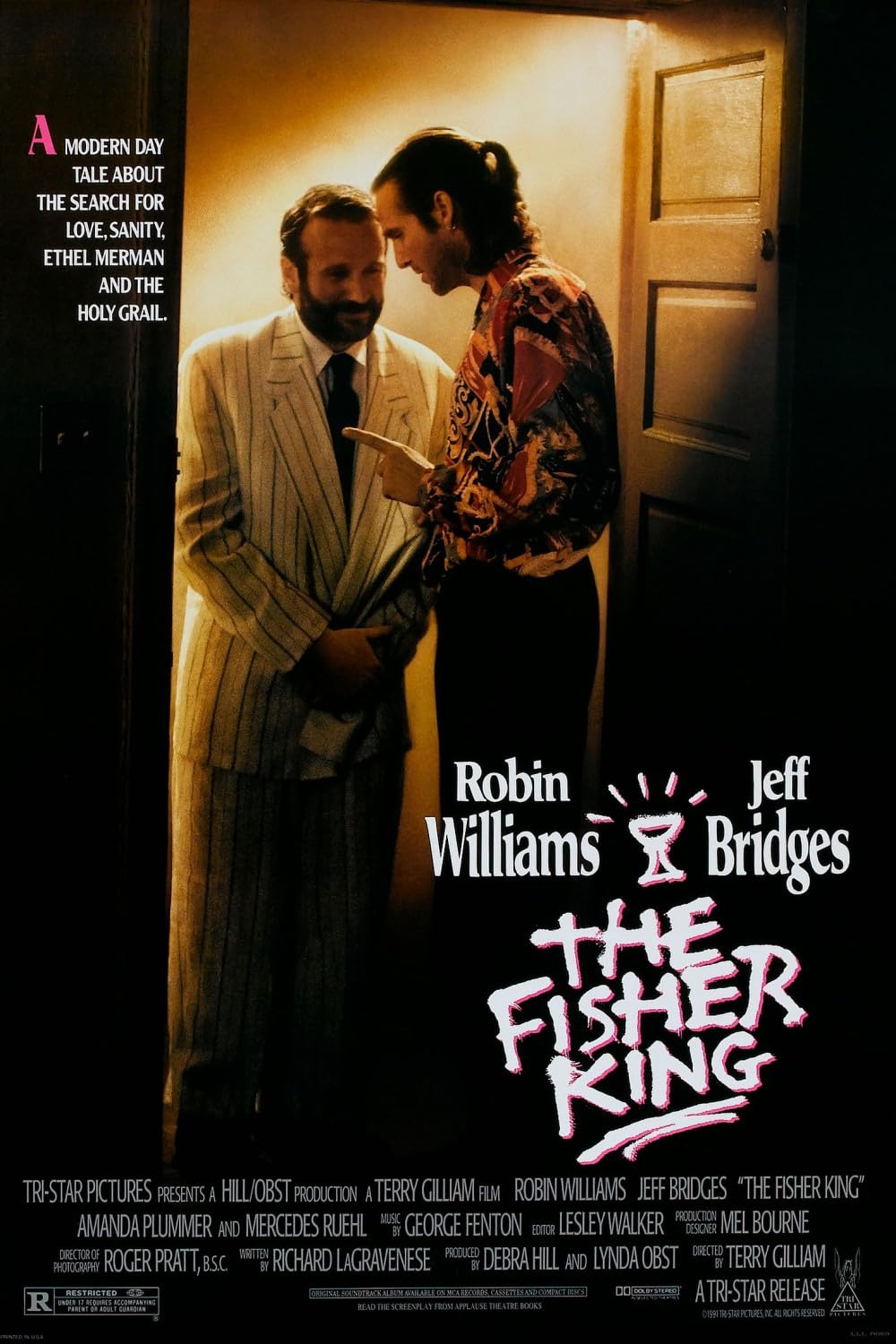
Starring: Jeff Bridges, Robin Williams, Mercedes Ruehl, Amanda Plummer, Michael Jeter, David Hyde Pierce, Tom Waits, and Harry Shearer
Grade: A
Such a thoughtful film like The Fisher King shouldn’t be boiled down simply to “Watch what you say to people”, but this movie acts as a great reminder to showcase how words can do a lot more harm than one may realize.
Summary
In New York City, shock jock radio host and star of The Jack Lucas Show in Jack Lucas (Bridges) takes calls from his listeners. One lady complains about her husband finishing her sentences, but it takes so long for her to get out this statement that Jack finishes what she’s saying for her. Almost immediately after, he’s annoyed and hangs up on her playing “Hit the Road Jack”, the show’s signature theme. This process continues. One woman calls in to talk about her affair with Senator Payton, but she’s bothered by the attention. Jack makes fun of her situation until she hangs up. Next is his regular caller Edwin, and Edwin talks about following in love with some girl at a high-end club named Babbit’s. Jack doesn’t want to hear another love story coming from Edwin, reminding him how he previously fell in love with a checkout girl at the grocery store and proposed. Jack knows this new girl is a yuppie, and he says they mate with their own kind. He refers to it as “yuppie inbreeding”, which is why “so many of them are retarded and wear the same clothes”. He adds that they don’t feel love but rather negotiate “love moments”. He refers to them as evil, doubling down until Edwin is silent and then agrees to listen to Jack. After Jack closes the show, he sits in a limousine with his agent Lou Rosen (Pierce). Lou is sure these producers want him for this television show, and Jack doesn’t want to hear anything unless there is an actual offer on the table. They are interrupted by a homeless man knocking on the window. Lou doesn’t have any change and asks Jack if he does, but he refuses to open the window. Plus, he knows a few quarters isn’t going to make a difference. He’s in his apartment later, and his girlfriend tells him Raoul called about wanting to have dinner with him. She wants to do something and seems to be bored with everything around her. Jack wants support since tomorrow is such a huge day for him because he might be getting his own sitcom, but she doesn’t really care. As he lights up a cigarette, he talks about how he always thought his biography would be titled Jack Lucas: The Face Behind the Voice, but now it can be Jack Lucas: The Face and the Voice, or Jack!.
She leaves the room while he talks. Later, he goes over different line deliveries of the script while in the bathtub. He goes over it some more that night and is confident in his chances. He turns on the news where an audio recording of his conversation with Edwin is played. In an unfortunate turn of events, it is revealed that Edwin went to Babbit’s with a shotgun and killed 7 people and then himself following Jack’s words of advice. Representatives for his show already reached out to expresses their sadness over the situation, but no formal statement has been made. Jack stares in shock over what he caused.
Three years later, Jack is working in a local video store with his girlfriend and store owner Anne (Ruehl). She finds him in the backroom reading the newspaper and wants him to come out to work. He finishes his Jack Daniel’s and heads out to talk to customers. One lady asks for a movie recommendation that fits in with the vibe of Katherine Hepburn and Carey Grant or something more modern like Goldie Hawn and Chevy Chase. She also asks if there is something with a comedian that she can’t remember the name of, referencing the comedian’s catchphrase of “Forgive me”. Sadly, this was the line Jack was going over three years previously because this customer is talking about the show that he was supposed to star in. Not saying a word, Jack pulls out porno Ordinary Peepholes and gives it to her. Anne interrupts to talk to Jack because she can tell he’s in his “emotional abyss” mood. He is, and she cuts off his miserableness by noting how much he hates people. She gives him the rest of the day off and tells him to hang out upstairs and relax. She’ll even cook tonight. That night, the two watch the TV show together that he was supposed to star in. Anne thinks it’s funny, but he doesn’t whatsoever, though he watches it all the time because it makes him feel better to see how unfunny it is. He wallows in his misery and continues to drink, talking about how its good to think and not read books like Love Song. Anne brings up how he used to like how they would not think and just be together, but Jack pours up another drink while saying “suicidal paranoiacs will say anything to get laid”. She storms out of the room. After Jack hears the star of the show say his catchphrase of “Forgive me”, he throws his drink at the TV and wanders out into the rain. He sees a homeless guy hang outside a hotel asking a wealthy father and son for money, but he’s quickly thrown out of there. The son walks over to Jack, calls him a bum, and gives him a wooden toy of Pinocchio. He turns to a group of homeless people and asks if any of them are named Jiminy, which gets a laugh from one guy.
The drunken Jack speaks aloud to the toy about Friedrich Nietzsche and how there are two types of people. One type is destined for greatness like Walt Disney and Hitler, and the other is the rest, the “bungled and the botched”. These people are teased and get close to greatness but never quite get there. Now, he has a new title for his autobiography, It Was No Fucking Picnic: The Jack Lucas Story. He caresses the doll and questions if he’s being punished for his sins. He goes to a body of water with his feet tied to a cinder block and is moments away from killing himself by jumping in the water. Before he can, two guys show up, beat him with bats, and douse him in gasoline. Suddenly, homeless man Parry (Williams) appears and acts like he’s a knight to stop the two men. When they corner him, Parry’s homeless friends start popping out of the corners to aid him. They start singing showtunes at the two men until Parry attacks them with dueling swinging socks. He takes one guy out, but the other escapes and drives off. Parry duct tapes the guy’s hands together while Jack pleads with Parry to not hurt him. Parry tries to calm Jack down by dragging him over to his other homeless friends, but Jack is just further freaked out. His arm accidentally catches fire around the bonfire they started. After he puts it out, the group starts singing again. Another hobo pours alcohol directly into Jack’s mouth until he gags over it and passes out. The next morning, Jack is woken up by Parry. Parry had him sleep in this small, makeshift home he has made under the bridge. He wants to make Jack some food, but Jack isn’t too interested in an old fruit pie. Parry is interrupted by an inner voice and speaks to it aloud but in the back of the room. He seems elated and acknowledges to the fictional person he sees that Jack is the guy they were looking for. He wants Jack to keep a secret. He heard from the “Little People” that Jack is “The one”. Jack questions the term, but Parry is distracted by things he sees around Jack and tells these figures to leave Jack alone. He starts spraying the area with an air freshener, and Jack starts to choke.
Parry says “they” said Jack isn’t ready to know yet, but Parry thinks he is. Parry runs around the room spraying the air freshener some more, so Jack tries to crawl away. He finds an altar of sorts with a few candles around a picture. Parry stops him and says he can’t be in there. Next, Parry yells more at the voices and gets mad they are frightening Jack. Parry wonders if Jack knows who he is. Since he doesn’t, Parry pulls out a sword and details how he’s a knight on a quest. This is why the “Little People” sent Jack there. The Little People work for God and so does Parry. He refers to himself as the “Janitor of God”. It came to him about a year ago when he was taking a shit. After he released, he saw “hundreds of the cutest little fat people floating right in front of me”. They said Parry had been chosen to get back something very special that He lost. Parry wasn’t so sure at first, so he asked them for a sign. They referred him to look in Progressive Architecture, February ’88, Page 33. He goes and grabs the book and stops Jack from leaving to show him. He turns to the page to find an article on real estate billionaire Langdon Carmichael. In the picture of the article of Carmichael, there is a silver chalice on his bookshelf. Parry sees it as the Holy Grail, God’s symbol of divine grace. Apparently, a billionaire has the Holy Grail on his bookshelf on the Upper East Side. Yeah, Jack isn’t buying it either. Jack thanks Parry for what he did the night before but tells him he’s psychotic. Still, Jack encourages him to get it as he steps out the door, but Parry pulls him back in to tell him he can’t get it on account of the mythical Red Knight (Chris Howell) always being there. He wants Jack to get it for him. That’s why he’s the one. Jack insists he’s not the one or anyone for that matter and tries to leave. Before he does, Parry finally tells Jack his name. When Jack responds by revealing his name, Parry somehow already knows. Parry gives Jack his shoes and his Pinocchio doll, but Jack says he can keep the doll. As Jack exits, Parry invites him back anytime (“Hey, now that you know where we are, don’t be a stranger. Come back! We’ll rummage!”). He tells Jack to give his love to his wife.
Jack reveals he isn’t married, which confuses Parry because he looks married.
Jack tries to find his way out of there, and a bridge worker stops him to ask what he’s doing there. He knows Parry lives there, but he only lets him stay there because of the “tragedy”, so he doesn’t want any visitors. Jack asks what the tragedy is, so the guy explains that Parry and his wife were in some bar. Some guy came in with a shotgun and blew the place apart, killing her. Jack can’t believe it. He was the one who caused Parry’s madness. The tragedy was the one Edwin pulled after talking to Jack on his show. Sometime after, Jack is back at the video shop and Anne yells at him for going out and not saying anything because who knows what could have happened to him. They talk in the room where all the pornographic movies are, and Anne gets a call from the front of the store of a male customer wanting to take a look at the section. As the guy enters the room, Anne asks Jack what happened, and he admits he was attacked, and two kids attempted to set him on fire. Anne changes her tune to a worried one but is distracted by the customer. He’s seen most of the videos, which is why he’s taking so long, so she grabs Creamer vs. Creamer and rushes him out the door. Jack didn’t call the cops and is relatively fine when Anne asks. She wants to know where he slept last night, so Jack just says it was at a friend’s place. She wants to know if he’s seeing someone else because he doesn’t need to pour gasoline on himself and light a match just to break up with her. Jack insists he was telling the truth, and he really was attacked, so she kisses him, which hurts because of his wound. Still, she tells Jack that she loves him. She says he doesn’t have to say it back, but she does encourage him. Later, the two talk about the Holy Grail after dinner once Jack brings it up. She is aware of the tale and talks about how she used to be Catholic. Anne does believe in God but doesn’t believe men were created in his image because most of the bad stuff that happens are directly rooted to men. She thinks men were created in the Devil’s image, and women were created out of God. Her reasoning for this is because women can have babies, which is like creation. It also goes along with women being attracted to men because the devil is a lot more interesting.
She says she’s slept with some saints in her time, so she knows what she’s talking about. According to Anne, the whole point of life is for men and women to get together, so God and the Devil can work it out. She uses this to change the subject to marriage and starts making out with him. He’s not in the mood considering all that has happened, but it doesn’t take long for him to relent to her advances. Sometime after, Jack goes back to Parry’s place, but Parry isn’t there. He decides to look around and finds paintings of the Red Knight, taking another look at the altar before being interrupted by the guy from earlier that works there. Jack tells him how he was looking for Parry, but the guy says Parry isn’t there. Next, he shows Jack a bunch of things the hospital said to keep away from Parry. The guy reveals that Parry’s real name is Henry Sagan. He was a teacher at Hunter College, they kept him at a mental place in Staten Island, and he didn’t speak for over a year. When he finally did, he became this “Parry” guy. Him and his wife used to live above the guy, so when he got released, Parry was sent there. He couldn’t work, and nobody wanted him. Because of this, the guy let Perry stay in the basement. When Parry helps out, he throws him a couple of dollars, and he rummages around for stuff. As he says this, Jack finds a picture of Parry’s deceased wife. It’s torn in half. Back at the apartment with Anne, Jack goes through his old stuff and listens to an audio recording of his show where a fan praised him for disparaging a homeless guy. On top of that, he takes a look at old newspapers detailing the Edwin incident. Anne tries to console him, but Jack feels like he’s cursed. Of all the people in the city, how did he meet the man who’s wife’s death he’s partially responsible for. Anne tells Jack that he didn’t kill anyone, but he can’t help but feel responsible. With the guilt eating him alive, he wishes he could just pay the fine and go home. He starts to cry, so Anne holds him. Following this, Jack goes around the city looking for Parry. He finally finds him doing some sort of prayer while sitting on top of a car. He approaches him, and Parry greets him right away before forcing him to the side of a building to hide.
Jack is just trying to shell out some money for him, but Parry keeps cutting him off from talking because he wants to see the unknown Lydia (Plummer) leave her place of work. He timed it, so he could watch her leave on her lunch break. Jack is forced to follow Parry, and the two watch her go to an outdoor bookshop. Parry is infatuated with her, and he notes to Jack that she buys a new book every two days. She’s clumsy too and knocks a bunch of stuff over. Later, they follow her to a restaurant where she goes about her Wednesday ritual of eating dumplings. Parry and Jack watch through the window, annoying the two customers in front of the window. Jack yells at them for staring, but Parry stops him, and they leave after Parry wipes the window clean. They follow Lydia back to the office. When she finally goes back inside, Parry talks about how smitten he is with her, but he doesn’t know her name. He is then distracted by a cooler he finds on the ground, so he goes over to grab it. Jack uses this opportunity to hand him $50 to help him out. Parry is confused by the gesture, so Jack adds another $20 before asking how much it will take. Parry talks about how nice he is and hugs him. He offers to talk Jack to lunch, but Jack declines to go back to work. He goes to leave but finds Parry giving the $70 to another crazy homeless guy. An agitated Jack goes over and tries to take the money back from the guy until Parry stops him. Jack explains how he was trying to help Parry and not the other guy. Knowing that Jack wants to help him, he takes him to Langdon Carmichael’s house. It looks like a castle, and Parry wants to break in to secure what he thinks is the Holy Grail. Jack follows him across the street to the outside of the house, but he tells them there is no Holy Grail and he’s going to get himself killed trying to get in there. Parry sees Jack’s comments as trying to protect him and says they are sweet, but Jack assures him that he just thinks Parry is a moron and he doesn’t want to get in trouble. Parry outs him for caring and for being a good person, shouting it to everyone nearby.
Jack is still down on himself and refers to himself as scum, self-centered, and weak with no will power. Parry thinks that’s why “They” sent him, but Jack cuts him off to say he doesn’t believe in the Little People or magic. Parry says all that matters is that Jack is going to help him, and Jack starts to get annoyed with his rants. He tries to speak logic into him by mentioning Parry’s real backstory that he found out. It’s enough for Parry to have a semi-psychotic break, and he jumps on the ground and starts screaming. He starts to get visions of the Red Knight. When Jack goes to check on him, the Red Knight goes in the opposite direction. Because of this, Parry says the Red Knight is afraid of Jack and they have him on the ropes. He leads Jack to chase after the Red Knight, and they run through the streets and into the park. Parry gets hit by a taxi on the way there, but he continues on. Eventually, the Red Knight gets away, so he sits on top of a rock. An exhausted Jack sits next to him to ask who they were chasing, so Parry tells him it was the Red Knight. Having enough, Jack says he gave him the money, and he’s allowed to do whatever he wants with it. Jack looks at the sky to God and hopes for the record to show he at least gave Parry the money. This time around, Parry wonders who Jack is talking to. Just then, Parry hears cries from another homeless guy (Jeter) in the park, so he goes over to help. This forces Jack to follow. Though he doesn’t want to help, he does after Parry’s insistence, and they get the guy to a mental hospital. Parry goes to get help inside, and Jack is forced to sit with the guy, as he freaks out about being there. Parry gets off track and tries to get a few customers there to sing and dance, and they’re not paying attention because they’re dealing with their own problems. The homeless guy tells Jack he used to sing at clubs, but things changed when he watched all his friends die. Later, Jack and Parry wait for Lydia, but she’s late. Parry goes to look around and ignores a disabled veteran (Waits) who wanted to talk to Perry about Jimmy Nickels getting picked up the day before. Jack humors the veteran and tries to talk to him like he’s interested, so the veteran says Jimmy got caught pissing on a bookstore.
The veteran rambles about how they are headed for social anarchy with stuff like this happening. Someone puts change in his cup as he talks, but the next person who attempts it misses. It falls to the ground, but the guy keeps going. Seeing this, Jack picks it up and calls the guy an asshole for not even looking at the veteran. The veteran says the guy was paying, so he doesn’t have to look. Though Jack may not acknowledge it outright, it’s hard not to internalize these words. Jack wanted the easy way and to look the other way with Parry. However, his job is not finished yet, and he will look to assist Parry in any way he can. Only then, can he reach redemption himself.
My Thoughts:
If you didn’t already know, Terry Gilliam thrives with eclectic narratives. Though mainstream audiences don’t respond as much to his productions, as his movies have never been noted for being moneymakers, people who do give his work a chance will have their minds opened to his gift for moviemaking and unbridled imagination in storytelling while finding heart, whimsy, tragedy, and romance in some of the most unique stories brought to screen. Not every film he’s been involved with is excellence personified or anything, but they are all memorable and stick in your subconscious in some sort of way due to its quirky or even odd presentation and a striking amalgamation of unusual themes and ideas. It’s where Terry Gilliam lives as a filmmaker. Gilliam didn’t write The Fisher King, but he was the correct man to bring it to life. Strange, traumatic, amusing, and moving, The Fisher King is a bizarre tale bordering on the mystifying, with an emotional core about a guilt-ridden man suffering from a personal and career low due to his own narcissistic and selfish ways, seeing what his carelessness caused, and trying to make up for it after coming face to face with his consequences years after the fact. Its values and basic themes do resonate with the viewer, but the fresh coat of paint the narrative is given to present it in a such a mesmerizing way makes the movie an unpredictable experience and unlike any other mainstream production you’ve seen before.
The narrative is centered around radio host Jack Lucas, portrayed by a phenomenal Jeff Bridges who’s take on the shock jock era of radio and the slimy stars that made the role such a big part of American pop culture back then is positively flawless. Those that didn’t grow up or live through this controversial time period of entertainment won’t appreciate it as much, but Bridges’s spot-on performance as the cocky and too-special-to-talk-to-you Jack Lucas is indeed Oscar-worthy. Matching the mean-spirited humor and attitude of Howard Stern and the prophet-like ego that some radio hosts like Rush Limbaugh had back then, operating as if he were speaking the truth that the people needed to hear, Jack is on top of the world in the biggest city in America. His confidence is at an all-time high, and how could it not be? He’s a star in broadcasting, has a high-end condo, a model girlfriend, and he’s about to transition into television to expand his brand and star persona. At this moment in time, he’s on the rise and is untouchable, feeling as if anything he touches turns to gold. In this stage of his life, Jack can say or do whatever he wants because that’s his brand and what got him to the dance. If controversial opinions and dark humor got him his money, of course he’s going to lean into it! Whatever happens outside the studio isn’t his problem. With The Jack Lucas Show, it allows Jack the creative freedom to speak his mind, get laughs, insult others, and talk like he’s the coolest guy in town, sitting on a proverbial throne looking down at anyone who thinks they’re on his level. The opening of the film is one of my favorites because of how immaculate it is in encapsulating that aforementioned era of radio, with the circling aerial shot of Jack in his smooth all-black look, slicked-back hair, and black sunglasses as speaks into the microphone oozing with a combination of attitude and arrogance. Sitting in a cold, gray, dark, and modern studio, Jack leans back in his chair and into his trash talking persona without a care in the world. Just like Howard Stern was back in the day, Jack revels in the fact that he’s this outlaw of radio and doesn’t care how much of a prick he is to his callers because he knows it’s entertaining and his fans love this rougher style of humor and conversation.
Acquiring such a fanbase in a major city gives Jack an unshakeable confidence, and his fans only crave what he brings to the table even more, as evidenced by Jack listening to an audio recording of his show years later when a fan gave him credit for trashing some homeless guy. It’s eerily reminiscent to guys like Stern and Opie and Anthony, their penchant for punching down on everyone and everything, and how it gave them legions of devoted followers that loved the negativity they brought to the media landscape. Again, if you didn’t live through this era, you won’t realize how fantastic Bridges is in the first act as Jack Lucas at his absolute best. Ready to get even bigger, Jack goes through his skincare routine, spouts off about a potential book about his life, and goes through line readings to himself like a real pompous celebrity who is all about himself and his career. Then, it all comes crashing down due to one fatal mistake, just like it would in real life with a celebrity. All it takes is one scandal to ruin a career, as well as several lives. We see it in the news every day, and The Fisher King‘s story begins to really take shape following this “big city” celebrity feel to open. After it draws you in, it turns into a dark and traumatic plot that sets up the rest of the movie. In a moment where the viewer can feel one’s life change before their very eyes, the star on the rise in Jack Lucas sees that his words to his random caller Edwin, where he trashed the yuppies of New York and criticized Edwin’s chances at love with one of them, resulted in a horrific tragedy where the caller murdered 7 people and himself. It was right after he had the on-air call with Jack, so Jack’s on-air personality and words are looked at as the person who inspired the murders since he spoke to the man directly before the incident. Now, Jack wasn’t the one who killed anyone, but he knows the reality of the matter. Due to his carelessness and his focus on his show and himself, he never cared to realize the importance of words having consequences, a lesson that is still being learned every day with public figures and everyday citizens, which is why this timeless feature is still so relatable. Jack got caught up. He was so focused on his brand of entertainment and trying to sustain his success as a star that the consequences of what he’s saying to unstable people, that might believe in everything he’s putting out there, never crossed his mind.
He just didn’t care. Jack was operating under the thought that when he goes home for the day, everything can be forgotten about because it’s entertainment and fun. However, that’s just not the case. Once something is said or done, it’s up for interpretation, and every individual out there will react to it differently, such is the case with art of any kind. Jack never expected real-life consequences due to his words, but when spoken with such conviction, it’s internalized as gospel to some who can’t discern fiction from reality, or rather when one is speaking truthfully or playing up a persona. This form of monologuing can affect and even hurt people, especially when coming out of the mouth of a public figure with followers. That is how powerful words can be. As much as others try to “sticks and stones” their way out of it, some people can’t bypass it and become deeply affected, whether they like to admit it or not. Because of Jack’s own selfishness, it never occurred to him that his words could inspire the wrong people or a violent reaction. If someone gets mad at a joke he said, it was never thought of as a big deal. It was boundary-pushing material simply because it was getting a reaction, bringing in viewers, making him money, and turning him into a star. Why care about anyone else’s feelings if it has that many benefits to the creator? Again, this was Howard Stern to a “T” back in the day. Still, the motivation was never to inspire someone to act out in violence or a homicidal manner. Yes, Jack did say, “They must be stopped before it’s too late” when referring to the rich who think they are better than everyone, but he didn’t mean it to be taken literally or as a call to action to his viewers. It was more Jack trying to take on the role of a philosopher thinking his opinions are worth listening to by the masses. Plus, it’s just part of his cool, 90s attitude and persona that was all the rage back then. However, the bluff was called in this case, and an unstable person became indirectly prompted to action because of the words Jack spoke. With this, many lives were lost and even more suffered for years after because of the “Edwin incident”.
Though the possibility of such an extreme consequence never crossed Jack’s mind beforehand, it hits him instantly after seeing it on the news. The scene in which Jack sees the news report showcases Bridges’s switch from cool, calm, and collected superstar to a remorseful man internalizing what he’s done is a stirring and powerful moment in time that makes the viewer sit up straight. It’s in this moment where the protagonist’s life unravels in an instant, and rock bottom is the result of the chaos. The movie starts with Jack telling his viewers “Thank God I’m me” while Snap!’s “I Got the Power” is played in the background, but now, he wishes he were literally anyone else.
When we see Jack next, he’s a depressed alcoholic working at a video store with his saint of a girlfriend Anne, who is willing to tolerate Jack’s constant misery. Ever since that night, Jack’s life is haunted by reminders of what happened. Nevertheless, it’s important to note that his depressive state isn’t focused purely on the deaths he may have caused. What seems to have bothered him more is his loss of celebrity status, his lifestyle, and what could have been if the Edwin incident didn’t happen. He is constantly reminded how another comedian took his spot on the sitcom he was going to get before the murders and how the sitcom is successful and very popular to the point where even Anne watches it. The self-pity is nearly insurmountable, but that’s the main issue at hand. Even during Jack’s lowest period, it’s still all about him. It’s not until he interacts with Parry that he is reminded of the real problem that was left unresolved. He has to answer for his sins and make up for it in some fashion, and it’s not as easy as just throwing money at the problem. He impacted Parry psychologically to the point where Parry had a psychotic break and became an entirely different person. It takes Jack a lot to realize that he can’t just give the man cash and hope that makes up for what happened. Parry needs someone to bring him back to reality, but first, Jack needs to meet Parry in what he perceives as his reality. Only then can he finally feel whole once again and atone for what he caused. Though Jack isn’t a religious man nor does he believe in Parry’s mission from God to get the Holy Grail, it was divine intervention that brought Jack to Parry. Do you think it’s a coincidence that of all the people in New York, Jack runs into one who was directly impacted by the Edwin incident, as Parry’s wife was one of the victims of the shooting? Of course not, this is life coming back around and giving Jack a chance at redeeming himself in the eyes of God. Jack is stubborn to the fact and is conflicted on how much he has to deal with in helping Parry, but this is what makes Jack such a well-written protagonist that is as frustrating as he is relatable.
Can’t this all just go away? Can’t I have my life back? Jack can see the answer is helping Parry quite early into the movie, but he wants to know how long he has to do it for because he wants to get it over with, missing the point entirely.
“You just don’t get it, do you Jack?”
Even when Parry is in a catatonic state and Jack is in the midst of his comeback, Jack sees Parry in the mental hospital and flips out on him because he still doesn’t recognize what he’s supposed to do. As Parry lies there motionless with no end to his slumber in sight, Jack goes on about how he doesn’t feel responsible for him or anybody, as if he’s refusing to give in to his ultimate mission. Though he’s talking to Parry in hopes that he’s listening, he’s really trying to say these statements to himself to stop from giving in, arguing that everybody has bad things happen to them and how he shouldn’t be held responsible. Doubling down, he tells Parry that he has it easy commenting, “It’s easy being nuts. Try being me”, basically saying that the guilt eating him alive for a lifetime is worse than what Parry has gone through in his emotional break. Still, Jack talks aloud like he’s speaking to his inner voice about how there’s nothing special about himself and he’s not going to risk his life for some “cup for some fucking vegetable motherfucker”. However, saying these words leads to Jack’s sobbing, as he knows deep down that he will never be able to move on without helping Parry. To save face, he makes it clear that he won’t steal the cup because he feels guilty or cursed. It’s because he wants to do it for Parry and Parry alone. It’s to make sense of it in his head, but that’s just it. That’s the breakthrough. Beforehand, Jack was trying to do this selfless act of guiding Parry because it will selfishly lead Jack back to prominence. It’s not until he goes about this mission from God selflessly to help Parry directly that he finally achieves the fulfillment he was looking for. It was never going to be easy. Jack thought he already struggled enough by helping him with love and such, but it was only when Jack was on the verge of another personal breakdown where he was shown the answer that he has been searching three years for.
It’s not until the professional, self-absorbed talker relents, shuts up, listens, and tries to understand Parry from all angles and see the meaning behind his rantings, Finally, it leads him to realizing what he has to do and what has to be accomplished. Following all of Jack’s screaming about his own inner struggles, he slows down, takes in everything he knows about Parry and what he’s learned over their time together, and comes to the conclusion he needs once he gives in and listens to all the noise. Sometimes, that’s all it takes. Just sit back and listen. You’ll be surprised as to how often the answer will become clear to you.
Playing Jack’s polar opposite is the kind-hearted Robin Williams who livens up the screen with his usual brand of manic humor mixed with serious pathos. On the big screen, few actors are able to switch from making one laugh (“Jack I may be going out on a limb here, but you don’t seem like a happy camper”) to making one weep like Williams, but his performance as Parry, or Henry Sagan, is magnificent. Parry can light up a room with his enthusiasm and willingness to help others, whether it be fellow homeless people or regular citizens. Nevertheless, his madness is evident. His initial energy is what is expected from a Robin Williams character and the viewer is prepared for this side of Parry, but things change once the explanation is revealed as to why he’s this crazy person ranting about being a knight for God looking to secure the Holy Grail from some wealthy man’s home. This personal tragedy he was a direct witness to would be world-shattering to anyone. As much as the words about Parry being there when his wife was killed can be understood as a tragic moment in time that led to Parry becoming who he is, it’s entirely different when we see it. In the life-altering flashback, the audience gets a glimpse of the former Henry Sagan sitting happily with his wife before she is shot and killed in front of his face in a brutal sequence. The agony expressed by Williams as her blood splatters on his face is unforgettable. No one should ever have to go through what Parry had to, as he, or anyone for that matter, was internally broken in half because of it. Jack can read about Parry’s backstory all he wants. He could never understand the true feelings of trauma that the former Henry had to go through in that moment. Just this sliver of a flashback breaks your heart on a whole other level. It’s at this point that the fun-loving, sweet side of Parry is understood in an entirely different manner. Being chased by the Red Knight is the past stalking him, the evils of what life has brought Parry trying to consume him. This is why Jack is the one. He is the only person who remotely comprehends what happened and can help Parry through it all.
Williams is able to balance his outlandish humor, which really does fit the character of a crazy homeless person, and a man who has been through personal tragedy with an emotionality that has to be seen to be believed. His authenticity in the performance makes every action work within the character’s reason, like him stripping in Central Park and looking up at the stars (“Lie on your back and concentrate on the clouds and bust them apart with your mind. You have to be nude because you can’t diffuse the psychic energy!”) or stalking Lydia because he’s in love with her. Once he goes about his reasoning for such things with such child-like innocence, his warming and earnest delivery of why he goes about such things is not only accepted but welcomed. It’s a charm Williams has that puts a smile on everyone’s face, making the audience feel an internal happiness just as he does. Even when Parry does have an episode, the viewer just wants to give the guy a hug because they know what he’s been through. They know the mental adversity he has to face and how incredibly difficult a battle it is to face alone.
If a film is done right, everything is tied together in some way, but it’s fascinating how it’s done in The Fisher King specifically. After Jack goes to the pitch meeting and ignores the homeless cabaret singer played by Michael Jeter when he was trying to get Jack’s attention (“I can’t believe I’m on a first name basis with these people”), the producers give him a pitch for a show on “a weekly comedy about the homeless. It’s not depressing in any way” and how they want to find a “funny and upbeat way of bringing the issue of homelessness to television”. The irony doesn’t go unnoticed, and it shakes Jack to his core as the producer details three wise and wacky homeless characters that love the freedom and the adventure they get from being homeless, reminding Jack of how insensitive and backwards this way of thinking is and how this similar situation has personally impacted his life. At the same time, the point of this potential show Home Free being about the enjoyment of living is enough for Jack to realize the unresolved conflict at hand. This screenplay is just beautifully intricate in a lot of ways and watching how it all is intertwined because of the magnificent work of screenwriter Richard LaGravenese is engrossing. At first, Parry’s retelling of the fable of the Fisher King is confusing in its details as to how it relates to the situation until he reveals how the king who failed to see the true purpose of the Holy Grail started to lose faith in man and even himself, feeling he “couldn’t love or feel loved”. Just as the wheels start turning for us, it starts turning for Jack who starts to see himself in the story. To finish the story, the fool saw that the king was wounded and gave him the Holy Grail with water in it, not realizing what it was. When the fool was asked how he was able to find something the king searched his entire life for, the fool didn’t know. All he knew was that the king was thirsty. Parry’s retelling of the story may be pretentious to some, but I thought it was powerful stuff that really puts life and the people encompassing it into perspective. Though Jack’s mission is only partially clear to him at this moment in time, it allows for him to appeal to Parry’s senses and to speak to him at his level, while trying to encourage him to pursue Lydia, adding that “A woman who loves you keeps you going, gives you strength”.
When Jack noticeably lies saying Anne does the same for him, prompting a smiling Parry to do the Pinocchio gesture with his nose, it only foreshadows the upcoming trials and tribulations both characters have to face alone as well as together. Even the smallest of elements like what is perceived as a humorous detail like Parry getting the oversized white suit from Jack, turns into a striking vision of the strait jacket he was forced to wear while in the mental hospital. This is the work of a master storyteller. Clearly, LaGravenese is a hopeless romantic at heart too, and we commend him for it. Truer words were never spoken as Anne comments to Jack about the potential of Parry and Lydia’s relationship, “I know two people could be at a party together, sitting right across from each other and never find each other. Another two people could be on opposite sides of the world, and nothing could keep them apart. Who knows?”. It makes anything seem possible, which really is the heart of this movie. The lines LaGravenese wrote for the Parry character finding beauty even trashy, predictable romance novels is delightfully wholesome. He defends Lydia’s job because he doesn’t consider anything trashy about romance and instead refers to it as passion, imagination, and beauty before sliding in “Besides, you find some pretty wonderful things in the trash”, making even more sense of his penchant for rummaging through garbage as this manic hobo. Though Lydia may think some people are meant to be alone, The Fisher King is evidence that there is hope for all of us in the game of love. Even if you’re a miserable radio host, a video store owner who’s a glutton for mental punishment, an unstable homeless person, or the most socially awkward woman you may ever come across, there quite literally is someone for everyone.
Mercedes Ruehl also shines as the rock of hers and Jack’s relationship. A tough New Yorker in her own right, Anne is a self-made woman who works hard and loves Jack, despite how much of an unruly jackass he can be. He crosses the line with her a number of times due to his offhand comments and refusal to commit to their relationship, but she always stays by his side. She might be the most patient woman ever considering how much she gives in their relationship and doesn’t receive anything back. At Jack’s lowest, she understands what he’s been through and gives him everything he needs, including every excuse in the book for his behavior. However, she still believes in his recovery and redemption, even more than him actually. Her loyalty to Jack is amazing, though tough to sit through at times because of how little he gives her in return. Even when he is close to making a comeback and it seems as if her hard work in helping him is finally paying off, Jack wants to slow things down and take a break to focus on his career again, further showing how he doesn’t comprehend his own mission. Still, Anne is just as interestingly written as Jack and possesses a personality with a lot of depth. Just as much as love is important to the character arc of Parry in pursuit of the inelegant and somewhat rude elf Lydia, the theme is still retained in the complicated characters of Jack and Anne at the same time, though in a much different manner. The dynamic of both couples still works though, and how they are intertwined and effect each other for the better is a sight to behold. Watching the innocence and pure romance between Parry and Lydia is very sweet in the most uncomfortable of ways too. The bitter, skeptical, and teary-eyed Lydia puts it in her head before Parry can even say anything that he just wants to sleep with her and leave (“We just met, made love, and broke up all in the space of 30 seconds”). This prompts an innocent plea of hopeful romance from Parry that is expertly delivered by the warm Williams asking for Lydia to give him just a chance, give him that first kiss “which I think is the best part”.
Impressively enough, they manage to input this awkward sexual humor in the moment too that somehow doesn’t kill the moment, which it easily could have had the wrong talent been involved. It happens right in the middle of Parry’s speech when he explains it wasn’t his intention to come up to her apartment. She gets embarrassed because she incorrectly thinks he’s not attracted to her, so he corrects her with, “Oh no. I want to. I have a hard-on for you the size of Florida”. As crazy as it sounds out of context, he says it in a way where it’s not off-putting but rather amusing in the moment, before going back to professing how he doesn’t want one night and that he’s in love with her. He just wants the first kiss and he’ll be back in the morning. It’s so moving that even Lydia caresses his face and asks him rhetorically, “You’re real, aren’t you?” because she can’t believe this goodwill falling into her lap for seemingly the first time in her life. It’s a beautiful moment, and the transition to Parry having a personal meltdown afterwards by remembering his wife’s death as he screams to the heavens “Noooo! Please! Let me have this!” makes the heart sink to the pits of your stomach. He’s so close but yet so far away at the same time.
For the record, there are still a lot of laughs, as always was the case with Robin Williams in the fold. Along with Jack following through with his promise of going after the Grail and Jack having to stop Parry from going through the trash during his date, the best example of this is Anne serving Parry while Jack prepares a suit for Parry’s date with Lydia. When Parry offers to have sex with Anne and stands on the table and Jack walks in calmy and tells him to knock it off to show Parry is just messing around, we’re not only laughing because of the dialogue, but we’ve come to appreciate how well the two understand each other as friends. Seeing this while Parry hurls a few more compliments her way, Anne relents and starts to grasp Parry’s innocence, despite his aggressive energy, humor, and enthusiasm. There’s this and the wonderful scene in which Anne does Lydia’s nails and explores her personality through conversation, with Lydia detailing her inability to connect with people. When she starts to loosen up over a drink and a smoke with encouragement from Anne (“You can be a real bitch”), it makes the viewer see ever so slightly what Parry sees. Suddenly, Parry seeing Lydia walk through the crowd during the fantastical waltz sequence makes sense, as it’s how he views Lydia in this magical sort of way. When he asks her innocently “Where you been?” during the climax, the explosion of happiness can be felt through the screen as the actors hit a homerun in one of the most gratifying moments of the film.
I also love that Parry can’t help but sing Groucho Marx’s “Lydia the Tattooed Lady” to Lydia in an ode to the underrated At the Circus. A Marx Brothers reference will always win me over, but anytime the name “Lydia” is mentioned, you can’t help but think of the iconic song.
As people age, we care less about who we are as individuals, what we can attain, and what we can be. What starts to happen is we start to appreciate the positives in life, like something as simple as nature, friends, family, the memories over time, and love in all its forms. Some need help finding beauty within the darkness and can’t do it alone because of what they have faced over the years. Terry Gilliam’s The Fisher King explores spirit, tragedy, and the connection between the two. At the same time, it shows the reality of life and its consequences and how everything one does or says in life can matter or mean something different to everyone. It takes a long time for Jack Lucas to fully uncork his purpose and figure out how to achieve fulfillment in his life. Nevertheless, watching him navigate his life from the lowest of lows to the highest of highs gives the audience hope. No matter how tragic the events of one’s life are, anyone can make a comeback. They just need the right support system around them to make it possible. You’ll laugh, you’ll feel, and you may even cry, but you will love when watching The Fisher King.


+ There are no comments
Add yours