
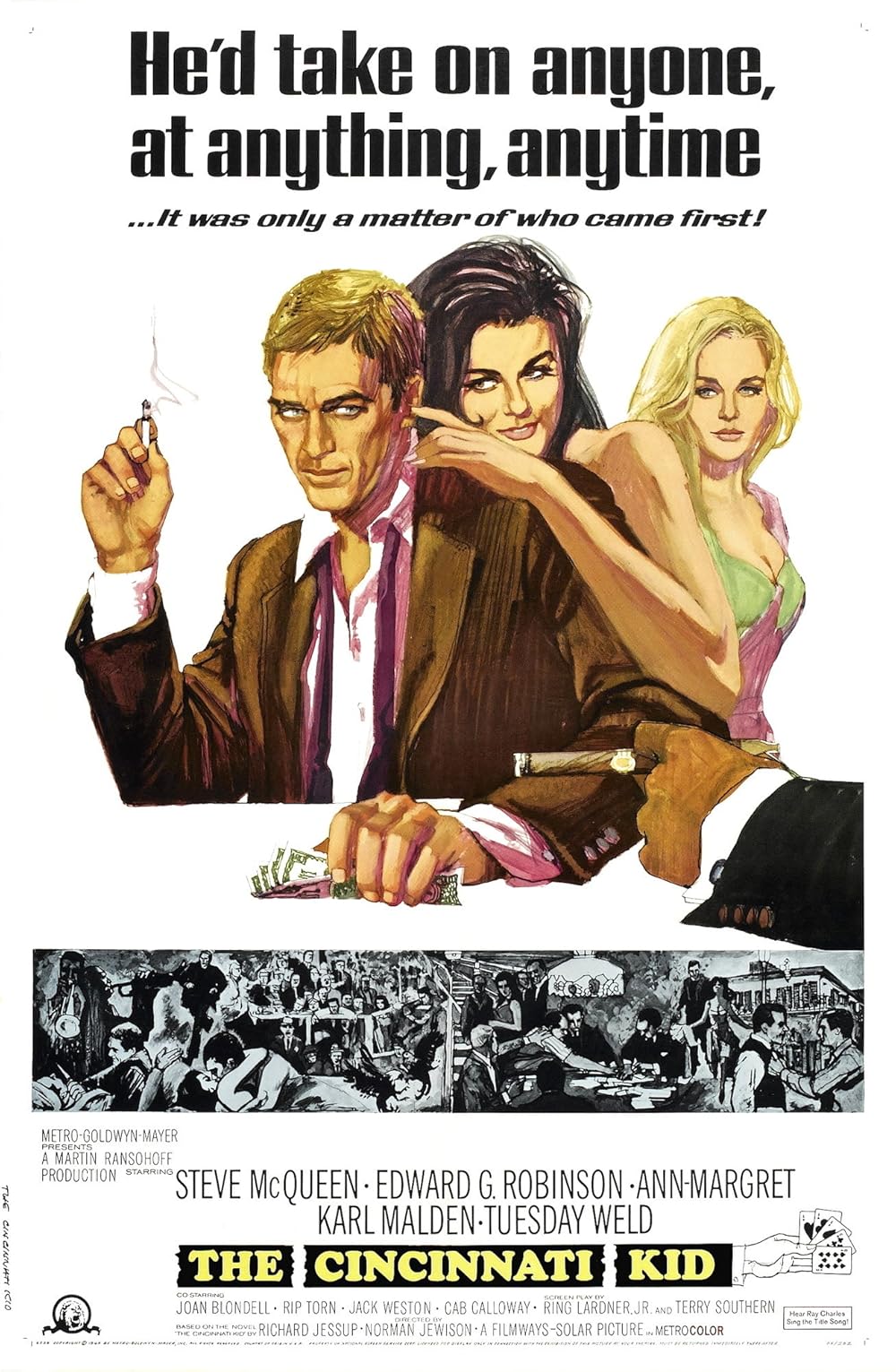
Starring: Steve McQueen, Edward G. Robinson, Ann-Margret, Karl Malden, Tuesday Weld, Rip Torn, Cab Calloway, Jack Weston, and Strother Martin
Grade: Classic
Why Kid insists on wearing that ugly, baggy leather coat, knowing it’s not conducive to the rainy weather of New Orleans, is beyond me.
Summary
In New Orleans, Louisiana, “The Cincinnati Kid” Eric Stoner (McQueen) walks down the sidewalk and is stopped by a funeral procession, as a group is hauling in a casket with a marching band leading the way. A Shoeshine Boy (Ken Grant) he knows stops him to play a quick game of quarters. Stoner beats him and slyly responds that the boy just isn’t ready for him yet before walking away. Following this, the Kid is playing in a smoke-filled poker game and wins out. Buster accuses him of marking the cards, but Kid embarrasses him in front of everyone by saying he doesn’t need marked cards to beat him. He exits the game and goes to the bathroom to splash his face with some water. Buster exits the game too to follow him. He has some guy block the door from the outside and goes in. Kid can sense what’s about to happen, so he grabs a razor blade that was laying on the sink. Buster approaches and demands the money from the game and pulls out a knife. Kid refuses, blocks Buster’s knife attack, and pushes the razor blade on his neck to force Buster to drop the knife. After this, he punches Buster down and tries to go out the door, but it’s locked. So, he grabs a bucket, breaks the window open, jumps out, and makes a run for it. Buster and his other henchman run after him. Kid runs through a railroad area and is able to elude them by using the trains to hide his movements.
Elsewhere, Lancey Howard (Robinson) arrives in town off a train. After giving money to a street performer and his monkey Tricky Bob, he takes a taxi to the Raleigh Hotel. There, he is greeted by the manager, as he’s a regular customer there. Kid shows up at some underground establishment and declines a game of pool with Eddy (Barry O’Hara) because it’s not his game. The poker players invite Kid over because they have been saving a seat for him, so he goes and sits next to Philly (Robert DoQui) who’s not playing too well. Just then however, he beats Wiley. He gets his money, but Kid is there to collect what Philly owes him. After getting the cash on the spot, he goes over and greets Gaffney who has his pet rooster there for some reason and Shooter (Malden). Shooter asks where he’s been, and Kid says he was across the river. When Shooter asks if he did any good, Kid responds that he scored a couple hundred bucks, but a guy there accused him of juicing the deck. Shooter is unimpressed, noting how he’s still playing with amateurs. He notes how dangerous it can be, but Kid says it’s the only game in town where he wasn’t holding markers on somebody. He is thinking about going to Miami, but Shooter reveals a rumor that Lancey Howard is in town. Some of the older guys in the room overhear this because Howard is a legendary poker player and they already start taking bets on who would win. Kid can’t help but smile at the prospect. At the hotel, Howard is on the phone with William Jefferson Slade (Torn) and confirms tomorrow is fine, stud poker is Slade’s game, and they will meet at 12PM at Slade’s hotel. As he lays in bed while his wife lights his cigarette, Slade tells Howard he wants to get Shooter to deal. Howard agrees to it. After Slade hangs up the phone, he tells his wife not to touch him. On a boat, Kid is with Shooter, and Shooter reminds Kid about what happened when he faced Howard. Shooter got destroyed. He warns Kid to just wait until it’s his turn to face Howard. Kid wonders if Shooter doesn’t think he’s ready, but Shooter isn’t sure. He acknowledges Kid as one of the greatest stud poker players he’s ever seen, but so is Howard. It’s not going to be like sitting down with Shooter and Doc Sokal (Milton Selzer).
Shooter goes on about how he plays percentages now, so he doesn’t win nor lose much. Kid asks Shooter if he thought he was ready when he sat down to play Howard, and Shooter admits that he thought he was the best stud poker player in the world when he did. Still, Kid knows he’s got something and so does Shooter.
However, Shooter reminds him that Howard is still the man and has a lot to protect. Howard would lose everything in the book and then some he’s made up just to kill you. Kid doesn’t want any lessons, however. He wants everything Howard has. Following this, Kid rides on the outside of a car and stops on a bridge to greet his girlfriend Christian Rudd (Weld). They discuss him ripping his jacket, her watching a French film about the Spanish army with subtitles at the movie theater, and it transitions from them walking together to Kid taking a bath, with Christian sitting beside the bath still talking about the movie. She gets annoyed with him because it looks like he’s not listening, but he insists she continue with the story. So, she does and talks about how the fathers and husbands all ended things being happy. It became apparent that they cared more about their lives than they did about their honor. She doesn’t think this makes sense, but he thinks it does because what good is honor if you’re dead? After an awkward pause, he asks why she was watching a French movie anyway, so she tells him that Shooter’s wife Melba (Margret) wanted to go. They have been hanging out since that game in Corpus. She thinks Kid doesn’t want them to hangout, but he assures her that he doesn’t care what she does. With this, she playfully shoves Kid’s head underwater. At Shooter’s house, he watches Melba use a knife to cut pieces to a puzzle to make them fit instead of her just finding the right pieces. He asks why she has to cheat at everything, adding that he hasn’t seen her play one game of Solitare without cheating. She doesn’t think it’s a big deal, but Shooter tells her that she will just be cheating herself and will be the loser as a result. Uncaring, she cuts another puzzle piece and smacks it into the puzzle to make it fit. Frustrated, Shooter leaves the room. The phone rings right by Melba, but she doesn’t get it because Shooter is usually mad when it’s for her. So, Shooter walks back in and answers the phone. It’s Howard, and he mentions the game he’s having with Slade. Howard has heard Slade is a local celebrity, so Shooter confirms and tells him that Slade comes from one of the richest families in the state.
While Melba tries to play with Shooter while he’s on the phone and he shoos her away, Howard gives Shooter’s reputation credit, and it leads to him agreeing to being at their game. Once he hangs up, Shooter gets irrationally angry at Melba, takes her apple, and crushes it in his hand. The next day, Christian and Melba hang out, look at bathing suits, go to a Turkish bathhouse, and get massages. There, they discuss Melba’s marriage, but she doesn’t seem too pleased about it. Still, Christian likes the idea because at least Melba knows how much she means to somebody, as she’s not sure where she stands with Kid. Meanwhile, Shooter deals for a poker game involving Howard, Slade, and a group of others. Slade puts in $2,000 and Howard raises. In the middle of this, he brings up Kid wanting a game with him and he asks Shooter if he’s any good, prompting Shooter to say confidently that Howard knows he is. Slade calls, but Howard beats him. With the game concluding, the others leave Shooter, Slade, and Howard at the table. Slade can’t help but ask Howard how he knew Slade didn’t have the king or the ace. Howard recollects a young man putting the same question to “Eddie the Dude”. Eddie told the man that all he paid for is the “looking price”. Lessons are extra. He excuses himself from the table to talk to Shooter, and they discuss a potential game with Kid. Shooter notes how Howard used to love the competition after he acts humble about his chances. Slade interrupts and demands Shooter deal the next game, so the two rejoin him at the table. At night, Kid has his shoes shined by the Shoeshine Boy on a street corner and Christian and Melba approach him to talk about their day. Melba brings up Kid potentially sitting down with Howard for a game, but this is news to Christian and she’s frustrated. Melba smiles and leaves, knowing she just started some shit. The Shoeshine Boy wants to play a game of heads or tails and calls heads, but Kid wins. Once again, he comments that the boy just isn’t ready for him yet. Kid and Christian go to a restaurant for dinner. To Kid’s shock, Christian reveals she’s thinking about going home for a visit. She’s thinking about going on a bus that leaves tonight.
However, she won’t go if Kid wants her to stay, at least until morning. So, they sleep together that night.
In the morning, Kid asks when she’s coming back, but she questions why he didn’t even ask why she’s going. So, he does, prompting Christian to go on about how Kid never wanted her hanging around his neck. He never said that, but she explains he’s never said anything about their relationship. Furthering her point, he doesn’t respond to this and changes the subject. He says that after the game, he will be “The man”, the best there is. People will sit down at the table with him, just so they can say they played with “The man”. He’s fully determined on making this dream a reality. He wants to be “The man”, and she’s fully aware. He wonders if this is about marriage, and she stops in her tracks. However, she just responds that she’s all packed, so Kid takes her suitcase outside for her. As she sits on the bus ready to go, Kid hands her a magazine through the open window. She caresses his hand until the bus pulls away. Back at the game, Slade is sobbing over how bad he lost to Howard and has to write a check to him. They just finished up playing a 30-hour stretch. Though he’s bothered, he gives Howard credit for his game and how it was a rewarding experience to watch the “great artist at work”. He thanks Howard for the privilege, so Howard appreciates it and adds that it’s a pleasure to meet someone who understands that “to the true gambler, money is never an end in itself but simply a tool, as language is to thought”. Before Slade leaves, he tells Shooter he wants to see him at his house in 30 minutes. Shooter says he can’t because he promised his wife, but Slade subtly demands it. Even after Slade leaves, his bodyguard nods to Shooter as if to say he needs to be there. Shooter calls Kid and tells him that he was supposed to take Melba with them to the fights tonight, but he can’t go now, so he wants Kid to take her instead, along with Christian. Kid reveals that Christian isn’t even there because she’s down at her parents’ place for a couple of days. He asks if the game with Howard is a go. Shooter says, “just about” but again asks if just Melba can go with him. Kid relents, so Shooter thanks him and says they will meet back at Shooter’s place after the fight.
After he hangs up, Shooter asks Howard if they are set for Monday night and how he can get Lady Fingers (Joan Blondell) to come. Howard hasn’t seen “that old bitch” in 10 years and comments that it might be long enough to think of her fondly. Apparently, she’s down though, as she “busted out in the Vegas faro game”. Plus, Shooter wants to use her as relief dealer if it’s okay with him. Howard is good with it. So, it’s official. At 8AM on Monday at Apartment 2A at the Old Lafayette, the game will commence. Before Shooter leaves, Howard asks if Kid is going to give him trouble, and Shooter concurs. Howard hopes it’s not a marathon game, prompting Shooter to remind him about their session in St. Louis. Howard remembers it well, as it involved some hoods from South Chicago. The longest game Howard ever played was on the maiden voyage of the Mauritania. It was Bishop’s Rock to Ambrose Light without a stop, 6 days. Still, Shooter lets Howard know that Howard has been “The man” for a long time to which he responds, “That is undoubtedly true”. However, he tells Shooter to not let it fool him. He’s not ready to retire yet. Kid and Melba show up to the fights, and Hoban (Jeff Corey) invites them over to sit by him. Melba doesn’t want to sit by them, so Kid tells her to sit where she wants. He’s going to sit with them regardless, so she’s forced to follow. Everyone around them ask about Shooter and Christian, but Kid downplays it. Melba doesn’t help with her flirtatious comments and gestures, however. Pig (Weston) tells Kid to not worry because his girl left him too. Following this, the fight commences. Actually, it turns out to be a cockfight they’re all there for. At one point, Melba wants to go to the car, so Kid tells her to go without him. Then, she starts to get into it once the fight becomes more heated and Kid starts betting money. At Slade’s place, Slade fires a gun at a target set up in his home. He has his wife Alice freshen up Slade’s drink and sends her to get snacks. They discuss their wives, their wives’ expensive tastes, and how they may drift away when they decide not to indulge. As Slade makes this point, he fires his pistol at the target again and brings it up. The small target was a playing card. It was a king, and the bullet went straight through the eye of the king. Slade knows Shooter will be dealing for the game between Kid and Howard and mentions how there’s a lot of betting interest developing in this game.
He asks Shooter what the odds to beat are. Shooter figures it’s 8 to 5 on Howard, though Shooter thinks the Kid’s chances are better than that on a personal note. Slade agrees with Shooter, which is why he’s planning on making a big bet. Shooter wouldn’t bet on it though. Slade talks about how Howard is an old man ready to fall. However, Kid might get nervous and may need a little help, implying he wants Shooter to fix the game. He wants to make a big bet and will do one for Shooter too in the neighborhood of $25,000, but Shooter refuses. Slade says Kid won’t need much help other than 2 or 3 hands going his way at the right time, adding that Melba would be proud if Shooter netted $25,000. Still, Shooter declines, prompting Slade to remind him how he’s carrying markers on him for $12,000. Shooter reminds them they are legitimate markers, and Slade gave him 2 years to pay it. However, Slade says just because he accepted his marker one day doesn’t mean he’s going to recognize it the next. The recognition is null and void if he sees Shooter as not of sound mind. He knows Shooter is not of sound mind because he saw him hesitate about accepting his $25,000 offer. Shooter questions why he’s even doing this because it can’t just be about money, so Slade admits he just wants revenge on Howard for destroying him. Just then, Alice let’s their daughters in the room to say goodnight. Slade asks if they want to hear a bedtime story about Melba, but Shooter interrupts to say he knows all those stories about her background. Slade asks if he knows why she left Shreveport, Louisiana. Shooter does, but Slade still thinks his daughters should hear it. Meanwhile, Kid brings Melba back to their house. She has him make them drinks while she changes her clothes. From the other room, she asks what Christian brings out in him, but he doesn’t respond. She comes out of the room and starts flirting with him, but he just gives her the drink. They discuss how Shooter is his oldest and best friend, and Kid makes it clear there’s nothing going to happen between him and her. Shooter calls the house and tells Melba he won’t be back for a while. Kid takes the phone from her and asks if the game with Howard is official, and he confirms it.
Kid tells him that Melba had a good time, and Shooter sadly responds that she’s a fun girl before hanging up. Right after, Kid and Melba kiss, but he slaps her hard enough on the ass to piss her off purposely. He then heads to the door. Before he leaves, Melba tells him that she hopes he loses, and he jokingly thanks her. Sometime after, Kid is looking around for Shooter at the hangout spot all the gamblers go, but Hoban hasn’t seen him. As Hoban excitingly tells Kid that Jolly from Boston, Lady Fingers, and Yeller (Calloway) from Memphis are all coming to town for the game, Shooter shows up. Kid doesn’t want to talk now and goes to leave, so Shooter asks what’s wrong. He says Jack Doyle is laying 12 to 5 on Howard, but Shooter explains that’s old conservative money that’s always on “The man”. Shooter assures Kid there’s plenty of money on him too. Kid is ready and wants to play now, as he’s getting anxious waiting. Shooter tries to get him to relax, but Kid leaves to walk in the rain. He stops by some band practicing indoors, goes back to his apartment for a smoke, and then takes a bus to see Christian. He shows up to her parents’ house and she’s elated. He says he just wanted to see how she was doing, and she’s happy to hear it. After introducing him to her mother, she has Kid sit down for a meal. They share a glance and a smile. Afterwards, they go outside to spend time with each other, and she takes Kid to a spot where she used to play as a kid. She goes on talking about her dreams and wishes and how she used to wish as a kid that someone would take her away to the big city like New Orleans or Mobile. With this, they start making out. That night, Kid has dinner with Christian and her parents. Just as Christian’s mother goes to clean the dishes, Christian gets some playing cards out and wants Kid to show her father some tricks he would show the Shoeshine Boy. Her father tries to excuse himself to work on his evening chores, but Christian sits him back down. Kid lines the cards out on the table and has her father pick out any card he wants. He picks one and Kid guesses correctly that it’s the three of hearts.
Christian’s dad loves it and has Christian’s mother try it. Kid correctly guesses it’s the three of spades and she finally laughs too. At the same time, Howard smokes a cigar in bed. The next morning, Kid heads back to New Orleans. While in bed together, Melba asks Shooter if he’s playing that night or just dealing, but he stares ahead until she asks again. He confirms he’s playing. He goes on frantically about how he’s been building a reputation for 25 years on honesty and integrity, but Melba interrupts to remind him about what he said about cheating yourself. He gets mad and tells her that he won’t help Kid unless he needs it, prompting Melba to laugh and say Shooter is reminding her more and more of her first husband. She says he was a loser too. He insists he’s no loser and brings up the possibility that Kid could get lucky and stay ahead the whole game. Melba agrees that it could happen, especially if Shooter is there to see that it does. He’s not too happy hearing this.
It’s all leading to the showdown at the poker table. With Shooter presiding over the game, “The Cincinnati Kid” looks to do what no one has done before him and that’s defeat “The Man” that is Lancey Howard.
My Thoughts:
One of the best card playing films in existence, The Cincinnati Kid is a wonderful mix of drama, humor, struggling romance, colorful characters in the seedy underworld of gambling, and a great depiction of the unbridled suspense involved in playing high stakes poker. Powered by Steve McQueen in one of his best roles, Norman Jewison’s film equally captures the excitement of the game and the pride the players have in being considered the absolute best.
It’s a relatable story for the driven and those who want to be “The Man”, and the others who actually are. The Cincinnati Kid is centered around pride, ego, ego death, and how these themes affect the poker-obsessed players once they face definitive results in big games. At the center of it all is the titular star, referred to by many as “Kid”, “The Kid”, or “Cincinnati”. How did he find himself in New Orleans with a name referring to the city of Cincinnati is hard to say because this is never established, but what is established is that despite his nickname resembling inexperience, he is far from it. From the outset, he’s the best poker player in the area and arguably the world. Everyone knows it, including the respected Shooter, a fellow player who is out of his prime and sticks to playing percentages now instead of going for the title of “The Man” like he used to. In the present day, Kid wants it, and he wants it BAD. His skills are noted by all, which is why his name is known. If he wants, he could continue to live by this and take every game in the area for the foreseeable future. However, this has become too small-time for Kid. A true player of the game wants to be challenged. He wants to face the best. Just like Ric Flair would say, “To be the man, you got to beat the man”. It’s that simple. In any sport or any facet of life, if you want to be at the top of your field and be “The Man”, you have to take out whoever is on top. It’s the crowning achievement that the biggest competitors strive for. There is no other way around it but THROUGH it. There are examples all over. To be considered amongst the pantheon of greats like Larry Bird and Magic Johnson, Michael Jordan had to defeat the entire NBA and start winning championships. It was the only way to be considered “The Man”. Recently, the Eagles had to face off against the juggernaut that was the Kansas City Chiefs. There was no other way. They had to face the team people know as the absolute best to become the best. Once they did, they became the undisputed champions. Here, the Cincinnati Kid is on the same journey. Only this time, he wants a game against five-card stud poker’s best, Lancey Howard. He dreams of it.
If he manages to beat Howard, the undisputed GOAT of the tables by all accounts, he will be “The Man”.
For some viewers, this motivation of the protagonist may lack substance because they aren’t driven by this “hunger” for more. They look at things like Kid’s girlfriend, Christian. She knows of Kid’s aspirations, but she doesn’t see it as important as their relationship and rightfully so. On the other hand, Kid isn’t opposed to their relationship, but as a dedicated player in his prime who has put everything he has into his career, he has to strike while the iron is hot. He doesn’t want Christian hanging around his neck for now, not forever. It’s just that at this point, he can’t afford mistakes. It’s about the right now, and it’s about cards. He may not get any better than this and he may not get another opportunity to face the best. He takes it ultra seriously, as we see when he gets ready for the big game. After packing loads of money and cigarettes and puts on a suit for the first time in the movie, Kid does a brief mathematical exercise on percentages to test himself last minute, using a playing card to block out the rest to allow him to go line by line. This is everything he’s worked towards. There can be no missteps. In basketball terms, he’s in the conference finals and is trying to make it to NBA Finals, knowing this could be his only shot at the crown. This is his chance to level up. He can’t screw it up. Kid knows he can be the best and is already considered among the greats, but no one will officially acknowledge it publicly until he beats the best and proves it, just like how Jordan was criticized for not being a “winning” player for his first six years in the league, despite putting up ungodly individual numbers from day one. It’s just like how Kid details to Christian after changing the subject about their relationship to talk about the eventual game against Howard. After that game, Kid will be “The Man”. It’s everything he’s ever wanted. Just like how all those other sports stars have wanted, Kid wants the same in five-card stud poker. Why should this be any different? Christian knows his obsession with being “The Man”, but she doesn’t understand it on his level because she’s not a player herself.
Those who aren’t as motivated in their real lives or haven’t experienced striving for more and struggling because of it won’t relate as much to a main character like Kid, but real competitors will, which is why The Cincinnati Kid is much more relatable than viewers may realize if they peak beneath the surface. The real kicker is the foreshadowing of their bathtub conversation of the French film. At first, it seems like a rather meaningless exchange to just give insight on Christian’s burgeoning friendship with Melba, but it all clicks once the ending is realized. Christian mentions how the movie she watched had the fathers and husbands from the war ending things being happy, caring more about their personal lives than they did about honor. She doesn’t see this as satisfactory. Nevertheless, Kid can, rhetorically asking what good honor is if you’re dead. With how things turn out for the Cincinnati Kid, he learns the lesson of life being more important than honor once he goes all-in on the biggest poker game he will ever have, which was akin to a war. Naturally, it’s one of my favorite endings of all time. The buildup following Shooter’s exit that Kid forces in an awesome moment (“What’s a matter with you Shooter? You don’t look too good. Why don’t you lay down?”) and lighting his cigarette right after, the bets rising, the closeups of everyone’s faces, the side comments from the supporting characters wondering of the possibilities, the tension in the room, the thoughts inside Kid’s head, all of it was perfectly executed by director Norman Jewison. It made the entire movie worth it, and it’s one of the best payoffs of the decade. The walkout at the end speaks volumes. It’s iconic. Really, the game itself is beautifully crafted by Jewison. From the lighting to the framing of certain dramatic pauses in the game, the wide shot of the three main characters, the shot above the table, and the transition from Kid refusing Slade’s offer and shutting the door to Kid’s eyes when he’s back on the table is just all-around masterful work.
Though they’re playing cards, the subtle mental chess game that develops between Kid and Howard is also great to watch. Just like Kid, you’re trying to figure out what angle Howard is playing, not just on the table but in person. The real genius of Howard’s strategy is seen as soon as Kid walks through the doors while Kid’s strategy begins minutes before that. Kid gets there on time, but he tells the taxi driver to take him around the block a couple of times. Clearly, it’s to make Howard sweat a little, as he knows the professional in Howard would show up early. It’s just enough for Kid to show he’s a much different opponent than what Howard has seen previously, and Howard responds by engaging in his strategy once Kid enters the building. After Lady Fingers tries to instigate things by implying Howard hasn’t been to New Orleans in a while because he’s scared of Kid, Howard asks, “Should I be?”. This sets up Kid to say, “Damn right” when he makes his entrance, showcasing his confidence in his own game that veers towards cockiness when the two have their first conversation. While everyone greets Kid because they all love him and want to see the old man fall, Howard stands on the other side of the room by himself. Once Kid greets him and asks how the city has treated him, Howard goes on about New Orleans always being good to him. Kid uses this line to say towns change, suggesting there might be a change in the tides when it comes to being “The Man”. Bypassing this, Howard gasses Kid up to see how far he takes his swagger, possibly in an effort to see if it translates to the way he plays cards because he can use Kid’s attitude to his advantage. Saying that he’s heard of Kid’s exploits for a couple of years in all the major cities like New York City, Chicago, and Miami and how he’s been told Kid is quite the stud player, Kid notably smiles and plays coy (“Do they?”). After Yeller interrupts to remind Kid of the time he gutted Yeller with a pair of fours and Kid jokes he overplayed his hand, everyone laughs but Howard. Instead, he slyly responds that it’s a dangerous thing to do, as he now has insight on the tricks Kid may try.
With just this little bit of a reveal, Howard has an advantage. It’s something he would never do, evidenced by his refusal to teach Slade anything about how he managed to beat him earlier in the movie like a magician abiding by the code of not revealing how he pulls off his illusions.
As a response to Howard’s “dangerous” critique, Kid comments that it all depends on who you’re sitting with. There’s a pause between them, and then we see how serious Howard becomes almost instantly with, “Well, let’s play some cards”. All he needed was that little bit of an exchange, and he understands Kid’s game much more than he did minutes before. This “game” of sorts between the physical game is just as exciting as the poker playing itself, with Kid staring unflinchingly at Howard any chance he gets because he wants to be “The Man” so badly and is looking for any kind of possible tell to beat him. It continues when Howard and Kid talk during the first break period. Howard begins by continuing with his playing to Kid’s ego to try and get him to let his guard down, mentioning how he’s the best stud poker player he’s seen in 35 years of action. Kid responds by complimenting his takedown of Pig with the jacks, and he admits he saw it coming when Howard asks him if he did. To try and correct his own form, Howard asks Kid if he saw it coming before he raised, prompting a smartened-up Kid to reiterate “I saw it coming Lancey”. He’s seeing what Howard is doing, as this would not only help Howard on his own game, but Howard can also see where Kid’s head is at if he reveals any bit of his thought process. It would let Howard think of a counter before the get back to the table. Once again, every line of the script matters, even if it doesn’t look like it at first. This is intensified when Howard suggests Kid come to Miami to play but notes the crucialness of having good nerves. Detailing how you can lose the feel of the cards if you have seen so much action day and night unless the nerves can hold, he asks Kid how his are doing. It’s all mind games, the intangibles of sports that can’t be calculated in statistics. It exists at every level, and Howard is showing why he’s “The Man” at every given opportunity, playing the game on and off the table. Only the absolute best would go this far, looking for every possible advantage that he could have over his opponent, just as all the greats of their respective sports do (shout out to Tom Brady’s days with the Patriots and the string of scandals involved).
It’s why Howard is the best. Kid can see what he’s doing, but he finds it hard to pivot out of without being rude, which allows him to fall into Howard’s first trap of asking if he has a girl. Kid looks down after admitting she’s out of town, so Howard uses this to plant a seed to throw off his mental game. It’s genius because he disguises it as advice, calling women a “universal problem in our business” and how he thinks it’s best to not look for a “fixed thing” upon looking back at his whole career. He suggests Kid just tie himself into “something nice when your away from the action and let it wear itself out”, meaning to go for temporary girls in-between his career so he can stay focused on poker. With Kid already having trouble keeping his eyes on the prize with Christian and Melba hanging around his peripherals, Howard’s words are just enough for Kid to second guess things, and Howard knows it. That’s why his smug comment about how glad he is that they had this talk is more of a smack in the face rather than a nice conversation-ender.
Edward G. Robinson is strong opposite McQueen. In one of his last great roles, you could argue it’s a late career best. Is the Kid getting to him? He very well might be. However, Robinson is McQueen’s equal onscreen and levels up in doing so, not faltering for a second any time they share the screen. Their back and forth is even better than “Fast Eddie” taking on Minnesota Fats in The Hustler, the 1961 classic that The Cincinnati Kid has been compared to since it was released. There are a lot of reason as to why too. The Steve McQueen and Paul Newman rivalry, poker versus pool, the similar narratives, the complicated relationships, and the up and comer protagonist wanting to take down the guy known as the best to varied results. For the record, both films are fantastic takes on the world of underground sports and the larger-than-life people involved in it. It’s hard to say which movie is better because how beloved they both are. To be fair, Newman might have the better dramatic performance, but that’s because the character of “Fast Eddie” is written with a more tragic outlook. McQueen’s Kid isn’t drowning in alcoholism and isn’t known like Eddie was for jumping the gun in his games because that strategy wouldn’t work in poker. Kid is just so motivated that it makes him anxious. Fats is an antagonist by default just because he’s the mountain Eddie has to climb, with the real villain being George C. Scott’s Bert Gordon. With Lancey Howard, he comes off as this too at first, but his evisceration of Pig, highlighted by his ruthless changing of his bet to whatever Pig had left since he couldn’t match Howard, destroying him with it, and lighting up a cigar afterwards shows how ruthless he can be, along with the aftermath of the final hand. The Hustler is more depressing, but it’s fulfilling on an Oscar-like level while The Cincinnati Kid is purer and more entertaining for wider audiences. It’s hard to say which film is better. It might just come down to what mood you’re in or what your game is.
Either way, they are both certified classics, and that’s undisputed.
A special shoutout goes to Ray Charles for the theme, even if it was too much. It sounded way too similar to a rejected James Bond tune than what the narrative was really calling for. Also, for history’s sake, it was really cool to see Steve McQueen and Cab Calloway converse, and the recurring joke of Lady Fingers messing with Howard who tries his best at hiding his disdain for her was very funny (“He’s a little bit younger than you, isn’t he?” – “Just deal”).
With a great supporting cast that strengthens as well as complicates the narrative outside the game, excellent direction from Norman Jewison, and a laser-focused Steve McQueen leading the charge, The Cincinnati Kid is a fantastic drama centered on the game of wits. It’s a film about the competitive mindset, how the best want to test themselves against the greatest, and what it takes to get there. It’s about being THE MAN and everyone knowing it, gaining the bragging rights and the title that everyone acknowledges. Sometimes, you have to find out if you are who you say you are. If it leads to falling on your sword, so be it. Nevertheless, forever wondering is not and never will be an option for those who strive for more.
Fun Fact: Sam Peckinpah was hired to direct initially but was dropped after producer Martin Ransohoff didn’t agree with his vision. Spencer Tracy was set to be Lancey Howard at first but was forced to quit due to his health.


+ There are no comments
Add yours