
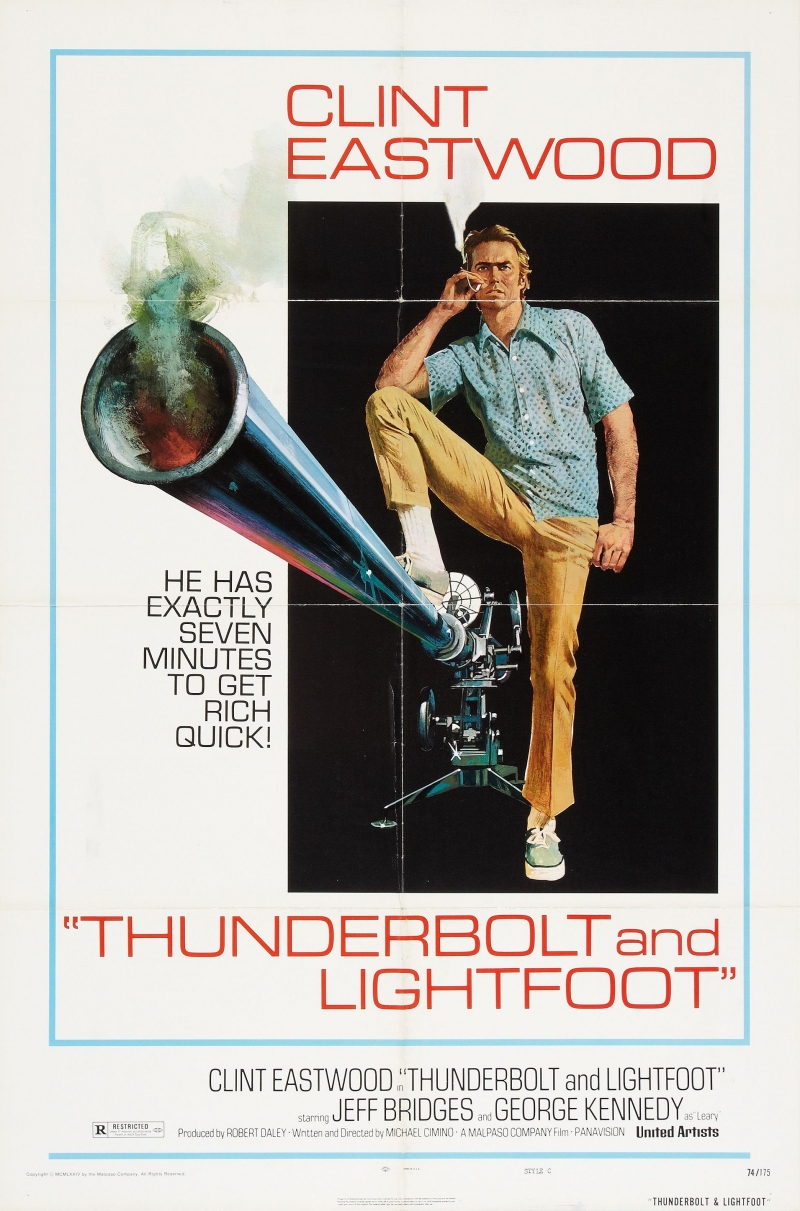
Starring: Clint Eastwood, Jeff Bridges, George Kennedy, Geoffrey Lewis, and Gary Busey
Grade: A+
Of all the crazy happenings in Thunderbolt and Lightfoot, one thing that I cannot get past is Lightfoot doing landscaping work in leather pants and thinking nothing of it. How does no one on his crew tell him how fucking stupid this is?
On a crew that includes Gary Busey no less!
Summary
A man shows up to a church service in a secluded location in Montana. There, John Doherty (Eastwood) is heading up the service as a preacher. Elsewhere, Lightfoot (Bridges) walks into a used car lot and walks by a nice sports car. The salesman invites him to try it out, so Lightfoot turns it on and revs the engine. The salesman says it’s $3,000 and change. Lightfoot says he’s just looking, so the salesman questions if he’s man enough to take on a car like this. Lightfoot isn’t sure and mentions he has a wooden leg. The salesman asks if he’s serious. Lightfoot looks at him, smiles, and comments, “You never can tell”. Then, he drives off, stealing the car.
Back at the church service, the guy enters and shoots at John in front of his parish. John ducks at just the right moment and escapes out the back door. He runs into the field, and the assassin chases after him, shooting. John runs into the road and tries to flag down the incoming vehicle, Lightfoot driving the stolen car. Lightfoot swerves out of John’s way and accidentally hits the assassin with his car. John forcefully jumps onto Lightfoot’s car as he spins around and drives off. When John climbs into the seat from the window, he injures his shoulder badly. Lightfoot admits he thought John was a cop but gives him credit for being a crazy preacher. He asks who was chasing him, and John passes him off as an old friend. Lightfoot responds, “With friends like that, you don’t need enemies”. Since he’s got nowhere to go, John asks Lightfoot where’s headed. He says he’s going south, so John invites himself for the ride. He compliments Lightfoot’s driving and wonders if he ever thought about doing it professionally. Lightfoot wonders why, so John notes that all great racing champions have blue eyes like him. He considers it a fact, but Lightfoot doesn’t want to hear it. He then tells John his name is Lightfoot, but he’s not Indian. They drive to a small lake, and John uses Lightfoot’s belt to put his arm and shoulder painfully back into place by tying the belt to his arm, hanging it from a tree, and pulling hard. At the same time, Lightfoot drinks from the lake and rubs water on his face. He notes that John is no ordinary preacher and asks who he really is. John counters by asking where the license plates are on his car. Lightfoot admits he doesn’t have any and stole the car five minutes before he almost ran into John. John asks if he likes to spend money, and Lightfoot concurs on the account of when he can get money. As a follow-up, John asks if he cares how he gets it, and Lightfoot happily replies that it doesn’t, as long as it doesn’t cost him too much. Following this, the two go to a gas station. As the attendant waits for customer Arnold to get out the right credit card, the two pull up and Lightfoot strikes up a conversation with the attendant. The worker goes on and on until Arnold gives him the right card, and then he goes inside.
John and Lightfoot get out of their car and tell Arnold and his wife to switch cars with them. They drag the couple out of their car and steal it. Lightfoot thought they were only going to get the plates, but John says they didn’t have a screwdriver. In the car, there’s a whole bunch of brand-new clothes too, so they both grab new shirts to wear. They drive into town and see a hooker talking to a driver in the distance. Lightfoot is confident he would never pay for that. Regardless, John is about to part ways and offers his watch as a gift, but Lightfoot doesn’t want his watch. He wants his friendship and thought they were getting along together. John tells Lightfoot that he’s 10 years too late. Lightfoot clocks him as one lost dude, and John laughs, though he still leaves. Lightfoot shouts that he’s as young as he feels before driving off, only to immediately be stopped by a bus crossing the road. John goes into a bus station and sees former associate Red Leary (Kennedy), who is clearly putting a wrapped-up gun into a locker.
Yeah, Red is here to kill him.
John gets out of there before Red can spot him and he goes right back into Lightfoot’s car, as he was still on the road since the bus just cleared out at that second. Lightfoot is ecstatic. That night, they rent a small room to stay in. John stays in while Lightfoot goes to a nearby camp area and steals a license plate off someone’s car before switching cars entirely. Melody (Catherine Bach) walks and is almost immediately bothered by guys in cars, so Lightfoot drives over at just the right time in the guise of saving her. He drives for a bit, and she wants out. He starts flirting with her and offers to take her anywhere she wants. She comments that she’s hungry, so he’s cool with that. She loosens up a bit, and they make fun of each other’s names. By the time Lightfoot makes it back to the room he’s staying at with John, he has two women with him. The other being Gloria (June Fairchild). John is pissed because they’re trying to lay low, but Lightfoot compliments Gloria’s ass out loud. Annoyed, she says that she got out of bed for this and doesn’t plan on jumping into another. Hearing this, Lightfoot tells John that Gloria is his girl, and he takes Melody out of there and leaves them alone. Soon after, John and Gloria fuck. Immediately after, she gets dressed because she wants John to take her home. However, he tells her that she can stay because he’s not driving out at 3:30AM to wherever the hell she lives. She threatens to run out of the room naked screaming “Rape!”. He doesn’t think she will, so she runs out and does so in her underwear just as a car pulls up, forcing John to grab Gloria and pull her back inside. He has her put her clothes on and gives her money for a taxi instead, which she accepts. She exits just as Lightfoot comes back. John asks how he did and Lightfoot responds, “Red-haired women are bad luck”. The next morning, Red is being driven by Eddie (Lewis), and they park across from the diner where John and Lightfoot are at. Red knows it’s their car and prepares his gun. Inside the diner, Lightfoot flirts with the waitress while they order and they joke around. Eventually, the two leave and are shot at by Red. They are able to drive off, so Eddie and Red chase after them. As Lightfoot drives, he notes that John must have been into something big. Still, they are able to escape because of Lightfoot’s driving down a hill that causes Eddie to get stuck.
Eddie and Red get out of the car mad and watch as Lightfoot drives off, with Red tripping and falling too. Eddie goes to take a piss near the car, so Red angrily shoots his gun off to stop him.
Lightfoot drives alongside Snake River and stops the car. Apparently, the transmission is finished, and the seals are gone. Now, they’re in Hells Canyon. He notes how private everything is in this area and adds that the Hells Canyon delivery boat the Idaho Dream is coming soon, and it should take them right up the river. John stays by the car and tells Lightfoot he’s better off getting as far away from him as he can. Lightfoot laughs the comment off. John goes over to him and brings up how lonely things can be. He asks if he has anyone close to him, and Lightfoot isn’t sure anymore. He talks about how he was a lot to handle as a kid and mentions how his parents sent him to boarding school. On the train there, he met some woman, and he found himself getting off with her in New Orleans. Two weeks later, he woke up in some dingy hotel, but they had a good time. After her, he just kept moving. John realizes that now, he just can’t stop. They take the Idaho Dream together, and John notes they’re broke and asks for suggestions. Lightfoot say if he knew what John knew, he wouldn’t be broke. Curious, John asks Lightfoot what he thinks John knows that he would like to know. With this invitation, Lightfoot asks if there is a good way to rob a bank, which John laughs off. Lightfoot changes the subject by talking about how he thinks man can do anything they set their mind to. His goal is to walk in and buy a white Cadillac convertible. Later, they hitchhike, and some insane and impatient hillbilly with a caged raccoon in the front seat picks them up. He swerves all over the road and crashes the car completely unprovoked. Next, he gets out and opens his trunk. It’s full of rabbits and he tries to force them out with his gun. He starts shooting at the rabbits, prompting John to ask what the hell is wrong with him. The guy tries to hit John with his gun, but John kicks his ass. Next, John steals his wallet, Lightfoot helps him take the rest of the rabbits out of the trunk, and the two steal the car and drive off. Just then, Lightfoot realizes he accidentally touched raccoon shit, so an amused John tells him to keep his hand out the window to let the rain get it off.
After they settle in some town for the time being, John notes that small town banks leave the phone off the hook in the vault at night, so the local operator can listen in. Lightfoot brings up how easy it would be to rob a bank and how anyone can do it, but John starts hitting him with facts. The newest bank vaults have walls of reinforced concrete five feet thick backed by 6 inches of steel, the vault door is stainless steel-faced, it’s an inch and a half of cast steel, another 12 inches of burn-resisting steel, and another inch and a half of open-hearthed steel. As they put their groceries in the car, John continues with how a vault door has 20 bolts, each an inch in diameter (8 on each side, 8 on the other, two top, and two bottom). This holds the door into a 16-inch steel jamb set in 18 inches of concrete, which is crosshatched by steel bars running both vertical and horizontal. The door is precision-made, so you can’t pour nitro in-between the seam of the door and the vault. If that isn’t enough, there’s microphones, electric eyes, pressure-sensitive mats, vibration detectors, tear gas, and even thermostats that detect the slightest rise in temperature. After wildly spouting off all these facts, he asks if Lightfoot is still interested in banks. Lightfoot laughs. He knew John wasn’t a preacher. He’s actually a bank robber. John says he is what he does, and he even forgot about the money at times. Lightfoot inquires further about the money, so John mentions his last big job being the Montana Armored, a heist he pulled off with a 20 mm cannon with armor-piercing shells. Lightfoot remembers this because it was on the news and recalls how they referred to the man who pulled it off as “The Thunderbolt”. Well, you’re looking at him.
Thunderbolt and Lightfoot.
“That sounds like something, doesn’t it?”
Lightfoot is enthralled with this news and is only interested further., prompting him to ask who was following them. Thunderbolt explains how Red is a war hero who saved his life once in Korea, as they were marines. Red was sent to prison in Illinois later on for stabbing a woman. While there, he met an old-time bank robber named Billy Lamb. Lamb taught him how to break safes. When they got out, Lamb introduced Red to Dunlop (Roy Jensen), an electronics expert. That’s the assassin who was trying to kill Thunderbolt that Lightfoot accidentally took out with his car in the opening of the movie. Eddie is just a driver and is harmless when he’s alone. Though Lightfoot reminds him that he’s still friends with Thunderbolt and doesn’t care about the money to calm his nerves, Lightfoot still asks what happened to the money. Thunderbolt details how they hid it in a one-room schoolhouse in Warsaw, Montana, a place Lamb went to as a kid. They hid all $500,000 in the wall behind the blackboard. It’s still there because it was up to Lamb to control the money “until the final split”. They kept in contact with each other through personals in the newspaper, but the older Lamb ended up getting a heart attack and died. Red started getting suspicious about it, but Thunderbolt wasn’t going to tell him where the money was because he knew Red would go straight for it, heat or no heat. Then, the cops released a statement saying the money had been found, even though it wasn’t true. Red got careless, but he couldn’t lead the others to the money because he didn’t know where it was. After all this, Red got arrested and convicted on another bank robbery that happened years before. Once he got out, he convinced the others Thunderbolt set him up. This resulted in Thunderbolt hiding out as a preacher, which evidently didn’t work, though Lightfoot gives him credit because he thought the church was a pretty good idea. Following this, the two drive to the schoolhouse in Warsaw but find that the school has been updated to a bigger building and it’s not there anymore. Spending the last of their money at the ice cream truck parked outside the school, they ponder what to do next. They get back to the car and sit down. Hiding in the backseat is Red and Eddie who hold them both at gunpoint.
Thunderbolt is forced to drive out to some canyon. They have Thunderbolt and Lightfoot get out of the car, and Thunderbolt asks how Dunlop is. They walk around it. He follows this up by asking Red what he wants. Red says he wants his ass, so Lightfoot jokes that flattery isn’t going to get him anywhere.
Pissed off, Red asks Thunderbolt if Lightfoot knows everything. Thunderbolt says “No”, but Lightfoot accidentally says “Yes”. Red drops Lightfoot with a punch to the gut. Next, he has Eddie hold his gun, so he can fight Thunderbolt one-on-one. In the middle of the action, Red accidentally hits Eddie after Thunderbolt ducks. Thunderbolt starts really kicking his ass until Red is having trouble breathing because of his asthma and falls. Eddie asks Red what he should do, and Red tells him to kill Thunderbolt. Eddie hesitates because he doesn’t really want to, so Thunderbolt grabs the guns from Eddie and hits him too. He points the guns at Red, and Red wonders what he’s waiting for because he would have killed Thunderbolt already if he was in his position. However, Thunderbolt gives Red both guns. Red argues that this doesn’t make up for two years and intends on killing Thunderbolt anyway, but an injured Lightfoot interrupts and brings up how the money was there in the schoolhouse. Red looks at Thunderbolt for more answers, so Thunderbolt tells him the money was never recovered. Everyone was lying, as they were working with the police. When Lamb died, he never came back there, but he says the money is there and it’s safe. He tells them about the one-room schoolhouse Lamb went to and how it’s behind a blackboard. Red asks where it is, but Thunderbolt says it’s gone and he doesn’t know where it is. It used to be by the new schoolhouse. Red drops his guns hearing this and walks over to Thunderbolt who is now sitting by the river. All four of them sit together and are deflated that they don’t know where it is but still managed to get away with it. Lightfoot drives them all back to town since everything has calmed down. During the quiet drive, Lightfoot suggests a wild idea. What if they robbed the Montana Armored again in the same exact way? He doesn’t think they would see it coming, especially something that big. They don’t even need Lamb anymore if they do it the same way. The other three laugh at first, but they start to reconsider the idea. After talking it out some more, Thunderbolt and Eddie are on board.
In the chance they do decide to go through with it, Red wants to know what they would use as a stake to operate with. Eddie suggests they all get jobs for a while. Red doesn’t like this idea, but they all end up doing it to collect some capital in preparation for the second heist.
You know what? This is so crazy that it just might work.
My Thoughts:
Michael Cimino’s directorial debut in Thunderbolt and Lightfoot is a rather unique heist film. Partial buddy comedy, road picture, and action film, the eccentricities of the story’s structure, its characters, and the job itself is what sets the movie apart from other features of its kind. Along with some beautiful location shooting and an unexpectedly lovable burgeoning friendship between the titular characters, Thunderbolt and Lightfoot is a sleeping triumph of Clint Eastwood’s highly touted filmography.
Despite the admittedly loose, aimless, free-flowing nature of the first hour, there is something so effortlessly likable about this film. For starters, a major contributing factor is the warm, colorful, and eye-catching landscapes in and around the underutilized state of Montana. The great location scouting alone seamlessly fits the tone of the narrative and its enriching blend of humor, drama, and a lot of heart, with the latter being hidden underneath the surface of its unruly group of characters. The other element of why this off-kilter presentation works is the smile of a young criminal in Jeff Bridges winning over the veteran in Clint Eastwood as they wander the countryside surviving day by day in the only way they know how. The two have enough natural chemistry to fill a heap of sequels had they decided to go that way, but this partnership is sadly only a one-off. The two main characters of Thunderbolt and Lightfoot becoming friends over a series of wild happenings, due to them both being criminal nomads of the western United States, is so entertaining that we stop worrying about how things will turn out. The viewer just starts to sit back and enjoy the ride. Really, you kind of have to, as the first hour of the movie may make a novice viewer who has walked into the story blindly wonder when something will actually happen related to the big bank robbery that is the film’s selling point. Some may say it’s due to the inexperience of Cimino at the time, but it’s actually all by design. The action of the bank robbery and the fallout is indeed the payoff, but the point of all of this is the friendship between Thunderbolt and Lightfoot. This is why the relaxed pace of the first half is crucial to the plot, as it endears us to the main characters and how they connect, despite them being real criminals who engage in some terrible acts in their drifter lives. The antihero duo rob people, steal cars, and do what they can to continue on living, but there is enough wiggle room to show they aren’t evil people, just troubled.
John “Thunderbolt” Doherty is a former marine, Korean War veteran, and war hero who downplays his past life to the bright-eyed Lightfoot who is along for the ride. It’s not until asshole Red reveals the truth to Lightfoot, where we actually realize that Thunderbolt has his moments (“One tank to a pop. Johnny got 4 of them in Korea. They gave him a silver star. He was a hero… That son of a bitch even saved my life once”). At heart, Thunderbolt is a good guy, especially compared to the rest of his crew that helped pull off the Montana Armored robbery so many years back. Obviously, he has his faults, and he’s still not a clean-cut hero, but he’s an easy protagonist and leader to get behind given the circumstances. This is mostly because the ever-likable Lightfoot is able to break Thunderbolt’s cool demeanor down with his friendliness and everyday energy that attracts people to him. Thunderbolt wanted to depart from their friendship once he rolls into town, but fate keeps bringing him back to Lightfoot, who wants to befriend and learn from him because he’s got nothing else going on. Once Thunderbolt eases up, he can’t help but like Lightfoot’s jovial company like in the diner scene when they gawk at the waitress (“Oh, God. That’s poetry”). We’ll give Thunderbolt a pass for strangely commenting how she has a “good jaw” though. Who says shit like that? The tough character would never admit his fondness for Lightfoot outright because he’s very typical of the masculine character Clint Eastwood would play during this period in his career, but it becomes more than that due to his chemistry with Bridges. Eastwood’s acting feels as genuine as it’s ever been up until that point. His subtle expressions of happiness and hidden laughter as Lightfoot interacts with his environment is one of a hardened man remembering what it was like to not be lonely in life, something he has become far too used to over the years because of how his own life turned out. There is a good chance Thunderbolt has met some solid people over the years, but he kept moving to avoid becoming too attached to any one person or any one thing. However, things changed when he had this chance encounter with Lightfoot in one of the craziest openings to a movie you will probably see in years, with Lightfoot stealing a car right off the lot and almost runs into Thunderbolt who is masquerading as a preacher and is nearly shot.
During this short time frame where the two travel together, a big brother/little brother relationship starts to develop between the two just as danger starts to creep in with Red and Eddie. Though the plot begins to take shape once Red and Eddie finally get a hold of them, you’re just as bothered by it all as Thunderbolt is. It’s because the audience will no doubt start to enjoy the random adventures the two stars have before the second half sets up the rest of the story. Seriously, had this been turned into a regular road film like Easy Rider, we wouldn’t have a problem with it. That’s how fun, easygoing, and laidback the understated first half is with the two riding around together causing trouble. Either way, the second half of the movie is what the poster promises, and it does not disappoint.
The love emulating from Lightfoot is natural too. With his goofball antics and cartoon, up-for-anything energy, he wins the viewer over as quickly as he does Thunderbolt. In an Academy-Award nominated performance, Jeff Bridges is the perfect antithesis to what is known as an Eastwood picture and the characters he usually surrounds himself with. Lightfoot dares to be different. Who else would flirt with a stranger and after they both bond over their confusing upbringings, suggest they could have the same father? That’s Lightfoot. He’s in a class of his own, and Eastwood’s Thunderbolt has to react naturally to him, which is why he ends up enjoying his company (“We gotta stop meeting like this. People are gonna talk”). For the record, had the film been about Thunderbolt and his uneasy partnership with the others in his gang en route to another heist, this still would have been a watchable action movie. He’s the glue that holds the feature together with his cool, intriguing, and badass main character with a compelling and humble backstory. With that being said, it would just be another action movie if they had gone down this path. The inclusion of Jeff Bridges as Lightfoot changes the dynamic of the group, the film itself since he is the center of all the comedy, and his colorful presence practically forcing Eastwood to lighten up his performance as a result, is what makes Thunderbolt and Lightfoot one to remember. Lightfoot revels in being the odd man out in a group of tough guys and veterans and watching him harmlessly mess with them while trying to ingratiate himself into their tense, temporary partnership is what gives Cimino’s feature a lasting impression. Lightfoot is a kid at heart who skipped out on his own after avoiding boarding school. Ever since he left school, he went out to live on his own and hasn’t come into contact with his family since. He’s just done whatever to keep on moving, living fast and free. It makes him the perfect person to add to Thunderbolt’s crew, as being willing to risk it all for a big payoff is a quality not many have.
His enthusiasm about the opportunity, as well as just being further let in on Thunderbolt’s life, is that of a child making friends in grade school. The young Lightfoot missed out on a lot in life. Now that he’s got someone to talk to, he wants to keep Thunderbolt in his inner circle as a close friend but also as an unofficial mentor of sorts. It’s the understated bond they have that drives the heart of Thunderbolt and Lightfoot, and the movie’s biggest takeaway. Even in massive moments like when they get to the schoolhouse in Warsaw, it looks like Lightfoot is just happy to be there with his friend, which is why his saddened expression when Thunderbolt talks about dividing the money between them and going their separate ways before the robbery commences is heartfelt. It makes us hope and pray it doesn’t go down like that. Thunderbolt connects with him too, as evidenced when he tells Red in the vault that he will have to go through him first if he is considering taking out Lightfoot. Once it’s all said and done between the two, the viewer will realize how likable the winning duo is and how much they will be missed once Paul Williams’s aptly named “Where Do I Go From Here?” plays the surely silent audience into the credits.
What Lightfoot has learned over time, like his thoughts on red heads or general quips in the heat of the moment, makes him an infectious co-star, even in his recklessness. It’s hard to bypass. Though his lack of maturity could be a hindrance, it’s his “anything is possible”, childlike outlook that sets things into motion in the first place. He’s not malicious in his screw-around tendencies. Even so, if a character like Red isn’t in the mood, someone like Lightfoot can come off as annoying. Nevertheless, Lightfoot doesn’t change for anyone. Along with thinking he can win Red over eventually (“We’re gonna be great friends, Red”), Red being perturbed so much by Lightfoot only increases his motivation to mess with Red, like when the four talk about their workdays in the trailer. Following Lightfoot showing up late again but dropping his share of profits on the table, he mentions how the woman he was talking about who comes to the window all the time was there again. Only this time, she was naked. When Red asks what Lightfoot did next, Lightfoot goes full-on Bugs Bunny by putting his hand over Red’s mouth and kissing his own hand. Naturally, Red flips out and threatens him promptly while Lightfoot makes a “kissy” face at him and laughs to piss him off further, getting a laugh out of Thunderbolt in the process. It’s such a great moment in the film to explain all of their personalities and where they are at in their respective relationships as they get closer to the bank robbery. Rounding out things is the impatient, untrustworthy, desperate but tough, money-hungry, Dr. Jerry Buss-looking Red, played well by supporting acting legend George Kennedy. He embodies the sliminess of Red that makes the criminal duo stars that much better of people in comparison. Watching Eastwood kick his ass was great too. Geoffrey Lewis isn’t asked to do too much as Red’s doofus partner, but he completes the foursome’s varying personality clashes and ultimate dynamic of tension, conflicted thoughts of trust, and more than likely dehydration considering the amount of beer they consume in the hot weather.
Eddie being a temporary ice cream man seemed oddly fitting too.
The only drawback is when they attempt to continue the free-flowing feel of the first half of the movie in the section when the four come together and get normal jobs to buy everything they need for the bank robbery. Not only is it hard to believe that they’re all making an equal amount of money since Thunderbolt is the only one working in a machine shop while Lightfoot landscapes, Eddie is an ice cream man, and Red refuses to do anything for a bit until he gets a job as a janitor, but the time wasted on their workdays doesn’t entirely seem worth it compared to the experimental nature of the first half of the movie that did pay off in comparison. Red telling a kid to “Go fuck a duck” was amusing, but Thunderbolt telling a secretary he forgot his social security number, mildly flirting with her, and it leading to nothing doesn’t exactly seem movie-worthy. At least we got Lightfoot chasing that girl with the company truck after she hit it with a hammer when he tried to flirt while driving. That was hysterical (“You freak! I love you! Come back!”).
As well done as some elements of the script are, others are half-baked and even confuse certain character traits. After Lightfoot tells the crew how he sold his car to add $200 to the pot, considering how it shouldn’t be on the highway anyway and Eddie already has a car, he grabs a beer for himself before stating aloud how the rich get richer and the poor get poorer. Thunderbolt questions where he gets all his “perks of wisdom” from since he’s full of quips throughout the movie, and Lightfoot says they come from books. This doesn’t lead to anything revelatory regarding Lightfoot, but it also doesn’t make sense coming from Thunderbolt since he is the one who quotes elaborate poetry and references prayers all the time. Why is he befuddled at Lightfoot doing the same? In addition, his quotes are nowhere as complex as Thunderbolt’s, so what this conversation accomplishes other than letting Red make a joke about Lightfoot’s ability to read is unclear. Going along with this, how the conversation even leads to bank robbing is inexplicable. Why does Lightfoot even bring up the topic to Thunderbolt? It’s obvious he’s not actually a preacher, but what about him leads Lightfoot to assume he knows something about robbing a bank? How does he make this step from a logical standpoint? Nothing that happens up until that point would lead someone to believe Thunderbolt is a bank robber. Yet, Lightfoot just brings it up on the boat ride like it’s the luckiest guess ever. Then, you get outright strange conversations like Thunderbolt’s coworker at the machine shop talking about how he bullied the sexually depraved fat guy who works at the Money Orders place, with him and his boys cornering the guy and putting his dick in the man’s hand for some reason.
Though it’s not essential to the film’s entertainment value, the discussion centered around the details between the four main characters and how intricate everything is, why Dunlop’s job was important (“Dunlop monitored the frequency of the signal on the wire. He duplicated it and then ran it back into the circuit with a spring-loaded snap switch. The whole deal fit into two lunch boxes”), and the exact timing of it all to the second is engrossing. Eastwood really takes charge in these scenes as the leader and experienced bank robber, with his cool specialty being that of using a cannon to blow through the vault. They relegate the action to a Sunday night between two buildings, a swift plan that could believably work for a small town in the 70s, and the strategic planning of it all and how they make their decisions is excellently done. The suspense felt in the actual robbery sequence is hair-raising and worth the payoff. Shit gets real during the third act, and the crew reminds the audience why they aren’t just a bumbling group of criminals but rather cold bank robbers that will cross the line to get to the ultimate prize. Seeing the sweaty Lightfoot look unconfident for the first time is an awesome moment to let the audience know things just got real. You can’t stop this thing once you start, and the veterans are here to let him know this isn’t a game. Thunderbolt doubles down with Lightfoot as a friend but a stern one, reminding him of his role of taking out the fat guy, tying him up, gagging him, and leaving him in the bathroom. Again, this was fun, but the fun is over. They have to get serious, even violent if it means getting the cash. It’s a fantastic way to set up the darker third act where we see a home invasion (“Oh no. Not again”), minor voyeurism, a beatdown of two innocent men, stealing a dead man’s clothes, and humor sprinkled in when it’s needed. Still, it’s weird because in those final moments, you can’t help but agree with Lightfoot. In that final stretch, we don’t see Thunderbolt and Lightfoot as criminals. They really accomplished something cool, and Lightfoot feeling proud of himself like he’s a hero means the world. It’s the purpose the kid always wanted and was searching for.
The satisfaction and happiness felt in the last 20 minutes is everything we hoped for too. Going in the direction of tragedy was poetic too, but allowing Lightfoot to have the dumbest expression on his face humanly possible was an awful decision that ruined the emotional effect (“You all right, boy?”). On a side note, I find it hard to believe that Red couldn’t sit quietly for an hour after everything was pulled off like clockwork up until that point. His crash out was on a Three Stooges level of absurdity. The payoff to what felt like a throwaway joke about the guard dog was deserved.
Filmmaker Michael Cimino’s Thunderbolt and Lightfoot is an unconventional crime comedy that has a lot of fun. It’s one of the most underrated capers of its era. An indelible experience, the movie is magnified by its group of four that makes up this unique narrative along with its humor, action, and undeniable chemistry between the members of the cast. Through the use of massive landscapes, open fields, quiet towns, and the unrefined plot structure, we get a sense of “anything can happen” with these four on the loose. The western United States is a playground for these differing personalities as they chase each other, fight, and bond searching for enough cash to retire comfortably on, risking it all while doing it. Its laidback, rambling style might throw the viewer off at first, as certain expectations are had with star Clint Eastwood at the forefront and a movie poster promising a cannon at some point. Nonetheless, don’t let the film’s offbeat nature turn you off from a wonderful and random adventure about friendship, crime, the element of surprise, trusting the gut, fate, and tragedy. The highly entertaining Thunderbolt and Lightfoot is funny, vulgar, violent, a bit unpredictable, surprisingly emotional, well-directed, and increasingly endearing with subsequent rewatches. On top of all that, our two titular characters make it all worth your while, as Eastwood and Jeff Bridges are the odd couple we never knew we needed.


+ There are no comments
Add yours