
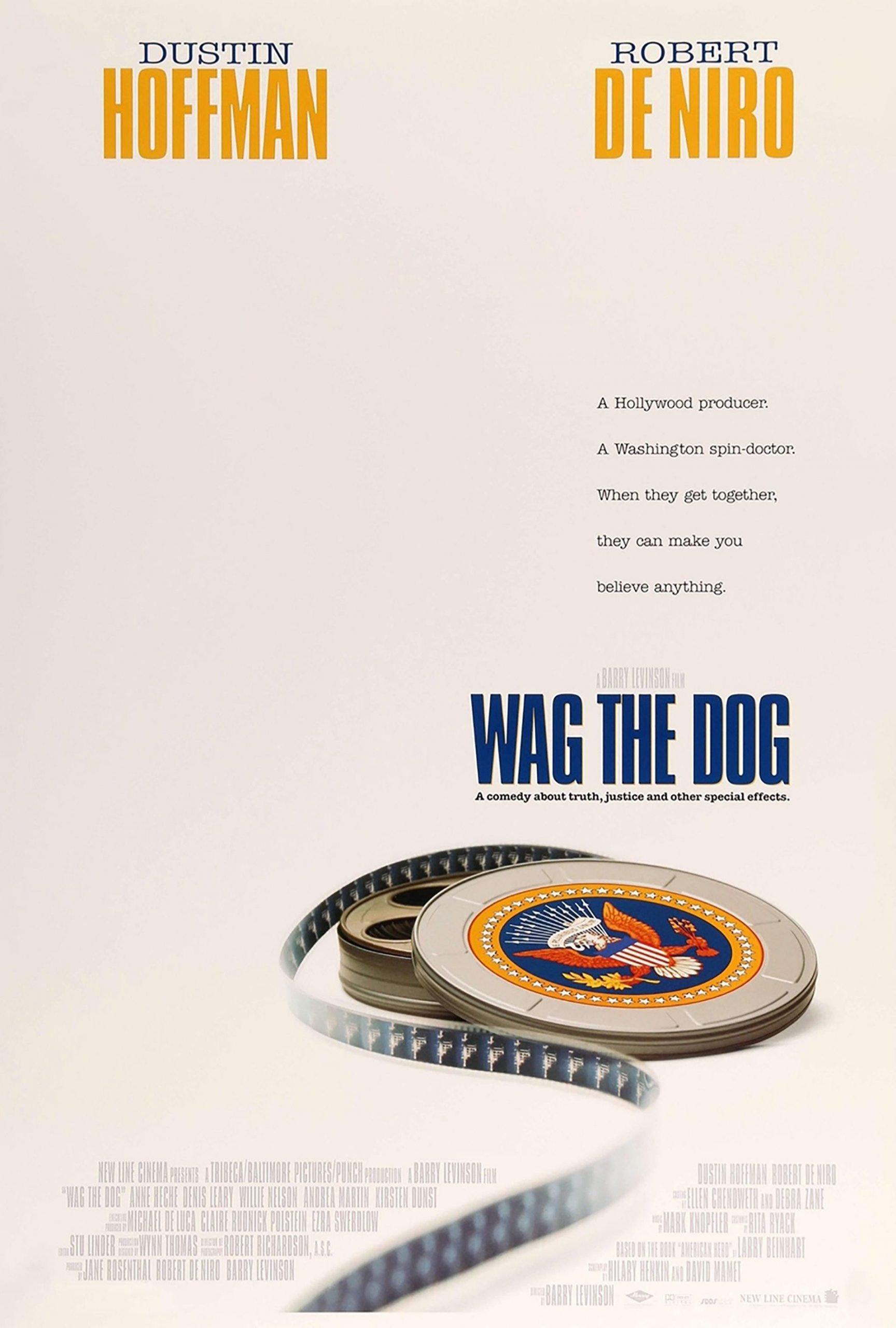
Starring: Robert De Niro, Dustin Hoffman, Anne Heche, Denis Leary, Willie Nelsen, Kirsten Dunst, Woody Harrelson, William H. Macy, John Michael Higgins, and Craig T. Nelsen, with Harland Williams, David Koechner, Jim Belushi, and Jay Leno
Grade: Classic
“God bless the men of the 303.”
Summary
Why does a dog wag its tail? Because a dog is smarter than its tail. If the tail were smarter, the tail would wag the dog.
A campaign commercial is shown where a man asks his friend what horse he will ride in the next race. His friend chooses the same one saying, “Never change horses in midstream”. The man responds that it sounds like a smart bet, and his friend replies, “Yeah, always stick with a winner”. At the end of the advertisement, the voiceover tells the viewer to keep America working and reiterates to not change horses mid-stream. All of this is an advertisement to reelect the sitting President of the United States, as Election Day is coming up.
Top level spin doctor Conrad Brean (De Niro) is brought into the White House at night. He follows presidential aide Winifred Ames (Heche) to the basement for a private meeting with John Levy (Higgins), his staff, and press office member Amy Cain (Suzanne Cryer). Wanting pure secrecy, Brean gestures for the in-house waiting staff to be removed, so Ames sends them away. Right away, Brean makes it clear that if anything discussed in this meeting gets out, one of them leaked it. Brean then wants Ames to tell the others what they need to know. Ames relays that the President said one thing when the news broke: Get me Conrad Brean. With this, Brean smiles at them. Now, he wants to know the situation. Amy says there were some Firefly girls from Santa Fe at the White House last month. One of the girls expressed interest in a Frederic Remmington bust, so the President took the girl to the office behind the Oval Office for a period no longer than three minutes. She’s alleging sexual misconduct. Right away, Amy suggests they say the girl had a funny drug reaction to the flu. Brean wants to know who has the story. Ames asks if he wants to know if it’s true, but Brean doesn’t see a difference. If the story breaks, they’ll have to run with it. Unfortunately, they don’t have long until it breaks. It will be on the front page of the Washington Post tomorrow. Right now, the President is in China and will be leaving to come back soon. Brean says the President needs to stay on the ground for another day at least. Amy asks why, and Brean is already agitated. After Amy confirms she’s the press office, Brean tells her to earn her money, to say the President is sick, and to get that story out immediately before the paper’s story because he needs at least a day to figure things out. Talking about the sickness, Brean suggests they issue it as a bulletin and how the President has some rare strain of something. Ames doesn’t think this will hold a day, but Brean is sure it will, asking why the President is in China. Levy responds that it’s about trade relations. Brean agrees and adds that it has “nothing to do with the B-3 bomber”. Levy tells him there is no “B-3 bomber”, and Brean says he just said that, and he doesn’t know why these rumors got started.
Oh, he’s good.
Brean needs $20,000 and a car, so Ames relays the message. Their meeting is interrupted by a worker mentioning how she has the rough-cut campaign commercial for opposing candidate Senator John Neal (Nelson). They had someone steal it from the editing bay, so the room all goes over to watch the tape. It will be on the air the day after tomorrow. It lambasts the President’s integrity while Maurice Chevalier’s “Thank Heaven for Little Girls” plays over it. Brean asks the others who will take the press conference today, so Amy asks if there is supposed to be one, to which Brean replies, “Well, what do you think?”. Brean goes on about how they will need this place as a base of operations, he will need 1-2 days, and whoever is talking to the person from the Post to let it slip that it hopefully won’t screw up the B-3 program. It will lead to the reporter asking what B-3 program and why should it screw it up. He continues detailing this hypothetical interaction and how the leaker could state something about how if the President decides to deploy the B-3 before its fully tested, which would again prompt the reporter to ask what for. Brean calls it “The Crisis”. Grabbing his fedora to head out the door, he still has to figure out what this “Crisis” is. They exit the room and walk down the hallway as Brean tells them to get General Scott and the Joint Chiefs of Staff and put them on a plane to Seattle right away because he gets all flustered and nervous when he talks to Boeing people. Amy is still confused because there’s no B-3 bomber, so Brean has to dumb it down for her. He agrees there isn’t and Scott is not in Seattle to talk to Boeing. It doesn’t have to prove out. It just has to distract the people. They have less than 2 weeks before the election. On the way out, Brean is given the $20,000 in an envelope, and he tells Ames he’s off to Hollywood to meet up with a film producer. He tells her to meet him at National in an hour. They’ll go to Chicago and they’ll connect in Los Angeles. On the plane together, Ames is still worried, so Brean calms her down. During Reagen’s administration, 240 marines were killed in Beirut. A day later, they invade Grenada. That was their MO. Change the story and change the lead. It’s not a new concept.
Ames tells him they can’t have a war, but he explains they aren’t having a war, only the appearance of one. Still, she doesn’t think they can afford the appearance of one either. He doesn’t think it would cost anything, but Ames thinks the American people would find out.
Brean asks who will tell them, using the Gulf War as an example as to how Americans didn’t really find out much of anything. He comments how one video of a bomb blowing up a building could be made out of Legos. So, who does he want to “go to war” with? Well, he’s working on it. After the overnight plane ride, Brean comes up with the idea of Albania being the chosen country because not even Ames really knows much about them. Brean considers them shifty, standoffish, and untrustworthy. Ames questions if they have done anything to America, but Brean counters by questioning what they have done for America. This is why they have to “mobilize the B-3 bomber”. At this point, they have no choice. He tells Ames to get her press office to deny any report of Albanian activity publicly. While they wait at their gate, they see a new report on a nearby television breaking the Firefly girl story accusing the President of sexual misconduct in the Oval Office. The girl’s attorney says there are no plans yet to hold a press conference. The news anchor details however that everyone is waiting for a response from the White House regarding the allegations. With the election days away, the anchor questions how much the outcome will be affected by the scandal. Brean watches intently and thinks. As they get onto their connecting flight, Ames contacts people who work with Albanian information and relays the message of General Scott being in Seattle and how she doesn’t think it has anything to do with the B-3 bomber. In a television interview, Senator Neal comments that the President should step down if the allegations are true. He knows the President has extended his visit in China, so he urges the President publicly to come home to face the music since the election is in 11 days. Currently, the President is still ahead in the polls by 17%. In Los Angeles, Brean and Ames travel to the mansion of Hollywood producer Stanley Motss (Hoffman). They arrive and find Motss in his tanning bed telling his assistant Ramon to get his veggie shake and to remind him in 10 minutes to switch to the other side.
Brean says they have mutual friends in Washington, and Motss questions if it’s true. He goes on about how he likes the President, as he inscribed a book to him. He tries to recall what the message was with something along the lines of “For progress to occur, it’s necessary for two generations to agree”, and Brean finishes it for him. Motss questions how he knows what the President inscribed, but Brean explains how it wasn’t the inscription. It was the title of the book itself, prompting Motss to say it’s a terrible title. Afterwards, Motss is in his study with his robe on and pulls out the book to find it, confirming that it’s the title. He admits he never looked at the cover. He just looked at what the President wrote to him. All three are interrupted by the news on the television where Levy holds a press conference to respond to the allegations. Motss thinks he’s fucked, but Brean mentions how they may have a chance if they can hold the break in the dam for 11 days until the election. However, Motss doesn’t think they can hold the dam and isn’t sure what Brean wants him to do about it. On the TV, Levy states how the President was advised to stay on the ground in China for 1 or 2 days. One of the reporters asks if the delay has anything to do with the situation in Albania. Levy denies knowing about this, but the reporter continues about how they learned the state department has set up a special Albanian task force at the ops center. Hearing this, Motss looks at Brean and Ames and back at the TV. Reporter Rose asks if General Scott’s flight to Seattle is connected to the B-3 bomber. Levy assures the room there is no B-3 bomber, but another reporter questions if the situation in Albania related in any way to the Muslim fundamentalist Anti-American uprising. Brean starts to laugh because they’re finally biting on it. Connecting the dots, Motss asks Brean how close he is to this whole thing, so Brean pulls out his phone and asks Motss what he wants Levy to say to show him. He calls a number, and Motss tells Brean to say something along the lines about how they are all concerned for the President, and their hopes and prayers are with him. Brean gives the phone to Ames, and she relays the message. It’s sent to Levy’s earpiece during the press conference on the spot, and he states it verbatim.
Even so, Motss isn’t satisfied because he doesn’t think Levy sold the line good enough. Regardless, Motss agrees they have bought themselves a day or two. Brean reminds him how they only have to string together 11 days until the election. Motss still doesn’t think it will hold for 11 days because the President fucked a girl scout, but Brean is quick to correct and him say it was a “Firefly girl”. Motss goes on about how there’s nothing that can hold this off, sans a war, prompting Brean to give Ames a look. Seeing this, Motss realizes this plan is already in effect. Noting how he is in show business, Motss wants to know why Brean is coming to him. Brean mentions the slogan “54, 40 or fight” and asks what it means. Motss can’t exactly remember where it’s from. After Brean mentions a couple more, he reminds Motss how they are war slogans. In these cases, the slogans are more memorable than the wars themselves. It’s because it’s show business. That’s why they are talking to Motss. He goes on talking about war imagery like the naked girl covered in napalm, Churchill’s “V” for victory, and five marines raising the flag in Mount Suribachi. They may remember the picture 50 years from now but have forgotten the war. He mentions the Gulf War, the smart bomb going down a chimney, and how there were 2,500 missions a day in 100 days, but one video of one bomb made people buy into that war. War is show business. They discuss what he does and how they don’t actually have to reveal to the public the details of this Albanian war because people won’t care, with Brean noting how he read the first draft of the Warren Report and how it said JFK was killed by a drunk driver. Bringing up the Gulf War again, he again talks about the one smart bomb falling down a chimney because that’s probably the one thing Motss remembers from it. Brean reveals he was there when they shot the video at a studio in Falls Church, Virginia with the 1/10th scale model of a building. Motss asks if that’s true, but Brean responds, “How the fuck do we know?”.
You see the point?
They want Motss to produce their war, or pageant rather. They need a theme, song, visuals, and whatever else. Brean likens it to the Oscars, prompting Motss to note he never won an Oscar, but he did produce the show before. Even so, he gets mad at the lack of respect a producer gets within a production because no one really knows what they do. Brean’s offer is that he could get an ambassadorship, but Motss isn’t interested. He’s cool with doing it for the fun of it and for a story to tell. However, Brean is adamant he cannot tell anyone. Motss says he’s just kidding, and they go through the details of why Albania would want to go to war with them. Motss thinks they would want to destroy their way of life in America as their motive. Gesturing to Ames to take notes, Motss goes on about how the President is in China to deal with the dispatch of the B-3 bomber to Albania because they just “found out” they have the bomb. However, he scratches that because Albania would have to have a rocket and such. Instead, he comes up with it being a suitcase bomb and gets excited about how good of an idea this already is. Now, he’s cooking. He goes over to his giant globe and determines that the suitcase bomb is in Canada. Motss decides Albanian terrorists have placed a suitcase bomb in Canada in an attempt to infiltrate the bomb into America. They love it, and Ames appreciates how cost-effective it is, which Motss boils down to what producing is. He then goes on a tangent about how Cecil B. DeMille needed an elephant for a reshoot on The Greatest Show on Earth. Before he can get into it, Motss’s assistant Grace (Suzie Plakson) gives Ames the phone because she has a call from the President. Motss tells her to wait, but she takes the call. Then, he gets annoyed because he doesn’t think anyone is listening, but Brean says he is. Motss loses his train of thought and brings up the suitcase bomb again, and Grace mentions how it would be a good title for a movie. He tells her to write it down. Now, he’s going through the treatment. In Act 1, Albania denies everything. The President comes on the air and says, “Be calm”. He then relays to his assistant he needs Johnny Dean (Nelsen), Liz Butsky (Andrea Martin), and the Fad King (Leary). He tries to move onto Act 2, but Brean cuts him off because they don’t need an Act 2. They just need to hold their interest until the election.
Motss smiles. It’s just a teaser.
Ames relays to the others that they are getting a great reaction on the Albanian idea. Later, Motss is on the phone with Johnny and laughs, telling the others how Johnny has a new wife and is riding around in a pickup truck with a shotgun and a dog. Brean fake laughs for him. As Motss tells Johnny how they need him immediately, Ames is still on the phone with the President and tells Brean that he’s worried about the possible Albanian backlash. Brean simply says they can’t have a war without an enemy. Actually, they could, but it would be a very dull war. Motss tells Johnny they need him for 11 days and will need him to write a song for this whole thing. Pausing the phone call for a moment, Motss asks Brean if there will be a “back end” on this thing like percentage points and money, so Brean confirms this. Ames wonders where this “back end” is coming from, but Brean says it’s like the “thing with the yellow ribbons”, referring to the hostages that tied yellow ribbons to everything during the situation in Iran. Ames thinks that it was a naturally occurring thing, but now, she’s questioning if it was a put-up job. Brean doesn’t answer. At the same time, Motss has Grace get Johnny a ticket, and Grace gives Motss another phone with the Fad King on the line. Immediately, he tells King there’s a back end. Sometime after, Motss has King, Liz, and Johnny at the house. King hates the ribbon idea because of the yellow ribbon thing and AIDS. They shoot ideas back and forth while Johnny tries to come up with some semblance of a song at the same time. King is thinking green armbands, and Motss shows Johnny a political cartoon making fun of the President, so Johnny tries making a song about it until Motss tells him it was just a joke he wanted to show him. Later, Brean and Ames flips through the channels on TV where everyone is talking about the President in the midst of all the recent news. Motss is with Grace going through a potential speech detailing a young girl in rubble, how she was driven from her home by Albanian terrorists, and asks what Grace thinks about the line “It is her, we are mobilizing to defend”. She likes it, so Motss asks if they can get a kitten for the girl. He sits down with his team and thinks the video might be too static with the girl just running from the village. He wants more energy.
Brean is given headshots to see who will play the victim in the news footage. Motss goes on about how the girl will be running towards the camera in a grainy, hand-held footage type of style. The group argues with which actress to go with next, with Motss determining King’s choice to be too Texan. This prompts King to ask why they are so locked into Albania, and Johnny saying Albania is hard to rhyme.
Motss tries to bring up random Albanian facts like how Jim Belushi is Albanian (which shocks Johnny) and asks everyone if they have ever eaten at an Albanian restaurant. None of them have and even question if such a thing exists, so King suggests they make up what would be considered a traditional Albanian dish. The group works out more details all night long and into the morning. Sometime in the morning, they see the President’s campaign ad about not wanting to change horses mid-stream, and they all think it’s terrible. Ames goes through all the major publications and sees that most of them are talking about the war. She gives Brean credit, but he’s half-asleep on the lawn chair by the pool, having slept there overnight. Back inside, Motss asks if they would vote for the President based on the commercial, but King doesn’t vote because of the one time the MLB started the fan voting thing for the MLB All-Star Game. He voted for Boog Powell for first base, and he didn’t get in, so it disappointed him. He’s never voted for the president. Motss admits he doesn’t vote either, but he does vote for the Academy Awards. Sadly, he never wins. Liz doesn’t vote either, but it’s because she doesn’t like the rooms. She’s too claustrophobic. As Ames gets Brean ready to go, Grace shows pictures to Motss of the girl with a cat, a kitten, and a dog. Motss doesn’t want to hear about the dog because it’s not what he asked for, but Grace says the pet wrangler suggested it. Ames interrupts the two to say she has to speak to the President before they decide on an animal. They kind of ignore her, and Motss details to Grace that the Albanian terrorists have a staging area for their atomic workshop, which is why the girl is fleeing. By the door, King suggests to Brean that it could be Italy instead of Albania because he could get his hands on a lot of walking around cash if so and how the boot could be a thing, adding that Albania doesn’t really do anything for him. Motss is still with Grace talking about the kitten. All 5 of them exit the house while Brean explains how they’re locked into Albania, and the President will officially “go to war” with them in 30 minutes.
On a news report, the anchor details the President apologizing over his secrecy regarding the war, how Albania has been a staging ground for terrorists around the world for a while, and a state of war is about to happen between the USA and Albania. Following this, the news footage is about to be shot. Motss meets with the young actress who will be portraying the young Albanian girl in Tracy Lime (Dunst) and gives her the direction of running towards him screaming on “action”. Not knowing the exact details, she asks if this is an ad or whatever, but Motss walks off to argue with the pet wrangler (Williams) who has a bunch of dog breeds like a schnauzer and a Lhasa apso. Brean takes Tracy aside to explain the details of what she’s doing and the “special situation” they’re in. Ames says the President wants a kitten, as does Motss, so they tell the pet guy to take all the dogs out of there. Ames goes over to Tracy to get her to sign something, but she doesn’t want to without her agent present. Ames explains it has nothing to do with her deal and that it’s for her “security clearance”. She signs it. Meanwhile, Motss shoos away a guy (Koechner) suggesting what Motss considers a “cat” and prefers the kittens Grace is holding. He notes how the other guy won’t stop pushing the Lhasa apso. Next, they go to film and Motss positions Tracy. He gives her a bag of chips in place of the kitten because it will be edited in later, as it allows for them to pick between a variety of kittens. Tracy goes over to Brean and asks if she can put this on her resume when it goes national, but he says “No”. She can’t tell anyone she did this. Otherwise, someone will come to her house and kill her. They are interrupted because Brean has to take a call from the President, and makeup tries to work on Tracy. The director stops them however because her character has been “raped by terrorists”. As Brean explains to the President how they are doing the kitten thing optically, Ames grabs the contract from the director to make sure Tracy isn’t an illegal immigrant. In post-production, Motss is there with the editing team. They insert a village background, flames, screaming, and sirens.
Brean is watching and confirms to Ames they will be in Washington that night, though Ames is told over the phone Neal has discovered something. Brean doesn’t think it matters and takes the phone from her. Motss impresses himself with his work and notes how good of an eye he has for casting. Even so, they let Tracy know they’re going to do it again. Following this, Motss suggests they insert a burning bridge for her to run across, so they go with it. Motss is now thinking she should be holding a calico kitten, and Ames is letting the President know over the phone about the process. Apparently, the President wants a white kitten, resulting in Motss becoming perturbed and wanting to speak with him. Ames won’t let him because the President is “mobilizing the sixth fleet”. His hand is forced, so Motss goes with the white one against his wishes. After they insert the kitten into the shot, Ames asks how soon they will get the cut, and she is told it will only take 4-5 hours. Ames is happy with this because they will be able to leak it to the press soon after. Later, the news shows the footage from the “Albanian front”. The anchor describes the video as they show it as a young Albanian national attempting to escape terrorist reprisals in her village. He adds that “America has seldom witnessed a more poignant picture of the human race”, and Brean is happy watching it with Ames and Motss. Motss notes how they used the same process with the last Arnold Schwarzenegger movie. Motss is excited about the rest of the plan. Once they add the song, the image, the merchandizing tie-ins, they’re going to be off to the races. The three cheers to the “beginning”. The next phase will take them to Nashville. They only got 10 days left until the election, so Brean and Motss just might be able to pull this thing off.
However, the hiccups have just begun.
My Thoughts:
Intelligent, hilarious, and scaringly plausible, Barry Levinson and David Mamet’s ever topical Wag the Dog is an expert political satire that is as entertaining as it is relevant. The scandal, the hiring of spin doctor Robert De Niro who’s powers behind the scenes are shrouded in secrecy, Dustin Hoffman lighting up the screen in his last Oscar-nominated role, and how the two navigate through the many peaks and valleys of their plan to distract the American public, everything about the engrossing Wag the Dog impresses, compels, and finds new life with every rewatch.
There are a lot of political satire and political thriller films that are referred to as being “culturally relevant” or are looked at as something that can be referenced by a news source for their real-world parallels in the world of politics, but there has never been one as ridiculously entertaining, creative, ingenious, and just as relevant today as the day it came out than Wag the Dog. Anytime another crazy event happens on the state, federal, or global level in government, there are echoes of Wag the Dog in one way or another. Released a month before the infamous scandal between President Bill Clinton and Monica Lewinsky and the bombing of the Al-Shifa pharmaceutical factory in Sudan after the news of the scandal broke, it eerily mirrored the entire premise of De Niro’s Conrad Brean setting up this elaborate distraction to make the public forget about the President being accused of sexual misconduct with a minor. Subsequent events like the Clinton administration bombing Iraq during his impeachment trial, Clinton intervening in the Kosovo War, and the many conspiracy theories of today’s political climate all breathe new life into the genius of Wag the Dog to this very day. At first, it seems like it will be another Canadian Bacon, not a bad movie by any means but not taken as seriously from its screenwriters as it could have been. However, the wheels start turning almost immediately after. With someone like David Mamet being involved in the writing and two of the greatest actors of their generation being attached as co-stars, the expectations rise and rightfully so. Once this is understood by the viewer, they will not be disappointed in the efficiently paced, energetic, and colorful film this turns into. It’s constant, moving at a quick pace to mirror how fast the characters have to work as well as think. They only have 11 days until the election, and they are in crisis mode. According to the expert storytellers involved like Brean and famed Hollywood producer Stanley Motss, the only way to distract the public from a career-killing allegation of sexual misconduct with a minor is a war. Brean understands this and gets the rest of the President’s advisors on board. He doesn’t need to have to tell the audience how bad this is. Him being brought in is good enough of a reason. In addition, he makes it clear what his job is when Ames asks if he wants to know if what the President did is actually true or not.
He doesn’t care because it makes no difference to him or anyone else. As soon as that headline is printed, it’s stained in the memories of everyone. The group inside as well as Brean have no concern about the truth. There job is to figure out a way to cover it up or move attention away from it long enough for the President to be reelected. That’s it. This cynical but authentic perspective of politics and the media is as gripping as it is entertaining because the viewer can’t help but see this thought process as factually correct, due to our increasingly jaded opinions of today’s political climate that is only reaffirmed daily. How protagonist Brean got into his position as this legendary spin doctor called in directly on the President’s orders is never said, but it’s understood immediately in the opening credits as the fedora-wearing Brean sets the tone by coming up with a series of plausible lies on the spot that are vague enough to answer questions but yield enough interest from outsiders with sly wording to take the conversation into a different direction. Once he gets the basic details and hearing the President is in China, De Niro locks you in with his conviction and his ability to have an answer or counter for everything, making it look like it’s the first day on the job for these presidential advisors with how good he is. For starters, he says to tell the President to stay on the ground in China for a day or two and add that he has a flu strain. This will buy everyone more time, including himself. This makes sense. To further it, they establish he’s there for trade relations, and Brean gives them an inch to show his line of thinking by adding with a wink and a nudge that it has nothing to do with the “B-3 bomber”, a recurring gag in the first act. For the viewer, we get it, but the others are confused because they’re shooting straight, prompting him to lean them more in the direction of what he’s getting at. Just bringing up the made-up topic that is specific enough and contains a buzzword or two is enough to garner intrigue, especially with attention-grabbing headlines that reporters search for and live by, a problem in the media that exists to this very day.
Any reporter worth their salary would have to ask further about such a thing because mentioning this unexpected “B-3 bomber” would make any reporter think they are the first person to hear about this, like it’s a forbidden topic that was accidentally blurted out. The “Where there’s smoke, there’s fire” concept tends to be true more often than not, so they would have to jump on it, or they might get left in the dust. News reporters, journalists, and sensationalist news coverage shows live by this whether they have a lot of details or not, and Brean knows it. This is why he preys on this, using this against the public just like he did before with his help during the smart bomb in the chimney that they filmed for the Gulf War and with what he’s doing now with the current President. You cannot say this is a ridiculous idea. With enough people sworn to secrecy at the highest level of government, especially back then when it was easier to keep a secret when social media didn’t exist and the internet was still in its infancy stages, this would 100% work. Obviously, a lot of variables would have to be controlled, but you have to take into consideration that the characters brought in to help are the best of the best. You don’t think they could do something similar in real life after a few contracts are signed? In Wag the Dog, these are professionals who are trained to come up with ideas due to their experience and their ability to react and adapt when another hurdle comes their way. Brean is a master of it in real-world scenarios, but he knows this specific scandal needs more expertise, as it’s not only an election year, but the election is also in 11 days. That’s why he has to move at an insane pace, and the movie itself follows his lead. With all of this in mind, the logical next step is to collect someone who can adapt in different, elaborate productions and has the resume and cache to back it up. This is when Stanley Motss is brought in, played by a wondrously funny Dustin Hoffman. Bringing in a Hollywood producer is not as crazy as it sounds when everything is established, along with the time clock. If anything, it’s just another brilliant idea from Brean that no one else would have considered.
Considering the situation they’re in, they need another producing genius on board. Brean is like a producer for real-life situations, as the role of a spin doctor is very much that of a real puppeteer behind the scenes. Nevertheless, he can’t do it all in the time given. Though Motss has never won an Oscar, he’s a famed producer in Hollywood who is called on to help. At first, he’s unsure, but Brean’s referencing of war slogans, famous pictures, and video footage of previous wars and battles through Mamet and Hilary Henkin’s skillful and researched dialogue opens the mind to not only Motss, but the viewer. Maybe it’s a little scandalous to call war “show business”, but the reality is frighteningly accurate in some regard. When a war happens, the media looks for symbols, they commercialize, they make heroes and villains to follow, they memorialize the figures who do something, movies and TV programs follow certain figures who get involved on either side, and news programs who have daily content to create look for updates to fill their scheduled programming, finding someone or something to either praise or point to blame. Why? It’s because of the need for content in general. It’s entertainment. War is real, but all the stuff that follows or surrounds it is entertainment, or “show business”. They take the information and spin it in some way to create shows, specials, programs, events, charity benefits, things to go to, and ways to make money off of it. Wag the Dog is opening this forbidden door of a possible truth, pointing to the disjointed reality of how all the non-service members have turned wars into money-making, media-controlled events, and the public falls for it every time. Brean is enlisting Motss to “produce” this war as an all-encompassing Hollywood production to ensure there is no way the President can lose this election. To the viewer’s benefit, they do exactly that and what follows is absolute brilliance in filmmaking, screenwriting, storytelling, and acting, as we watch two virtuosos at work that create a full-on Hollywood spectacle of a completely made-up idea and fooling two countries into believing it wholeheartedly. Repeatedly, the audience will find themselves laughing at how funny and well-thought-out the ideas of the team are, along with how fantastic the characters are at pivoting when the heat is on.
At the same time, the viewer will find themselves asking internally but also knowing the answer, “Could this happen?”.
Yes, yes it could.
Dustin Hoffman is tremendous as the hilarious Hollywood producer Stanley Motss who is “57-62 depending on the bio”. Considering his wealth in experience in dealing with the larger-than-life personalities who take on the profession, both Hoffman and De Niro know the producer type. It’s no surprise that Hoffman took inspiration from real-life producer Robert Evans with the way he carries himself, his attire, quirks, and that smarmy, cheesy, trying-to-make-a-sale producer way in which he talks. Hoffman as Motss just talking with Johnny on the phone and relaying to his assistant Grace how Johnny is “riding around right now in a pickup truck with a shotgun and a dog” and laughing hysterically is gold. It’s the mile-a-minute way of thinking and speaking, and the phoniness of a producer that Hoffman emulates on a remarkably funny level that allows him to take the picture by storm. The character is written perfectly with this in mind, like his comments to Brean about how he hates when they send the long limousines out for him because it’s hard to make the turn into his massive property. Brean says it’s fine and he’ll just stretch out, and Motss is quick to reply, “Ok, just make do” as if he’s suffering. It’s the little exchanges like this that really complete the character, along with what becomes his catchphrase in the film assuring everyone, “This is nothing!” anytime something disastrous happens like the debacle with who Sgt. Schumann ends up being. With Hoffman’s charming delivery that is very much the schmoozey Hollywood type, he lightens up the screen anytime he does something and is quick to detail “It’s just producing. That’s what it is”, likening the job at one point to being a samurai warrior while spouting off confident nonsense like, “Fuck the world! Try a 10AM pitch meeting coked to the gills, no sleep, and you haven’t even read the treatment”, as if Hollywood has prepared him for anything and everything. Every line spoken and delivered by Hoffman is masterful. It’s a late career best.
Then, it’s the pivots. The movie gets better every minute, but the pivots Brean and Motss have to take after something goes wrong like the CIA acting like they backed down to Brean’s confidence only to play hardball with their own lies to stop them in their tracks with the Canadian border standdown thing was great, or Brean visualizing the President getting a sacred traditional offering of sorts from an Albanian girl and her mother at the airport and wanting rain for it to add to the scene, so he has Ames divert the President’s plane to Boca Raton instead of Andrews. The best moment comes from right after they get the news of the troops standing down. Brean is ready to throw in the towel (“It’s over. I saw it on television”), but Motss’s ego and confidence in his job fuels the redirection. It might be one of the very few times we love to see the arrogance of a character, as Motss refuses to end this “war” until he says it’s over, talking about how this is “My picture. This isn’t the CIA’s picture!”. In classic Motss fashion, he talks about another anecdote about making The Four Horsemen of the Apocalypse and letting the fast-talking Fad King explain the rest, “Three of the horsemen died” before Motss can’t help but chime in again adding, “You hear what he’s saying? Three of them died two weeks before the end of principal photography. This is nothing! This is just Act 1: The War. Now, we really do need an Act 2, so we work”. With Mamet’s trademark dialogue exchanges on full display, the Fad King and Motss go back and forth in the best conversation of the movie.
King: “You know what? It’s like the Japanese.”
Motss: “What?”
King: “In the caves…”
Motss: “Go on.”
King: “Okinawa”
Motss: “Go on.”
King: “They didn’t believe the war was over.”
Motss: “That’s right. We have a guy who doesn’t believe. No, no, no, no, an American serviceman – “
King: ” – A brave American serviceman is left behind.”
Motss: “A hero. Oh my God. What was I thinking? We had a war. We forgot the hero! You can’t have a war and not have a hero. It’s like we sent him the Christmas card and forgot the – what do you call it?”
King: “The fruitcake.”
Motss: “There you go.”
You get GOLD in almost every conversation had, even in ones that ultimately mean nothing but show Brean’s spin doctor prowess like his expert deflecting in his conversation with CIA Agent Charles Young. Still, this is a personal favorite. Well, there’s that, their response to reading the background behind Schumann on the plane, and Motss referring to the whole CIA intervention as lucky and how this fictional serviceman was “left behind, just discarded like an old shoe”, prompting King to respond, “That’s good”. Motss starts to smile and asks, “What’s good? What did I say?”. After King reiterates the shoe line and Motss feeds his own ego with, “Old shoe? It’s just instinct”. Then, he tells Brean to get a list from the pentagon of all the people in special military programs before saying to himself aloud, “Left behind like an old shoe… That is good”. The best way to deal with a producer is playing to his ego and making sure his confidence stays at an all-time high because they can pull off some miraculous things, as we find out (“Bottom of the 9th. You see? They don’t know who they’re playing with”). Brean does great dealing with Motss’s personality and does so even in the climax of the movie before Motss’s ego consumes him.
The producing of this war is flat-out mesmerizing. From the signature song they make to Brean having the record snuck into the Library of Congress as if it were a folk song made in the 1930s (a genius and yet another totally plausible move), how they have the advisor “remember” the song in her meetup with the CBS guy that sets the chain of events off, the placing of the shoes on the tree as a nationwide movement to create this mythological war hero, Motss acknowledging the corniness of the speech he wrote but how it’s going to work to the point where he performs it for all the crying secretaries and the President, trying to figure out a Latin motto for the 303 patch, the “courage, mom” message that is shown at Times Square, how it turns into a merchandizing angle with King talking about getting Dennis Rodman to die his hair in leopard print to tie-in with a shoe from Nike and a cheeseburger meal from Johnny Rockets, and how it gets so far that there are plans for Schumann to potentially get a Congressional Medal of Honor and a memorial statue being built over the Albanian war, with no one seeing a problem morally with any of it. It’s so well done that it’s almost discouraging from a screenwriting standpoint because it makes you question just like Motss does, “How do I top this?”.
The shot of the American flag superimposed over Conrad Brean looking through the window speaks a thousand words by the end of this glorious story. Wag the Dog is genius. There’s no other way to put it. It manages to make a political satire laugh-out-loud funny and somehow avoids the pretentiousness that usually consumes the genre whole, a near impossible thing to pull off. One of the year’s best and the decade’s most underrated, a superb all-star cast powered by the direction of Barry Levinson and another phenomenally written screenplay by David Mamet and partner Hilary Henkin, Wag the Dog needs to be seen and appreciated by as many people as possible. Simply put, they just don’t make them like this anymore.


+ There are no comments
Add yours