
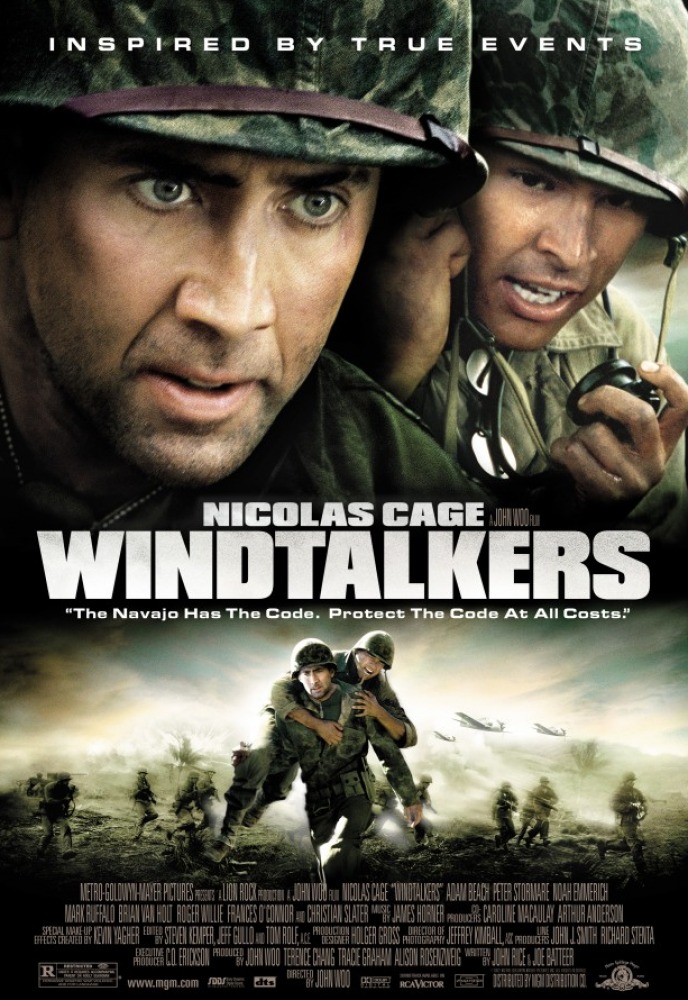
Starring: Nicolas Cage, Adam Beach, Christian Slater, Mark Ruffalo, Peter Stormare, Frances O’Connor, and Jason Isaacs
Grade: B+
Joe Enders’s reply of “No more stupid questions today private. That’s an order” to Ben’s question of if he’s ever seen ghosts is something I need to make part of my regular lexicon.
Summary
During World War II in 1943, Navajo member Ben Yahzee (Beach) says goodbye to his family and heads on a bus there to pick him up. The bus is filled with members of the Navajo tribe, including Ben’s friend Charlie Whitehorse (Roger Willie). This surprises Ben, but he’s happy to see him. Charlie jokes that he didn’t want their white brothers to think Ben was the best they had. On the Solomon Islands, Corporal Joe Enders (Cage) leads his troops, but they are under heavy fire and running out of ammunition. Eventually, they get to a point where they are using some logs for cover. The enemy is closing in, and a few of the soldiers like Tommy suggest they get out of there. However, Enders stands firm on their orders to hold their position, even though he looks just as anxious as they do. Tommy gets shot and then subsequently blown up by a grenade, leading him to fall onto Enders. The soldier next to Enders gets shot too, and Enders fires back and takes out three. Enders is cover fire for the last soldier with him, but this soldier is shot just as well. He falls into Enders’s arms and says, “God damn you, Joe Enders” before dying. Enders yells emotionally before a grenade is thrown and blown up right next to him. He hits the ground.
At Camp Pendleton, California, the Navajo are sworn into the military and take classes to be code talkers. In one of these classes, the instructor questions them on the word for tank. No one knows, except for Ben who correctly guesses the Navajo word for tortoise. He tries to answer the next question too, which is asking what the right word for artillery is, but Charlie beats him to the punch and guesses it right. At the Kaneohe Bay U.S. Naval Hospital, Enders is in a wheelchair staring into the distance, as the words of his soldiers still ring in his head. His left ear was severely damaged from what happened. He’s unable to hear Pharmacist’s Mate 2nd Class Rita Swelton (O’Connor) when she greets him to give him his pills. It’s not until Rita goes to his other ear that she is able to get his attention. Enders compliments her and then stands up from his wheelchair to show her how much better he’s getting. He’s able to walk a little bit before stumbling, but he’s able to hold himself up by using the wall. Rita tells him that he’s a mess, but Enders points out an amputee being wheeled around and corrects her to say that guy is a mess. Enders sees himself as getting better every day. Rita explains that he has a perforated eardrum and his equilibrium is all screwy. He can’t go back to war if he can’t stand up. Enders tries to walk some more, prompting Rita to ask why he doesn’t just stay there. She tries to joke that someone has to keep the WAVES company, but he’s in no mood. He just asks her if she’s going to help him or not. Following this, Enders is getting his hearing tested, as it’s part of the things he has to pass to get back into action. Enders gets into a booth and puts on headphones, and the man plays noise at certain decibels. Enders raises a hand to acknowledge what side it came from. Unbeknownst to the man administering the test, while Rita is standing behind the man, she is signaling to Enders when to raise his hand. To the man’s shock, Enders passes the test with flying colors.
Rita doesn’t feel good about it, though Enders smiles at her.
Back in the codename class, the instructor talks about how speed and accuracy under pressure is the key when on the radio. Timing them, he plays a recording and asks them to transcribe. Charlie is able to nail the transcription, which Ben jokes is beginner’s luck. In the military office, Enders waits and Sgt. Peter “Ox” Henderson (Slater) sees him, though he keeps going. Finally, Enders is brought in to speak to Major Mellitz (Isaacs). Mellitz looks at Enders’s record and notes how well he’s done as a Marine and how much better he is at that than being a civilian, as his record also mentions how he stole a motorbike and crashed it, got kicked out of high school, and has a charge for assault and battery on Father Crispin O’Donnell. He questions if Enders really attacked a priest, but Enders explains how O’Donnell was the assistant principal at Archbishop Keenan High School and the head disciplinarian. Mellitz just replies that he was a public school boy himself. Moving on, he notes how Enders had some minor problems in boot camp but has a commendation for valor in Shanghai, and he made a hell of a stand on the Solomon Islands, referencing the opening of the movie. He asks if it was a tough bit of business there, and Enders confirms. Nevertheless, he’s prepared to jump right back into action. Mellitz brings up how the Japanese have busted every code they have thrown at them and Enders’s men on the Solomon Islands were lost to a broken code. After asking if Enders ran into any Navajo on the Solomons and Enders being confused, Mellitz details how the Corps have developed a new code based on their language. It’s apparently had a quite an impact, so the navy have gone to great lengths to protect it. This is why Enders was brought there. He is going to be paired with one of them to keep him safe. His job is to keep the man alive, so he can do his job. Enders argues that his talents should be used for killing the Japanese, not babysitting some Navajo man. Mellitz assures him they didn’t pick his name out of a hat. They need good Marines for this job. He shows Enders graphic pictures of a Navajo soldier who was tortured to death by Japanese intelligence who were trying to bust their code.
Fortunately, the man couldn’t help even if he wanted to. He was a Navajo, not a code talker. The code is based on their language, but it’s still a code. He tells Enders that he cannot let his code talker fall into enemy hands under any circumstances. His mission is to protect the code at all costs. With this, Enders is officially given a promotion to sergeant. Following this, Enders gets in a jog at camp. As Ben and Charlie arrive, Ox sees Enders and runs over to him to start a conversation. He explains how his nickname is “Ox” because he’s from Oxnard, California. At the same time, Ben asks a random soldier if he knows where the 2nd Join Assault Signal is, but the soldier responds rudely about how he doesn’t. Charlie notes how he’s never seen so many white men before, but Ben adds that they have probably never seen so many Navajo. Meanwhile, Ox continues to try and talk with Enders. Seeing Enders’s scar so he knows he’s seen some action, Ox says he has seen some too and got shot in the ass by the Japanese. Enders doesn’t respond. Ox asks if his duty with JASCO has anything to do with the Navajo radiomen, but Enders replies that he’s not at liberty to say. After noting how they are both sergeants, Ox assumes his orders that he’s not at liberty to say are the same as his. Enders lets him know that it’s not a democracy. It’s the Marines. Ox sees Ben and Charlie looking lost, so he goes to help them out. Before he walks away, Enders warns him to not get too friendly. At lunchtime, Enders eats by himself until Ben shows up and asks if he can join him, as the Corps paired them up. Enders is in no mood to engage in conversation, but Ben continues. He sits next to Enders but accidentally knocks over his coffee. Next, Ben tries to offer his to make up for it, but he spills it into Enders’s food while he says it. Enders doesn’t flip out, but he’s seething. He has Ben hold his plate, he salts Ben’s food, takes Ben’s food, and leaves Ben with the plate he messed up. Enders leaves, and Ben knows he messed up bad. Charlie shows up to ask how his white man is, and Ben simply replies, “Hungry”.
That night, all the soldiers are hanging out and playing cards. Ben is writing to his son. After Enders wins a game and some soldiers leave, Ox invites Ben and Charlie to come play, so Ben does. The others try and mess with Ben, but he takes it in stride. While they play the game, Charlie plays the flute and Ox notes how beautiful it sounds. The next day, Gunnery Sergeant Richard Hjelmsted (Stormare) has the entire platoon in his tent, and he tells them they are shipping out tomorrow morning to the island of Saipan. It’s one of their steppingstones on the way to Tokyo, and it’s of strategic importance that they capture the island. They can get an advanced naval base and an airstrip to land and refuel the B-29, which would get their bombers in range of Tokyo. As he talks about how they’re going to take Saipan from the 30,000 that live there, the soldiers cheer. The only one who doesn’t look excited is Corporal Milo Pappas (Ruffalo). Hjelmsted continues about how they are going to be at the front of the division, sniffing out enemy positions and coordinating the naval gunfire, which is exactly what they have been training to do for the last four months. With this, he announces the new radiomen from headquarters as Ben and Charlie, and the sergeants assigned to protect them in Enders and Ox respectively. Enders isn’t even listening. His thousand-yard stare is evident, as he looks ahead and remembers the incident at the Solomon Islands. He grabs at his wounded ear too, which Ben notices. Enders suddenly rushes out of there while everyone watches him in confusion. Enders pukes outside, and Ben runs over to check on him. He gives Enders a pill to take to “get rid of the taste”, as him and Charlie went through the same thing on the boat ride from San Diego. He offers him a Life Saver, but Enders just asks what he’s doing there. Ben just says he’s trying to help, but this isn’t what Enders meant. He meant what is Ben doing in the military. Ben says it’s his war too. He’s fighting for his country, land, and people. He adds that he’s a code talker and does in 2 and a half minutes what used to take an hour. He adds that someone with more stripes than Enders thinks that’s worth something.
Holding a cigarette in his mouth, Enders sarcastically says to remind him to time Ben when he has bullets flying over his head. Ben asks what is wrong with him and then leaves. That night, the platoon parties, drinks, and sings at the bar. Enders drinks by himself. Rita shows up and greets him. She gives him some pills in case his ear starts aching. She tells him to call in the morning, but she realizes that he’s shipping out in the morning after seeing his expression. Flirting, she brings up how he’s going to ship out without buying her a drink. They get a couple shots of Bacardi, and she toasts to war, prompting Enders to give her a perplexed expression. On the Japanese Island of Saipan on June 16th, 1944, the platoon is in the middle of a battle. As they navigate their way through the warzone, the chemistry issues between Enders and Ben are apparent. Enders gives him the orders of staying right behind him as he moves, but Ben is slow to react at first which leads Enders to yell at him. Ben is also taken aback at one point when Enders goes on a crazy killing spree while yelling and having visions of the Solomon Islands fiasco. Meanwhile, one of the guys gets caught in the barbed wire fence and Ox tells the others to get him out of there. Unfortunately, the whole group is killed right in front of Ox. He fires a rocket launcher as a response. Ben trips and his helmet falls. When he grabs it, he sees the picture of his wife inside and gets emotional. Another soldier is shot, and Enders drags him right next to Ben. After he calls a soldier over to take care of the wounded one and tells Ben to put his helmet on, Enders goes back out there. The soldier has Ben put his hand on the wounded soldier’s chest to apply pressure. Once he’s allowed to take his hand off, Ben stares at the blood on his hand. Pappas and another throw grenades to stop a tank, and then Enders orders Harrigan (Brian Van Holt) to use the flamethrower to take it out. Later, the platoon is in a trench, and Pappas beings to hyperventilate, which is a normal thing for him. As he explains how he can’t breathe when he gets excited, Harrigan jokes how it must be hell on his girl, which gets a laugh from the soldiers while they are under fire.
Hjelmsted tells Enders to get the navy on the horn to dig out the guns, so Enders relays the coordinates to Ben. However, after more men are shot, Ben is stunned. Enders has to yell at him to do his job. Ben sends the message to Charlie, and the USS California is able to intercept it. The Japanese listen to it too, but they question if it’s even English because it sounds like they are underwater. With this, the platoon is able to gain significant ground, as the Navy fires several key shots at the coordinates to free them up. Enders leads them out and they dive into some trenches to take out more Japanese troops. Enders is mowing down people left and right and has Harrigan torch the turret box. When the Japanese troops exit it on fire and get burned alive, Harrigan and Ben are visibly affected at the sight. This momentary distraction allows for a Japanese soldier to crawl right over to Ben and the two point their rifles at each other’s face at the same time. Enders is out of ammo, so he yells at Ben to kill the guy. Ben stalls while the Japanese soldier is about to fire. Enders saves him by slicing the troop’s throat with his knife while he makes eye contact with Ben, as he’s pissed off at Ben’s lacking response time. As he takes Ben for cover and takes one of his earache pills, Hjelmsted gives the satchel charge to Nellie (Martin Henderson) since the guy who did have it died. Nellie, Pappas, and Harrigan get near Enders, and Enders sees Nellie trying to get confidence in himself to do this. Enders knows he can’t, so he takes the satchel charge from him. He runs up the hill and takes cover while the others shoot off enemy troops. Enders sets the charge and throws the satchel at the small base where the Japanese troops are at. Unfortunately, there’s only a small window where he can get it through, and Enders misses, as it bounces off. After a Japanese troop is shot and falls by him, Enders kicks the guy upwards and the guy gets shot several times from both sides for being in the way. Enders uses this as a distraction to run over, grab the satchel, throw it into the base, and jump away just as it explodes.
In front of his very eyes, Ben sees serious combat for the first time and gets a taste for what is in store. At the same time, he sees Enders for who he is, a hardened hero with the effects of war deadening him to reality. Sadly, these two are going to see plenty of more devastating action.
My Thoughts:
Since there are so many World War II movies that have flooded the big screen over the years, there are quite a few that have gone under the radar. John Woo’s Windtalkers is one of them. Focusing on the less talked about story of the Navajo code talkers that helped the United States during the war, Nicolas Cage and Adam Beach team up in this intense, bloody, emotional, and big budget spectacle in a tale of how death-defying battles can bring people together just as much as it takes lives away.
First if all, it needs to be said that Nicolas Cage is fantastic as Joe Enders, a tone-setting protagonist that has experienced death like no one else in his platoon but has the undying desire to be back on the battlefield rather than be stuck nursing his debilitating wounds. Movie fans know that John Woo and Cage go well together (see Face/Off), and their relationship in terms of delivering on the action side of things is further strengthened in Windtalkers, as it’s the film’s strongest positive. Other elements of the movie can be criticized, but the military action sequences and action hero performance of Cage, as Enders bravely goes above and beyond, is some of the most exhilarating in recent memory. It’s setup is striking by design, as we see Enders at his lowest quickly in the first act in the emotionally charged battle sequence on the Solomon Islands. Here, Enders is leading his squad, but they are under heavy fire. In-between the bullets being shot in his group’s direction, his expression tells the viewer that he is worried about what’s to come. However, when his fellow soldiers start shouting how they don’t want to die and suggest retreating, Enders has to respond as only a soldier would. As much as he privately does want to get his men out of there, he doesn’t see a choice. He has to follow orders. It’s crucial that they hold this position, so he puts on a brave face for them and orders them to continue. It becomes a decision that would change and haunt him for the rest of his life, as everyone he is with gets shot and killed. Enders himself is also brutally injured in the attack by a grenade. Being that the entire situation was under his direct orders, he is responsible and he knows it, and he internalizes the pain and trauma day in and day out. He can’t help but think about it anytime he has a moment to himself or when his mind wanders off when others are in the room. How can he not? This is what he does. He knows nothing else. His life is the military at this point.
When he meets with Major Mellitz, it’s also established that war is the only thing he excels at, but there is an irony that comes with it. As good of a Marine as Enders is hailed as being, the mission that lands him the promotion to sergeant got his entire squad killed, with himself nearly being included in the mess. His survival and heroic actions deserve recognition, but this “positive” makes us think. Enders isn’t happy. Though he appreciates the words, he knows what happened that day and it burns inside of him mentally, physically, emotionally, and spiritually. He cost those men their lives, and he’s the only one who walked away and is rewarded for it? That’s a difficult pill to swallow, and it wears on him. Literally, the last words spoken to him by one of those soldiers who followed his command were, “God damn you Joe Enders”. It might be an on the nose line as far as war clichés go because hammering this point home is a little over the top, but it doesn’t make the viewer groan at the point they are trying to make. It’s a tone-setting moment that shows the war at its worst and why Enders becomes the hardened individual that he is. He has to live with those words for the rest of his life. Think about it, that last soldier used his dying breath to call him out directly. These words would live with any one of us for a lifetime considering the circumstances that surrounded it. Even so, Enders holds it in as any man would, burying it within himself despite it creeping to the surface at the worst times possible. It’s the only thing he can do. He is supposed to be the no-nonsense, fearless Marine leading his troops into battle. Showing an emotional vulnerability is not an option, knowing the challenges they face or will face moving forward. Enders won’t allow his soldiers to crack under the pressure, so he knows he can’t do so either, as a mentally weak platoon will be the first to go. He works overtime in trying to put on his front for everyone’s sake. Then, when it’s time, the moments when he does let out some of his true self are expertly saved for crucial scenes within the narrative, and its payoff is that much more powerful.
In one great example, Enders gets a Silver Star from the Colonel for his and Ben’s daring infiltration of a Japanese base area to get to their radio, but he gives the medal to Pappas to send to Nellie’s wife since Nellie was killed during the battle. That night, a drunk Enders continuously drinks Japanese sake near the graves they dug for the fallen soldiers, and Ben tells him it was noble of him to give Nellie’s wife his medal. Enders laughs while saying he doesn’t give a shit about medals, as he threw the first one he got into the ocean. Ben asks what he got it for, and the reality strikes in when Enders’s smile immediately leaves his face while he responds, “Not dying”. He then lets Ben in on what happened with how the 15 men that fought with him got decorated too, but it was for dying, which is why the medal is meaningless to him. Then, he lets out an extra detail we weren’t privy to beforehand, explaining how none of the sergeants made it out of the landing craft at the beginning of their mission, so Enders was left in charge. It was his first command ever. He wasn’t John Wayne. He had the same amount of experience as Pappas essentially, but the chain of command made him the leader due to the circumstances, and he was forced to “hold some shitty swamp marsh on the ass end of nowhere”. Up until this point, the viewer is led to believe that Enders is this longstanding Marine who knows nothing but war and just had a failed mission, but the reality is that he was just another young guy trying to figure it out and was forced into a horrible situation. He was in a position he had zero experience in and did the best he could, but all those men who trusted Enders and followed his command died because of him. He even admits to Ben that they begged him to pull back, but he carried on and not one of them made it. When he sarcastically adds “… And for that, they gave me a Silver Star”, it’s the wakeup call of what war actually is that Ben and the viewer are both slapped with. It puts everything into perspective. Obviously, fighting for your country is what inspires many, but seeing people being killed all around you and having to take someone else’s life are all part of the game as well. It changes people, as we can see with Enders who struggles with finding himself after that fateful battle at the Solomon Islands.
Nevertheless, Ben tries to make him feel better by asking about the names of those who were killed since it might be good to tell the story about them and who they were, but the cynical Enders who is still suffering under the weight of his decisions replies, “What a magical pile of Navajo horseshit. What the hell for?”. Trying to maintain his optimism while sympathizing with Enders for the hell he’s been through, Ben proudly states that it would honor their memory. He also adds that it wasn’t his fault and he was just following orders, a line he uses against Enders later unfortunately, following the Charlie incident. Not in the mood to hear it, Enders just responds in a mocking manner, “Yeah, I’m a good fucking Marine”. It’s two sides of the same coin. Ben looks at it from the perspective of an honorable Navajo who looks at those in fallen combat in one way, albeit because he’s seen less combat at this point in the story. On the other hand, the jaded Enders has become close to being completely numb and chooses to wallow in the trauma of what happened, refusing acceptance and to move on from it. It’s a great exchange that shows why these polar opposite personalities from different backgrounds and experiences were brought together for a reason. It’s why Enders walks into the cemetery with his bottle and hears the soldiers’ voices shouting in his head as he looks at a grave before passing out, and Ben takes him back to the tent to do a small ritual “Protection Ceremony” to aid him in combat when he thinks Enders is asleep (“I ain’t that drunk Yahzee. You cut that horseshit out”). Enders may lead by example and helps Ben become a better soldier by instilling the toughness and bravery he needs to survive, but Ben is there to help Enders regain his humanity and help him recover from his trauma, even if he tries to run away from it. It’s why their bond becomes as strong as it does in the second half of the movie and the closing moments. Even though Enders is stern with Ben about sending letters to his son George Washington Yahzee and yells at him until he puts them away, he realizes he was being a bit harsh and asks about his family.
Once Ben extends the olive branch by asking for a cigarette to begin smoking for the first time, the bond truly starts, and it becomes stronger with each subsequent battle or in scenes like when they first get to Tanapag Village. After Enders gives some pain pills to a kid in dire need of some, he draws a picture of a church in sand on a table. He downplays it to Ben as something he used to do as a kid on his grandmother’s kitchen table. Enders used to be Catholic too and tries to get philosophical with Ben about how they confirmed him at 8 and anointed him with Holy Water, telling him “I was soldier of Christ. I guess somewhere along the way, I must have switched units”. Ben corrects him because they use oil to confirm. Even so, it’s part of the chemistry being built, as he too was surprisingly raised Catholic, as he did mission school on the reservation. He talksa about being forbidden to talk Navajo at mass and got caught one Sunday doing it, which got him tied to a radiator for 2 days in the basement as a punishment. Enders makes him smile by reminding him how they are letting him talk Navajo now, and it’s the most comfortable they have ever looked with each other’s company. It’s their relationship at its apex. You can’t help but smile as Ben invites him to Monument Valley where he lives, how he can meet his family there (“He can meet Joe Enders, the guy who watched over daddy’s scrawny ass”), Enders saying Ben must be a very good father and even calls him by his first name, and Enders revealing that his real Italian last name pre-Ellis Island was “Endrolfini”. Sadly, the worst is yet to come, foreshadowed by Enders angrily wiping away the drawing once they are called away for a specific job. Just when they are at their best, they are tested like never before, as Enders’s mission to protect the code at all costs puts him in another god-awful situation he is forced to act on.
Hey, he was following orders… because he’s a good fucking Marine.
With a movie like this, the battlefield sequences need to be good. Thankfully, they are magnificent. John Woo does not disappoint. There are a handful of these sequences that stretch from 12-15 minutes each, and they are flawlessly executed from start to finish. The large-scale explosions, cannon fire, and unknown extras as enemy soldiers fill out every crevice, Cage is fantastic leading the charge, and all the supporting characters are all active in the sequences to ensure their staying power in the audiences’ memory, so it’s not entirely focused on one person. Due to the budget being put to good use and some expertly done storyboarding to set everything up, Woo completely maximizes the landscape the production allows. It’s exactly what you want in a movie like this, so though potential Navajo viewers may not appreciate a singular focus on the intricacies of the code talkers, moviegoers in general will be entertained by the full-scale battle sequences that will have you on the absolute edge of your seat. Even so, the gist of their job and its importance is covered well enough to where the viewer understands why these code talkers were instrumental in these battles, so it all works out in the end. As stated previously, the best action sequence was without question everything following the platoon getting bombed off the truck by their own fellow Marines due to a miscommunication, which burns Ben’s backpack radio. It fires on all cylinders in terms of story, character development, and production values. To show the heroism and horrors of war in one fell swoop, the earliest part of the sequence has Nellie saving an amputee by jumping into a hole for cover with him but getting incinerated in an explosion right in front of Pappas who was his closest friend. At the same time, Ben tries to step up due to their radio situation and comes up with the plan to disguise himself as a Japanese soldier, acknowledging Enders’s comments from earlier that he could be mistaken for one without his uniform. Enders refuses the idea because it complicates his job since he is supposed to protect the code at all costs and this is undoubtedly risky, but Hjelmsted argues with Enders in the hole because he’s the one in charge and likes Ben’s suggestion.
If they pull it off, they can use the Japanese radio to stop the friendly fire. Reluctantly, Enders goes with him and tells Ben the Japanese word for prisoner ahead of time, as it turns out Enders knows a surprising amount of Japanese in this scene. Regardless, it leads to the best moment of the movie where Enders coaches him through their plan as they are cornered by Japanese soldiers. He tells Ben to hit him. Once he knocks Enders down, the soldiers start kicking the shit out of Enders while he screams Japanese at them. Eventually, he’s hit in his bad ear and they throw him down, prompting Enders to crawl over to Ben, grab the gun he planted in the back of Ben’s pants, shoots them all like a fucking badass, grabs the last guy after he kills him and jumps onto the netting that covers the trench where the radio is at, busting through the tent. I cannot stress enough how exhilarating this scene is, and Cage is awesome at is action hero best. Immediately, Enders starts shooting everyone else after getting up and the situation forces Ben to finally go through stabbing someone with a bayonet before grabbing the radio to call for the ceasefire and the subsequent redirection of the fire on the Japanese troops. Then, there’s the third act. Right after they get through the minefield and a pissed off, crazy-eyes Ben practically goes rogue in killing (even blasting one guy with a shovel) and Enders is forced to go after him, we’re off to the races. Once again, the audience is surely to be on the edge of their seat as the heroes face certain death, but Enders refuses to repeat history. The moment where Ben dares Enders to take him out, but he has a final burst of adrenaline to throw him over his shoulder to make a run for it is the stuff of legends. That man Joe Enders is an underrated cinematic hero, a fierce warrior, and a damn good Marine.
A majority of the criticism hurled at Windtalkers was that despite its premise, it focuses on a white main character, but this is blown out of proportion. On one hand, it’s partially true that the focus is on star Nicolas Cage in his role as the hardened war hero who has become deeply affected by his experiences on the battlefield, but we need to look at the reality of why the movie was constructed in the manner it was. The time period in which the movie came out needs to be considered. Adam Beach did well in his role as the main code talker, but he wasn’t going to sell this movie as the main attraction. It needed a star to attract some eyes, and a John Woo collaborator like Cage makes a lot of sense. Granted, the movie bombed at the box office anyway, but the idea behind this move was strategic. Still, it also needs to be said that critics wanted one movie that focused in on the role the Navajo had during the war and saw the movie as a whitewashing of the whole thing. However, the movie doesn’t downplay the role the Navajo had. It’s quite literally the opposite. Even if they were assigned protectors in Enders and Christian Slater’s Ox, they don’t get out of any of those situations without the code talkers doing their job. They also get plenty of moments to kick ass to, so it’s not just the white characters getting all the glory. On top of that, Woo didn’t set out to make a biographical war film strictly about the Navajo. The Navajo’s role in World War II is used as a starting point and backdrop to differentiate the movie from others in the genre, but it’s used to set up why Ben Yahzee and Joe Enders find themselves partnered up. It’s about these specific characters in the heat of battle. By his own words, Woo wanted the story to be about friendship, understanding, and redemption, using the relationship between Enders and Ben to exemplify these topics and themes. If a viewer walks into the film without preconceived expectations about historical importance and go into it just as a movie fan looking for a good war film, you will be surprised at the accuracy in which Woo accomplishes his own mission as a storyteller. By the time those credits roll, how can you not be satisfied with how the friendship of Enders and Ben develops and strengthens over time?
Look at how Ben is able to learn from Enders and become a better soldier and win his respect. On the other side, look at how Enders becomes a better man by being lucky enough to partner with a soulful person like Ben when he was close to losing his own humanity. This was a real friendship of understanding and humility. That’s what Windtalkers is about, and it’s a good movie. It is derivative of many others in the genre, but the drop off in entertainment value is not as big as people may have you believe. Plus, have you ever seen Christian Slater crushing it on the harmonica while his Navajo counterpart is hitting the flute in a beautiful, uniquely made mashup? Did you know “Chindis” is what the Navajo call evil spirits? Do you know of the significance of smearing ash on one’s forehead in terms of Navajo culture? I would think not.
Remember, they’re not “Injuns”. Ben is Navajo of the Bitter Water People and born for the Towering House Clan. Put some respect on his name and put some respect on this movie while you’re at it!
Though many other war films have done it better, the closeness of the unit consisting of Mark Ruffalo’s Pappas, Neville, Chick, Harrigan, and the others as they discuss the possibilities of what lies ahead, what they can’t wait to do when they’re back at home, and their worries about potentially dying is some great filler for the supporting characters to play around in to add to the scariness of the environment. As we know, war is hell. Going along with this, war is bad enough, so having to get shit from your fellow soldiers is an unneeded stress. Even so, the racism Ben and Charlie face are expected elements of the story, especially knowing the time period. As anger-inducing as Chick picking a fight with Ben is and acting like he thought he was Japanese soldier since he didn’t have his uniform on right after he bathed in the creek, it’s more than likely accurate in its depiction. If anything, there was probably more than just one soldier like this in most units, but it might have been exhausting cinematically, which is probably why they just made Chick the main racist (“Sure you did, Chick”). It was cool to see Enders choke him like that right after though. Cage has so many of these incredibly badass moments in Windtalkers that it levels up the movie as a whole, like Enders slicing the one soldier’s throat to save Ben because he hesitated but he looks at Ben while he does it. It doesn’t get cooler than that, but Cage tries to get there in almost every action scene following it. He goes on crazy, electric, one-man army killing sprees where he looks like John Rambo, and you become so entrenched in the action and his performance that you don’t want it to stop. Then, you have a litany of specific peak Cage moments like him jumping out of the hut with Hjelmsted just as it was blown up, putting Harrigan out of his misery almost in an instant because he was so used to making these decisions by the time the third act comes around, and a watery-eyed Enders telling Ben to shoot him when Ben threatens him because he’s that far off the edge. It’s powerful, and all of it just strengthens the decades long list of amazing Nicolas Cage moments that need to be remembered forever.
Ultimately, one gripe that may have cost the movie that doesn’t get enough coverage is the film’s marketing. For widespread audience attention, the title does the excitement of the film no favors. If a regular person missed the trailer or didn’t see or hear much about the movie, never in their wildest dreams would they guess this to be a John Woo directed war movie. This hindered its box office and general legacy significantly. Even though it’s explained in a transitional scene by one of the soldiers on the radio that one of the Navajo soldiers referred to them as “Windtalkers” and the other guy saying he likes it, it’s just a boring name for an action movie that gets as violent and intense as it does. The job title is referred to as “code talkers” in the first place, which is not only a cooler name but it’s the actual job title. It’s not lost on us that the “Windtalkers” nickname does mean more in context due to the Navajo referring to the radiomen as such, which encapsulates their working relationship, but it’s objectively NOT eye-catching for novice audiences looking for a war movie to see. Even if Codetalkers is the cooler title in comparison, it can still be argued further that the scene where Christian Slater’s Ox and Roger Willie’s Charlie are overwhelmed by a bunch of Japanese soldiers in a bloody and catastrophic fight alone should tell you why this movie deserved an even stronger title to match its intensity and heartfelt drama.
For the record, Slater was electric in this scene specifically. It reminds us how good Broken Arrow was, another Woo action classic. Damn that swordsman to hell.
Rita was a missed opportunity. They lead the audience to believe she’s going to be a factor at some point down the line, and we even hear her voiceover dictating her letters to Enders who doesn’t respond to any of them. Sadly, she’s never seen onscreen again after the bar scene. Does she really not have anyone else to go after to where she’s writing to Enders? He gave her almost nothing in those interactions. How desperate is she? In one of the later letters, she admits how she lies awake wondering if he’s dead or alive and even asks if he’s reading her letters or if he’s listening. What does Enders do? He does absolutely nothing. He never responds. Rita was too good for him. What a waste of time on her part. She did not deserve that. On a less important note, is it just me or does Frances O’Connor hold a strong resemblance to Jessica Harper? Moving on, Enders confronting Hjelmsted about wanting out was another missed opportunity by the way. There needed to be a much bigger emotional outburst from Cage when he pushed Peter Stormare’s Hjelmsted against the wall. His delivery of “Goddamn it! I can’t do it! I can’t perform my duty!” was shockingly low energy for such a pivotal moment in depicting the breaking psyche of Enders.
Highlighted by some truly amazing battle sequences, a unique historical plot point that drives the drama of the narrative, and Nicolas Cage’s action heroism and disillusioned war veteran performance, John Woo’s Windtalkers is an engaging and rousing war movie that is definitely worth the watch for fans of the genre.


+ There are no comments
Add yours