
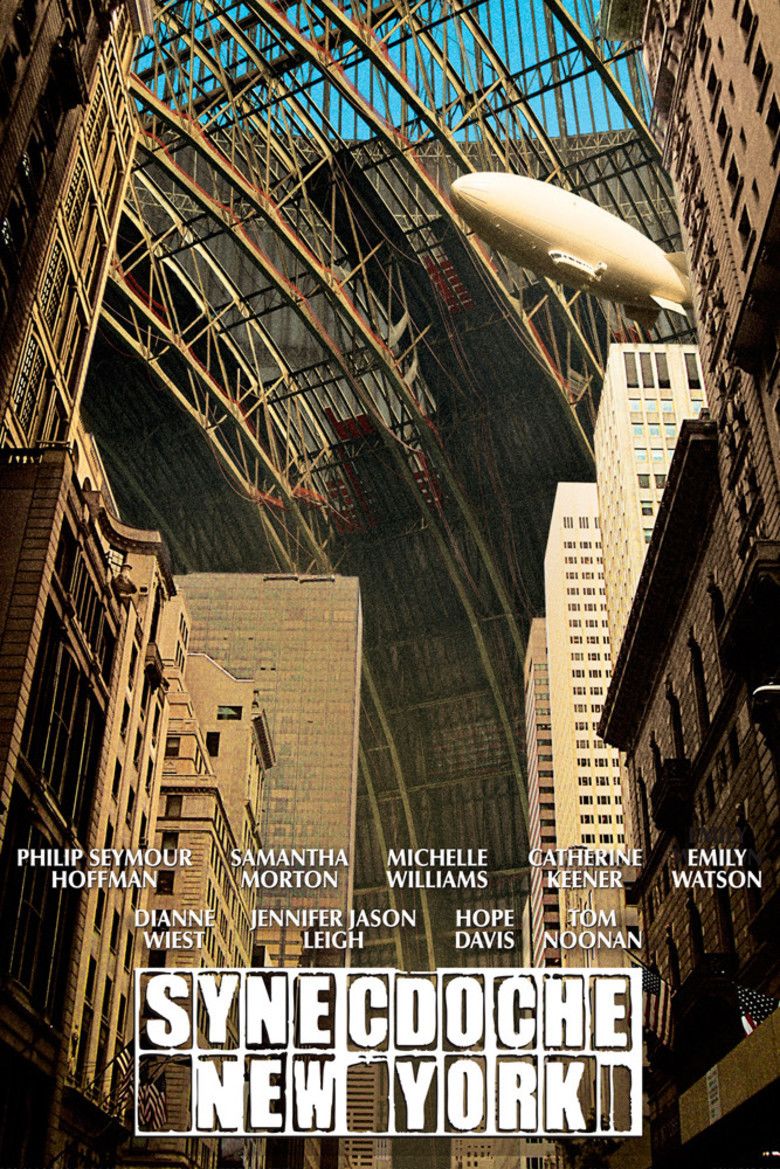
Starring: Philip Seymour Hoffman, Samantha Morton, Michelle Williams, Catherine Keener, Tom Noonan, and Jennifer Jason Leigh
Grade: Classic
In yet another cinematic example of the filmmaker’s genius/madness seen on the big screen, we can’t help but ask again, “Is Charlie Kaufman okay?”.
Summary
It’s 7:45AM on September 22nd in Schenectady, New York, and theater director Caden Cotard (Hoffman) wakes up to his radio clock where Elke Putzkammer, professor of literature at Union College, is being interviewed about autumn in poetry and literature. The interviewer asks why so many people write about the fall, and she replies that it’s because it’s the beginning of the end. If a year is a life, then September is when things start to die. It’s a melancholy month. Because of that, it’s quite beautiful. After she reads a somber poem, Caden finally gets out of bed and goes downstairs to his wife Adele (Keener) and their daughter Olive (Sadie Goldstein). The phone rings. Since Adele is with Olive in the bathroom helping her wipe, she asks Caden to answer it, but he refuses because it’s Maria (Leigh). Adele answers the phone while a distraught Caden says aloud how he doesn’t feel well. He gets the mail, and a sickly man is on the front cover. He goes back inside the house to read the paper and finds that 76-year-old Nobel Peace Prize winner Harold Pinter died. As Olive yells from the bathroom for Adele to check on her, Caden ignores this and tries to bring up the production of The Dumb Waiter to Adele that he did at Albany Fest. Adele ignores his comment and makes Olive oatmeal. Once she enters the room however, she demands peanut butter and jelly, which annoys Adele. Still reading the paper, Caden sees another newsstory of a deadly flu strain found on a Turkish farm. Olive asks to watch TV before school, so Caden turns on a cartoon for her. On the program, a virus is mentioned again. After Caden notes the expired milk in the fridge, Olive eats a peanut butter and jelly sandwich that Adele made for her. A dejected Adele stares out the window while Caden mentions that the first black graduate of the University of Alabama died from a stroke at 63, Vivian Malone Jones. Following this, Caden shaves in the bathroom. When he tries to rinse his razor, the piping malfunctions and the water sprays directly at him. The handle blows off into his face and cuts it, prompting him to yell for Adele to help him since the water is spewing everywhere. Eventually, they get it to stop, but Caden is covered in blood. Next, he’s at the doctor getting stiches and is told that it will probably leave a scar much to Caden’s chagrin.
Following a few questions from the doctor, Caden is told to see an ophthalmologist. Strangely enough, Caden thought he said neurologist first but is corrected by the doctor. At night, Adele is driving the family and has to correct Olive who thought it was Tuesday. In reality, it’s Friday. Adele asks Caden details about the doctor visit, and he tells her that his pupils apparently weren’t properly opening and closing. She corrects him and refers to it as “dilating”, but Caden is sure he’s right on what the doctor said. She wonders if the bump to the head did it. Caden does say it could be, but the doctor wasn’t sure. He repeats this response a few times until Adele stops him. Olive tries to bring up her bathroom issues, and Caden half-heartedly responds before saying aloud how bad the timing of this all is because he has rehearsals coming up. He also has to apologize for saying “fuck” a few times in front of Olive. While Caden calls someone, Olive asks him what a plumber is and he tries to explain to her while talking on the phone, with Adele correcting him on things at the same time. Once the phone call ends, he goes back to trying to explain plumbing to Olive, but she starts freaking out because Caden and Adele relate the piping in houses to blood vessels in the body that everyone has. She starts yelling that she doesn’t want blood over and over again, so Adele tries to calm the situation by saying she doesn’t have blood. Caden gets annoyed during this, as he tells Adele not to tell Olive misinformation like that. Sometime after, he’s at the ophthalmologist. The guy isn’t sure it was the bump to the head, but he does think Caden should see a neurologist. Caden thought he said urologist. Later, Caden is at rehearsals for his take on Death of a Salesman. After a mishap on set that narrowly avoids injuring actress Claire (Williams), Caden goes to check on her to make sure things are okay. He talks to lead actor Tom (Daniel London) and reminds Tom to keep in mind that a young person playing his character of Willie Loman thinks he’s only pretending to be at “the end of a life full of despair, but the tragedy is that we know that you, the young actor, will end up in this very place of desolation”. Claire then asks if he has any notes for her, but Caden kind of ignores her and walks off to make a phone call.
Following a pleasant conversation with receptionist Hazel (Morton) in the lobby, who mentions how good the signal is where she is at and they share a chuckle, Caden goes outside to call Adele, telling her that Dr. Heshborg wants him to see Dr. Scoriano because “my pupils don’t work”. Later, he uses a spoon to examine his own shit in the toilet to determine he has blood in his stool. He mentions it to Adele in bed that night. She’s half asleep when he says it and asks if he’s talking about the stool in his office. The next day, Caden and Adele are at marriage counseling with therapist Madeline Gravis (Hope Davis). Gravis asks Adele what it was like when she was pregnant with Olive. Adele remembers being hopeful, as if things were going to change. All three agree something did change, but Adele is quick to say that it didn’t change as much as she’d hope, though she admits right after that this was a terrible thing to say. Gravis corrects her and says there aren’t any terrible things said here, only true and false. With this, Adele asks permission to say something awful. Once Gravis allows it, Adele admits fantasizing about Caden dying, piling on about how it allowed her to “start again, guilt free”. Gravis has the audacity to ask Caden if this feels terrible. Once he confirms this, she comments, “Okay good”. Sometime after, Caden is sitting outside of the theater for a break. Hazel pulls in and greets him. She tells him how she’s reading The Trial and loves it, adding that she feels like an idiot for not knowing about the book. He tells her she’s no idiot, so she uses this as chance to flirt with him, inviting him to tell her that she’s very bright and he loves her eyes. He plays along and says these two statements to her. Then, he asks her what to say next. She plays coy, replying that she can’t say it because it’s dirty. At home, the plumber works on the sink. Caden asks if he can step out, so he can use the bathroom, but the plumber invites him in because he’s seen “boy parts” before. Weirded out, he goes to the basement and asks Adele if he can piss in the sink. She laughs it off and says it’s fine. As he pisses a brown color, with Olive in the room mind you, he tells Adele the play sold out.
He looks over at Adele’s artwork and compliments her picture, a painting of a faceless naked woman. Changing the subject, she asks how rehearsal went, and he admits it was awful. They have 560 lighting cues alone. He’s not sure why he makes it so complicated, but Adele comments that this is what he does. Following Caden kissing Olive on the head and complimenting her artwork too, Adele apologizes because she can’t make it tonight. She has two canvasses she has to get ready to ship for tomorrow. Caden is heartbroken because it’s opening night, but he downplays it and leaves to figure out what he’s going to wear. Right before the show, Caden sits in the aisle and looks at the stage. Hazel is in the crowd and looks back at him. They share a smile, with Caden crossing his fingers hoping for the best. At the afterparty, Claire talks about her insecurities to Caden, but he calms her down. Noticing him not feeling well, she kisses her forehead. Hazel sees this and is bothered. Claire goes on about how great Caden was to work with and how she’s going to miss working with her, but he assures her that he will be around. Once she leaves, Caden tends to his head before being interrupted by Hazel. They sit down in a booth, and she asks where Adele is. Caden explains how she had to work and that she has a show in Berlin in two weeks. They’re going there for a month. Hazel questions why she likes Caden so much, and he wonders the same. With this, she suggests they get high in her car. Caden isn’t sure because he gets horny when he’s high. She implies certain possibilities, but he doesn’t go through with it. After a shot of Hazel driving home unhappy, we go back to the afterparty where Caden is with a drunk Claire in the booth. She lays her head on his shoulder, as he worries about a vein in his arm and questions when the reviews will get in. In the early hours of the morning, Caden gets home to find that Adele is still up and she’s hanging out with Maria. She came over to keep Adele company, and they lost track of time. Even so, Adele got her work done.
Adele apologizes again for missing the play but asks how it went. He reveals that it went great, and The Times complimented the idea to cast young actors in the roles of Willy and Linda. As Adele and Maria kind of babble a bit about how great it is and how they both can’t wait to see it that night, Adele asks if Maria can get a ticket too. Caden calls them out for being stoned. Adele admits this, but she questions if Caden is truly happy with his production. He keeps his true thoughts close to the chest but says he is happy, and he can’t wait to hear what they think of it. Adele comments that it doesn’t matter what she thinks and Maria doubles down by saying that the only thing that matters is Caden’s artistic satisfaction. There’s an awkward silence, and Caden goes upstairs. Next, Hazel goes to a house showing of a house that’s on fire. She walks with the real estate agent and talks about buying a house alone and how she had to question what she was waiting for now that she’s 36. Hazel likes the house but is concerned about dying in the fire, to which the agent replies, “It’s a big decision how one prefers to die”. She wants Hazel to meet her son Derek (Paul Sparks). He’s been living in the basement since his divorce. Just then, Derek pops up from the basement to greet them without a shirt. During the showing of Caden’s play, Caden sits in the audience with Maria and Adele, and neither are giving him the reaction he desires. Afterwards, Adele brings up to Caden how successful the play is while Caden’s father questions why the young actors were playing old people. Caden explains how it was an artistic choice that he will explain later to him. Adele goes on about how she can’t get excited about Caden restaging someone else’s old play because there’s nothing personal in it. Caden points out how people are coming out of the theater crying, but Adele counters with criticizing the people he’s playing to. The next morning, Adele is on the phone with Maria about how she cuddled all night with Olive, and it was great. On the television, the cartoon playing looks like an animated version of Caden smoking while hanging out with a deer. Caden sneaks downstairs because his dad is sleeping in the living room, and he gets to the kitchen to greet the girls.
Right away, he mentions he might have arthritis. They both ignore him. Caden takes a look at The Schenectadian and goes right to the obituaries before adding that his joints are stiff. Now finished with her phone call, Adele ignores him and takes a sip of her coffee. He asks who she was on the phone with, and she unsurprisingly says it was Maria. Caden comments how it’s only been three hours since they last spoke, so Adele transitions this into mentioning how she wants to go to Berlin with just Olive and not him. She thinks it will be good for the both of them. After Caden’s dad walks into the kitchen, Adele adds that she thinks it would be good for the two of them to do this alone. Caden can’t believe it and doesn’t know how to respond. Following this, he’s walking Olive outside and zips her coat. She notes how there are things on his face and asks what’s wrong, so he tells her they are pustules and refers to them as “sycosis”. He tries to explain how this is different from psychosis. Naturally, Olive doesn’t know what he’s trying to say. So, he talks about how psychosis means “crazy” like Adele and sycosis can be used to describe the pimple-like things on his face. Olive sweetly points out how he could have both, but he assures her that he doesn’t. Later, Adele packs for her trip, so Caden asks if he disappointed her somehow. She walks around it by saying that she doesn’t know what she’s doing and they’re just spending a little time apart. They’ll talk when she gets back. However, she comments that everyone is disappointing (“The more you know someone, it’s just… This whole romantic love thing. It’s just a projection anyway, right?”). She starts to cry and tells Caden that she loves him. While she hugs him, she admits she doesn’t know what she’s doing. Caden gets emotional too and nods when she reiterates that they will talk when she gets back. At night, he hangs in the basement and gets emotional looking at her artwork.
Next, Caden is in the basement and watches an advertisement for Flurostatin TR on the television while he brushes his teeth. It allows you to “live life when it’s your turn to face the challenges of chemotherapy”. He imagines himself in the commercial and then touches his leg because he sees there is a lesion of some sort on it. Oddly enough, he uses the toothbrush to start scrubbing stuff on the ground. Next, he starts scrubbing on the table, even spitting on it. After this, he manically scrubs the entire basement clean. While this goes on, the cartoon with a character that looks like him plays a tune about how you fall down and died and how maybe someone cried but “not your one-time bride”. He lies on the ground. Following this, he sees their therapist Gravis and tells her that he’s lonely, hurt, and he thinks Adele is right that he’s not doing anything real. As he talks, he notices a sizeable bump on Gravis’s toe since she has an open-toed shoe on. She questions what would be considered real, prompting Caden to admit that he’s afraid he’s going to die, how he doesn’t know what’s wrong with him, and he wants to do something important while he’s still here. She replies that this would be the time to do it and brings up a book that could help him get better. It’s called Getting Better, and she wrote it. In fact, she wrote all the books that are displayed in her office. He glances at some of the pages, and she immediately charges him $45. That night, Caden looks on her website and finds a graphic of himself with a fake quote from him saying, “It’ll change my life!”. After this, he’s at the dentist and the guy recommends he sees a periodontist. He will probably recommend gum surgery. Soon after, Caden is getting gum surgery. That night, he calls Adele, but she can barely hear him and guesses incorrectly who is on the line twice. Then, she cuts the conversation short because she’s at a party and she’s “famous”. Right after the phone call, Caden starts convulsing and seizing out but is able to call 9-1-1 in time. In the lobby of the doctor’s office, he grabs a magazine to read, and Adele’s face is on the cover. He flips to her article and skims over it. He sees a quote from her emblazoned on top of one of the pages commenting, “I’m at a point in my life where I only want to be around joyous, healthy people”.
He’s called in and meets with a doctor in the Department of Evaluative Services. The doctor notes that he’s had some sort of seizure that seems to be a synaptic degradation, fungal in origin. Autonomic functions are going haywire. He will lose his ability to salivate, cry, and other stuff. He does reveal that it’s serious, and they will enroll him in some biofeedback program. He says it’s possible that Caden learn some sort of manual override. Sometime after, Caden approaches Hazel in the lobby, and she brings up getting a drink. He takes her up on it, and she flirts heavy at the bar they’re at. She wants to take him back to her place. Caden argues that Adele is only on vacation, but Hazel points out how she’s been gone for a year and hasn’t called. He says it’s been a week, so Hazel jokes that she’s going to buy him a calendar. With this, he agrees to go back with her for one drink. She takes the napkin he tore apart for her scrapbook, and they go back to her place. It’s still on fire, but they just ignore it while they have drinks. After she has him get on his knees to beg for a kiss and he plays along, they have sex. In the middle of it though, he’s not into it and the mood is soured. She gets off him, and he goes on about how he’s sick and he thinks he’s dying. He starts to get emotional once he reminds himself how he has a kid, and he’s married. He makes sure Hazel knows that he had a good time and she’s a nice person, but she’s not feeling it and has him leave. Sometime after, he leaves a message on Hazel’s answering machine since they haven’t talked in a bit. She hears the message but doesn’t respond. Later, Caden gets a fax from Adele where she wanted to relay the message from Olive that she doesn’t want Caden to read the diary she left because she left it under her pillow by mistake. He finds it but doesn’t open it. Following this, he gets a letter that has named him a 2009 MacArthur Fellow. In the letter, it is said they hope Caden will use this grant of financial freedom to “create something unflinchingly true, profoundly beautiful and of unremitting value to your community and to the world at large”. At therapy, he brings up the grant to Gravis and how he’s going to use it to do a theater piece, something he can finally put his real self into.
She sits next to him on the couch and asks what is his real self. He’s not sure, though he mentions the MacArthur is called “The Genius Grant”. Because of this, he wants to earn it. She thinks it’s wonderful because he will have to discover his real self in the process. Caden tries to ask her how old kids are when they start to write and she cuts him off almost immediately by mentioning a “brilliant” novel written by a 4-year-old, Little Winky by Horace Azpiazu. Apparently, he’s a virulent anti-Semite. The story follows his initiation into the Ku Klux Klan, his immersion into the pornographic snuff industry, and his ultimate degradation at the hands of a black ex-convict named Eric Washington Jackson Jones Johnson Jefferson. Apparently, Azpiazu killed himself when he was 5. When Caden asks why the kid killed himself, Gravis says she doesn’t know and asks Caden why did he. He’s confused by this, so she reiterates why Caden would kill himself in his situation, and Caden doesn’t know. Next, Caden talks about bringing his production to New York to some realtor, so he can get it seen by people who matter. The realtor mentions how this theater they are going to is centrally located and is at the heart of the theater district. She takes him inside, and it’s a massive, decrepit warehouse. Later, he meets with Hazel to tell him his idea of doing a massive theater piece that is uncompromising and honest. As he goes on about how he sees theater as the beginning of thought and how it’s the truth not yet spoken, an uninterested Hazel sips on her drink. Still, he goes on about how it’s the feeling a man has after being hit in the jaw, or love and all its messiness. The waitress brings them their food, and he tries to salivate in accordance with his biofeedback training. Moving on, he asks Hazel to help, not with the box office but rather be his assistant. She’s not sure she can because she’s kind of angry, but he wants to normalize it because he thinks they can have a lot of fun together. After he struggles with his food due to the salivating problem, he comments that he misses her. She just calls it disturbing.
Back at home, Caden opens Olive’s diary. Looking at some details like her favorite color being pink, he goes to a store and purchases a big pink box that says “Nose” with a picture of a nose and ships it to Olive as a gift. Later, Caden meets with his cast and crew in a meeting of sorts. His idea is to start talking honestly. With this, he sees a piece of theater evolving naturally out of it. He starts things off by detailing how he has been thinking a lot about dying lately. Immediately, Claire says he’s going to be fine. He appreciates the kind words, but he points out the facts in that at some point they all will die. That’s what he wants to explore. They’re all hurtling towards death. They are all there in the moment, alive, but they all know in the back of their minds they will die, with “each of us secretly believing we won’t”. Claire chimes in and calls it brilliant and compares it to Karamazov. At a bar later, Caden is hanging by himself but tries to hide in the booth when Hazel shows up with Derek. Claire appears and approaches the two, and there is an underlying tension between Claire and Hazel, especially once Claire reveals she’s meeting Caden there. Caden pops out to greet Claire and to stop things before they get worse. After an awkward four-way conversation, Caden takes Claire to sit in their private booth. Soon after, she asks what Caden wants from her character. He’s not entirely sure yet, so he tells her they will build it over time together and they will try to find a real person to model it after. Claire points out how Hazel is interesting and wonders why she is working at a box office at her age. She wonders if she wanted to be an actress but lacked the confidence. At the same time, Caden talks over her because he’s not too enthusiastic about basing a character off of Hazel. Still, Claire is excited about the project, prompting Caden to ask why. She refers to it as “brave” and how she feels as if she’s going to be a part of a revolution. As Claire goes on about how she’s thinking of Artaud, Krapp’s Last Tape, and Grotowski, Caden is only half listening because he’s watching Hazel talk from a distance. Caden then admits to Claire that he doesn’t know what he’s doing, but Claire says this is why it’s so refreshing.
Claire: “Knowing that you don’t know is the first and the most essential step to knowing, you know?”
Caden: “I don’t know.”
Afterwards, Caden and Claire walk to their cars and Claire reveals her mother died last night to Caden’s shock. He wonders why she’s even out, but she just changes the subject noting that her car is close. She says it was nice meeting him and then apologizes because she doesn’t know why she said that, but Caden passes it off as a slip of the tongue. She thinks it’s a Freudian slip, but he’s not sure how it’s Freudian. She tries to come up with reasoning on her thought process, and he just goes along with it. The next day, Caden attends Claire’s mother’s funeral. He’s at her place later and they have sex. A lot of time passes, they get married, and he’s gifting Olive a new package to send overseas to her. Following this, Caden is with his cast and crew, and they are going through a scene in a locker room. He stops the scene to talk about how they need to discover the essence of each being. To get there, he wants to work with each of them separately. He starts with Davis (Stephen Adly Guirgis). This bothers Claire. At home, Claire expresses how there is a difference between favoring her and pretending like they’ve never met. Considering they have their daughter Ariel (Daisy Tahan) now, people know they’ve had sex. She says this in front of Ariel too. Caden tells Claire they will talk about her character once they put Ariel to bed. That night, Ariel is sleeping, and Caden is in a chair next to her bed reading a magazine. A young Olive is nude in it, with the article being about her and how she’s the first 10-year-old with a full body tattoo. He’s emotional seeing what she has turned into. Claire interrupts because she feels like she’s had a breakthrough with her character, but Caden declares that he has to find his daughter. Claire mentions how his daughter is right there, but he wants to find his “real daughter”. Claire starts flipping out, so he shows her the article and how she’s tattooed. Claire comments how everyone is tattooed and shows him her gigantic back tattoo of a devilish figure on it. Still, he gets on a flight to Germany. On the flight, he reads Gravis’s book, with it talking about how “redundancy is fluid. Life moves to the south. There is only the now, and I am always with you. For example, look to your left”. He looks over to the other seat, and Gravis is there. She points out she’s free to travel too since he cancelled their meeting.
Caden mentions how he’s not really getting the book, but Gravis replies that it’s getting him and says he’s almost unrecognizable now. She stands next to his seat and grips her thigh. The words he reads in the book next imply that she gave himself to him, he turned it down, and now “This book is over”. Every page following it is blank. He looks at her in confusion. Finally, Caden gets to Adele’s art gallery and asks the receptionist where Adele is. He refers to himself as her husband, but she says Caden is not her “husbands”. He is neither Gunther nor Heinz. He points out how he’s Olive’s father, but the receptionist says she can’t help him. Later, Caden is reading Olive’s diary outside at some restaurant. She talks about how wonderful Germany is and how her new dads are brilliant directors of theater. His reading is interrupted by Maria who is surprisingly there. Now sporting a German accent, she talks about how she lives there with Adele, Olive, Gunther, Heinz, Uschi, and Britt. She’s everyone’s nanny. Caden demands to see Olive, but Maria says “they” sent her instead because “they” have decided it’s not a great time. He brings up the tattoo, and Maria explains that she did that because Olive is her “project”. He yells that she’s a 4-year-old at her, but Maria points out that she’s actually almost 11. She also calls Olive her muse. When she says she loves her, Caden tackles her to the ground, and they wrestle before she escapes. He chases her to some sort of compound, and he finds that pink box with “nose” on it that he sent as a gift, discarded outside of the building. He’s heartbroken but uses eye drops to gives himself tears for the moment. He sits down and holds the box, wailing aloud. He starts feeling chest pains in the middle of it, goes to a doctor, leaves, and is on another flight with a tube coming out of his nose. The old passenger next to him tells Caden, “Death comes faster than you think”. Back at work, Caden’s production is starting to become more lifelike. There are hundreds of actors and actresses involved now, and he gives them new directions like explaining to two of them that they are actors playing actors. He wants them to act like they are having an affair offset and to bring it into their characters.
He tells a cameraman that he’s not just filming things, he’s in it as well. He walks by another actress, tells her that she’s also attracted to the man she’s talking to, and to express guilt felt about telling him about somebody else knowing that. He goes near the squared off area where Claire and Ariel are at, as they are also in the play. Caden tells Ariel he can’t play right now, and Claire irons clothes in-scene while telling Ariel that Caden doesn’t live with them anymore because he had to “go find himself”. Though he is saddened, he moves onto the next group and finds Tom and Davis, and he explains how they should be having an argument. They throw insults, prompting a dissatisfied Caden to tell Tom to not turn into a different person as soon as he tells him to change his action. Following this, Caden is at another doctor’s visit and has a doctor check on his right leg that has been shaking uncontrollably. It’s never happened before. He asks the doctor if he’s dying, but he doesn’t have an answer for Caden. Waiting at a bus stop at night, Cade sees a movie poster for Little Winky being promoted. Sometime after, Caden is walking down the sidewalk but is having trouble moving. He runs into Hazel who greets him. Though he’s noticeably shaking, they have a pleasant conversation. A lot of time has passed since they last saw each other. She’s married to Derek, and she has two five-year-old twin boys. Derek took them to the Natural History Museum so she could shop. She asks how things are with Caden, and he talks about having a daughter with Claire, but they are separated. He changes the subject back to her, and she talks about working with Lens Shapers. After this, she cuts the conversation short, hugs him, and leaves. Later that day, he spots Hazel and her family at a rooftop restaurant. Having enough, he tries to jump off the roof, but a random customer stops him and pulls him back. At night, a still shaking Caden reads Olive’s diary about how she loves Maria and how she’s so much more of a father than Caden ever was with “his drinking, and unfortunate body odor and rotting teeth”. She talks about how she could only loath Caden but also “perhaps pity him”.
Caden goes to Claire’s apartment and tells her he wants to come back and take care of her and “Olive”. Realizing he didn’t say “Ariel”, he corrects himself. She lets him in, and they have sex. In the middle of it, he imagines an actor (Noonan) that looks like him watching, and the actor is holding Ariel in his lap. He also gets a phone call, so he stops to answer it. He gets the news that his father died. Apparently, his body was riddled with cancer, and he didn’t know it. He only went to the doctor’s because his finger hurt. They said he suffered horribly and he called out for Caden before he died. He also said he regretted his life, amongst other things. As Caden repeats all of this from the phone call, Ariel is seen peeking through the doorway and a shadowy figure is seen behind the curtain of the window. Caden continues saying it was the “longest and saddest deathbed speech any of them had ever heard”. At the funeral, Caden’s mother tells him there was so little left of his father that they had to fill the rest of the coffin with cotton balls to keep him from rattling around. At the wake, Caden is now sporting a cane. He goes to the bathroom and calls Hazel but gets her answering machine. At night, Caden waits outside of Hazel’s burning house and waves to her and Derek when they get home. She goes over to him, and he asks her what to do next. She gets in the car with him and comments how everyone has to figure out their own life. He admits he just wants her to look at him like she used to, but she can’t. He apologizes to her for everything and admits he screwed everything up, but she tells him she’s okay. He can’t help but admit he doesn’t want her to be okay. Well, he does, but it does bother the hell out of him. She offers to help any way she can, and he offers the same. However, she explains she’s fine because she has Derek.
Heartbroken, Caden leaves.
It’s time to focus on his magnum opus of a production. Unfortunately, as his personal life deteriorates at the same time that his play becomes larger and his vision for what he wants out of it becomes less clear, it becomes harder to distinguish fiction from reality, with Caden getting deeper into his work to the point where it may never get finished.
My Thoughts:
Synecdoche, New York is simultaneously one of the most miserable films in existence but also possibly, a certified masterpiece. The whirlwind of emotions and questions one has while watching Charlie Kaufman’s directorial debut is a once-in-a-lifetime experience that throws any and all expectations or preconceived notions out the window with an entirely original feature that has the ability to move you years after the fact. The film has been called pretentious and inaccessible, and it really is. As personal as the movie can be while capturing all of our deepest fears and anxieties in an unsettling but authentic psychological profile of an egotistic and borderline schizophrenic theater director, a lot of it can be too esoteric for regular audiences to digest all of its psychological themes, references, and philosophical ramblings. By the end, the film’s events become so uncomfortable and depressing in combination with the exploration of the screenplay’s complexities and unraveled ideas that the viewer will be as heartbroken and frustrated as they are awe-inspired. Synecdoche, New York is one of the very few films in which I can confidently say that I haven’t been the same person since viewing it. It’s a movie that could take a lifetime to unpack and also has this uncanny ability to make the viewer rethink their entire life, as well as human existence in general to the point of exhaustion and confusion. It’s a movie that is generational but also something I wouldn’t recommend to most. Can you think of any other feature that fits into this category?
At first, the story draws the audience in with a simple premise of theater director Caden Cotard working on his version of Death of a Salesman while wallowing in his persistent pessimism, regularly seeing the negative aspects of life everywhere he turns but not realizing how destructive it is for those around him. Though they are affected by his depressing aura, Caden doesn’t focus on the negative with his family, but rather everything around him. As soon as he opens the newspaper, he looks at the obituaries. The only headlines he notices involves the deaths of others and sees it every day. At the same time, his body is turning on him. He feels aches and pains every day and finds new things wrong with him, mentioning it so consistently that his wife Adele doesn’t care anymore. Caden doesn’t necessarily assume the worst, but he hears it from every doctor he sees and tends to dwell in it and overthink it. One doctor recommends Caden see another, and they continuously give him either vague descriptions of what’s going on or terrible news. It’s never anything positive. For an obsessive man in the arts who is already focused entirely on his self-interests, ego, and creating something raw and personal to him, the neurotic first act is fitting to who the character is. It’s why Caden’s life becomes so intrinsically attached and obsessed with the concept of death to where he centers his whole life and career around it, to the point where his life passes him by at a rapid pace and he doesn’t even notice it until it’s too late. Caden can’t seem to stop to focus on the present, the here and now and the people that are in front him who want to be in his life. It’s always about life ending in death and his subsequent focus on his artistry, which eventually matches his insecurities and internal struggle with his emotions and brings them to life in his play, a mammoth-scale, all-encompassing art that will never see the light of day due to his ever-changing opinions and philosophies that persist to his last day on Earth (“I know how to do this play now”).
The reason the production goes from a day-to-day thing and turns into a 17+ year production with no end in sight is because of Caden’s life becoming the production. It’s more than just death. It’s everything. Everything is everything. There is a reason for every movement, every person, every action, and every reaction. People can be found in other people, and memories and consequences can circle back in a different form, whether one realizes it or not. Regret, love, guilt, clarity, and self-realization are all tangled into the web that is one’s life, and everything is what makes up life. Furthermore, the words of the priest in the third act ring true as, “Everything is more complicated than you think. You only see a tenth of what is true. There are a million little strings attached to every choice you make. You can destroy your life any time you choose, but maybe you won’t know for 20 years, and you may never know”. This series of philosophic answers to life itself does come off as pompous, but this screenplay is as depressingly real as it gets.
Caden’s mental anguish is minorly present at the beginning because of his tendency to display elements of Cotard’s syndrome (making sense of the character’s last name), but it’s magnified when his life gets increasingly worse with each day. It starts with the total deterioration of his relationship with his wife Adele, someone who outright says in therapy that she fantasized about Caden’s death to start anew with no strings attached. An artist in her own right, Adele is already malcontented from the opening. Both her and Caden are focused on their work and though they interact, there is a disconnect when they are speaking to each other. Neither Adele nor Caden listen to the other, or one talks over the other’s points, possibly due to neither of them having the ability to live in the present while working on their respective art because of what it means to them and to the people. Is it pretentious to think of it as the latter? Possibly, but for those that have reached the highest levels of success in these professions that are notoriously difficult to succeed in, some level of pretentiousness is needed for the mind behind the work to care for what they do, to put their heart and soul into it, and to get the result they are satisfied with. It’s the dark side of creativity really. If not pursued in this manner, unfulfillment will be the artist’s downfall. Unfortunately, so many get caught up in this belief in self-importance and ego that many lose interest or focus in their personal lives, which is why we see so many families fall apart within the entertainment industries and the arts. Their whole lives become about their work, and it’s only intensified when success is reached. It’s just the difficulty, as well as importance in remembering that you have to balance it with real-life, is where people fail. Such as the case with Caden as a director and Adele as a painter. It’s as if they are having different conversations while they respond to the other, with neither caring to delve deeper in their dialogue to avoid a full-blown argument. It’s a fundamental problem in their relationship that Adele has no problem in admitting. She doesn’t know the root of the problem but is real enough to acknowledge that things cannot be like this anymore for them to progress as a family or for her own sanity and progression into the forthcoming years.
Caden is blindsided by this revelation because he’s too into his own creative process and what he sees for his own future. Leading up to this moment in time, he just saw everything as mild disagreements but nothing serious enough to warrant a potential split. Even after Adele fucks off to Berlin for what is supposed to be a small trip with Olive, for Adele to get a small break from Caden to regroup her mindset, she promises Caden that they will talk when she gets back. She’s even emotional about it because she knows how serious this is and does seem sorrowful that it has gotten to this point. It hits Caden too, as he wonders if he disappointed her somehow. It’s these words that makes sense of all their previous interactions regarding the release of Caden’s Death of a Salesman. Before and after the release of the play, he looks for her approval because that’s just how creators are. In a perfect world, Maria is right in that the only thing that matters is the creator’s artistic satisfaction. Sadly, it’s not that easy. Caden represents the neurotic artist, as well as the general human being who outwardly downplays if the approval of his peers matters to him. On the inside however, he is desperate to hear praise or compliments hurled in his way because it is something he secretly craves. Any time words of positivity are sent his way throughout the story, we can tell it means the world to him, and he can’t help but start liking the person more because of it. It’s like when Caden is about to have sex with Tammy after the funeral. Shortly after commenting about his loneliness and how he may have been better at life if he was a girl, Tammy telling Caden that he’s pretty boosts his confidence enough to jump into bed with her. A small statement of affirmation like that was all he needed to hear. However, his first wife in Adele never understood this side to him, which is why he sought her approval for his play and only got criticism in return. It’s not Caden disappointing her. It’s the other way around, but neither will ever know that or accept it. With Adele, her emotional intelligence started to bleed out at some point in their marriage to the point where she wallowed in her own personal misery, longing for more in her career and personal life.
It wasn’t about them. It was about her and what she wants to do without Caden’s presence.
By that stage in their marriage, it didn’t matter what Caden accomplished. She had one foot out the door mentally and was going to move on in one way or another. In their last conversation before she departs for good, her response to his question of him disappointing her is that everyone is disappointing, adding that it’s the ultimate conclusion for everyone in existence if you get to know them more. It’s a dreary, negative theory on life and humanity itself, but it’s really where the entire film sits, directly in the deepest pits of the stomach, an area of burning negativity that we try to fight off every day and at our worst moments. Furthering their incompatibility but also where her mental state is at during this period in her life, she lambasts the concept of “romantic love” and refers to it as a projection, as if it’s a mere fantasy. Though they will forever be intertwined and Caden’s failure in this relationship haunts him in more ways than one, the fact that they have an emotional goodbye with the promise of a follow-up conversation in hopes of rekindling what is lost is what makes it so hard as the minutes go by. Little do either of them know, their lives and this film would never be the same from this scene on. For a while, Caden still holds onto the belief that they will fix things when Adele gets back, but this is where Charlie Kaufman plays with the timeline of the movie and the audience’s perception of what is true and what isn’t. As more women like Hazel or Claire try to flirt with the director, he initially can’t consider their offers because he’s still married. He’s still waiting for Adele’s return. After all, it’s only been a week. To complicate things, Hazel tells him that it’s been a YEAR since she’s left. Who’s right and who’s wrong? Does Caden only see this as a week in his head because of his inability to cope and come to terms with Adele leaving, or is Hazel messing with him? Considering how the story flows, chances are it’s the former, as it’s the only explanation for how quickly in the movie Adele becomes a star in the art world after leaving Caden. Once she sees her success, she’s gone and never looks back, even subtly referencing Caden in her magazine interview where she talks about only wanting to be around joyous and healthy people, two things Caden never was.
Even as he moves on to different women in his life, his connection to his first wife never leaves him. Part of it is because of Olive but another part of it is because there seems to be a slight inkling that maybe if he attempts to help in some way or try to understand here through her art, things will get better. At least, that’s what it seems when he assumes the role of housekeeper “Ellen” and starts inexplicably cleaning Adele’s apartment. Then again, it could also be rooted to his general frustrations, or him seeing his love of cleaning as part of him getting in touch with his anima, a theme that is touched on a lot with Caden’s journey. With that being said, I have no answer for why one of Adele’s letters to “Ellen” detailed “We had quite a fuck last night and its musty and gross” when referring to the bedsheets and Caden immediately lays down on them and smells it. Regardless of this, it seems more positive in its intent, as he continues to read the messages Adele leaves for “Ellen” because it’s the only form of communication he has with her at this point in their lives, along with seeing her art galleries that consist of miniatures that take telescopic lenses to actually see what they are, showcasing how her art as the polar opposite of Caden’s increasingly gigantic theater production. His work gets bigger and spirals out of control to mirror what his messy life has become while Adele’s paintings get smaller, as her life and career shoots her into superstardom and happiness. Why is this happening to Caden? Why does he have to suffer so badly? It’s obvious that he’s not the greatest partner and his inability to love himself keeps him from loving and focusing on another for too long before reverting back to his art, but does he need to experience such painful lessons of loss, guilt, regret, and lies to understand his own mortality and why things turned out the way they did? This is when the true intention of his lifelike theater production is revealed, as Kaufman’s film spirals into madness in the second half. The movie’s initial story purposely loses its main character’s identity within the complex jungle he created with his own actions, as Caden stands and watches as he becomes a background character in his own life because of how hung up he is on his play and wanting to earn the “genius” label attached to his grant.
He created his expectations, and they consume him to the point where nothing else matters.
Due to his insistence on having it be as real as possible (“I won’t settle for anything less than the brutal truth”), regularly reconstructing or trashing entire sets and scenes for being a “lie”, and his warehouse of sets turning into a full-scale recreation of New York and thousands of actors encompassing it in character, Caden realizes he can only bring his vision to life accurately if he too is a character (“I’m not excusing myself from this either. I will have someone play me to delve into the murky, cowardly depths of my lonely, fucked-up being!”). With this, he casts non-actor Sammy in the role. Sammy apparently has followed Caden for 20 years but sells Caden on his casting on the promise that he will see his real self when watching Sammy act because he knows exactly who Caden is. Along with this and Sammy further shadowing Caden to emulate him in his performance, Caden starts to lose his own self while watching “himself” interact with people who are playing those from his real life. His second wife Claire is one of them and later Hazel. Instead of distinguishing between the real and the play, Caden falls further down the rabbit hole and quickly loses out on Claire because of his increasingly complex and confusing process in attempt to find the truth in his work, which he doesn’t realize is his life. In one scene, Claire hits her breaking point, and Caden is so entrenched in the play, he doesn’t see why. She acts with Sammy, who is playing Caden, but she complains in-character in a self-referential way that she doesn’t like the person playing Caden because he’s feeling her up in rehearsals. In character as Caden, Sammy states that “He’s your husband” to where she has to look over at the real Caden to yell, “He’s not my goddamn husband. YOU are!”. Caden just thinks the scene was great, and him and Sammy discuss making Hazel a character to explore this side of Caden. Fully fixated on the production, Caden agrees and doesn’t even try to go after Claire once she storms out. It’s still all about his work. Even though he started a new family, he fell into the same trap that he put himself in with his first family.
Everyone else can balance their lives and their careers, but Caden can’t and it costs him dearly (“I want you out of the apartment! The real one! You can keep this one”). When he tries to come out of it like explaining to Claire how he didn’t threaten to clean Hazel’s toilet as a response, as it was Sammy who said it, Claire knew he thought it because Sammy is Caden. It’s this bizarre, meta, play-within-a-play that Caden has created that continues to spiral out of control once real life events happen and people leave him. Even so, his only response is to add it to the play or have someone else play that role. At one point, the actress playing Hazel tells Sammy, who is playing Caden, that the actress playing Hazel is ready to start today, as the real Hazel watches. You confused? You should be. When Caden goes to his mother’s funeral, he brings Tammy because the real Hazel is on a date with Sammy, and Tammy has been playing Hazel, which is why he’s comforted by this since she’s the second-best thing available. That’s what it becomes. With this chaotic environment that Kaufman gives the audience, Synecdoche, New York becomes a feature that is incomparable to any other. By the end, there is someone playing Caden and another playing that person. When the role of Ellen is left vacant once Millicent takes over as Caden, Caden fills in the slot and isn’t even directing the play anymore because it’s not his role, completely losing himself within the story. In its confusion of trying to decipher Caden’s creative process as he gets further and further removed from his own life, it’s absolutely mesmerizing. Still, he does have moments that bring him back to his awful reality when he needs it though. One of these examples is the reveal of what happened to his first daughter Olive, and how Adele’s narcissism and lack of parenting led the 4-year-old to getting a full body tattoo and being groomed by Maria, evidently under Adele’s supervision.
With the exception of the life-changing ending with the haunting series of stage directions, the most heartbreaking scenes of the film involve Caden interacting with Olive in her adult years. It becomes nearly impossible to reach her due to Maria, Adele, and the weird, arthouse German family they live with hiding Olive from Caden and feeding her head with lies about her father. He has quite a few meltdowns knowing that he failed her. The worst of it comes when he’s somewhere in Germany and the only way he can get a glimpse of her as a young adult is paying to see her as a performing artist where she dances naked behind a glass wall. Your heart sinks seeing Caden’s reaction, as he tries to get her attention before he’s pulled away by security for making a scene. It’s a father’s worst nightmare, and it’s not even because of how she turned out. It’s a father seeing how he failed and let a horrid group of people influence and change her developing mind to where she sees the lives of the arthouse crowd as normal. She will never know innocence like she was when she was a child and will never grasp why what happened to her in the developing stages of her life was the work of people who were unfit to be raising a kid in such a wackjob environment not meant for children. On top of this and being told for her entire life that Caden was a deadbeat by the god-awful person that ruined the family beyond comprehension in Maria, the last time Caden is able to see her is on her deathbed. As he reads her diary about how ill she’s become, Caden recalls when she was just an innocent kid and how they would play some game about fairies. Transitioning to her in the hospital, Olive is unrecognizable to him and only knows German. She speaks into a device, and it translates it to English for him to understand and vice versa. This is painful to watch by itself, as it shows how far removed Caden is from his own daughter that they don’t even speak the same language anymore, a metaphor referring to them living and developing on two different planets essentially. The thought of this and seeing it in practice can’t help but make the heart ache as Caden looks at her with such despair and guilt.
It only gets worse, with Olive revealing that her flower tattoos given to her by Maria are infected and are the reason for her dying, but she doesn’t regret it because “Maria gave me a reason to live once you left. The flowers defined me”. It’s a complete lie perpetuated by Adele and Maria. Adele took her away from Caden and literally never came back! He tries to explain this and how he spent years trying to find her and he never left, but Olive doesn’t believe him. Sadly, we can’t even blame her. They poisoned her mind for years to the point where it has become a fact, so why would she believe Caden now? He can’t prove himself to her and she hasn’t seen him in person since she was a kid. Why should she trust his words? In this scene, he’s just stuck and is forced to eat his life’s failures without protest. Piling onto the misery and bowl full of lies, Olive was told by Maria that Caden is gay and has a lover named Eric and believes wholeheartedly in whatever this demon Maria has said about him. Naturally, Caden can’t believe the falsehoods said about him, but Olive tries to get him to understand his fake struggles by revealing that she went through the same thing when she fell in love with Maria, and “We began to have dirty, aching sex”. Continuing with things no father ever wants to hear coming from their daughter’s mouths, she states that Maria introduced her to “myself” and “to my vagina and to hers”. This poor girl has no idea how evil and destructive Maria has been to not only Caden but to herself. Nevertheless, it’s too late to fix it or change Olive’s mind in any way. Whatever misinformation she was fed by Adele, Maria, and Adele’s two German husbands is now 100% accurate, and she has no reason to believe otherwise from the father that, according to them, abandoned her. It’s a callback to Caden telling Adele in that car to not lie to Olive about the concept of blood vessels just to make her feel better. Without Caden there to say anything, Adele just continued to lie along with Maria about Caden to explain his disappearance from Olive’s life. Sadly, it worked and it’s all “true” to Olive. Because of this, her last dying wish is to forgive Caden for something that never fucking happened and how she can’t do so until he asks for forgiveness. It’s literally maddening to the point of physical pain.
Olive is about to die thinking her father left her to “have anal sex with my homosexual lover Eric” and wants Caden to “admit” this total lie, so SHE can forgive him. With his hands tied behind his back and wanting for her to be at peace with him, he just goes with it for her sake. In a moment that nearly leaves the viewer at a breaking point of unbridled anger, Olive reveals that she can’t forgive him and dies. Believing in her own lies, Maria comments, “I hope your happy faggot” to end the scene with him replying that he’s not. It’s just devastating. I have never seen a character on film in such an unwinnable situation such as that one.
*Of all the names Caden comes up with for the play such as The Flawed Light of Love and Grief, The Obscure Moon Lighting an Obscure World, Unknown, Unkissed, and Lost, and Infectious Diseases in Cattle, I thought he nailed it in the first attempt with Simulacrum.*
As miserable as it sounds, and it is, it’s magnificently done, as Caden’s journey to self-realization is unforgettable, especially due to the amazing work of Philip Seymour Hoffman. If you didn’t already consider him an all-time great at his craft, his performance here will shut the mouths of any and all doubters. When Hoffman’s Caden is at his most manic, writing thousands of stage direction notes to give to his actors to adjust their scenes and performances every day to his unsatisfaction (“… He’ll get notes too and they will correspond to the ones I truly receive every day from my God! Get to work!”), you become fascinated as the years go by, and people move on in their lives while Caden is still stuck in his never-ending cycle of trying to find out the truth to the point where he doesn’t even believe in an actor who committed suicide in front of him (“Get up!”). He descends into the abyss as he misses out on real life. He thought he mattered and was the centerpiece to all of this, but the reality is revealed to him in that he is a mere speck in time that exists on this planet in a “a fraction of a fraction of a second”, spending years trying to find something or someone that will make it all better. With Caden, the idea is that his art will do it, but life moves so quickly before he can see it through that he may never reach this longing goal of being at peace. So, the story begs the question, what if it doesn’t? What if you don’t figure it out until it’s too late? What if you missed everything because you focused too hard on the wrong thing? Are you the main character, or does it not matter because there’s a bigger picture at hand? It’s about the questions, not the answers. Caden has a breakthrough with his play when this thought is in his mind too. He almost goes even bigger with it, bringing up how there are nearly 13 million people in the world and thinks aloud of an idea where none of them are extras in his play and they’re all leads in their own stories.
Movie or not, this is an inherent fact. We’re all the leads of our own stories. If Caden Cotard were to really make his play become as authentic as humanly possible, that would be the way to go. That is life.
Ambitious, inventive, mesmerizing, and filled with despair, Charlie Kaufman’s distressing Synecdoche, New York is hard to follow, makes the viewer an emotional and psychological wreck, and some of its final words to the audience revel in reminding us that we aren’t special, the world will forget us, life goes on, and you will only figure out the meaning to all of this when you’re about to call it quits. This isn’t specific to you either, as it’s everyone’s experience. Everyone is everyone. Now, it’s time to move forward knowing you only get one chance in life to play you. Let’s hope to God that we don’t all fuck it up. Admittedly, it’s terrifying to think about it, but the realities of life are indeed terrifying.
The end is built into the beginning. What can you do?


+ There are no comments
Add yours