
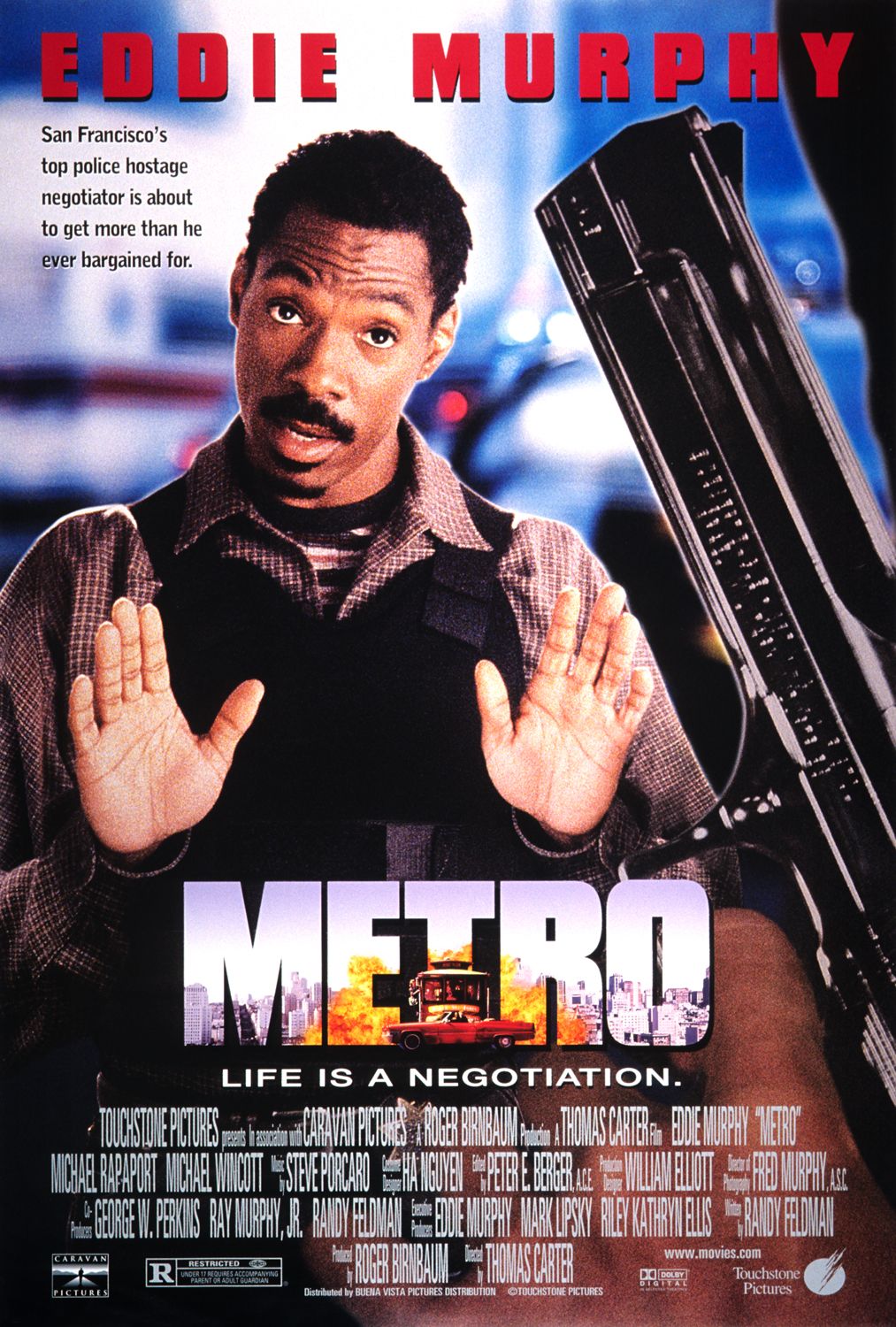
Starring: Eddie Murphy, Michael Wincott, Michael Rapaport, Carmen Ejogo, Art Evans, and Donal Logue
Grade: B-
If Metro was one of those movies that got played on cable all the time, there’s a chance it would have a much bigger following than what it has. Though it’s not without its issues, it’s nowhere near as bad as critics may have led you to believe.
Summary
In San Francisco, California, Inspector Scott Roper (Murphy) is the go-to hostage negotiator for the San Francisco Police Department. While he’s riding in his sports car listening on his radio to a horse race he bet on, he gets a call to deal with a bank robbery/hostage situation. Upon getting there, he is told by Inspector Eiko Kamura (Kim Miyori) where the command post is. She explains how the suspect Earl (Logue) came in shortly after the bank opened and botched the robbery. The teller hit the silent alarm. Earl has 17 hostages and shot one of them. It was the guard, but he’s still alive. Roper correctly guesses Earl has already asked for a car, but Kamura adds that he also wants a plane waiting at the airport. Roper again correctly guesses that if Earl doesn’t get the plane, he will kill all the hostages in five minutes. Roper is brought into the command post that’s inside of a convenience store, and Lt. Sam Baffert (Evans) greets him and lets him know that Captain Frank Solis (Denis Arndt) is on his way down. Roper is given Earl’s file, and Sam tells him that Earl is no genius before adding that SWAT wants to go in. Roper sarcastically asks if they haven’t killed anyone this week. Looking at the file, Roper guesses Earl is probably on drugs based off of his record and he asks what Earl’s demeanor is like. Kamura says he’s agitated and even ripped the phone out. Roper decides that he has to meet with Earl face-to-face. Sam refuses this, but Roper is insistent because of the situation. He also thinks that SWAT may cost more lives than they intend. Roper just wants to go in to get a look and make sure everything is alright in there. He also points out how there is no violence recorded on Earl’s rap sheet and that the guard inside that is wounded might bleed to death the more they wait. They know Roper is right. He grabs some donuts and heads across the street to the bank with a bullet proof vest.
Upon entering, he sees Earl with his gun holding a banker close to him while all the other hostages are behind him. The guard is alive but still bleeding.
Roper makes it clear to Earl that he doesn’t have a weapon, as he’s only a negotiator. The bag just contains donuts. Earl demands he kick the bag over, so he does. Earl has the banker open the bag, and he sees the donuts. He assumes Roper poisoned the donuts or something, but Roper just brought them for the hostages. To be fair though, he ordered a dozen and there are like four in the bag, but whatever. Earl kicks the bag over and tells some of the hostages to eat the donuts to test them, and Roper tells them to go ahead because they are safe. Roper is just trying to establish to Earl that he’s a straight shooter. He says he’s working on getting him a car, but they have to go through some steps first. After getting the banker to reveal her name as Debbie (Jeni Chua), he asks Earl to point the gun away from Debbie’s head. Earl refuses and threatens to kill her again, but Roper reminds him that this is the worst thing he can do because if someone dies, he can’t help him. He points out the sharpshooters across the building and SWAT on the roof, adding that they will make a move if Earl kills anyone. Earl is freaking out and asks what his chances are, and Roper admits they aren’t bad. Last month, someone robbed a bank in Daily City, made it all the way to the freeway, and managed to lose the cops with the car they gave him. However, that bank robber didn’t kill anybody. With this, he looks over at the wounded guard, Harold. He has Harold on a chair with wheels and tells Earl that it’s his duty to take Harold to safety because of his situation. He even invites Earl to shoot him if he wants, but the next negotiator will tell him the same thing as its part of their oath. Earl lets it happen but just demands that he gets his car. As Roper wheels Harold out, he tells everyone they will get out of there eventually. Roper helps Harold out the door and gives him to SWAT. He then asks one of the SWAT guys for a gun and hides it under his vest. Roper doesn’t want to do this because he hasn’t had to shoot anyone in three years.
The SWAT member questions why he can’t keep the streak alive. To be fair, Roper would like to, but he knows Earl is close to killing somebody based off what he’s seen so far.
Roper walks back into the bank and says they have a car coming and they will get everyone out, but he wants a hostage for a sign of good faith. Earl argues that he gave him Harold already, but Roper points out how he was dying anyway and did Earl the favor with that one. He asks for Debbie, but Earl refuses and points to three other female bankers. Roper takes this and guides the women out. He tells Earl he will get the car but then stops to ask if he wants a hard top or a convertible. Earl wants a hard top. Roper walks towards the door and sees the reflection of Earl on the glass. He asks if he wants manual or automatic. As Earl says automatic, Roper turns around and shoots Earl perfectly in the arm to save Debbie. Roper runs and stands over Earl with his gun as SWAT enters the building. The day is saved. Afterwards, Roper exits the building with Solis, and the media is already there to ask questions. One reporter brings up how Roper has had 9 previous successful negotiations and asks how this one was different. Solis answers for him and says Roper won’t be available for questioning for another 2 hours. Roper avoids everyone’s questions for the most part and walks through the mob only to get his picture taking by his ex-girlfriend, Veronica “Ronnie” Tate (Ejogo). He playfully comments how he’s still in love with her and the baseball player she’s with in Greg Barnett (Charleston Pierce) is bad news. Ronnie points out how Greg makes $2 million a year, is a really nice guy, and he worships her. Roper argues that he worships her too, but she reminds Roper how he worships his bookies, noting his gambling problems. Roper says Greg’s knees are bad and she’s going to eventually be wheeling him around in a wheelchair, but Ronnie responds that Roper only wants her back because he can’t have her. Roper still persists and asks if they can go out this weekend, but she declines. She also brings up how he said he would take out Troy over a month ago. Roper argues that he’s had a rough month, but Ronnie guilt trips him about how Troy’s eyes light up when he mentions him and how it disappoints him when he doesn’t show.
Later in the movie, we find out that “Troy” is a fucking dog by the way.
Anyway, Roper suggests all three of them go to the park on Saturday, but Ronnie just wants Roper to take Troy because she sees enough of him. Plus, she’s seeing Greg on Saturday. He considers this tacky and thinks it will confuse Troy, so he wants to continue this debate while he gives her a ride. Just as he says this though, his car is towed in front of the both of them. He tries to yell that it’s his while showing his badge, but the driver shouts back that it now belongs to Silver Hills Financial, as he clearly owes some money. Later, Roper gets back to the station and enters Sam’s office while Sam is on the phone. Sam got them two floor seats for tonight, but dinner is on Roper. Roper appreciates it and goes to meet with Solis in his office next. On the way to Solis’s office, he makes eye contact with Inspector Kevin McCall (Rapaport), who’s sitting on the bench outside the office. Roper walks straight into the office while Solis is on the phone. Solis relays that the Chief says good job for the whole hostage thing that morning. Roper tells Solis to relay that he wants a raise, but Solis instead tells the Chief that he just said, “Thank you very much”. After hanging up, Solis tells Roper the news. He’s being assigned a new partner he is to train to take over for him. This is Kevin McCall. Solis says that every Metro captain agrees McCall is their best sharpshooter and the most likely to succeed. Roper is pissed and looks at McCall’s file. He notes how high McCall tested on intellectual aptitude, though it wasn’t as high as Roper scored. He also sees that McCall is a national marksman finalist, attended NYC for college, went to sniper school, has a mayoral commendation, and a litany of other additional skills. One of them being lip reading, and McCall is utilizing that skill while seeing Roper read off his resume. Roper considers McCall a great option for the Marines but doesn’t see him as a negotiator. He thinks McCall will quit in two weeks. Solis says that he will worry about it, not Roper. To go along with this, Roper wants a $5,000 raise. Solis agrees to it.
On top of that though, Roper wants a car. Solis refuses, but Roper points out how he’s been to impound and they have a beautiful black Benz just sitting there and no one is touching it.
Solis responds that impound isn’t a rent-a-car company, but Roper argues that it has to be a part of the deal because his Trans Am got repossessed this morning. Solis doesn’t promise him anything, but he will see what he can do. Roper adds that he gets to keep all the money even if McCall quits because SWAT guys don’t have the temperament or the background for what he does. While he finishes his point, Solis knocks on the window of his office to get McCall’s attention, signaling for him to come in. Once McCall enters, Roper puts on a front and changes his tune, greeting him in an overly nice manner. Implying that he read his lips, McCall thanks him but says he will be there longer than two weeks. Seeing that the jig is up, Roper tells him to not read his lips and to save it for sniper school. McCall agrees but tells him not to worry about what he’s doing for the next two weeks. Solis interrupts angrily, but the two say everything is fine. They go to leave, and Solis tells Roper to see the impound lot, giving him the greenlight to grab a car. Roper thanks him and leads McCall out. As the two walk and talk through the office, Roper asks if he’s ever been in a hostage situation to which McCall responds, “Only at the very end”, as he was a sharpshooter. Roper wonders what he felt like after the shooting, and McCall says it felt like it had to be done. Roper argues that it very rarely has to be done. They talk some more, and Roper notes McCall’s wise-ass tendencies, so he wants to give him a test. He puts a pen cap inside of a glass pop bottle and challenges him to get the cap out without touching or destroying the bottle. It’s a test in lateral thinking. The obvious solution isn’t always the only solution. You have options. He leaves McCall alone for the night to figure it out. Following this, Roper is walking with Sam in the impound lot. Sam wants to make a stop on the way. They busted Frank Antonucci on possession, so he gave them a lead on a jewelry heist. Roper doesn’t think Frank’s phony self is worth the time, but Sam thinks it’s worth the look.
Sam also thinks McCall getting hired is a good idea because it will take some pressure off of Roper. He’s actually starting to get worried about Roper and mentions how he’s not sure why he can’t get back with Ronnie.
As they make it over to the convertible Benz, Roper explains how it’s her and how she’s with Greg. Sam gives Greg credit because he’s a great baseball player, but Roper doesn’t want to hear it (“Why don’t you just get some pom-poms and start chanting ‘Greg! Greg! Greg! Fuck him!”). Roper can’t get into the Benz with the keys he was given, and the alarm goes off. Sam takes the keys and looks around. He finds that the keys Roper was given was for an ugly red pickup truck, and Roper can’t believe it. He complains nonstop about it, but Sam doesn’t care. Roper gives him a ride to an apartment building and asks Sam if he wants him to come up with him, but Sam declines because he’s just going to talk to the guy. Roper is cool with this because he doesn’t want to be late. He asks if Sam wants to put any money on the Warriors game. Since the line is Warriors plus 6, Sam says he will take half of that action. Roper says he’s smart for that. Sam gets out of the truck, and Roper tells him to hurry up. As Sam takes the elevator up to the apartment in question, Roper goes across the street to a phone booth to make his bet with his bookie. Sam knocks on the door of Michael Korda (Wincott), and Korda invites him in. Sam guesses he’s playing some Count Basie on his record player, but Korda corrects him. He’s playing Duke Ellington’s 1945 recording of “Things Ain’t What They Used to Be”. Making conversation, Sam asks where he found it, and Korda tells him about a used record shop he went to called “Memory Lane”. His initial plan was to go in there for a rare Robert Johnson. Sam thinks he knows the place, so Korda gives him the record to look at. During this, he asks Korda if he knows Frank Antonucci. Putting a cigarette in his mouth, Korda jokingly asks if he’s talking about the guy who owns the bakery down the street. Sam laughs and says he’s talking about a different Frank, a man who deals in stolen jewelry. He asks if he knows anybody like that, but Korda doesn’t. Sam coughs and asks for some water, so Korda puts out his cigarette and goes to get some for him.
While Korda goes to the kitchen, Sam starts looking through his stuff while commenting aloud that the reason he’s asking is because they arrested him with some stolen jewelry. As he says this, he finds a book on Korda’s table, Understanding Jewelry.
Sam goes on about how they traced it back to another robbery. Frank said he was fencing it for Korda. Korda spots Sam eyeing the papers in his trash can while he pours water for him and tells Sam there must be some kind of mistake. He gives Sam the water and tells him that he has a cousin who has had a lot of run-ins with the law. Korda wouldn’t be surprised if his cousin was trying to bring him into this because it wouldn’t be the first time. His cousin’s name is Clarence Teal (Paul Ben-Victor), and he assures Sam they will know who he is talking about. After that, he notes how Sam’s cough seems better, as he knows Sam was bullshitting. Sam still tries to play it off and drinks the water. Meanwhile, Roper makes a bet for $200 in the phone booth and hangs up. Following this, Sam is taking the elevator back down and is on the phone requesting a search of Korda’s apartment. At this point, Roper is waiting outside the truck. As soon as Sam exits the elevator, Korda is waiting for him and stabs him to death. A tenant enters the building and screams at the sight of Sam. Roper hears the scream and runs into the building to find Sam. He yells at the woman to call an ambulance while he pulls out his gun and runs up the stairs. He breaks into the apartment, but Korda is gone. He hears a mother being startled in a different apartment, so he opens that door. However, it’s just a kid that made a mess, so he tells the mother he’s a cop. He runs frantically down the stairs and outside, but Korda is gone. That night, Roper is in Solis’s office, and Solis relays that the Chief wanted him to know how sorry he is. Roper is still shaken, recalling how Sam stated he was just going up to talk to the guy. He looks at Korda’s mugshot, slams the file down, and demands he be put on this case. Solis can’t do it because he knows Roper is too close to all of this. The department has to handle it. Roper demands to know who’s running it, so Solis says it’s Kamura and Glass. Roper storms out of the office and goes straight to Kamura to ask what she has.
Kamura hangs up the phone and tells Roper that Solis said to keep him out of it. Roper doesn’t care and yells at everyone there to let him know if they get any information on this case. He drives over to Ronnie’s place, and she heard what happened, so she lets him in. After Roper notes a new photograph of Ronnie’s on the wall and she says she’s been working a different style in her art, he greets Troy. Roper sits down with Ronnie and tells her that he’s not going to take up too much of her time. He just needed someone he could talk to. Ronnie notes how awful this must be because he never talks to someone when he’s hurting. Roper goes on about how it was his fault because he should have just went with Sam. Ronnie comments how he can’t save everyone, but Roper uses this as a way to strengthen his point because he proved that tonight. She holds his hand. He tries to put his other hand on top of hers, but she pulls away. Roper calls this visit a waste of time while he looks around for his keys, so Ronnie questions what he wants from her. He shouts that it’s obviously something he can’t have anymore. She can’t believe he’s trying to make her feel guilty, bringing up how when they were together, he would go out of his way to prove that he didn’t need her. Now, for one night, he needs her again? She refuses this. She can’t be his friend because she knows what will happen. A few weeks from now, Roper will be back on top, and he will shut her out as soon as he doesn’t need her again. Roper can’t believe that’s what she thinks, but Ronnie counters that if he thought otherwise, he never showed it. He tries to get serious with her, but there is a knock on the door. Roper takes this as his cue to leave but he can’t find his keys still, so Ronnie points out how it’s on the desk by the door, the same place he always left them. Ronnie opens the door. It’s Greg, and him and Roper share an uneasy glance. Roper just notes who Greg is before sadly leaving. Greg looks at Ronnie disappointed while he enters.
The next day, Clarence gets to a warehouse and Korda attacks him over how he told Frank how he got everything from him. Clarence argues that Frank has respect for Korda, and he was trying to lowball Clarence, so that’s why he used his name. As Korda slaps him a few times, Clarence says Frank has never flipped on anybody before. He said he had the cops paid off, so Korda shouts that it wasn’t the cop that showed up to his apartment. Clarence offers a couple thousand for him to leave town, but Korda knows everyone is aware of who he is now. Korda has $10 million and could have disappeared. He angrily talks about how he’s going to have to stick around and take care of Clarence for the rest of his life. Clarence asks if he killed the cop, and Korda just looks at him. Clarence apologizes while he sits down, and Korda says it’s okay. It’s not his fault he’s stupid. At the station, Roper asks Kamura what she has. She brings up how Korda’s cousin Clarence is in town. Apparently, he moved a month ago and they have some leads. Roper throws a million suggestions to Kamura at once because he’s so invested, but Solis interrupts to remind Roper that he’s not on the case. Disheartened, Roper tells them they’re going good work and walks over to his desk where McCall is. McCall expresses his condolences and relates to him because he lost someone in SWAT. Roper changes the subject to see what he’s reading, Strategies & Countermeasures in Hostage Situations. Roper isn’t impressed. Either way, McCall shows him that he figured out the bottle test. He fills the bottle with water, which allowed for the cap to get to the top by itself. Roper claps for him and gives him an “A”, explaining how McCall can now see that no force was required and no damage was done. Later, the two are in a private office watching security camera footage of an old hostage situation with Roper’s former partner. In the video, his partner negotiated with the shooter to be his hostage instead of the kid he had at gunpoint. Unfortunately, there was a scuffle and the guy shot and killed Roper’s partner seconds after before being gunned down himself. Watching the video, McCall asks why he did it.
Roper deduces that his partner thought the kid had a 0% chance of survival, so he thought his odds were better. Roper remembers how they had a plan, but SWAT opened up fire too early, which caused the shooter to take out his partner.
Roper turns to McCall and tells him that the most important thing is to always use his eyes to make that connection. It’s to connect with them and establish how you’re always on their side. He then asks McCall how much money he has on him. Since he has about $100, Roper takes him to the horse track. McCall knows he’s a compulsive gambler, but Roper explains that he likes being there because of the multitude of possibilities. Everything is there for him to see, if you know the conditions you are looking for. It’s like a hostage situation. He points out how the number 4 horse looks broken down, and it seems like you shouldn’t bet on it. However, in reality, you should, as he points out how the owner of the horse is wearing a championship belt buckle. She wouldn’t be wearing that if the horse wasn’t worth anything. He thinks number 5 doesn’t feel like running, but the shiny coat and liveliness of the number 6 horse is enough for him to put some money on it. McCall doesn’t see it and jokes he should seek help. The two watch the race and since McCall’s money is part of the bet, he cheers alongside Roper. The number 4 horse wins, just like he said. They get $800. As they go to collect, Roper tells McCall how he’s been coming there for 6 years. His partner put him onto the place. He gets his cash and gives McCall his share, but McCall sees how he only gave him $300. Roper notes his good eyes and gives him the other $100. He then gets a call for a hostage situation, so the two head out. Upon getting there, the two walk together and an annoyed Roper sees Solis’s nice car that he got from impound for $14,000 when it’s worth at least $30,000. Eventually, they find Solis, and he tells Roper that the silent alarm went off 32 minutes ago and the fire alarm followed. There was a unit about a block away, and the suspect got trapped inside. No one has been seen. The suspect just calls himself “Joe”. There is no confirmation, but there could be more involved. An employee escaped through the rear door. As far as they can ascertain, there are two jewelers, two salespeople, a manager, a security guard, an elderly woman, and they believe one other female.
This particular store is where they have a lot of jewelry making and repairs. Any given day they can have $8 million to $10 million in raw stones in the store. This means this group didn’t just wander in. They knew what they were looking for. All Solis promised them so far was that he would talk to his superiors. Roper asks McCall if he found any good points of entry. Since McCall was looking at the building layout, he tells the two how the place was designed as a vault. Roper uses the phone to call “Joe”. He’s prepared to give him what he wants, but he wants to come in to talk to him first. Immediately, “Joe” declines. In reality, it’s Korda, and he’s wearing a ski mask with a gun pointed at the hostages. Roper insists he come there to make sure no one is hurt and they can continue. Korda reluctantly agrees to let him. Roper lets him know ahead of time that they will be operating on trust. With this, he will not be armed. Korda gives him 5 minutes. Wearing his bulletproof vest, Roper walks across to the bank. The sharpshooters are ready, and the crowd is outside to watch. Clarence is in the crowd. Watching from the command post, McCall asks Solis how Roper knows the guy won’t shoot him. Solis admits he can’t. Roper gets to the door, and Korda opens the door pointing a gun at the head of a teary-eyed woman. Calmly, Korda tells him to listen because he’s only going to say it once. He wants a new, four-wheel drive vehicle in perfect condition and a uniform cop to drive it up. Next, he wants the cop to leave the engine running and for him to walk to the end of the block. Then, they’ll come out. He assures Roper he knows all the tricks. When he says, “perfect condition”, he means that if it’s low on wiper fluid, someone will be shot and they will start again. He wants a plane waiting at the airport, and he will only tell them where to go once he gets there. That’s all for now. Roper agrees, but he wants to be able to come inside to take a look around to make sure everyone is alright. Korda refuses, saying he’s just going to do stuff for him right now. Roper wants one act of good faith and asks for one hostage.
Korda does give him something. It’s a wrapped-up paper. Roper opens it and it’s a severed, bloody ear. Korda means business. He lets Roper know that in 15 minutes, there will be a bigger piece. He drags the woman back inside and shuts the door in Roper’s face. Roper goes back to the command post and flat-out tells Solis they have to take this guy out.
Solis questions if they can wear him down, so Roper shows him the severed ear. Roper believes there is one fatality in the store already, and he thinks gunfire is what set the fire alarm off. He also thinks Korda was working by himself because the whole time he was talking to Roper, he wouldn’t leave the doorway with the hostage. Roper also notes his calm and creepy demeanor and how he indicated familiarity with their techniques. He asks them if they should go in and get him or wait for him to come out. McCall says they should wait for him to come out because there are too many unknowns in there, and they agree. McCall is asked to show a plan. Going to a picture he drew of everything, McCall says when they drive the car, they should be 3 feet away from the curb and put their best man Anderson on the high ground. He wants Anderson aiming 20 degrees down angle. Solis expresses his concern to Roper about feelings of this thing going sideways, but Roper has some “good news” in that Korda is wearing a ski mask to protect his identity, so they can’t determine whether he’s going to shoot all the hostages. Inside the store, Korda doesn’t have his mask on anymore and he tells the manager to drag the two bodies behind the counter. He breaks some glass to take some more jewels, and one elderly woman tries to make a break for it. Korda goes over and strikes her down. The manager tries to step in, but Korda points his gun at him and tells him to think. The manager backs down. Korda tells the blonde woman hostage privately that if the elderly woman isn’t conscious by the time he’s done, she will be dead. Roper calls once the car pulls up, but Korda doesn’t answer. McCall signals everyone to come to the window. They see two hostages exit but use fire extinguishers to make everything around them cloudy to cut down visibility. Korda has his ski mask back on and is behind the hostages walking them out. Using binoculars however, Roper sees the actual plan at play.
It’s Korda and he’s out in the open! He switched clothes and had the manager wear the ski mask once they exited the bank, so Korda is actually in plain sight acting like he’s a hostage!
Roper calls it out exactly, and they relay to SWAT to hold their fire. Unfortunately, the sharpshooters jump the gun and headshot the bank manager with the ski mask clean. Korda springs into action, grabs the blonde woman hostage, and gets into the car and drives off. Roper grabs Solis’s keys and him and McCall go out and chase him. They get into a high-speed chase throughout San Francisco, and Korda is able to elude them for the most part until he crashes. Still, he gets out of the car and onto a trolley just as Roper gets close. Hanging on the side of the trolley, Korda throws a passenger off that was in his way and starts shooting at Roper and McCall. The driver stands up and tries to get Korda to put the gun down, but Korda shoots him too, and he falls into the steering/pedal mechanism. It makes the trolley go down the street at a rapid pace. A majority of the passengers start falling out the sides of the trolley, and it also smacks a car out of its way completely. After it demolishes another car, Roper gets close and he has McCall take the wheel. He gets on the hood and jumps onto the back of the trolley. Korda sees it and looks for a clean shot, though Roper makes his way to the side after another car is hit by the trolley. Korda nearly shoots him, but Roper leans back, barely holding on. He gets his gun out, but a car almost hits him, so he drops his gun to get out of the way. Eventually, Roper gets on the trolley, and they get into a fight. Roper is able to smash Korda’s head through the window and disarm him. They get into it some more, and Roper gets the best of him and even knocks him out. Roper gets to the pedal mechanism to try and brake while McCall rides next to the trolley. Unfortunately, they are going too fast and he can’t get the trolley to stop. So, he jumps off of it and back into the car. He has McCall plant the car directly in front of the trolley as they near the end of the line. In the middle of this, Korda wakes up, jumps onto the roof of a taxi, and hits the pavement. Finally, the trolley comes to a stop. They saved the rest of the passengers. Still, Korda is on the run, and a lot of the people point him out to Roper and McCall.
They follow Korda to a nearby parking garage. Before entering, Roper realizes he lost his gun during the chase, so McCall gives him his backup, and they both go inside the building. After heading to separate floors, Roper has a scare after a dog inside of a car jumps at him, and it sets off the alarm. Thankfully, the window was closed and the dog couldn’t attack. Moving on, Roper walks over with his gun, and Korda appears, already in a car. He drives straight at Roper trying to hit him, but Roper gets out of the way. He fires off a few shots and connects on the car. He shoots out a tire too, so Korda gets to the lower level but crashes. Roper pulls Korda out of the car and keeps his gun on him as he talks about how Sam was a friend of his and how he had a family. Uncaring, Korda tells him, “Why don’t you tell that to somebody who gives a shit?”. Roper wants to kill him, and Korda can feel it. Smiling, Korda practically dares him. Roper shoots next to Korda to make him flinch but suggests a hypothetical where there was a struggle. If there was, he could kill Korda right there. McCall shows up and tells Roper to put the gun down because they got him. Roper is still incensed because he sees Korda smiling, so he strikes him.
Though they have Korda for now, they won’t have him for long, and Roper and Korda’s battle will continue to get deeper and more personal. Something has to give.
My Thoughts:
The selling point of Metro is seeing Eddie Murphy’s attempt at portraying a grounded, mature action hero. He’s dipped into the action comedy genre plenty of times before, but Metro is his first big try in making more of a straight and narrow action movie with shootouts, big set pieces, and a tough main character with an emotional intensity that Murphy hadn’t attempted previously. It was during his experimental phase where the superstar tried to branch out with certain roles and genres to varying degrees of success. Much like with Vampire in Brooklyn, Murphy is trying, but he’s not fully committed to the transition, along with a lot of other key elements that affect the final product. With Metro, there’s a surprising number of things that work, but the amount of time it takes to convince the audience that a jokester like Murphy is now a certified action hero takes longer than expected. Not that getting rid of the humor entirely would have helped, but toning down certain attempts at comedy actually would have because the little bit that is shown teases the viewer into expecting the star to revert back to his fun-loving persona that we have seen before in refined action comedies truer to the genre like the Beverly Hills Cop franchise, The Golden Child, and the 48 Hrs. series. With Metro, the tone needed to commit to one or the other. Murphy’s face on the poster, the time period in which it came out, and elements to it suggest a humorous slant, but viewers expecting this type of Murphy-led action comedy due to the equity he’s built with audiences for 20 years up until that point may be disappointed if this is what they expect going into it. If things were taken seriously through and through like a majority of the movie does and the marketing for it was more obvious to brace the viewer for the tone of the narrative, Metro would have been appreciated far more than it was because these critical reviews do not tell the whole story. Really, it was just a movie that critics weren’t expecting and they reacted in kind.
For those who are apprehensive at the thought, Eddie Murphy as Scott Roper isn’t half-bad. Though elements are there to make this a big budget comedy-focused action comedy because Murphy as a fast-talking hostage negotiator could have been hilarious, the star takes things as seriously as the real job would entail. Along with a new haircut to signify a change to audiences expecting the usual comedy fare, there’s a change in attitude and demeanor in Murphy’s performance as Roper. When he kicks that door down to save Ronnie from Clarence’s home invasion, the intensity is felt. Roper is very careful about his job and is without a doubt the best they have for high stakes situations, which is why his word carries as much weight as it does to his co-workers. When he tells the SWAT team member to give him a gun because he senses the anxiousness from Earl that may lead to him killing someone, the viewer believes it. If there was another way out, Roper would take it, but this isn’t that time. The same is said when Roper tells Solis immediately that the ski mask-wearing Korda needs to be taken out as soon as possible. He has a feeling for people, the human mind, and can read situations better than anybody, which makes him invaluable at his position, though this begs the question why his first assignment after the opening is to train someone to take his job when he’s never even spoken aloud about quitting and there is no inclination of any sorts to the idea of it. Regardless, the contrast of Roper’s well-known abilities in law enforcement shockingly don’t translate into his personal life. Because of how well Roper is able to utilize his skills to calm down hostage situations and get hostile people to trust him while he does well in understanding things from their perspective, you would think he’d have no trouble with relationships. However, this is not the case. Along with his troubled vice of gambling, Ronnie reminds him time and time again that Roper never made an effort to connect with her and make her think there was true love there.
In the first act, she is quick to point out how the cool Roper would seemingly go out of his way to make it seem like he didn’t need her. Now, that they aren’t together and she took a stand, he wants her back without changing his ways. He tries to act like he’s a changed man but saying it and meaning it are two different things. It’s an emotional trap that Ronnie doesn’t want to entertain. Then again, she kind of does. There is still something there if she actively goes out of her way to see Roper at crime scenes, messes with him, and still invites him over to hang out with their stupid dog they shared when they were together. For someone who is far past rekindling what was lost, she doesn’t show it at all. It’s obvious she’s dangling that carrot there for Roper because if she really knew they couldn’t be friends, then she wouldn’t go out of her way to invite him to hang out with their dog, along with approaching him, and taking his picture knowing he’s still actively flirting with her. This is why the romantic angle in Metro isn’t compelling as it needs to be. Ronnie’s dating some other guy in Greg, but we only see him once and she openly teases Roper knowing his feelings. It makes their getting back together all too predictable. At the same time, it’s not even like we care because Roper doesn’t do enough to convince the viewer that he has earned her. Him lashing out once she refuses his advances again, after he goes to her house following Sam’s death, doesn’t do either character any favors. Roper using Sam’s death to try and get a sympathy fuck makes him look like a prick, and Ronnie acting surprised that he’s trying to fuck again when that’s been the entirety of the circumstances surrounding their friendship post-breakup makes her look like a dunce, or an untrustworthy partner in general because it never should have gotten this far if she was serious about not letting Roper in. What the hell did Greg do to deserve this? If you’re dating this guy and he has to go out of town, why would you invite your ex-boyfriend over who you apparently have no intention on getting back together with?
It just comes off as Ronnie buying time with this baseball player until Roper proves himself. So, Roper spends time wining and dining her (literally in some cases), and Murphy does his best in making us believe that this relationship is worth saving. Sadly, it just doesn’t get past the label of surface-level romance at best. There’s no new ground being broke here. All we get is that memorable quip by Roper wanting her to say, “Naked in Tahiti”. The attraction is felt, but the undying love isn’t. Their big dinner scene in the kitchen where Roper teases removing gambling from his life even though Ronnie knows it would make him miserable, how the root of his gambling issues is that he would channel his personal troubles into betting rather than having an open dialogue with her, and Roper explaining how he did this to avoid bringing Ronnie into this darker world does give some insight into their relationship, but you can almost predict every succeeding line in the conversation. Plus, Roper doesn’t come off as this obsessive gambler he’s written as to begin with. I’m with Ronnie. I’d like to believe him, but I really don’t. In the same respect, Carmen Ejogo trying to sound nearly Shakespearean in recalling a time where Roper came home after losing a hostage on Union Square and “You came here that night and you made love to me. It was so intense and passionate, but you hadn’t even talked to me. I didn’t even know what happened until I saw it on the news next morning” was just laughable in its attempt to sound real.
Though I’ve said it in previous reviews, the San Francisco setting and cop movies just go hand in hand. There’s so much style to the city, the filmmakers never miss an opportunity to utilize the setting, and the open world feeling of San Francisco on camera always makes for some great action sequences such as the trolley chase. It really makes the movie. Admittedly, the climax was nowhere near as strong, and the decision to put it in the secluded shipyard with Korda having eyes on the whole place with Ronnie as his hostage wasn’t the awesome finish we are expecting, but Michael Wincott’s fantastic performance allows for even the most above average scenes mean more in context. As the villain, the man with the unforgettable voice makes this hostile feud even more intense, as he has a believability factor as the antagonist that forces Murphy to rise to the occasion when we’re still trying to adjust to him as an action hero. It’s not that Wincott is acting circles around Murphy, but he’s the stronger performer due to having the luxury of playing the better-defined character. In doing so, it brings out the best in Murphy, as Roper and Metro in general shines when he’s dead serious and becomes incensed with the calm but wicked responses from Korda who is clearly a dangerous man with the way he carries himself. Actually, he’s better at being a badass than Roper is and can sense it, which is why Roper’s loud threats aren’t as strong as the character thinks they are, like in the visitation scene. Roper flips on Korda since he knows he sent Clarence after Ronnie and threatens to blow his brains out, but the gravelly voiced Korda acts like he doesn’t know what he’s talking about until Roper shows him the picture of a dead Clarence. He knows it was Korda’s cousin and shouts how he’s not playing with him, and Korda is sitting there seething in his chair. Though he acts like he doesn’t care before Roper reveals his cousin’s death to him, the viewer is already let in on the violent outbursts of Korda and how he’s not one to be fucked with, easily flipping a switch in an instant.
Roper was made an enemy after he arrested Korda, and Korda demanding Clarence go after Ronnie to make this personal was just the beginning. Now that Roper has one-up on Korda and killed the only person that he was close with, we believe in every word Korda responds with. Fueled by the intensity of Wincott, Korda pauses following Roper’s threats before commenting, “You know in Naples, there’s an expression. When you think you’re fucking them, they’re fucking you”. It’s a strange way to reply at first, and Roper is quick to tell him that he’s not in Naples, but Kondra lays the foundation and cements what’s to come. With the hate coming out of his pours to the point of tears nearly coming out, he lets Roper know “I don’t give a fuck about anything or anybody or now”. Korda calls him a slur and talks about how he interfered with $10 million, pointing out that his threats and his audacity of showing him a picture of his dead cousin has set in stone that “I got exactly 10 years in here to figure out how to fuck with you and everything you care about”. They both stand, as the glass sits between the cop and prisoner, and Roper’s challenge to Korda to try him essentially draws the battle lines in an awesome scene. On paper, Murphy versus Wincott doesn’t seem like the marquee main event match worthy of headlining an action movie, but it does work well in context. Again, they bring out the best in each other, and the hatred the characters have for each other due to how personal it gets is solid as far as action movies go. Wincott should have been in the movie more in general. He needed to be rewarded for his conviction in the role. They needed to add something in reshoots to include more scenes with Korda doing stuff because he really carries the other half of this thing. It’s only further evidenced through hindsight, as the aforementioned romance storyline just wasn’t strong enough to warrant the attention it gets.
A major factor in what stops the movie from getting to that next level is that the humor just doesn’t fit. Metro was begging to be a straight action film, which is why some scenes like Roper voicing the mannequins during McCall’s practice test of a hostage situation was amusing but felt out of place. It’s why the jokey conversation in the epilogue in Tahiti didn’t work. If it was more of a comedy-focused movie, Roper joking about wearing a thong on the beach would fit the tone, but the intensity of Metro, especially following such a violent climax, makes it a weird note to end on. It makes you question why they wanted the audience to remember this dialogue exchange in the closing minutes of the movie. Considering everything that transpires over the personal and hostile battle between Roper and Korda, this was the type of action comedy that needed to end in the typical action movie ending where the ambulances and cops come in to clean up the place as the main characters all embrace over succeeding. I suppose the relaxed Tahiti ending was a good way to tie the loose end up of Roper offering the vacation during the dinner scene, but the conversation being based entirely on Roper potentially wearing a thong that Ronnie bought for him is just an odd way to go out. You either have to have more comedy altogether in a movie with a star like Murphy or just try to embrace the idea of being a full-on action film. Throwing in splashes in the manner it’s done here doesn’t work. As stated in my review of Blue Streak, Martin Lawrence found the perfect balance of the action comedy subgenre that Murphy wasn’t able to but tried with Metro. The failure to figure out what the tone of Metro was supposed to be based on the screenplay was the same problem Murphy would run into with The Adventures of Pluto Nash but on the opposite side of the coin. Everything about it screamed madcap comedy because of how it was presented, but he wanted to make it closer to an action-focused sci-fi spectacle with a tinge of humor.
In all fairness, Metro isn’t that much of a misfire, as it’s actually strong enough to show that Murphy could pull off an action movie with the right material. It starts out strong and does well in establishing that this is a different Eddie Murphy movie than what we are used to. It’s just that the production as a whole doesn’t fully commit to it, which is why the humor inserted into some scenes just don’t fit. Still, the energy that Murphy was trying for in Beverly Hills Cop III was what led to a much better attempt at it in Metro.
Michael Rapaport is decent as former sharpshooter who is looking to become a hostage negotiator himself. Making him the wise crack guy instead of Murphy was a nice change of pace, and he plays off the McCall character’s unique attributes quite well. It’s nothing impressive, but it gets the job done. They present the importance of his abilities as a lip reader and his sharp memory well enough to the point where you forget that the annoying Rapaport is playing the character. That’s not nothing. The home invasion sequence was a thrilling scene, especially with the teasing of someone appearing in the mirror a few times before Clarence finally shows up. If he was scarier looking and larger in his appearance and presence, it may have been even more thrilling. Plus, it would have made Roper look stronger as a hero and Korda that much more intimidating if he was able to strike fear into the heart of his cousin to force this action in the first place. Then again, maybe there was just a call for a henchman that Murphy was taller than, and they got the guy from Jean-Claude Van Damme’s Maximum Risk instead of taking the role seriously. In Paul Ben-Victor’s defense though, he does a good job at playing the nervous idiot cousin that Wincott’s Korda gets to yell at (“JUST FUCKING DO IT!”). The best part about their scenes together is when Korda implies that he killed someone or wants someone to be killed, and Clarence doesn’t get it until Korda gives him the most annoyed glance as if to say, “What do you think I’m saying to you, dumbass!”.
The scene where Roper has to convince Frank to let him grab the bag of jewels from the evidence room to barter with Korda was a decent enough to stress the crucialness of the situation, with Roper saying it’s the only way to save Ronnie and how Frank would break every rule in the book to do the same thing to save his wife Mary. Nevertheless, this is a writing mistake, as a conversation like this with an unknown character doesn’t carry the emotional weight the film tries to suggest because we are just introduced to Frank and have never seen Mary. There are no personal ties to this character the viewer just met. An easy fix for this would be to show Roper interacting with Frank in the first act in either an off-hand comment, Frank telling him he did a good job in the most recent hostage situation, or one of them giving coffee to the other as a friendly gesture. That’s all that’s needed to establish an emotional connection and would in turn make this scene actually mean what it’s intended to. In this case, we would feel for Frank who does respect the hell out of Roper, leading to Roper’s plea for help becoming that of understanding that it’s do-or-die and why he needs this favor. The way it actually plays out makes it feel like a random insertion that could have been avoided, with Roper just sneaking the keys off someone’s desk and desperately breaking into the evidence room being a much easier way to get to the inevitable conclusion. On a side note, if Korda had eyes on the entirety of the shipyard and watched Roper exiting the truck, there’s no way he didn’t see McCall getting out from under the truck. First of all, he didn’t wait that long after Roper left the truck to crawl out from under it. Second of all, McCall isn’t that fast. It’s not like he was too quick to spot. Despite how much experience the character has, it looked like he jeopardized the whole mission in that lead-up to the climax once Roper started walking away.
There’s also that moronic response from Ronnie after she comes home with Roper, and Roper pulls out his gun because things felt off. After he reveals to her that Korda escaped, she has the gull to ask “You don’ think he’d—” like she is shocked that the guy with a personal vendetta against Roper that just escaped from prison, may want to show up at their place to kill them. It’s like, yeah! Where the fuck have you been?! Obviously, that’s what Roper is worried about since Korda told him his plans to his face!
Other than the content itself, the real decision that led to Metro‘s lack of commercial success was the R-rating. Usually, the rating is necessary if it couldn’t be avoided artistically, the movie is really violent and it strengthens the action, or the dialogue is spicier with the cussing, and it can’t be removed without effecting the emotional intensity or humor of major scenes. However, Metro doesn’t utilize the rating in this fashion at all. It contains the same action sequences you’d find in any action comedy. Really, the R-rating was to allow for Murphy to cuss as much as he wants when Roper is frustrated. In reality, Roper still could have expressed his anger without it, so the decision to make it Rated-R was a terrible and downright lazy one. This one lone decision cut the box office totals in half, as Metro is basically a PG-13 movie with cursing. Again, you either go all-in on the R-rating or show why it was needed, or you cut some stuff out to appeal to a wider audience. If this rating was given strictly for a character fuming and he doesn’t say anything particularly noteworthy in doing so other than he will “Blow your fucking brains out”, it’s just not a good decision from a financial standpoint. If the main character was going on these elongated monologues that were thought-provoking and significant in showing the depth of his personality or the situation at hand like in a Martin Scorsese or Quentin Tarantino-like way, no one would bat an eye, but this is far from the case with Metro.
Out of the string of bombs Eddie Murphy was involved in during this period in his career, Metro might have been the best one out of the bunch. It won’t set action movie fans on fire or anything, but it will turn their heads on Murphy’s capabilities under this different light. The goal is to walk in with low expectations. If you do that, you might be pleasantly surprised. Though riddled with every action movie cliché you can probably guess off the top of your head, Metro was worth the swing and a miss to see if Murphy could expand his acting portfolio. With a few tweaks, this may have marked a turning point in the star’s career. As it stands however, it’s just doesn’t quite get there despite its noted number of positives.


+ There are no comments
Add yours