
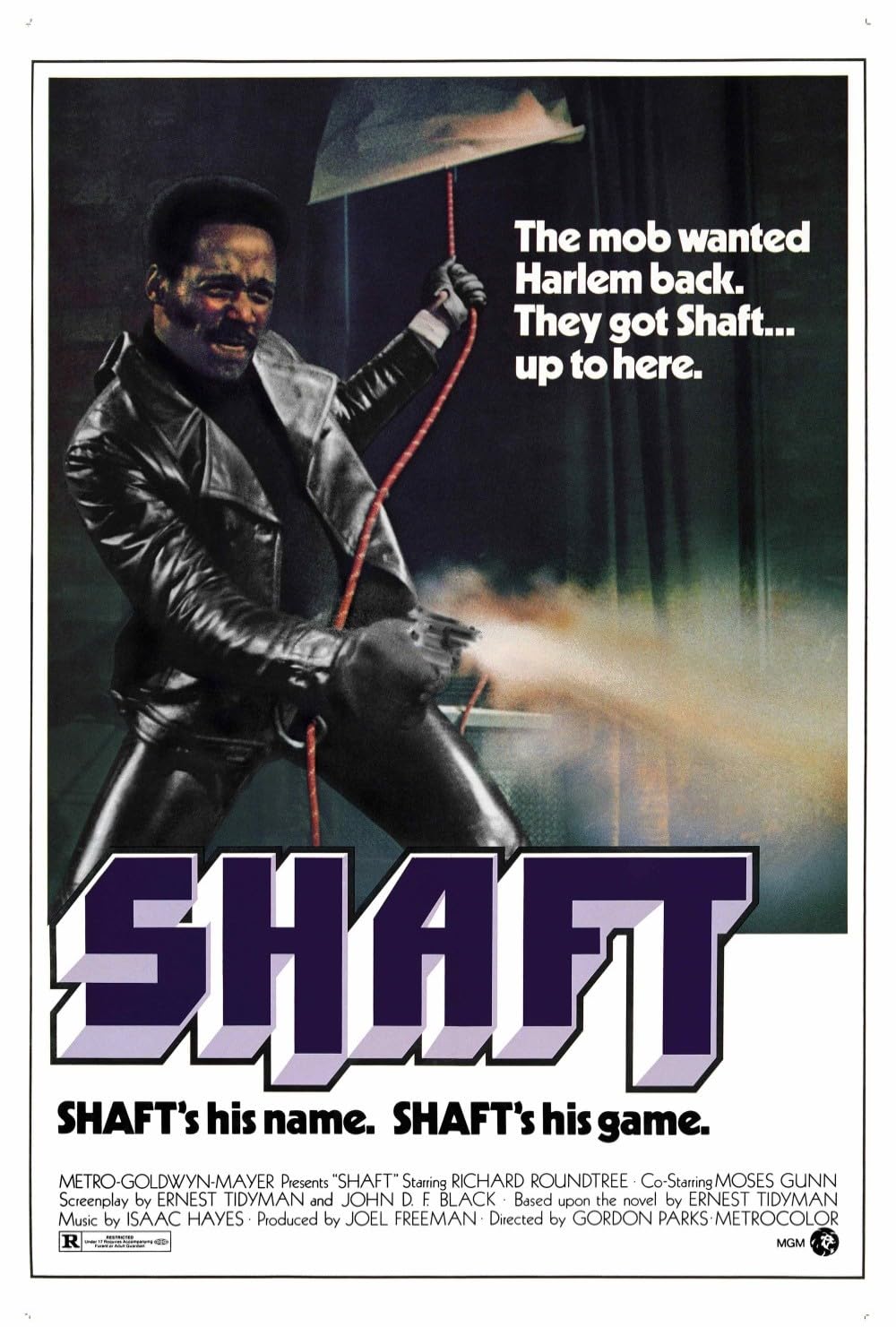
Starring: Richard Roundtree
Grade: B+
No one in the history of the world has pulled off the turtleneck like John Shaft.
Summary
In New York City, private detective John Shaft (Roundtree) walks through the busy streets and sidewalks. After flashing his badge to a watch peddler who tried to get his attention and the guy running away, and Shaft walking through a protest of some sort, he stops by the newspaper stand to talk with the blind worker Marty that he’s friends with. Marty tells Shaft that two guys came by looking for him 10 minutes ago. Shaft asks if they are from Harlem, but Marty jokes that everyone looks the same to him since he’s blind, which gets a chuckle out of Shaft. Next, Shaft goes to the shoeshine place to talk with Cul (Arnold Johnson). Cul also says that a couple of guys were looking for him. They came by when he opened up and asked where they could find Shaft. One was wearing a plaid coat. The other was wearing a sharp black and gray suit. They had guns on them too. Meanwhile, police Lt. Vic Androzzi (Charles Cioffi) and his partner Det. Tom Hannon (Lawrence Pressman) pull up and park outside. Androzzi approaches Shaft outside of the shoeshine place once he exits. He wants to sit down and talk, but Shaft has no interest, inviting him to call sometime instead. Androzzi persists, so Shaft tells him to say whatever he has to say on the spot. Tom shows up, so Androzzi tells Tom to get a couple of cigars for them. He asks Shaft what kind he likes, but Shaft doesn’t have time to beat around the bush and wants Androzzi to say what he has to say. Androzzi sends Tom away, and he walks and talks with Shaft. After some joking responses from Shaft for Androzzi’s initial vague questioning, Androzzi asks why two people from Harlem are looking for him. Shaft jokes they are soul brothers and they came down so he can teach them the handshake. Androzzi asks if they found him, and Shaft confirms, adding that he wasn’t hiding. Androzzi tells Shaft to give him a call if he finds out anything and that he’s still at the 38th Precinct. Shaft just replies, “Right on”. He turns to leave just as Tom shows up with the cigars. He asks where Shaft is going to which he jokingly replies, “To get laid, where the hell you going?”.
Shaft laughs out loud before walking away. Tom tells Androzzi that Shaft has a lot of mouth on him, but Androzzi gives Shaft credit, saying that he’s man enough to back it up too. Despite Androzzi getting no information from Shaft, he does respect him.
Shaft heads back to his office, and he sees one of the Harlem guys with the plaid jacket snooping around in the lobby, Leroy (Tommy Lane). He runs away before Leroy can seem him and sneaks through the back entrance. He strikes Leroy, takes him into the elevator, takes his gun, and holds him at gunpoint, taking him all the way back to his office. As they enter the room, Shaft sees the other Harlem guy Sims (Al Kirk) and a fight ensues once Sims knocks the gun out of Shaft’s hand. In the middle of the brawl, Leroy runs towards Shaft who moves out of the way, and Leroy goes head-first out the window and to his death. Shaft grabs Sims before he can escape and points his gun at him, demanding to know what he wants from him. Shaft also says the police are going to ask Sims why he threw Leroy out the window, implying that he will pin it on him. He threatens to kill Sims on the spot, so Sims finally reveals that Harlem gangster Bumpy Jonas (Moses Gunn) sent for him. Soon after, Shaft is brought into the police department for questioning, and Androzzi’s superior Captain Byron Leibowitz (Joseph Leon) doesn’t buy Shaft’s story of what happened, as Shaft lies and says he was taking up a sick friend to his office and some random guy attacked them when they got there, which lead to a fight that resulted in his sick friend getting thrown out the window. Leibowitz asks why he went out the window, so Shaft just challenges him to ask the man who started the fight. Leibowitz can tell Shaft knows more than what he’s leading on, but Shaft tells him that what he thinks and what he can prove are two different bags. Leibowitz points out all the weapons they confiscated and asks if his friends all carry stuff like that, and Shaft says that it depends because his friends don’t walk around with rabbit’s feet anymore. Leibowitz threatens to arrest him, but Shaft fires back by threatening to sue him for false arrest. Still, Leibowitz is in no way convinced that the man went out the window like he said he did, rhetorically asking if Shaft thinks he’s a klutz.
Shaft simply responds, “Don’t ask, and I won’t tell you”, which gets a snort laugh out of Androzzi. Leibowitz notes that Shaft is licensed by the city and the state but adds that he can’t afford to be a wise ass when a felony case is involved. Since Leibowitz is suggesting Shaft could lose his license, Shaft states that threatening his livelihood is a violation of his rights and asks Androzzi to confirm.
Androzzi bypasses this and tells Leibowitz to leave so he can talk to Shaft privately. Leibowitz isn’t happy, but he agrees and exits. Androzzi says he might be in a lot of trouble, but Shaft knows Androzzi will try and save him. Androzzi will try, but he wants something from Shaft. Still, Shaft stays firm on not saying anything. Androzzi knows the guy Shaft threw out the window was one of Bumpy Jonas’s guys and how Bumpy wouldn’t like hearing about what happened, but Shaft assures him that he didn’t throw the guy out the window. Furthermore, he doesn’t care what Bumpy has thinks. Androzzi brings up how 2 weeks ago they were hearing rumblings. They know it’s not the Panthers or the Young Lords, but they know something big is about to happen. He just wants to know what. He knows Bumpy wants Shaft for something and Shaft knows what’s going on, so that’s what Androzzi wants to know. He doesn’t care who is involved, he just wants to know what is happening. Shaft messes with him on how he’s suddenly concerned with minorities, and Androzzi tries to dispel Shaft bringing up race by holding a black pen to his face and commenting that he’s not so black. In response, Shaft puts a white coffee mug to Androzzi’s face to tell him he’s not so white. Having enough, Androzzi reveals they can nab Shaft for manslaughter for what they have right now. He can be charged. If he is, his license will be suspended, and he’ll be out of business for 6 months. On top of that, he’ll have no gun permit and Bumpy will still be looking for him. It’s going to be trouble for Shaft and all of Harlem. All he wants to know from Shaft is what is going on, so they can prepare. Shaft says he’ll think about it. Androzzi accepts this for now, but he will give him 48 hours before he will come knocking again. After Shaft confirms he has the number of Bumpy’s private phone, Androzzi lets him go and says he will deal with Leibowitz. They shake up and Shaft exits.
Following this, Shaft calls Bumpy off a payphone. Bumpy answers from his office and immediately tells Shaft that he has the wrong number. However, Shaft tells him who it is, prompting Bumpy to ask how he got his number. Shaft jokes that he got it from a bathroom wall at a subway. Bumpy says they’re looking for him. After this, Shaft buys a bag of chestnuts from a street vendor and tries to pick up a cab. Unfortunately, the cab bypasses him for a white customer that he was ahead of. Meanwhile, Bumpy and his bodyguard Willy (Drew Bundini Brown) show up to Shaft’s office to talk. Since he isn’t there, Bumpy has Willy break in. They wait inside, and Willy talks about how Shaft is being disrespectful for not being there when he said he was and how he threw Leroy out the window. Shaft shows up and ignores Willy’s threats and tells Bumpy to get out of his chair. Once Shaft takes off his leather trenchcoat, Bumpy gets up without protest, telling Willy to wait outside the door. He sits in front of Shaft’s desk while Shaft sits down and mentions Sims and Leroy trying to muscle up Shaft earlier. Bumpy doesn’t hold a grudge about Leroy, but Shaft doesn’t give a damn what he thinks. Even so, Bumpy has a job for him. He’s not trying to hustle, but Bumpy explains that it’s actually a detective job. Someone kidnapped his daughter Marcy (Sherri Brewer). They didn’t leave a ransom note, and no one saw what happened. He wants Shaft to find her. Shaft argues that the cops have a whole unit that does this for free, but Bumpy knows he can’t go to the cops. Getting serious with him, Shaft asks if he has any idea who it could be. Bumpy admits that a lot of people hate his guts. Shaft is aware and goes off on a tangent for all the illegal stuff Bumpy gets involved in like beating up some guy and taking his money and selling drugs to the youth. Bumpy points out how his daughter has never sold anything to anyone and is a straight kid who’s going to college.
Whoever kidnapped her did it to get at Bumpy. He mentions there’s a piece of Harlem he can’t get his hands on. It’s owned by a militant group called the La Mumbas, and they are led by Ben Buford (Christopher St. John). He imagines they had something to do with it. He considers sending his guys over there, but Shaft doesn’t like this because the amount of bloodshed that will come from it. Bumpy starts to get emotional wondering about the hypothetical of if they killed Marcy. Shaft knows they want to see Bumpy burn as badly as the police, but he doesn’t think kidnapping someone is really their thing. Bumpy points out how the only reason anyone kidnaps someone is for money, so he asks Shaft what other bunch in Harlem needs money enough to grab his kid. Shaft questions what his story was about if he believes this, but Bumpy replies that he thinks they have her. He didn’t say they have her in Harlem. He doesn’t think they are dumb enough to take her someplace uptown. Shaft doesn’t think this adds up, but Bumpy asks what the hell he would even need Shaft for if he knew who had her. He’s just guessing at this point. If the La Mumbas don’t have her, they still might know something. With this, he wants to know if Shaft will take the job. Shaft wants $50 an hour plus expenses, and no questions on how he spends it. Bumpy agrees to everything and just gets teary-eyed talking about wanting his daughter back. He pulls out an envelope of cash and gives it to Shaft to get started. Wiping away his tears with his handkerchief, he asks Shaft when he will hear from him. Shaft replies, “When I got something to say”. Before Bumpy can leave, Shaft leaves him with a parting note. If Bumpy sends another person after him with a gun, Shaft promises to kill the motherfucker and come looking for Bumpy right after. Bumpy just stares, blows smoke from his cigar, and leaves. Shaft sits in his chair and laughs to himself (“Fake mother”).
Accepting the job, he heads right out to begin. He asks Joe if he’s seen Buford around, but he hasn’t. He goes to Buford’s old apartment to talk with the landlord (Gordon Parks), but he apparently wants to know where Buford is too because he’s owed 6 month’s rent. This goes on for a while, as he asks a bunch of people around town. Finally, he runs into one guy and pays him $20 after he initially acts like he doesn’t know who he’s talking about. Once he gets the cash, he gives up Buford’s address to Shaft and how there will be a meeting around 9PM that he heard about. Later, Shaft waits at his girlfriend’s house, and they get intimate almost as soon as she walks through the door. That night, Shaft is at a restaurant, and Androzzi approaches asking about the visitor he got from uptown. He asks Shaft what he got information-wise, but Shaft tells him he got laid and walks out. He takes a taxi to Buford’s address, and some unknown man spots Shaft getting into the taxi. Once Shaft gets to the apartment, he spots some kid hanging outside in the cold, so he gives him some money and tells him to get something to eat. Shaft sneaks inside the apartment complex and knocks on Buford’s door. He’s there with all his cohorts. When Shaft says who it is, he’s let in because they know each other. Buford is surprised that he even found him, but Shaft is quick to tell him he has a big mouth. One of the guys tells Shaft to cool it, but he shuts him up by snapping, “Don’t let your mouth get your ass in trouble”. Buford insists he has nothing to tell Shaft, but he doesn’t want to hear any jiving because they put in a lot of street time together. Buford reminds him that it was a long time ago, and he doesn’t even know Shaft anymore. He gives him 1 minute to say what he came there to say. After that, he wants Shaft to leave, or he’ll throw him out. Once Buford confirms he knows who Marcy Jonas is, Shaft asks if he knows where she is because she’s been kidnapped and Bumpy thinks it was him. Buford tells him they don’t do that kind of thing, so Shaft asks if he knows about anything regarding the kidnapping.
Buford ignores him and tells him to leave. Shaft isn’t budging just yet, but they hear machine gun fire outside the door. Shaft asks if they have guns, but Buford reveals they don’t have any there (“I’ll be goddammed!”). Just then, a wounded man associated with Buford falls through the door and hits the ground in front of them, dead. The group runs to the roof, and Shaft and Buford break in and hide in an old woman’s apartment. The unknown assailant mows down the rest of Buford’s crew on the stairs. Once the heat calms down, Shaft and Buford come out of their hiding spots in the woman’s apartment. Shaft apologizes to the woman and gives her some money for the door he kicked open. Buford grabs the scissors from the woman’s sewing kit and threatens to stab Shaft because he thinks he set them up. The woman pleads with Buford to not do it. Shaft tells Buford to never threaten him again and to not call him Judas. Shaft pushes past him and walks towards the door. Burford relents, puts the scissors down, and meets Shaft by the door. They sneak out together hoping for the coast to be clear. They see Buford’s crew dead on the stairs and the dead doorman outside. Buford tries to process it, but Shaft hears the sirens and leads him out of the building. They see another guy dead outside, but it’s not one of Buford’s men. As the cops get closer, Shaft questions whether they want him or Buford at this point. Still, the two get out just in time. Back at the station, Androzzi is fielding calls left and right over the incident. Tom interrupts because he has a call from Shaft. Androzzi hangs up his other call to take it. From a payphone somewhere with Buford next to him, Shaft tells Androzzi that he’s coming down to see him because Androzzi’s been holding out on him. Androzzi says he will wait and asks if he knows anything about the shootout at Harlem. Shaft reveals he was there and hangs up.
After a stressed out Androzzi tells Tom to relay to Leibowitz that he went out to chase a lead to get Leibowitz off his back, he tells Tom to send Shaft in when he gets there. Meanwhile, Shaft has Buford hide out at Dina’s place. He tells him to get some sleep, but Buford is shaken over his dead brothers. He doesn’t think he should be there, but Shaft explains it’s the only place to be for him until they found out why they died. Buford accuses Shaft of thinking like a white man, but Shaft retorts that Buford doesn’t think at all. He asks Buford if he wants to get wasted to which Buford replies, “If that’s what it takes, yeah!”. Even so, Shaft says he will find out what he can and will be back in the morning to pick him up. Still agitated with Shaft, Buford sternly tells him that Shaft is wrong if he thinks he’s going to owe him for all of this, though Shaft is quick to say that he doesn’t have anything he wants. After Shaft gets an extra key from Dina so he doesn’t wake her up when he returns, he tells Buford to watch his mouth. Buford angrily replies that he will say any damn thing he wants, but Dina tells him not in this house, getting a laugh out of Shaft. At the station, Shaft goes to Androzzi’s office, shuts the door in Tom’s face, refuses Androzzi’s offer to sit in the chair in front of his desk, and sits on the desk instead. He tells Androzzi that he gave him nothing. Shaft even offers to let them arrest him for manslaughter, telling Androzzi he’s not agreeing to the deal. Shaft goes on about how anyone who could identify the guys with the machine guns got wiped out, and Androzzi adds that it was 5 of Buford’s people and probably the guy who identified Shaft. He reminds Shaft about how he was telling him about Bumpy doubling his crews up in Harlem but adds that they got some visitors downtown. They were from all over the place, Los Angeles, Phoenix, Philadelphia, and even Decatur, Illinois. All of them are suspected as being guns for the mafia and most are staying at a hotel down by the village.
Besides this, a couple of guys from Harlem went across to New Jersey to try and kidnap some mafia bigwig and blew it, killing the guy’s runner. Still, the man maintains that his runner was in Florida on a fishing trip. Shaft deduces that a war is coming. Androzzi comments that it’s the mafia against Bumpy, hood against hood on the inside but black against white on the outside. They could have tanks and troops on Broadway if this thing breaks open, and Shaft realizes Androzzi has a point. He gives Shaft pictures of the “visitors” and tells him that he knows Shaft took the Bumpy job. Regardless, Androzzi will be at the station. If he’s not, he tells Shaft to call him at home.
Business just picked up in this kidnapping case, and it’s much bigger than any of them could have imagined. Good thing Shaft is the one on the case!
My Thoughts:
Jumpstarting a genre along with Melvin Van Peebles’s Sweet Sweetback’s Baadasssss Song, saving MGM from bankruptcy due to its commercial success, and creating a hero for black and white audiences alike, the influential Shaft was a trail blazing film that was instrumental in diversifying the Hollywood landscape like never before. As stylish as it is gritty due to the independent nature of the production, Shaft marked a major turning point in the film industry. Undoubtedly an imperfect movie, its legacy is what makes it untouchable in the eyes of many.
It all begins and ends with the titular character in a star-making performance by Richard Roundtree. In Shaft, Roundtree’s inexperience as a leading actor is noted in a lot of ways, but there is a quality he possesses that cannot be taught. Of course, we are talking about the “movie star” aura that can carry an actor through a movie regardless of his or her technical ability. Though Roundtree never got as big as he should have, as the Shaft franchise was the peak of his success, there is no doubt he has the “It” factor. Just like the character of John Shaft himself, Roundtree is the epitome of cool. The opening of the film is all the audience needs, to know exactly who John Shaft is. Wearing his trademark brown leather trenchcoat with the blue lining and turtleneck, Shaft walks through the streets of New York City looking like the baddest “mother-SHUT YOUR MOUTH”! The only thing the viewer needs to comprehend who we’re dealing with is how the protagonist is told that some guys from Harlem are looking for him and how he’s unafraid of hearing such news. If anything, he’s not even surprised. Along with this, the opening sequence also shows how popular Shaft is around these parts, as he runs into friends and associates all over the place who know who he is and the respect he commands, something that becomes a staple of the character that is carried over when Samuel L. Jackson takes over the franchise in 2000’s Shaft and as recently as 2019’s Shaft sequel. Whether it’s the big city itself or the underworld below it where the shady characters go to work, everyone knows Shaft. By the end of all five films and the short-lived television series, the protagonist becomes a folk hero of sorts, which is why Jackson’s John Shaft II stresses to his son how important the family name is when he doesn’t understand it in 2019’s Shaft. It all started in 1971 with Gordon Parks’s feature and the work of Roundtree, who is arguably more instrumental to the success of the character than the screenwriters themselves.
Had Richard Roundtree not possessed this quality mixture of coolness without trying, being a believable ladies’ man that can attract a woman with a glance and a smile and being strong enough to earn his spot as one of the top action heroes of his day, Shaft would not have succeeded like it did. Thankfully, Roundtree had all the intangibles, even if his acting isn’t anything special. He does what is asked of him, being the baddest man to walk into the room and looking good while doing it. No one intimidates Shaft. It could be gangsters in Harlem or the police themselves, and Shaft is still quick to tell them who’s game it is when they enter his presence. Bumpy Jonas is the biggest gangster in Harlem, and he has his large henchman Willy with him, played by real-life assistant trainer and cornerman for Muhammed Ali in Drew Bundini Brown. They wait in Shaft’s office, and both try their hand at striking fear in Shaft, but he doesn’t flinch for a second. In fact, he challenges them, demanding Bumpy get out of his seat and telling Willy off. Even after he accepts Bumpy’s job offer, he makes it well known that he will come for his ass if Bumpy sends another one of his guys over to kill him. This is the world building of Shaft, as the film represents the underbelly of New York City and how tough you have to be while in Shaft’s position of private investigating. He’s a hero, but he can’t play nice because the criminals will come for his neck and so will the police who assume he’s involved in shady dealings just because of the people who want to hire him. His balls of steel are unmatched by any protagonist in action cinema. Some characters portrayed by the Bruce Lees and Chuck Norrises of the world are fearless in their own right, but they only act when attacked or threatened. Shaft knows who’s bad, but he will invite his opponents to test him, as if he craves the practice to freshen up his skills. That’s the difference. He never shows an ounce of weakness, but it’s not a front he puts on. It’s just who John Shaft is.
When he takes Buford to meet with Bumpy, he could be cordial with Willy and comply to make things go smoothly, but he refuses to bend even for him. Willy demands they allow him to frisk them, but Shaft comments, “You better get 6 more helpers in here Willy”. After Willy admits nobody searches him when Shaft asks, Shaft responds, “Then get the same cat to search us”. He’s too smart to know the disadvantage he will be in if he’s outnumbered and without a gun in case things go haywire, so he’d rather leave than relinquish the independence the gun allows him to have. Bumpy needs him more than he needs Bumpy. It’s Bumpy’s daughter at stake after all, so Willy relents and calls Bumpy to get permission to let Shaft and Buford in without being frisked. Once Bumpy gives him the greenlight, Willy tries to get the last word in by threatening Shaft. Instead of ignoring him, what does Shaft do? He gets close to Willy’s face and tells him confidently in front of the other henchman in the room to completely discredit him, “Why don’t you stop playing with yourself, Willy? You ain’t gone do shit!”. He’s practically daring Willy to make a move. Shaft wants him to make his day, but Shaft is right. Mind your business while the men talk, Willy. Shaft doesn’t have time for a dick measuring context. If it was, Shaft in Africa subtly tells us that he’d win this too. Even though he’s aware he’s dealing with the fucking mafia in the bar scene, Shaft still breaks a bottle over Carmen’s head after Carmen spits blood on him. When he approaches the two in Androzzi’s office on behalf of Bumpy and tells him his demands of seeing Marcy to make sure she’s good, Patsy says he’s not saying anything because he thinks the cops are listening. Shaft sternly responds that it’s a risk he will have to take, demanding a number from them to call. Once he gets it, he turns and shoots them both an aggressive look to make sure they know he means business. Again, this is the MAFIA that he’s dealing with, but not even the mafia can intimidate John Shaft.
Along with our star protagonist, what goes hand in hand with the movie’s success is the creation of the funk anthem “Theme from Shaft” due to the work of legendary soul artist Isaac Hayes. For modern viewers, it may sound like a corny television theme song from the 70s, but historians of cinema know why this is one of the greatest movie themes in existence. Along with familiarizing the audience with this brand-new hero who maintains a near mythical status, with some carefully written lyrics that explain his character to a “T”, it’s instrumental possesses this energy to it that stays in your head. What’s amazing is that you don’t mind it at all. You just think to yourself, “Right on”. As if it were even a question, Hayes won the Academy Award for Best Original Song. In doing so, he became the first African American to win it or any Academy Award in a non-acting category, along with being the first recipient of the award who both wrote and performed the winning song. It’s pure cinematic greatness and shows how crucial music can be in cultivating a character for the screen and aiding in its quest to solidify a cinematic legacy.
Now, this might be controversial to some, but the movie as a whole doesn’t do anything out of the ordinary. The main character is one of the greatest cinematic heroes to come out of Hollywood, but this first movie is shockingly routine in its beats. The action is nothing more than decent at its best, there aren’t nearly as many action scenes as you’d like, the detective work and the intricacies involving Shaft’s case aren’t compelling nor nearly as intricate as any of its contemporaries in the genre, and really, no one outside of John Shaft is all that interesting. Christopher St. John’s Ben Buford and his group of black nationalists offered an intriguing subplot to strengthen other aspects of the story, but there is no depth to Buford or his group. We don’t know what their overarching mission is, who Buford is outside of being angry over some of his guys being shot, and what the details are regarding his uneasy alliance with Shaft if they use to be friends on the street back in the day. They had something with Buford, but it becomes ultimately underwhelming. To be fair, Charles Cioffi’s Vic Androzzi is likable and is the lone supporting character who maximizes the minutes he was given onscreen to positive results, even if he didn’t do anything too crazy. Why he was never brought back from a narrative or entertainment standpoint in future Shaft productions is questionable, especially when the odd couple of Bumpy and Willy are brought back in Shaft’s Big Score!. Speaking of which, other than bald-spot Willy’s odd finger gestures and way of speaking, and Moses Gunn’s performance being all over the place, the supporting cast of characters don’t offer much. It makes sense for Bumpy to act the way he does in the first part of the film to establish how this terror of a gangster is genuinely frightened for his daughter, but the scene in which Shaft and Buford meet him in his office to discuss business is straight-up confusing. In the scene, Shaft confronts Bumpy about how Bumpy knew who grabbed Marcy and it wasn’t Buford’s guys. It was Bumpy who started everything by snatching the mafia guy, made some money, and now the mafia is coming for him for revenge.
He knew it when he hired Shaft. What’s weird is that Bumpy gets oddly cocky in his responses, and it confuses his overall feelings on the matter. It doesn’t make sense for him to get smart with Shaft, talking arrogantly about how they “burned some kid, missed the man we wanted to grab for a trade” and how he conned Shaft but never lied to him, even though these terms basically mean the same thing.
Bumpy then tries to be devious in the way he talks about the costs and laughs. For someone who is in danger of losing his daughter, the way Gunn reacts in this scene is a total misunderstanding of the script, as he switches back from being an evil gangster to a sad father willing to agree to whatever payment it takes to get his daughter back. He flips flops back and forth with almost every other line. There’s one moment where he walks right up to the camera and reveals that he didn’t know the mafia would come after Shaft “… but it doesn’t shake me up. They made a good move to take out my front man. They’ll probably try again. I would”. However, right after this, he agrees to Buford’s demand of $10k a man and has this emotional stare into the distance commenting, “I can always get more money. I only got one baby”. Following all of this, with Bumpy agreeing to paying another $50k for the men Buford lost the night before and Shaft’s fee of $20k, Bumpy makes sure to tell Shaft he better not fail at these prices. When Shaft points out how Bumpy just said money didn’t matter to him and all he wanted was Marcy back, Bumpy replies that money always matters and they both share a smile. What? So, which is it?! What is up with this guy? Either Gunn didn’t fully comprehend what was written, Gordon Parks completely ignored him when he asked for notes, or he’s a full-on schizophrenic. Besides this, Bumpy is right that Shaft would need an army to infiltrate the mafia-protected hotel, but why would he need Buford’s guys? Doesn’t Bumpy have a bunch of insane gangsters on his payroll? Why risk bringing in Buford’s group and unloading all that cash to ensure his involvement? It could be that I’m overestimating how many guys Bumpy has, but it couldn’t be that much less than the small group Buford collects for the climax. After all, Bumpy is the lead gangster in Harlem. Surely, he would have loads of protection, right?
The screenwriters just didn’t seem to care to do anything noteworthy with anyone outside of the main character, which is a shame because there was a lot of room to grow the subplots and the relationships between members of the supporting cast. Shaft can be slow moving at times too. Considering how well they introduce the main character in the first act, the second act where they get deeper into uncovering the case’s details isn’t as earth-shattering as it’s explained to be. In fact, it’s rather mundane outside of the action or Shaft interacting with random people, like the scene in the bar where he acts like an undercover bartender to stall the mafia guys who are stalking his apartment before the cops show up. The movie itself just isn’t anywhere near as enticing as the protagonist himself nor is it as exciting as people say it is. When there are fight scenes or shootouts, the action hero qualities of Roundtree are shown, but the moments are few and far between, which effect the overall viewing experience. Once it’s over, you realize that the majority of Shaft was just the main character talking shit to people and having sex. This is coming from a huge fan of the series too. Think about it. Did him fucking Linda really do anything for the story other than to show how easily Shaft can get laid? Not really, all it did was allow for the somewhat amusing recurring joke of her declining to close his door upon her exit (“Close it yourself shitty”). The action that is present in the movie is either badly choreographed or too quick. For example, how in the fuck did Leroy fly out the window by himself? You’re telling me had that much momentum in that small room to where he was unable to stop running head-first through a window and out of the building to his death? Leibowitz having questions surrounding Shaft’s story isn’t agitating. It’s downright logical. If we didn’t see it ourselves as the viewer, we wouldn’t believe Shaft either.
In terms of things happening too quick, the climax at the hotel is a perfect example. The suspense leading up to it where Shaft and Buford get the troops ready and everyone picks their spots in the plan before they storm the mafia-protected hotel to save Marcy is excellent.
The tension is authentic, and Shaft wearing the all-black leather fit to signify this is a big deal is the stuff of legends. However, the actual payoff is so perfectly executed, it’s over in two minutes. Granted, it strengthens the lore behind John Shaft to show how good he is at his job, how intelligent he is, and how his leadership and action hero skills are second to none, which puts him on par with all the fictional greats of his era. Nevertheless, this plan being executed so well by our hero, and everything going off without a hitch to pull the mission off in under two minutes with zero issues, took the air out of the room. It was over and done with just like that. From a direction standpoint, this was a terrible decision. No one is suggesting an explosive Michael Bay type of ending, but a shootout to where it at least looks like the good guys may lose would have added an enormous amount to the excitement of the movie since this was what the entire film was building towards. There’s no reason why it couldn’t have turned into a five-minute sequence with shooting through the hallways and a couple of one-on-one fights involving the main characters with the mafia guys. Yet they decide to show the audience that Shaft is too good at his job at the expense of the movie, making us question, “This is what we were waiting for?”. With so much start-and-stop action throughout the movie, the assumption is that it’s all leading to a finale of epic proportions. It was good to an extent, and everything leading up to it built the anticipation to a fever pitch, especially when Shaft breaks through the window on beat with the music, but everything working perfectly for the good guy team ended the movie in an abrupt and arguably disappointing manner, though the final conversation between Shaft and Androzzi over the phone was a great way to lead into the credits. As iconic as Shaft is, how instrumental it was in changing the industry, and helping birth a genre of film due to its popularity, it’s not even the best movie in the franchise.
Strangely enough, that honor belongs to John Singleton’s Shaft. Gordon Park’s original movie and its watchability is carried entirely on the back of Roundtree and his presence. He’s untouchable as the main character and will always be the best lead out of the three men who have been lucky enough to carry the name that he made famous. Unfortunately, it just makes you wish the movie as a whole had more substance and was worthy of the gravitas Roundtree brought to the production. It’s almost like the screenwriters didn’t expect him to be this good this early and underwrote the film. The lower budget obviously hampers things, but another shootout or fight at the midpoint would have made a huge difference in keeping the energy up, even if it was on the villain side of things to make us believe more in the threat they are portrayed to be. We needed more thrilling scenes like the first attempt to save Marcy that left Shaft nearly dead (“I halfway believe you, but you’re my ace, so I gotta call you”). It showed Shaft isn’t superhuman at just the right time but still presented his resilience, getting ready to go immediately after he’s patched up by Sam to lead the charge back out, despite nearly bleeding to death. Had there been a few more lively moments like this, we wouldn’t have noticed the narrative hangups. Regardless, the aura surrounding 1971’s Shaft is special. Even if the screenplay is unimpressive, you can sense why this movie was special. It’s a feeling that none of the other movies in the franchise have, despite most of them being better in overall quality. It’s the only movie in the series that feels like an event, and it’s a quality that cannot be replicated, which is why there is such a stark contrast between this film and its sequel in Shaft’s Big Score! just one year later. Despite a bigger budget and all the key elements and ideas remaining, the soul of the first movie is gone and it’s evident. In fact, one can argue that it never truly returns.
Certain details were befuddling though. Does anyone know why Shaft keeps a gun in a plastic bag in the freezer? It was funny to see the one guy give Shaft gin for the fluid to light the newspaper with, but if the guy had a bottle of gasoline ready, why didn’t he just lead with that? Additionally, Shaft’s apartment in Greenwich Village begs the question how lucrative his private investigating business is because it’s the best apartment depicted in the entire series. I’m not sure what was up with that painting on the wall that Androzzi stared at though. Was that a jester or a clown or something? It didn’t really fit the vibe or the character. While we’re on the subject, what was up with that waitress where Shaft orders the espresso? Was she high (“I always forget the lemon peel”)?
Hey, at least Shaft replies to an “I love you” from a girl with “Yeah, I know” years before Han Solo did in The Empire Strikes Back. What a legend.
Even though the character is better than the movie, the slick and spirited Shaft is a special film with a style all its own. What it did for the film industry is something that supersedes the content of the movie, creating a cool black action hero beloved by all with an electric theme song and badassery on a whole other level. With this, a franchise began and a legacy was cemented. Gordon Parks’s Shaft is a movie that deserves its respect from fans of cinema. Even so, it’s not as complete as we remember it and is far from the best film in the series it started.
Stay loose, baby.
Fun Fact: Isaac Hayes auditioned for John Shaft but was offered the score instead when he didn’t get the role.


+ There are no comments
Add yours