
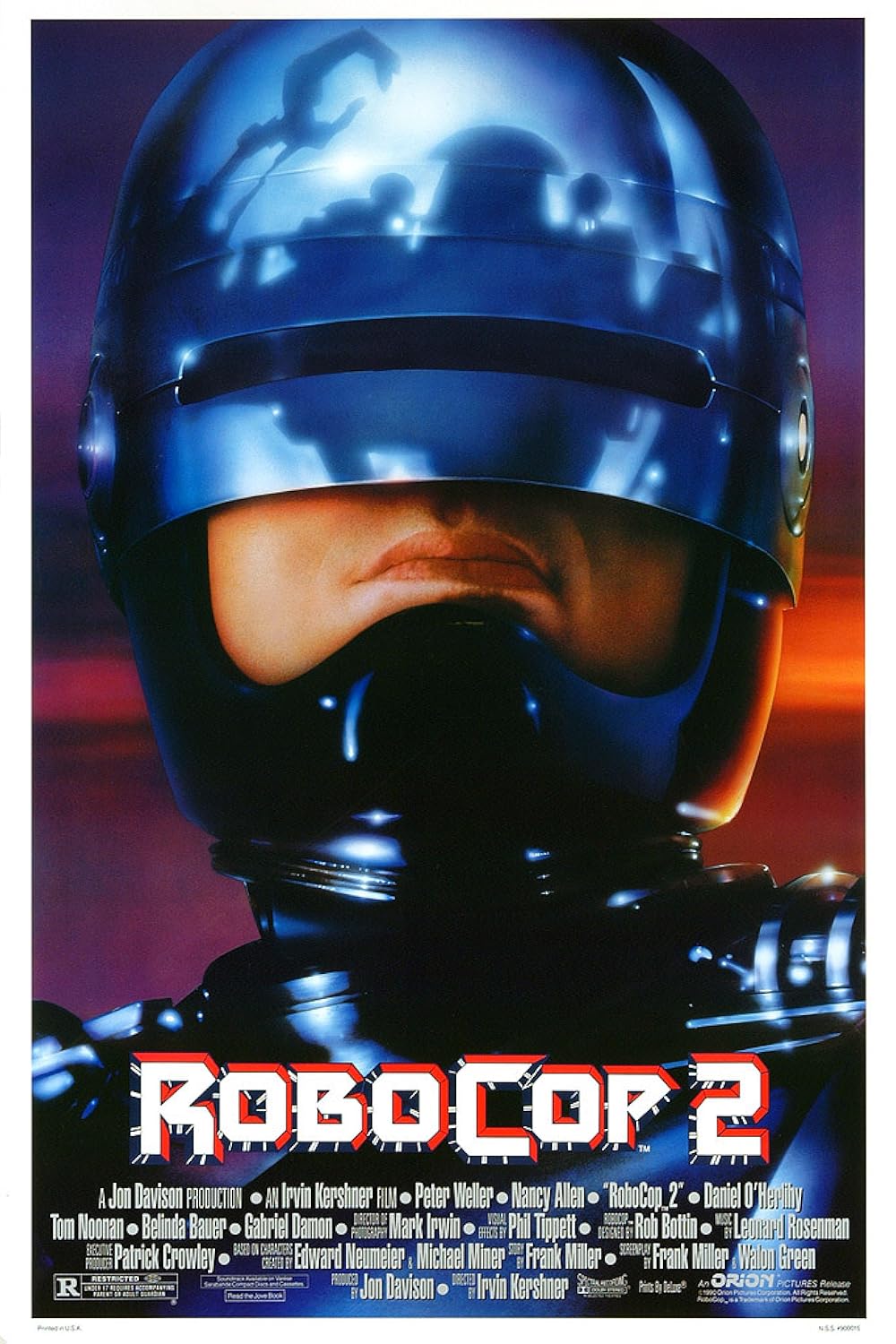
Starring: Peter Weller, Nancy Allen, and Tom Noonan
Grade: A
Hopefully, those media members in the climax of the movie get a raise. No matter how many people were shot and killed by RoboCop 2, those idiots stayed right there in the middle of the action to try and film it.
Bravo.
Summary
A commercial is shown for Magna Volt, the newest invention in auto security. In the advertisement, a guy breaks into a car in a parking garage. When he sits down, the invention has two restrictive metal bars cover the man’s body, and he’s electrocuted. There is no embarrassing alarm noise, no need to trouble the police, and it won’t even run down your battery. The spokesperson for the ad opens the door as he mentions the last point, and the guy who has just been fried falls out of the seat and onto the ground. The tagline is “Magna Volt: lethal response”.
Next, we go to news show Media Break where they detail a story about the Amazon nuclear power facility blowing its stack, eradiating the world’s largest rainforest. Environmentalists are calling it a disaster (“…Don’t they always”). In other news, Attorney General Marcos approved the ED 209 Combat Unit for deployment in 5 American cities, despite widespread complaints of malfunction. In the video shown of the ED 209, it struggles getting out of a hole in the middle of a road. The Surgeon General (Jon Ingle) was also assassinated 20 minutes ago by a militant addict of deadly designer drug “Nuke”. They go to a clip of the Surgeon General calling it the most addictive narcotic in history at a press conference and how it’s the biggest health threat in the country. As he talks about it more, he’s shot and killed, and the shooter is brought down as he screams “Nuke!”. Back on Media Break, they get a transmission from convicted murderer and leader of the Nuke cult in Cain (Noonan). Cain simply says, “People want paradise, and they will have it”. Cain’s group is behind the assassination and many more acts of terrorism including the firebombing of a drug treatment clinic that left five dead last week. In addition, the male anchor talks about another breakdown in negotiations between Detroit’s police and OCP, with the police protesting again out of their demand for better terms from OCP (Omni Consumer Products), the corporation contracted by the city to run the Detroit Police Department. In an interview, one cop details how OCP cut their salaries by 40%, cancelled their pensions, and they refuse to negotiate.
It’s as if they wanted the strike.
Deep in the heart of Detroit, the whole place is turned upside down. People are doing drugs and laying around on the street, and an old lady with a shopping cart full of cans almost gets hit by a car. The cart is hit, and the lady is on the ground. Some guy feigns helping her up but then steals her purse, pulling out money and an expensive bracelet. Two hookers rob that guy and run away. A group blows up a gun store and takes a majority of the inventory. One of the guys asks the wounded owner where the bullets for his gun is, so the owner points it out to him. Next, the guy shoots the owner. The group hears sirens, but one guy mentions the cops being on strike. They go out to check and see the cop car coming towards them anyway. The guy uses his rocket launcher from the store and fires it at the car. He nails it, and the car flips over. He shoots it again with a bazooka, and the others follow it with their automatic weapons. The car blows up, but RoboCop/Alex Murphy (Weller) steps out unscathed. He shoots them all down and finds Nuke in their car. He picks up one guy and demands to know where it’s made, but the guy only knows where to get it. Robocop walks down the street, and all the unsavory characters in town look at him. Still, he remembers his prime directives:
- Serve the public trust
- Protect the innocent
- Uphold the law
RoboCop finds the place, knocks on the door, and waits for the door man to come to the peephole before he punches through the door entirely to hit the guy. Upon getting inside, RoboCop locks two more guys in the freezer they move some Nuke into. He goes by one larger room and looks through the window of the door to see countless women making Nuke while there is one of the women’s babies in a corner of the room. Watching over the women while they make it is Caine, Catzo (Michael Medeiros), and young boy Hob (Gabriel Damon). RoboCop enters arrest mode, turns off the music, and tells everyone to freeze. Right after, Caine’s men start shooting at him, and Caine and Cazto run in different directions to hide. As RoboCop shoots people down left and right, Caine turns on a handle to let a bunch of smoke in to cover their exit. Caine, Catzo, and Caine’s lover Angie (Galyn Görg) escape to the car. One woman is already in the backseat and frantically pleads with Caine for help, but Caine shoots and kills her. Officer Anne Lewis (Allen) gets into the building and hears the men trying to get out of the freezer. She opens it, stops the first guy from shooting, and shoots the second guy. RoboCop looks around at the laboratory before he spots Hob. His targeting system doesn’t allow him to fire. Hob knows RoboCop can’t shoot a kid, so Hob shoots him in the head before running off. It doesn’t knock RoboCop down or anything, but he suffers a tracking error in his recording of the shooting. Because of this, him replaying Hob in the moment reminds him of visions of his son Jimmy, as RoboCop still has remnants of his past life as Alex Murphy. Following this, RoboCop and Lewis both point their guns at one guy who threatens to shoot a baby that he has in his hands. The mother is right next to him. RoboCop tells Lewis to lower her weapon, and he allows for the guy to come out of his hiding spot while his programming goes through a plot trajectory to fire on the guy. It finally suggests shooting off the steel door on the storage container, so RoboCop fires. It ricochets off the door and hits the guy perfectly on top of his head. Before he falls to the ground, Lewis grabs the baby and hands it back to the mother. Once the mother leaves, RoboCop intentionally steps on a small bottle containing Nuke.
Sometime after, RoboCop hides in his car in a neighborhood and spots Jimmy riding his bike to the house. Murphy’s wife Ellen (Angie Bolling) is putting things in the mailbox and spots his car, looking at him. RoboCop gets a flashback to hanging around the house with Ellen and kissing her. After getting out of the flashback, he drives by the house and out of the neighborhood. Ellen looks through the window at the car concerned. Back at the department, OCP attorney Holzgang (Jeff McCarthy) sits with RoboCop and goes through a series of questions. He brings up how OCP defines him as a machine that utilizes some living tissue, which RoboCop confirms. He then asks if RoboCop considers himself human, and he stalls. They stop the recording of the conversations because of it, and Holzgang asks if he has any idea what he’s doing to Ellen. He offers RoboCop her file to look at, but he just looks at him. Ellen’s lawyer Tom Delaney (Ken Lerner) is there on her behalf, as she is suing OCP. Up to a few months ago, she wouldn’t leave the bedroom. She’s been through therapists, hypnotists, and harmonic treatments up to this point. Holzgang interrupts to lambast RoboCop for driving by her house day after day, spying on her, trying to make her think her husband is still alive. Tom chimes in to say Ellen has barely started to accept the loss and RoboCop is ripping her to pieces with his actions. Holzgang doesn’t understand why RoboCop is even trying because he doesn’t think he could be a husband to her anymore. What can he offer her? Companionship? Love? OCP lab tech Linda Garcia (Patricia Charbonneau) looks saddened hearing this, as does RoboCop who somberly agrees with them. With this, Holzgang tells them to begin recording again. He asks RoboCop if he is Alex Murphy and if he’s human. RoboCop responds “No” to both questions, though it does pain him. Holzgang says that he is simply a machine, so RoboCop reiterates that he’s a machine, “nothing more”. Holzgang sees this as satisfactory and has them stop recording. He tells RoboCop to stay sitting and tells the others to get Ellen. Tom wants to be nice and suggests they give them privacy, and Holzgang is cool with it.
They all leave the room, but they keep RoboCop locked behind a cage of sorts. Ellen walks in, and RoboCop gets out of his chair to greet her. They stand across from each other with the cage wall dividing them. Right away, Ellen recognizes him as Murphy and asks if he remembers her. She doesn’t care what they have done to him. RoboCop puts his face closer to the cage wall and asks for Ellen to touch him. She uses her finger to touch his lip and notes how cold it is. He responds that they “made this to honor him”. Cold and blunt, he tells her Murphy is dead and he doesn’t know her. She cries and leaves. Afterwards, RoboCop looks through the window to watch her approach Tom before getting into her car, asking him why this is happening. Following a commercial for OCP of some guy using an outdated system, losing an account, and killing himself, Mayor Marvin Kuzak (Willard E. Pugh) goes to OCP Headquarters to meet with OCP executive Donald Johnson (Felton Perry), Holzgang, and OCP CEO “The Old Man” (Dan O’Herlihy). Right away, Kuzak and the city councilman want to know when OCP is going to pay the police so they can go back to work. Holzgang points out how Detroit itself still owes them over $37 million. Kuzak doesn’t see how they can get the money during this period of distress, and the Old Man doesn’t expect them to. Holzgang chimes in to bring up their contract with the city. In the event of a default, OCP secures uncontested right of foreclosure on all city assets. The councilman looks at it and confirms Kuzak signed this contract. Despite missing one payment, OCP has the right to foreclose. The Old Man confirms this, as well as his plans to take Detroit private. They deliberately undermined the city’s credit and essentially set up the police strike to make it happen. Kuzak starts to see OCP’s deviousness and questions their goals and how they are willing to let Detroit tear itself apart, just so they can raid it like any other corporation. He calls them all murderers and threatens to sue them on the way out, with the Old Man welcoming the challenge. Afterwards, the Old Man walks with Johnson and talks about he’s been waiting patiently for 5 months.
They walk by Dr. Juliette Faxx (Belinda Bauer) and Johnson tells him about how they moved Juliette up to head the attitude adjustment team. She joins them on their walk, as the Old Man moves the subject back to discussing their project and how he wants to see results because they’ve spent $90 million already. In a test video, Johnson introduces their next project. With OCP already pioneering cyborg technology, they have taken another leap forward. With state-of-the-art destructive capabilities, commanded by a combination of software and organic systems, they have come up with what they see as an improvement over the original, the aptly named “RoboCop 2”. The robot steps out, shoots one engineer, shoots the other, and then itself before it flashes its police lights and sirens above its shoulders. Another test video is shown of the improved version of the “RoboCop 2” prototype. It walks out, takes off its helmet to reveal a skull, and falls on the ground face-first, dying. The Old Man cannot believe this is what $90 million has given him. Following this, he walks with Johnson again, and Johnson explains how each time, all the prototypes go crazy. The Old Man can’t fathom why these robots have emotional problems, but the main engineer Schenk (John Doolittle) explains how they are cybernetic organisms and have living human tissue. He sees it as the problem. Johnson calls all the people used for the project as fine men and respected police officers, having reviewed the files himself. Just then, Juliette interrupts to argue that police officers may not be the best candidates. They’re physical, macho, and body proud. When they find themselves stripped of all this, she’s not surprised they become suicidal. Johnson points out how their one success was a cop, Alex Murphy. Juliette agrees but brings up how he was the top of his class, a devout Irish-Catholic, and a family man. Everything in his profile indicates a fierce sense of duty, which is what she thinks kept him alive. Annoyed, Johnson tells her that her area of expertise is psychology, not robotics. Even so, the Old Man wants to hear her out, so she continues. She believes Murphy’s case was unusual but not unique. She thinks they can find someone else, “someone to whom the prospect might even be desirable”.
Johnson comments to the Old Man that he’s never heard of anyone who wanted to be a robot, but Juliette counters with a possible screening process she can supervise on the cheap, especially because they wouldn’t want to waste all the work they’ve already put into this project. The Old Man agrees and puts Juliette on the project, with her getting to report to him directly. Once she leaves, he comments to Johnson that he could learn a thing or two from her. Back at the Metro West, RoboCop and Lewis drive to the station. Most of the police officers are outside protesting, and one cop gets mad at the sight of RoboCop driving in, noting how they’ll remember him when the strike is over. Inside, Sgt. Reed (Robert DoQui) is dealing with a million citizen complaints at once while RoboCop and Lewis enter. Officer Duffy (Stephen Lee) walks in, accosts some of the prisoners in their cell, goes into a private room, and takes some Nuke. At night, RoboCop and Lewis are hidden in an abandoned building and spying at some underground arcade bar in a messed-up part of the city. They see Hob ride on the back of a motorcycle with some guy driving it. Hob gets off and starts handing out Nuke to random people, and RoboCop remembers from his recorded footage that this is the kid they’re looking for. While they continue to listen in and spy on Hob from the building, they see Hob speak to Duffy, with Duffy revealing the locations of three different cop cars to allow Hob’s group to take them out. They give Duffy cash, but he doesn’t count it. Hob insists he count it, but Duffy says it’s fine. To “help him with his conscience”, Hob has one of his guys give Duffy some Nuke. Initially, Duffy doesn’t want it, but Hob knows he does and goads him into taking it. RoboCop enters the arcade, and everyone stops. Since there are a lot of younger kids there, he rhetorically asks, “Isn’t this a school day?”, prompting everyone to throw stuff at him. Hob is alerted that the cops are there, so they run. Duffy tries to escape but can’t find a route. Hob and his guy run into Lewis outside who holds them at gunpoint. Hob tries to shoot his gun, but Lewis kicks it upwards while he fires. The gunshots are heard inside the arcade, and everyone starts running around in a panic.
Lewis is forced to fight Hob’s guy, and this allows Hob to run. Hob tries to fire his gun into a crowd, but he’s out of ammo. He goes back over to Lewis once she takes out his guy and starts choking her from behind. While these two wrestle, RoboCop finds Duffy and throws him into an arcade machine. He demands to know where Cain is at. Eventually, Lewis is able to slam herself against the wall outside while Hob is on her back, and he lets go of her, though he escapes. Lewis recovers but instead chases after Hob’s minion when he runs. After RoboCop is done slamming Duffy’s head into arcade games, he finally tells RoboCop that Cain is at the old sludge plant at River Rouge. With this, RoboCop calls Duffy a rotten cop and throws him to the ground. By himself and driving into the daylight, RoboCop goes straight to the sludge plant. He gets up to a closed gate, gets out of the car, rips the lock off, gets back in the car, and drives through. Almost immediately after driving through, the car explodes as it set off a trap. Catzo goes down to examine the rubble, and there is no one inside the car, so he assumes RoboCop is dead. Miraculously, RoboCop is still alive and managed to get out in time, hiding behind a wall. He walks through the plant, and Catzo and Hob spot him. Hob positions guys and has them shoot at him. RoboCop takes a bunch of shots, but it doesn’t faze him. Suddenly, the shooting stops. RoboCop looks around and sees paintings of Mother Teresa, Jesus, and Elvis Presley. Below the pictures is the skeleton of Elvis enclosed in a see-through casket. Moving on, RoboCop walks and finds Angie who runs in the opposite direction. He turns the corner and is staring across the room at Cain. They establish one of them must die, so RoboCop walks forward to oblige. Unfortunately, his hand his shot off by Hob who is stationed above them with a massive machine gun. RoboCop is stuck and starts to short circuit in place. Next, Angie shoots him with a spear gun in the chest that subsequently electrocutes him. It drops RoboCop to his knees. Cain uses this opportunity to compare himself to Jesus and how they both have been hounded and attacked like criminals, but he doesn’t blame RoboCop because he’s programmed to do so.
As Cain’s followers circle the two, RoboCop is still being electrocuted but says he will kill Cain. Cain points out how he just tried, but he still forgives him. RoboCop pulls the spear out of his chest and touches his severed wrist. It sends a shockwave through the spear and shocks Angie to the ground. However, one of Cain’s henchmen sends a crane his way and knocks out RoboCop. A mechanically operated magnet is brought over and picks up RoboCop’s body. They drop it down on a platform, lock him to it with chains, and then use tools to pick him apart piece by piece. Hob has heard RoboCop has a brain, and he makes it known that he wants to see it. Before they get to that though, Cain tells RoboCop that he wasn’t the one who beat him. It was actually the existence of Nuke that did it all. After he injects himself with it, Catzo uses a jackhammer on RoboCop to cut off his leg, and they continue ripping him to shreds with machinery. Later, they drive by Metro West in a limo and drop off the stripped remnants of RoboCop in front of the cop protesters before speeding off. He’s not dead, but he’s in shambles. He’s taken in the back to be examined, and Linda knows he’s feeling this pain, arguing his pain centers are alive. Holzgang doesn’t buy it and just thinks the backup generators are making him twitch a lot. Lewis knows Murphy is suffering too and asks how long he will last. The other doctor says they have him on life support, and they’re keeping the brain going with micro-shocks. He could go at any time. Reed comes over to ask what’s going on, and one cop blames it on OCP for not wanting to lift a finger to help RoboCop. Holzgang argues this “unit” needs millions of dollars in parts and they can’t expect authorization for that amount of cash overnight. Linda exclaims that if they don’t fix RoboCop, it’s murder. Holzgang doesn’t care and argues that he’s doing everyone a favor just by talking to them. That night, a neck brace-wearing Duffy exits a limo with Hob and Catzo, as they bailed him out of jail. Drinking from the bottle, Duffy thanks the two as they get to the hideout. Then, Catzo hits Duffy over the head to knock him out. He’s stretchered into a room with Cain, Hob, and Angie.
As Duffy wakes up, he thanks Cain for bailing him out. He sees Hob and tries to defend himself because he’s not sure what Hob said about him, but Angie calls Duffy out for giving up their hideout to RoboCop, which he denies. They bring in a guy to torture Duffy and brutally cut open his chest. Hob and Angie can’t believe what they’re seeing, but Cain stands there and licks his lips. Angie thought Cain was just going to scare him to which Cain replies, “Doesn’t he look scared?”. As Hob winces and looks away, Cain grabs him by the back of the head and turns him to make sure he watches Duffy be brutally murdered. At OCP, Schenk argues with Juliette, as he can’t believe she’s actually considering taking the minds of criminals and death row inmates for the “RoboCop 2” project. She concedes that the subjects are “socially misaligned”, but since they are of no use for society, she sees this as a positive. Juliette thinks they need a subject who will welcome the power and virtual immortality they offer. She sees this as a good place to start looking. Schenk tells her she’s out of her mind and he refuses to let her use his lab to put those brains into his cyborg. She dismisses him, so he says he’s going straight to Johnson with this since he’s been waiting for an excuse to fire her. Later, Johnson goes to the Old Man while he’s in his jacuzzi and details how Schenk told him about what Juliette is doing, but the Old Man defends her. Johnson adds that she’s keeping RoboCop offline, creating a public relations disaster. The Old Man bypasses this and brings up how Johnson needs to look at the bigger picture, like the foreclosure. With RoboCop out of commission, the chaos in the city will increase and so will the odds of the city falling under the control of OCP. Johnson agrees but still argues that any competent executive should find a way to deal with a corporate image problem. Just then, Juliette shows up with only a robe on and tells Johnson she agrees. The Old Man doubles down and says they’ve already discussed the matter privately and he trusts Johnson to implement her ideas. With Juliette having the Old Man firmly in her control, the severed RoboCop has a system failure. Shortly after, they take RoboCop’s body to work on, and Linda wants to be with him since she has the most experience.
Holzgang doesn’t think they need anyone, and they argue in the hallway as RoboCop is wheeled in front of them. Reed stops them in the hallway and tells Holzgang that he wants RoboCop to be on his feet after all this because he’s one of them. The uncaring Holzgang says it could happen or maybe they will sell his parts for scrap because it’s entirely up to OCP. In addition, RoboCop is off warranty. In a private meeting led by Juliette, she brings up RoboCop’s prime directives and how it influences his behavior. She wants to update the program and wants to hear from her subordinates on how they should do so. They talk about how much heat they’ve been taking from parents, how RoboCop has become a role model, how he should maybe talk things out with people instead of using his gun, how he should address environmental issues, and how they’ve never seen him do anything nice to offset him shooting everything. One lady brings up an example of him visiting an orphanage. Johnson sarcastically adds to this moronic point by saying he should visit the Red Cross and roast marshmallows with boy scouts, but Juliette knows what he’s doing and just says this is a great point. Juliette takes all of these notes and has Schenk upload the program to RoboCop. He is resisting however because it’s too much data. Juliette pleads with the now awake and reconstructed RoboCop to give in. RoboCop ignores her and wants to be let go to leave. She insults him by wondering what he could possibly do and asks who he thinks he is. RoboCop responds, “Alex Murphy”. Juliette calls it a delusion and a glitch in his system, assuring him Alex Murphy is dead. If you take away the plastic, metal, and wires, he’s just a couple of chunks on a coroner’s table. She tells him he wouldn’t even be a corpse. She types up something on the computer and asks him again who he is. He responds, “Officer Alex Murphy, Detroit Police Department”. She refuses this and types up something else. The program asks what he is, and he responds, “RoboCop, Crime Prevention Unit, OCP”. Now, Juliette is satisfied. With where the program is at, whatever she types, he thinks it. He reiterates this to her as Schenk watches in horror. Juliette speaks aloud about the opportunity RoboCop represents.
She calls psychotherapy a slow and clumsy practice but with him it’s simple and direct. She calls RoboCop lucky because they can do in moments with him what would take years with a human patient. RoboCop blindly responds that he’s lucky, and Juliette goes on about how he’s “free”. He’s free from doubt, and free from having to make painful choices. Again, RoboCop comments, “I am free”.
The irony of this is not lost on us.
Anyway, she determines he’s ready, so Schenk uploads the command program. Soon after, RoboCop is back up and running, and the rest of the cops are happy to see he’s back. Linda wants to take a look at him before he heads out, as she wants to double check OCP’s work. However, he instead decides to leave with Lewis and has a noticeably jovial attitude about all of this. So much so that Linda knows something is wrong. Somewhere in Detroit, a little league baseball team robs an electronics store. The coach is leading the pack, and all the kids destroy the place and beat up the owner. When RoboCop and Lewis drive up, the coach starts shooting at their car. The kids see RoboCop is here and try to run out the back door, but the door is locked. During the shootout, RoboCop strangely sits in the passenger seat and doesn’t move until Lewis tells him to get with it. He gets out of the car, happily greets the shooter a good morning, and walks towards him while the guy fires at the both of them. Lewis uses RoboCop as a shield and headshots the guy before asking what’s wrong with RoboCop. Lewis gets into the store and the kids surrender. She waits for RoboCop, but he’s reading the Miranda Rights to the dead coach. Lewis has to tell him that the guy is dead before he admits he’s having some trouble. RoboCop enters the store and sees all the kids in trouble. Instead of getting serious, he acts like a disappointed parent and talks about how this isn’t nice, how they are only hurting the people they love, and mentions the lessons they will be teaching their parents. Once he brings up nutrition, one of the kids realizes he’s fucked up and says it. RoboCop starts commenting about bad language, so the kids use the opportunity to run away because they know he isn’t going to do anything. On the drive back, RoboCop goes the speed limit to set an example, calls Lewis by her first name of “Anne”, and compliments her hair. Hearing this, Lewis knows OCP did something to him, but he assures Lewis that he’s fine.
Following this, he compliments how nice the moon looks. When Lewis reminds him that it’s daytime, he just says that it’s the thought that counts. Just then, RoboCop stops the car and goes over to turn off a fire hydrant that kids are playing with. He tells them about waste and bad language, but the kids make fun of him and leave. One spray paints “Kik me” on his back before leaving. Lewis walks RoboCop back to the car, but out of nowhere, he stops her and shoots around the head of some guy to stop him in his tracks. After the cigarette falls out of the guy’s mouth, RoboCop thanks him for not smoking.
Yes, something is wrong with RoboCop. The question is if he can fix himself in time to take down his next list of challengers.
My Thoughts:
For some, RoboCop 2 was the beginning of the end for the franchise, as studio meddling resulted in the series shifting its focus from the violent, action-packed satire it was in the original movie to a lesser-than sequel that tried to deliver more of everything but didn’t reach the same heights of intelligence from a screenplay perspective. Though it might not have the impact nor would it be considered as “smart” as the first movie, RoboCop 2 is a stronger sequel than people give it credit for, with more exciting action sequences, a lighter and less depressing tone to reflect the franchise’s growing popularity with younger audiences, fantastic special effects, and another interesting crop of villains for our beloved protagonist to face off against. It’s a notable contrast from its predecessor, but it’s a fun follow-up that continues the storied legacy of Alex Murphy well, further ingraining him in the pantheon of cinematic heroes.
Though it’s true that it’s not as ultraviolent as the first movie, it’s not devoid of grittiness. What Detroit has turned into in this sequel is even worse than before, with most of the city looking like a post-apocalyptic wasteland where every citizen is a criminal in one way or another. It’s a little over-the-top in presentation, as is the overdone “comedic” performance of William E. Pugh as Mayor Kuzak, but it’s not a deal-breaker. It came out in 1990 after all. Still, where the city is following the first movie is established right from the outset, with RoboCop stomping through the decrepit streets before finding a drug lab he’s been in search of. In just one elongated sequence, we get a sliver of what’s to come: a foul-mouthed pre-teen with a gun, a tall and creepy hippie cult leader, a guy threatening to shoot a baby, you name it. It’s a reminder that the excessiveness of RoboCop that teeters into B-movie territory at times is still very much present. It may not include as many severed limbs, blood, or random crashes into vats of toxic waste (thank God), but there is enough badass action, shootouts, and chase sequences that do more than enough to make this a sequel worth watching. Though the shootout in Sal’s drug lab in the first movie is still the best one between the two, RoboCop leading the raid of Cain’s place at the mill after he shocks himself back to normal was right up there (“Are we cops?”). It’s choreographed like a real war sequence, with the tension rising as the cops play it out like guerilla fighters sneaking in before the battle commences, and it’s great, though I will admit I’m a sucker for RoboCop doing the no-look kill-shot move no matter the situation. Anytime he does it, it’s so cool and his determination in this scene after he takes out the sniper just screamed, “I’m back motherfuckers!”. One thing to note is how much more mobile the protagonist is than ever before, as evidenced with how he handles going after Cain when Cain tries to escape in the van. It’s a great extended action sequence that not only shows the increased production value in this sequel compared to the movie’s predecessor, but it also works in showing how badly Cain has gotten under the skin of RoboCop because of how detrimental he is to society (“Cain is bugging me!”), with RoboCop fully embracing his newfound position as a role model and protector of everyone, something that is built upon heavily going into RoboCop 3 once his legend increases.
With the combination of Juliette trying to erase Murphy’s identity with new programming, OCP’s interference with his personal life force, and Cain’s desire to be the face of havoc, RoboCop is incensed enough to straight-up electrocute himself in a nod to Patrick Henry’s legendary words, “Give me liberty or give me death”. It’s a great scene that proves his humanity is too strong to be erased, with Murphy going through enough pain that once he hears the lab techs discuss how being shocked with a few thousand volts while praying his insulation holds could either result in a shutdown of his life support system or essentially work as a factory reset that could get him back to normal, he goes outside and sticks his hands into the breaker to shock himself until Lewis hits him with a wooden plank to free him from it. To further the Christ allegories the first movie plays with, his fellow police officers lift Murphy’s lifeless body until he resurrects, standing up as a new RoboCop, one who has his prime directives removed and is free from the restraints of OCP. Peter Weller’s performance in this sequel mirrors the events of the film well, with an increase in human emotion with every other scene, as the old Alex Murphy rises to the surface of RoboCop more and more. Extra emphasis is placed in his statements and conflicted responses, and his dueling moments of anger and sadness become notably present depending on the situation he finds himself in or the person he faces. It’s a huge shift for the character moving forward and should have allowed even more freedom for the actor in RoboCop 3 to further said shift. Unfortunately, Weller’s exit from the series halted the natural progression of the titular character and Robert John Burke instead chose to do an impression of Weller’s performance. In Burke’s defense, it was a surprisingly decent impression, but it slowed what could have been a deeper overlying character arc in the grand scheme of the trilogy.
One inconsistency that hurts RoboCop 2 and its potential is that for how big of a moment it is for Murphy to regain his true self after the electrocution scene, he never reaches back out to his wife Ellen to apologize for their previous encounter where he closed the book on their life with a pack of lies. The first act is set up as Alex Murphy on the verge of a breakthrough, deciding how or even if he should approach his family to tell them he is alive. He goes as far as stalking Ellen’s house and their son Jimmy, as he’s unsure whether to reveal himself to them or watch over them from afar. It’s a compelling philosophical question for the character to face, but the idea is botched. Instead of his relationship to his family being something that hangs over the rest of the movie in some way, it’s disappointingly thrown to the side over legal issues. In what should be a defining moment of the franchise, Ellen comes to meet RoboCop, and he admits he consists of the former remnants of Alex Murphy, though he tells Ellen coldly that he’s not actually her husband, even though we know he doesn’t believe that. He doesn’t express any of the revelatory feelings he had in the first movie that all but confirmed he is still Murphy. He decides instead to concede entirely to Holzgang and Ellen’s lawyer Tom’s points about him, lying not only to Ellen by saying Murphy is dead, but doubling down and saying he doesn’t know her. She emotionally runs out of there and asks Tom why this is all happening to her, and that’s that. She’s literally never seen again. Again, this pivotal moment has been building for two movies, but it’s totally mishandled in a variety of ways. First of all, Angie Bolling was not ready for the spotlight, as her overacting killed what should have been a heart-wrenching moment. Considering all Ellen has been through up until this point where she’s been through a canonical year of grieving, therapy, the news of her husband dying, coming to grips with it, hearing he’s alive, but then also learning he’s still technically dead, is a lot for one woman to go through. However, she’s been through the hysterical part already, more than likely offscreen after the events of the first act in 1987’s RoboCop.
In a moment like this, as the sequel takes place a year after the first movie, where RoboCop existing means Murphy is there but isn’t’ actually alive (to her knowledge), Ellen reacting in a frantic, hyper-emotional way is too much. A subtle, grounded, heartfelt breakdown of sorts where the pain is seen in her eyes as she holds back tears felt much more in-tune with what was going on. Secondly, we know Murphy is lying for Ellen’s sake, just so she can move on. He can’t help but agree with Holzgang in that it’s not like he can be a husband to her, as there are too many physical complications involving her potentially shacking up with a cyborg, even if he is technically her husband. Apparently, the 1988 RoboCop animated television show didn’t get this message with the sexual overtones between Murphy and Lewis, but I digress. With Murphy in RoboCop 2, it’s understood why he said what he said, but it was so harsh and blunt in its delivery, a follow-up to this part of the story arc was not only needed, but going back to it in the end was just plain logical. The initial conversation could happen as is, but they had to face each other one more time to right the wrongs of this scene. That’s the only way it can work. Having Murphy lie to Ellen’s face to “protect” her and ending their relationship in that manner was a terrible decision from a screenwriting standpoint. The story had to get closure to this major plot point somewhere in the narrative because it’s vital to the progression of the RoboCop character moving forward. Closure could still be accomplished between Murphy and Ellen without Murphy having to lie to her. Had he been honest and just repeat how it wouldn’t be right for her to be stuck with him, knowing he can’t provide the same way a human can in a heartfelt exchange could have been the kicker to make this sequel a multilayered, emotionally driven action film rather than the straight actioner it ended up being. Instead of being a disguised satire like the first film, RoboCop 2‘s calling card could have been how it furthered the compelling questions surrounding Murphy’s situation, how it’s nearly impossible to revert back to who he once was and why his family can’t be reunited, and its fallout would serve as a great explanation as to why the third film takes the route it does.
Really, that’s the ending they should have went with. Though the ending of RoboCop 2 fit the abrupt finish of the first movie (“Patience Lewis. We’re only human”), that final conversation between Murphy and Ellen needed to happen to close the book on their family ties. Following his conversation with Lewis, Murphy should have laid it all on the table by driving up to Ellen’s house when Jimmy was at school or something. Then, he could have one final exchange with Ellen, being real with her about who he is but admitting he can’t be the husband and father he was before he was turned into RoboCop. While speaking sensitively to the situation and Ellen’s feelings, Murphy could then tell her how she needs to move on from him for Jimmy’s sake. In the closing moments, they can both come to the agreement to not let Jimmy know he’s technically alive, as it would be too difficult for their son to understand Murphy’s situation and why he can never come home again. In the closing minute of the film, a saddened RoboCop can exit, get back into his car, put his helmet back on, and take one last look at his home before driving off into the sunset, moving on and accepting his new role as Detroit’s resident superhero. You could even add a narration right before the credits like Sam Raimi’s Spider-Man, with Murphy ending the film stating a badass, cinematic final line that’s as simple as “I was Alex Murphy. Now, I am RoboCop”. It would be the perfect way to set up RoboCop 3 while adding a great deal of emotional substance and storytelling that RoboCop 2 was lacking outside of the main hero/villain arc because besides that first act coming to a screeching halt with Murphy and Ellen, no new ground is broken regarding Murphy’s internal struggles.
As previously stated, the action is just as good if not better this time around, and the chase sequence in particular where we get the iconic image of RoboCop on a motorcycle going after Cain, after Murphy stops one guy from driving past him by grabbing the front of the bike and flipping the guy off it with one hand, was arguably the best chase sequence of the original trilogy. It was cool enough to where your mind is already made up in the first few seconds of seeing it that RoboCop having a bike moving forward should be the standard. Since the technology wasn’t there yet to make it look realistic enough for RoboCop to have a flight pack in RoboCop 3, they should have just kept it grounded and gave Murphy an official Robo-cycle. Thankfully, RoboCop: Alpha Commando and the 2014 remake understood this and adjusted accordingly. Also, this is the best the RoboCop costume has ever looked. My biggest gripe moving forward is that none of the live-action productions that came after RoboCop 2 retained it. Some may call the look of it cartoonish, but I thought it was a surprising improvement that again should have been the standard moving forward. It’s shinier, more distinct, and has a blue tint to the armor that makes it look a lot cooler. On the other hand, the refusal to use Basil Poledouris’s iconic “Rock Shop” theme from the first movie undoes this progress. Just when they take a step in the right direction with this sequel, they take two steps back. How could you not close the movie on that theme song? It’s literally perfect! The commercials and Media Break interludes are continued as well, but it’s too derivative of the first movie and isn’t nearly as entertaining this time around. The satire is noted in the sun block advertisement that admits can cause cancer with frequent use (“They say 20 seconds in the California sun is too much since we lost the ozone layer…”) and others, but it’s too removed from the story at hand to warrant its placement. It seems purposeless. Plus, it’s not funny enough to make up for its lack of purpose either.
The special effects and prosthetics are again phenomenal though. I was marveling at how realistic the broken-in-half RoboCop looked like to the point where I was wondering how they pulled it off. Going along with this, and the stop-motion action sequences of RoboCop 2 crushing Angie’s head (“It’ll take some getting used to, but it will be great Cain”) and RoboCop fighting RoboCop 2 from the Civic Centrum, to the elevator, through the ground, into the boiler room, and back out to the street was both intense and A LOT of fun. The ending to it was hilariously gruesome too. It might be one of my favorite cinematic death scenes ever for how definitive it was. In addition to this, I loved the playset-looking model of the Old Man’s unveiled prototype of New Detroit, AKA the future Delta City.
I imagine it’s similar to what the Walt Disney Company is trying to pull off today in secret, but let’s try and stay on topic, shall we?
Instead of delving deeper with its satire, this time it’s only surface level in its criticisms. Though the main idea of the OCP corporation taking over a city parallels the power corporations have in real life, the commentary on their lack of morality in their decision making (other than Juliette’s role in the story) is really seen in the third act more than anything else, with the Old Man moving on by pinning things on his subordinate and literally walking over a dead body in front of a bunch of reporters to live on another day (“This could look bad for OCP, Johnson. Scramble the best spin team we have”). What was most interesting about the Old Man’s desire for the creation of Delta City was how well equipped his argument was in the face of Mayor Kuzak’s emotional plight in defense of the citizens of Detroit. For everything Kuzak brings up to make the Old Man look bad, he responds with a quick and detailed answer as if he’s been preparing for it his entire life. Kuzak mentions how people’s houses will be torn down, so he replies that every citizen will have a safe and secure unit to live in, Kuzak mentions the loss of neighborhoods they grew up in, but the Old Man counters with how dangerous these neighborhoods have become and tells him to not be clouded by nostalgia, Kuzak brings up democracy and how no one elected him, but the Old Man mentions how anyone can buy OCP stock and own a piece of the city (“What could be more democratic than that?”). Even the viewer can’t help but acknowledge Kuzak loses this battle handily, by the people and for the people funnily enough. If you want to see how powerful a politician at work can be, just watch this exchange between the two. Even though we know the Old Man is one of the many antagonists of the movie, the audience can’t help but see his points because of how he responded so concisely and confidently. Along with this, there is the repeat of the use of the line, “It will make ‘Made in America’ means something again”. He says it in reference to making the RoboCop 2 machines in Detroit to give everyone jobs, and Cain says it earlier in the film regarding the push for more Nuke.
Basically, this all goes back to how the work of the police department has reached its apex, which is why they want a raise and better benefits. Seeing the perfect storm at hand, OCP refuses and initiates the strike since their contract with the city of Detroit will allow them to take over the local government if the city defaults on their payments. Thus, it would allow the Old Man to create Delta City, something he’s wanted since the first RoboCop. It’s quite the situation, and it’s only the tip of the iceberg regarding the convoluted crossover of storylines that are involved in the development of this sequel. Despite RoboCop working tirelessly in preventing crime and taking out bad guys, it’s becoming overwhelming, which is why this strike couldn’t come at a worse time. In the midst of all this is the aforementioned Nuke, a highly addictive street drug that has even found its way into the police force, with the corrupt Officer Duffy helping the bad guys just to pay for his habit. It’s not like cocaine or anything. Nuke is changing minds and influencing decisions at such a high level, there is an unofficial war at hand to get as much of it as possible. One of the many antagonists is the underrated Cain, a cult leader with a god complex who is at the head of the Nuke movement, gaining traction in Old Detroit’s underworld. One of his vague messages is even broadcasted on Media Break, so it shows how much power he’s gaining. With prior arrests totaling 6 counts of murder, 47 counts of disturbing the peace, and being notably court-martialed in the “Amazon War”, Cain pushes Nuke hard and is constantly in the lab overseeing its production because he believes in it. He wants a version of Nuke for every mood (“White Noise, Black Thunder, Red Ramrod, Blue Velvet”), as it will allow their customers to “control every aspect of their emotional lives”. He even tests it himself to see how it can be improved, even noting to Frank how the Benzedrine had his teeth wiggling and how he should cut it with “scopolamine, 5 mills per”. The already insane convicted murderer is so hopelessly addicted to the drug that his consciousness is addicted to it as well.
Even when (SPOILERS, SPOILERS, SPOILERS) Juliette pulls the plug on Cain because she sees him as a perfect candidate for RoboCop 2 since his addiction ensures his obedience to OCP’s future directives, only the existence of Cain’s brain in a glass case within the robot is enough to maintain his addiction to Nuke. That’s how powerful the drug is. RoboCop 2 can’t even ingest the drug in any way, but it still demands it from Juliette, with its mechanical claw outstretching from its body to grab it. Why she is surprised it backfires when the Old Man dangles Nuke in front of its face for the taking is beyond me. Now, as creative as this storytelling device is in showing the importance of Nuke and how the building up of Cain for most of the movie is vital in stressing why RoboCop 2 is such an intimidating villain for our hero to face off with, the mishandling of all the colorful antagonists in the second half of the movie is why the film loses so much steam. They do a great job at introducing them and developing their weirdo relationships with each other within the underworld of Old Detroit, but what results with each of their character arcs is just lackluster. For instance, they grossly underestimated the possibilities of Cain’s involvement in the narrative. Highlighted by a solid performance from Tom Noonan, his quiet but ghoulish demeanor and developing traits made him an captivating and imposing figure for RoboCop to face, as though he isn’t scary physically, there is something the Cain character offers as a villain that is engrossing and totally different from anyone RoboCop faces in the entire history of the franchise. Writing him off as early as they did to insert him inside the RoboCop 2 machine made sense from a story standpoint as it coincided with Juliette’s idea, but it arguably could have been accomplished without having to kill Cain off. It was really a disservice to all the work put into building up the character as the main antagonist. If anything, Catzo’s role could have been expanded and he could have been the guy thrown into RoboCop 2, with Cain complicating things by wanting the robot to follow his directives over Juliette and OCP’s after initially teaming up with them at some point to try and stop RoboCop.
Following this, the climax could have been the tension hitting a fever pitch, and everyone fighting each other in the Civic Centrum, with the cops, the OCP guards, and Cain’s followers all going to war, resulting in RoboCop still cleaning house in the way he did and finishing off RoboCop 2 and Cain in the end. For the record, I would have picked Duffy to be the guy because his double agent role would work in combination with this story idea, but his death scene was too perfect in establishing Cain. Him forcing Hob to watch Duffy be literally split down the middle was a dastardly way in solidifying the mercilessness of Cain. With Hob, I actually thought it was genius to have a kid bad guy because of how different it is, especially because RoboCop isn’t sure how to approach the child in regards to his criminality. He can’t just shoot him like everyone else. Hob is still a kid, a bastard one at that but still. Now, the role of Hob wouldn’t have worked with an actor who wasn’t ready for the challenge, but Gabriel Damon was fantastic. He does what Chloë Grace Moretz did for Hit-Girl in Kick-Ass only 20 years earlier. Really, he’s that good at playing this badass little kid who’s cussing up a storm, goads Angie into continuing her Nuke addiction, threatens her so she stays by his side moving forward when he takes the reins of Cain’s empire, and calls Kuzak a queer before offering to buy Detroit out of its debt for $50 million, with the caveat of Hob being able to continue pushing Nuke while Kuzak can take credit for winning the war on crime. Unfortunately, the character isn’t strong enough to be believable at that point as a leader of a criminal enterprise, which goes back to my initial point of how they did Cain wrong. Hob either needed more time to stand on his own two feet, or Cain should have stayed as himself for the whole movie, with Hob just working to prove himself to stay as a strong number two to him. Besides this, the attempt at a sad death scene for him was asinine. The character didn’t earn it, even if he was a child. On the other hand, Peter Weller did a magnificent job in conveying the emotion of RoboCop reacting to Hob’s final moments, with his stalled and somber delivery of “Yes” to Hob stating how dying sucks being particularly noteworthy.
It’s like Weller responds in lowercase, if that makes any sense. It’s yet another reason as to why the underrated actor is missed in the role moving forward.
It all comes down to preference. That’s how different RoboCop and RoboCop 2 are. As deep as the first movie goes with Alex Murphy’s struggle in realizing he is a man confined to the insides of a machine devoted to the law, RoboCop 2 went the entertainment route. There is more action, humor, and colorful characters that take the story in all sorts of different directions to liven the somber core of the franchise up. Though it still contains some intriguing themes and topics worthy of being discussed regarding the titular character, the conclusions to a lot of these questions aren’t as definitive or as satisfactory as they should be. It’s mostly because the film goes right back to the fun at hand instead of wallowing in tragedy. It’s not a bad thing, as director Irvin Kershner’s RoboCop 2 is quite enjoyable to watch unfold with its new upbeat presentation. However, die-hard fans of the first movie may not be nearly as pleased with the new direction of the series.


+ There are no comments
Add yours