
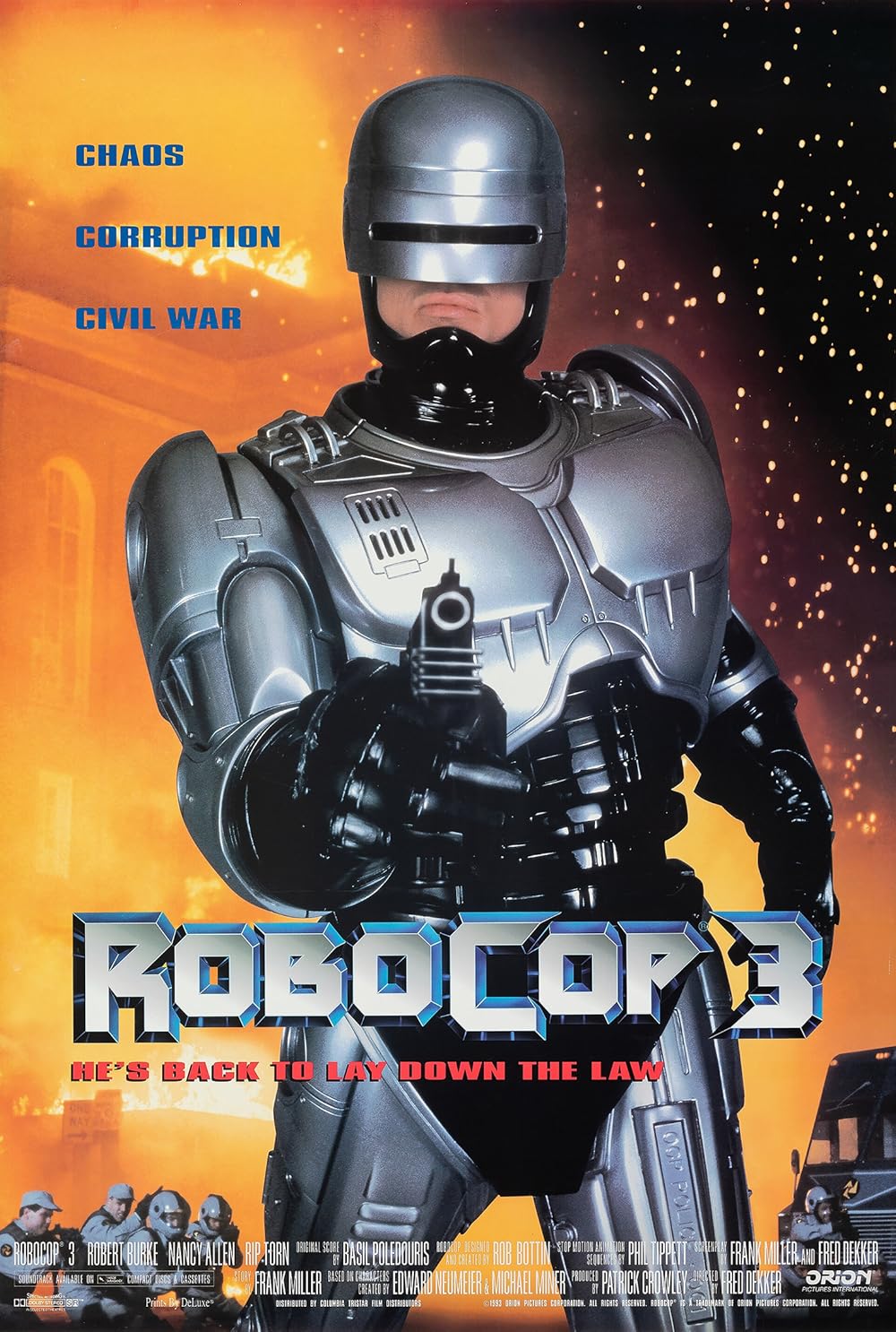
Starring: Robert John Burke, Nancy Allen, Rip Torn, Mako, Bradley Whitford, Mr. Kruger from Seinfeld, Drew Carey’s dad from The Drew Carey Show, Stephen Root, Jeff Garlin, and Shane Black
Grade: B-
Fun fact, there are more suicides in RoboCop 3 than there are in any other production in the franchise. On top of that, they are HILARIOUSLY done.
Don’t sit there and tell me this movie wasn’t entertaining in some ways.
Summary
To open the film, we get an advertisement for OCP’s (Omni Consumer Products) Delta City, a city that supposedly will put an end to crime, poverty, and has 2 million jobs waiting to be filled. Apparently, OCP has all but succeeded in finally putting their plan together, as they have been working on it since the first RoboCop.
On Media Break, they detail how the Kanemitsu Corporation bought Detroit from OCP. A video is shown of the new CEO (Torn) of OCP shaking hands with Kanemitsu (Mako) himself. Of course, crime is still running rampant, so OCP’s solution is the “Rehabilitators”, Rehabs, or Urban Rehabilitation Officers. From the blazing fields of the Amazon War come state-of-the-art urban pacification. Incident Commander of OCP Rehabilitation Concepts Paul McDaggett (John Castle) is interviewed, and he talks about how they’re here to help the people, augment the police force, and deal with the gang problem. A reporter asks about the validity of reports detailing how they have been taking people from their homes to make way for Delta City. McDaggett doesn’t deny they’ve been serving an eviction notice or two, but he argues most of these people have already taken their urine tests and placement exams. They’ve got new jobs waiting for them, and McDaggett just sees them as helping the people make their transitions. He insists they are cops and nothing more. The reporter asks, “Nothing more?”, and he sarcastically replies that they aren’t robots if that’s what she means. In the middle of this, parents David (John Posey) and Keiko Halloran (Jodi Long) watch Media Break while their daughter Nikko (Remy Ryan) does her calculus homework. When McDagget was being questioning, David tells Nikko to go to bed. Following this, Nikko is in her room. She has an action figure of RoboCop and the ED 209 from the first RoboCop on her table. David goes into her room to check on her, and she’s still awake. She wonders if the news was right about how bad it is out there, and David assures her everything is fine and they are safe at home. Out of nowhere, a giant crane comes crashing through the window, and David jumps onto Nikko to cover her (“I’ll buy that for a dollar!”). Keiko runs over to them, and the three run out of the house as its being destroyed. An eviction notice from the city of Detroit is seen on the coffee table.
In the Cadillac Heights neighborhood of Detroit, all the citizens there are being harassed by the Rehabilitation officers, and they are forcibly putting everyone on buses. Bertha (CCH Pounder) shouts in opposition at them and yells at everyone to not listen, but McDaggett hits her in the face with his gun. McDaggett gives the gun to one of his soldiers and tells him to get her out of there, giving him the greenlight to shoot her if he has to. The soldier takes her down the street, and she falls. She discreetly puts a timed bomb on the barricade near her. When the soldier picks her back up, Bertha punches him, takes his megaphone, and yells at people to get back. After the bomb goes off and everyone looks in her direction, she uses the megaphone to plead with people to stay in the city to fight for their home, arguing there is no silver lining and just corporations that want to line their pockets. At the same time, David and Keiko are forced onto a bus by soldiers, but Nikko is left on the street to fend for herself. Eventually, the chaos clears and Nikko is by herself in the rubble still hopelessly asking for her mom and dad. She finds her RoboCop action figure and picks it up. Next, a spotlight is shined on her. A soldier fires a machine gun in the air and demands she stay where she is. Instead, Nikko runs in the opposite direction, so the guy chases after her. She runs by a parked van, and Bertha pops out, grabs her, and puts her in the van to hide. Once the soldier comes around the corner, he can’t find Nikko and leaves. Bertha calms her down. Inside the van with them are other resistance members aligned with Bertha like Moreno (Daniel von Bargen), Zack (Stanley Anderson), and Coontz (Root). Soon after, Nikko waits in the car with Moreno and Bertha, Zack, and Coontz set up a timer and blow up a fence to the police armory. They all go through the gate and run directly into ED 209. Nobody knows what to do as it gives them 20 seconds before it starts firing, but Nikko goes right up to it and goes straight to the power source in its leg. With one second to spare, Nikko changes its core to be as loyal as a puppy, and it stops itself and turns off. Zack uses a key card he stole off a dead cop to try to get into the building, but it immediately sets off the alarm as an access breach. Hearing the alarm, Zack assumes correctly someone deleted the access signature. Coontz wants to get out of there, but Bertha knows they have a few more minutes and thinks they should try to get the door open. Just then, Nikko rewires ED 209 to send a rocket through the door to help them out. They get inside the armory and start snatching up weapons and a flight pack as the police head in their direction.
Just as they are about to escape in the van, cops from Security Concepts show up and tell them to freeze. Nikko controls ED 209 and has it fire at the cops to allow for her and the group to escape. Elsewhere, a man (Lee Arenberg) walks into a diner and points his gun at the cashier (Garlin), demanding all the money in the register. It turns out that every customer in the diner is a cop, and they all point their guns at the man to counter him to which the cashier sarcastically asks, “What’s it like being a rocket scientist?”. They get a call on dispatch, and all the cops argue who is going to be the one to check it out. They nominate Officer Anne Lewis (Allen), and two officers go with her. On dispatch, they say to look out for a battered yellow van, which is the one Bertha and her crew are in. As they hear this, they see the van drive by, so they all run into their cars to chase after it. Moreno drives the yellow van through the streets and uses a remote control to change the streetlights green. Some of the cop cars crash into cars in the intersection because of this. Lewis swerves out of the way of one car but immediately crashes into a parked car and flips over. Along with Lewis, the cops argue with the guy they crashed into who’s mad they busted his brand new SUX. He also makes a snide comment about Lewis being a female cop, which she doesn’t appreciate. The resistance crew is now being chased by a new cop car. It doesn’t take long before they realize it’s RoboCop/Alex Murphy (Burke), exciting Nikko. Lewis is with the other cops, and they spot a post with the spray-painted logo of the Splatterpunk street gang. The citizen who was crashed into continues with his comments to Lewis, so she grabs him by the tie. He tries to apologize by bringing up how his brother’s a cop, but he’s shot from the back. The cops realize they are under fire against the Splatterpunks and take cover behind their cars, shooting back. While in pursuit of the van, RoboCop gets Lewis’s call for backup, so he turns around and goes to help her instead. At Metro West, a cop who is in charge of tracking things lets Sgt. Reed (Robert DoQui) know that RoboCop turned around. Reed is pissed.
He calls RoboCop and demands he continue pursuit because he’s already sent three vehicles Lewis’s way. Despite it being a direct order, RoboCop doesn’t respond and then punches and breaks the dispatch system in his car.
The Splatterpunks slowly include more people, and they start closing in on Lewis and the two other cops. RoboCop speeds to the roof of a parking garage, takes off his left hand, screws in a gun directly in the wrist hole instead, drives off the roof, and lands right where everyone is at. The Splatterpunks start shooting at his car. RoboCop pops out of the roof, tells them not to loiter, and starts shooting at the gang. He takes out a few before the others start running. Lewis thanks him afterwards but asks if there are any left. He’s detecting three. Out of nowhere, someone shoots but RoboCop catches the bullet, narrowly stopping Lewis from getting shot in the head. He then shoots and kills the guy who did it offscreen. Now, he’s only detecting two. RoboCop follows the last two guys, and they can hear him coming. They jump out on the street, throw and break three bottles of alcohol on him, and the one shoots a flare gun at RoboCop, setting him on fire. Despite being on fire, the unfazed RoboCop still walks after them. He follows them into an abandoned store, but the guy panics while aiming and can’t pull the trigger. The sprinklers are set off and stop the fire engulfing RoboCop. He then arrests both men. His armor is blackened a bit from the fire, but he tells Lewis he’s fine when she asks. Later, Lewis is driving RoboCop through a chaotic area of the city, and he spots a father being separated from his son by two officers. He records it. Lewis sees it too and almost hits Nikko who runs across the street while Lewis is driving. Nikko stops on the sidewalk and shares eye contact with RoboCop. He records this too. Nikko is interrupted by Bertha and Coontz who call her back to the church they are hiding in. Nikko runs to them, and RoboCop looks at the cross above the church. At OCP headquarters, the CEO takes a video call from Kanemitsu who criticizes them, says there is more than just money at stake here, and how their competitors laugh the more they screw up. The CEO admits their faults but still argues they have done everything they can to get Delta City back on schedule. Kanemitsu doesn’t buy it and tells him that he will be sending an agent to correct their failures.
Once the video call is over, the CEO turns to his other executives at the table like Donald Johnson (Felton Perry), the head of OCP’s Security Concepts Division Jeffrey Fleck (Whitmore), and some associates from the Kanemitsu Corporation. He talks about this transition period, the former chairman’s dream of Delta City, and how current Detroit is a warzone. Johnson argues that it’s just a small resistance group and they have no reason to believe they pose a significant threat. The CEO counters that he considers a deficit of $350 million a significant threat. He asks Johnson if he would agree with this, and Johnson just takes it and sits down. Next, the CEO asks Fleck where RoboCop is since they spent so much money on him already and Fleck is the head of Security Concepts. Fleck says the police had a problem with the unit and he’s dealing with it personally. The CEO suggests to Whitmore he get RoboCop on the Rehab team because he might solve the resistance group problem. The CEO dismisses them all but also asks Fleck to try and get the police on their side this time around. McDaggett walks in to talk to the CEO while everyone leaves and brings up how he may not want a robot on his team. The CEO says McDaggett has four days. If Cadillac Heights isn’t cleared for demolition by Friday midnight, their loans will be called in and OCP will be ruined. McDaggett knows. He then goes on about how the CEO might be further over the hill then they say he is if he is just figuring out how blurry the line is between big business and war. At Kanemitsu Headquarters, an executive is weary about Kanemitsu’s plan to send their agent Otomo (Bruce Locke) to Detroit because they have never deployed him in such a populated area, but Kanemitsu refuses to discuss it further. Kanemitsu enters a private room where Otomo sits cross legged with a sword in his hands. At police precinct Metro West, a lawyer argues for his male hooker client that he was just meeting up friends at that motel, but Reed points out the obvious in that he was with a non-union video crew and a German shepherd. The lawyer calls this prejudicial and questions whether the arresting officer asked to see their union cards, prompting Reed to ask Cecil to deal with it because he doesn’t have the time.
While Fleck walks in, RoboCop is being worked on by Dr. Marie Lazarus (Jill Hennessey) in the back. Fleck marches back to their area and wants to know what happened with RoboCop, so Lazarus bluntly tells him that he was shot to hell and set on fire. This isn’t what Fleck is talking about though. He wants to know why RoboCop disobeyed a direct order. She suggests the only reason RoboCop would do something like that would be if he didn’t agree with it. His friend needed help, and he made a judgement call. Fleck tells her human cops do that and RoboCop is a machine, so Lazarus wonders why OCP put Murphy in there in the first place if they just wanted a robot. Fleck tells her that Murphy is dead and that it’s on record. She starts to get angry with Fleck and tells him that this is Murphy, what’s left of his face, portions of the cerebrum and cerebellum, and human tissue that’s still alive. She wonders how he can interface human components with a machine and then complain when the human part makes a decision. Apparently, it’s Fleck’s first fucking day because he’s confused that they not only got Murphy’s resume as a cop but also his memories, feelings, and emotional baggage. Lazarus calls it Murphy’s humanity but nonetheless confirms. Hearing this, Fleck demands she find out where his emotions are and to get rid of them entirely. If it means wiping out his memory, he says it’s too bad. One doctor chimes in and says they can cut out the appropriate circuits by implanting a microneural barrier and hands it to Fleck in a small plastic bag. Fleck takes it and tosses it to Lazarus, ordering her to do it. He doesn’t give a shit how smart she is. OCP owns the cops, which means they own RoboCop, which means they own her. Fleck says they want RoboCop on the Rehab team, meaning they need to make him predictable. Otherwise, she’s fired. Lewis walks in to hear the last part of this. Once Fleck exits, Lewis and Lazarus see RoboCop glitching, and Lewis asks him what’s going through his head. He’s going back through his own memory and recalls the father and son being separated on the street. As he thinks about this, the feed shows up on the television monitor since he’s plugged into his special chair. The moment of the father and son is then transitioned to Murphy’s family, as he recalls his wife Ellen holding their son Jimmy around Christmas time.
The other doctor asks Lazarus if she wants him to install the neuro barrier, but she says she will do it while she watches the monitor. Once he leaves, Lazarus has Lewis leave too because she wants to be alone with RoboCop. She continues to watch his memories, with one of them being Jimmy tipping his baseball hat to him and how it parallels Nikko with her hat when RoboCop saw her in front of the church. He recalls a moment with Ellen too where she was so happy to see him return home. In a meeting room, Reed shows the cops pictures of Splatterpunk members and calls them terrorists and to not be swayed by their homelessness. He shows suspected rebel locations on the screens. If any of those locations appear on their regular beat, they are told to check it out and report any unusual findings. One cop speaks with Lewis and asks if she heard what they did to Murphy, gesturing that they essentially screwed him back to factory settings. RoboCop enters the room, and all the cops watch him silently. He looks at the monitors until a picture of the church is put on the screen. He recalls the recorded video of Nikko and heads out. Lewis follows him. She tries to talk to him but stops once she sees him use his data spike to snatch the files on all the suspects in the Splatterpunk gang. RoboCop and Lewis go the car. One cop asks Lewis if she wants her body armor, but she declines because she’s off duty. Once the two sit in the car, Lewis asks what’s going on. RoboCop asks if she has family, and she reminds him of the brother in Pittsburgh who never calls. She asks “Robo” if he’s okay. He’s fine, but he tells her to call him, “Murphy”. She smiles, and they drive off. Back in the office, Lazarus sits in her chair and takes a hammer to the neuro barrier she was supposed to implant in RoboCop. Later, RoboCop walks into the church where everyone is hiding and pulls out his gun, scanning the room. Lewis sees what he’s doing and sees all the people in the pews. Just then, they both hear Rehab gather outside and demand whoever’s inside to come out. Lewis and RoboCop make it onto the steps, but McDaggett tells them to stay there.
Lewis tells McDaggett they’re police officers, but he’s not after them. McDaggett has reason to believe there are squatters inside the church, and he demands they step away from the door. Lewis argues on behalf of the civilians and how they’re just trying to stay warm, but McDaggett says they need to be in the nearest rehabilitation center, adding that some of them are armed terrorists. As he talks, RoboCop looks at the people inside again and remembers one of his prime directives: serve the public trust. McDaggett again demands they step away and threatens them with a charge of obstructing justice. RoboCop remembers his second directive: protect the innocent. As McDaggett assures that he will not ask politely the next time, RoboCop remembers his third directive: uphold the law. When McDaggett gives a final warning, RoboCop remembers the crucial fourth directive: never oppose an OCP officer. He sees the logo on the truck, so all he can do is fire at McDaggett’s feet until he’s out of ammo. RoboCop tells them to back off, or they will have trouble, and Lewis doubles down, saying they will have to shoot through them. McDaggett obliges and shoots Lewis. RoboCop targets McDagget but his directive won’t let him shoot. At the same time, McDaggett and his men blast away at RoboCop, prompting him to just take it. RoboCop blows up one of their trucks instead, but McDaggett shoots down RoboCop with a large rifle. McDaggett has his men cease fire. RoboCop is on the ground suffering, and he’s notified of his system damage, with him only running at 72% efficiency. It goes down to 69% when Nikko comes to the door and sees it’s him. Bertha throws some smoke grenades to block the view of McDaggett’s men and Nikko convinces RoboCop to come with them. The group acts as cover fire for RoboCop while he carries Lewis into the church. They barricade the door behind him, and he places her on the altar. She tells RoboCop she’s scared, but he tells her it won’t be long. She wants him to avenge her and makes him promise, which he does. Lewis dies.
Nikko and Bertha want RoboCop to come with as the resistance gets ready to go. Coontz doesn’t think it’s a good idea because he’s a cop, but they defend him. With this, RoboCop decides to go with them. They go through a hidden trap door to go under the church and into the sewer. McDaggett breaks through the barricade and gets into the church. The GPS says RoboCop is there, so he realizes they are underground and tells one of his soldiers to find a manhole. Bertha gets to a locked door and does a special knock. Zack opens it and lets them all in. Trailing behind is Nikko and RoboCop. Unfortunately, RoboCop is only at 25% efficiency and is starting to slow down significantly. Finally, Nikko asks if he’s okay. He assures her that he’s fine but falls face-first into the water. Zack, Moreno, Nikko, and a reluctant Coontz help carry RoboCop into the secured room. They sit RoboCop up, and he mumbles something about “tracking”. The argue over what it means until Nikko reaches into RoboCop’s back and pulls out his tracking device. She gives it to Moreno who throws it down the hallway of the sewer under the manhole cover on 8th Street, a manhole they booby trapped with a bomb. Not long after, one of McDaggett’s men pulls up the manhole and it explodes, killing him. McDaggett and more of his soldiers see it from down the road while they walk. Underground, Zack readies everyone to go since McDaggett is close. Coontz nearly has a panic attack and doesn’t think all this is worth it anymore, so Zack tries to bring him back down to earth by saying if he doesn’t think it’s worth it, he’s just excess baggage. Bertha doubles down. She admits Cadillac Heights might not be much, but it’s their home. It’s all they got. If he doesn’t think their homes are worth it, what is? Coontz silently walks away from the conversation.
Though injured, RoboCop is now part of the resistance, and he will help with their war, as he promised Lewis that he would avenge her.
My Thoughts:
In the weakest movie of the original trilogy, RoboCop 3 struggles under the pressure of needing to continue the overarching story started back in 1987 logically, satisfying the dedicated fanbase that fell in love with the character from the start, and dealing with structural and tonal shifts forced by the studio in an effort to expand the franchise’s audience. Considering what it was facing, it’s still an enjoyable outing. It may contain less bloody ultraviolence and killing sprees than even RoboCop 2, as this film is placed firmly in the family-friendly style of the action movie genre, but there’s plenty of shootouts, car chases, and general action to suffice. It’s nowhere near the disaster RoboCop fans make it out to be. It’s definitely tamer than the previous two movies, but it’s still a fun science fiction action endeavor that does a solid job at finishing off the trilogy, albeit in a lower quality way. If the viewer has made it this far and has dedicated enough time to the series to get to the third movie, they just want to see things wrapped up in a satisfying and exciting manner. As fans, they want to see Alex Murphy’s story completed. With this in mind, it needs to be said that the gimmicks aren’t needed as badly as people think. Just because there’s a lack of Rated-R content doesn’t mean the movie was dead on arrival. There has been enough of a world built up at this point that they have much more to go off of for its screenplay. If the producers rely on severed limbs, graphic content, and brutal violence with each movie, then they never had much of a movie to begin with. Of course, it would have been nice because of the love we have for RoboCop and RoboCop 2, but the change in tone and style isn’t a dealbreaker. It still works from time to time. What hinders RoboCop 3 from fully capitalizing on its style are bad performances, a lack of dimension to certain characters or storylines, inconsistencies with the rest of the franchise, and a rather disappointing showdown between the hero and what should have been another big-time adversary for him to face in the comically bad Japanese ninja agent Otomo.
It couldn’t be more obvious how badly they wanted to appeal to action figure-loving boys with a jetpack-wearing RoboCop taking on a robot ninja in a duel. It’s as if a kid wrote part of the screenplay in his notebook when he was supposed to be paying attention in class.
With the focus of the studio in mind however, the idea behind RoboCop 3 is to put all the deeper social commentary and satire of American culture to the side in favor of focusing on the cool stuff like its main character kicking bad guy ass, shootouts, awesome gadgets and weaponry, and the aforementioned introduction of robot ninjas. RoboCop 2 is guilty of this nucleus shift as well, but there are still deeper details in the screenplay that callback to what the first movie was going off about. Nevertheless, RoboCop 3 takes it even further to where it’s more or less a RoboCop comic book. Here, the focus is firmly on completing the story of Alex Murphy, his role in the police department and OCP, and the growing unrest of Detroit that has resulted in an unofficial dystopian society facing an oppressive city takeover from the combined work of OCP and the Kanemitsu Corporation and their hiring of mercenaries. In a way, it succeeds at doing this, with RoboCop returning to the screen in a huge way and being treated as this mythical protector of the city that kids and adults look up to. It’s as if he is revered by the younger citizens as this Batman-like superhero of Detroit, with Nikko clutching onto her RoboCop action figure in hopes of meeting him one day. Knowing how revered he is and who he is as a person, RoboCop essentially going rogue and going to the depths of the city to fight for the poor people in need, RoboCop 3 does a great job at adjusting certain elements to let Murphy become a cool, Mad Max-like character in the face of evil. Actually, the vibe of the whole film is similar to Mad Max. A lot of critics have thrown around the term “family friendly” much too liberally when describing this third movie of the franchise too. Referring to the film as this makes it sound unbearable for anyone over the age of ten, but that’s not the case. Really, if any RoboCop production was too “family friendly” or groan-inducing nonsense to the point of jumping the shark, look no further than the 1994 live-action television series RoboCop. THAT show aligns much more with the criticisms that were unfairly hurled at RoboCop 3.
It’s true that RoboCop 3 is the weakest movie out of the bunch and is noticeably lower in quality, but it’s a solid genre movie.
Assuming Mayor Kuzak failed in recouping the budget in the interim period between RoboCop 2 and RoboCop 3 since he’s nowhere to be found, and The Old Man’s dream of Delta City is finally coming to fruition because of the leadership of the new CEO making it clear in the first act, the bad guys are apparently winning. Now, the citizens are facing heavy corporate intrusion, as OCP has implemented a military-like force to take people out of Detroit. It lets us in on the premise of RoboCop 3 right from the outset, as there is only one option left for the citizens: an all-out war. There’s nothing else they can do. Though it’s a story we see a lot in science fiction, we are once again introduced to a rebel resistance fighting the evil suits who are trying to remove them from their homes. It’s hard to say how it ranks against other versions of it, but it’s not too high on the list. Even so, each member of the core group, along with some bit parts from others in the cast, does a good job in making the most with their minutes of screentime, considering how many characters and interweaving stories they have to get through. In what was surely an unintentional move by the casting department, a majority of the supporting cast consisted of a who’s who of 90s sitcom character actors. It literally got the point where you start to wonder if it was a tongue-in-cheek decision because there are that many of them. Despite these thoughts of a potential production-wide inside joke, it’s purely coincidental, as most of them didn’t make their mark on their respective shows until later on in the decade. Still, as a huge sitcom fan, you can’t help but point out each actor when they appear like Rick Dalton in Once Upon a Time…in Hollywood, as Mr. Kruger from Seinfeld, the guy who called Jerry Seinfeld a phony in Seinfeld and later got his thumbs broken accidentally, Drew Carey’s dad in The Drew Carey Show who was also Judge Vandelay in the series finale of Seinfeld, and Jeff Garlin who had a recurring role in Mad About You all appear in some fashion. It’s borderline distracting, but in hindsight, had they somehow had the foresight to lean into this and made the entire resistance consist of recognizable supporting sitcom characters, it may have been the funniest and greatest decision the franchise ever made.
Somewhere, there is a retconned graphic novel of RoboCop 3 waiting to be made with this idea in mind.
Though the number of deaths occurring to major characters is a RoboCop staple, they chose the wrong people this time around. Surprisingly, Officer Anne Lewis wasn’t one of them. Despite being there from the beginning, the character has contributed nothing since the first movie. She did nothing of note in RoboCop 2 to further endear the viewer to her character, and she offers nothing substantial to make us love or respect her role in the franchise. By the time RoboCop 3 comes around, it’s more or less the same. From 1987 to 1993 and three movies in total, along with the 1988 cartoon RoboCop for that matter, they never get past the surface with Lewis. They reveal almost nothing about her backstory or personality outside of work, what makes her tick, her background, how she grew up, her philosophies on life, why she likes her job, if she likes her job, if she has any relationships worth talking about (other than the one off-hand comment about her brother in this movie), or even her general hobbies. After all this time, Lewis is still the exact same person, with her character arc completely flatlining after 1987’s RoboCop to where she’s just kind of there for the rest of the movies. To be a co-star in every RoboCop production up until this point and STILL be considered nonessential is legitimately impressive. A lesser character like Sgt. Reed has more character development through the three movies than Lewis does! In this third film, Lewis is gunned down by McDaggett and this SHOULD be an emotional death on the level of someone like Qui-Gon Jinn’s climactic demise in Star Wars: Episode I – The Phantom Menace. Nancy Allen’s Lewis has built up seven years of equity with the fanbase by sticking through it, she’s the main character’s best friend, she helped him find his humanity again, and she has been Murphy’s most trusted ally from the beginning, seeing him from when he was killed in the first movie all the way until now. Unfortunately, her going out like a warrior was met with nothing more than a shrug, proving how lackluster the writing of her character has been from the beginning. In a last-ditch effort to make her death a big deal, they try to tug the heartstrings with Lewis getting a final, teary-eyed exchange with Murphy on her deathbed minutes after.
Nevertheless, the writing of it is poor, it’s too theatrical-sounding, and Nancy Allen delivers it in a hammy, TV-movie like manner on par with the below-average production values of RoboCop 3 as a whole. On top of that, the line “Officer down” was handed to Robert John Burke on a silver platter, but it’s nowhere near as impactfully delivered as we know Peter Weller would have managed to make it had he starred instead. Now, Burke isn’t awful or anything, but there is a problem with his casting that is more detrimental than the studio may have realized before RoboCop 3 went into production. Though I said it before in my review of RoboCop 2, Weller was gradually increasing his emotional responses with every other scene, as it aligned with how the story was written. If he stayed on, there is a great chance Weller’s performance would have continued to trend in this direction for RoboCop 3, in an effort to keep things consistent with the story and progression of the character through all these years as Murphy embraces and works more on his humanity. Robert John Burke does a great job in replicating Weller’s performance and his look from the first movie, but it doesn’t fit with where the character seemed to be going following RoboCop 2. This is just part of the inconsistencies that bog down the third film. They do a good job at progressing the overall story with Delta City being built, Detroit at its worst, OCP’s deal with Kanemitsu, and how RoboCop himself has become a folk hero of sorts to the citizens of Detroit. However, the screenwriters stall progression on important details of the franchise that were well established. For example, one of the defining moments of RoboCop 2 had Murphy shock himself to reset his programming. In doing so, his prime directives were removed, freeing him to run roughshod on the many villains they were facing. In RoboCop 3, this is completely forgotten about in the heat of the moment. One can’t help but feel it’s forgotten about on purpose purely out of laziness, as it’s used as an explanation as to why RoboCop doesn’t go full Rambo on McDaggett and his Rehabilitation officers once Lewis is shot in front of him in a way that mirrors what Boddicker and his crew did to Murphy all those years back.
Had the writing been consistent with its predecessor, a furious RoboCop would’ve started killing so many of those Rehab officers in that moment, they would have had to retreat. Why did they go the route of reintroducing his prime directives when its removal was such a crucial part of the movie prior? All the events of RoboCop 3 could have still happened the same way had RoboCop just reacted in anger and started shooting back at them once McDaggett shot Lewis. He still could’ve taken Lewis into the church, he still could’ve promised to avenge her death, and McDaggett redirecting the focus of the Rehab officers to killing RoboCop and snatching up the rest of the resistance could all be accomplished without reverting back to a storytelling device that was ALREADY REMOVED from the series! Going back to it without explaining in the story why the prime directives have returned to his programming after everything he accomplished in RoboCop 2 is just plain lazy. It’s as simple as that. It’s even dumber when the Lazarus saves RoboCop when they reboot him, and it’s shown on the screen that the fourth directive has been deleted. Again, we have already done this! Going along with this, the head of OCP Security Concepts in Jeffrey Fleck was cast well, as Bradley Whitford is undeniably good at playing a smug son of a bitch, but his character’s lack of knowledge about the history of RoboCop and why they are at this stage with him is practically insulting to the viewer and wastes valuable screentime. Why is he genuinely surprised OCP has gotten the emotional baggage and memory of Alex Murphy when Dr. Lazarus has to remind him of this in her argument that Murphy’s human side made a decision? Why are we still going over this? This has been established from the very first movie. Also from a canonical standpoint, RoboCop himself is famously the only successful product the company has produced. How would a high-ranking executive not know this, especially one who worked in the same department that was responsible for fucking creating him? Besides being a prick, a solid portion of Fleck’s lines reek of the “informational dump” character who is utilized in reminding the audience of the rules of the world-building. However, if the viewer doesn’t know this BASIC information about the main character by the THIRD film in the trilogy, why the fuck are they even watching it?
The leader of the supporting cast is CCH Pounder as Bertha. Not that she was setting the movie on fire or anything with her performance, but (SPOILERS, SPOILERS, SPOILERS) what little heart the movie had left was lost with her abrupt death. This was a terrible decision on the screenwriter’s part, especially considering how interchangeable Stanley Anderson’s Zack and Daniel von Bargen’s Moreno were. She provided just as much toughness and personality as everyone else, but she was the only one in the group who made a connection with Nikko. It just didn’t sit right to kill her off. At the same time, you could argue that Fleck didn’t deserve to be fired so hastily after RoboCop went underground. Not only was it not his fault, but Whitford was kind of funny in his role and was missed after he exited. Considering the regime changes of OCP, all the PR disasters the company has been through, and his playing of both sides depending on the movie, we can’t help but wonder how Johnson has come out of all of these movies unscathed. How has he not been fired or shot in the midst of all this? Had the movie adhered more to its predecessor, the lab tech character Linda from RoboCop 2 would have made perfect sense to have an expanded role here. Instead, Jill Hennessey is cast to play an entirely new character in Dr. Marie Lazarus. Is her last name another bible allegory, with her resurrecting RoboCop this time around, in a Christ/Lazarus role reversal? Considering the previous movies playing with biblical themes regarding the titular star, the chosen last name of Lazarus does seem intentional.
RoboCop 3 also has a fair amount of earned laughs this time around. The interplay between Zack and Moreno was fun (“Don’t yell at me” – “Well, don’t do it”), the dry responses from Murphy to others is still amusing (“I’ve been better”), the comedic timing of both suicides were perfect in their delivery, and the cynical conversation between Fleck and Johnson while the office around them is in chaos was very funny. They are told one guy just jumped out the window, and Johnson comments how it’s the 4th one this month. Fleck calls the deceased guy “chicken shit” while throwing garbage in a trash can some guy is holding as he walks past them, and it’s hilarious. Fleck then brags how he’d shoot himself if given the chance because it’s less showy, even showing Johnson his gun. It’s such a wild sequence, but it’s a great way to show what OCP has become. It’s like how Fleck describes it as the fall of the Roman Empire and how their situation has become “survival of the least expendable”. In all the office scenes, this aura of the writing being on the wall after the Kanemitsu Corporation got involved with them is felt wholeheartedly.
Bertha stresses how if they hold out for three days, they will be good. How does she figure this? It’s never explained. They just continuously reiterate this without going into further detail, and everyone just buys it for some reason. At most, Nikko tells RoboCop slightly more by repeating how Bertha told her they if they hold out for 2 more days, they will have to let her parents go and they will be a family again, but why would Bertha think this? Even if Nikko’s parents were alive, what would two magical days do? It’s not like OCP would just change their minds and let them come back. It’s just idiotic melodrama. Speaking of which, Rehab’s raid on the resistance hideout, resulting in Lazarus helping Nikko escape through this fenced gate and then closing it on her and telling her to go, made zero sense. Why couldn’t Lazarus leave with Nikko? There was nothing stopping her. She was small enough to fit through the space too, and neither Rehab nor OCP knew Lazarus or Nikko were even there. They didn’t come there looking for anyone specifically. They just wanted the group. The two girls could have easily escaped together with plenty of time to spare had Lazarus not do the overdramatic “Go without me!” cliché. The same can be said for the ending, as RoboCop only had a little bit of time to escape the building before the bomb went off. Instead of turning and using the window behind him with the flight pack, he chooses to go the long way instead. These decisions just don’t make sense! With Lazarus and Nikko, all it led to was Nikko climbing through the vent of OCP Headquarters later on to hand Lazarus a computer to deliver her illegal broadcast to tell everyone to fight the power. It’s a good cinematic moment, but it was so avoidable that it lessened the emotional effect of the scene. Also, it makes us wonder, where in the fuck is the President during all of this? Lazarus had to go on TV to say a corporation has hired mercenaries to kill them, and there is a shootout between a team of deputized citizens and the Detroit Police Department against said mercenaries and gang members they hire, and the federal government doesn’t get involved? Do they really have nothing to say about any of this? What in the fuck is going on?
From a writing perspective, a creative perspective, and for plenty of other reasons, making the Japanese guy send a silent ninja robot after the hero is asinine, but the lack of imagination regarding the look and abilities of the character was even more disappointing. For example, why is he using a jagged line on see-through projection paper as a base for a map? Him just overlaying it on a regular map shows a serious lack of imagination regarding the science of the movie. Plus, it just seems strange for a hi-tech Japanese robot in the world of RoboCop no less, to show such a lack of detail regarding how Otomo operates. His abilities with a sword are slow and basic too. For a million-dollar robot creation, you think Otomo would be actually good at using its weapon, but he’s not. Then, there was that weird jaw dislocation move he does more than once after taking damage, and it might be the scariest thing to happen in the franchise since Emil went through the vat of toxic waste. The weird smile he makes is imprinted in your brain for a lifetime. Regardless, the showdown we are waiting for between Otomo and RoboCop is comical and not in a good way. The choreography is just putrid and cheap-looking, and the first go-around ends so abruptly it makes the viewer question, “Wait, that’s it?”. At least it gave us that moment where Murphy tells him how he’s under arrest for assaulting an officer, and Otomo responds by cutting off Murphy’s fingers with his sword to which Murphy adds, “…and destruction of police property”. By the time RoboCop is fighting two twin ninjas in the climax, you can’t help but laugh at how ridiculous it is. Thankfully, the expansion of Sgt. Reed’s role into someone who’s values are too strong to back down to OCP and Rehab was a cool development to endear him to the franchise. He was practically begging to do more since the first movie, so letting him become such a big part of the third act was great. McDaggett is too one-dimensionally evil to be a real person, and moments like where he jumps out a window of a motel, hits the roof of the overhang, and lands on his feet are laughably outrageous.
However, I will give the writers credit for his dastardly intelligent move in throwing money in the street once he saw the children playing street hockey during the chase scene. Knowing RoboCop would be forced to stop because of the children in the way, this was a great example of the villain knowing his opponent all too well.
The addition of the flight pack is a good idea to allow for RoboCop to move faster and give the director more opportunities to use him in action sequences (“Well, it looks like odds on the home team just went up”), but the effects are too cheesy to make it look good. The idea behind it being adjusted by Lazarus to work as an auxiliary power unit that can recharge him anytime that he puts it on is a good one because he doesn’t have to go back to that special chair all the time. Yet, the special effects just weren’t ready for what the narrative was asking of it. Like I stated in the review of RoboCop 2, had Murphy drove around on a motorcycle, it would have been just as good. Then again, that pink Cadillac he commandeered from the pimp would have worked too. Also, the jury is out on RoboCop now having a removable hand to insert weapons there. It’s a cool accessory for a toy line, but there was something about it that didn’t feel right. As awesome it was for RoboCop to storm the Rehab staging area at Metro West and use his flamethrower on everyone (complete with the return of the iconic theme song), it would have been better had he been carrying the flamethrower rather than part of his body being one (“You may want to call the fire department”). There is just something about RoboCop with his signature gun in one hand mowing people down that feels more natural than his hand being removed to be the weapon itself. Furthermore, the rebooting sequence to save RoboCop left so many questions unanswered regarding his thought process moving forward, but the most glaring is the moment when his memory seems to picture Lewis, his former wife Ellen, and Lazarus. Each picture morphs into the next woman, and our question is why? Does he think they are the same person now? What does this mean?
The Media Break interludes are at an all-time low, but the female anchor flipping out over the bullshit she’s told to spew about RoboCop was a cool moment. Along with this, the Johnny Rehab cartoon commercial does feel like a prelude to the “Commander Cash” advertisements of 1994’s RoboCop television show.
With cheap production values from RoboCop shooting someone’s gun into the air where it’s visibly on wires to the “explosive” finale, RoboCop 3 does not reach the heights of the previous two films. They take themselves too seriously when they shouldn’t and vice versa. The only solution was to either tell the cast to tone down the hammy performances, get better actors in general, or change the tone entirely, as the inconsistencies of the overall style and direction of the movie were noticeable, along with the noted inconsistencies from story and character details previously established in other films. With that being said, RoboCop 3 is still a solid continuation of the story, still adds to the legacy of the main character well, and there are still a lot of action sequences and moments to look back on fondly. It’s not the cinematic finale fans of the franchise were craving, but it’s still entertaining in its own right. It’s even good at times. It’s just sad that it’s not as great as it could have and should have been.


+ There are no comments
Add yours