
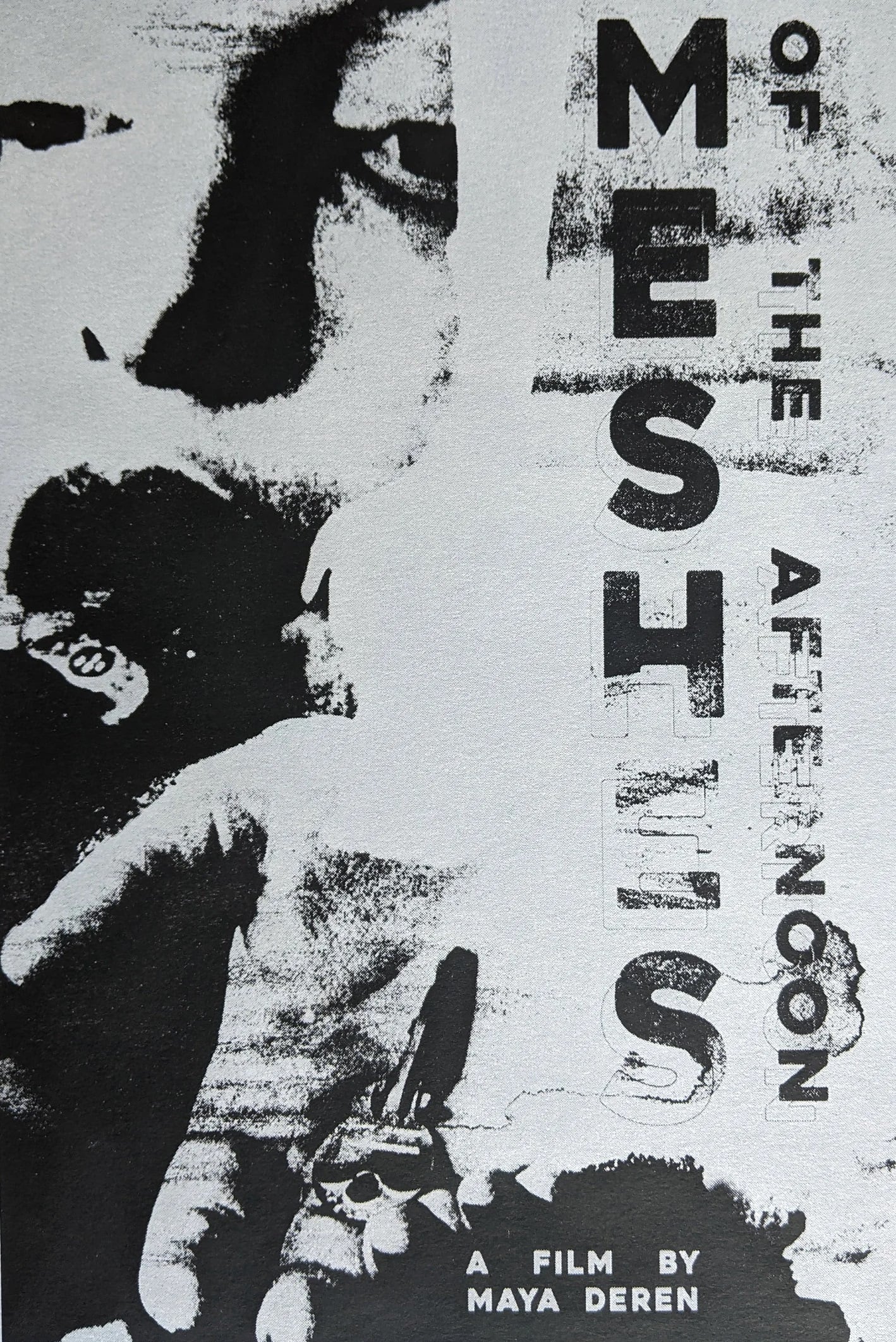
Starring: Maya Deren and Alexandr Hackenschmied
Grade: C-
Today, you will probably see a better experimental short film at any random film festival. However, that doesn’t make Meshes of the Afternoon any less engrossing.
It still deserves its flowers without a doubt.
Summary
A woman’s arm lowers into the screen holding a white flower and lays it in an alley. Next, the arm disappears.
A woman (Deren) wearing all black comes by, picks it up, and continues to walk. Suddenly, she stops after seeing a black hooded figure walk away in the distance. Moving along, the woman walks up the steps to her home. She knocks on the door and tries to open it, but it’s locked. She pulls out her key from her purse but drops it. She tries to catch it as it bounces, but it goes all the way down the steps. Finally, the woman is able to grab it from the ground and heads back up the stairs, unlocking the door. Inside the house, things look dark. The curtains are over the windows, there aren’t any pictures on the wall, and there’s a piece of bread on the kitchen table with a knife in it, along with coffee inside a coffee cup and a spoon. Just then, the knife somehow falls out of the piece of bread by itself. On the stairs, a phone is placed there. It was never hung up. The phone is hanging next to the rest of the mechanism. The woman walks over to it, then past it, and then up the dimly lit stairs. She sees that the bedroom door is open, the lights are on, and the curtain is moving as if the window were open. After this, the curtain stops moving. Also in the bedroom is a record player playing something and men’s clothes on the ground next to it. The woman turns off the record player. She goes back downstairs and sits in the chair that faces the window and the main door. She puts the flower in her lap and starts to feel herself up. Then, she closes her eyes to nap. Seemingly in her dream, she sees the black-hooded figure from the opening holding the white flower and walking down the alley outside. The figure stops and turns to look back, revealing a mirror for a face. A different version of the woman sees the figure and chases after him, but he walks away. Despite him walking and her running, she can’t catch up to him. She stops, walks up the stairs, looks around suspiciously, and enters the house. This time when she scans her house, the knife is on the steps.
In slow motion, she runs past it and up the stairs. Heading into the bedroom, she runs her face into the curtain. Next, she inexplicably pops in from the window back into the room. She looks down and finds the phone on the bed. She moves the comforter slightly, only to find the knife again. She puts the comforter back on the knife to cover it, swiftly hangs up the phone, and gets back up into the window frame. When she leans back, she is transported back to the stairs and has to climb her way back down the stairs into the living room. Once she finally gets there, she finds another version of herself still sleeping on the chair. The record player is playing. The woman floats down from the ceiling and turns off the record player. She looks at her other self sleeping in the chair and walks over to the window. Again, she sees the mirror-faced figure walking down the alley with his flower. This time the walk is brisker. Strangely enough, another version of the woman is seen running after him. While this chase is happening, the woman is still watching it all through the window. However, just like earlier, the woman can’t catch up to the figure, stops, and walks up the stairs. The version of the woman that watches the repeat action pulls her key out of her mouth. Following this, the new version of the woman opens the door and looks around. The mirror-faced figure with the flower is inside and walks up the stairs. The woman floats over to the stairs after the figure but struggles due to the hallway shifting its foundation, forcing her to stumble a few times on the way. The woman is too tired to get all the way up and stops near the top of the stairs. As this happens, the mirror-faced figure lays the flower on the bed, looks at her, and disappears in an instant.
She’s startled at the sight and every version of her stands in silence on the steps pondering what to do next. The line between dreams and reality only continue to blur.
My Thoughts:
Meshes of the Afternoon is an experimental short film from the then husband-and-wife team of Maya Deren and Alexandr Hackenschmied and is considered by many to be ahead of its time. Considering what was being released in the 1940s, the surreal story does stand out from the rest as this avant-garde short with a shifty narrative where what’s real and what is an illusion is confusing for not only the main character but the audience as well. For modern audiences, it is shotty-looking, not lit very well (whether intentional or not), and the budget is low, but the narrative is still strangely engrossing to this day. Through the utilization of odd camera techniques, unique editing, slow motion, impressionistic storytelling, and bizarre imagery, Meshes of the Afternoon leaves a lasting impression due to the filmmaking abilities and artistry of Deren and Hackenschmied, giving viewers a dreamy, suspenseful, and at times, hair-raising experience.
As is the case with any story bordering on the surreal, the short film is confusing in some regard. In other areas, it can be seen as pretentious, though this could be said about most experimental and arthouse films. Even so, there is some quality to it that begs the viewer’s attention. You want to unpack it. Part of it is the indifferent reactions coming from Dern herself, as her character navigates through her dreams and comes into contact with other versions of herself. The nameless main character is not afraid of the random items placed around the room or facing herself. She just goes along for the ride. When she sees the terrifying villain of her dreams, she’s not startled at its sight, nor does she have the face of someone who wants to attack it. The woman just wants to catch up to this unknown figure to see it up close. It’s a sense of wonder she has that is intriguing, but her plain-facing it, after not being able to catch the figure before walking inside the house to restart the dream in the most apathetic manner possible, is what yields more questions. For the record, the character doesn’t question a thing. She just goes. It’s us that have the questions. It’s inexplainable and confusing as you try to make sense of it all. In the film’s defense, the story’s events really are a great representative of a dream, from the woman stepping on a beach, grass, and the carpet of her living room, all the way up to the moment where she pulls a knife on the version of herself who is sleeping, until she is woken up by the man in real time. Again, in terms of trying to depict dreaming in a realistic way, Meshes of the Afternoon succeeds. It’s so accurate in its mysteriousness and at times nonsensical moments that it actually hurts it a bit.
With all of this being said, it’s not untouchable or anything. It makes sense that it gets credit for being important to film in general because of its style and how mesmerizing its imagery can be at times, but part of the story does drag, the ending doesn’t feel right, certain moments seem big but are underwhelming (the three versions of the woman sitting at the kitchen table comes to mind immediately), the inclusion of the key is irrelevant in the grand scheme of things, and the woman having those silver googly eyes before attempting to kill the other version of herself takes you out of the story because of how laughable it is. Everything else can be looked at as an aesthetic choice to mask the lower budget, but that decision specifically made it look amateurish and stupid. The climax involving the worried thoughts of the woman coming to the conclusion that the man and the mirror-faced figure are one and the same was great though. The effect of the glass break once she uses the knife should have been the finale though. The actual ending was overdone, and the makeup used to give the appearance of a bloody death looked like seaweed.
The flower-holding, black-clothed, mirror-faced antagonist’s design is awesome. Keeping the budget and the story in mind, the husband-and-wife team coming up with this cool of a character and having it be so startlingly unforgettable is a testament to how creative they both were. This LOOKS like a dark figure that would haunt someone’s dreams. Just its appearance and slight movements of walking, turning, or looking at the protagonist without technically doing anything of significance shows how important presentation is to a character and how something incredible can be done with no dialogue or action of any kind. The character’s presence and just doing something as simple as placing a flower on the bed is nerve-racking. By himself, he is able to turn this experimental short film into horror territory. It’s that creepy. I loved it. It’s appearance in dreams could have been a franchise on its own. My wish is for a filmmaker today to watch this and bring the character back to life to expound on its mythology. There is a world here begging to be explored. It’s that striking and memorable in its silence, which is an important thing to note as well. A short, black-and-white film like Meshes of the Afternoon has to be experienced in the right way to be appreciated. It needs to be treated like you’re attending a premier of a horror film. The viewer needs to be in a dark room with no sound. Once this is adhered to, the viewing experience is guaranteed to be much different than if you were to watch it in the daytime or on your laptop with the light on. I would even argue that the original silent release should be watched instead of the 1959 reprint that included a score by Deren’s third husband Teiji Ito. Something about the silence adds to the suspense and overall value of the short.
Though it has been argued how much Hackenschmied had to do with it all compared to Deren, it doesn’t matter. The team’s ability in just 14 minutes to destroy time and space and create this world of illusion is quite the endeavor in the avant-garde section of filmmaking. The story and some production values aren’t necessarily thorough, and it won’t leave the viewer in awe, but the captivating Meshes of the Afternoon will capture the imagination through its brief runtime.


+ There are no comments
Add yours